Dhvani
 Echo – a good poem is one that haunts one after
reading
 Taken from grammar
 In grammar – sounds of utterances which reveal the
integral linguistic sign (sphota)
Dhvani
 A good poem with its sound as well as the literal sense
reveals, over & above the literal sense, a charming
sense which has great aesthetic value
Dhvani
 The term ‘Dhvani’ is referred to –
 suggestive poetry where the suggested sense
predominates over literal sense
 The suggested sense
 The function of suggestion
Dhvani
 Anandavardhana – Dhvanyaloka (9th cen)
“The quality of poetry depends upon the imp. given to
the element of suggestion”
Suggestion – the soul of poetry
Dhvanyaloka
 There are 2 kinds of beautiful ideas in poetry
1. Vacya (literal)
2. Pratiyamana (implied)
Vacya/Pratiyamana
 Vacya is invariably –
1. An idea, or
2. A figure of speech
 But suggested sense, pratiyamana may be –
1. An idea, or
2. A figure of speech, or
3. An emotion
Anandhavardhana
 Bharata – main objective of dramatic work –to arouse
rasa
 Anandavardhana extended it to poetry
 Dhvani the soul of poetry
 Dhvani-stresses on the method of treatment
 Rasa – the ultimate effect
 Suggestion alone is not enough, the suggested sense
must be charming
Rasa Realization
 Abhinavagupta (अभिनवगुप्त) (c. 950 – 1020 AD) - one
of India's greatest
philosophers, mystics and aestheticians He was also
considered an important
musician, poet, dramatist, theologian, and logician —
a polymathic personality who exercised strong
influences on Indian culture.
Rasa Realization
“when thus the formal or intellectual,
imaginative & emotional elements of a
poem blend into one predominant
sentiment & making a simultaneous
appeal, awaken the sthayibhava of the
reader or spectator, the relish of rasa is
manifested as a unity in the heart,
leaving no trace of the constituent
elements; & this is why rasa dhvani is
called asamlaksyakrama-vyangya or the
suggested sense with imperceptible
stages"
Criticisms against Dhvani
 Nyaya & Mimamsaka schools do not recognize
dhvani
 Jayaratha’s commentary on Alamkaravasva 12 anti
dhvani theories are mentioned
1. Anandhavardhana himself mentioned many of the
views against dhvani in Dhvanyaloka
Criticisms against Dhvani
1. Dhvani vs Anumana
2. Dhvani vs Arthapatti
3. Dhvani vs Laksana
4. Dhvani vs Abhidha
5. Dhvani vs Tatparyavrtti
6. Dhvani vs Vakrokti
Anumana (Inference)
Naiyayika school rejected the
suggestive power of dhvani
Mahimabhatta wrote his Vyaktiviveka
with the specific purpose of proving
that dhvai is included in anumana. But
Anandhavardhana anticipated this &
justified his stand in 3rd chap.
Dhvanyaloka
Anumana (Inference)
 Anandhavardhana-
 Inference depends on the knowledge of
vyapti or the invariable concomitance bet.
the middle & major terms of a proposition.
Eg. The landscape lay as still as a painted
picture. Here, the word still is an instance of
inference and not suggestion
 Dhvani- the relationship between the
expressed sense & the implied sense is
something similar bet. light and a pot. As
light reveals the pot so the expressed sense
reveals the suggested sense
Dhvani vs Arthapatti
 Immediate inference based on universal
relation between the absence of the major &
the absence of the middle terms
 Samsarga maryada
 But, arthapatti means to a valid knowledge,
demands of suggested sensee accuracy &
definiteness,
 But-
 In dhvani, implied sense is vague
 Z
Dhvani vs Laksana
 Figure of speech
 Alamkarikas like Mukulabhattasay at times sentences
convey ideas diff. from literal sense, but all such
instances come under laksana
 Acc. To Anandhavardhana laksana operates when
there is some inconsistencyin the primary sense &
cancels it, but in Dhvani primary sense neednt be
cancelled
 Z
Dhvani vs Abhidha
 Mimamsakas of Prabhakara school
 Anandhavardhana –
 Abhidha only primary meaning
 Dhvani can be there even without abhidha
 Z
Dhvani vs Tatparyavrtti
 Function of the sentence to explain the
verbal comprehensions arising from it
 Dhanika, Dhanamjaya
 Abhinavagupta answers -
The power of tatparyavrtti is exhausted by
establishing the logical connection of the
word meanings & cannot givefurther
suggestions
Dhvani vs vakrokti
 Kuntakas vakrokti is almost similar to dhvani
 Mahimabhatta rejects vakrokti as dhvani theory in
disguise
 Yet both complimentary
 Dhvani from the point of view of the reader
 Vakrokti from the point of view of the writer
 Dhvani the imaginative content
 Vakrokti poets imaginative skill
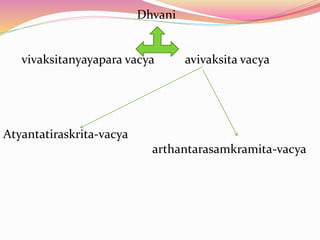
Classification of Dhvani
vivaksitanyayapara vacya
(based on abhidha, so called abhidhamula)
avivaksita vacya
(based on laksana, so called laksanamula)
Dhvani
vivaksitanyayapara vacya avivaksita vacya
Atyantatiraskrita-vacya
arthantarasamkramita-vacya
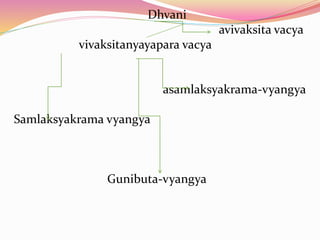
Dhvani
avivaksita vacya
vivaksitanyayapara vacya
asamlaksyakrama-vyangya
Samlaksyakrama vyangya
Gunibuta-vyangya
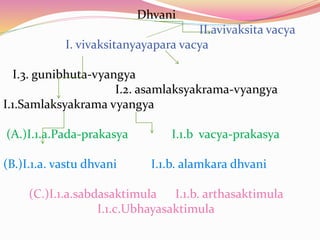
Dhvani
II.avivaksita vacya
I. vivaksitanyayapara vacya
I.3. gunibhuta-vyangya
I.2. asamlaksyakrama-vyangya
I.1.Samlaksyakrama vyangya
(A.)I.1.a.Pada-prakasya I.1.b vacya-prakasya
(B.)I.1.a. vastu dhvani I.1.b. alamkara dhvani
(C.)I.1.a.sabdasaktimula I.1.b. arthasaktimula
I.1.c.Ubhayasaktimula
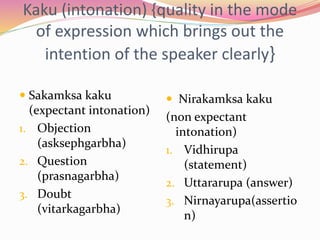
Kaku (intonation) {quality in the mode
of expression which brings out the
intention of the speaker clearly}
 Sakamksa kaku
(expectant intonation)
1. Objection
(asksephgarbha)
2. Question
(prasnagarbha)
3. Doubt
(vitarkagarbha)
 Nirakamksa kaku
(non expectant
intonation)
1. Vidhirupa
(statement)
2. Uttararupa (answer)
3. Nirnayarupa(assertio
n)

cupdf.com_dhvani.pptx

  • 2.
    Dhvani  Echo –a good poem is one that haunts one after reading  Taken from grammar  In grammar – sounds of utterances which reveal the integral linguistic sign (sphota)
  • 3.
    Dhvani  A goodpoem with its sound as well as the literal sense reveals, over & above the literal sense, a charming sense which has great aesthetic value
  • 4.
    Dhvani  The term‘Dhvani’ is referred to –  suggestive poetry where the suggested sense predominates over literal sense  The suggested sense  The function of suggestion
  • 5.
    Dhvani  Anandavardhana –Dhvanyaloka (9th cen) “The quality of poetry depends upon the imp. given to the element of suggestion” Suggestion – the soul of poetry
  • 6.
    Dhvanyaloka  There are2 kinds of beautiful ideas in poetry 1. Vacya (literal) 2. Pratiyamana (implied)
  • 7.
    Vacya/Pratiyamana  Vacya isinvariably – 1. An idea, or 2. A figure of speech  But suggested sense, pratiyamana may be – 1. An idea, or 2. A figure of speech, or 3. An emotion
  • 8.
    Anandhavardhana  Bharata –main objective of dramatic work –to arouse rasa  Anandavardhana extended it to poetry  Dhvani the soul of poetry  Dhvani-stresses on the method of treatment  Rasa – the ultimate effect  Suggestion alone is not enough, the suggested sense must be charming
  • 9.
    Rasa Realization  Abhinavagupta(अभिनवगुप्त) (c. 950 – 1020 AD) - one of India's greatest philosophers, mystics and aestheticians He was also considered an important musician, poet, dramatist, theologian, and logician — a polymathic personality who exercised strong influences on Indian culture.
  • 10.
    Rasa Realization “when thusthe formal or intellectual, imaginative & emotional elements of a poem blend into one predominant sentiment & making a simultaneous appeal, awaken the sthayibhava of the reader or spectator, the relish of rasa is manifested as a unity in the heart, leaving no trace of the constituent elements; & this is why rasa dhvani is called asamlaksyakrama-vyangya or the suggested sense with imperceptible stages"
  • 11.
    Criticisms against Dhvani Nyaya & Mimamsaka schools do not recognize dhvani  Jayaratha’s commentary on Alamkaravasva 12 anti dhvani theories are mentioned 1. Anandhavardhana himself mentioned many of the views against dhvani in Dhvanyaloka
  • 12.
    Criticisms against Dhvani 1.Dhvani vs Anumana 2. Dhvani vs Arthapatti 3. Dhvani vs Laksana 4. Dhvani vs Abhidha 5. Dhvani vs Tatparyavrtti 6. Dhvani vs Vakrokti
  • 13.
    Anumana (Inference) Naiyayika schoolrejected the suggestive power of dhvani Mahimabhatta wrote his Vyaktiviveka with the specific purpose of proving that dhvai is included in anumana. But Anandhavardhana anticipated this & justified his stand in 3rd chap. Dhvanyaloka
  • 14.
    Anumana (Inference)  Anandhavardhana- Inference depends on the knowledge of vyapti or the invariable concomitance bet. the middle & major terms of a proposition. Eg. The landscape lay as still as a painted picture. Here, the word still is an instance of inference and not suggestion  Dhvani- the relationship between the expressed sense & the implied sense is something similar bet. light and a pot. As light reveals the pot so the expressed sense reveals the suggested sense
  • 15.
    Dhvani vs Arthapatti Immediate inference based on universal relation between the absence of the major & the absence of the middle terms  Samsarga maryada  But, arthapatti means to a valid knowledge, demands of suggested sensee accuracy & definiteness,  But-  In dhvani, implied sense is vague  Z
  • 16.
    Dhvani vs Laksana Figure of speech  Alamkarikas like Mukulabhattasay at times sentences convey ideas diff. from literal sense, but all such instances come under laksana  Acc. To Anandhavardhana laksana operates when there is some inconsistencyin the primary sense & cancels it, but in Dhvani primary sense neednt be cancelled  Z
  • 17.
    Dhvani vs Abhidha Mimamsakas of Prabhakara school  Anandhavardhana –  Abhidha only primary meaning  Dhvani can be there even without abhidha  Z
  • 18.
    Dhvani vs Tatparyavrtti Function of the sentence to explain the verbal comprehensions arising from it  Dhanika, Dhanamjaya  Abhinavagupta answers - The power of tatparyavrtti is exhausted by establishing the logical connection of the word meanings & cannot givefurther suggestions
  • 19.
    Dhvani vs vakrokti Kuntakas vakrokti is almost similar to dhvani  Mahimabhatta rejects vakrokti as dhvani theory in disguise  Yet both complimentary  Dhvani from the point of view of the reader  Vakrokti from the point of view of the writer  Dhvani the imaginative content  Vakrokti poets imaginative skill
  • 20.
    Classification of Dhvani vivaksitanyayaparavacya (based on abhidha, so called abhidhamula) avivaksita vacya (based on laksana, so called laksanamula)
  • 21.
    Dhvani vivaksitanyayapara vacya avivaksitavacya Atyantatiraskrita-vacya arthantarasamkramita-vacya
  • 22.
  • 23.
    Dhvani II.avivaksita vacya I. vivaksitanyayaparavacya I.3. gunibhuta-vyangya I.2. asamlaksyakrama-vyangya I.1.Samlaksyakrama vyangya (A.)I.1.a.Pada-prakasya I.1.b vacya-prakasya (B.)I.1.a. vastu dhvani I.1.b. alamkara dhvani (C.)I.1.a.sabdasaktimula I.1.b. arthasaktimula I.1.c.Ubhayasaktimula
  • 24.
    Kaku (intonation) {qualityin the mode of expression which brings out the intention of the speaker clearly}  Sakamksa kaku (expectant intonation) 1. Objection (asksephgarbha) 2. Question (prasnagarbha) 3. Doubt (vitarkagarbha)  Nirakamksa kaku (non expectant intonation) 1. Vidhirupa (statement) 2. Uttararupa (answer) 3. Nirnayarupa(assertio n)

Editor's Notes

  • #7 Vacya – “pookkunnitha mulla, pookkunnilanji, pookkunnu thenmavu, pookkunnasokam” Pratiyamana – “if winter comes, can spring be far behind?”
  • #8 Idea – “know then thyself/ presume not God to scan/the proper study of mankind is man” Figure of speech “mannavandra vilangidunnu / chandraneppol ninmukham” Emotion -