Presented by Khushbu Makwana
Smt.S.B Gardi Department of English MKBU
Presentation topic – Dhvani Theory
Paper no-109: Literary Theory & Criticism an
d Indian Aesthetics
M.A sem-2
Roll no-13
Enrolment no-4069206420210019
Batch-2021-23
Email id- khushbumakwana1239@gmail.com
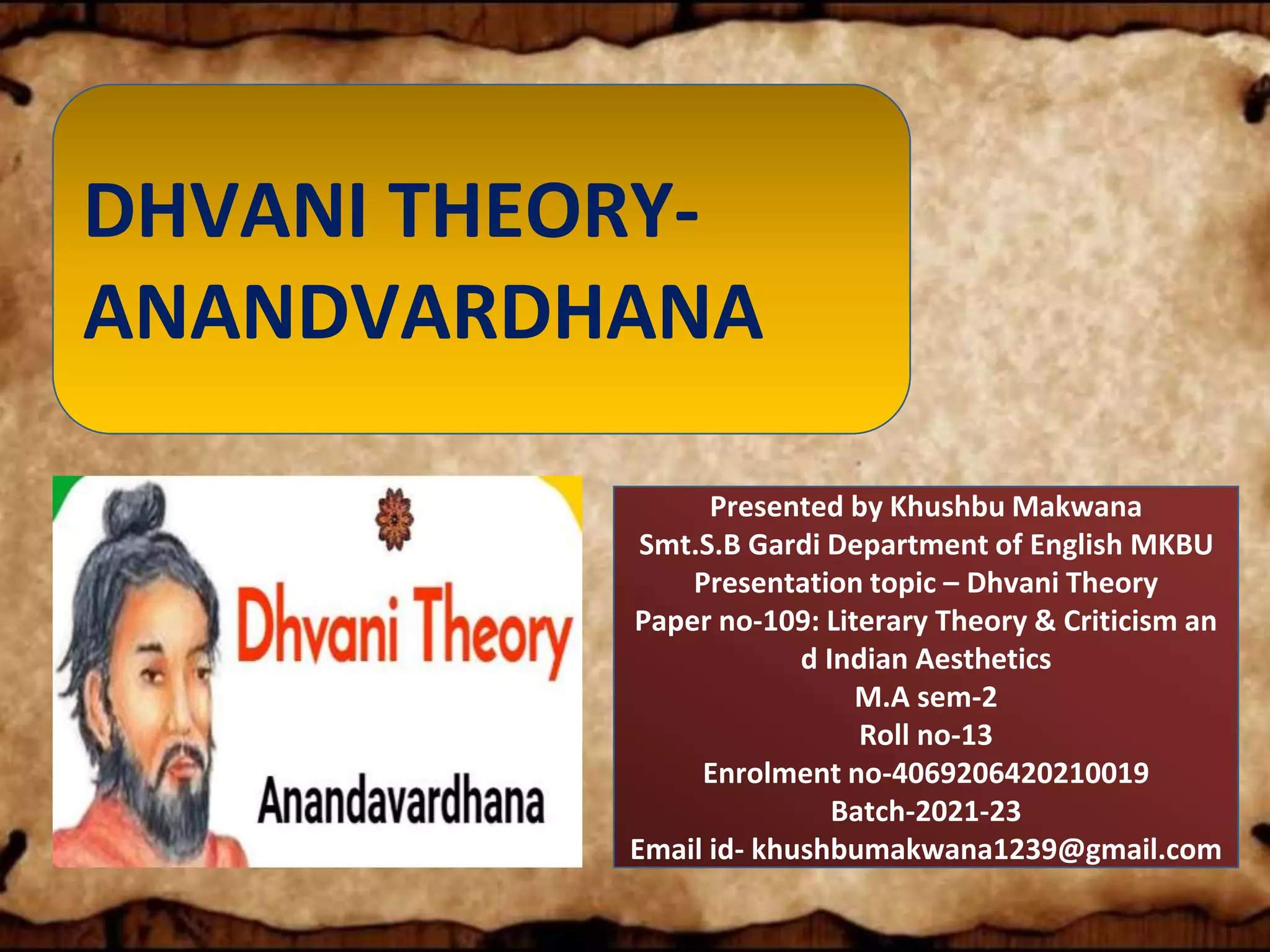
DHVANI THEORY-
ANANDVARDHANA
 The Theory of Dhvani or suggestion was first intr
oduce by Anandvardhana in his treatise Dhvanyal
oka in the ninth century.
 Anandvardhana is the first literary critic to give a
full bodied from to the concept and to enunciate
a new principle of literary evaluation absorbing t
he concepts propounded by the earlier theoretici
ans.
 The doctrine has since then been accepted as an i
mportant principle of criticism in Indian poetics a
nd has been strongly recommended by Anandvar
dhana both for poets and critics.
Introduction:
The Dhvanyaloka is divided into four chapters called
Uddyotas. In the beginning of the first Uddyota Anan
davardhana summarizes the purpose of writing his bo
ok:“Kavyastama dhvanir iti budhair yah samamnata-
purvah.” It means the soul of poetry has already been
recognized, the theory of dhvani is the essence of poe
try.
It is regarded as a “meaning school” which gives suggestio
n. That suggested sense is not apprehended by more kno
wledge of grammar and dictionary. It is only apprehended
by the knower of the poetic meaning, who knows how to r
ecognize the essence of poetic meaning.
# The word dhvani is used for: -
I. Conventional symbol- the articulate sound.
II. Conventional meaning
III. The power of word to convey the suggestive meaning
Iv. The suggestive meaning
v. Poetic work containing the suggestive element.
Dhvani School of Poetry :-
The Dhvani theory, in all its minute details has five thousa
nd, three hundred and fifty-five subdivisions of suggestive
poetry. Dhvani is what one overhears in good poetry, the
meaning that echo after a statement has been made. It is
basically a semantic theory.
A composition where suggested sense predominates is cal
led Dhvani. The word Dhvani is used for both - the suggest
ive word and the suggestive meaning. The poetic language
can never be possible without Dhvani.
In Dhvanyāloka, Dhvani becomes an all-embracing principl
e that explains the structure and function of the major ele
ments of literature - the aesthetic effect (Rasā), the figural
mode and devices (Alamkāra), the stylistic values (Riti) an
d excellence and defects (Guna-dosa).
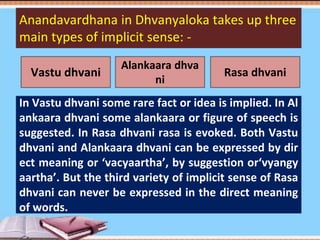
Alankaara dhva
ni
Rasa dhvani
Vastu dhvani
Anandavardhana in Dhvanyaloka takes up three
main types of implicit sense: -
In Vastu dhvani some rare fact or idea is implied. In Al
ankaara dhvani some alankaara or figure of speech is
suggested. In Rasa dhvani rasa is evoked. Both Vastu
dhvani and Alankaara dhvani can be expressed by dir
ect meaning or ‘vacyaartha’, by suggestion or‘vyangy
aartha’. But the third variety of implicit sense of Rasa
dhvani can never be expressed in the direct meaning
of words.
Anandvardhana has borrowed the term “dhvani” from the field
of grammar. Anandvardhana discusses all the factors connected
to dhvani doctrine such as Alamkara, Guna, Riti, etc.
# Grammatical Definitions :
1.ध्वनति इति ध्वतन: - That which suggest both word and meani
ng is Dhvani
2.ध्वन्यिे इति ध्वतन - That which is suggested is Dhvani
3.ध्वननं ध्वतन: - Process of Suggestion is Dhvani
4.ध्वतन समुदाय: ध्वतन: - Entire Literature is Dhvani
"That kind of poetry, where in the (conventional) meaning rend
ers itself secondary or the (conventional) word renders it's mea
ning secondary and suggests the (intended or) implied meaning
; is designated by the learned as Dhvani or 'Suggested Poetry'"
The communication of proper meaning through words requires a
proper arrangement of sounds. Language basically can be written
or spoken which has words as their foundation. Sanskrit critic has
described three types of words:
 Construction of Dhvani :
1.अतिधा (Abhidha) - Literal Meaning of the word
2.लक्षणा (Lakshana) - Characteristically Meaning of the wor
d
3.व्यंजना (Vyanjana) - Poetic & Metaphysical Meaning of the
word
 In this way, the third word Vyanjana reaches the soul an
d gives the suggested (extraordinary) meaning of the word.
 It is also called 'dhvani'. Basically, Dhvani is created by P
ada (पद) which combines to form Vākya (वाक्य) and from V
ākya, Rasābhāva () is generated.
 According to Anandavardhana a word is not only endow
ed with the two powers of denotation and implication but
also that of suggestion.
Many authors such a Bharat, Mammatt, Bhāmah, Dandi con
sidered various aspects such as Rasā, Alamkār, Riti, Guna-do
sh as the important part of the poem. But Ānandvardhan is
one step ahead. He said the above-mentioned aspects were
the body of the poetry. In short, they were part of the poetr
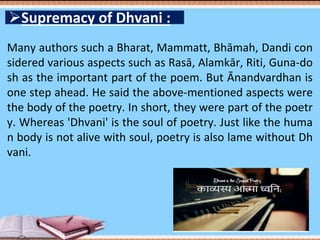
y. Whereas 'Dhvani' is the soul of poetry. Just like the huma
n body is not alive with soul, poetry is also lame without Dh
vani.
Supremacy of Dhvani :
Dhvani theory is a theory of meaning and symbolis
m which leads to the poetry of suggestion being acc
epted as the highest kind of poetry. Dhvani Theory i
s, therefore, Ānandvardhan's greatest contribution
to the poetic world. Through Dhvani or Vyanjana, t
he poet creates a world of his expression embellish
ed with various poetic devices. Hence, Dhvani in tru
e sense is beyond the suggestible meaning and sugg
estible element. Ānandvardhan's Dhvani Theory is
highly supported by Abhinavgupta.
Conclusion :
Resources :
https://www.exoticindiaart.com/book/details/h
andbook-of-indian-poetics-and-aesthetics-theori
es-of-rasa-dhvani-alamkaras-riti-vakrokti-and-au
citya-etc-azb551/
https://books.google.co.in/books?id=3NJvxASB
A9IC&printsec=frontcover&source=gbs_ge_sum
mary_r&cad=0#v=onepage&q&f=false
Thank you

Sem2 ppr9 Indian & Western Criticism.pptx

  • 1.
    Presented by KhushbuMakwana Smt.S.B Gardi Department of English MKBU Presentation topic – Dhvani Theory Paper no-109: Literary Theory & Criticism an d Indian Aesthetics M.A sem-2 Roll no-13 Enrolment no-4069206420210019 Batch-2021-23 Email id- khushbumakwana1239@gmail.com DHVANI THEORY- ANANDVARDHANA
  • 2.
     The Theoryof Dhvani or suggestion was first intr oduce by Anandvardhana in his treatise Dhvanyal oka in the ninth century.  Anandvardhana is the first literary critic to give a full bodied from to the concept and to enunciate a new principle of literary evaluation absorbing t he concepts propounded by the earlier theoretici ans.  The doctrine has since then been accepted as an i mportant principle of criticism in Indian poetics a nd has been strongly recommended by Anandvar dhana both for poets and critics. Introduction:
  • 3.
    The Dhvanyaloka isdivided into four chapters called Uddyotas. In the beginning of the first Uddyota Anan davardhana summarizes the purpose of writing his bo ok:“Kavyastama dhvanir iti budhair yah samamnata- purvah.” It means the soul of poetry has already been recognized, the theory of dhvani is the essence of poe try.
  • 4.
    It is regardedas a “meaning school” which gives suggestio n. That suggested sense is not apprehended by more kno wledge of grammar and dictionary. It is only apprehended by the knower of the poetic meaning, who knows how to r ecognize the essence of poetic meaning. # The word dhvani is used for: - I. Conventional symbol- the articulate sound. II. Conventional meaning III. The power of word to convey the suggestive meaning Iv. The suggestive meaning v. Poetic work containing the suggestive element. Dhvani School of Poetry :-
  • 5.
    The Dhvani theory,in all its minute details has five thousa nd, three hundred and fifty-five subdivisions of suggestive poetry. Dhvani is what one overhears in good poetry, the meaning that echo after a statement has been made. It is basically a semantic theory. A composition where suggested sense predominates is cal led Dhvani. The word Dhvani is used for both - the suggest ive word and the suggestive meaning. The poetic language can never be possible without Dhvani. In Dhvanyāloka, Dhvani becomes an all-embracing principl e that explains the structure and function of the major ele ments of literature - the aesthetic effect (Rasā), the figural mode and devices (Alamkāra), the stylistic values (Riti) an d excellence and defects (Guna-dosa).
  • 6.
    Alankaara dhva ni Rasa dhvani Vastudhvani Anandavardhana in Dhvanyaloka takes up three main types of implicit sense: - In Vastu dhvani some rare fact or idea is implied. In Al ankaara dhvani some alankaara or figure of speech is suggested. In Rasa dhvani rasa is evoked. Both Vastu dhvani and Alankaara dhvani can be expressed by dir ect meaning or ‘vacyaartha’, by suggestion or‘vyangy aartha’. But the third variety of implicit sense of Rasa dhvani can never be expressed in the direct meaning of words.
  • 7.
    Anandvardhana has borrowedthe term “dhvani” from the field of grammar. Anandvardhana discusses all the factors connected to dhvani doctrine such as Alamkara, Guna, Riti, etc. # Grammatical Definitions : 1.ध्वनति इति ध्वतन: - That which suggest both word and meani ng is Dhvani 2.ध्वन्यिे इति ध्वतन - That which is suggested is Dhvani 3.ध्वननं ध्वतन: - Process of Suggestion is Dhvani 4.ध्वतन समुदाय: ध्वतन: - Entire Literature is Dhvani "That kind of poetry, where in the (conventional) meaning rend ers itself secondary or the (conventional) word renders it's mea ning secondary and suggests the (intended or) implied meaning ; is designated by the learned as Dhvani or 'Suggested Poetry'"
  • 8.
    The communication ofproper meaning through words requires a proper arrangement of sounds. Language basically can be written or spoken which has words as their foundation. Sanskrit critic has described three types of words:  Construction of Dhvani : 1.अतिधा (Abhidha) - Literal Meaning of the word 2.लक्षणा (Lakshana) - Characteristically Meaning of the wor d 3.व्यंजना (Vyanjana) - Poetic & Metaphysical Meaning of the word
  • 9.
     In thisway, the third word Vyanjana reaches the soul an d gives the suggested (extraordinary) meaning of the word.  It is also called 'dhvani'. Basically, Dhvani is created by P ada (पद) which combines to form Vākya (वाक्य) and from V ākya, Rasābhāva () is generated.  According to Anandavardhana a word is not only endow ed with the two powers of denotation and implication but also that of suggestion.
  • 10.
    Many authors sucha Bharat, Mammatt, Bhāmah, Dandi con sidered various aspects such as Rasā, Alamkār, Riti, Guna-do sh as the important part of the poem. But Ānandvardhan is one step ahead. He said the above-mentioned aspects were the body of the poetry. In short, they were part of the poetr y. Whereas 'Dhvani' is the soul of poetry. Just like the huma n body is not alive with soul, poetry is also lame without Dh vani. Supremacy of Dhvani :
  • 11.
    Dhvani theory isa theory of meaning and symbolis m which leads to the poetry of suggestion being acc epted as the highest kind of poetry. Dhvani Theory i s, therefore, Ānandvardhan's greatest contribution to the poetic world. Through Dhvani or Vyanjana, t he poet creates a world of his expression embellish ed with various poetic devices. Hence, Dhvani in tru e sense is beyond the suggestible meaning and sugg estible element. Ānandvardhan's Dhvani Theory is highly supported by Abhinavgupta. Conclusion :
  • 12.
  • 13.