1
THE SELF
EARLY THEORISTS OF ‘THE SELF’
William James, Charles Cooley
SELF-CONCEPT & SELF-ESTEEM
Pelham & Swann (1989)
Gender differences?
Self-objectification theory
2
EARLY THEORISTS OF THE ‘SELF’
3
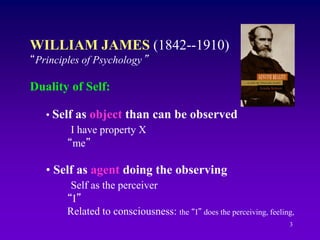
WILLIAM JAMES (1842--1910)
“Principles of Psychology”
Duality of Self:
• Self as object than can be observed
I have property X
“me”
• Self as agent doing the observing
Self as the perceiver
“I”
Related to consciousness: the “I” does the perceiving, feeling,
4
CHARLES COOLEY (1864-1929)
“Human Nature and the Social Order”
The Social Self:
• Self can’t be understood in isolation--must be
studied in interaction with others
• Self is not an inherent property of human nature but
rather a socially-constructed entity: our sense of self
is built upon the life-long experience of seeing
ourselves through the eyes of others (“looking-glass
self”)
James, Mead, Cooley --> SYMBOLIC
INTERACTIONISM
5
SYMBOLIC INTERACTIONISM
(Social) reality is an illusion, nothing is
inherently real, only the meanings and
symbols we collectively construct and use
to describe reality are real; these symbols
can be deconstructed to reveal who develop
them and how they are useful to particular
groups.
6
SELF-CONCEPT & SELF-ESTEEM
7
How do people move from having specific knowledge
about their attributes to global evaluations of their self-
worth?
Augusto Pinochet (1915-?) Sylvia Plath (1932-1963)
Undeserved high self-esteem ? Undeserved low self-
esteem ?
PARADOX: Often there is no obvious relationship between people’s accomplishments
and virtues and their global self-esteem
8
PELHAM & SWANN (1989)
GLOBAL SELF-ESTEEM (GSE)
General affective evaluation of own’s worth or importance. 2 components:
(1) Affective component: COLOR
• Basic sense of pride/shame about oneself.
• Largely rooted in temperament (individual differences in basic tendency to feel positive
and negative emotions) and early childhood experiences; stable, fuzzy, unconscious, hard
to verbalize, spontaneous, irrational (“feeling is believing”)
• Also known as trait self-esteem
(2) Cognitive component: CONTENT
• Known as self-concept (SC)
• Hierarchically organized set of specific mental self-views about one’s characteristics
(roles, abilities, etc.) and their evaluation
• Dynamic, clear, verbalized, rational (“seeing is believing”)
Framing factors: DYNAMICS
1. Attribute importance
2. Attribute certainty determine
impact of SC on
3. Actual/Ideal/Ought Self discrepancy GSE
9
10
POSITIVE &
NEGATIVE
AFFECT
SELF-
CONCEPT
(COGNITIVE
COMPONENT)
TRAIT
SELF-ESTEEM
(AFFECTIVE
COMPONENT)
GLOBAL SELF-ESTEEM
FRAMING FACTORS:
1. Attribute importance
2. Attribute certainty
3. Actual/Ideal/Ought
discrepancy
11
Gender differences in global self-
esteem ?
• Not reliable and/or sizable differences
have been found in adults (Maccoby & Jacklin,
1974)
• Sources of global self-esteem associated
to different things for men and women
(Josephs, Markus, & Tafarodi, 1992)
Differences in agency and communion
12
• Girl’s self-confidence fairly high until
age 11 or 12
– Assertive about feelings
• At adolescence
– Many girls accept stereotyped notions of
how they should be (behavior and looks)
• Repress true feelings
• Adopt a “nice” and woman-like self-
presentation
GIRLS SELF-ESTEEM
(Gilligan, 1990)
13
PHYSICAL SELF IN YOUNG
WOMEN
14
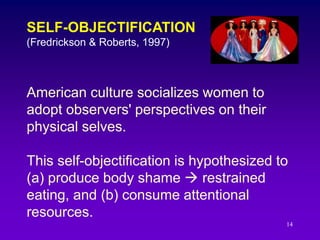
SELF-OBJECTIFICATION
(Fredrickson & Roberts, 1997)
American culture socializes women to
adopt observers' perspectives on their
physical selves.
This self-objectification is hypothesized to
(a) produce body shame  restrained
eating, and (b) consume attentional
resources.
15
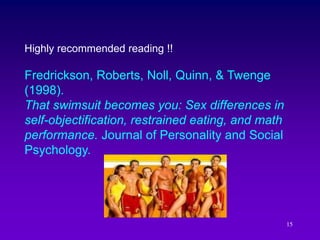
Highly recommended reading !!
Fredrickson, Roberts, Noll, Quinn, & Twenge
(1998).
That swimsuit becomes you: Sex differences in
self-objectification, restrained eating, and math
performance. Journal of Personality and Social
Psychology.
16
Question for the class:
Why is self-esteem in (Caucasian)
girls lower than for the other ethnic
groups?

self-2.ppt

  • 1.
    1 THE SELF EARLY THEORISTSOF ‘THE SELF’ William James, Charles Cooley SELF-CONCEPT & SELF-ESTEEM Pelham & Swann (1989) Gender differences? Self-objectification theory
  • 2.
    2 EARLY THEORISTS OFTHE ‘SELF’
  • 3.
    3 WILLIAM JAMES (1842--1910) “Principlesof Psychology” Duality of Self: • Self as object than can be observed I have property X “me” • Self as agent doing the observing Self as the perceiver “I” Related to consciousness: the “I” does the perceiving, feeling,
  • 4.
    4 CHARLES COOLEY (1864-1929) “HumanNature and the Social Order” The Social Self: • Self can’t be understood in isolation--must be studied in interaction with others • Self is not an inherent property of human nature but rather a socially-constructed entity: our sense of self is built upon the life-long experience of seeing ourselves through the eyes of others (“looking-glass self”) James, Mead, Cooley --> SYMBOLIC INTERACTIONISM
  • 5.
    5 SYMBOLIC INTERACTIONISM (Social) realityis an illusion, nothing is inherently real, only the meanings and symbols we collectively construct and use to describe reality are real; these symbols can be deconstructed to reveal who develop them and how they are useful to particular groups.
  • 6.
  • 7.
    7 How do peoplemove from having specific knowledge about their attributes to global evaluations of their self- worth? Augusto Pinochet (1915-?) Sylvia Plath (1932-1963) Undeserved high self-esteem ? Undeserved low self- esteem ? PARADOX: Often there is no obvious relationship between people’s accomplishments and virtues and their global self-esteem
  • 8.
    8 PELHAM & SWANN(1989) GLOBAL SELF-ESTEEM (GSE) General affective evaluation of own’s worth or importance. 2 components: (1) Affective component: COLOR • Basic sense of pride/shame about oneself. • Largely rooted in temperament (individual differences in basic tendency to feel positive and negative emotions) and early childhood experiences; stable, fuzzy, unconscious, hard to verbalize, spontaneous, irrational (“feeling is believing”) • Also known as trait self-esteem (2) Cognitive component: CONTENT • Known as self-concept (SC) • Hierarchically organized set of specific mental self-views about one’s characteristics (roles, abilities, etc.) and their evaluation • Dynamic, clear, verbalized, rational (“seeing is believing”) Framing factors: DYNAMICS 1. Attribute importance 2. Attribute certainty determine impact of SC on 3. Actual/Ideal/Ought Self discrepancy GSE
  • 9.
  • 10.
    10 POSITIVE & NEGATIVE AFFECT SELF- CONCEPT (COGNITIVE COMPONENT) TRAIT SELF-ESTEEM (AFFECTIVE COMPONENT) GLOBAL SELF-ESTEEM FRAMINGFACTORS: 1. Attribute importance 2. Attribute certainty 3. Actual/Ideal/Ought discrepancy
  • 11.
    11 Gender differences inglobal self- esteem ? • Not reliable and/or sizable differences have been found in adults (Maccoby & Jacklin, 1974) • Sources of global self-esteem associated to different things for men and women (Josephs, Markus, & Tafarodi, 1992) Differences in agency and communion
  • 12.
    12 • Girl’s self-confidencefairly high until age 11 or 12 – Assertive about feelings • At adolescence – Many girls accept stereotyped notions of how they should be (behavior and looks) • Repress true feelings • Adopt a “nice” and woman-like self- presentation GIRLS SELF-ESTEEM (Gilligan, 1990)
  • 13.
  • 14.
    14 SELF-OBJECTIFICATION (Fredrickson & Roberts,1997) American culture socializes women to adopt observers' perspectives on their physical selves. This self-objectification is hypothesized to (a) produce body shame  restrained eating, and (b) consume attentional resources.
  • 15.
    15 Highly recommended reading!! Fredrickson, Roberts, Noll, Quinn, & Twenge (1998). That swimsuit becomes you: Sex differences in self-objectification, restrained eating, and math performance. Journal of Personality and Social Psychology.
  • 16.
    16 Question for theclass: Why is self-esteem in (Caucasian) girls lower than for the other ethnic groups?

Editor's Notes