Toru Dutt
Biography
Prepared By : Janvi Nakum
Department Of English
Indian English Literature
Name : Janvi Nakum
Roll No. 11
Paper Coad : 201
Sem : 3
Email id : janvinakum360@gmail.com
3
4
One leaf the Angel took and therewith touched
His forehead, and then gently whispered 'Nay!'
Never, oh never had I seen a face
More beautiful than that Angel's, or more full
Of holy pity and of love divine."
"The Tree of Life"
Toru Dutt
 Toru Dutt poet, novelist, essayist, translator and polyglot—was an
outstanding pioneer in the history of Indian literature.
 Toru Dutt was born on March 4, 1856, in Rambagan, 12
Manicktollah Street, Calcutta, Toru Dutt died of
consumption(tuberculosis) , at the age of 21 on 30 August 1877.
Father Govin Chunder Dutt and mother Kshetramoni, a family that
become Christians in 1862. Toru was the youngest child, arriving
after sister Aru and brother Abju.
5
The Dutt family, renowned for its aristocracy,
progressive Westernised outlook and literary
leanings, was a gifted product of the cultural
renaissance of mid-nineteenth-century Bengal. Her
father was a noted linguist and a published poet
writing in English while her mother was a cultured
and intelligent woman with a literary bent of mind.
Toru’s uncles and cousins were also prolific writers
of prose and poetry in English.
6
⊳ Their cousin was the poet and civil servant Romesh Chunder
Dutt. Both girls honed their English and French during a four-
year residence in England and France, starting in 1869 at the
French School at Nice, then in London in 1870, where The Dutt
Family Album was published, and last in Cambridge in 1871,
where the sisters attended the "Higher Lectures for Women."
The family returned in September 1873 to their city house in
Rambagan and their garden residence at Baugmaree.
7
Toru Dutt had a thorough knowledge of India’s traditional past and this had
given her a strong foundation for a better superstructure to be constructed
over the edifice. In the stories of the Ramayana, the Mahabharata, the
Vishnu Purana and Srimadbhagavat, Toru Dutt found rich food for her
imagination. After her return to India she began to study Sanskrit and
acquired mastery in it and she read the Hindu classics in the original
Sanskrit version. She brought out her second volume under the title of
Ancient Ballads and Legends of Hindustan with an introduction by Edmund
Gosse who considers it, “Toru’s chief legacy to posterity.” Here she glorifies
India’s cultural heritage. She evolved herself from a translator into a poet.
She translated many French and Sanskrit poems into English.
8
9
10
Her Works
 Essays:
Toru’s Essays appeared in print for the first time in December 1874, in The Bengal Magazine.
 Translation: A Scene from Contemporary History :
In June and July 1875, came out two Translations in prose by Toru. In fact these were
two speeches delivered in the French Legislative Assembly.
 A Sheaf Gleaned in French Fields:
In March 1876 Toru published A Sheaf Gleaned in French Fields. It contained
translations of 165 poems. Toru’s book was so popular that within a few months of its
publication a second edition of it was printed.
11
 Bianca or The Young Spanish Maiden:
It was an unfinished romance published after Toru’s death. Bianca was published in
The Bengal Magazine between January and April 1878 as a serial.
 Le Journal de Mademoiselle d’ Arvers:
It was a finished novel by Toru.
 Letters:
Toru’s letters were published in 1921 under the title The Life and Letters of Toru
Dutt. Toru had written 53 letters only to her British friend named Mary Martin.
12
Ancient Ballads and Legends of Hindustan:
It was published in 1882 after her death. There are nine ballads or legends in it. They are based
on Indian myths and legends.
The first thing that strikes us about her poetics is her anxiety for the presentation and interpretation
of Hindu myths and legends and thus expound the multi-dimensionality of the Hindu view of life.
Although a Christian by faith and soaked in French and English cultures, she was at heart a true
Indian and she had heard the stories of the Hindu epics and puranas, stories of mystery and
miracle from her parents; and her Ancient Ballads and Legends at Hindustan
holds a mirror to the soul of India, and breathe, as Edmund Gosse Hindustan holds a mirror to the
soul of India, and breathe, as Edmund Gosse Lakshman, Buttoo, Prahlad etc. are not mere tales
for nursery children, but are instinct, with great moral values.
E.F.Oaten appreciates her creative and imaginative power and her almost faultless technical skill
Toru’s craftsmanship in verse is beautifully brought out in Ancient Ballads and Legends of
Hindustan.
⊳ Savitri
⊳ Lakshman
⊳ Jogadhya Uma
⊳ The Royal Ascetic and Hind
⊳ Dhruva
⊳ Buttoo
⊳ Sindhu
⊳ Prahlad
⊳ Sita
⊳ The most popular among
them are The Lotus and Our
Casuarina Tree.
13
14
Lakshman
In poems like “Lakshman“, we find the translator growing into a poet. Under her creative impulse
she selected and elaborated particular passage from the original texts which she found suitable
for producing desirable artistic effect. “Lakshman” is a good example of this. She translated the
piece from the forty-fifth canto of “Aranyakandam” of the Ramayana.
Though “Lakshman” is short, it is a brilliant poem of nineteen stanzas. Within this short span, she
sharply presents the characters of Sita and Lakshman with dexterity by using the method of
contrast. She depicts the reaction of Sita and Lakshman to the suspected calamity. She loses
her nerve and her equipoise and accuses Lakshman of infidelity and evil design. Sita’s gentility
and sadness of heart disappear in the face of crisis and she becomes weak. While in the grip of
fear, she forgets her husband’s valour and strength and mistrusts Lakshman.
15
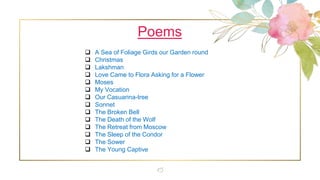
 A Sea of Foliage Girds our Garden round
 Christmas
 Lakshman
 Love Came to Flora Asking for a Flower
 Moses
 My Vocation
 Our Casuarina-tree
 Sonnet
 The Broken Bell
 The Death of the Wolf
 The Retreat from Moscow
 The Sleep of the Condor
 The Sower
 The Young Captive
Poems
K. R. Srinivasa Iyengar has rightly observed
that Toru’s “feeling for words was
impeccable, and her eye and ear were alike
trained for poetic description or dialogue”.
Among her shorter poems “Our Casuarina
Tree” can claim its place with great, and
immortal poems in the whole range of
English language, by virtue of its structural
beauty, rich and subtle and metaphoric
design.
16
Works Cited
Gosse, Edmund, and Kegan Paul. “Dutt, Toru | RPO.” Representative Poetry
Online,
https://rpo.library.utoronto.ca/poets/dutt-toru
Gupta, Rekha. “Toru Dutt's Life and Works—Biography of Toru Dutt.” Indian
English Literature, 30 April 2022,
https://www.indianenglishlit.com/2022/04/toru-dutt-life-and-works-biography-of-
toru-dutt.html
“Home.” YouTube, 5 December 2018,
https://ijcrt.org/papers/IJCRT2009378.pdf
Sarkar, Somnath. “Lakshman by Toru Dutt Analysis | Lakshman Character
Analysis.” All About English Literature, 6 March 2021,
https://www.eng-literature.com/2021/03/toru-dutt-lakshman-analysis.html
18
Thank you

Toru dutt biography

  • 1.
  • 2.
    Department Of English IndianEnglish Literature Name : Janvi Nakum Roll No. 11 Paper Coad : 201 Sem : 3 Email id : janvinakum360@gmail.com
  • 3.
  • 4.
    4 One leaf theAngel took and therewith touched His forehead, and then gently whispered 'Nay!' Never, oh never had I seen a face More beautiful than that Angel's, or more full Of holy pity and of love divine." "The Tree of Life"
  • 5.
    Toru Dutt  ToruDutt poet, novelist, essayist, translator and polyglot—was an outstanding pioneer in the history of Indian literature.  Toru Dutt was born on March 4, 1856, in Rambagan, 12 Manicktollah Street, Calcutta, Toru Dutt died of consumption(tuberculosis) , at the age of 21 on 30 August 1877. Father Govin Chunder Dutt and mother Kshetramoni, a family that become Christians in 1862. Toru was the youngest child, arriving after sister Aru and brother Abju. 5
  • 6.
    The Dutt family,renowned for its aristocracy, progressive Westernised outlook and literary leanings, was a gifted product of the cultural renaissance of mid-nineteenth-century Bengal. Her father was a noted linguist and a published poet writing in English while her mother was a cultured and intelligent woman with a literary bent of mind. Toru’s uncles and cousins were also prolific writers of prose and poetry in English. 6
  • 7.
    ⊳ Their cousinwas the poet and civil servant Romesh Chunder Dutt. Both girls honed their English and French during a four- year residence in England and France, starting in 1869 at the French School at Nice, then in London in 1870, where The Dutt Family Album was published, and last in Cambridge in 1871, where the sisters attended the "Higher Lectures for Women." The family returned in September 1873 to their city house in Rambagan and their garden residence at Baugmaree. 7
  • 8.
    Toru Dutt hada thorough knowledge of India’s traditional past and this had given her a strong foundation for a better superstructure to be constructed over the edifice. In the stories of the Ramayana, the Mahabharata, the Vishnu Purana and Srimadbhagavat, Toru Dutt found rich food for her imagination. After her return to India she began to study Sanskrit and acquired mastery in it and she read the Hindu classics in the original Sanskrit version. She brought out her second volume under the title of Ancient Ballads and Legends of Hindustan with an introduction by Edmund Gosse who considers it, “Toru’s chief legacy to posterity.” Here she glorifies India’s cultural heritage. She evolved herself from a translator into a poet. She translated many French and Sanskrit poems into English. 8
  • 9.
  • 10.
    10 Her Works  Essays: Toru’sEssays appeared in print for the first time in December 1874, in The Bengal Magazine.  Translation: A Scene from Contemporary History : In June and July 1875, came out two Translations in prose by Toru. In fact these were two speeches delivered in the French Legislative Assembly.  A Sheaf Gleaned in French Fields: In March 1876 Toru published A Sheaf Gleaned in French Fields. It contained translations of 165 poems. Toru’s book was so popular that within a few months of its publication a second edition of it was printed.
  • 11.
    11  Bianca orThe Young Spanish Maiden: It was an unfinished romance published after Toru’s death. Bianca was published in The Bengal Magazine between January and April 1878 as a serial.  Le Journal de Mademoiselle d’ Arvers: It was a finished novel by Toru.  Letters: Toru’s letters were published in 1921 under the title The Life and Letters of Toru Dutt. Toru had written 53 letters only to her British friend named Mary Martin.
  • 12.
    12 Ancient Ballads andLegends of Hindustan: It was published in 1882 after her death. There are nine ballads or legends in it. They are based on Indian myths and legends. The first thing that strikes us about her poetics is her anxiety for the presentation and interpretation of Hindu myths and legends and thus expound the multi-dimensionality of the Hindu view of life. Although a Christian by faith and soaked in French and English cultures, she was at heart a true Indian and she had heard the stories of the Hindu epics and puranas, stories of mystery and miracle from her parents; and her Ancient Ballads and Legends at Hindustan holds a mirror to the soul of India, and breathe, as Edmund Gosse Hindustan holds a mirror to the soul of India, and breathe, as Edmund Gosse Lakshman, Buttoo, Prahlad etc. are not mere tales for nursery children, but are instinct, with great moral values. E.F.Oaten appreciates her creative and imaginative power and her almost faultless technical skill Toru’s craftsmanship in verse is beautifully brought out in Ancient Ballads and Legends of Hindustan.
  • 13.
    ⊳ Savitri ⊳ Lakshman ⊳Jogadhya Uma ⊳ The Royal Ascetic and Hind ⊳ Dhruva ⊳ Buttoo ⊳ Sindhu ⊳ Prahlad ⊳ Sita ⊳ The most popular among them are The Lotus and Our Casuarina Tree. 13
  • 14.
    14 Lakshman In poems like“Lakshman“, we find the translator growing into a poet. Under her creative impulse she selected and elaborated particular passage from the original texts which she found suitable for producing desirable artistic effect. “Lakshman” is a good example of this. She translated the piece from the forty-fifth canto of “Aranyakandam” of the Ramayana. Though “Lakshman” is short, it is a brilliant poem of nineteen stanzas. Within this short span, she sharply presents the characters of Sita and Lakshman with dexterity by using the method of contrast. She depicts the reaction of Sita and Lakshman to the suspected calamity. She loses her nerve and her equipoise and accuses Lakshman of infidelity and evil design. Sita’s gentility and sadness of heart disappear in the face of crisis and she becomes weak. While in the grip of fear, she forgets her husband’s valour and strength and mistrusts Lakshman.
  • 15.
    15  A Seaof Foliage Girds our Garden round  Christmas  Lakshman  Love Came to Flora Asking for a Flower  Moses  My Vocation  Our Casuarina-tree  Sonnet  The Broken Bell  The Death of the Wolf  The Retreat from Moscow  The Sleep of the Condor  The Sower  The Young Captive Poems
  • 16.
    K. R. SrinivasaIyengar has rightly observed that Toru’s “feeling for words was impeccable, and her eye and ear were alike trained for poetic description or dialogue”. Among her shorter poems “Our Casuarina Tree” can claim its place with great, and immortal poems in the whole range of English language, by virtue of its structural beauty, rich and subtle and metaphoric design. 16
  • 17.
    Works Cited Gosse, Edmund,and Kegan Paul. “Dutt, Toru | RPO.” Representative Poetry Online, https://rpo.library.utoronto.ca/poets/dutt-toru Gupta, Rekha. “Toru Dutt's Life and Works—Biography of Toru Dutt.” Indian English Literature, 30 April 2022, https://www.indianenglishlit.com/2022/04/toru-dutt-life-and-works-biography-of- toru-dutt.html “Home.” YouTube, 5 December 2018, https://ijcrt.org/papers/IJCRT2009378.pdf Sarkar, Somnath. “Lakshman by Toru Dutt Analysis | Lakshman Character Analysis.” All About English Literature, 6 March 2021, https://www.eng-literature.com/2021/03/toru-dutt-lakshman-analysis.html
  • 18.