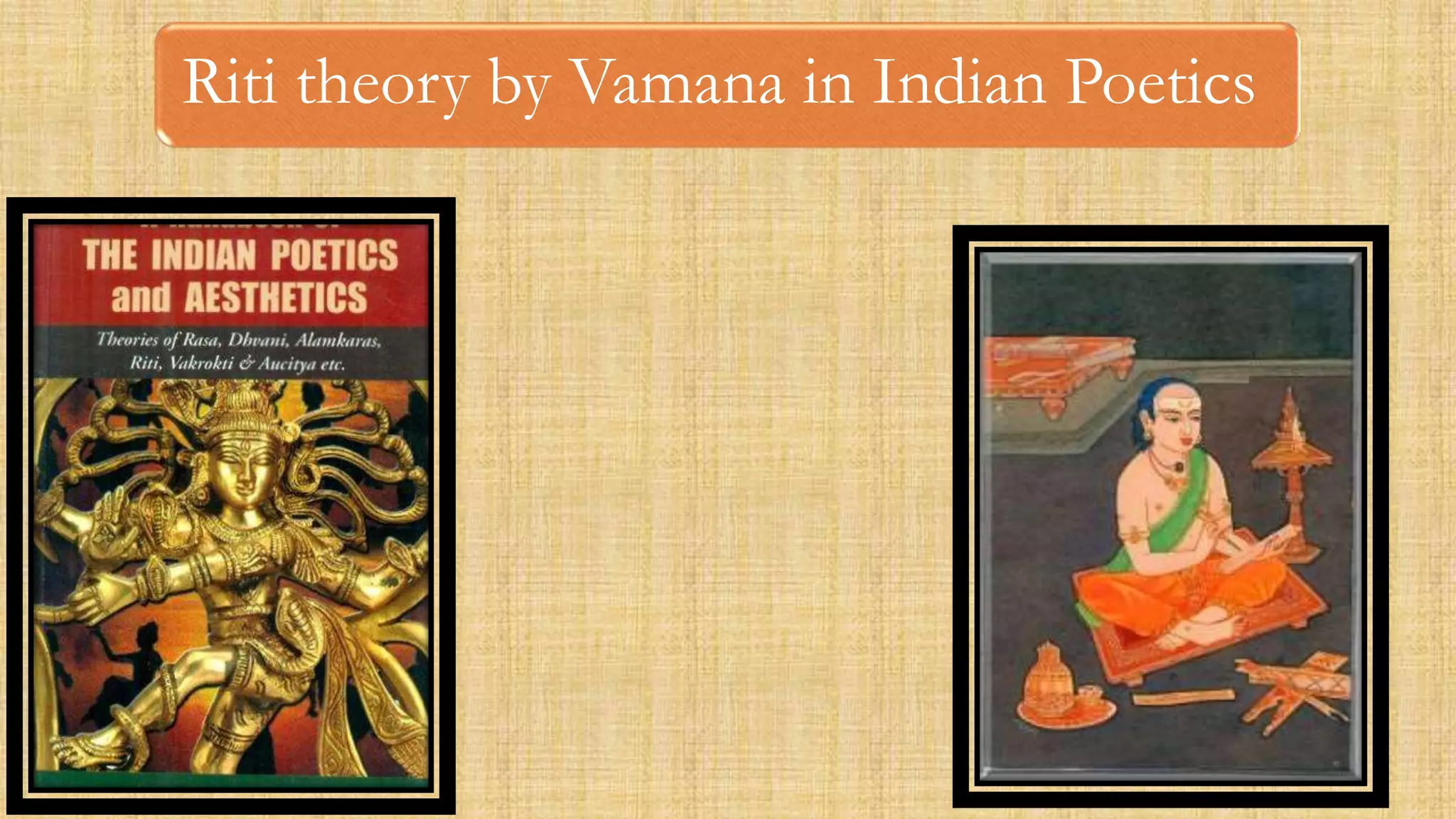
Riti theory by Vamana in Indian Poetics
Prepared by Nidhi Dave
Roll no 16
P – 109 Literary Theory
And Criticism And
Indian Aesthetics
MA Sem 2
Email I’D
davenidhi05@gmail.com
Submitted to –
Department of English
Maharaja
Krishnakumarsinhji
Bhavnagar University.
Introduction
The word
Indian poetics
is used in the
context of
Sanskrit
poetics. Like
Aristotle’ s
Poetics.
Indian poetics
focused
mainly on
drama.
In Indian
poetics, there
were several
schools like
Rasa,
Alankara, Riti,
Dhvani,
Vakrokti and
Auchitya.
Acharya
vamana us the
propounder
of Riti Theory
and declared
the riti to be
soul of poetry.
He was the
first poetician
who perceived
clearly and
stated
categorically
that the
differentia of
a Kavya as a
literary species
was Beauty.
The Elements of Poetics are as follows:
Kavyaswarupa -Nature
of poetry, Causes of
poetry: definition of
poetry, various classes
of poetry and purpose
of poetry.)
Shabdshakti (power of
words)
Dhvani kavya (poetry
with suggestive
Meaning)
Gunibhut-Vangamaya-
Kavya (poetry where
suggested is secondary
to the primary sense)
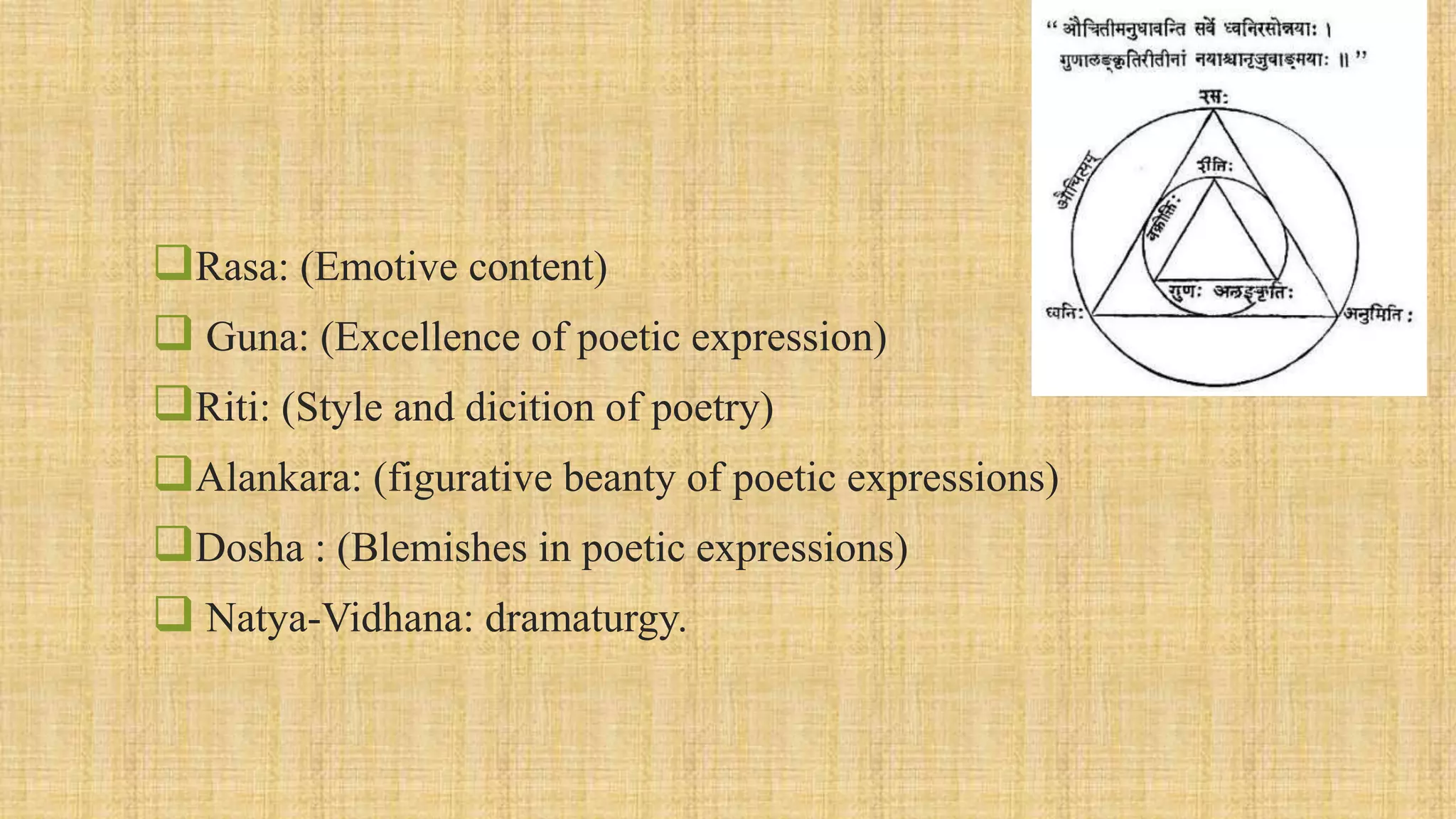
Rasa: (Emotive content)
 Guna: (Excellence of poetic expression)
Riti: (Style and dicition of poetry)
Alankara: (figurative beanty of poetic expressions)
Dosha : (Blemishes in poetic expressions)
 Natya-Vidhana: dramaturgy.
Kavya and Indian Poetics in Riti
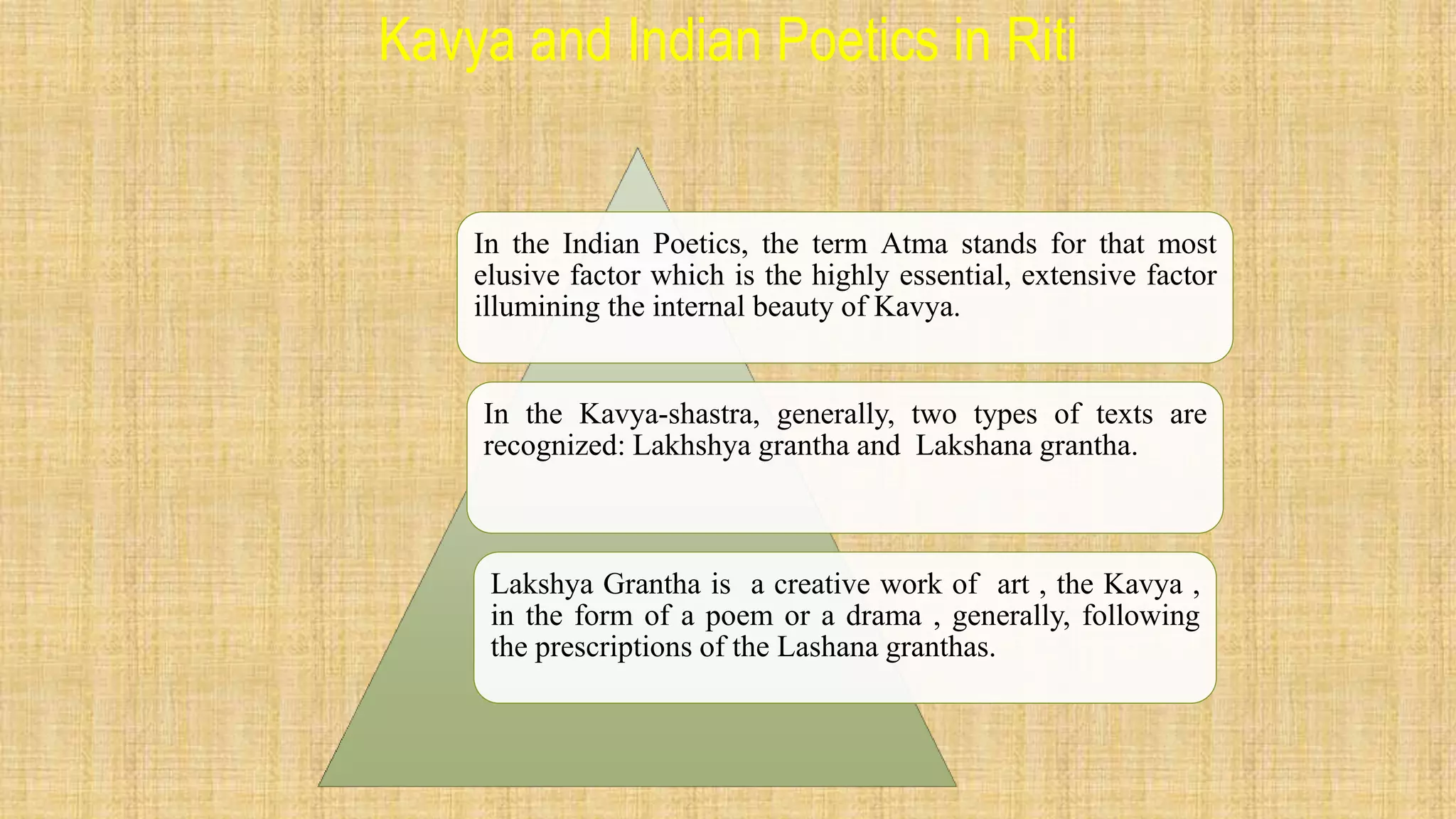
In the Indian Poetics, the term Atma stands for that most
elusive factor which is the highly essential, extensive factor
illumining the internal beauty of Kavya.
In the Kavya-shastra, generally, two types of texts are
recognized: Lakhshya grantha and Lakshana grantha.
Lakshya Grantha is a creative work of art , the Kavya ,
in the form of a poem or a drama , generally, following
the prescriptions of the Lashana granthas.
Various Thinker’s View on Riti
Various thinkers and writers of the Lakshana granthas, over a long period, have
put forward several theories based on their concept of the essential core , the
heart or the soul of the Kavya (kavyasya Atma).
While the authors like Bhamaha, Dandin, Udbhata and Rudrata focused on
Alamkara; Vamana emphasized the concept of Riti. However, it was
Anandavardhana who changed the entire course of discussion by introducing the
concept of Dhvani.
It was perhaps Vamana the author of Kavyalankara-sutra-vritti who initiated the
speculation about the Atman or the soul of poetry. He declared – Ritir Atma
kavyasya – // Vkal_1,2.6 // (Riti is the soul of Poetry).
Vamana’s Views on Riti
Although Vamana was the first to use the term Atma explicitly, the notions of the spirit or the inner-being
of Kavya were mentioned by the earlier scholars too, though rather vaguely.
Vamana called the first section (Adhikarana) of his work as Sarira-adhikaranam – reflexions on the body of
Kavya. After discussing the components of the Kavya-body, Vamana looks into those aspects that cannot
be reduced to physical elements. For Vamana, that formless, indeterminate essence of Kavya is Riti.
Then, Vamana said; the essence of Kavya is Riti (Ritir Atma Kavyasya – Vkal_1,2.6 ); just as every body has
Atma, so does every Kavya has its Riti.The explanation offered by Vamana meant that the verbal structure
having certain Gunas is the body of Kavya, while its essence (soul) is, Riti.
• – Rinati gacchati asyam guna iti riyate ksaraty asyam vanmaddhu-dhareti va ritih
(Vamana KSS).
• The language and its structural form lead us to the inner core of poetry. And,
when that language becomes style (Riti), it absorbs into itself all the other
constituent elements of poetry. It allows them, as also the poetic vision, to shine
through it.
• Dandin had earlier highlighted two styles (Marga) of presenting a Kavya:
Vaidarbhi and Gaudi, each having its special characteristics. To that, Vamana
added Panchali – sā tridhā vaidarbhī gauḍīyā pāñcālī ceti . (And, much later,
Rudrata, in his Kavya-alamkara, added Latiya as the fourth Riti; while Raja Bhoja
in his Sringara Prakasa added Avantika and Magadhi as other styles.)
• According to Vamana, only the Vaidarbhi Marga, which he approves, has all the twenty Gunas – sweet as the
notes of the lute.
• According to Vamana, the Gaudiya is marked by Ojas (vigour) and Kanti (grace) , but it lacks Madhurya
(sweetness) and Saukumarya (delicacy) plagued by long winding compounds and bombastic words. And,
Panchali, he says, while it has Madhurya and Saukumarya, it is devoid of Ojas and Kanti
• He remarks that the difference between Vaidarbhi and other modes (Gaudi, Panchali etc) is analogous to
differences between silken thread and jute fiber (I.2.11-18).
• Therefore, Guņas are nitya (essential) because they are related to the soul of poetry called rītī and alamkāra
are anitya (trivial) because they are related to the body of poetry namely śabda and artha
• Gauḍī dambarabaddhā syād vaidarbhī lalitakramā / pāňcālī miśra bhāvena lāṭī tu mṛdubhiḥ padaiḥ
Dandin and Kutakas views on riti
• As said earlier; Dandin had named certain literary styles as Marga-s (say, Vaidarbhi and
Gaudiya Marga). Vamana not only modified the concept of style, but also renamed Marga as
Riti – style or diction – rītīnāṃ pūrvā vaidarbhī grāhyā , guṇānāṃ sākalyāt .
• Vaidarbhi, Gaudiya and Pañc li are the three rītī that poets choose as their mode of expression.
Vaidarbhi, for V mana, is superior to the other two styles as it possesses ten guņas as
mentioned earlier by Dandin.
• Riti, according to him, is a particular mode or organization of verbal structure that is different
from common usage – Visista pada-racana – having the excellences of Gunas. He, in fact,
calls this structure or arrangement of words as Viseso Gunatma (1.2.8) – a combination of
various Gunas.
• Kutaka also objected to the old practice of classifying the Vaidarbhi, Gaudi and Panchali type
of Ritis as Uttama , Madhyama and Adhama , receptively.
• Thus, Riti is not just a regional mode of arranging words or diction or style; and, it
could mean harmony and rhythm in the composition , as well. Just as in the human
body the placement and proportion of each organ contributes to the handsome or
otherwise appearance of a person, so also the arrangement of the words which aptly
bring out the poetic and the dramatic intent of the component are highly important.
Riti aims to harmonize Sabda and Artha, the body and the soul.
• Vamana , therefore, accorded Riti a very high position by designating Riti as the Soul
of Kavya – Ritr Atma kavyasya / śarīrasyeveti vākyaśeṣaḥ (I.2.6) – Riti is to the Kavya
what Atman is to the Sarira (body).
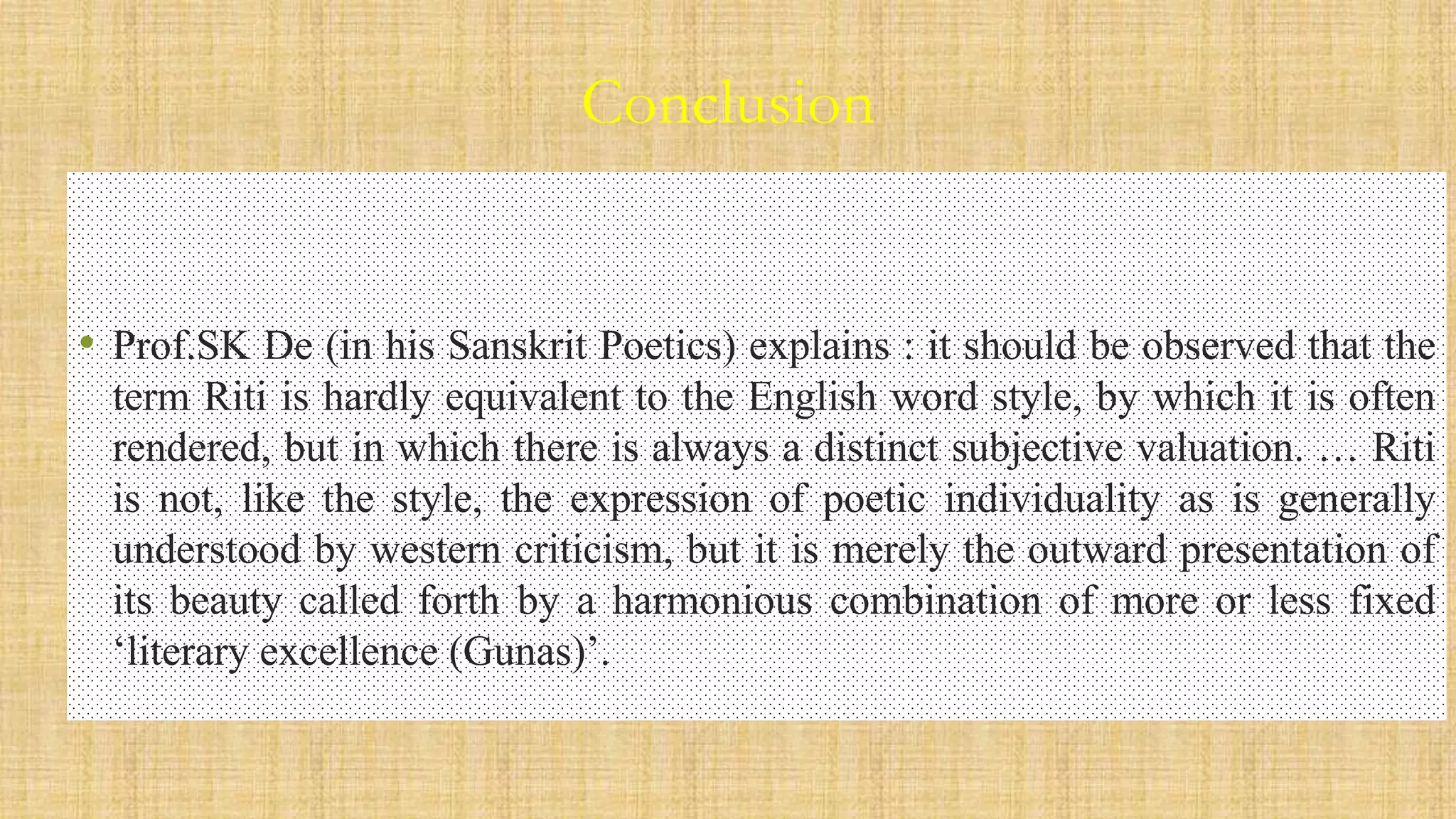
Conclusion
• Prof.SK De (in his Sanskrit Poetics) explains : it should be observed that the
term Riti is hardly equivalent to the English word style, by which it is often
rendered, but in which there is always a distinct subjective valuation. … Riti
is not, like the style, the expression of poetic individuality as is generally
understood by western criticism, but it is merely the outward presentation of
its beauty called forth by a harmonious combination of more or less fixed
‘literary excellence (Gunas)’.
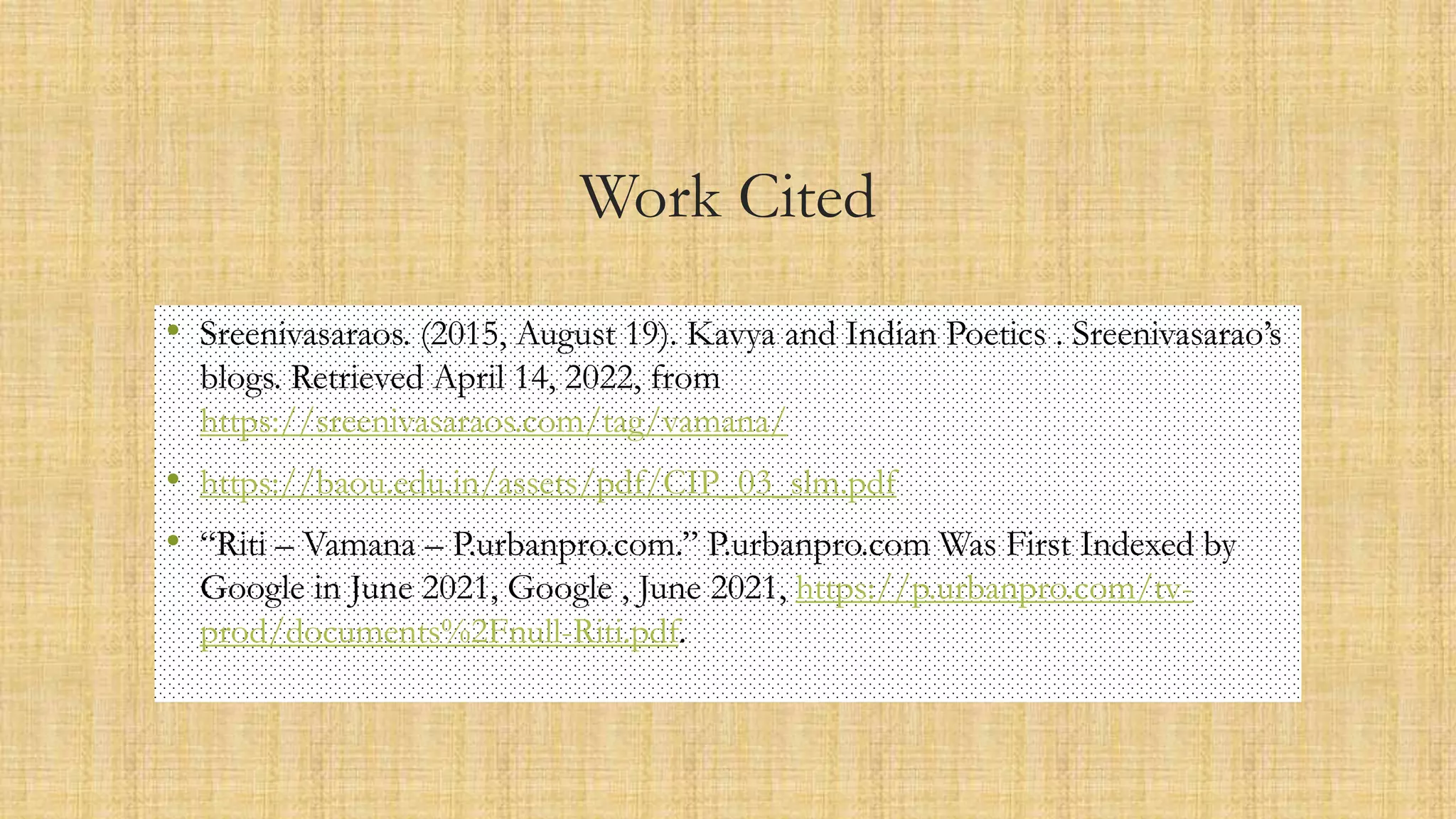
Work Cited
• Sreenivasaraos. (2015, August 19). Kavya and Indian Poetics . Sreenivasarao’s
blogs. Retrieved April 14, 2022, from
https://sreenivasaraos.com/tag/vamana/
• https://baou.edu.in/assets/pdf/CIP_03_slm.pdf
• “Riti – Vamana – P.urbanpro.com.” P.urbanpro.com Was First Indexed by
Google in June 2021, Google , June 2021, https://p.urbanpro.com/tv-
prod/documents%2Fnull-Riti.pdf.
Thank you

Riti Theory by Nidhi Dave

  • 1.
    Riti theory byVamana in Indian Poetics
  • 2.
    Prepared by NidhiDave Roll no 16 P – 109 Literary Theory And Criticism And Indian Aesthetics MA Sem 2 Email I’D davenidhi05@gmail.com Submitted to – Department of English Maharaja Krishnakumarsinhji Bhavnagar University.
  • 3.
    Introduction The word Indian poetics isused in the context of Sanskrit poetics. Like Aristotle’ s Poetics. Indian poetics focused mainly on drama. In Indian poetics, there were several schools like Rasa, Alankara, Riti, Dhvani, Vakrokti and Auchitya. Acharya vamana us the propounder of Riti Theory and declared the riti to be soul of poetry. He was the first poetician who perceived clearly and stated categorically that the differentia of a Kavya as a literary species was Beauty.
  • 4.
    The Elements ofPoetics are as follows: Kavyaswarupa -Nature of poetry, Causes of poetry: definition of poetry, various classes of poetry and purpose of poetry.) Shabdshakti (power of words) Dhvani kavya (poetry with suggestive Meaning) Gunibhut-Vangamaya- Kavya (poetry where suggested is secondary to the primary sense)
  • 5.
    Rasa: (Emotive content) Guna: (Excellence of poetic expression) Riti: (Style and dicition of poetry) Alankara: (figurative beanty of poetic expressions) Dosha : (Blemishes in poetic expressions)  Natya-Vidhana: dramaturgy.
  • 6.
    Kavya and IndianPoetics in Riti In the Indian Poetics, the term Atma stands for that most elusive factor which is the highly essential, extensive factor illumining the internal beauty of Kavya. In the Kavya-shastra, generally, two types of texts are recognized: Lakhshya grantha and Lakshana grantha. Lakshya Grantha is a creative work of art , the Kavya , in the form of a poem or a drama , generally, following the prescriptions of the Lashana granthas.
  • 7.
    Various Thinker’s Viewon Riti Various thinkers and writers of the Lakshana granthas, over a long period, have put forward several theories based on their concept of the essential core , the heart or the soul of the Kavya (kavyasya Atma). While the authors like Bhamaha, Dandin, Udbhata and Rudrata focused on Alamkara; Vamana emphasized the concept of Riti. However, it was Anandavardhana who changed the entire course of discussion by introducing the concept of Dhvani. It was perhaps Vamana the author of Kavyalankara-sutra-vritti who initiated the speculation about the Atman or the soul of poetry. He declared – Ritir Atma kavyasya – // Vkal_1,2.6 // (Riti is the soul of Poetry).
  • 8.
    Vamana’s Views onRiti Although Vamana was the first to use the term Atma explicitly, the notions of the spirit or the inner-being of Kavya were mentioned by the earlier scholars too, though rather vaguely. Vamana called the first section (Adhikarana) of his work as Sarira-adhikaranam – reflexions on the body of Kavya. After discussing the components of the Kavya-body, Vamana looks into those aspects that cannot be reduced to physical elements. For Vamana, that formless, indeterminate essence of Kavya is Riti. Then, Vamana said; the essence of Kavya is Riti (Ritir Atma Kavyasya – Vkal_1,2.6 ); just as every body has Atma, so does every Kavya has its Riti.The explanation offered by Vamana meant that the verbal structure having certain Gunas is the body of Kavya, while its essence (soul) is, Riti.
  • 9.
    • – Rinatigacchati asyam guna iti riyate ksaraty asyam vanmaddhu-dhareti va ritih (Vamana KSS). • The language and its structural form lead us to the inner core of poetry. And, when that language becomes style (Riti), it absorbs into itself all the other constituent elements of poetry. It allows them, as also the poetic vision, to shine through it. • Dandin had earlier highlighted two styles (Marga) of presenting a Kavya: Vaidarbhi and Gaudi, each having its special characteristics. To that, Vamana added Panchali – sā tridhā vaidarbhī gauḍīyā pāñcālī ceti . (And, much later, Rudrata, in his Kavya-alamkara, added Latiya as the fourth Riti; while Raja Bhoja in his Sringara Prakasa added Avantika and Magadhi as other styles.)
  • 10.
    • According toVamana, only the Vaidarbhi Marga, which he approves, has all the twenty Gunas – sweet as the notes of the lute. • According to Vamana, the Gaudiya is marked by Ojas (vigour) and Kanti (grace) , but it lacks Madhurya (sweetness) and Saukumarya (delicacy) plagued by long winding compounds and bombastic words. And, Panchali, he says, while it has Madhurya and Saukumarya, it is devoid of Ojas and Kanti • He remarks that the difference between Vaidarbhi and other modes (Gaudi, Panchali etc) is analogous to differences between silken thread and jute fiber (I.2.11-18). • Therefore, Guņas are nitya (essential) because they are related to the soul of poetry called rītī and alamkāra are anitya (trivial) because they are related to the body of poetry namely śabda and artha • Gauḍī dambarabaddhā syād vaidarbhī lalitakramā / pāňcālī miśra bhāvena lāṭī tu mṛdubhiḥ padaiḥ
  • 11.
    Dandin and Kutakasviews on riti • As said earlier; Dandin had named certain literary styles as Marga-s (say, Vaidarbhi and Gaudiya Marga). Vamana not only modified the concept of style, but also renamed Marga as Riti – style or diction – rītīnāṃ pūrvā vaidarbhī grāhyā , guṇānāṃ sākalyāt . • Vaidarbhi, Gaudiya and Pañc li are the three rītī that poets choose as their mode of expression. Vaidarbhi, for V mana, is superior to the other two styles as it possesses ten guņas as mentioned earlier by Dandin. • Riti, according to him, is a particular mode or organization of verbal structure that is different from common usage – Visista pada-racana – having the excellences of Gunas. He, in fact, calls this structure or arrangement of words as Viseso Gunatma (1.2.8) – a combination of various Gunas. • Kutaka also objected to the old practice of classifying the Vaidarbhi, Gaudi and Panchali type of Ritis as Uttama , Madhyama and Adhama , receptively.
  • 12.
    • Thus, Ritiis not just a regional mode of arranging words or diction or style; and, it could mean harmony and rhythm in the composition , as well. Just as in the human body the placement and proportion of each organ contributes to the handsome or otherwise appearance of a person, so also the arrangement of the words which aptly bring out the poetic and the dramatic intent of the component are highly important. Riti aims to harmonize Sabda and Artha, the body and the soul. • Vamana , therefore, accorded Riti a very high position by designating Riti as the Soul of Kavya – Ritr Atma kavyasya / śarīrasyeveti vākyaśeṣaḥ (I.2.6) – Riti is to the Kavya what Atman is to the Sarira (body).
  • 13.
    Conclusion • Prof.SK De(in his Sanskrit Poetics) explains : it should be observed that the term Riti is hardly equivalent to the English word style, by which it is often rendered, but in which there is always a distinct subjective valuation. … Riti is not, like the style, the expression of poetic individuality as is generally understood by western criticism, but it is merely the outward presentation of its beauty called forth by a harmonious combination of more or less fixed ‘literary excellence (Gunas)’.
  • 14.
    Work Cited • Sreenivasaraos.(2015, August 19). Kavya and Indian Poetics . Sreenivasarao’s blogs. Retrieved April 14, 2022, from https://sreenivasaraos.com/tag/vamana/ • https://baou.edu.in/assets/pdf/CIP_03_slm.pdf • “Riti – Vamana – P.urbanpro.com.” P.urbanpro.com Was First Indexed by Google in June 2021, Google , June 2021, https://p.urbanpro.com/tv- prod/documents%2Fnull-Riti.pdf.
  • 15.