Consciousness
Sleep and Dreams
Consciousness
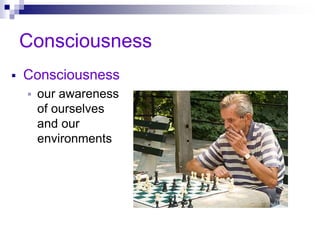
 Consciousness
 our awareness
of ourselves
and our
environments
Consciousness
 Waking
Consciousness
 What you are currently
aware of and attending
to
 Linear (serial)
processing
 The result of cognitive
processing
Integrated Information Theory of
Consciousness
 Consciousness can exist to varying
degrees depending on the person, time of
day, distractions, amount of sleep or food,
mental and physical illness, medicine, etc.
 In order to be conscious the brain
integrates a complex web of information
from sensory systems and cognitive
processes. Cerebrum, somatosensory,
frontal lobe…what other areas?
Consciousness
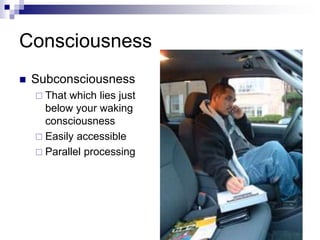
 Subconsciousness
 That which lies just
below your waking
consciousness
 Easily accessible
 Parallel processing
Consciousness
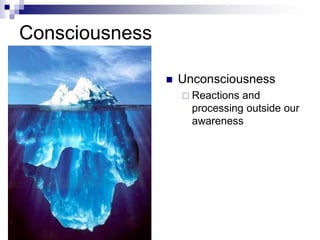
 Unconsciousness
 Reactions and
processing outside our
awareness
Introspection
• The only direct way to study consciousness
is to have people look within themselves, or
introspect.
• Introspection is a powerful research tool—
but it is limited.
• People often lack words for
experiences.
• Different individuals may use the same
words to describe different
experiences.
Mistaken Introspections
• Introspections are also sometimes mistaken.
• People don’t realize what factor
influenced their thoughts or behavior.
• Or they insist a factor influenced them
even though it didn’t.
• These cases suggest introspection
often is people’s best after-the-fact
estimation of why they acted or felt the
way they did.
Brain Areas
 The amygdala regulates emotions and fight or
flight type responses. It also helps in the
formation of emotional memories.
 The hippocampus helps store (consolidate)
episodic memories meaning your autobiography,
perceptions, and the emotions associated with
these memories.
 The exact content of consciousness depends on
diverse brain sites and what a person is
conscious of.
Varieties of Consciousness
• Our conscious state changes when we’re
asleep.
• EE`G data allows us to distinguish distinct
stages of sleep.
• People seem to need an adequate amount of
sleep as well as the right amount of both
slow-wave and REM sleep.
Sleep
 Why do we need to sleep?
 Sleep helps our brain consolidate learning and
memories. Our bodies also need to sleep to
rejuvenate, grow muscle, repair, and to pay
attention.
 https://www.ted.com/talks/russell_foster_w
hy_do_we_sleep?language=en
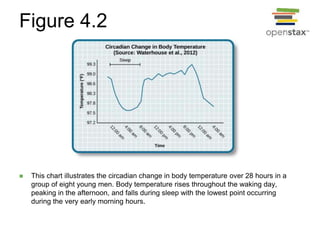
Figure 4.2
 This chart illustrates the circadian change in body temperature over 28 hours in a
group of eight young men. Body temperature rises throughout the waking day,
peaking in the afternoon, and falls during sleep with the lowest point occurring
during the very early morning hours.
Figure 4.3
 The suprachiasmatic nucleus (SCN) serves as the brain’s clock mechanism. The
clock sets itself with light information received through projections from the retina.
Sleep Deprivation and
Consciousness
 Sleep deprivation occurs when an individual fails
to get enough sleep. The amount of sleep that a
person needs varies from one person to
another, but on average most adults need about
seven to eight hours of sleep each night to feel
alert and well rested.
 https://youtu.be/JWKDgs9bMws
Figure 4.4
 Devices like this are designed to provide exposure to bright light to help people
maintain a regular circadian cycle. They can be helpful for people working night
shifts or for people affected by seasonal variations in light.
Figure 4.5
 This figure illustrates some of the negative consequences of sleep deprivation.
While cognitive deficits may be the most obvious, many body systems are
negatively impacted by lack of sleep. (credit: modification of work by Mikael
Häggström)
Figure 4.6
 This is a segment of a polysonograph (PSG), a recording of several physical variables during
sleep. The x-axis shows passage of time in seconds; this record includes 30 seconds of data.
The location of the sets of electrode that produced each signal is labeled on the y-axis. The red
box encompasses EEG output, and the waveforms are characteristic of a specific stage of
sleep. Other curves show other sleep-related data, such as body temperature, muscle activity,
and heartbeat.
Figure 4.7
 The pineal and pituitary glands secrete a number of hormones during sleep.
Figure 4.8
 Brainwave activity changes dramatically across the different stages of sleep. (credit
“sleeping”: modification of work by Ryan Vaarsi)
Figure 4.9
 Brainwave activity changes dramatically across the different stages of sleep.
Figure 4.10
 Stage 2 sleep is characterized by the appearance of both sleep spindles and K-
complexes.
Sleep Disorders
 Nightmares are dreams with vivid and disturbing
content. They are most common
inchildren during REM sleep, but they can
happen to adults as well. They usually involve
and immediate awakening and good recall of the
dream. Sleep terrors, also common in children,
are often described as extreme nightmares that
take place during non-REM sleep.
Sleep Disorders
 Sleep terrors have common
characteristics. They usually include
arousal, agitation, large pupils, sweating,
and increase blood pressure. Usually the
child screams and appears terrified for
several minutes until they eventually relax
and return to sleep. Sleep terrors usually
take place early in the night and may be
combined with sleepwalking. The child
typically does not remember or only has a
vague memory of their dream.
Sleep Disorders
 https://youtu.be/NP3aEx2QWgY
 Sleep Disorders in Children
 How do these issues affect emotional
health? School? Work?
Relationships?
Quiz 4
 What are three types of brain waves?
 Why do we need REM sleep?
Dreams
• Dreams are associated with REM sleep.
• Dream showcase a range of ordinary preoccupations,
but they also include weird elements like being naked
in public.
• Many people propose that dreams have hidden
meaning.
• Most researchers say they are just a hodgepodge
of activated images made into a narrative by the
sleeping brain or the person recalling the dream.
Altered States of Consciousness
 Sleep and Dreams
 Hypnosis
 Chemically altered states
Sleep and Dreams
 Sleep
 periodic, natural, reversible loss of
consciousness
 Circadian Rhythm
 the biological clock
 regular bodily rhythms that occur on
a 24-hour cycle, such as of
wakefulness and body temperature
Sleep and Dreams
 Stage 1
Lasts up to 5 minutes
Hallucinations
Hypnogogic experience
 Stage 2
20 minutes
Sleep spindles
Sleep talking may occur
Sleep and Dreams
 Stage 3
Transitional stage
Lasts only a few minutes
 Stage 4
Brain emits delta waves
Lasts 30 minutes
Sleep walking, bed wetting may occur
You can still process the outside world
Brain Waves and Sleep
Stages
 Alpha Waves
 slow waves of a
relaxed, awake
brain
 Delta Waves
 large, slow waves
of deep sleep
Stages in a Typical Night’s
Sleep
0 1 2 3 4 5 6 7
4
3
2
1
Sleep
stages
Awake
Hours of sleep
REM
Stages in a Typical Night’s
Sleep
Hours of sleep
Minutes
of
Stage 4
and
REM
1 2 3 4 5 6 7 8
0
10
15
20
25
5
Decreasing
Stage 4
Increasing
REM
Sleep and Dreams
 REM (Rapid Eye Movement) Sleep
 recurring sleep stage
 vivid dreams
 “paradoxical sleep”
 muscles are generally relaxed, but other
body systems are active
Sleep Deprivation
 Effects of Sleep
Loss
 fatigue
 impaired
concentration
 depressed immune
system
 greater vulnerability
to accidents
Sleep Disorders
 Insomnia
 persistent problems in falling or staying
asleep
 Narcolepsy
 uncontrollable sleep attacks
 Sleep Apnea
 temporary cessation of breathing
 momentary reawakenings
Night Terrors and
Nightmares
 Night Terrors
 occur within 2 or
3 hours of falling
asleep, usually
during Stage 4
 high arousal--
appearance of
being terrified
0 1 2 3 4 5 6 7
4
3
2
1
Sleep
stages
Awake
Hours of sleep
REM
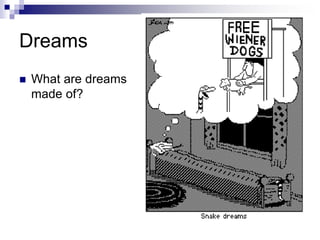
Dreams
 What are dreams
made of?
Dreams: Freud
 Sigmund Freud--The Interpretation of
Dreams (1900)
 wish fulfillment
 discharge otherwise unacceptable
feelings
 Manifest Content
 remembered story line
 Latent Content
 underlying meaning
Dreams: Freud
 Dreams
 Dream is a safe outlet for the mind
 Deals with unacceptable thoughts and
emotions
 Manifest content is the “dressed up”
symbolic version of the unconscious
 Most adult dreams have strong sexual
undertones
 Dream interpenetration is the “royal road
to the unconscious”
Dreams: Information
processing
 As Information Processing
 Dreams serve to sift and sort
memories of our daily experiences
 Helps us to better process and store
memories and learning from the
previous day
Dreams: Information
processing
 Support for theory
REM sleep increases following a stressful
experience and intense learning experiences
People will perform worse on a memory test if
kept from dreaming the night before
Dreams: Activation-synthesis
 Neural activity is random and dreams are
your brain’s attempt to make sense of it
 Your brain tries to impose meaning on
meaningless stimuli
Dreams: Activation-synthesis
 Support
Eye movement of REM sleep coincides with
bursts of neural activity in the visual cortex
Would account for random and bizarre
occurrences in dreams
Dreams: Physiological Function
 Dreams serve to provide neural
stimulation for a sleeping brain
 Stimulation of the neural pathways
strengthens connections and makes
processing faster and more efficient
Dreams: Physiological Function
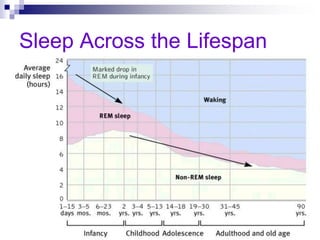
 Support
Infants and children experience longer
periods of REM sleep than adults.
REM sleep periods decrease as we age
Sleep Across the Lifespan
Dreams
 So which is the best theory?

CONSIOUSNESS-SLEEP-DREAMS.ppt

  • 1.
  • 2.
    Consciousness  Consciousness  ourawareness of ourselves and our environments
  • 3.
    Consciousness  Waking Consciousness  Whatyou are currently aware of and attending to  Linear (serial) processing  The result of cognitive processing
  • 4.
    Integrated Information Theoryof Consciousness  Consciousness can exist to varying degrees depending on the person, time of day, distractions, amount of sleep or food, mental and physical illness, medicine, etc.  In order to be conscious the brain integrates a complex web of information from sensory systems and cognitive processes. Cerebrum, somatosensory, frontal lobe…what other areas?
  • 5.
    Consciousness  Subconsciousness  Thatwhich lies just below your waking consciousness  Easily accessible  Parallel processing
  • 6.
    Consciousness  Unconsciousness  Reactionsand processing outside our awareness
  • 7.
    Introspection • The onlydirect way to study consciousness is to have people look within themselves, or introspect. • Introspection is a powerful research tool— but it is limited. • People often lack words for experiences. • Different individuals may use the same words to describe different experiences.
  • 8.
    Mistaken Introspections • Introspectionsare also sometimes mistaken. • People don’t realize what factor influenced their thoughts or behavior. • Or they insist a factor influenced them even though it didn’t. • These cases suggest introspection often is people’s best after-the-fact estimation of why they acted or felt the way they did.
  • 9.
    Brain Areas  Theamygdala regulates emotions and fight or flight type responses. It also helps in the formation of emotional memories.  The hippocampus helps store (consolidate) episodic memories meaning your autobiography, perceptions, and the emotions associated with these memories.  The exact content of consciousness depends on diverse brain sites and what a person is conscious of.
  • 11.
    Varieties of Consciousness •Our conscious state changes when we’re asleep. • EE`G data allows us to distinguish distinct stages of sleep. • People seem to need an adequate amount of sleep as well as the right amount of both slow-wave and REM sleep.
  • 12.
    Sleep  Why dowe need to sleep?  Sleep helps our brain consolidate learning and memories. Our bodies also need to sleep to rejuvenate, grow muscle, repair, and to pay attention.  https://www.ted.com/talks/russell_foster_w hy_do_we_sleep?language=en
  • 13.
    Figure 4.2  Thischart illustrates the circadian change in body temperature over 28 hours in a group of eight young men. Body temperature rises throughout the waking day, peaking in the afternoon, and falls during sleep with the lowest point occurring during the very early morning hours.
  • 14.
    Figure 4.3  Thesuprachiasmatic nucleus (SCN) serves as the brain’s clock mechanism. The clock sets itself with light information received through projections from the retina.
  • 15.
    Sleep Deprivation and Consciousness Sleep deprivation occurs when an individual fails to get enough sleep. The amount of sleep that a person needs varies from one person to another, but on average most adults need about seven to eight hours of sleep each night to feel alert and well rested.  https://youtu.be/JWKDgs9bMws
  • 16.
    Figure 4.4  Deviceslike this are designed to provide exposure to bright light to help people maintain a regular circadian cycle. They can be helpful for people working night shifts or for people affected by seasonal variations in light.
  • 17.
    Figure 4.5  Thisfigure illustrates some of the negative consequences of sleep deprivation. While cognitive deficits may be the most obvious, many body systems are negatively impacted by lack of sleep. (credit: modification of work by Mikael Häggström)
  • 18.
    Figure 4.6  Thisis a segment of a polysonograph (PSG), a recording of several physical variables during sleep. The x-axis shows passage of time in seconds; this record includes 30 seconds of data. The location of the sets of electrode that produced each signal is labeled on the y-axis. The red box encompasses EEG output, and the waveforms are characteristic of a specific stage of sleep. Other curves show other sleep-related data, such as body temperature, muscle activity, and heartbeat.
  • 19.
    Figure 4.7  Thepineal and pituitary glands secrete a number of hormones during sleep.
  • 20.
    Figure 4.8  Brainwaveactivity changes dramatically across the different stages of sleep. (credit “sleeping”: modification of work by Ryan Vaarsi)
  • 21.
    Figure 4.9  Brainwaveactivity changes dramatically across the different stages of sleep.
  • 22.
    Figure 4.10  Stage2 sleep is characterized by the appearance of both sleep spindles and K- complexes.
  • 23.
    Sleep Disorders  Nightmaresare dreams with vivid and disturbing content. They are most common inchildren during REM sleep, but they can happen to adults as well. They usually involve and immediate awakening and good recall of the dream. Sleep terrors, also common in children, are often described as extreme nightmares that take place during non-REM sleep.
  • 24.
    Sleep Disorders  Sleepterrors have common characteristics. They usually include arousal, agitation, large pupils, sweating, and increase blood pressure. Usually the child screams and appears terrified for several minutes until they eventually relax and return to sleep. Sleep terrors usually take place early in the night and may be combined with sleepwalking. The child typically does not remember or only has a vague memory of their dream.
  • 25.
    Sleep Disorders  https://youtu.be/NP3aEx2QWgY Sleep Disorders in Children  How do these issues affect emotional health? School? Work? Relationships?
  • 28.
    Quiz 4  Whatare three types of brain waves?  Why do we need REM sleep?
  • 29.
    Dreams • Dreams areassociated with REM sleep. • Dream showcase a range of ordinary preoccupations, but they also include weird elements like being naked in public. • Many people propose that dreams have hidden meaning. • Most researchers say they are just a hodgepodge of activated images made into a narrative by the sleeping brain or the person recalling the dream.
  • 30.
    Altered States ofConsciousness  Sleep and Dreams  Hypnosis  Chemically altered states
  • 31.
    Sleep and Dreams Sleep  periodic, natural, reversible loss of consciousness  Circadian Rhythm  the biological clock  regular bodily rhythms that occur on a 24-hour cycle, such as of wakefulness and body temperature
  • 32.
    Sleep and Dreams Stage 1 Lasts up to 5 minutes Hallucinations Hypnogogic experience  Stage 2 20 minutes Sleep spindles Sleep talking may occur
  • 33.
    Sleep and Dreams Stage 3 Transitional stage Lasts only a few minutes  Stage 4 Brain emits delta waves Lasts 30 minutes Sleep walking, bed wetting may occur You can still process the outside world
  • 34.
    Brain Waves andSleep Stages  Alpha Waves  slow waves of a relaxed, awake brain  Delta Waves  large, slow waves of deep sleep
  • 35.
    Stages in aTypical Night’s Sleep 0 1 2 3 4 5 6 7 4 3 2 1 Sleep stages Awake Hours of sleep REM
  • 36.
    Stages in aTypical Night’s Sleep Hours of sleep Minutes of Stage 4 and REM 1 2 3 4 5 6 7 8 0 10 15 20 25 5 Decreasing Stage 4 Increasing REM
  • 37.
    Sleep and Dreams REM (Rapid Eye Movement) Sleep  recurring sleep stage  vivid dreams  “paradoxical sleep”  muscles are generally relaxed, but other body systems are active
  • 38.
    Sleep Deprivation  Effectsof Sleep Loss  fatigue  impaired concentration  depressed immune system  greater vulnerability to accidents
  • 39.
    Sleep Disorders  Insomnia persistent problems in falling or staying asleep  Narcolepsy  uncontrollable sleep attacks  Sleep Apnea  temporary cessation of breathing  momentary reawakenings
  • 40.
    Night Terrors and Nightmares Night Terrors  occur within 2 or 3 hours of falling asleep, usually during Stage 4  high arousal-- appearance of being terrified 0 1 2 3 4 5 6 7 4 3 2 1 Sleep stages Awake Hours of sleep REM
  • 41.
    Dreams  What aredreams made of?
  • 42.
    Dreams: Freud  SigmundFreud--The Interpretation of Dreams (1900)  wish fulfillment  discharge otherwise unacceptable feelings  Manifest Content  remembered story line  Latent Content  underlying meaning
  • 43.
    Dreams: Freud  Dreams Dream is a safe outlet for the mind  Deals with unacceptable thoughts and emotions  Manifest content is the “dressed up” symbolic version of the unconscious  Most adult dreams have strong sexual undertones  Dream interpenetration is the “royal road to the unconscious”
  • 44.
    Dreams: Information processing  AsInformation Processing  Dreams serve to sift and sort memories of our daily experiences  Helps us to better process and store memories and learning from the previous day
  • 45.
    Dreams: Information processing  Supportfor theory REM sleep increases following a stressful experience and intense learning experiences People will perform worse on a memory test if kept from dreaming the night before
  • 46.
    Dreams: Activation-synthesis  Neuralactivity is random and dreams are your brain’s attempt to make sense of it  Your brain tries to impose meaning on meaningless stimuli
  • 47.
    Dreams: Activation-synthesis  Support Eyemovement of REM sleep coincides with bursts of neural activity in the visual cortex Would account for random and bizarre occurrences in dreams
  • 48.
    Dreams: Physiological Function Dreams serve to provide neural stimulation for a sleeping brain  Stimulation of the neural pathways strengthens connections and makes processing faster and more efficient
  • 49.
    Dreams: Physiological Function Support Infants and children experience longer periods of REM sleep than adults. REM sleep periods decrease as we age
  • 50.
  • 51.
    Dreams  So whichis the best theory?