
UNDERSTANDING PSYCHOLOGY
9TH EDITION
By Robert Feldman
Powerpoint slides by Kimberly Foreman
 CHAPTER NINE:
INTELLIGENCE
MODULE 26: What is
Intelligence?
 What are the different definitions and
conceptions of intelligence?
 What are the major approaches to
measuring intelligence, and what do
intelligence tests measure?
Theories of Intelligence: Are There
Different Kinds of Intelligence?
 G-factor
› General factor for mental ability
› Was thought to underlie performance in
every aspect of intelligence
› Recent theories view intelligence as a
multidimensional concept
Theories of Intelligence: Are There
Different Kinds of Intelligence?
 Fluid Intelligence
› Reflects information-processing capabilities,
reasoning, and memory
 Crystallized Intelligence
› Accumulation of information, skills, and
strategies that people learn through
experience
Theories of Intelligence: Are There
Different Kinds of Intelligence?
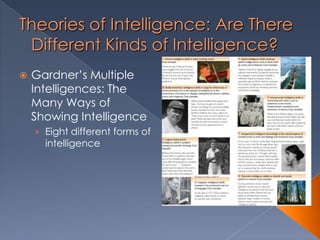
 Gardner’s Multiple
Intelligences: The
Many Ways of
Showing Intelligence
› Eight different forms of
intelligence
Theories of Intelligence: Are There
Different Kinds of Intelligence?
 Is Information Processing Intelligence?
› Information-processing approach
 Way people store material in memory and use
that material to solve intellectual tasks
 Speed of processing
The Biological Basis of
Intelligence
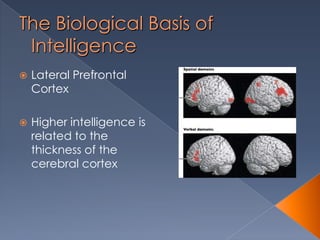
 Lateral Prefrontal
Cortex
 Higher intelligence is
related to the
thickness of the
cerebral cortex
Practical Intelligence and
Emotional Intelligence
 Practical Intelligence
› Related to overall success in living
 Emotional Intelligence
› Set of skills that underlie the accurate
assessment, evaluation, expression, and
regulation of emotions
Assessing Intelligence
 Intelligence Tests
› Quantify and measure intelligence in an
objective manner
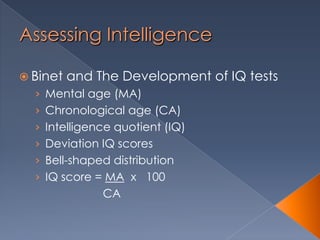
Assessing Intelligence
 Binet and The Development of IQ tests
› Mental age (MA)
› Chronological age (CA)
› Intelligence quotient (IQ)
› Deviation IQ scores
› Bell-shaped distribution
› IQ score = MA x 100
CA
Assessing Intelligence
 Contemporary IQ Tests: Gauging
Intelligence
› Achievement test
 Designed to determine a person’s level of
knowledge in a specific subject area
› Aptitude test
 Designed to predict a person’s ability in a
particular area or line of work
Assessing Intelligence
 Reliability and Validity: Taking the
Measure of Tests
› Reliability
 Tests measure consistently what they are trying
to measure
› Validity
 Tests actually measure what they are
supposed to measure
› Norms
 Standards of test performance that permit the
comparison of one person’s score on a test to
scores of others
Assessing Intelligence
 Adaptive Testing: Using Computers to
Assess Performance
› Adaptive in the sense that the computer
individualizes the test to the test-taker
Scoring Better on Standardized
Tests
 Learn as much as you can about the test
before you take it
 Practice
 If the test is administered on a computer,
take practice tests on a computer
 Time yourself carefully
 Be aware of the scoring policy
 If it is a paper-and-pencil test, complete
answer sheets accurately
MODULE 27: Variations in
Intellectual Ability
 How can the extremes of intelligence be
characterized?
 How can we help people reach their full
potential?
Mental Retardation
 Disability characterized by significant
limitations both in intellectual functioning
and in conceptual, social, and practical
adaptive skills
› Mild with an IQ of 55 to 69
› Moderate with an IQ of 40 to 54
› Severe with an IQ of 25 to 39
› Profound with an IQ below 25
Mental Retardation
 Identifying the Roots of Mental
Retardation
› Fetal alcohol syndrome
 Caused by a mother’s use of alcohol while
pregnant
› Familial retardation
 No apparent biological defect exists but there
is a history of retardation in the family
Mental Retardation
 Integrating Individuals with Mental
Retardation
› Education for All Handicapped Children Act
of 1975 (Public Law 94-142)
 Least restrictive environment
 Mainstreaming
 Full inclusion
The Intellectually Gifted
 Have IQ scores greater than 130
 Programs for the gifted are designed to
provide enrichment that allows
participants’ talents to flourish
MODULE 28: Group Differences in
Intelligence: Genetic and
Environmental Determinants
 Are traditional IQ tests culturally biased?
 Are there racial differences in
intelligence?
 To what degree is intelligence influenced
by the environment, and to what degree
by heredity?
MODULE 28: Group Differences in
Intelligence: Genetic and
Environmental Determinants
 Background and experiences of test-
takers have the potential to affect results
 Some standardized IQ tests contain
elements that discriminate against
minority-group members whose
experiences differ from those of the white
majority
The Relative Influence of Genetics
and Environment: Nature,
Nurture, and IQ
 Culture-fair IQ Test
› One that does not discriminate against the
members of any minority group
 Heritability
› Measure of the degree to which a
characteristic can be attributed to genetic,
inherited factors

09 intelligence

  • 1.
    UNDERSTANDING PSYCHOLOGY 9TH EDITION ByRobert Feldman Powerpoint slides by Kimberly Foreman
  • 2.
  • 3.
    MODULE 26: Whatis Intelligence?  What are the different definitions and conceptions of intelligence?  What are the major approaches to measuring intelligence, and what do intelligence tests measure?
  • 4.
    Theories of Intelligence:Are There Different Kinds of Intelligence?  G-factor › General factor for mental ability › Was thought to underlie performance in every aspect of intelligence › Recent theories view intelligence as a multidimensional concept
  • 5.
    Theories of Intelligence:Are There Different Kinds of Intelligence?  Fluid Intelligence › Reflects information-processing capabilities, reasoning, and memory  Crystallized Intelligence › Accumulation of information, skills, and strategies that people learn through experience
  • 6.
    Theories of Intelligence:Are There Different Kinds of Intelligence?  Gardner’s Multiple Intelligences: The Many Ways of Showing Intelligence › Eight different forms of intelligence
  • 7.
    Theories of Intelligence:Are There Different Kinds of Intelligence?  Is Information Processing Intelligence? › Information-processing approach  Way people store material in memory and use that material to solve intellectual tasks  Speed of processing
  • 8.
    The Biological Basisof Intelligence  Lateral Prefrontal Cortex  Higher intelligence is related to the thickness of the cerebral cortex
  • 9.
    Practical Intelligence and EmotionalIntelligence  Practical Intelligence › Related to overall success in living  Emotional Intelligence › Set of skills that underlie the accurate assessment, evaluation, expression, and regulation of emotions
  • 10.
    Assessing Intelligence  IntelligenceTests › Quantify and measure intelligence in an objective manner
  • 11.
    Assessing Intelligence  Binetand The Development of IQ tests › Mental age (MA) › Chronological age (CA) › Intelligence quotient (IQ) › Deviation IQ scores › Bell-shaped distribution › IQ score = MA x 100 CA
  • 12.
    Assessing Intelligence  ContemporaryIQ Tests: Gauging Intelligence › Achievement test  Designed to determine a person’s level of knowledge in a specific subject area › Aptitude test  Designed to predict a person’s ability in a particular area or line of work
  • 13.
    Assessing Intelligence  Reliabilityand Validity: Taking the Measure of Tests › Reliability  Tests measure consistently what they are trying to measure › Validity  Tests actually measure what they are supposed to measure › Norms  Standards of test performance that permit the comparison of one person’s score on a test to scores of others
  • 14.
    Assessing Intelligence  AdaptiveTesting: Using Computers to Assess Performance › Adaptive in the sense that the computer individualizes the test to the test-taker
  • 15.
    Scoring Better onStandardized Tests  Learn as much as you can about the test before you take it  Practice  If the test is administered on a computer, take practice tests on a computer  Time yourself carefully  Be aware of the scoring policy  If it is a paper-and-pencil test, complete answer sheets accurately
  • 16.
    MODULE 27: Variationsin Intellectual Ability  How can the extremes of intelligence be characterized?  How can we help people reach their full potential?
  • 17.
    Mental Retardation  Disabilitycharacterized by significant limitations both in intellectual functioning and in conceptual, social, and practical adaptive skills › Mild with an IQ of 55 to 69 › Moderate with an IQ of 40 to 54 › Severe with an IQ of 25 to 39 › Profound with an IQ below 25
  • 18.
    Mental Retardation  Identifyingthe Roots of Mental Retardation › Fetal alcohol syndrome  Caused by a mother’s use of alcohol while pregnant › Familial retardation  No apparent biological defect exists but there is a history of retardation in the family
  • 19.
    Mental Retardation  IntegratingIndividuals with Mental Retardation › Education for All Handicapped Children Act of 1975 (Public Law 94-142)  Least restrictive environment  Mainstreaming  Full inclusion
  • 20.
    The Intellectually Gifted Have IQ scores greater than 130  Programs for the gifted are designed to provide enrichment that allows participants’ talents to flourish
  • 21.
    MODULE 28: GroupDifferences in Intelligence: Genetic and Environmental Determinants  Are traditional IQ tests culturally biased?  Are there racial differences in intelligence?  To what degree is intelligence influenced by the environment, and to what degree by heredity?
  • 22.
    MODULE 28: GroupDifferences in Intelligence: Genetic and Environmental Determinants  Background and experiences of test- takers have the potential to affect results  Some standardized IQ tests contain elements that discriminate against minority-group members whose experiences differ from those of the white majority
  • 23.
    The Relative Influenceof Genetics and Environment: Nature, Nurture, and IQ  Culture-fair IQ Test › One that does not discriminate against the members of any minority group  Heritability › Measure of the degree to which a characteristic can be attributed to genetic, inherited factors