Classical Music
A GENTLE INTRODUCTION AND GUIDE
ELIZABETH KEANE – ORGANIST/DIRECTOR OF ST. BRENDAN’S CATHEDRAL
CHOIR
What is Classical Music
 The word ‘Music’ originates from the Greek word (Mousike) which means (Art) of
the Muses
 There is no simple definition because it is an Art form and peoples opinions come
into play
 It is much easier to list the QUALITIES music must have – Rhythm, Melody,
Harmony for example
 Classical music is just like other forms of music, except the sounds are more
organised within a formal structure.
 Remember – Classical musicians were influenced by society and many used folk
songs, ethnic music in the compositions
Why learn about Classical Music
 You don’t need a College education to enjoy music but the more you know about
it or the Composer, his life/influences etc. the deeper your enjoyment of the
piece/work will be.
 Music has been developing since the 9th Century with the introduction of
harmonisation these complexities lead to subtle changes that you only become
aware of as your knowledge of the music deepens
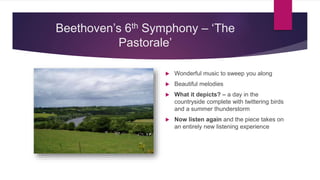
Beethoven’s 6th Symphony – ‘The
Pastorale’
 Wonderful music to sweep you along
 Beautiful melodies
 What it depicts? – a day in the
countryside complete with twittering birds
and a summer thunderstorm
 Now listen again and the piece takes on
an entirely new listening experience
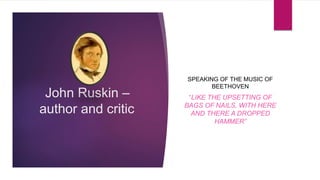
John Ruskin –
author and critic
SPEAKING OF THE MUSIC OF
BEETHOVEN
“LIKE THE UPSETTING OF
BAGS OF NAILS, WITH HERE
AND THERE A DROPPED
HAMMER”
The Royal Influence
 Music has always been with us – folk music as Mark Twain observed is “music
nobody ever wrote”
 These ‘nobodies’ composed ballads such as ‘Greensleeves’ back in the Middle
Ages.
 However, the Royalty of the time required a different ‘sort’ of music – they
required a higher level of musical expression and had the power and money to
influence.
 This was the start of Classical Music as we know it today
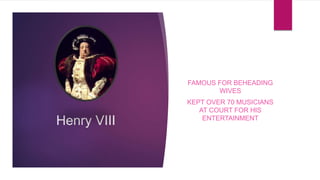
Henry VIII
FAMOUS FOR BEHEADING
WIVES
KEPT OVER 70 MUSICIANS
AT COURT FOR HIS
ENTERTAINMENT
The Creation of Classical Music
 Classical Music is the creation of a composer. There is no improvisation like
Jazz – the Soprano will sing ‘as written’
 However, Interpretations of Speed, Loudness or Instrumental emphasis varies
according to the Conductor.
 Herbert Von Karajan or Sir Simon Rattle recordings of the same work vary greatly
– that’s why Classical music is so alive and exhilarating today
 Classical music can be instrumental, vocal or a combination of both
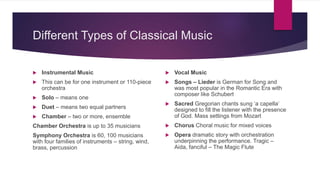
Different Types of Classical Music
 Instrumental Music
 This can be for one instrument or 110-piece
orchestra
 Solo – means one
 Duet – means two equal partners
 Chamber – two or more, ensemble
Chamber Orchestra is up to 35 musicians
Symphony Orchestra is 60, 100 musicians
with four families of instruments – string, wind,
brass, percussion
 Vocal Music
 Songs – Lieder is German for Song and
was most popular in the Romantic Era with
composer like Schubert
 Sacred Gregorian chants sung ‘a capella’
designed to fill the listener with the presence
of God. Mass settings from Mozart
 Chorus Choral music for mixed voices
 Opera dramatic story with orchestration
underpinning the performance. Tragic –
Aida, fanciful – The Magic Flute
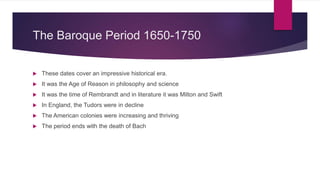
The Baroque Period 1650-1750
 These dates cover an impressive historical era.
 It was the Age of Reason in philosophy and science
 It was the time of Rembrandt and in literature it was Milton and Swift
 In England, the Tudors were in decline
 The American colonies were increasing and thriving
 The period ends with the death of Bach
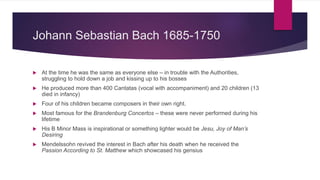
Johann Sebastian Bach 1685-1750
 At the time he was the same as everyone else – in trouble with the Authorities,
struggling to hold down a job and kissing up to his bosses
 He produced more than 400 Cantatas (vocal with accompaniment) and 20 children (13
died in infancy)
 Four of his children became composers in their own right.
 Most famous for the Brandenburg Concertos – these were never performed during his
lifetime
 His B Minor Mass is inspirational or something lighter would be Jesu, Joy of Man’s
Desiring
 Mendelssohn revived the interest in Bach after his death when he received the
Passion According to St. Matthew which showcased his gensius
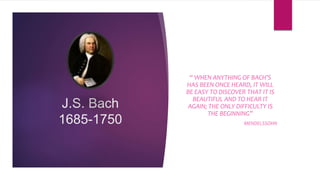
J.S. Bach
1685-1750
“ WHEN ANYTHING OF BACH’S
HAS BEEN ONCE HEARD, IT WILL
BE EASY TO DISCOVER THAT IT IS
BEAUTIFUL AND TO HEAR IT
AGAIN; THE ONLY DIFFICULTY IS
THE BEGINNING”
MENDELSSOHN
George Frederic Handel 1685-1759
 Beethoven described him as ‘the greatest of us all’
 Left Germany and studied in Italy, composing cantatas, displaying his talents as
an organist and learnt to write Italian-style operas.
 Returned to Germany but spent a long time in London. Moved their with King
George 1 and wrote the Water Music Suite for the Kings trips on the Thames.
 Was financially secure and much of his music was for stage – perhaps more
accessible than Bach.
 Most important work – The Messiah which he wrote in 24 days. He said when he
wrote it he ‘saw heaven before me, and the great God Himself’ This was
premiered in Dublin
Other composers of the Baroque Era
 Vivaldi for uplifting, energetic rhythms
 Telemann for chamber music
 Scarlatti – his Sonatas for keyboard
 Purcell – English composer: Opera
 Music of this era is characterized by its
formal structure
 It is very ornate and embellished
 Can be classed as ‘busy’
 Can be challenging to musicians and
listeners
The Classical Period 1760-1820 aprox.
 These dates are loose and there is plenty of overlap from the Baroque and also
into the Romantic Era
 Major Stylistic difference between the Baroque and the Classical was the latter’s
focus on simplicity and formal elegance
 The period includes some literary greats such as Thomas Paine, Robert Burns,
Jane Austen, Shelley
Franz Joseph Haydn 1732-1809
 Sometimes called the father of the Symphony, he defined their forms and produced an incredible
body of work
 Born in Austria and was one of 12 children, had a beautiful singing voice and sang in his local
church
 Moved to Vienna to sing in St. Stephen’s Cathedral and studied music, received Royal patronage
and conducted the court orchestra.
 Concert world in London was really successful for his symphonies, retired wealthy to Vienna and
died shortly after.
 Symphonies – Farewell (No. 45) Military (No. 100) Drum Roll (No. 103)
 His Trumpet Concerto is special and perhaps his Quartets like Emperor (op.76 No.3)
 Choral works of importance are the Coronation Mass or The Mass in Time or War
Mozart 1756-1791
 His real name was Johannes Chrysostomus Wolfgangus Theophilus Mozart; Wolfgang for short
but his father preferred Gottlieb to Theophilus and in Latin it translates into Amadeus (love of God)
 Austrian born, child prodigy and started piano at the age of three. Composition followed and he
had a great ear for music. Played for the Pope and King George III and had Royal patronage.
 By 15 he had petered out on the concert circuit and followed his father into church service as
Organist/Director. Wasn’t appreciated and paid very little, he remained on the poverty line for most
of his life.
 He worked very hard on his compositions, unlike the portrayal in the film and his pieces were well
received. His genius reached the pinnacle of expression with operas, concertos, symphonies and
chamber music
 Sadly he died in 1791 in poverty most likely of typhoid fever at the age of 35 and was buried in a
pauper’s grave
Mozart and the Cataloguer!
 Mozart pieces will usually have a letter ‘K’ and a number. It refers to Kochel, most
composers identified pieces by opus numbers (opus meaning work) but Mozart
worked so quickly that he sometimes lost count ( his Symphony No.24 is really
No. 31 for example) Ludwig Kochel systematically catalogued every one of
Mozart’s compositions assigning each one a number from 1 to 626. There are
mistakes but with such a volume of compositions it’s easy to see why!
 Important works to enjoy include Eine Kleine Nachtmusik, his final symphonies
No. 40 in G Minor or No. 41 in C, his Requiem, the Coronation Mass – Opera
includes Don Giovanni, Magic Flute
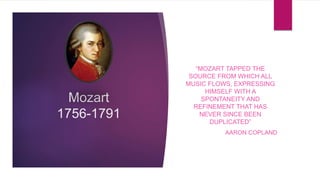
Mozart
1756-1791
“MOZART TAPPED THE
SOURCE FROM WHICH ALL
MUSIC FLOWS, EXPRESSING
HIMSELF WITH A
SPONTANEITY AND
REFINEMENT THAT HAS
NEVER SINCE BEEN
DUPLICATED”
AARON COPLAND
Beethoven 1770-1827
 Difficult man who was hard to get along with, had a huge ego and was rude. Defied rules of polite
society but broke the compositional chains that bound so many of his composing colleagues – bit
of a rebel
 Born into an unhappy family of alcoholics, violent father and pushed by his father who thought he
had ‘another Mozart’ and could exploit him.
 Worked in the court orchestra, organist and by 17 left for Vienna where he played for Mozart and
studied under Haydn, but the relationship was difficult.
 Generally accepted in society but by his mid 20’s deafness had started to develop and this
increased his isolation. Fell in love with married women or Royalty.
 30,000 people attended his funeral with Franz Schubert a torchbearer.
 His symphonies are indispensable and wonderful, all 9 of them. The piano sonatas include
Pathetique, Moonlight. Only wrote one Opera
The Romantic Era
 The 19th Century was an age of individualism. Expressions of Mood including joy,
sorrow, hope and despair. There was a fusion of Art forms with poetry inspiring
music and music enhancing drama.
 The rise of the Lieder/Song cycles
 Rise of Feminism and female composers such as Fanny Mendelssohn and Clara
Schumann
Felix Mendelssohn 1809-1847
 Educated and accomplished gentleman with a culturally aware family who nurturing
and encouraged his musical abilities. Younger brother to Fanny who was a composer
in her own right
 His career was short lived but his Violin Concerto is his most loved as is his ‘Wedding
March’. He travelled widely and performed, conducted and taught during his 38 years.
 A Midsummer Night’s Dream is a good introduction to his music, his Venetian Boat
songs showcase his life of travel and his chamber music is enchanting
 He was Jewish and during the reign of the Nazis they tried to write him from history,
tore down statues and even composed ‘other Wedding Marches’ but nothing could
erase musical history
Frederic Chopin 1810-1849
 Chopin is piano music, he left very little else just a few chamber pieces, a sonata and a few songs.
 Born outside Warsaw and talented from an early age with poetry writing, drawing and piano
playing.
 His child genius at piano saw the aristocratic society welcome him and he continued to study and
perform until he embarked on a European tour with possible visits to US. The tour wasn’t a
success due to political turmoil
 His health was poor and his work ethic drained him of whatever energy he had. He was later
diagnosed with tuberculosis and when already dying had to flee from France to England during
the 1848 Revolution. This taxed him further with concerts for fundraising for his native Poland. He
returned to Paris and died shortly afterwards.
 If you don’t like piano – give Chopin a miss but his nocturnes are wonderful for moments of
reflection or on a larger scale try the B-flat Minor Sonata
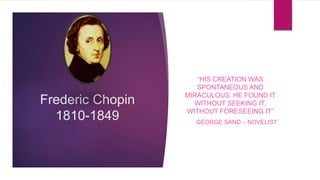
Frederic Chopin
1810-1849
“HIS CREATION WAS
SPONTANEOUS AND
MIRACULOUS. HE FOUND IT
WITHOUT SEEKING IT,
WITHOUT FORESEEING IT”
GEORGE SAND – NOVELIST
Other Musicians of the Romantic Era
 Tchaikovsky for his ballets and
symphonies
 Antonin Dvorak – his new world
symphony and the American string quartet
 Bedrich Smetana – beautiful imagery
 Charles Gounod – opera
 Cesar Franck - chamber music
 Gabriel Faure - ballet
 Berlioz - fantastic Requiem
 Edvard Greig
The list is endless with a never ending source
of delight
Classical music in the 20th Century
 This era has a number of influences, experimental, radical, absurdist
 The world was is a state of flux with wars, the atomic age, the space age
 Debussy composed music that created a mood not reflect it
 Stravinsky pushed boundaries with his use of primal, savage rhythms and difficult
harmonies
 However, during this time some romantic composers remained – Gustav Mahler,
conductor and composer famous for his symphonies but are over an hour long.
The 5th is most special.
 Vaughan Williams gave us folk songs re-worked, think Greensleeves – his work
appeared later in life and his Magnificat is substantial.
Classical Music in the 20th Century
 Claude Debussy was convinced that music was made up of colours and rhythms
and his compositions really do have strong imagery. His piece ‘La Mer’ (The Sea)
has good rhythm and is very descriptive. He is also famous for ‘Clair Du Lune’ for
piano which is ever popular
 Igor Stravinsky towers above most of his 20th century colleagues and his
compositions changed the face of music in our time.
 His music pushed boundaries, divided musicians and caused rows between Ravel
and Saint-Saens, the latter thinking Stravinsky was a faker!
 His music is tough to listen to but perhaps start with ‘Firebird’ then approach ‘the
rite of spring’
Classical music in the 20th Century
 Prokofiev (1891-1953) who was a brilliant pianist, defied authorities and his
professors showcasing his own compositions during his graduation ceremony and
causing uproar. Famous for ‘Peter and the Wolf’ and ‘Love for three Oranges’
 Shostakovich (1906-1975) struggled through the Russian Revolution and the
people were recovering from famine. He had creative originality but the Soviet
society became more prudish and his music was disliked, he threaded a thin line
with the authorities and lived in constant fear. His music was split – approved,
think of the ballet ‘The Age of Gold’ and disapproved, the 7th symphony which was
inspired by the horrific war years and is unforgettable.
Classical Music in the 20th Century
 George Gershwin (1898-1937) came from humble beginnings but advanced after
Al Jolson sang ‘Swanee’. He also wrote musicals such as ‘Lady Be Good’ and
‘Strike up the Band’. He entered the concert arena aged 25 with the now famous
‘Rhapsody in Blue’ which is Jazz/Classic fusion. Died suddenly aged 38 of a brain
tumor.
 Aaron Copland (1900-1990) parents were Russian emigrants. Used American folk
themes imaginatively including cowboy tunes (Billy the Kid) Rodeo(1942). He won
an Oscar for his film score to ‘The Heiress’ in 1950
Music today
 Today music and musical scores for film are a huge industry and many
composers should be acknowledged. Bernstein for ‘West side story’ Oscar
winner Miklos Rozsa for ‘Ben Hur’ Alex North wrote music for over 60 films
including ‘Good Morning, Vietnam’
 Not forgetting Mr John Williams who is well known for films such as E.T, Jaws and
Superman
 On the other side of Classical music you have Philip Glass – a minimalist
composer who combines rhythmic cycles with non-western devices and
technology. His score for the ‘thin blue line’ and his ‘dance pieces’ showcase his
abilities and interests
“
”
Nothing on earth is so well-suited to make the
sad merry, to give courage to the despairing,
to make the proud humble, to lessen envy
and hate, as music
MARTIN LUTHER IN THE 16TH CENTURY
Any questions or anything you would like to contribute to the group? What has been your
experience of Classical Music?

Culture night 2015

  • 1.
    Classical Music A GENTLEINTRODUCTION AND GUIDE ELIZABETH KEANE – ORGANIST/DIRECTOR OF ST. BRENDAN’S CATHEDRAL CHOIR
  • 2.
    What is ClassicalMusic  The word ‘Music’ originates from the Greek word (Mousike) which means (Art) of the Muses  There is no simple definition because it is an Art form and peoples opinions come into play  It is much easier to list the QUALITIES music must have – Rhythm, Melody, Harmony for example  Classical music is just like other forms of music, except the sounds are more organised within a formal structure.  Remember – Classical musicians were influenced by society and many used folk songs, ethnic music in the compositions
  • 3.
    Why learn aboutClassical Music  You don’t need a College education to enjoy music but the more you know about it or the Composer, his life/influences etc. the deeper your enjoyment of the piece/work will be.  Music has been developing since the 9th Century with the introduction of harmonisation these complexities lead to subtle changes that you only become aware of as your knowledge of the music deepens
  • 4.
    Beethoven’s 6th Symphony– ‘The Pastorale’  Wonderful music to sweep you along  Beautiful melodies  What it depicts? – a day in the countryside complete with twittering birds and a summer thunderstorm  Now listen again and the piece takes on an entirely new listening experience
  • 5.
    John Ruskin – authorand critic SPEAKING OF THE MUSIC OF BEETHOVEN “LIKE THE UPSETTING OF BAGS OF NAILS, WITH HERE AND THERE A DROPPED HAMMER”
  • 6.
    The Royal Influence Music has always been with us – folk music as Mark Twain observed is “music nobody ever wrote”  These ‘nobodies’ composed ballads such as ‘Greensleeves’ back in the Middle Ages.  However, the Royalty of the time required a different ‘sort’ of music – they required a higher level of musical expression and had the power and money to influence.  This was the start of Classical Music as we know it today
  • 7.
    Henry VIII FAMOUS FORBEHEADING WIVES KEPT OVER 70 MUSICIANS AT COURT FOR HIS ENTERTAINMENT
  • 8.
    The Creation ofClassical Music  Classical Music is the creation of a composer. There is no improvisation like Jazz – the Soprano will sing ‘as written’  However, Interpretations of Speed, Loudness or Instrumental emphasis varies according to the Conductor.  Herbert Von Karajan or Sir Simon Rattle recordings of the same work vary greatly – that’s why Classical music is so alive and exhilarating today  Classical music can be instrumental, vocal or a combination of both
  • 9.
    Different Types ofClassical Music  Instrumental Music  This can be for one instrument or 110-piece orchestra  Solo – means one  Duet – means two equal partners  Chamber – two or more, ensemble Chamber Orchestra is up to 35 musicians Symphony Orchestra is 60, 100 musicians with four families of instruments – string, wind, brass, percussion  Vocal Music  Songs – Lieder is German for Song and was most popular in the Romantic Era with composer like Schubert  Sacred Gregorian chants sung ‘a capella’ designed to fill the listener with the presence of God. Mass settings from Mozart  Chorus Choral music for mixed voices  Opera dramatic story with orchestration underpinning the performance. Tragic – Aida, fanciful – The Magic Flute
  • 10.
    The Baroque Period1650-1750  These dates cover an impressive historical era.  It was the Age of Reason in philosophy and science  It was the time of Rembrandt and in literature it was Milton and Swift  In England, the Tudors were in decline  The American colonies were increasing and thriving  The period ends with the death of Bach
  • 11.
    Johann Sebastian Bach1685-1750  At the time he was the same as everyone else – in trouble with the Authorities, struggling to hold down a job and kissing up to his bosses  He produced more than 400 Cantatas (vocal with accompaniment) and 20 children (13 died in infancy)  Four of his children became composers in their own right.  Most famous for the Brandenburg Concertos – these were never performed during his lifetime  His B Minor Mass is inspirational or something lighter would be Jesu, Joy of Man’s Desiring  Mendelssohn revived the interest in Bach after his death when he received the Passion According to St. Matthew which showcased his gensius
  • 12.
    J.S. Bach 1685-1750 “ WHENANYTHING OF BACH’S HAS BEEN ONCE HEARD, IT WILL BE EASY TO DISCOVER THAT IT IS BEAUTIFUL AND TO HEAR IT AGAIN; THE ONLY DIFFICULTY IS THE BEGINNING” MENDELSSOHN
  • 13.
    George Frederic Handel1685-1759  Beethoven described him as ‘the greatest of us all’  Left Germany and studied in Italy, composing cantatas, displaying his talents as an organist and learnt to write Italian-style operas.  Returned to Germany but spent a long time in London. Moved their with King George 1 and wrote the Water Music Suite for the Kings trips on the Thames.  Was financially secure and much of his music was for stage – perhaps more accessible than Bach.  Most important work – The Messiah which he wrote in 24 days. He said when he wrote it he ‘saw heaven before me, and the great God Himself’ This was premiered in Dublin
  • 14.
    Other composers ofthe Baroque Era  Vivaldi for uplifting, energetic rhythms  Telemann for chamber music  Scarlatti – his Sonatas for keyboard  Purcell – English composer: Opera  Music of this era is characterized by its formal structure  It is very ornate and embellished  Can be classed as ‘busy’  Can be challenging to musicians and listeners
  • 15.
    The Classical Period1760-1820 aprox.  These dates are loose and there is plenty of overlap from the Baroque and also into the Romantic Era  Major Stylistic difference between the Baroque and the Classical was the latter’s focus on simplicity and formal elegance  The period includes some literary greats such as Thomas Paine, Robert Burns, Jane Austen, Shelley
  • 16.
    Franz Joseph Haydn1732-1809  Sometimes called the father of the Symphony, he defined their forms and produced an incredible body of work  Born in Austria and was one of 12 children, had a beautiful singing voice and sang in his local church  Moved to Vienna to sing in St. Stephen’s Cathedral and studied music, received Royal patronage and conducted the court orchestra.  Concert world in London was really successful for his symphonies, retired wealthy to Vienna and died shortly after.  Symphonies – Farewell (No. 45) Military (No. 100) Drum Roll (No. 103)  His Trumpet Concerto is special and perhaps his Quartets like Emperor (op.76 No.3)  Choral works of importance are the Coronation Mass or The Mass in Time or War
  • 17.
    Mozart 1756-1791  Hisreal name was Johannes Chrysostomus Wolfgangus Theophilus Mozart; Wolfgang for short but his father preferred Gottlieb to Theophilus and in Latin it translates into Amadeus (love of God)  Austrian born, child prodigy and started piano at the age of three. Composition followed and he had a great ear for music. Played for the Pope and King George III and had Royal patronage.  By 15 he had petered out on the concert circuit and followed his father into church service as Organist/Director. Wasn’t appreciated and paid very little, he remained on the poverty line for most of his life.  He worked very hard on his compositions, unlike the portrayal in the film and his pieces were well received. His genius reached the pinnacle of expression with operas, concertos, symphonies and chamber music  Sadly he died in 1791 in poverty most likely of typhoid fever at the age of 35 and was buried in a pauper’s grave
  • 18.
    Mozart and theCataloguer!  Mozart pieces will usually have a letter ‘K’ and a number. It refers to Kochel, most composers identified pieces by opus numbers (opus meaning work) but Mozart worked so quickly that he sometimes lost count ( his Symphony No.24 is really No. 31 for example) Ludwig Kochel systematically catalogued every one of Mozart’s compositions assigning each one a number from 1 to 626. There are mistakes but with such a volume of compositions it’s easy to see why!  Important works to enjoy include Eine Kleine Nachtmusik, his final symphonies No. 40 in G Minor or No. 41 in C, his Requiem, the Coronation Mass – Opera includes Don Giovanni, Magic Flute
  • 19.
    Mozart 1756-1791 “MOZART TAPPED THE SOURCEFROM WHICH ALL MUSIC FLOWS, EXPRESSING HIMSELF WITH A SPONTANEITY AND REFINEMENT THAT HAS NEVER SINCE BEEN DUPLICATED” AARON COPLAND
  • 20.
    Beethoven 1770-1827  Difficultman who was hard to get along with, had a huge ego and was rude. Defied rules of polite society but broke the compositional chains that bound so many of his composing colleagues – bit of a rebel  Born into an unhappy family of alcoholics, violent father and pushed by his father who thought he had ‘another Mozart’ and could exploit him.  Worked in the court orchestra, organist and by 17 left for Vienna where he played for Mozart and studied under Haydn, but the relationship was difficult.  Generally accepted in society but by his mid 20’s deafness had started to develop and this increased his isolation. Fell in love with married women or Royalty.  30,000 people attended his funeral with Franz Schubert a torchbearer.  His symphonies are indispensable and wonderful, all 9 of them. The piano sonatas include Pathetique, Moonlight. Only wrote one Opera
  • 21.
    The Romantic Era The 19th Century was an age of individualism. Expressions of Mood including joy, sorrow, hope and despair. There was a fusion of Art forms with poetry inspiring music and music enhancing drama.  The rise of the Lieder/Song cycles  Rise of Feminism and female composers such as Fanny Mendelssohn and Clara Schumann
  • 22.
    Felix Mendelssohn 1809-1847 Educated and accomplished gentleman with a culturally aware family who nurturing and encouraged his musical abilities. Younger brother to Fanny who was a composer in her own right  His career was short lived but his Violin Concerto is his most loved as is his ‘Wedding March’. He travelled widely and performed, conducted and taught during his 38 years.  A Midsummer Night’s Dream is a good introduction to his music, his Venetian Boat songs showcase his life of travel and his chamber music is enchanting  He was Jewish and during the reign of the Nazis they tried to write him from history, tore down statues and even composed ‘other Wedding Marches’ but nothing could erase musical history
  • 23.
    Frederic Chopin 1810-1849 Chopin is piano music, he left very little else just a few chamber pieces, a sonata and a few songs.  Born outside Warsaw and talented from an early age with poetry writing, drawing and piano playing.  His child genius at piano saw the aristocratic society welcome him and he continued to study and perform until he embarked on a European tour with possible visits to US. The tour wasn’t a success due to political turmoil  His health was poor and his work ethic drained him of whatever energy he had. He was later diagnosed with tuberculosis and when already dying had to flee from France to England during the 1848 Revolution. This taxed him further with concerts for fundraising for his native Poland. He returned to Paris and died shortly afterwards.  If you don’t like piano – give Chopin a miss but his nocturnes are wonderful for moments of reflection or on a larger scale try the B-flat Minor Sonata
  • 24.
    Frederic Chopin 1810-1849 “HIS CREATIONWAS SPONTANEOUS AND MIRACULOUS. HE FOUND IT WITHOUT SEEKING IT, WITHOUT FORESEEING IT” GEORGE SAND – NOVELIST
  • 25.
    Other Musicians ofthe Romantic Era  Tchaikovsky for his ballets and symphonies  Antonin Dvorak – his new world symphony and the American string quartet  Bedrich Smetana – beautiful imagery  Charles Gounod – opera  Cesar Franck - chamber music  Gabriel Faure - ballet  Berlioz - fantastic Requiem  Edvard Greig The list is endless with a never ending source of delight
  • 26.
    Classical music inthe 20th Century  This era has a number of influences, experimental, radical, absurdist  The world was is a state of flux with wars, the atomic age, the space age  Debussy composed music that created a mood not reflect it  Stravinsky pushed boundaries with his use of primal, savage rhythms and difficult harmonies  However, during this time some romantic composers remained – Gustav Mahler, conductor and composer famous for his symphonies but are over an hour long. The 5th is most special.  Vaughan Williams gave us folk songs re-worked, think Greensleeves – his work appeared later in life and his Magnificat is substantial.
  • 27.
    Classical Music inthe 20th Century  Claude Debussy was convinced that music was made up of colours and rhythms and his compositions really do have strong imagery. His piece ‘La Mer’ (The Sea) has good rhythm and is very descriptive. He is also famous for ‘Clair Du Lune’ for piano which is ever popular  Igor Stravinsky towers above most of his 20th century colleagues and his compositions changed the face of music in our time.  His music pushed boundaries, divided musicians and caused rows between Ravel and Saint-Saens, the latter thinking Stravinsky was a faker!  His music is tough to listen to but perhaps start with ‘Firebird’ then approach ‘the rite of spring’
  • 28.
    Classical music inthe 20th Century  Prokofiev (1891-1953) who was a brilliant pianist, defied authorities and his professors showcasing his own compositions during his graduation ceremony and causing uproar. Famous for ‘Peter and the Wolf’ and ‘Love for three Oranges’  Shostakovich (1906-1975) struggled through the Russian Revolution and the people were recovering from famine. He had creative originality but the Soviet society became more prudish and his music was disliked, he threaded a thin line with the authorities and lived in constant fear. His music was split – approved, think of the ballet ‘The Age of Gold’ and disapproved, the 7th symphony which was inspired by the horrific war years and is unforgettable.
  • 29.
    Classical Music inthe 20th Century  George Gershwin (1898-1937) came from humble beginnings but advanced after Al Jolson sang ‘Swanee’. He also wrote musicals such as ‘Lady Be Good’ and ‘Strike up the Band’. He entered the concert arena aged 25 with the now famous ‘Rhapsody in Blue’ which is Jazz/Classic fusion. Died suddenly aged 38 of a brain tumor.  Aaron Copland (1900-1990) parents were Russian emigrants. Used American folk themes imaginatively including cowboy tunes (Billy the Kid) Rodeo(1942). He won an Oscar for his film score to ‘The Heiress’ in 1950
  • 30.
    Music today  Todaymusic and musical scores for film are a huge industry and many composers should be acknowledged. Bernstein for ‘West side story’ Oscar winner Miklos Rozsa for ‘Ben Hur’ Alex North wrote music for over 60 films including ‘Good Morning, Vietnam’  Not forgetting Mr John Williams who is well known for films such as E.T, Jaws and Superman  On the other side of Classical music you have Philip Glass – a minimalist composer who combines rhythmic cycles with non-western devices and technology. His score for the ‘thin blue line’ and his ‘dance pieces’ showcase his abilities and interests
  • 31.
    “ ” Nothing on earthis so well-suited to make the sad merry, to give courage to the despairing, to make the proud humble, to lessen envy and hate, as music MARTIN LUTHER IN THE 16TH CENTURY Any questions or anything you would like to contribute to the group? What has been your experience of Classical Music?