MUSIC OF THE MEDIEVAL,
RENAISSANCE, AND BAROQUE
PERIODS
SESSION 2
PRESENTED BY:
CHUA, CHRISTOPHER
Subject Teacher
 The lesson is focused on the performance practice of
Music based on the Medieval Period, the Renaissance
period, and the Baroque Period.
 The concepts are presented through interactive
approaches in music. In this module, you will learn
another important concept in the history of Western
Music. We will be discussing the performance practice
(setting, composition, role of composers, performers,
and audience) of the Medieval, Renaissance, and
Baroque period, identifying known composers, and we
will also know about the role of music in people’s lives
back then.
LEARNING TASK 1:
CLASSIFY THE COMPOSER FROM THE MEDIEVAL,
RENAISSANCE AND BAROQUE PERIOD.
WRITE YOUR ANSWERS IN YOUR NOTEBOOK.
1. PALESTRINA-
2. HANDEL-
3. BACH-
4. VIVALDI-
5. DE LA HALLE-
6. MORLEY-
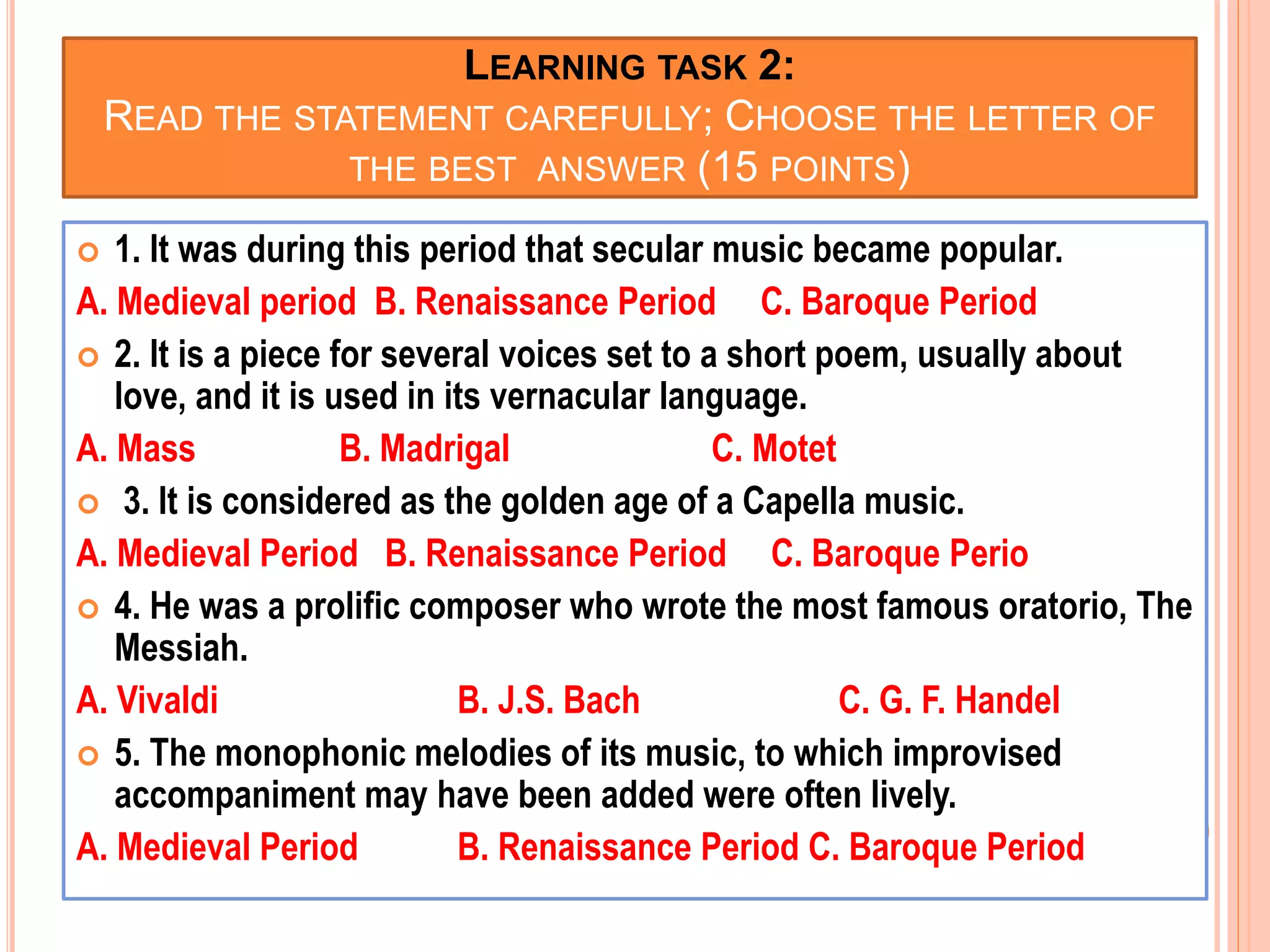
LEARNING TASK 2 :
LEARNING TASK 2:
READ THE STATEMENT CAREFULLY; CHOOSE THE LETTER OF
THE BEST ANSWER (15 POINTS)
 1. It was during this period that secular music became popular.
A. Medieval period B. Renaissance Period C. Baroque Period
 2. It is a piece for several voices set to a short poem, usually about
love, and it is used in its vernacular language.
A. Mass B. Madrigal C. Motet
 3. It is considered as the golden age of a Capella music.
A. Medieval Period B. Renaissance Period C. Baroque Perio
 4. He was a prolific composer who wrote the most famous oratorio, The
Messiah.
A. Vivaldi B. J.S. Bach C. G. F. Handel
 5. The monophonic melodies of its music, to which improvised
accompaniment may have been added were often lively.
A. Medieval Period B. Renaissance Period C. Baroque Period
PROMINENT COMPOSERS OF THE ERAS
Adam de la Halle,
 was a French-born trouvère, musician, and poet.
 also known as Adam le Bossu (Adam the Hunchback).
He made history in the world of music during the
Medieval Period.
 He is known for his uniqueness and versatility.
 He was a self-proclaimed genius, often describing
himself as Maistre (Master) because of his completion
of some advanced studies.
 He also explored and mastered the monophonic
composition and its more complex form-the motet.
 He died in Italy 1285.
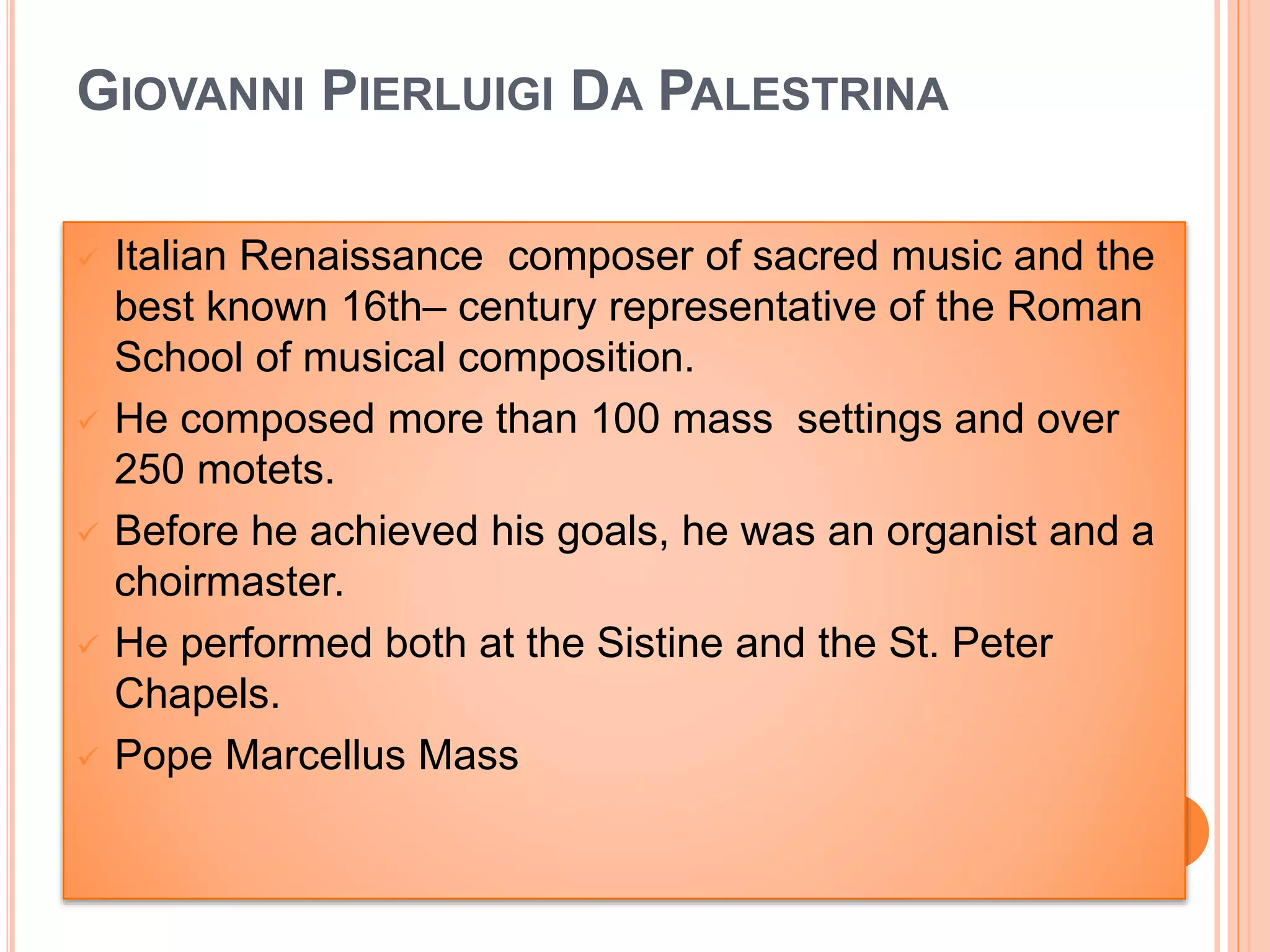
GIOVANNI PIERLUIGI DA PALESTRINA
 Italian Renaissance composer of sacred music and the
best known 16th– century representative of the Roman
School of musical composition.
 He composed more than 100 mass settings and over
250 motets.
 Before he achieved his goals, he was an organist and a
choirmaster.
 He performed both at the Sistine and the St. Peter
Chapels.
 Pope Marcellus Mass
THOMAS MORLEY
 Another famous composer of the Renaissance Era.
 He was also an organist at St. Paul s Cathedral.
Together with Robert Johnson, they are the only
composers who survived contemporary setting of
verse by Shakespeare.
 Fire ,Fire my Heart/ April is My Mistress ‘Face/
It was a lover and His lass/ Fantasie
The Baroque period was generally a time of newfound
ideas. From major innovations in science to vivid
changes in geography, people were exploring the world
around them. The music of the era was just as extreme
as the new changes. Some of the personalities/ great
composers are:
 Johann Sebastian Bach –Fugue in G Minor
 Antonio Vivaldi- Four Season
 George Friedrich Handel- Messiah
 Claudio Monteverdi
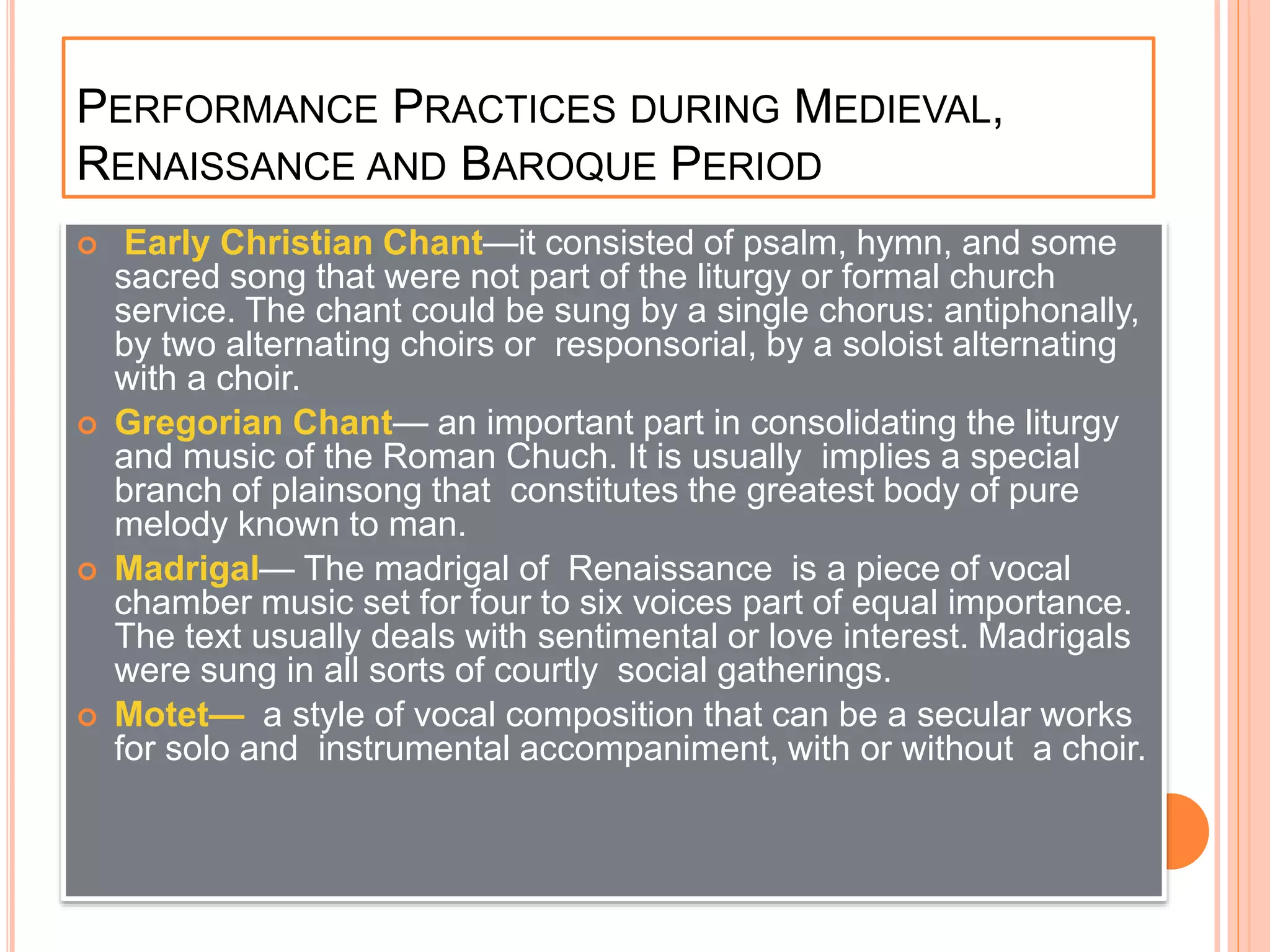
PERFORMANCE PRACTICES DURING MEDIEVAL,
RENAISSANCE AND BAROQUE PERIOD
 Early Christian Chant—it consisted of psalm, hymn, and some
sacred song that were not part of the liturgy or formal church
service. The chant could be sung by a single chorus: antiphonally,
by two alternating choirs or responsorial, by a soloist alternating
with a choir.
 Gregorian Chant— an important part in consolidating the liturgy
and music of the Roman Chuch. It is usually implies a special
branch of plainsong that constitutes the greatest body of pure
melody known to man.
 Madrigal— The madrigal of Renaissance is a piece of vocal
chamber music set for four to six voices part of equal importance.
The text usually deals with sentimental or love interest. Madrigals
were sung in all sorts of courtly social gatherings.
 Motet— a style of vocal composition that can be a secular works
for solo and instrumental accompaniment, with or without a choir.
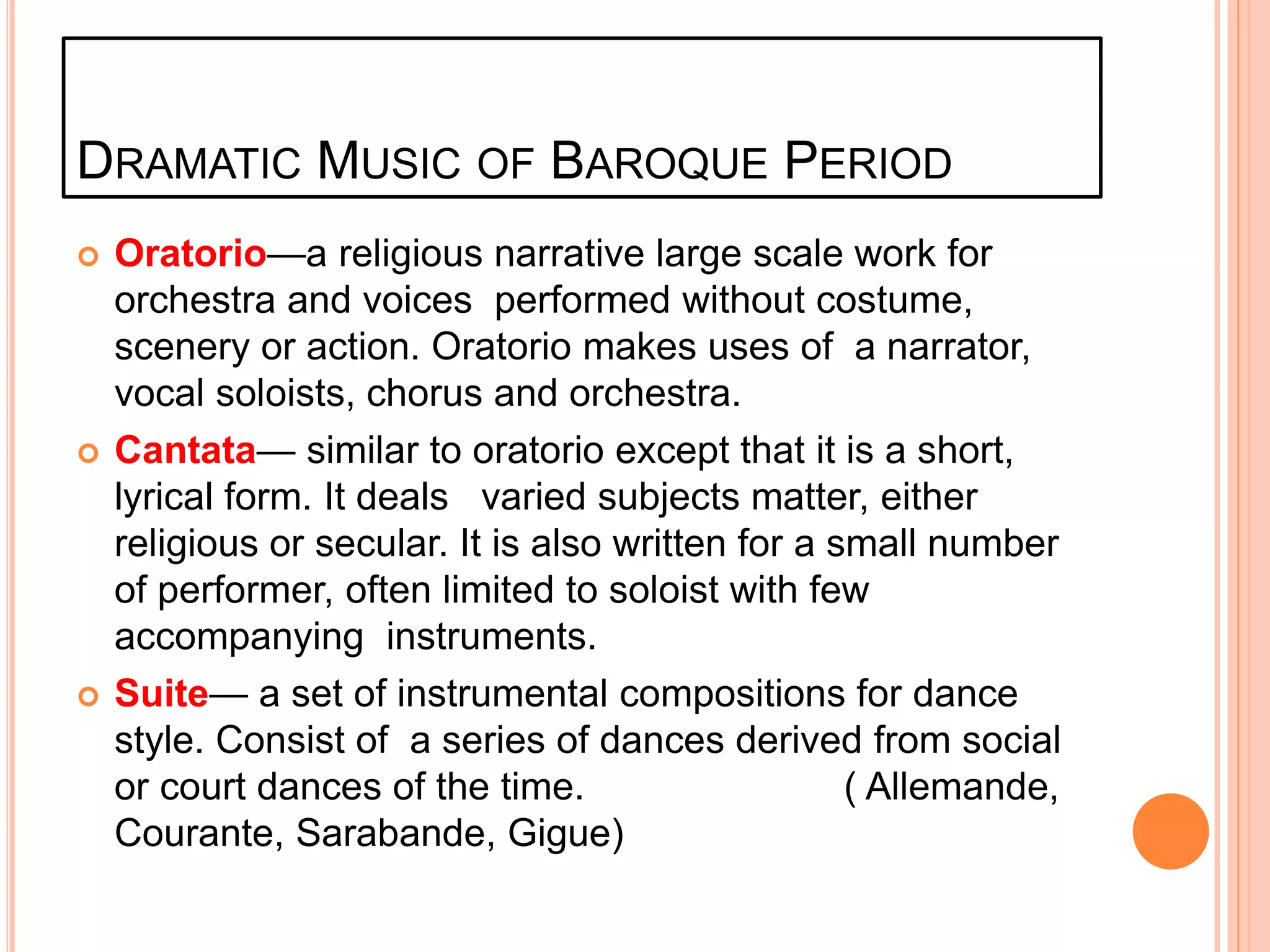
DRAMATIC MUSIC OF BAROQUE PERIOD
 Oratorio—a religious narrative large scale work for
orchestra and voices performed without costume,
scenery or action. Oratorio makes uses of a narrator,
vocal soloists, chorus and orchestra.
 Cantata— similar to oratorio except that it is a short,
lyrical form. It deals varied subjects matter, either
religious or secular. It is also written for a small number
of performer, often limited to soloist with few
accompanying instruments.
 Suite— a set of instrumental compositions for dance
style. Consist of a series of dances derived from social
or court dances of the time. ( Allemande,
Courante, Sarabande, Gigue)
TOPIC SUMMARY:
 The Music of the Medieval period, like any other kind of music,
expressed feelings that are difficult to put into words, and words that
cannot remain silent.
 One of the most famous trouveres is Adam dela Halle, who was the
composer of one of the oldest secular music theater pieces known in
the West, “Le Jeu de Robin et Marian”.
 The Renaissance may be described as the age of human creativity-
the time where the brilliant and great artist and composers were born
like Giovanni Pierluigi da Palestrina.
 Music is an essential part of civic, religious, and courtly life in this
period. It is also a form of prayer as the Mass served as one of the
most important and sacred form of music, while the text of many of
these Madrigals however centered on themes of spurned love, which
are commonly sad but pleasing to the senses.
PERFORMS MUSIC OF THE
MEDIEVAL, RENAISSANCE, AND
BAROQUE PERIODS
SESSION 3
LEARNING TASK 1: CLASSIFY THE FOLLOWING WORDS
OR PHRASES TO WHICH PERIOD IT BELONGS; COPY THE
TABLE BELOW ON YOUR ANSWER SHEET OR ON YOUR
ACTIVITY NOTEBOOK.
MEDIEVAL MUSIC RENNAISANCE
MUSIC
BAROQUE MUSIC
*Imitation of pitch and or voices *Liturgical music
*Musical Genres *Polyphonic music
*Madrigal *Performance of many
instruments *Gregorian chant
*Opera Mass *Monophonic music *Choral
Music *Cantata
LEARNING TASK 2: READ AND UNDERSTAND THE FOLLOWING
STATEMENTS. IF THE STATEMENT IS CORRECT, WRITE TRUE AND
FALSE IF OTHERWISE. ANSWER ON A PIECE OF PAPER OR ON YOUR
ACTIVITY NOTEBOOK.
 1. Western music started by the fall of the Roman
Empire.
 2. Monophony is a vocal music which has several
melodies sung at the same time.
 3. Some musical terms developed during the
baroque period was still used today.
 4. A Capella music came from an Italian term which
means "in the manner of the chapel".
 5. Instrumental music includes the use of
instruments only.
LEARNING TASK 2
 6. During the 16th century, instrumental music
flourished rapidly and several techniques were
made.
 7. Liturgical music of the Medieval period is secular
music.
 8. At the beginning of the middle age of western
music, there were so many instruments.
 9. Madrigal is the secular music of the Renaissance
period.
 10. Acapella uses human voices and also
instruments.
TOPIC SUMMARY
 The middle age of Western music developed in
Europe , started by the fall of the Roman empire.
By this time, Christian Church became a prominent
influence on Europe's culture, politics, and also in
music with which give birth to many vocal and
instrumental music. These influence in music
flourished not only during this time but still
flourished by the next era by adding and changing
some practices and theories. Furthermore, these
musical practices and theories became the
backbone of the music that we have until this
modern day.
TOPIC SUMMARY
 The western vocal music that was developed in
Europe was Monophonic music and Polyphonic
music. Monophonic music has a single line of
melody and on the other hand, Polyphonic music
has several melodies that are sung at the same
time. Another term that we are most familiar with
was Acapella music, this is an Italian term which
means "in the manner of the chapel". This is the
kind of music that uses human voices without any
accompaniment of musical instruments in the
background.
TOPIC SUMMARY
 Acapella can be done with a single person or a group of
people who harmonize their voices. Vocal music for a
group of people is also called choral music, in this
music, people are divided into different voice ranges,
such as bass, tenor, alto, and soprano.
 Western music, were only a few instruments and their
primary usage was to double or to substitute for voices
in vocal polyphonic music or to provide music for
dancing. 16th century, instrumental music flourished
rapidly, and techniques were made like such as strongly
accented intervallic skips, wide ranges, long, sustained
tones and phrases, and much melodic ornamentation.
Music 9 q1 session 2 & 3

Music 9 q1 session 2 & 3

  • 1.
    MUSIC OF THEMEDIEVAL, RENAISSANCE, AND BAROQUE PERIODS SESSION 2 PRESENTED BY: CHUA, CHRISTOPHER Subject Teacher
  • 2.
     The lessonis focused on the performance practice of Music based on the Medieval Period, the Renaissance period, and the Baroque Period.  The concepts are presented through interactive approaches in music. In this module, you will learn another important concept in the history of Western Music. We will be discussing the performance practice (setting, composition, role of composers, performers, and audience) of the Medieval, Renaissance, and Baroque period, identifying known composers, and we will also know about the role of music in people’s lives back then.
  • 3.
    LEARNING TASK 1: CLASSIFYTHE COMPOSER FROM THE MEDIEVAL, RENAISSANCE AND BAROQUE PERIOD. WRITE YOUR ANSWERS IN YOUR NOTEBOOK. 1. PALESTRINA- 2. HANDEL- 3. BACH- 4. VIVALDI- 5. DE LA HALLE- 6. MORLEY-
  • 4.
    LEARNING TASK 2: LEARNING TASK 2: READ THE STATEMENT CAREFULLY; CHOOSE THE LETTER OF THE BEST ANSWER (15 POINTS)  1. It was during this period that secular music became popular. A. Medieval period B. Renaissance Period C. Baroque Period  2. It is a piece for several voices set to a short poem, usually about love, and it is used in its vernacular language. A. Mass B. Madrigal C. Motet  3. It is considered as the golden age of a Capella music. A. Medieval Period B. Renaissance Period C. Baroque Perio  4. He was a prolific composer who wrote the most famous oratorio, The Messiah. A. Vivaldi B. J.S. Bach C. G. F. Handel  5. The monophonic melodies of its music, to which improvised accompaniment may have been added were often lively. A. Medieval Period B. Renaissance Period C. Baroque Period
  • 5.
    PROMINENT COMPOSERS OFTHE ERAS Adam de la Halle,  was a French-born trouvère, musician, and poet.  also known as Adam le Bossu (Adam the Hunchback). He made history in the world of music during the Medieval Period.  He is known for his uniqueness and versatility.  He was a self-proclaimed genius, often describing himself as Maistre (Master) because of his completion of some advanced studies.  He also explored and mastered the monophonic composition and its more complex form-the motet.  He died in Italy 1285.
  • 6.
    GIOVANNI PIERLUIGI DAPALESTRINA  Italian Renaissance composer of sacred music and the best known 16th– century representative of the Roman School of musical composition.  He composed more than 100 mass settings and over 250 motets.  Before he achieved his goals, he was an organist and a choirmaster.  He performed both at the Sistine and the St. Peter Chapels.  Pope Marcellus Mass
  • 7.
    THOMAS MORLEY  Anotherfamous composer of the Renaissance Era.  He was also an organist at St. Paul s Cathedral. Together with Robert Johnson, they are the only composers who survived contemporary setting of verse by Shakespeare.  Fire ,Fire my Heart/ April is My Mistress ‘Face/ It was a lover and His lass/ Fantasie
  • 8.
    The Baroque periodwas generally a time of newfound ideas. From major innovations in science to vivid changes in geography, people were exploring the world around them. The music of the era was just as extreme as the new changes. Some of the personalities/ great composers are:  Johann Sebastian Bach –Fugue in G Minor  Antonio Vivaldi- Four Season  George Friedrich Handel- Messiah  Claudio Monteverdi
  • 9.
    PERFORMANCE PRACTICES DURINGMEDIEVAL, RENAISSANCE AND BAROQUE PERIOD  Early Christian Chant—it consisted of psalm, hymn, and some sacred song that were not part of the liturgy or formal church service. The chant could be sung by a single chorus: antiphonally, by two alternating choirs or responsorial, by a soloist alternating with a choir.  Gregorian Chant— an important part in consolidating the liturgy and music of the Roman Chuch. It is usually implies a special branch of plainsong that constitutes the greatest body of pure melody known to man.  Madrigal— The madrigal of Renaissance is a piece of vocal chamber music set for four to six voices part of equal importance. The text usually deals with sentimental or love interest. Madrigals were sung in all sorts of courtly social gatherings.  Motet— a style of vocal composition that can be a secular works for solo and instrumental accompaniment, with or without a choir.
  • 10.
    DRAMATIC MUSIC OFBAROQUE PERIOD  Oratorio—a religious narrative large scale work for orchestra and voices performed without costume, scenery or action. Oratorio makes uses of a narrator, vocal soloists, chorus and orchestra.  Cantata— similar to oratorio except that it is a short, lyrical form. It deals varied subjects matter, either religious or secular. It is also written for a small number of performer, often limited to soloist with few accompanying instruments.  Suite— a set of instrumental compositions for dance style. Consist of a series of dances derived from social or court dances of the time. ( Allemande, Courante, Sarabande, Gigue)
  • 11.
    TOPIC SUMMARY:  TheMusic of the Medieval period, like any other kind of music, expressed feelings that are difficult to put into words, and words that cannot remain silent.  One of the most famous trouveres is Adam dela Halle, who was the composer of one of the oldest secular music theater pieces known in the West, “Le Jeu de Robin et Marian”.  The Renaissance may be described as the age of human creativity- the time where the brilliant and great artist and composers were born like Giovanni Pierluigi da Palestrina.  Music is an essential part of civic, religious, and courtly life in this period. It is also a form of prayer as the Mass served as one of the most important and sacred form of music, while the text of many of these Madrigals however centered on themes of spurned love, which are commonly sad but pleasing to the senses.
  • 13.
    PERFORMS MUSIC OFTHE MEDIEVAL, RENAISSANCE, AND BAROQUE PERIODS SESSION 3
  • 14.
    LEARNING TASK 1:CLASSIFY THE FOLLOWING WORDS OR PHRASES TO WHICH PERIOD IT BELONGS; COPY THE TABLE BELOW ON YOUR ANSWER SHEET OR ON YOUR ACTIVITY NOTEBOOK. MEDIEVAL MUSIC RENNAISANCE MUSIC BAROQUE MUSIC *Imitation of pitch and or voices *Liturgical music *Musical Genres *Polyphonic music *Madrigal *Performance of many instruments *Gregorian chant *Opera Mass *Monophonic music *Choral Music *Cantata
  • 15.
    LEARNING TASK 2:READ AND UNDERSTAND THE FOLLOWING STATEMENTS. IF THE STATEMENT IS CORRECT, WRITE TRUE AND FALSE IF OTHERWISE. ANSWER ON A PIECE OF PAPER OR ON YOUR ACTIVITY NOTEBOOK.  1. Western music started by the fall of the Roman Empire.  2. Monophony is a vocal music which has several melodies sung at the same time.  3. Some musical terms developed during the baroque period was still used today.  4. A Capella music came from an Italian term which means "in the manner of the chapel".  5. Instrumental music includes the use of instruments only.
  • 16.
    LEARNING TASK 2 6. During the 16th century, instrumental music flourished rapidly and several techniques were made.  7. Liturgical music of the Medieval period is secular music.  8. At the beginning of the middle age of western music, there were so many instruments.  9. Madrigal is the secular music of the Renaissance period.  10. Acapella uses human voices and also instruments.
  • 17.
    TOPIC SUMMARY  Themiddle age of Western music developed in Europe , started by the fall of the Roman empire. By this time, Christian Church became a prominent influence on Europe's culture, politics, and also in music with which give birth to many vocal and instrumental music. These influence in music flourished not only during this time but still flourished by the next era by adding and changing some practices and theories. Furthermore, these musical practices and theories became the backbone of the music that we have until this modern day.
  • 18.
    TOPIC SUMMARY  Thewestern vocal music that was developed in Europe was Monophonic music and Polyphonic music. Monophonic music has a single line of melody and on the other hand, Polyphonic music has several melodies that are sung at the same time. Another term that we are most familiar with was Acapella music, this is an Italian term which means "in the manner of the chapel". This is the kind of music that uses human voices without any accompaniment of musical instruments in the background.
  • 19.
    TOPIC SUMMARY  Acapellacan be done with a single person or a group of people who harmonize their voices. Vocal music for a group of people is also called choral music, in this music, people are divided into different voice ranges, such as bass, tenor, alto, and soprano.  Western music, were only a few instruments and their primary usage was to double or to substitute for voices in vocal polyphonic music or to provide music for dancing. 16th century, instrumental music flourished rapidly, and techniques were made like such as strongly accented intervallic skips, wide ranges, long, sustained tones and phrases, and much melodic ornamentation.