













Cultural
Materialism
Marvin Harris
 A cultural
anthropologist, is
responsible for the
most systematic
statement of cultural
materialist principles.
 Proponent of
Cultural
Materialism.
Cultural Materialism
 Explains cultural similarities and
differences as well as models for
cultural change within a societal
framework.
 A scientific research strategy that
prioritizes material, behavioral and etic
processes in the explanation of the
evolution of human socio-cultural
systems.
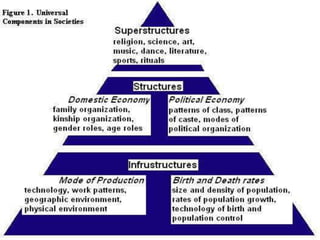
 Consist of three distinct levels:
Infrastructure, structure and
superstructure.
Assumptions
 Cultural Materialism is based on two
key assumptions about societies. First,
the various parts of society are
interrelated. When one part of society
changes, other parts must also change.
 The second assumption of CM is that
the foundation of the socio-cultural
system is the environment.
Three distinct
levels
Infrastructure
 Promotes the idea that
infrastructure, consisting of
“material realities” such as
technological, economic and
reproductive (demographic)
factors mold and influence the
other two aspects of culture.
 The material infrastructure
consists of the technology and
social practices by which a
society fits in to its environment.
 It is through the infrastructure that
society manipulates its
environment by modifying the
amount and type of resources
needed.
Infrastructural
Component
Technology (mode of
production)
Population (mode of
reproduction)
The modes of
production and
reproduction are attempts
to strike a balance
between population level
and the consumption of
energy from a finite
environment.
Mode of Production
- Consists of behaviors aimed at satisfying
requirements for subsistence.
- Technology and the practices employed for
expanding or limiting basic subsistence
production, especially the production of food
and other forms of energy.
 Technology of subsistence
 Technological-environmental relationships
Examples:
 Hunting and Gathering
 Horticulture
 Pastoral
 Agrarian
 Industrial
 Hyper-industrial
Mode of reproduction
- Consisting of behaviors aimed at
controlling destructive increases or
decreases in population size.
- Technology and the practices
employed for expanding,
limiting and maintaining
population size.
examples
 Demography
 Mating patterns
 Fertility, natality, mortality
 Nurturance of infant
 Medicine
 Contraception, abortion, infanticide
Structural
- This component of socio-cultural systems
consists of the organized patterns of social
life carried out among the members of a
society.
- Each society must maintain secure and
orderly relationships among its people, its
constituent groups, and with neighboring
societies.
 Political Economy
 Domestic Economy
Political Economy
- These groups and organizations perform
the functions of regulating production,
reproduction, exchange, and consumption
within and between groups and socio-
cultural systems.
- These groups may be large or small, but
their members tend to interact without
any emotional commitment to one
another.
Examples
 Political organizations, factions,
military,
Corporations, Division of labor,
police,
Education, media, taxation, urban,
rural hierarchies, war, class, caste,
Service and welfare organizations,
Professional and labor organizations.
Cultural economy
Consists of a small number of
people who interact on an
intimate basis. They perform many
functions, such as regulating
reproduction, basic production,
socialization, education, and
enforcing domestic discipline.
Examples
Family structure, domestic division
of labor, education, age and sex roles,
Community, domestic discipline,
hierarchies, sanctions,
Voluntary organizations,
Friendship Networks,
Some religious groups.
Superstructure
- “Superstructure” sector consists of
ideological and symbolic aspects of
society such as religion.
- Given the importance of symbolic
processes.
Behavioral Superstructure
 Mental Superstructure
Behavioral
Superstructure
The Behavioral Superstructure includes
recreations activities, art, sports, empirical
knowledge, folklore, and other aesthetic
products.
Examples:
• Art, music, dance, literature
• Rituals, advertising,
• Sports, games, hobbies,
• Science
Mental
Superstructure
The mental superstructure involves the
patterned ways in which the members of a
society think, conceptualize, and evaluate
their behavior.
Examples:
 Myths, aesthetic standards and philosophies,
ideologies, religion
• Therefore, cultural materialists believe
that technological and economic
aspects play the primary role in shaping
a society.
• Cultural materialism aims to
understand the effects of
technological, economic and
demographic factors on molding
societal structure and superstructure
through strictly scientific methods.
Cultural Materialism

Cultural Materialism

  • 1.
  • 2.
    Marvin Harris  Acultural anthropologist, is responsible for the most systematic statement of cultural materialist principles.  Proponent of Cultural Materialism.
  • 3.
    Cultural Materialism  Explainscultural similarities and differences as well as models for cultural change within a societal framework.  A scientific research strategy that prioritizes material, behavioral and etic processes in the explanation of the evolution of human socio-cultural systems.  Consist of three distinct levels: Infrastructure, structure and superstructure.
  • 4.
    Assumptions  Cultural Materialismis based on two key assumptions about societies. First, the various parts of society are interrelated. When one part of society changes, other parts must also change.  The second assumption of CM is that the foundation of the socio-cultural system is the environment.
  • 5.
  • 6.
    Infrastructure  Promotes theidea that infrastructure, consisting of “material realities” such as technological, economic and reproductive (demographic) factors mold and influence the other two aspects of culture.
  • 7.
     The materialinfrastructure consists of the technology and social practices by which a society fits in to its environment.  It is through the infrastructure that society manipulates its environment by modifying the amount and type of resources needed.
  • 9.
  • 10.
    The modes of productionand reproduction are attempts to strike a balance between population level and the consumption of energy from a finite environment.
  • 11.
    Mode of Production -Consists of behaviors aimed at satisfying requirements for subsistence. - Technology and the practices employed for expanding or limiting basic subsistence production, especially the production of food and other forms of energy.  Technology of subsistence  Technological-environmental relationships
  • 12.
    Examples:  Hunting andGathering  Horticulture  Pastoral  Agrarian  Industrial  Hyper-industrial
  • 14.
    Mode of reproduction -Consisting of behaviors aimed at controlling destructive increases or decreases in population size. - Technology and the practices employed for expanding, limiting and maintaining population size.
  • 15.
    examples  Demography  Matingpatterns  Fertility, natality, mortality  Nurturance of infant  Medicine  Contraception, abortion, infanticide
  • 17.
    Structural - This componentof socio-cultural systems consists of the organized patterns of social life carried out among the members of a society. - Each society must maintain secure and orderly relationships among its people, its constituent groups, and with neighboring societies.  Political Economy  Domestic Economy
  • 18.
    Political Economy - Thesegroups and organizations perform the functions of regulating production, reproduction, exchange, and consumption within and between groups and socio- cultural systems. - These groups may be large or small, but their members tend to interact without any emotional commitment to one another.
  • 19.
    Examples  Political organizations,factions, military, Corporations, Division of labor, police, Education, media, taxation, urban, rural hierarchies, war, class, caste, Service and welfare organizations, Professional and labor organizations.
  • 21.
    Cultural economy Consists ofa small number of people who interact on an intimate basis. They perform many functions, such as regulating reproduction, basic production, socialization, education, and enforcing domestic discipline.
  • 22.
    Examples Family structure, domesticdivision of labor, education, age and sex roles, Community, domestic discipline, hierarchies, sanctions, Voluntary organizations, Friendship Networks, Some religious groups.
  • 24.
    Superstructure - “Superstructure” sectorconsists of ideological and symbolic aspects of society such as religion. - Given the importance of symbolic processes. Behavioral Superstructure  Mental Superstructure
  • 25.
    Behavioral Superstructure The Behavioral Superstructureincludes recreations activities, art, sports, empirical knowledge, folklore, and other aesthetic products. Examples: • Art, music, dance, literature • Rituals, advertising, • Sports, games, hobbies, • Science
  • 27.
    Mental Superstructure The mental superstructureinvolves the patterned ways in which the members of a society think, conceptualize, and evaluate their behavior. Examples:  Myths, aesthetic standards and philosophies, ideologies, religion
  • 29.
    • Therefore, culturalmaterialists believe that technological and economic aspects play the primary role in shaping a society. • Cultural materialism aims to understand the effects of technological, economic and demographic factors on molding societal structure and superstructure through strictly scientific methods.