Shifting Values and Preferences:
A Key Driver of Rural Change & Quality of Life
David L. Brown
Cornell University, USA
OECD Rural Conference
Edinburgh, Scotland
April 10, 2018
Global Shifts in Social Attitudes, Values, and
Aspirations Are Likely to Play a Role in Shaping How
Rural & Urban Areas Succeed in the 21st Century
• Today, I will focus on three changes in social attitudes and values that
affect rural [and urban] society across the OECD.
• Each of these attitudes is framed negatively in contemporary discourse, and
each can have negative impacts on rural, and/or urban, society
• I will examine the following:
• Extreme Nationalism
• Climate Change Skepticism
• Opposition to Immigration
Rise of Extreme Nationalism
• Post-WWII realization that extreme nationalism
needed to be contained
• Led to development of GATT; later the WTO; and ultimately the EU
• The goal was to produce a more cooperative world economy
where nationalistic tendencies were tempered and contained
• European Union: countries pool sovereignty,
and forswear extreme nationalism
• Set itself up as the political model for the 21st century.
• This commitment seems to be breaking down at the present time
• PEW data show decline in support of EU across 10 EU
countries;
• Forty-two percent want more power returned to their
national capitals
• Brexit
• Trump withdrawing from multi-lateral trade
agreements and announcing unilateral tariffs
• Rural Impact
• Affects ability to trade agricultural commodities, energy & raw
materials, and manufactured goods beyond national boundaries
• New “Farm Crisis” [NYT April 1, 2018]
• “10 percent of Iowa farmers probably won’t make it this
year, and 10 percent more will likely fail next year.
• Because of tariffs on pork, soy beans, etc.
• Could constrain labor supply
PEW: Global Attitude Survey: Spring 2016
Climate Change Skepticism
• Public attitudes affect implementation of climate policy [Tjernstrom & Titenberg]
• Attitudes also affect personal & community-level environmental behavior
• Most OECD and EU residents believe that human activities adversely affect the
environment
• But this belief is weakening, and climate skepticism is increasing (Eurobaramoter)
• 12% of EU identify climate change as the top problem facing the world in 2017
• Decline from 20% in 2011
• 43% see climate change as one of top 4 problems facing the world in 2017
• Decline from 51% in 2011
• The proportion agreeing that ‘claims that human activities are changing the climate
are exaggerated’ almost doubled between 2003-08 in UK.
• Increasing from 15% to 29% (Whitemarsh 2011)
• European experience suggests that the poor economy profoundly affects beliefs
about climate change, and inclination to respond
• Even in a political culture in which climate science is very widely accepted.
• The percentage of Americans agreeing that the seriousness of global warming is
generally exaggerated by the media increased from 35% in 2008 to 48% in 2010.
(Scruggs & Benegal 2012)
• In 2011, barely a majority of Americans (52%) said that human actions are mostly to blame
for climate change, down from 63% in 2008
• Rural issues
• Rural environment becomes more vulnerable in response to skeptism
• reduction in support for public sector resource management schemes and regulations [clean air,
coal, pipelines]
• More difficult to institute community-based adaptation strategies
Gallup, 2012
Opposition to Immigration
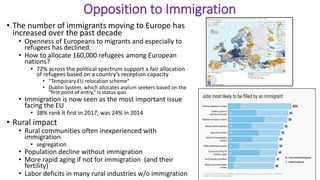
• The number of immigrants moving to Europe has
increased over the past decade
• Openness of Europeans to migrants and especially to
refugees has declined.
• How to allocate 160,000 refugees among European
nations?
• 72% across the political spectrum support a fair allocation
of refugees based on a country’s reception capacity
• “Temporary EU relocation scheme”
• Dublin System, which allocates asylum seekers based on the
“first point of entry,” is status quo
• Immigration is now seen as the most important issue
facing the EU
• 38% rank it first in 2017; was 24% in 2014
• Rural impact
• Rural communities often inexperienced with
immigration
• segregation
• Population decline without immigration
• More rapid aging if not for immigration (and their
fertility)
• Labor deficits in many rural industries w/o immigration
Why Paint Such A NegativePicture?
• Attitudes toward immigrants, expenditures for public goods that protect
the environment, and international social, economic and political
cooperation tend to become more conservative during times of economic
decline and political instability
• Social exclusion increases at the local level
• People become more self protective, less tolerant, and more ethnocentric during
difficult times.
• Hence, economic downturns and periods of political instability can
adversely affect communities, both rural and urban
• But not necessarily!
• The adverse impacts of these megatrends and key drivers of rural change are not
direct, automatic nor mechanistic
• They are mediated by unequal social structures and exacerbated by extreme right or left wing
populists who fan these fears and insecurities
• Accordingly, rural communities with legacies of inclusiveness, fairness and collective
responsibility can minimize xenophobia, intolerance, and environmental pillage
during trying times such as these.
Thank You!

David Brown - Shifing values and preferences

  • 1.
    Shifting Values andPreferences: A Key Driver of Rural Change & Quality of Life David L. Brown Cornell University, USA OECD Rural Conference Edinburgh, Scotland April 10, 2018
  • 2.
    Global Shifts inSocial Attitudes, Values, and Aspirations Are Likely to Play a Role in Shaping How Rural & Urban Areas Succeed in the 21st Century • Today, I will focus on three changes in social attitudes and values that affect rural [and urban] society across the OECD. • Each of these attitudes is framed negatively in contemporary discourse, and each can have negative impacts on rural, and/or urban, society • I will examine the following: • Extreme Nationalism • Climate Change Skepticism • Opposition to Immigration
  • 3.
    Rise of ExtremeNationalism • Post-WWII realization that extreme nationalism needed to be contained • Led to development of GATT; later the WTO; and ultimately the EU • The goal was to produce a more cooperative world economy where nationalistic tendencies were tempered and contained • European Union: countries pool sovereignty, and forswear extreme nationalism • Set itself up as the political model for the 21st century. • This commitment seems to be breaking down at the present time • PEW data show decline in support of EU across 10 EU countries; • Forty-two percent want more power returned to their national capitals • Brexit • Trump withdrawing from multi-lateral trade agreements and announcing unilateral tariffs • Rural Impact • Affects ability to trade agricultural commodities, energy & raw materials, and manufactured goods beyond national boundaries • New “Farm Crisis” [NYT April 1, 2018] • “10 percent of Iowa farmers probably won’t make it this year, and 10 percent more will likely fail next year. • Because of tariffs on pork, soy beans, etc. • Could constrain labor supply PEW: Global Attitude Survey: Spring 2016
  • 4.
    Climate Change Skepticism •Public attitudes affect implementation of climate policy [Tjernstrom & Titenberg] • Attitudes also affect personal & community-level environmental behavior • Most OECD and EU residents believe that human activities adversely affect the environment • But this belief is weakening, and climate skepticism is increasing (Eurobaramoter) • 12% of EU identify climate change as the top problem facing the world in 2017 • Decline from 20% in 2011 • 43% see climate change as one of top 4 problems facing the world in 2017 • Decline from 51% in 2011 • The proportion agreeing that ‘claims that human activities are changing the climate are exaggerated’ almost doubled between 2003-08 in UK. • Increasing from 15% to 29% (Whitemarsh 2011) • European experience suggests that the poor economy profoundly affects beliefs about climate change, and inclination to respond • Even in a political culture in which climate science is very widely accepted. • The percentage of Americans agreeing that the seriousness of global warming is generally exaggerated by the media increased from 35% in 2008 to 48% in 2010. (Scruggs & Benegal 2012) • In 2011, barely a majority of Americans (52%) said that human actions are mostly to blame for climate change, down from 63% in 2008 • Rural issues • Rural environment becomes more vulnerable in response to skeptism • reduction in support for public sector resource management schemes and regulations [clean air, coal, pipelines] • More difficult to institute community-based adaptation strategies Gallup, 2012
  • 5.
    Opposition to Immigration •The number of immigrants moving to Europe has increased over the past decade • Openness of Europeans to migrants and especially to refugees has declined. • How to allocate 160,000 refugees among European nations? • 72% across the political spectrum support a fair allocation of refugees based on a country’s reception capacity • “Temporary EU relocation scheme” • Dublin System, which allocates asylum seekers based on the “first point of entry,” is status quo • Immigration is now seen as the most important issue facing the EU • 38% rank it first in 2017; was 24% in 2014 • Rural impact • Rural communities often inexperienced with immigration • segregation • Population decline without immigration • More rapid aging if not for immigration (and their fertility) • Labor deficits in many rural industries w/o immigration
  • 6.
    Why Paint SuchA NegativePicture? • Attitudes toward immigrants, expenditures for public goods that protect the environment, and international social, economic and political cooperation tend to become more conservative during times of economic decline and political instability • Social exclusion increases at the local level • People become more self protective, less tolerant, and more ethnocentric during difficult times. • Hence, economic downturns and periods of political instability can adversely affect communities, both rural and urban • But not necessarily! • The adverse impacts of these megatrends and key drivers of rural change are not direct, automatic nor mechanistic • They are mediated by unequal social structures and exacerbated by extreme right or left wing populists who fan these fears and insecurities • Accordingly, rural communities with legacies of inclusiveness, fairness and collective responsibility can minimize xenophobia, intolerance, and environmental pillage during trying times such as these.
  • 7.