Video: Emerging Powers: India
• What did you find informative
about this film?
• What is the basic argument that
the film presents about India and
about globalization?
• How does the film interpret such
things as India’s widespread
poverty and its periodic flare-ups
of ethnic and religious strife?
• Why are India and China so
important?
“Globalization in its current phase has
been described as an unprecedented
compression of time and space
reflected in the tremendous
intensification of social, political,
economic, and cultural
interconnections and
interdependencies on a global scale.”
Stegler, p. ix
• time-space compression
• deterritorialization and supraterritoriality
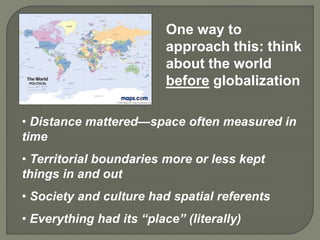
One way to
approach this: think
about the world
before globalization
• Distance mattered—space often measured in
time
• Territorial boundaries more or less kept
things in and out
• Society and culture had spatial referents
• Everything had its “place” (literally)
In a world of deterritorialization and
supraterritoriality:
•Distance becomes almost irrelevant (the end of
distance)
•Boundaries are increasingly permeable.
•Groups and cultures increasingly don’t have a
territorial basis
•A new kind of non-physical “place” is emerging
Bosworth and Gordon: A survey of
some key processes of globalization
• Technological advances
• Expansion of international commerce (exports
and imports)
• Rising importance of private capital flows
(stock markets and multinational corporations)
• Increasing travel and migration (international
tourism and domestic diversity)
• Increased communication and interaction
between peoples (through all sorts of media)
Bosworth and Gordon also point to some of the
key public controversies over globalization:
What are they?
“Can globalization be harnessed so that all citizens
and countries benefit and not just the lucky few?”
1. 1. Is globalization
Westernization? Is it a threat
to non-western societies?
2. What is the right question to
ask about globalization and
the poor?
3. What are the “legitimate”
questions that “anti-
globalization” protestors ask?
Amartya Sen: How to Judge
Globalization (Normatively)
“Our global civilization is a world
heritage... The idea of an immaculate
Western conception is an imaginative
fantasy.”
“Globalization has much to offer, but even
as we defend it, we must also, without any
contradiction, see the legitimacy of many
questions that the antiglobalization
protestors ask.”
“The world powers bear an awesome
responsibility for helping in the
subversion of democracy in Africa and ofr
all the far-reaching negative
consequences of that subversion.”
“Over the past decade globalization has
been driven by technological
advances…..But globalization has also
been driven by policies and ideas…”
Bosworth & Gordon
Next time: globalization as a neoliberal
project
Acquisitions a prominent part of OFDI from India
► Good distribution across industries and regions
► Achieving an increased prominence, strong growth
► Important component to OFDI and strategy of MNCS from India
 Strategy and performance
► Performance strong on an absolute and a comparative basis
► Several market expansion motives related to good performance
► Market clearly rewarding international expansion strategy of
Indian firms
► Need comparative analysis to other modes
► Need deeper analysis of strategy and performance of acquisitions

Globalization

  • 2.
    Video: Emerging Powers:India • What did you find informative about this film? • What is the basic argument that the film presents about India and about globalization? • How does the film interpret such things as India’s widespread poverty and its periodic flare-ups of ethnic and religious strife? • Why are India and China so important?
  • 3.
    “Globalization in itscurrent phase has been described as an unprecedented compression of time and space reflected in the tremendous intensification of social, political, economic, and cultural interconnections and interdependencies on a global scale.” Stegler, p. ix • time-space compression • deterritorialization and supraterritoriality
  • 4.
    One way to approachthis: think about the world before globalization • Distance mattered—space often measured in time • Territorial boundaries more or less kept things in and out • Society and culture had spatial referents • Everything had its “place” (literally)
  • 5.
    In a worldof deterritorialization and supraterritoriality: •Distance becomes almost irrelevant (the end of distance) •Boundaries are increasingly permeable. •Groups and cultures increasingly don’t have a territorial basis •A new kind of non-physical “place” is emerging
  • 6.
    Bosworth and Gordon:A survey of some key processes of globalization • Technological advances • Expansion of international commerce (exports and imports) • Rising importance of private capital flows (stock markets and multinational corporations) • Increasing travel and migration (international tourism and domestic diversity) • Increased communication and interaction between peoples (through all sorts of media)
  • 7.
    Bosworth and Gordonalso point to some of the key public controversies over globalization: What are they? “Can globalization be harnessed so that all citizens and countries benefit and not just the lucky few?”
  • 8.
    1. 1. Isglobalization Westernization? Is it a threat to non-western societies? 2. What is the right question to ask about globalization and the poor? 3. What are the “legitimate” questions that “anti- globalization” protestors ask? Amartya Sen: How to Judge Globalization (Normatively)
  • 9.
    “Our global civilizationis a world heritage... The idea of an immaculate Western conception is an imaginative fantasy.” “Globalization has much to offer, but even as we defend it, we must also, without any contradiction, see the legitimacy of many questions that the antiglobalization protestors ask.” “The world powers bear an awesome responsibility for helping in the subversion of democracy in Africa and ofr all the far-reaching negative consequences of that subversion.”
  • 10.
    “Over the pastdecade globalization has been driven by technological advances…..But globalization has also been driven by policies and ideas…” Bosworth & Gordon Next time: globalization as a neoliberal project
  • 11.
    Acquisitions a prominentpart of OFDI from India ► Good distribution across industries and regions ► Achieving an increased prominence, strong growth ► Important component to OFDI and strategy of MNCS from India  Strategy and performance ► Performance strong on an absolute and a comparative basis ► Several market expansion motives related to good performance ► Market clearly rewarding international expansion strategy of Indian firms ► Need comparative analysis to other modes ► Need deeper analysis of strategy and performance of acquisitions