Lean Learning Robin Millar  www.wilm.ca
Centre for Education and Work (CEW) The Centre for Education and Work (CEW) is a not-for profit organization affiliated with the University of Winnipeg Research and development on the WILM since 2003 www.cewca.org
Learning informally With a partner, discuss something you learned at work, not through training, but on the job. What did you learn? How did you learn it?
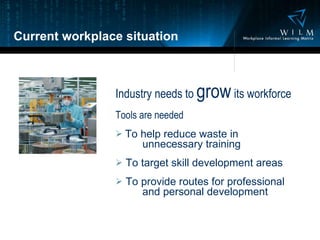
Current workplace situation Industry needs to  grow  its workforce Tools are needed To help reduce waste in    unnecessary training To target skill development areas To provide routes for professional   and personal development
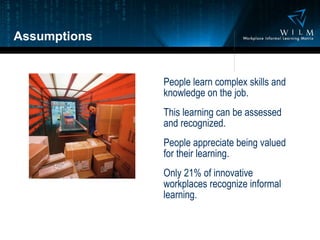
Assumptions People learn complex skills and knowledge on the job. This learning can be assessed and recognized. People appreciate being valued for their learning. Only 21% of innovative workplaces recognize informal learning.
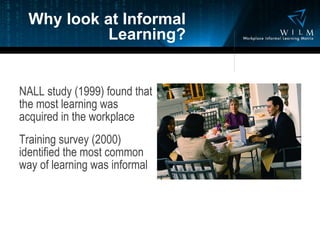
Why look at Informal Learning? NALL study (1999) found that the most learning was acquired in the workplace Training survey (2000) identified the most common way of learning was informal
Why do people learn informally? To perform their jobs more effectively and efficiently To fill in gaps not provided in training To learn new skills demanded by workplaces
Definitions: Informal Learning Learning resulting from daily life activities related to work, family, or leisure.  It is not structured in terms of learning objectives, learning time or learning support and typically does not lead to certification.  Informal learning is learner directed and dependent upon work situations.
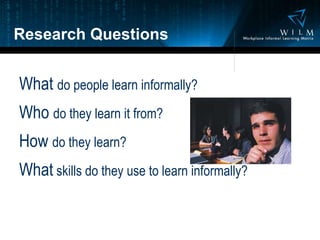
Research Questions What  do people learn informally? Who  do they learn it from? How  do they learn? What  skills do they use to learn informally?
CEW research in Informal Learning 2003-04 Developed a research methodology for assessing informal learning in the workplace Applied this to over 48  entry  level positions in Manitoba and Saskatchewan
Research data 2005-08 The WILM has been validated with: supervisors middle managers In over  120  different jobs across a range of sectors including construction, manufacturing, public service, crown corporations, energy, entertainment, hospitality, hotel management, health centres
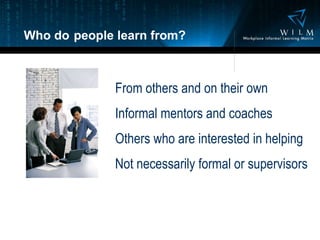
Who do   people learn from? From others and on their own Informal mentors and coaches Others who are interested in helping Not necessarily formal or supervisors
Workplace Informal Learning Matrix The purpose of the WILM is to raise awareness in workplaces about informal learning provide useful ways of assessing “soft” or essential skills provide a tool that is easy to administer and user friendly
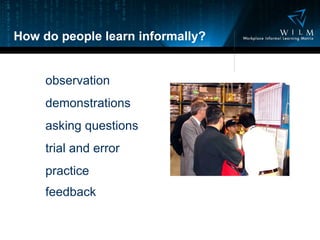
How do people learn informally? observation demonstrations asking questions trial and error practice feedback
Research findings… Essential skills Workplace specific skills Non-technical skills
Essential Skills   Oral communication Working with others Thinking skills: especially problem solving and decision making Learning skills What do people learn informally?
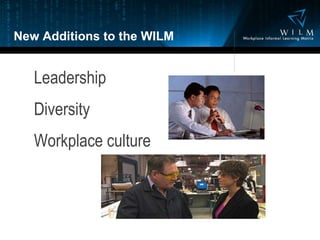
New Additions to the WILM Leadership Diversity  Workplace culture
Categories for informal learning Organized what people learn informally into categories Workplace Informal Learning Matrix Capture the Learning Video
Research Companies participated from Nova Scotia, Quebec, Ontario, Manitoba, Saskatchewan, Alberta, British Columbia Sectors included construction, manufacturing, public service, crown corporations, energy, entertainment, hospitality, hotel management, health centres Over 120 jobs
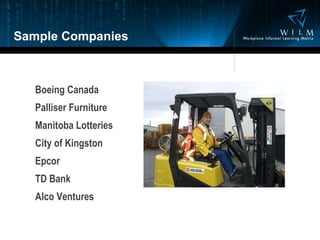
Sample Companies Boeing Canada Palliser Furniture Manitoba Lotteries City of Kingston Epcor TD Bank Alco Ventures
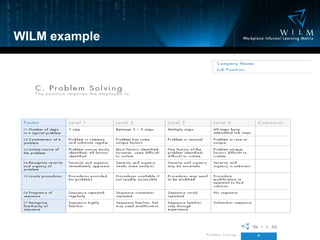
What is the ”Matrix”? Factors plus four complexity levels People evaluated  their jobs  not themselves personally
WILM example
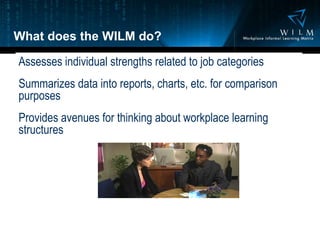
What does the WILM do? Assesses individual strengths related to job categories Summarizes data into reports, charts, etc. for comparison purposes Provides avenues for thinking about workplace learning structures
Impact Study In 2007-08, we examined the WILM in over 40 companies to identify how they used the tools
Applications of the WILM As a recruitment tool For developing better job descriptions For developing behavioural questions for interviewing new hires
Applications of the WILM As a retention tool For performance review and performance appraisal To provide more in-depth information for competency development To provide more in-depth information for benchmarking quality To target individual training plans and develop employee learning plans For recognizing learning to improve company morale
Business case for the WILM Identify strengths and weaknesses in learning target training events focus on what people really need to know, reduce  costs Recognize informal learning As part of a range of retention strategies Helps develop new retention strategies Retaining workers
Example Comparison of two working teams Analyzed strengths and weaknesses using WILM data Provided information about what areas need development communication problem solving leadership
Customizing the WILM The CEW can: provide a free orientation for participating companies demonstrate how to administer and gather data from the WILM analyze WILM results and link to company business develop a customized WILM for your company develop a competency-based system for employees
WEBSITE materials www.wilm.ca CEW contact:  [email_address] www.cewca.org

CSTD WILM Presentation

  • 1.
    Lean Learning RobinMillar www.wilm.ca
  • 2.
    Centre for Educationand Work (CEW) The Centre for Education and Work (CEW) is a not-for profit organization affiliated with the University of Winnipeg Research and development on the WILM since 2003 www.cewca.org
  • 3.
    Learning informally Witha partner, discuss something you learned at work, not through training, but on the job. What did you learn? How did you learn it?
  • 4.
    Current workplace situationIndustry needs to grow its workforce Tools are needed To help reduce waste in unnecessary training To target skill development areas To provide routes for professional and personal development
  • 5.
    Assumptions People learncomplex skills and knowledge on the job. This learning can be assessed and recognized. People appreciate being valued for their learning. Only 21% of innovative workplaces recognize informal learning.
  • 6.
    Why look atInformal Learning? NALL study (1999) found that the most learning was acquired in the workplace Training survey (2000) identified the most common way of learning was informal
  • 7.
    Why do peoplelearn informally? To perform their jobs more effectively and efficiently To fill in gaps not provided in training To learn new skills demanded by workplaces
  • 8.
    Definitions: Informal LearningLearning resulting from daily life activities related to work, family, or leisure. It is not structured in terms of learning objectives, learning time or learning support and typically does not lead to certification. Informal learning is learner directed and dependent upon work situations.
  • 9.
    Research Questions What do people learn informally? Who do they learn it from? How do they learn? What skills do they use to learn informally?
  • 10.
    CEW research inInformal Learning 2003-04 Developed a research methodology for assessing informal learning in the workplace Applied this to over 48 entry level positions in Manitoba and Saskatchewan
  • 11.
    Research data 2005-08The WILM has been validated with: supervisors middle managers In over 120 different jobs across a range of sectors including construction, manufacturing, public service, crown corporations, energy, entertainment, hospitality, hotel management, health centres
  • 12.
    Who do people learn from? From others and on their own Informal mentors and coaches Others who are interested in helping Not necessarily formal or supervisors
  • 13.
    Workplace Informal LearningMatrix The purpose of the WILM is to raise awareness in workplaces about informal learning provide useful ways of assessing “soft” or essential skills provide a tool that is easy to administer and user friendly
  • 14.
    How do peoplelearn informally? observation demonstrations asking questions trial and error practice feedback
  • 15.
    Research findings… Essentialskills Workplace specific skills Non-technical skills
  • 16.
    Essential Skills Oral communication Working with others Thinking skills: especially problem solving and decision making Learning skills What do people learn informally?
  • 17.
    New Additions tothe WILM Leadership Diversity Workplace culture
  • 18.
    Categories for informallearning Organized what people learn informally into categories Workplace Informal Learning Matrix Capture the Learning Video
  • 19.
    Research Companies participatedfrom Nova Scotia, Quebec, Ontario, Manitoba, Saskatchewan, Alberta, British Columbia Sectors included construction, manufacturing, public service, crown corporations, energy, entertainment, hospitality, hotel management, health centres Over 120 jobs
  • 20.
    Sample Companies BoeingCanada Palliser Furniture Manitoba Lotteries City of Kingston Epcor TD Bank Alco Ventures
  • 21.
    What is the”Matrix”? Factors plus four complexity levels People evaluated their jobs not themselves personally
  • 22.
  • 23.
    What does theWILM do? Assesses individual strengths related to job categories Summarizes data into reports, charts, etc. for comparison purposes Provides avenues for thinking about workplace learning structures
  • 24.
    Impact Study In2007-08, we examined the WILM in over 40 companies to identify how they used the tools
  • 25.
    Applications of theWILM As a recruitment tool For developing better job descriptions For developing behavioural questions for interviewing new hires
  • 26.
    Applications of theWILM As a retention tool For performance review and performance appraisal To provide more in-depth information for competency development To provide more in-depth information for benchmarking quality To target individual training plans and develop employee learning plans For recognizing learning to improve company morale
  • 27.
    Business case forthe WILM Identify strengths and weaknesses in learning target training events focus on what people really need to know, reduce costs Recognize informal learning As part of a range of retention strategies Helps develop new retention strategies Retaining workers
  • 28.
    Example Comparison oftwo working teams Analyzed strengths and weaknesses using WILM data Provided information about what areas need development communication problem solving leadership
  • 29.
    Customizing the WILMThe CEW can: provide a free orientation for participating companies demonstrate how to administer and gather data from the WILM analyze WILM results and link to company business develop a customized WILM for your company develop a competency-based system for employees
  • 30.
    WEBSITE materials www.wilm.caCEW contact: [email_address] www.cewca.org