www.cst.com
1
CST STUDIO SUITE™ 2006B
Application Note
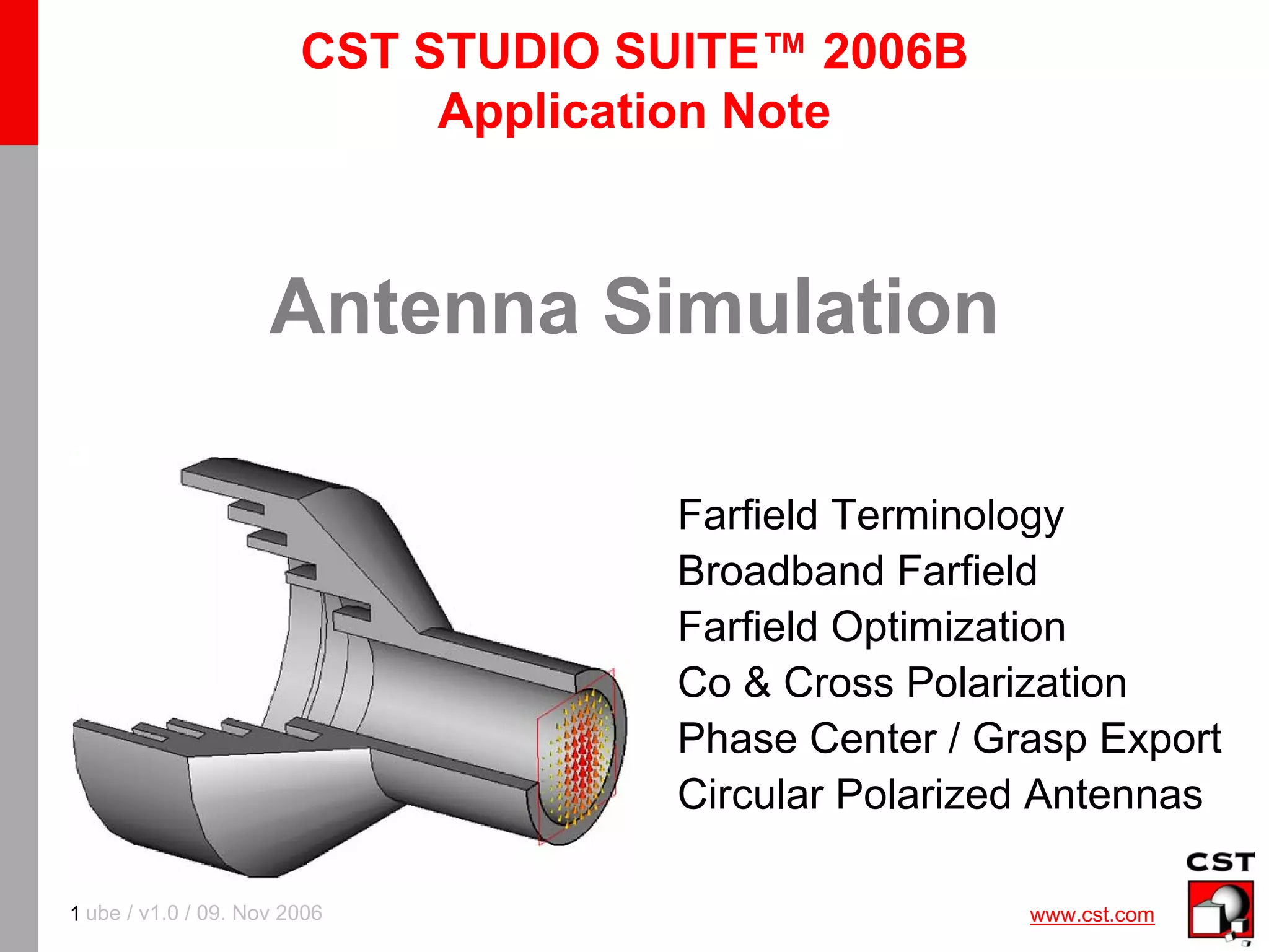
Antenna Simulation
Farfield Terminology
Broadband Farfield
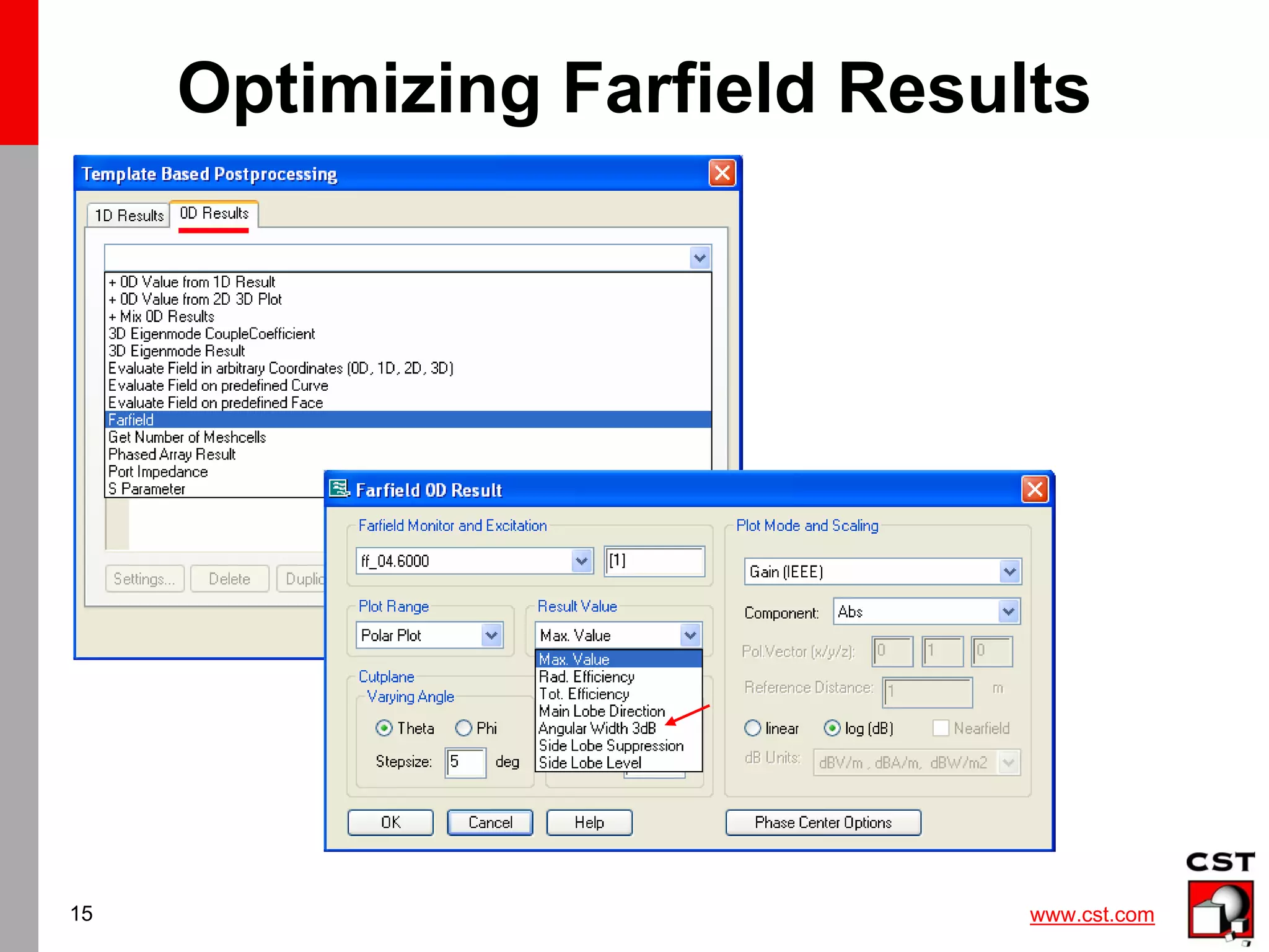
Farfield Optimization
Co & Cross Polarization
Phase Center / Grasp Export
Circular Polarized Antennas
ube / v1.0 / 09. Nov 2006
www.cst.com
2
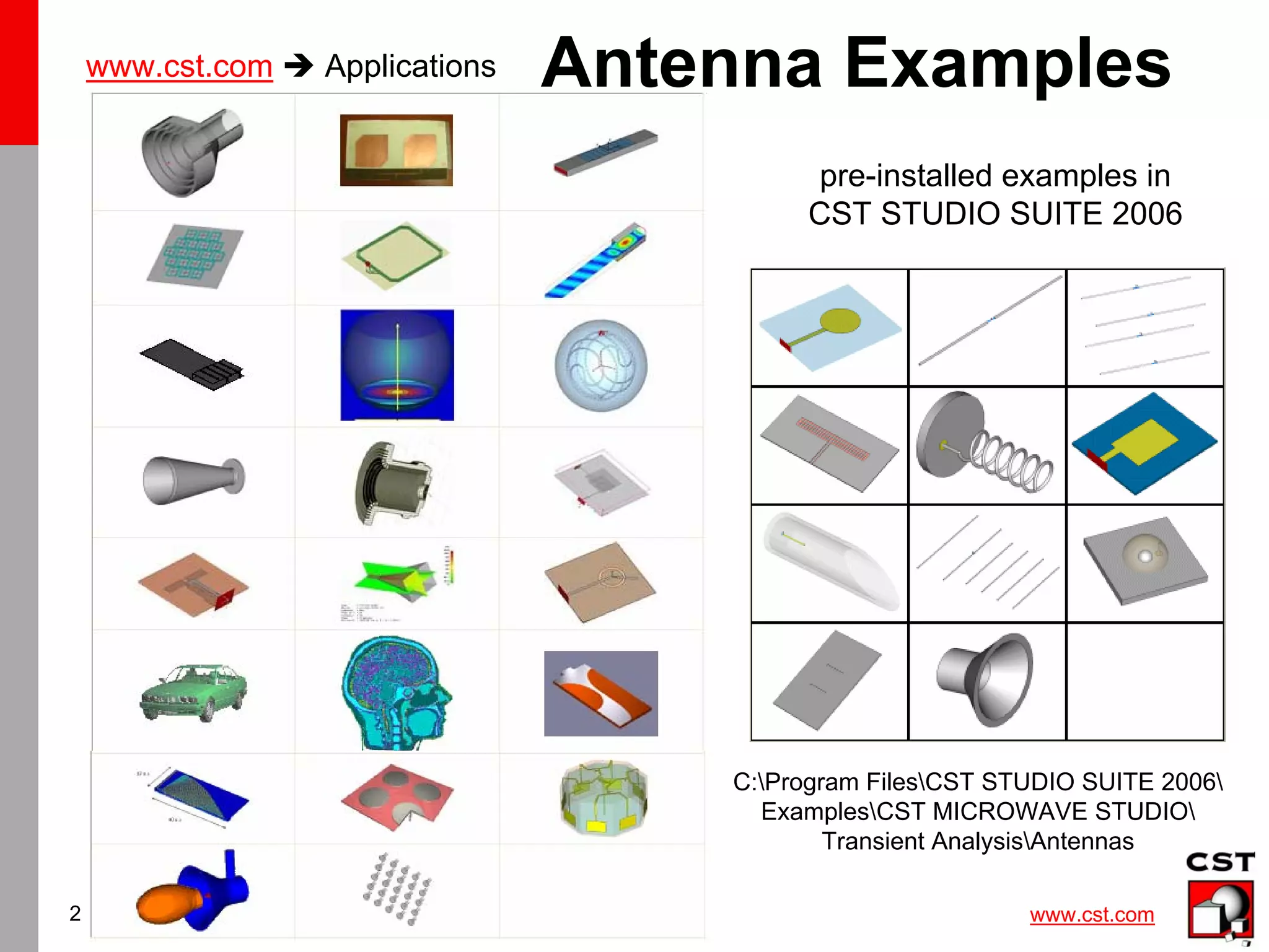
www.cst.com Î Applications
pre-installed examples in
CST STUDIO SUITE 2006
C:Program FilesCST STUDIO SUITE 2006
ExamplesCST MICROWAVE STUDIO
Transient AnalysisAntennas
Antenna Examples
www.cst.com
3
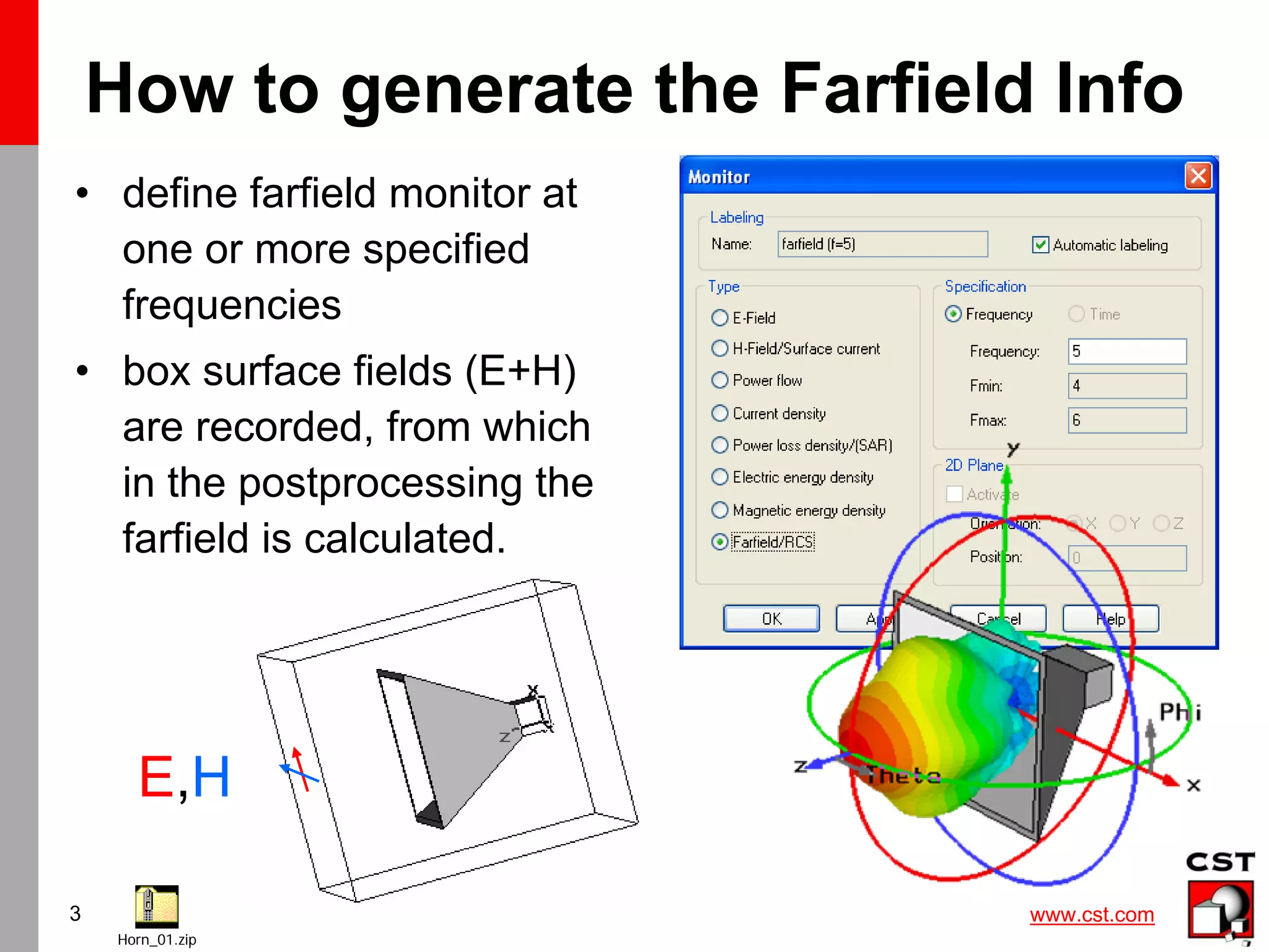
How to generate the Farfield Info
• define farfield monitor at
one or more specified
frequencies
• box surface fields (E+H)
are recorded, from which
in the postprocessing the
farfield is calculated.
Horn_01.zip
E,H
www.cst.com
4
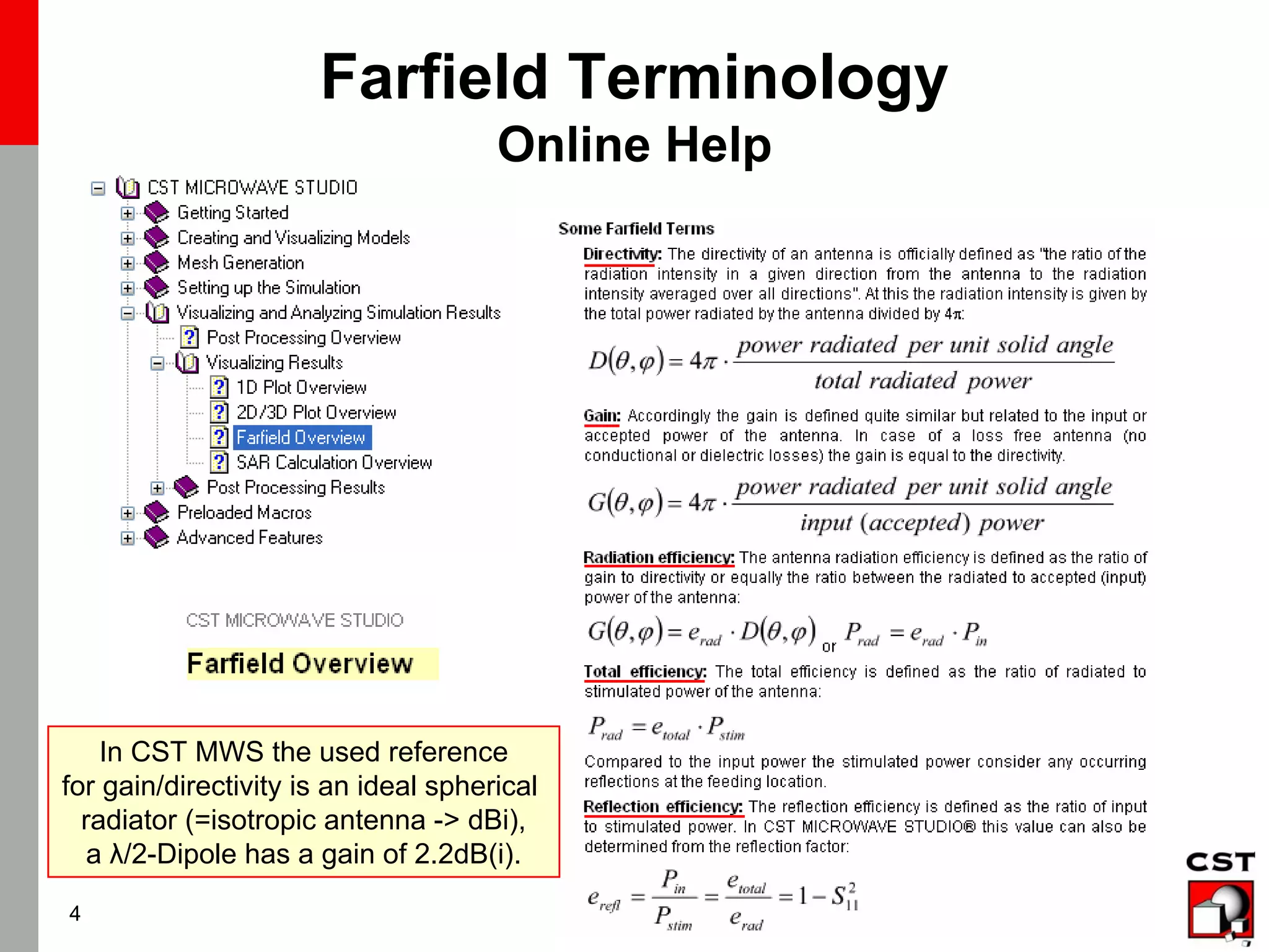
Farfield Terminology
Online Help
In CST MWS the used reference
for gain/directivity is an ideal spherical
radiator (=isotropic antenna -> dBi),
a λ/2-Dipole has a gain of 2.2dB(i).
www.cst.com
5
Tips & Tricks
to obtain accurate farfield results
www.cst.com
6
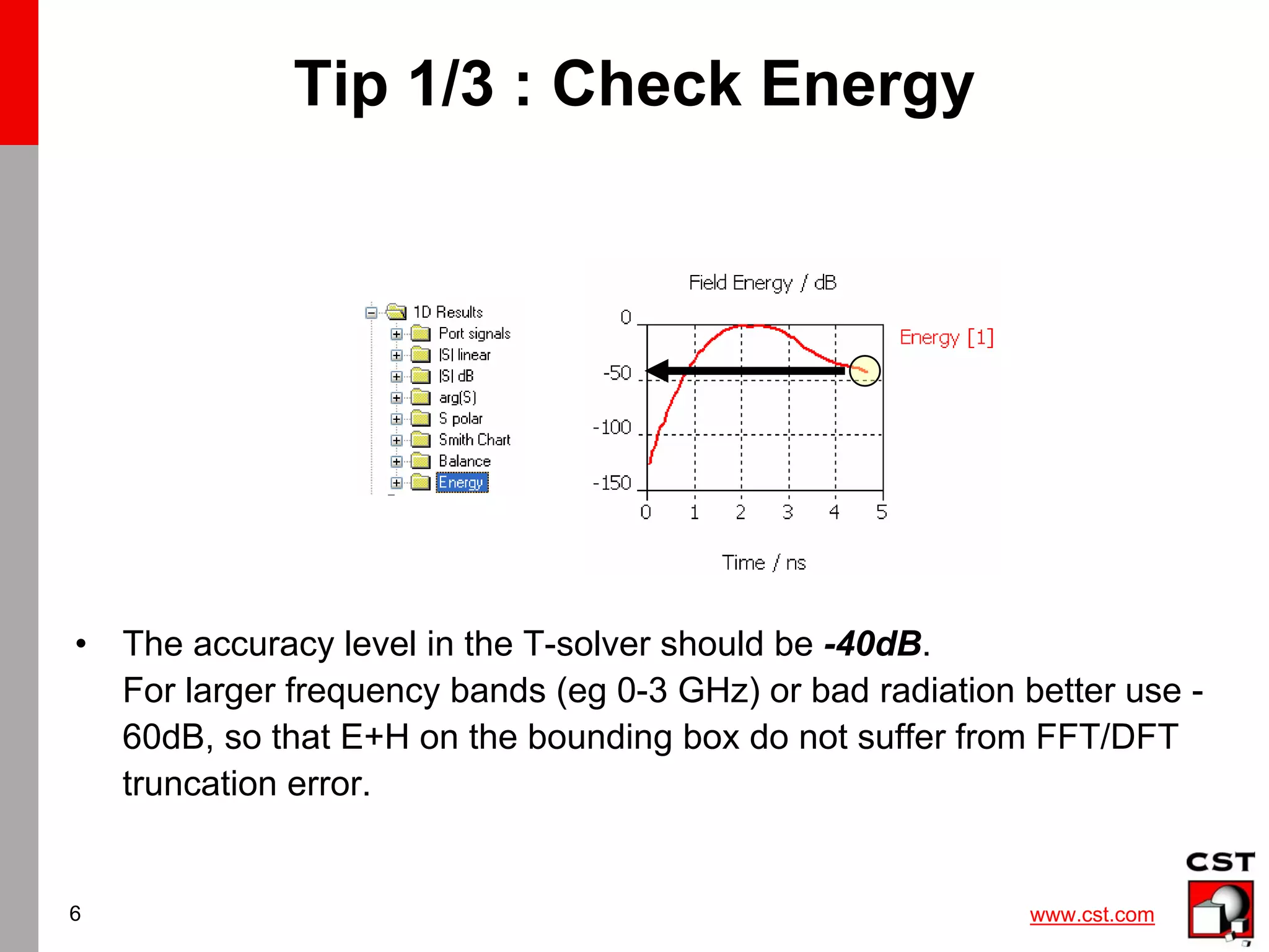
• The accuracy level in the T-solver should be -40dB.
For larger frequency bands (eg 0-3 GHz) or bad radiation better use -
60dB, so that E+H on the bounding box do not suffer from FFT/DFT
truncation error.
Tip 1/3 : Check Energy
www.cst.com
7
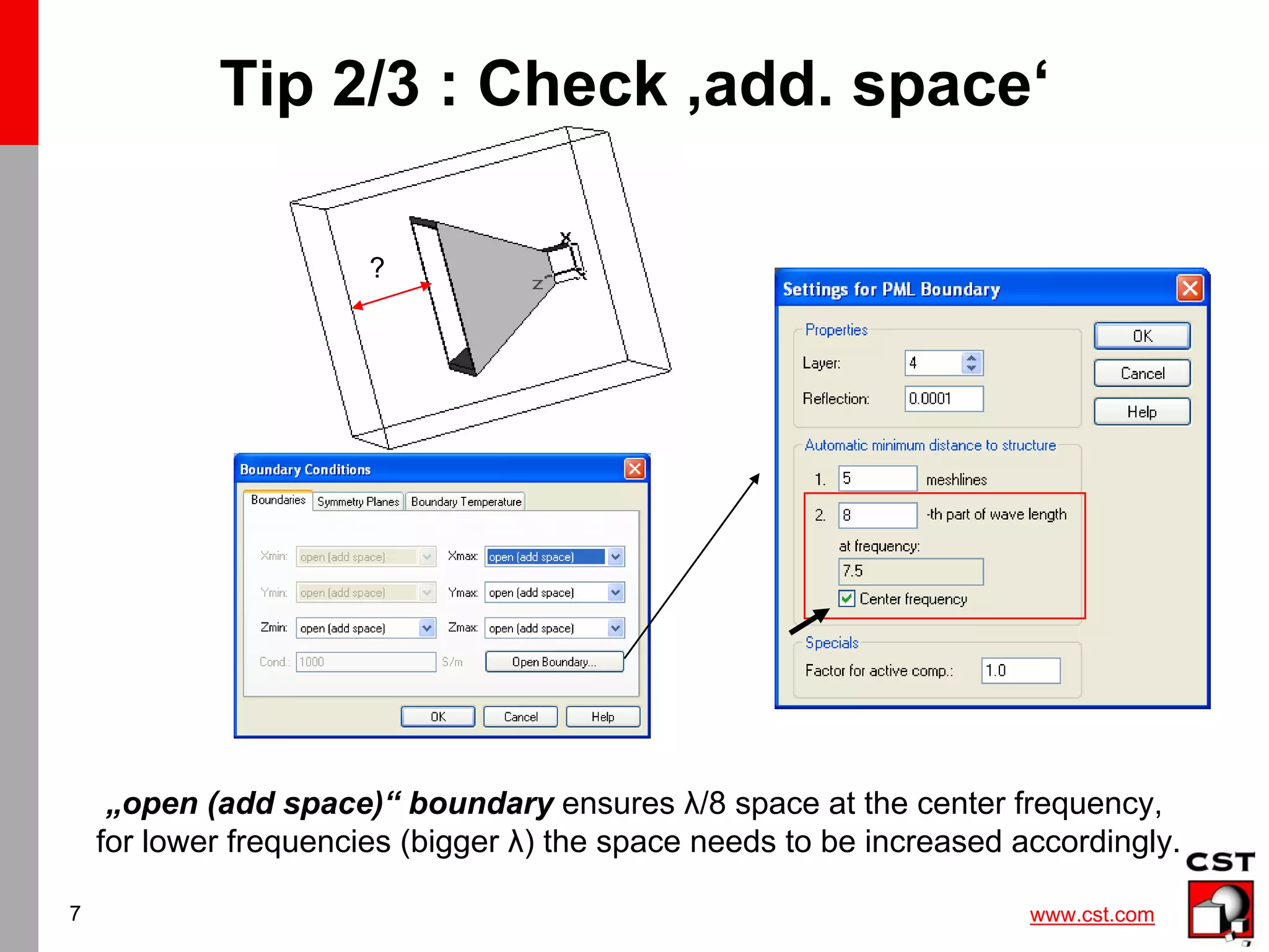
Tip 2/3 : Check ‚add. space‘
?
„open (add space)“ boundary ensures λ/8 space at the center frequency,
for lower frequencies (bigger λ) the space needs to be increased accordingly.
www.cst.com
8
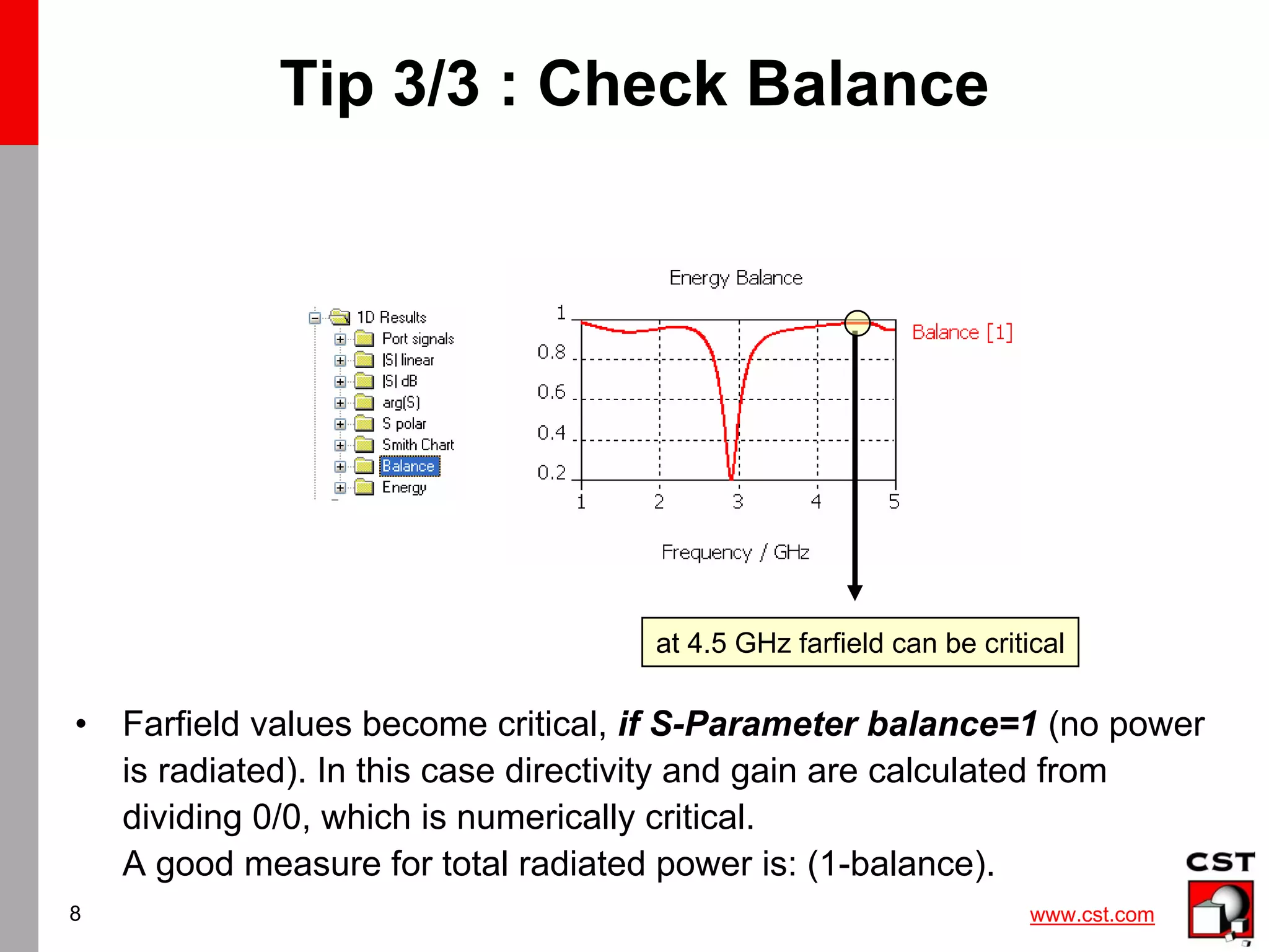
Tip 3/3 : Check Balance
• Farfield values become critical, if S-Parameter balance=1 (no power
is radiated). In this case directivity and gain are calculated from
dividing 0/0, which is numerically critical.
A good measure for total radiated power is: (1-balance).
at 4.5 GHz farfield can be critical
www.cst.com
9
How to calculate farfield
Broadband at many frequencies
www.cst.com
10
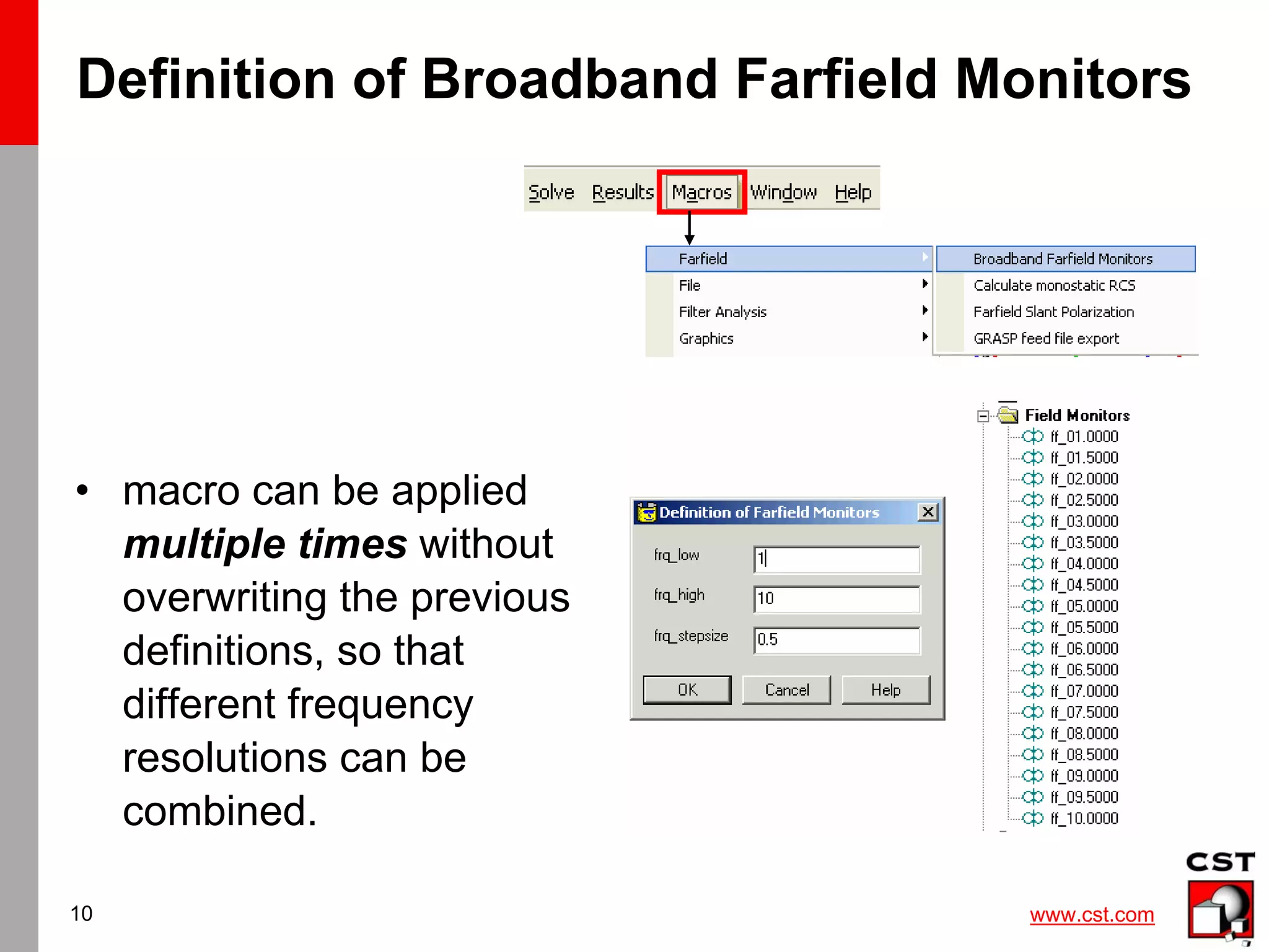
Definition of Broadband Farfield Monitors
• macro can be applied
multiple times without
overwriting the previous
definitions, so that
different frequency
resolutions can be
combined.
www.cst.com
11
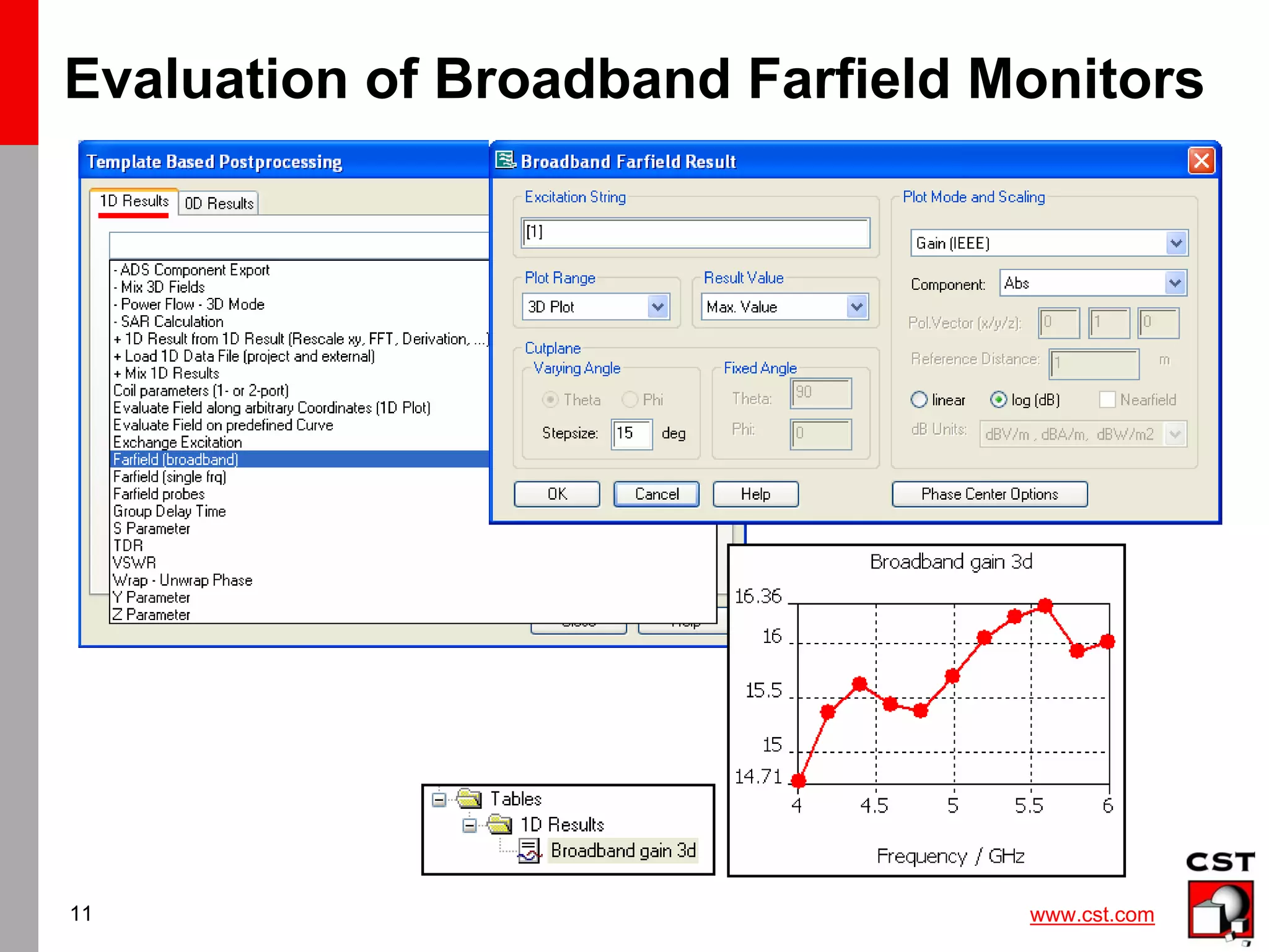
Evaluation of Broadband Farfield Monitors
www.cst.com
12
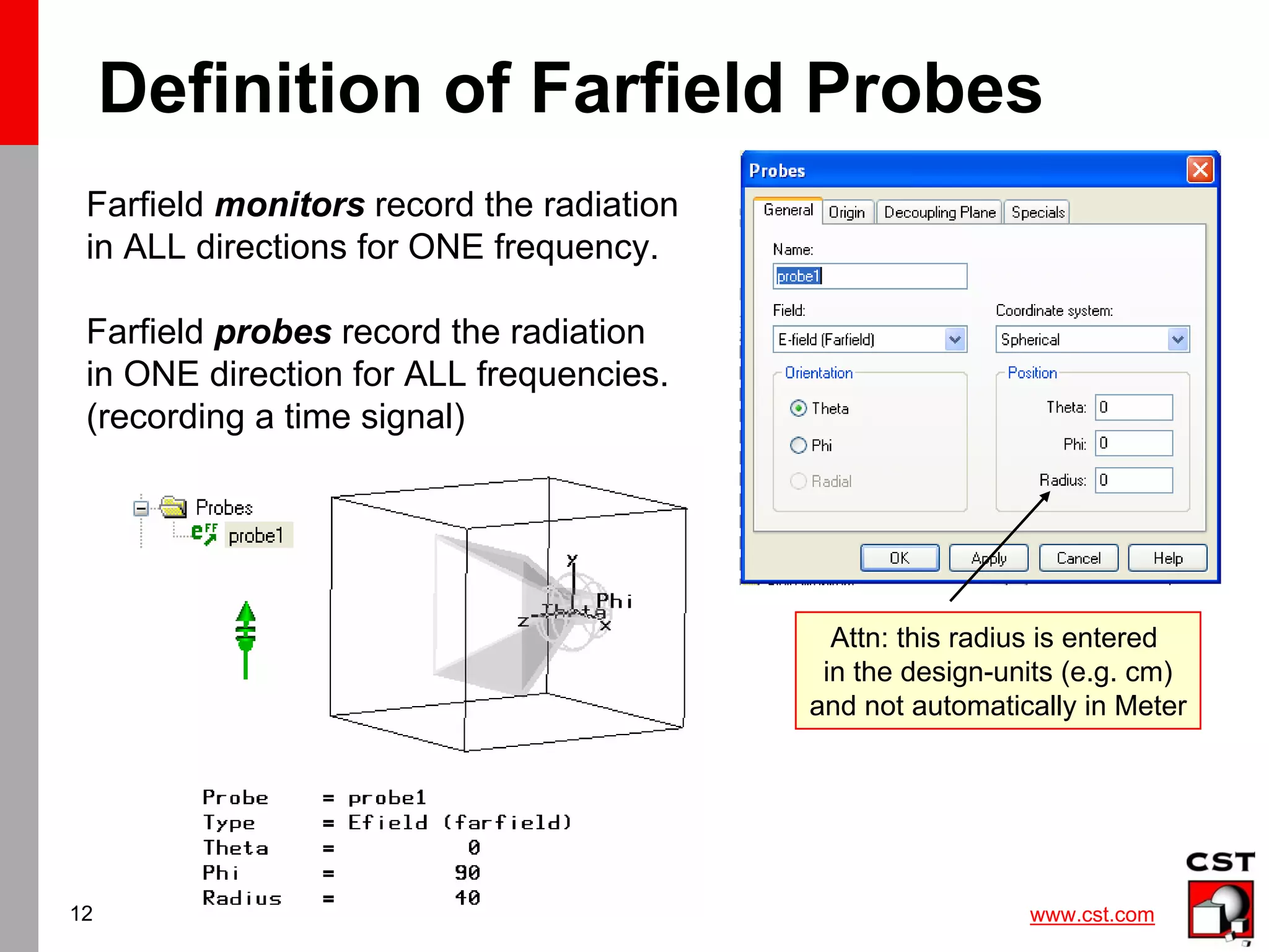
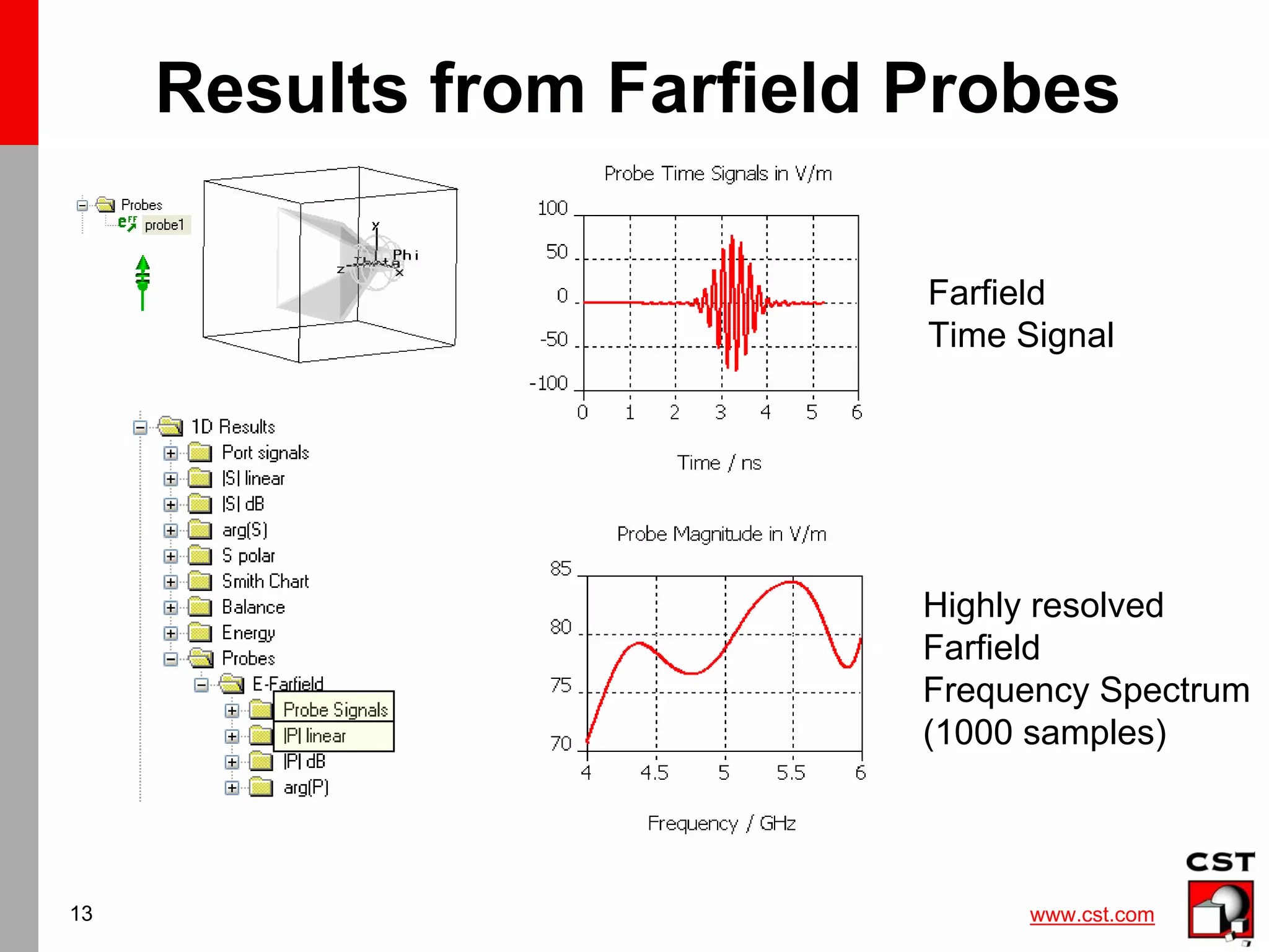
Definition of Farfield Probes
Farfield monitors record the radiation
in ALL directions for ONE frequency.
Farfield probes record the radiation
in ONE direction for ALL frequencies.
(recording a time signal)
Attn: this radius is entered
in the design-units (e.g. cm)
and not automatically in Meter
www.cst.com
13
Results from Farfield Probes
Farfield
Time Signal
Highly resolved
Farfield
Frequency Spectrum
(1000 samples)
www.cst.com
14
Optimizing Farfield Results
www.cst.com
15
Optimizing Farfield Results
www.cst.com
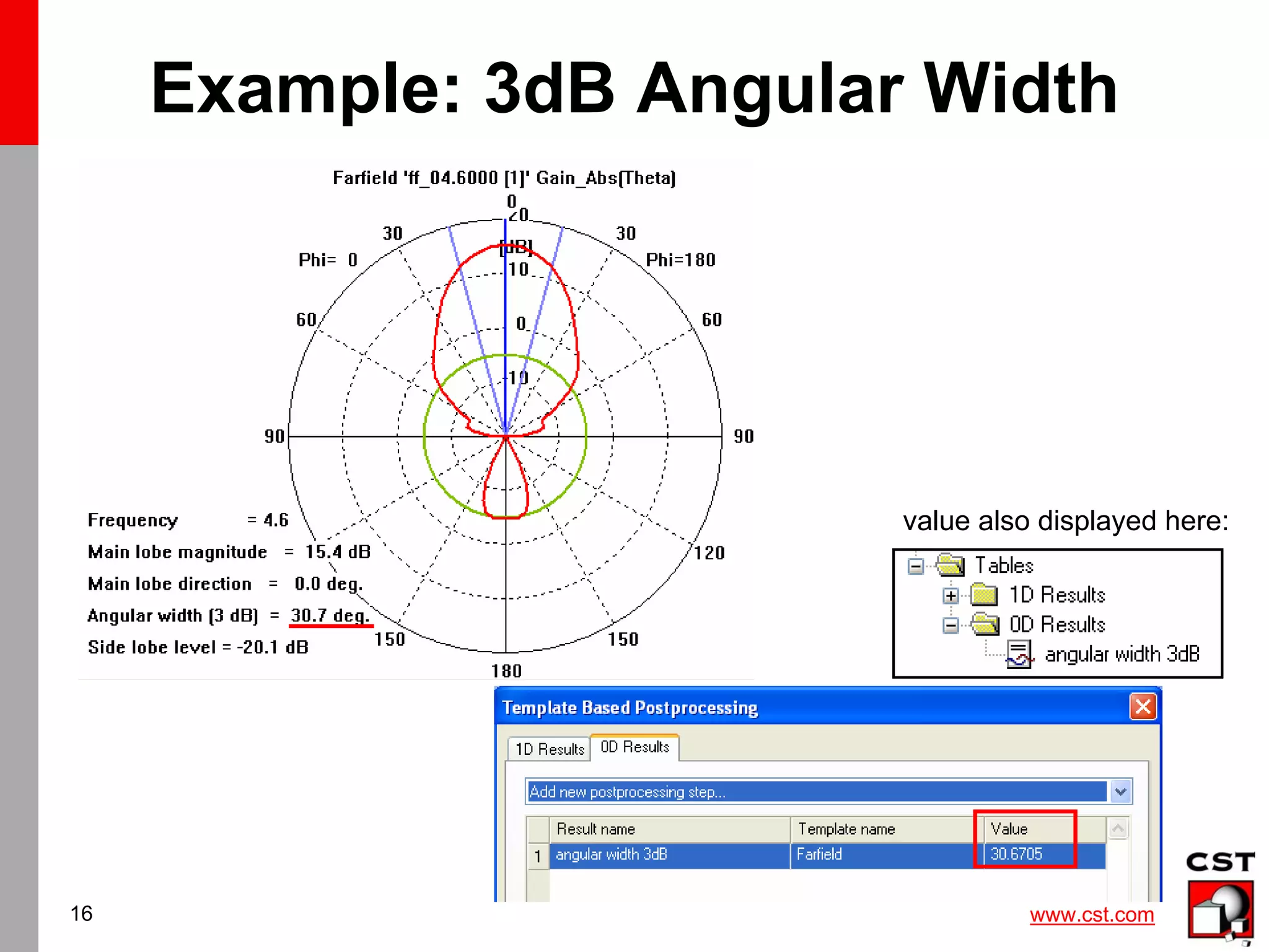
16
Example: 3dB Angular Width
value also displayed here:
www.cst.com
17
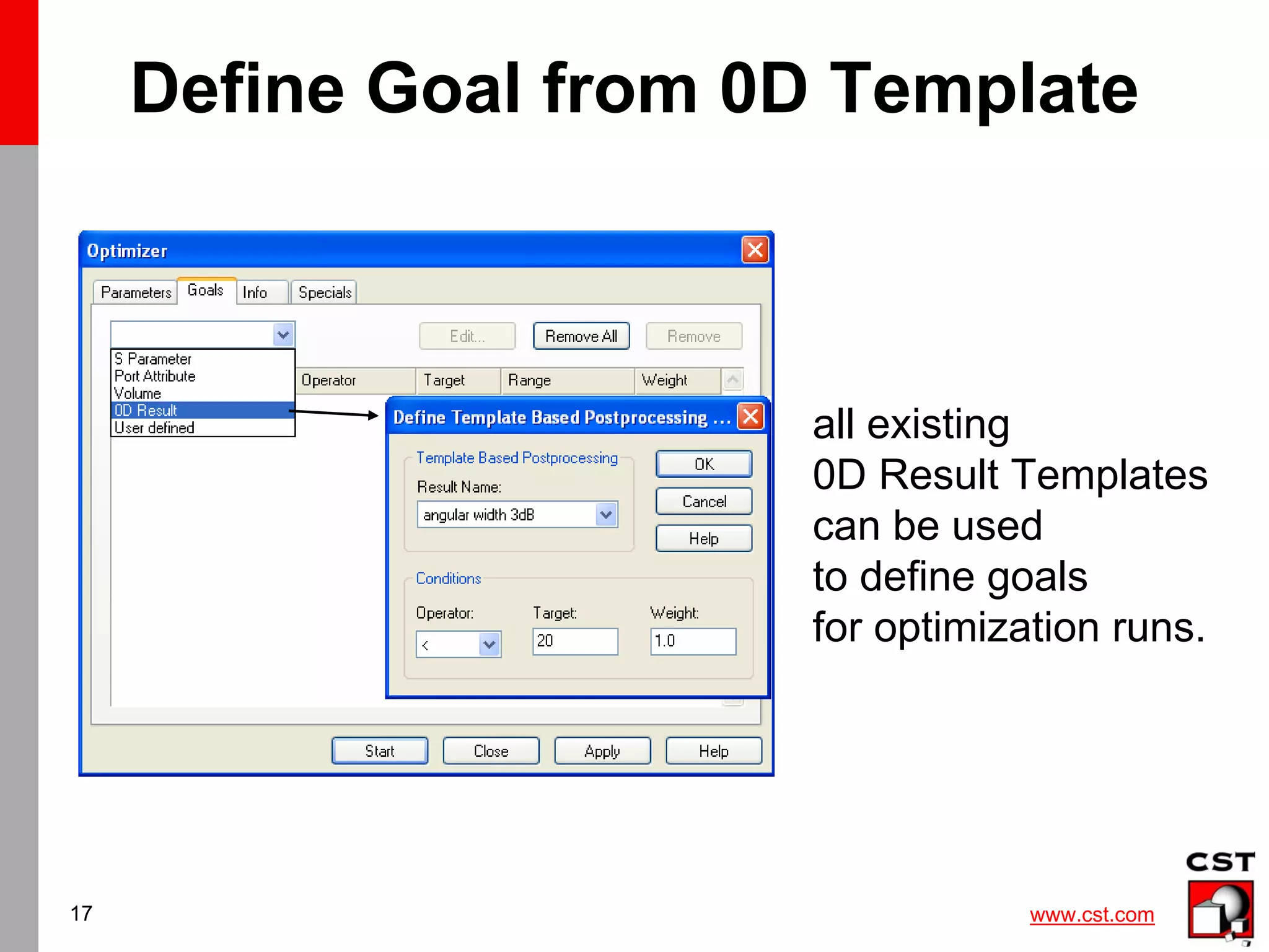
Define Goal from 0D Template
all existing
0D Result Templates
can be used
to define goals
for optimization runs.
www.cst.com
18
Co & Cross Polarization
www.cst.com
19
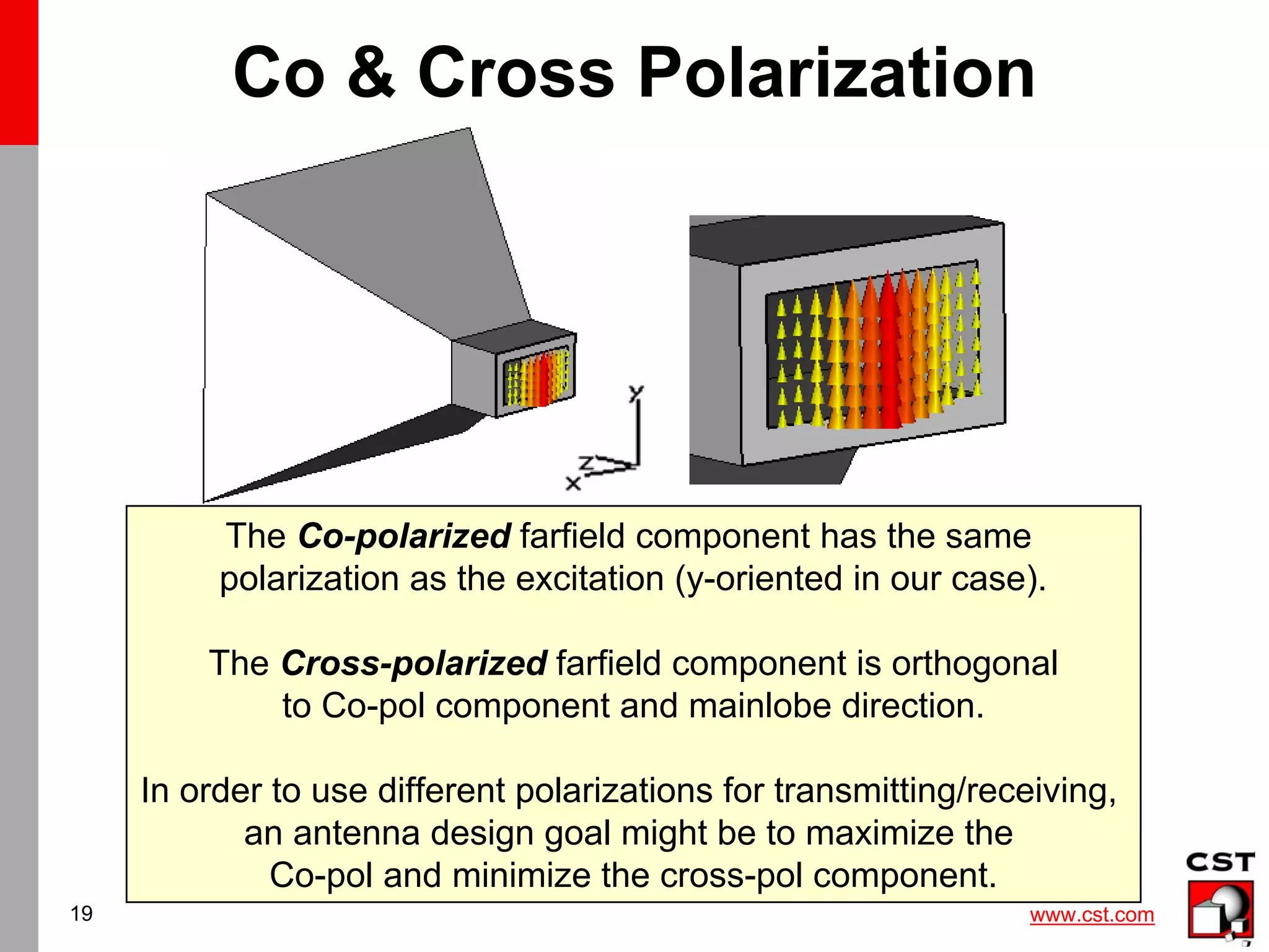
Co & Cross Polarization
The Co-polarized farfield component has the same
polarization as the excitation (y-oriented in our case).
The Cross-polarized farfield component is orthogonal
to Co-pol component and mainlobe direction.
In order to use different polarizations for transmitting/receiving,
an antenna design goal might be to maximize the
Co-pol and minimize the cross-pol component.
www.cst.com
20
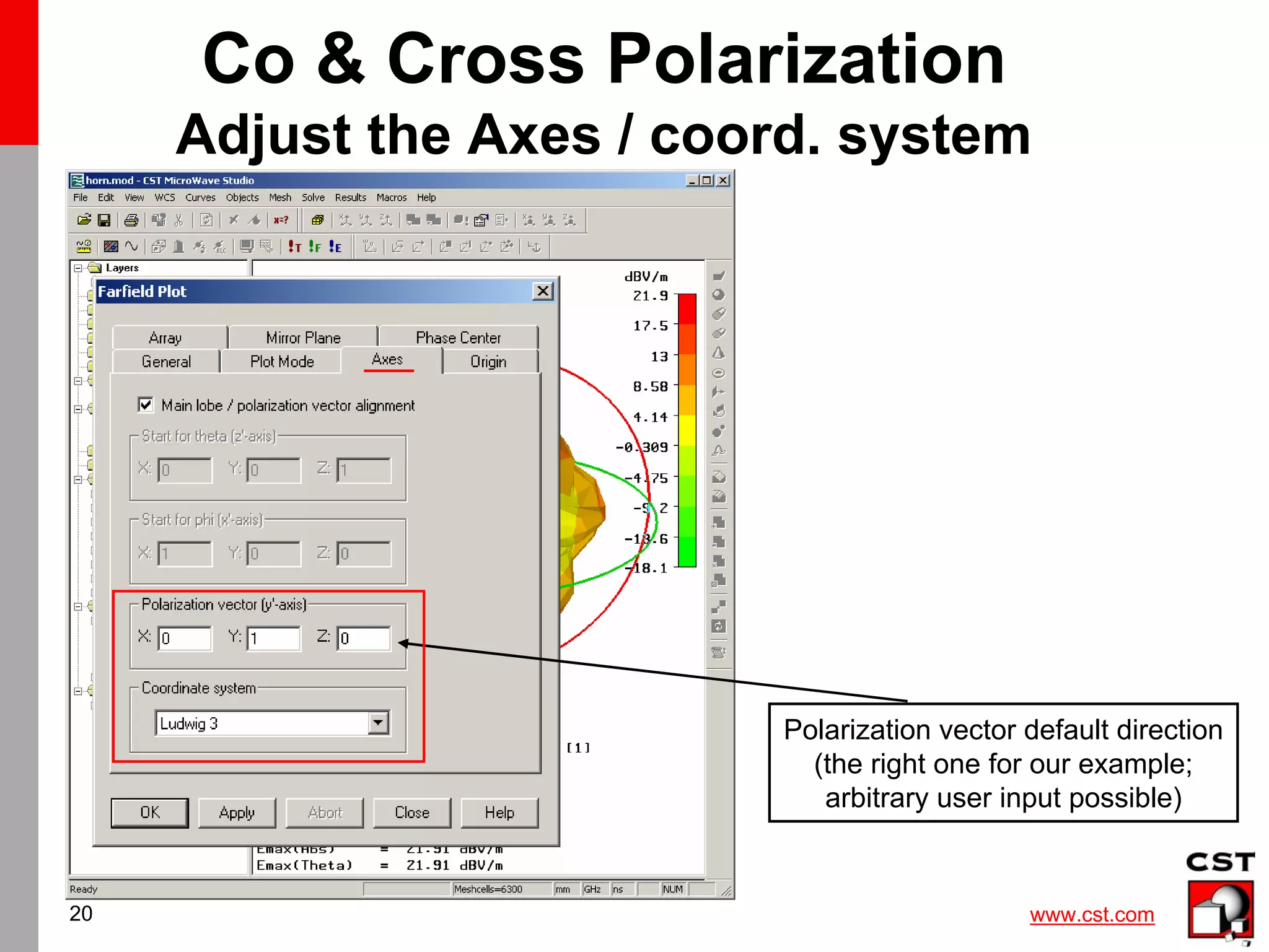
Co & Cross Polarization
Adjust the Axes / coord. system
Polarization vector default direction
(the right one for our example;
arbitrary user input possible)
www.cst.com
21
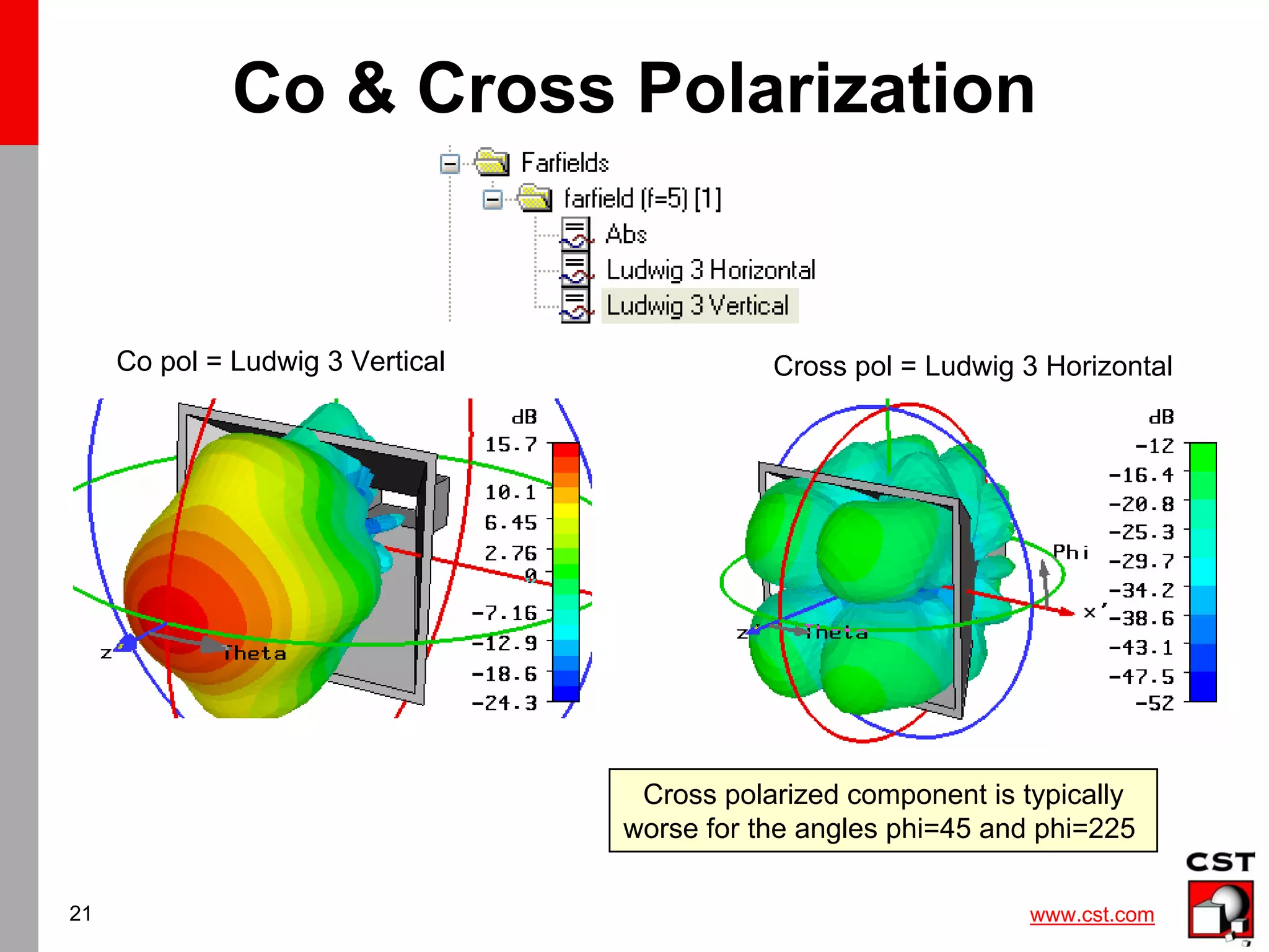
Co pol = Ludwig 3 Vertical Cross pol = Ludwig 3 Horizontal
Co & Cross Polarization
Cross polarized component is typically
worse for the angles phi=45 and phi=225
www.cst.com
22
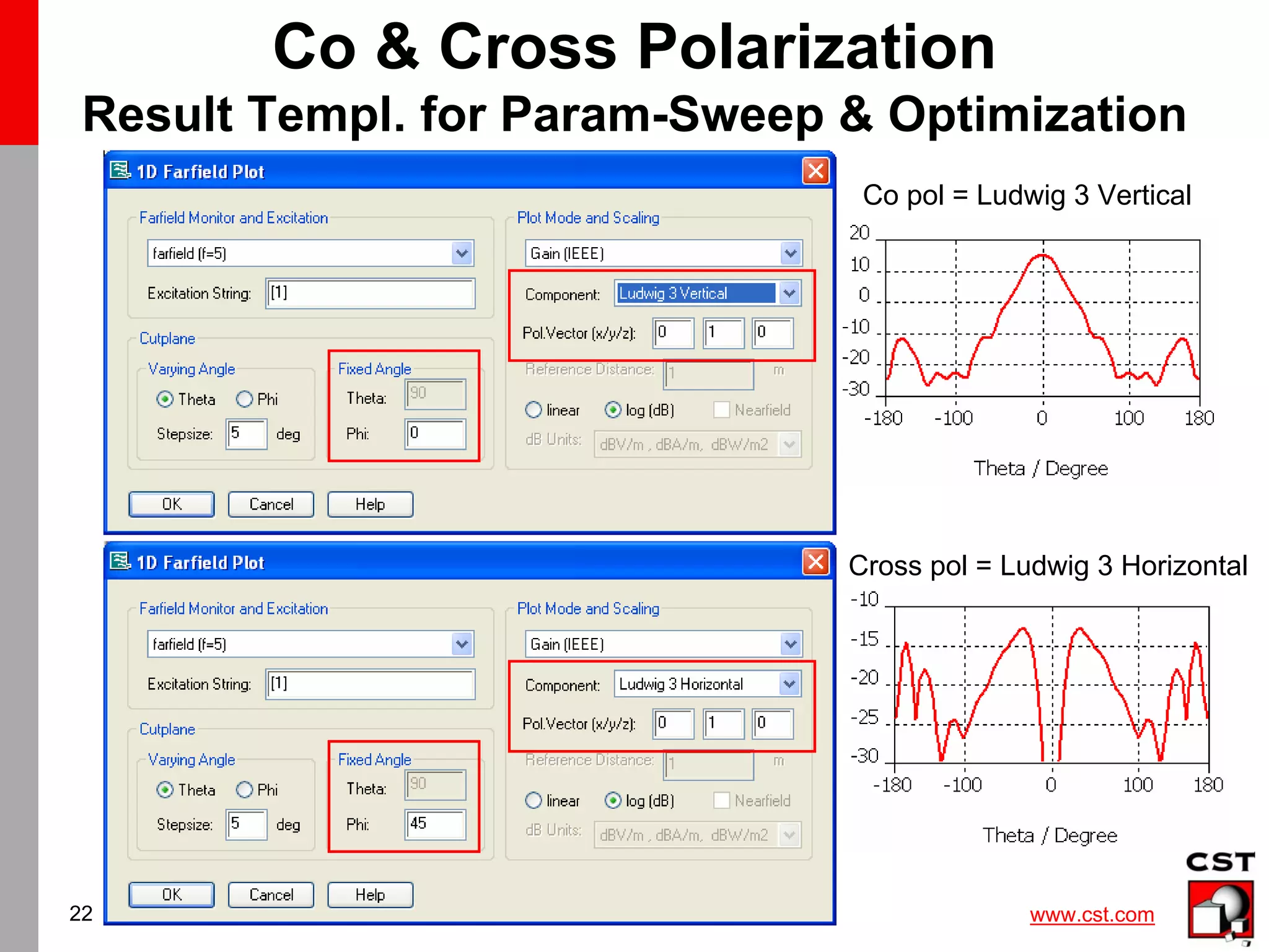
Co & Cross Polarization
Result Templ. for Param-Sweep & Optimization
Co pol = Ludwig 3 Vertical
Cross pol = Ludwig 3 Horizontal
www.cst.com
23
Phase Center / Grasp Export
www.cst.com
24
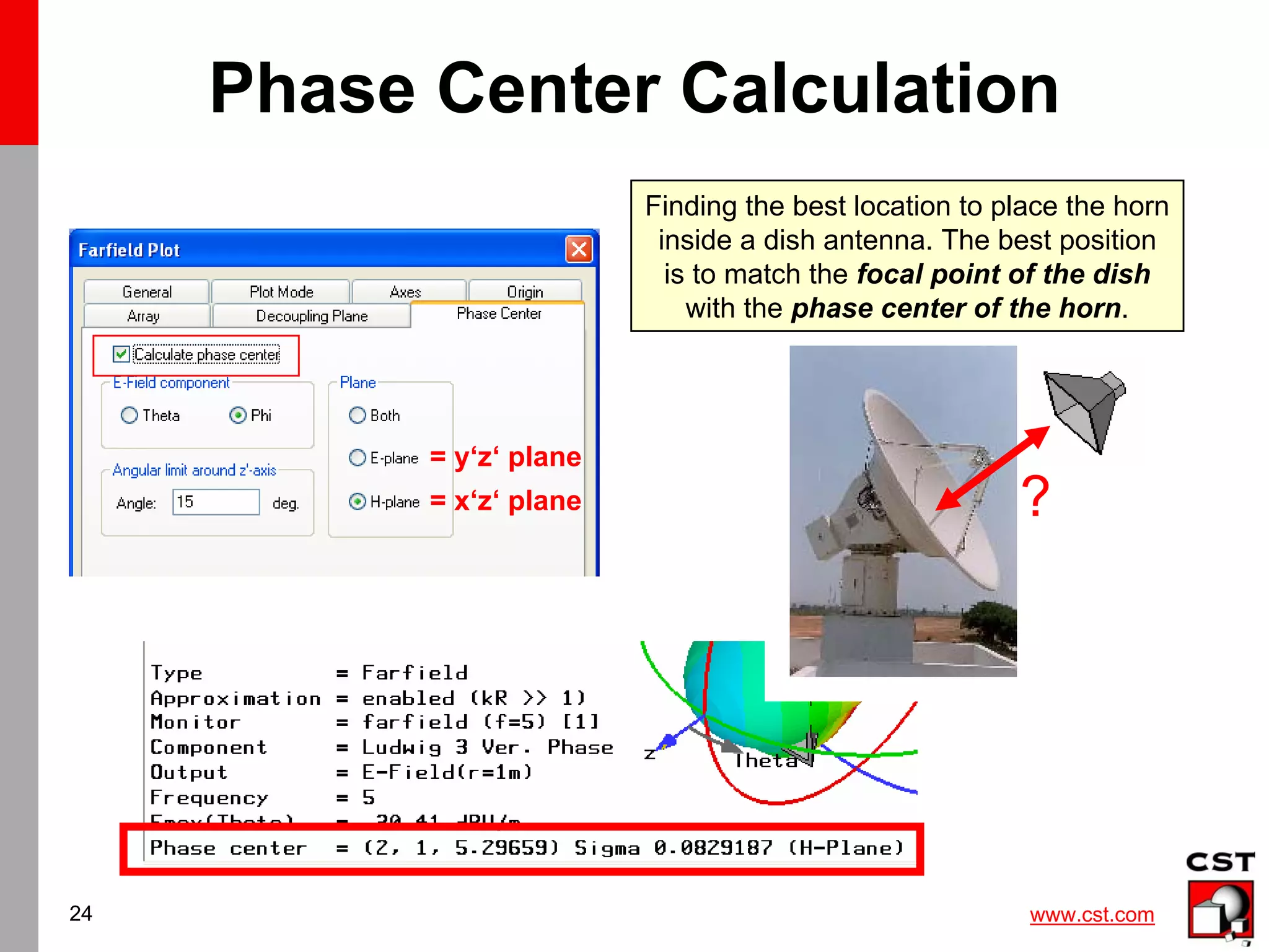
Phase Center Calculation
= y‘z‘ plane
= x‘z‘ plane
Finding the best location to place the horn
inside a dish antenna. The best position
is to match the focal point of the dish
with the phase center of the horn.
?
www.cst.com
25
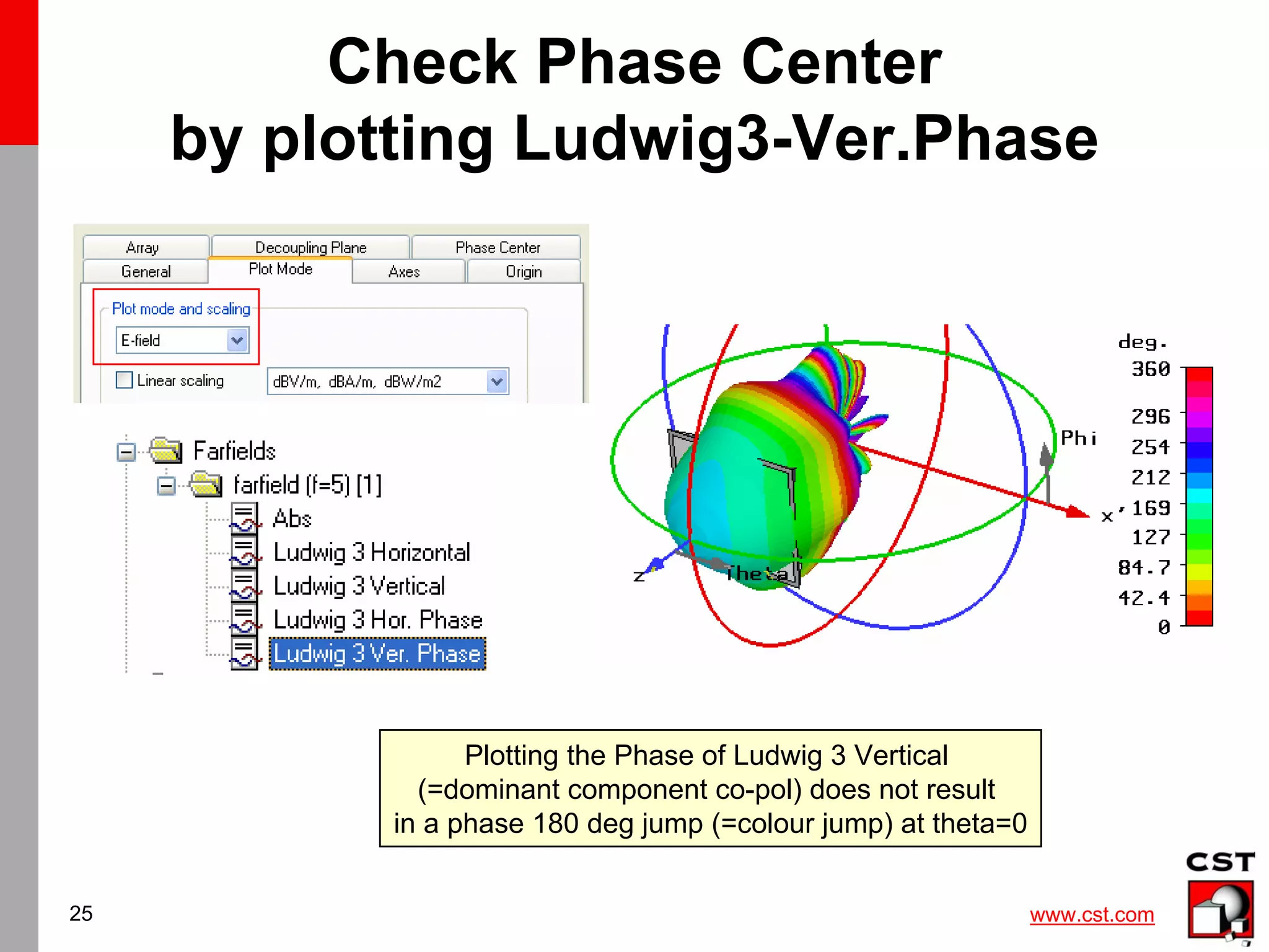
Check Phase Center
by plotting Ludwig3-Ver.Phase
Plotting the Phase of Ludwig 3 Vertical
(=dominant component co-pol) does not result
in a phase 180 deg jump (=colour jump) at theta=0
www.cst.com
26
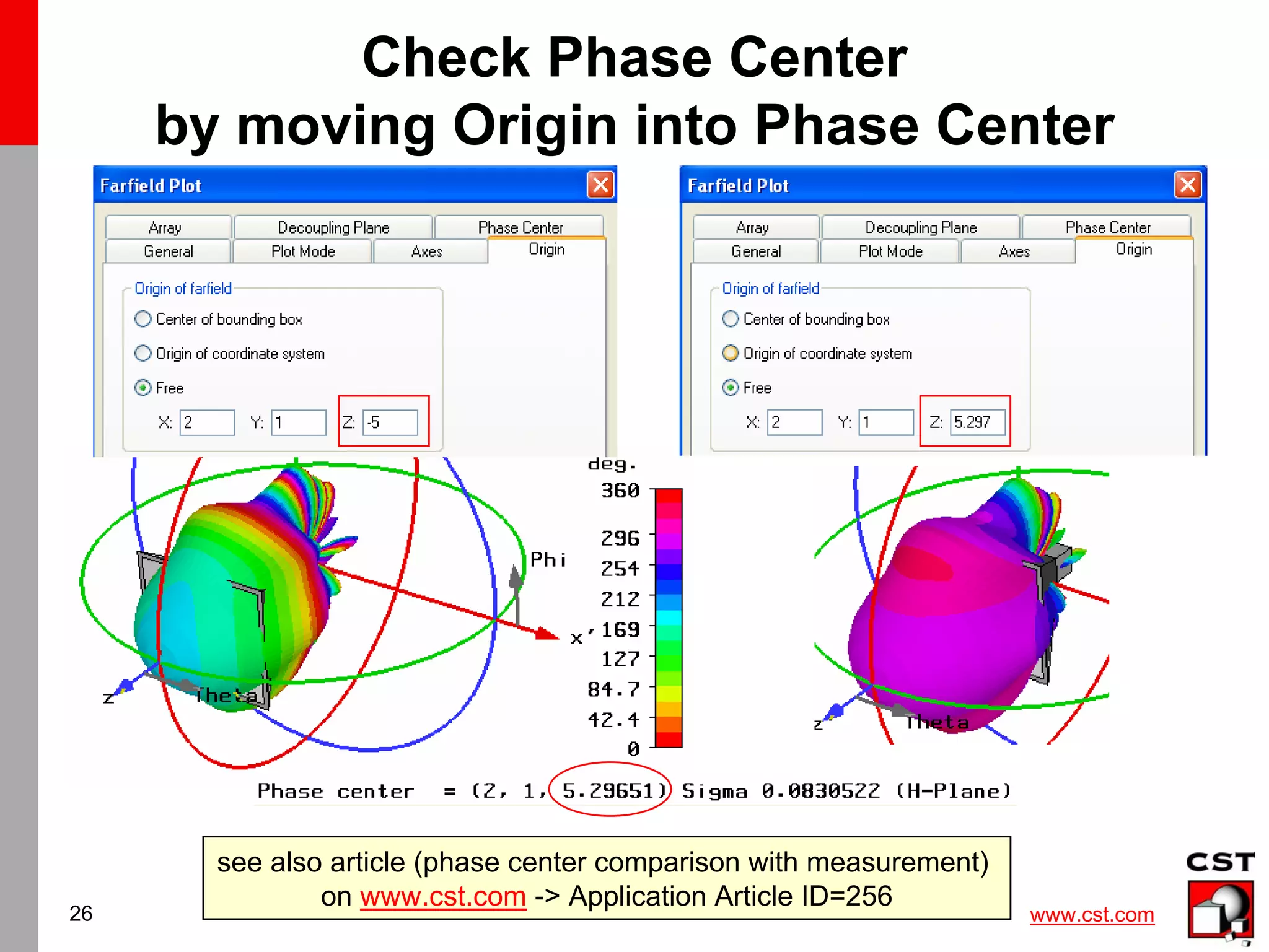
Check Phase Center
by moving Origin into Phase Center
see also article (phase center comparison with measurement)
on www.cst.com -> Application Article ID=256
www.cst.com
27
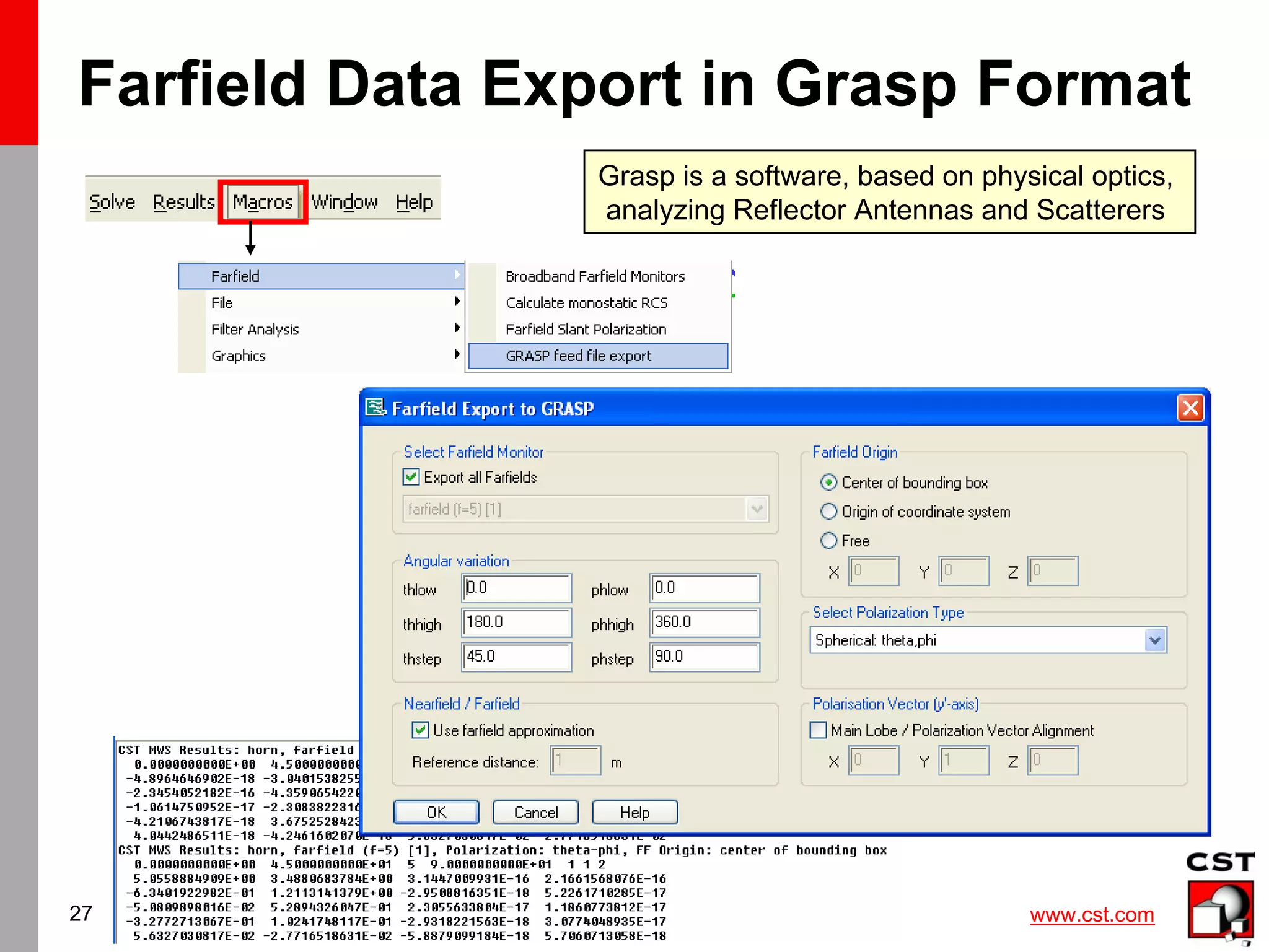
Farfield Data Export in Grasp Format
Grasp is a software, based on physical optics,
analyzing Reflector Antennas and Scatterers
www.cst.com
28
Circular Polarized Antennas
www.cst.com
29
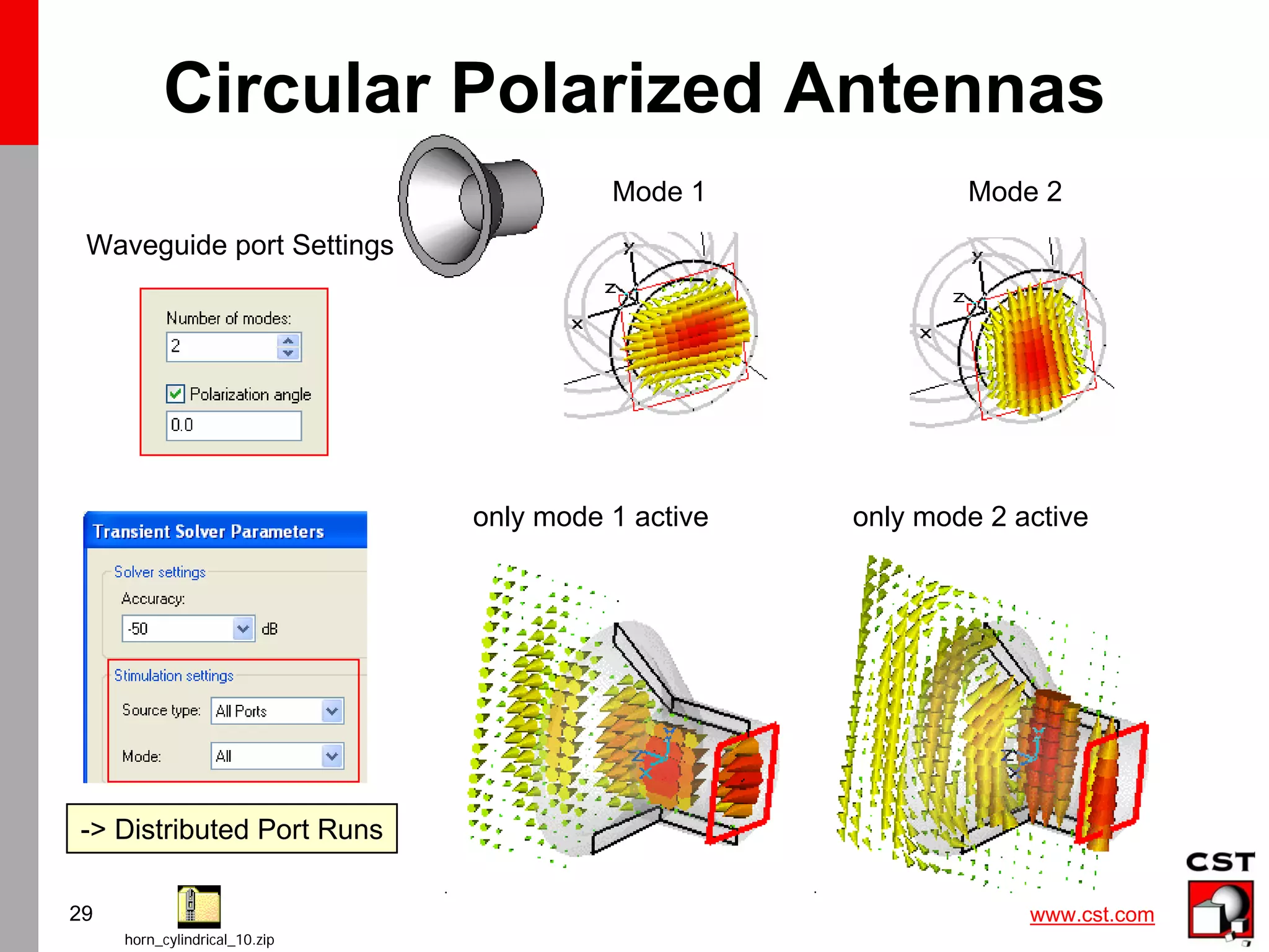
Circular Polarized Antennas
Waveguide port Settings
Mode 1 Mode 2
only mode 1 active only mode 2 active
horn_cylindrical_10.zip
-> Distributed Port Runs
www.cst.com
30
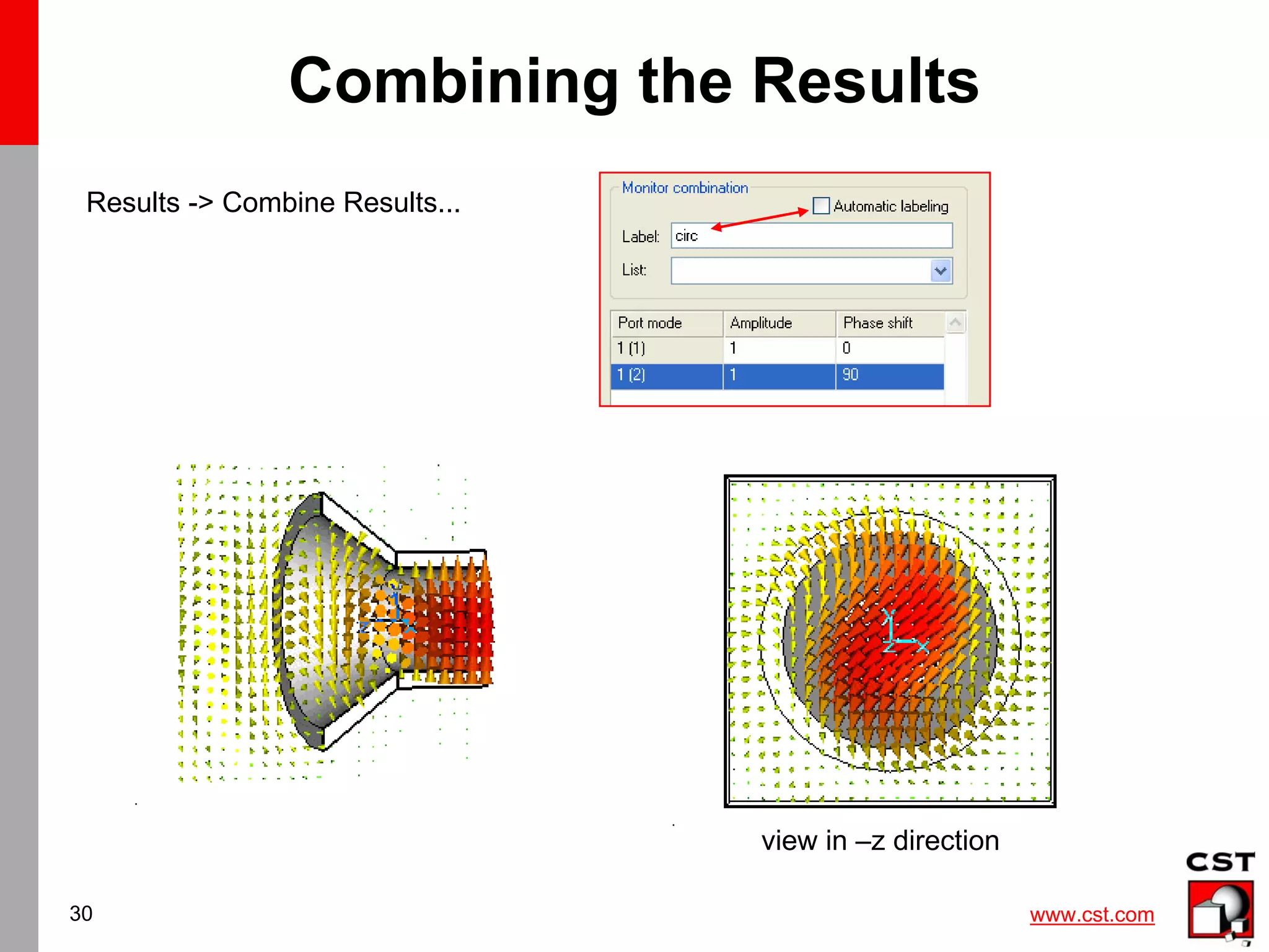
Combining the Results
Results -> Combine Results...
view in –z direction
www.cst.com
31
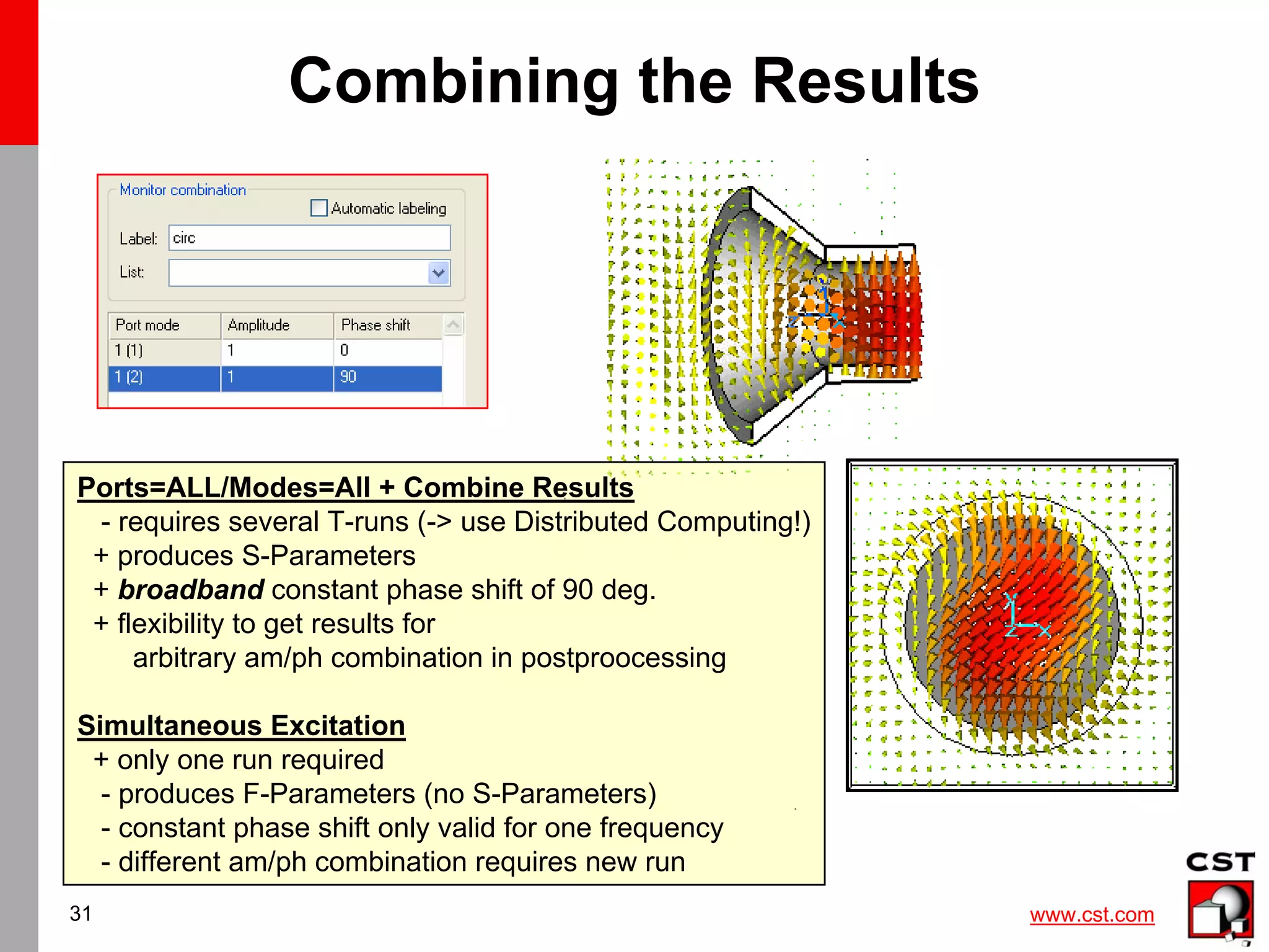
Combining the Results
Ports=ALL/Modes=All + Combine Results
- requires several T-runs (-> use Distributed Computing!)
+ produces S-Parameters
+ broadband constant phase shift of 90 deg.
+ flexibility to get results for
arbitrary am/ph combination in postproocessing
Simultaneous Excitation
+ only one run required
- produces F-Parameters (no S-Parameters)
- constant phase shift only valid for one frequency
- different am/ph combination requires new run
www.cst.com
32
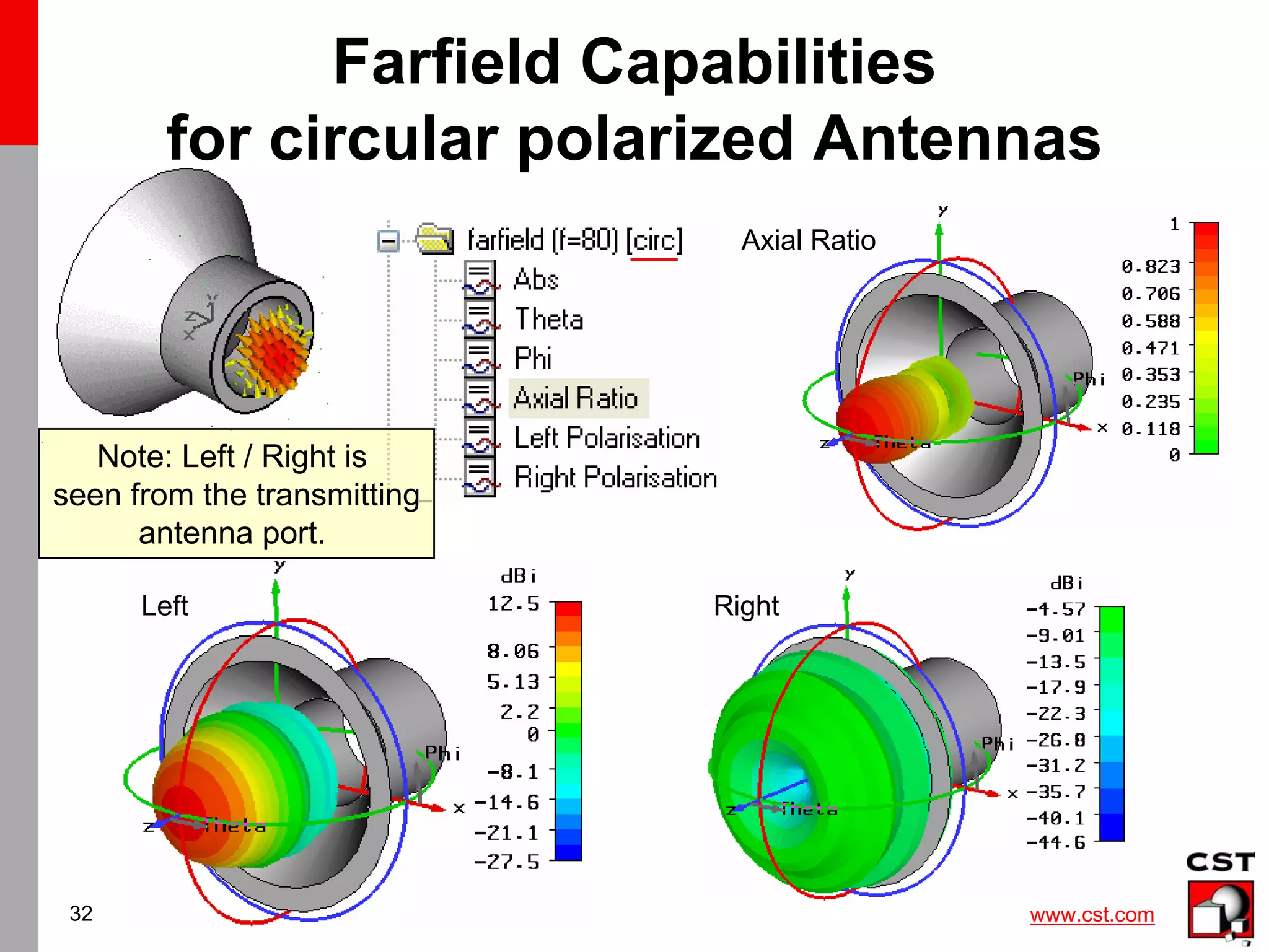
Farfield Capabilities
for circular polarized Antennas
Axial Ratio
Left Right
Note: Left / Right is
seen from the transmitting
antenna port.
www.cst.com
33
Result Template for Combined Monitor
1[1.0,0.0]+2[1.0,90],[80]
Note: In all farfield result templates
the Excitation string has
to be set manually !!
It is recommended to use
a shorter userdefined labelling
instead of the automatic
number- labelling.
„circ“
„circ“
www.cst.com
34
Summary
• Antenna Farfield can be recorded in time and
frequency domain (Probe / Monitor)
• Postprocessing templates automize result
extraction (e.g. broadband farfield)
• checklist for accurate farfield:
– energy decayed to -40dB [-60dB] ?
– enough surrounding space (λ/8) – open (add space)?
– Is antenna radiating at this frequency? (S-balance<1 ?)
• Advanced capabilities to extract:
co+cross-pol / phase center / Grasp input data
RL pol / axial ratio

CST_ANTENNA-CST STUDIO SUITE™ 2006B.pdf

  • 1.
    www.cst.com 1 CST STUDIO SUITE™2006B Application Note Antenna Simulation Farfield Terminology Broadband Farfield Farfield Optimization Co & Cross Polarization Phase Center / Grasp Export Circular Polarized Antennas ube / v1.0 / 09. Nov 2006
  • 2.
    www.cst.com 2 www.cst.com Î Applications pre-installedexamples in CST STUDIO SUITE 2006 C:Program FilesCST STUDIO SUITE 2006 ExamplesCST MICROWAVE STUDIO Transient AnalysisAntennas Antenna Examples
  • 3.
    www.cst.com 3 How to generatethe Farfield Info • define farfield monitor at one or more specified frequencies • box surface fields (E+H) are recorded, from which in the postprocessing the farfield is calculated. Horn_01.zip E,H
  • 4.
    www.cst.com 4 Farfield Terminology Online Help InCST MWS the used reference for gain/directivity is an ideal spherical radiator (=isotropic antenna -> dBi), a λ/2-Dipole has a gain of 2.2dB(i).
  • 5.
    www.cst.com 5 Tips & Tricks toobtain accurate farfield results
  • 6.
    www.cst.com 6 • The accuracylevel in the T-solver should be -40dB. For larger frequency bands (eg 0-3 GHz) or bad radiation better use - 60dB, so that E+H on the bounding box do not suffer from FFT/DFT truncation error. Tip 1/3 : Check Energy
  • 7.
    www.cst.com 7 Tip 2/3 :Check ‚add. space‘ ? „open (add space)“ boundary ensures λ/8 space at the center frequency, for lower frequencies (bigger λ) the space needs to be increased accordingly.
  • 8.
    www.cst.com 8 Tip 3/3 :Check Balance • Farfield values become critical, if S-Parameter balance=1 (no power is radiated). In this case directivity and gain are calculated from dividing 0/0, which is numerically critical. A good measure for total radiated power is: (1-balance). at 4.5 GHz farfield can be critical
  • 9.
    www.cst.com 9 How to calculatefarfield Broadband at many frequencies
  • 10.
    www.cst.com 10 Definition of BroadbandFarfield Monitors • macro can be applied multiple times without overwriting the previous definitions, so that different frequency resolutions can be combined.
  • 11.
  • 12.
    www.cst.com 12 Definition of FarfieldProbes Farfield monitors record the radiation in ALL directions for ONE frequency. Farfield probes record the radiation in ONE direction for ALL frequencies. (recording a time signal) Attn: this radius is entered in the design-units (e.g. cm) and not automatically in Meter
  • 13.
    www.cst.com 13 Results from FarfieldProbes Farfield Time Signal Highly resolved Farfield Frequency Spectrum (1000 samples)
  • 14.
  • 15.
  • 16.
    www.cst.com 16 Example: 3dB AngularWidth value also displayed here:
  • 17.
    www.cst.com 17 Define Goal from0D Template all existing 0D Result Templates can be used to define goals for optimization runs.
  • 18.
  • 19.
    www.cst.com 19 Co & CrossPolarization The Co-polarized farfield component has the same polarization as the excitation (y-oriented in our case). The Cross-polarized farfield component is orthogonal to Co-pol component and mainlobe direction. In order to use different polarizations for transmitting/receiving, an antenna design goal might be to maximize the Co-pol and minimize the cross-pol component.
  • 20.
    www.cst.com 20 Co & CrossPolarization Adjust the Axes / coord. system Polarization vector default direction (the right one for our example; arbitrary user input possible)
  • 21.
    www.cst.com 21 Co pol =Ludwig 3 Vertical Cross pol = Ludwig 3 Horizontal Co & Cross Polarization Cross polarized component is typically worse for the angles phi=45 and phi=225
  • 22.
    www.cst.com 22 Co & CrossPolarization Result Templ. for Param-Sweep & Optimization Co pol = Ludwig 3 Vertical Cross pol = Ludwig 3 Horizontal
  • 23.
  • 24.
    www.cst.com 24 Phase Center Calculation =y‘z‘ plane = x‘z‘ plane Finding the best location to place the horn inside a dish antenna. The best position is to match the focal point of the dish with the phase center of the horn. ?
  • 25.
    www.cst.com 25 Check Phase Center byplotting Ludwig3-Ver.Phase Plotting the Phase of Ludwig 3 Vertical (=dominant component co-pol) does not result in a phase 180 deg jump (=colour jump) at theta=0
  • 26.
    www.cst.com 26 Check Phase Center bymoving Origin into Phase Center see also article (phase center comparison with measurement) on www.cst.com -> Application Article ID=256
  • 27.
    www.cst.com 27 Farfield Data Exportin Grasp Format Grasp is a software, based on physical optics, analyzing Reflector Antennas and Scatterers
  • 28.
  • 29.
    www.cst.com 29 Circular Polarized Antennas Waveguideport Settings Mode 1 Mode 2 only mode 1 active only mode 2 active horn_cylindrical_10.zip -> Distributed Port Runs
  • 30.
    www.cst.com 30 Combining the Results Results-> Combine Results... view in –z direction
  • 31.
    www.cst.com 31 Combining the Results Ports=ALL/Modes=All+ Combine Results - requires several T-runs (-> use Distributed Computing!) + produces S-Parameters + broadband constant phase shift of 90 deg. + flexibility to get results for arbitrary am/ph combination in postproocessing Simultaneous Excitation + only one run required - produces F-Parameters (no S-Parameters) - constant phase shift only valid for one frequency - different am/ph combination requires new run
  • 32.
    www.cst.com 32 Farfield Capabilities for circularpolarized Antennas Axial Ratio Left Right Note: Left / Right is seen from the transmitting antenna port.
  • 33.
    www.cst.com 33 Result Template forCombined Monitor 1[1.0,0.0]+2[1.0,90],[80] Note: In all farfield result templates the Excitation string has to be set manually !! It is recommended to use a shorter userdefined labelling instead of the automatic number- labelling. „circ“ „circ“
  • 34.
    www.cst.com 34 Summary • Antenna Farfieldcan be recorded in time and frequency domain (Probe / Monitor) • Postprocessing templates automize result extraction (e.g. broadband farfield) • checklist for accurate farfield: – energy decayed to -40dB [-60dB] ? – enough surrounding space (λ/8) – open (add space)? – Is antenna radiating at this frequency? (S-balance<1 ?) • Advanced capabilities to extract: co+cross-pol / phase center / Grasp input data RL pol / axial ratio