Paging Concepts
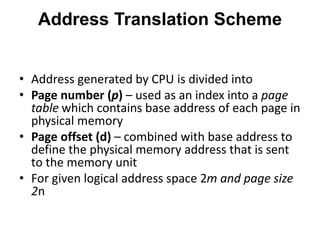
Address Translation Scheme
• Address generated by CPU is divided into
• Page number (p) – used as an index into a page
table which contains base address of each page in
physical memory
• Page offset (d) – combined with base address to
define the physical memory address that is sent
to the memory unit
• For given logical address space 2m and page size
2n
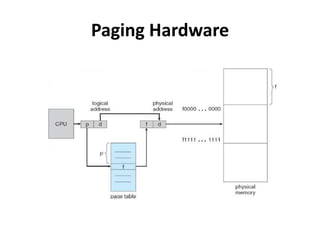
Paging Hardware
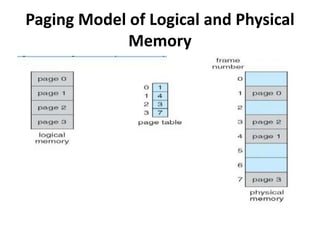
Paging Model of Logical and Physical
Memory
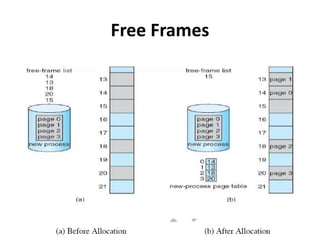
Free Frames
Implementation of Page Table
• Page table is kept in main memory
• Page-table base register (PTBR) points to the page table
• Page-table length register (PRLR) indicates size of the page table
• In this scheme every data/instruction access requires two memory
accesses. One for the page table and one for the data/instruction.
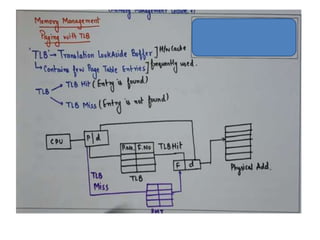
• The two memory access problem can be solved by the use of a
special fast-lookup hardware cache called associative memory or
translation look-aside buffers (TLBs)
• Some TLBs store address-space identifiers (ASIDs) in each TLB
entry – uniquely identifies each process to provide address-space
protection for that process
Associative Memory
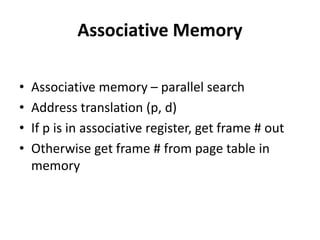
• Associative memory – parallel search
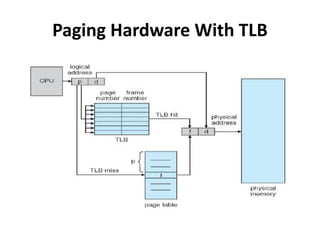
• Address translation (p, d)
• If p is in associative register, get frame # out
• Otherwise get frame # from page table in
memory
Paging Hardware With TLB
Effective Access Time
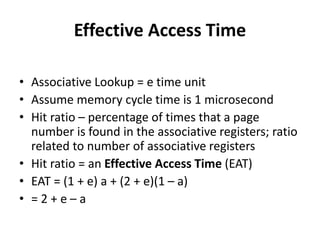
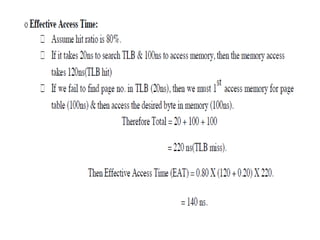
• Associative Lookup = e time unit
• Assume memory cycle time is 1 microsecond
• Hit ratio – percentage of times that a page
number is found in the associative registers; ratio
related to number of associative registers
• Hit ratio = an Effective Access Time (EAT)
• EAT = (1 + e) a + (2 + e)(1 – a)
• = 2 + e – a
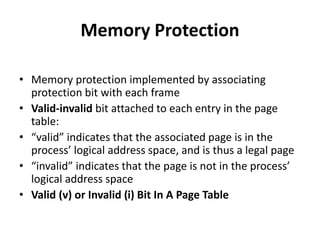
Memory Protection
• Memory protection implemented by associating
protection bit with each frame
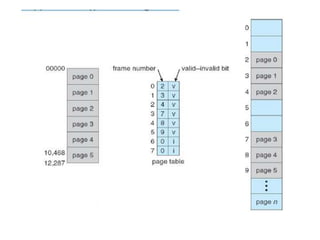
• Valid-invalid bit attached to each entry in the page
table:
• “valid” indicates that the associated page is in the
process’ logical address space, and is thus a legal page
• “invalid” indicates that the page is not in the process’
logical address space
• Valid (v) or Invalid (i) Bit In A Page Table
Shared Pages
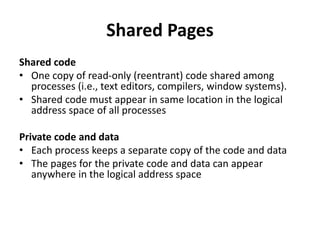
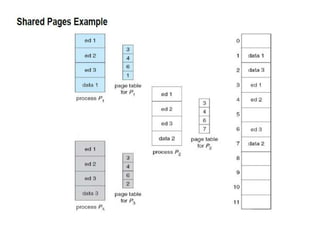
Shared code
• One copy of read-only (reentrant) code shared among
processes (i.e., text editors, compilers, window systems).
• Shared code must appear in same location in the logical
address space of all processes
Private code and data
• Each process keeps a separate copy of the code and data
• The pages for the private code and data can appear
anywhere in the logical address space
Structure of the Page Table
• Hierarchical Paging
• Hashed Page Tables
• Inverted Page Tables
Hierarchical Page Tables
• Break up the logical address space into
multiple page tables.
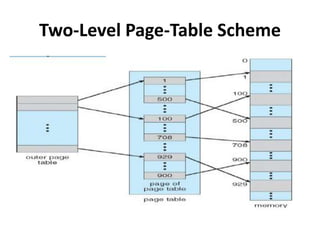
• A simple technique is a two-level page table.
Two-Level Page-Table Scheme
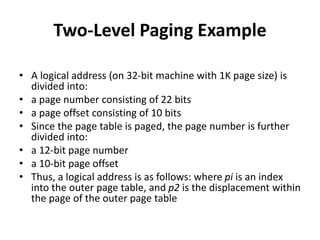
Two-Level Paging Example
• A logical address (on 32-bit machine with 1K page size) is
divided into:
• a page number consisting of 22 bits
• a page offset consisting of 10 bits
• Since the page table is paged, the page number is further
divided into:
• a 12-bit page number
• a 10-bit page offset
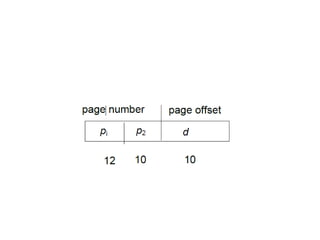
• Thus, a logical address is as follows: where pi is an index
into the outer page table, and p2 is the displacement within
the page of the outer page table
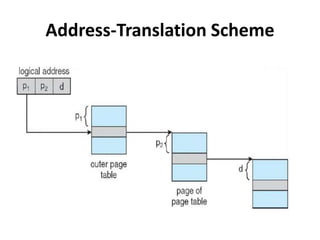
Address-Translation Scheme
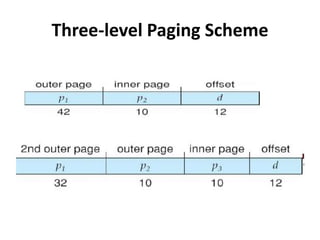
Three-level Paging Scheme
Hashed Page Tables
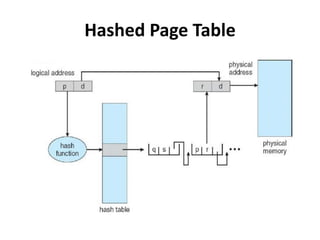
• Common in address spaces > 32 bits
• The virtual page number is hashed into a page
table
• This page table contains a chain of elements
hashing to the same location
• Virtual page numbers are compared in this chain
searching for a match
• If a match is found, the corresponding physical
frame is extracted
Hashed Page Table
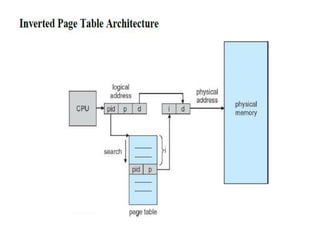
Inverted Page Table
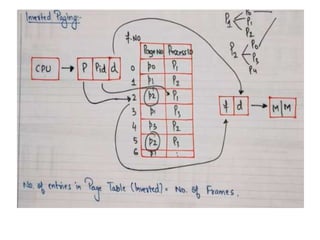
• One entry for each real page of memory
• Entry consists of the virtual address of the page
stored in that real memory location, with
information about the process that owns that
page
• Decreases memory needed to store each page
table, but increases time needed to search the
table when a page reference occurs
• Use hash table to limit the search to one — or at
most a few — page-table entries
Kalpana Devi/Operating System/Paging.pptx

Kalpana Devi/Operating System/Paging.pptx

  • 1.
  • 2.
    Address Translation Scheme •Address generated by CPU is divided into • Page number (p) – used as an index into a page table which contains base address of each page in physical memory • Page offset (d) – combined with base address to define the physical memory address that is sent to the memory unit • For given logical address space 2m and page size 2n
  • 3.
  • 4.
    Paging Model ofLogical and Physical Memory
  • 5.
  • 6.
    Implementation of PageTable • Page table is kept in main memory • Page-table base register (PTBR) points to the page table • Page-table length register (PRLR) indicates size of the page table • In this scheme every data/instruction access requires two memory accesses. One for the page table and one for the data/instruction. • The two memory access problem can be solved by the use of a special fast-lookup hardware cache called associative memory or translation look-aside buffers (TLBs) • Some TLBs store address-space identifiers (ASIDs) in each TLB entry – uniquely identifies each process to provide address-space protection for that process
  • 8.
    Associative Memory • Associativememory – parallel search • Address translation (p, d) • If p is in associative register, get frame # out • Otherwise get frame # from page table in memory
  • 9.
  • 10.
    Effective Access Time •Associative Lookup = e time unit • Assume memory cycle time is 1 microsecond • Hit ratio – percentage of times that a page number is found in the associative registers; ratio related to number of associative registers • Hit ratio = an Effective Access Time (EAT) • EAT = (1 + e) a + (2 + e)(1 – a) • = 2 + e – a
  • 12.
    Memory Protection • Memoryprotection implemented by associating protection bit with each frame • Valid-invalid bit attached to each entry in the page table: • “valid” indicates that the associated page is in the process’ logical address space, and is thus a legal page • “invalid” indicates that the page is not in the process’ logical address space • Valid (v) or Invalid (i) Bit In A Page Table
  • 14.
    Shared Pages Shared code •One copy of read-only (reentrant) code shared among processes (i.e., text editors, compilers, window systems). • Shared code must appear in same location in the logical address space of all processes Private code and data • Each process keeps a separate copy of the code and data • The pages for the private code and data can appear anywhere in the logical address space
  • 16.
    Structure of thePage Table • Hierarchical Paging • Hashed Page Tables • Inverted Page Tables
  • 17.
    Hierarchical Page Tables •Break up the logical address space into multiple page tables. • A simple technique is a two-level page table.
  • 18.
  • 19.
    Two-Level Paging Example •A logical address (on 32-bit machine with 1K page size) is divided into: • a page number consisting of 22 bits • a page offset consisting of 10 bits • Since the page table is paged, the page number is further divided into: • a 12-bit page number • a 10-bit page offset • Thus, a logical address is as follows: where pi is an index into the outer page table, and p2 is the displacement within the page of the outer page table
  • 21.
  • 22.
  • 23.
    Hashed Page Tables •Common in address spaces > 32 bits • The virtual page number is hashed into a page table • This page table contains a chain of elements hashing to the same location • Virtual page numbers are compared in this chain searching for a match • If a match is found, the corresponding physical frame is extracted
  • 24.
  • 25.
    Inverted Page Table •One entry for each real page of memory • Entry consists of the virtual address of the page stored in that real memory location, with information about the process that owns that page • Decreases memory needed to store each page table, but increases time needed to search the table when a page reference occurs • Use hash table to limit the search to one — or at most a few — page-table entries