SOFTWARE ENGINEERING & PROJECT
MANAGEMENT(21CS61)
FACULTY NAME: Prof.BhavanaNagaraj/Prof.Chandana D C
SECTION:VI A&B
MODULE-1
• Software and Software Engineering: The nature of Software, The unique
nature of WebApps, Software Engineering, The software Process, The
software Engineering practice, The software myths, How it all starts
Textbook 1: Chapter 1: 1.1 to 1.7
• Process Models: A generic process model, Process assessment and
improvement, Prescriptive process models, Waterfall model, Incremental
process models, Evolutionary process models, Concurrent models,
Specialized process models.

Textbook 1: Chapter 2: 2.1 to 2.4
Software and Software Engineering
1. The nature of Software
2. The unique nature of WebApps
3. Software Engineering
4. The software Process
5. The software Engineering practice
6. The software myths
7. How it all starts
1.The nature of Software
• Today, software takes on a dual role.
• It is a product, and at the same time, the vehicle for delivering a product.
• As a product, it delivers the computing potential embodied by computer
hardware or more broadly, by a network of computers that are accessible
by local hardware.
• Whether it resides within a mobile phone or operates inside a mainframe
computer, software is an information transformer—producing, managing,
acquiring, modifying, displaying, or transmitting information that can be
as simple as a single bit or as complex as a multimedia presentation
derived from data acquired from dozens of independent sources.
• Software delivers the most important product of our time—
information.
• It transforms personal data (e.g., an individual’s financial
transactions) so that the data can be more useful in a local context;
• It manages business information to enhance competitiveness; it
provides a gateway to worldwide information networks (e.g., the
Internet), and provides the means for acquiring information in all
of its forms.
The questions that were asked of the lone programmer are the same
questions that are asked when modern computer-based systems are
built
Why does it take so long to get software finished?
 Why are development costs so high?
Why can’t we find all errors before we give the software to our
customers?
 Why do we spend so much time and effort maintaining existing
programs?
 Why do we continue to have difficulty in measuring progress as
software is being developed and maintained?
1.1 Defining Software
Software is:
(1) Instructions (computer programs) that when executed
provide desired features, function, and performance;
(2) Data structures that enable the programs to adequately
manipulate information, and
(3) Descriptive information in both hard copy and virtual
forms that describes the operation and use of the programs
Software has characteristics that are considerably
different than hardware
1. Software is developed or engineered; it is not manufactured
in the classical sense.
2. Software doesn’t “wear out.
3. Although the industry is moving toward component-based
construction, most software continues to be custom built
1.2 Software Application Domains
Today, seven broad categories of computer software present
continuing challenges for software engineers:
1. System software
2. Application software
3. Engineering/scientific software
4. Embedded software
5. Product-line software
6. Web applications
7. Artificial intelligence software
1.3 Legacy software
Legacy software systems were developed decades ago and have been
continually modified to meet changes in business requirements and computing
platforms.
The proliferation of such systems is causing headaches for large organizations
who find them costly to maintain and risky to evolve.
Legacy systems often evolve for one or more of the following reasons:
The software must be adapted to meet the needs of new computing environments or
technology.
The software must be enhanced to implement new business requirements.
The software must be extended to make it interoperable with other more modern systems
or databases.
The software must be re-architected to make it viable within a network environment
2. The unique nature of WebApps
1.Network intensiveness. A WebApp resides on a network and
must serve the network may enable worldwide access and
communication (i.e., the Internet) or more limited access and
communication (e.g., a corporate Intranet). needs of a diverse
community of clients.
2.Concurrency. A large number of users may access the WebApp
at one time. In many cases, the patterns of usage among end users
will vary greatly
3.Unpredictable load. The number of users of the WebApp may
vary by orders of magnitude from day to day.
4.Performance. If a WebApp user must wait too long (for access, for serverside
processing, for client-side formatting and display), he or she may decide to go
elsewhere
5.Availability. Although expectation of 100 percent availability is
unreasonable, users of popular WebApps often demand access on a 24/7/3.
6.Data driven. The primary function of many WebApps is to use hypermedia to
present text, graphics, audio, and video content to the end user.
7.Content sensitive. The quality and aesthetic nature of content remains an
important determinant of the quality of a WebApp
8.Continuous evolution: Unlike conventional application software that evolves over a
series of planned, chronologically spaced releases, Web applications evolve continuously
9.Immediacy: Although immediacy—the compelling need to get software to market
quickly—is a characteristic of many application domains, WebApps often exhibit a time-
to-market that can be a matter of a few days or weeks.
10.Security:Because WebApps are available via network access, it is difficult, if not
impossible, to limit the population of end users who may access the application.
11.Aesthetics: An undeniable part of the appeal of a WebApp is its look and feel. When an
application has been designed to market or sell products or ideas, aesthetics may have as
much to do with success as technical design.
3 Software Engineering
Software Engineering: The application of a systematic, disciplined, quantifiable approach to the
development, operation, and maintenance of software; that is, the application of engineering to
software.
In order to build software that is ready to meet the challenges of the twenty-first century, you must recognize a few
simple realities:
Software has become deeply embedded in virtually every aspect of our lives, and as a consequence, the number of
people who have an interest in the features and functions provided by a specific application8 has grown dramatically
Problem before a software solution is developed. The information technology requirements demanded by
individuals, businesses, and governments grow increasing complex with each passing year.
Individuals, businesses, and governments increasingly rely on software for strategic and tactical decision making
as well as day-to-day operations and control.
As the perceived value of a specific application grows, the likelihood is that its user base and longevity will also
grow
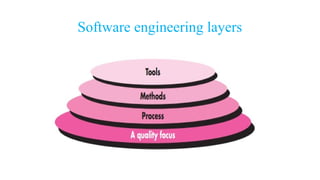
Software engineering layers
4. The Software Process
A process is a collection of activities, actions, and tasks that
are performed when some work product is to be created.
A generic process framework for software engineering
encompasses five activities
1. Communication
2. Planning
3. Modelling
4. Construction
5. Deployment
1.Communication
Before any technical work can commence, it is critically important to
communicate and collaborate with the customer.
The intent is to understand stakeholders’ objectives for the project and to
gather requirements that help define software features and functions
2.Planning
Any complicated journey can be simplified if a map exists.
A software project is a complicated journey, and the planning activity
creates a “map” that helps guide the team as it makes the journey.
The map—called a software project plan—defines the software
engineering work by describing the technical tasks to be conducted, the
risks that are likely, the resources that will be required, the work products
to be produced, and a work schedule
3.Modeling.
Whether you’re a landscaper, a bridge builder, an aeronautical engineer,
a carpenter, or an architect, you work with models every day.
 You create a “sketch” of the thing so that you’ll understand the big
picture—what it will look like architecturally, how the constituent parts
fit together, and many other characteristics
4.Construction.
This activity combines code generation (either manual or automated) and
the testing that is required to uncover errors in the code.
5.Deployment.
The software (as a complete entity or as a partially completed increment)
is delivered to the customer who evaluates the delivered product and
provides feedback based on the evaluation.
Software engineering process framework activities are complemented by a
number of umbrella activities.
1. Software project tracking and control
2. Risk management
3. Software quality assurance
4. Technical reviews
5. Measurement
6. Software configuration management
7. Reusability management
8. Work product preparation and production
1. Software project tracking and control: Allows the
software team to assess progress against the project plan
and take any necessary action to maintain the schedule.
2. Risk management: Assesses: risks that may affect the
outcome of the project or the quality of the product.
3.Software quality assurance:-defines and conducts the
activities required to ensure software quality.
4.Technical reviews—assesses: software engineering work
products in an effort to uncover and remove errors before
they are propagated to the next activity
5.Measurement:defines and collects process, project, and product
measures that assist the team in delivering software that meets
stakeholders’ needs; can be used in conjunction with all other
framework and umbrella activities.
6.Software configuration management:-manages the effects of
change throughout the software process.
7.Reusability management:-defines criteria for work product reuse
(including software components) and establishes mechanisms to
achieve reusable components.
8.Work product preparation and production:-encompasses the
activities required to create work products such as models,
documents, logs, forms, and lists
5.Software engineering practice.
Introduced a generic software process model composed of a set of activities that
establish a framework for software engineering practice. Generic framework
activities—communication, planning, modeling, construction, and deployment—and
umbrella activities establish a skeleton architecture for software engineering work.
1.5.1.The Essence of practice
1.5.2.Generic Principles
1.The Essence of practice
1. Understand the problem (communication and analysis).
2. Plan a solution (modeling and software design).
3. Carry out the plan (code generation).
4.Examine the result for accuracy (testing and quality
assurance).
1. Understand the problem
Who has a stake in the solution to the problem? That is, who are the stakeholders?
What are the unknowns? What data, functions, and features are required to properly
solve the problem?
Can the problem be compartmentalized? Is it possible to represent smaller problems
that may be easier to understand?
 Can the problem be represented graphically? Can an analysis model be created?
2. Plan a solution
Have you seen similar problems before? Are there patterns that are recognizable
in a potential solution? Is there existing software that implements the data,
functions, and features that are required?
Has a similar problem been solved? If so, are elements of the solution reusable?
Can sub problems be defined? If so, are solutions readily apparent for the sub
problems?
Can you represent a solution in a manner that leads to effective implementation?
Can a design model be created?
3.Carry out the plan
The design you’ve created serves as a road map for the system you want to build.
There may be unexpected detours, and it’s possible that you’ll discover an even better
route as you go, but the “plan” will allow you to proceed without getting lost.
Does the solution conform to the plan? Is source code traceable to the design
model?
Is each component part of the solution provably correct? Have the design and code
been reviewed, or better, have correctness proofs been applied to the algorithm?
4.Examine the result for accuracy
You can’t be sure that your solution is perfect, but you can be
sure that you’ve designed a sufficient number of tests to
uncover as many errors as possible.
Is it possible to test each component part of the solution?
Has a reasonable testing strategy been implemented?
Does the solution produce results that conform to the data,
functions, and features that are required? Has the software
been validated against all stakeholder requirements?
2.Generic Principles
1. The First Principle: The Reason It All Exists
2. The Second Principle: KISS (Keep It Simple, Stupid!
3. The Third Principle: Maintain the Vision
4. The Fourth Principle: What You Produce, Others Will Consume
5. The Fifth Principle: Be Open to the Future
6. The Sixth Principle: Plan Ahead for Reuse
6. Software myths
1. Management myths
2. Customer myths
3. Practitioner’s myths.
1. Management myths
Managers with software responsibility, like managers in most disciplines, are
often under pressure to maintain budgets, keep schedules from slipping, and
improve quality.
Myth: We already have a book that’s full of standards and procedures for
building software. Won’t that provide my people with everything they need to
know?
Reality: The book of standards may very well exist, but is it used? Are software
practitioners aware of its existence? Does it reflect modern software
engineering practice? Is it complete? Is it adaptable? Is it streamlined to
improve time-to-delivery while still maintaining a focus on quality? In many
cases, the answer to all of these questions is “no.”
Myth: If we get behind schedule, we can add more programmers and catch
up (sometimes called the “Mongolian horde” concept).
Reality: Software development is not a mechanistic process like
manufacturing. In the words of Brooks “adding people to a late software
project makes it later.” At first, this statement may seem counterintuitive.
However, as new people are added, people who were working must spend
time educating the newcomers, thereby reducing the amount of time spent
on productive development effort. People can be added but only in a
planned and well coordinated manner
Myth: If I decide to outsource the software project to a third party, I can just
relax and let that firm build it.
Reality: If an organization does not understand how to manage and control
software projects internally, it will invariably struggle when it outsources
software projects
2. Customer myths
In many cases, the customer believes myths about software
because software managers and practitioners do little to correct
misinformation. Myths lead to false expectations (by the
customer) and, ultimately, dissatisfaction with the developer
Myth: A general statement of objectives is sufficient to begin
writing programs—we can fill in the details later.
Reality: Although a comprehensive and stable statement of
requirements is not always possible, an ambiguous “statement of
objectives” is a recipe for disaster. Unambiguous requirements
iteratively) are developed only through effective and continuous
communication between customer and developer.
Myth: Software requirements continually change, but change can be
easily accommodated because software is flexible.
Reality:
It is true that software requirements change, but the impact of
change varies with the time at which it is introduced.
When requirements changes are requested early (before design or
code has been started), the cost impact is relatively small.
However, as time passes, the cost impact grows rapidly
resources have been committed, a design framework has been
established, and change can cause upheaval that requires additional
resources and major design modification.
3.Practitioner’s myths
Myths that are still believed by software practitioners have been
fostered by over 50 years of programming culture. During the early
days, programming was viewed as a
n art form. Old ways and attitudes die hard.
Myth: Once we write the program and get it to work, our job is done.
Reality: Someone once said that “the sooner you begin ‘writing code,’
the longer it’ll take you to get done.” Industry data indicate that
between 60 and 80 percent of all effort expended on software will be
expended after it is delivered to the customer for the first time
Myth: Until I get the program “running” I have no way of assessing its
quality.
Reality: One of the most effective software quality assurance
mechanisms can be applied from the inception of a project.
Myth: The only deliverable work product for a successful project is the
working program.
Reality: A working program is only one part of a software configuration
that includes many elements A variety of work products (e.g., models,
documents, plans) provide a foundation for successful engineering and,
more important, guidance for software support.
Myth: Software engineering will make us create voluminous and
unnecessary documentation and will invariably slow us down.
Reality: Software engineering is not about creating documents. It is
about creating a quality product. Better quality leads to reduced rework.
7.How it all starts
Every software project is precipitated by some business need—the
need to correct a defect in an existing application
 The need to adapt a “legacy system” to a changing business
environment;
The need to extend the functions and features of an existing
application; or the need to create a new product, service, or system.
 At the beginning of a software project, the business need is often
expressed informally as part of a simple conversation.
Thank You

SE&PM-MODULE-1 2.pptx Software engineering

  • 1.
    SOFTWARE ENGINEERING &PROJECT MANAGEMENT(21CS61) FACULTY NAME: Prof.BhavanaNagaraj/Prof.Chandana D C SECTION:VI A&B
  • 2.
    MODULE-1 • Software andSoftware Engineering: The nature of Software, The unique nature of WebApps, Software Engineering, The software Process, The software Engineering practice, The software myths, How it all starts Textbook 1: Chapter 1: 1.1 to 1.7 • Process Models: A generic process model, Process assessment and improvement, Prescriptive process models, Waterfall model, Incremental process models, Evolutionary process models, Concurrent models, Specialized process models. Textbook 1: Chapter 2: 2.1 to 2.4
  • 3.
    Software and SoftwareEngineering 1. The nature of Software 2. The unique nature of WebApps 3. Software Engineering 4. The software Process 5. The software Engineering practice 6. The software myths 7. How it all starts
  • 4.
    1.The nature ofSoftware • Today, software takes on a dual role. • It is a product, and at the same time, the vehicle for delivering a product. • As a product, it delivers the computing potential embodied by computer hardware or more broadly, by a network of computers that are accessible by local hardware. • Whether it resides within a mobile phone or operates inside a mainframe computer, software is an information transformer—producing, managing, acquiring, modifying, displaying, or transmitting information that can be as simple as a single bit or as complex as a multimedia presentation derived from data acquired from dozens of independent sources.
  • 5.
    • Software deliversthe most important product of our time— information. • It transforms personal data (e.g., an individual’s financial transactions) so that the data can be more useful in a local context; • It manages business information to enhance competitiveness; it provides a gateway to worldwide information networks (e.g., the Internet), and provides the means for acquiring information in all of its forms.
  • 6.
    The questions thatwere asked of the lone programmer are the same questions that are asked when modern computer-based systems are built Why does it take so long to get software finished?  Why are development costs so high? Why can’t we find all errors before we give the software to our customers?  Why do we spend so much time and effort maintaining existing programs?  Why do we continue to have difficulty in measuring progress as software is being developed and maintained?
  • 7.
    1.1 Defining Software Softwareis: (1) Instructions (computer programs) that when executed provide desired features, function, and performance; (2) Data structures that enable the programs to adequately manipulate information, and (3) Descriptive information in both hard copy and virtual forms that describes the operation and use of the programs
  • 8.
    Software has characteristicsthat are considerably different than hardware 1. Software is developed or engineered; it is not manufactured in the classical sense. 2. Software doesn’t “wear out. 3. Although the industry is moving toward component-based construction, most software continues to be custom built
  • 9.
    1.2 Software ApplicationDomains Today, seven broad categories of computer software present continuing challenges for software engineers: 1. System software 2. Application software 3. Engineering/scientific software 4. Embedded software 5. Product-line software 6. Web applications 7. Artificial intelligence software
  • 10.
    1.3 Legacy software Legacysoftware systems were developed decades ago and have been continually modified to meet changes in business requirements and computing platforms. The proliferation of such systems is causing headaches for large organizations who find them costly to maintain and risky to evolve. Legacy systems often evolve for one or more of the following reasons: The software must be adapted to meet the needs of new computing environments or technology. The software must be enhanced to implement new business requirements. The software must be extended to make it interoperable with other more modern systems or databases. The software must be re-architected to make it viable within a network environment
  • 11.
    2. The uniquenature of WebApps 1.Network intensiveness. A WebApp resides on a network and must serve the network may enable worldwide access and communication (i.e., the Internet) or more limited access and communication (e.g., a corporate Intranet). needs of a diverse community of clients. 2.Concurrency. A large number of users may access the WebApp at one time. In many cases, the patterns of usage among end users will vary greatly 3.Unpredictable load. The number of users of the WebApp may vary by orders of magnitude from day to day.
  • 12.
    4.Performance. If aWebApp user must wait too long (for access, for serverside processing, for client-side formatting and display), he or she may decide to go elsewhere 5.Availability. Although expectation of 100 percent availability is unreasonable, users of popular WebApps often demand access on a 24/7/3. 6.Data driven. The primary function of many WebApps is to use hypermedia to present text, graphics, audio, and video content to the end user. 7.Content sensitive. The quality and aesthetic nature of content remains an important determinant of the quality of a WebApp
  • 13.
    8.Continuous evolution: Unlikeconventional application software that evolves over a series of planned, chronologically spaced releases, Web applications evolve continuously 9.Immediacy: Although immediacy—the compelling need to get software to market quickly—is a characteristic of many application domains, WebApps often exhibit a time- to-market that can be a matter of a few days or weeks. 10.Security:Because WebApps are available via network access, it is difficult, if not impossible, to limit the population of end users who may access the application. 11.Aesthetics: An undeniable part of the appeal of a WebApp is its look and feel. When an application has been designed to market or sell products or ideas, aesthetics may have as much to do with success as technical design.
  • 14.
    3 Software Engineering SoftwareEngineering: The application of a systematic, disciplined, quantifiable approach to the development, operation, and maintenance of software; that is, the application of engineering to software. In order to build software that is ready to meet the challenges of the twenty-first century, you must recognize a few simple realities: Software has become deeply embedded in virtually every aspect of our lives, and as a consequence, the number of people who have an interest in the features and functions provided by a specific application8 has grown dramatically Problem before a software solution is developed. The information technology requirements demanded by individuals, businesses, and governments grow increasing complex with each passing year. Individuals, businesses, and governments increasingly rely on software for strategic and tactical decision making as well as day-to-day operations and control. As the perceived value of a specific application grows, the likelihood is that its user base and longevity will also grow
  • 15.
  • 16.
    4. The SoftwareProcess A process is a collection of activities, actions, and tasks that are performed when some work product is to be created. A generic process framework for software engineering encompasses five activities 1. Communication 2. Planning 3. Modelling 4. Construction 5. Deployment
  • 17.
    1.Communication Before any technicalwork can commence, it is critically important to communicate and collaborate with the customer. The intent is to understand stakeholders’ objectives for the project and to gather requirements that help define software features and functions 2.Planning Any complicated journey can be simplified if a map exists. A software project is a complicated journey, and the planning activity creates a “map” that helps guide the team as it makes the journey. The map—called a software project plan—defines the software engineering work by describing the technical tasks to be conducted, the risks that are likely, the resources that will be required, the work products to be produced, and a work schedule
  • 18.
    3.Modeling. Whether you’re alandscaper, a bridge builder, an aeronautical engineer, a carpenter, or an architect, you work with models every day.  You create a “sketch” of the thing so that you’ll understand the big picture—what it will look like architecturally, how the constituent parts fit together, and many other characteristics 4.Construction. This activity combines code generation (either manual or automated) and the testing that is required to uncover errors in the code. 5.Deployment. The software (as a complete entity or as a partially completed increment) is delivered to the customer who evaluates the delivered product and provides feedback based on the evaluation.
  • 19.
    Software engineering processframework activities are complemented by a number of umbrella activities. 1. Software project tracking and control 2. Risk management 3. Software quality assurance 4. Technical reviews 5. Measurement 6. Software configuration management 7. Reusability management 8. Work product preparation and production
  • 20.
    1. Software projecttracking and control: Allows the software team to assess progress against the project plan and take any necessary action to maintain the schedule. 2. Risk management: Assesses: risks that may affect the outcome of the project or the quality of the product. 3.Software quality assurance:-defines and conducts the activities required to ensure software quality. 4.Technical reviews—assesses: software engineering work products in an effort to uncover and remove errors before they are propagated to the next activity
  • 21.
    5.Measurement:defines and collectsprocess, project, and product measures that assist the team in delivering software that meets stakeholders’ needs; can be used in conjunction with all other framework and umbrella activities. 6.Software configuration management:-manages the effects of change throughout the software process. 7.Reusability management:-defines criteria for work product reuse (including software components) and establishes mechanisms to achieve reusable components. 8.Work product preparation and production:-encompasses the activities required to create work products such as models, documents, logs, forms, and lists
  • 22.
    5.Software engineering practice. Introduceda generic software process model composed of a set of activities that establish a framework for software engineering practice. Generic framework activities—communication, planning, modeling, construction, and deployment—and umbrella activities establish a skeleton architecture for software engineering work. 1.5.1.The Essence of practice 1.5.2.Generic Principles
  • 23.
    1.The Essence ofpractice 1. Understand the problem (communication and analysis). 2. Plan a solution (modeling and software design). 3. Carry out the plan (code generation). 4.Examine the result for accuracy (testing and quality assurance).
  • 24.
    1. Understand theproblem Who has a stake in the solution to the problem? That is, who are the stakeholders? What are the unknowns? What data, functions, and features are required to properly solve the problem? Can the problem be compartmentalized? Is it possible to represent smaller problems that may be easier to understand?  Can the problem be represented graphically? Can an analysis model be created?
  • 25.
    2. Plan asolution Have you seen similar problems before? Are there patterns that are recognizable in a potential solution? Is there existing software that implements the data, functions, and features that are required? Has a similar problem been solved? If so, are elements of the solution reusable? Can sub problems be defined? If so, are solutions readily apparent for the sub problems? Can you represent a solution in a manner that leads to effective implementation? Can a design model be created?
  • 26.
    3.Carry out theplan The design you’ve created serves as a road map for the system you want to build. There may be unexpected detours, and it’s possible that you’ll discover an even better route as you go, but the “plan” will allow you to proceed without getting lost. Does the solution conform to the plan? Is source code traceable to the design model? Is each component part of the solution provably correct? Have the design and code been reviewed, or better, have correctness proofs been applied to the algorithm?
  • 27.
    4.Examine the resultfor accuracy You can’t be sure that your solution is perfect, but you can be sure that you’ve designed a sufficient number of tests to uncover as many errors as possible. Is it possible to test each component part of the solution? Has a reasonable testing strategy been implemented? Does the solution produce results that conform to the data, functions, and features that are required? Has the software been validated against all stakeholder requirements?
  • 28.
    2.Generic Principles 1. TheFirst Principle: The Reason It All Exists 2. The Second Principle: KISS (Keep It Simple, Stupid! 3. The Third Principle: Maintain the Vision 4. The Fourth Principle: What You Produce, Others Will Consume 5. The Fifth Principle: Be Open to the Future 6. The Sixth Principle: Plan Ahead for Reuse
  • 29.
    6. Software myths 1.Management myths 2. Customer myths 3. Practitioner’s myths.
  • 30.
    1. Management myths Managerswith software responsibility, like managers in most disciplines, are often under pressure to maintain budgets, keep schedules from slipping, and improve quality. Myth: We already have a book that’s full of standards and procedures for building software. Won’t that provide my people with everything they need to know? Reality: The book of standards may very well exist, but is it used? Are software practitioners aware of its existence? Does it reflect modern software engineering practice? Is it complete? Is it adaptable? Is it streamlined to improve time-to-delivery while still maintaining a focus on quality? In many cases, the answer to all of these questions is “no.”
  • 31.
    Myth: If weget behind schedule, we can add more programmers and catch up (sometimes called the “Mongolian horde” concept). Reality: Software development is not a mechanistic process like manufacturing. In the words of Brooks “adding people to a late software project makes it later.” At first, this statement may seem counterintuitive. However, as new people are added, people who were working must spend time educating the newcomers, thereby reducing the amount of time spent on productive development effort. People can be added but only in a planned and well coordinated manner Myth: If I decide to outsource the software project to a third party, I can just relax and let that firm build it. Reality: If an organization does not understand how to manage and control software projects internally, it will invariably struggle when it outsources software projects
  • 32.
    2. Customer myths Inmany cases, the customer believes myths about software because software managers and practitioners do little to correct misinformation. Myths lead to false expectations (by the customer) and, ultimately, dissatisfaction with the developer Myth: A general statement of objectives is sufficient to begin writing programs—we can fill in the details later. Reality: Although a comprehensive and stable statement of requirements is not always possible, an ambiguous “statement of objectives” is a recipe for disaster. Unambiguous requirements iteratively) are developed only through effective and continuous communication between customer and developer.
  • 33.
    Myth: Software requirementscontinually change, but change can be easily accommodated because software is flexible. Reality: It is true that software requirements change, but the impact of change varies with the time at which it is introduced. When requirements changes are requested early (before design or code has been started), the cost impact is relatively small. However, as time passes, the cost impact grows rapidly resources have been committed, a design framework has been established, and change can cause upheaval that requires additional resources and major design modification.
  • 34.
    3.Practitioner’s myths Myths thatare still believed by software practitioners have been fostered by over 50 years of programming culture. During the early days, programming was viewed as a n art form. Old ways and attitudes die hard. Myth: Once we write the program and get it to work, our job is done. Reality: Someone once said that “the sooner you begin ‘writing code,’ the longer it’ll take you to get done.” Industry data indicate that between 60 and 80 percent of all effort expended on software will be expended after it is delivered to the customer for the first time
  • 35.
    Myth: Until Iget the program “running” I have no way of assessing its quality. Reality: One of the most effective software quality assurance mechanisms can be applied from the inception of a project. Myth: The only deliverable work product for a successful project is the working program. Reality: A working program is only one part of a software configuration that includes many elements A variety of work products (e.g., models, documents, plans) provide a foundation for successful engineering and, more important, guidance for software support. Myth: Software engineering will make us create voluminous and unnecessary documentation and will invariably slow us down. Reality: Software engineering is not about creating documents. It is about creating a quality product. Better quality leads to reduced rework.
  • 36.
    7.How it allstarts Every software project is precipitated by some business need—the need to correct a defect in an existing application  The need to adapt a “legacy system” to a changing business environment; The need to extend the functions and features of an existing application; or the need to create a new product, service, or system.  At the beginning of a software project, the business need is often expressed informally as part of a simple conversation.
  • 37.