
WELCOME TO A
JOURNEY TO
CS419

Dr. Hussien Sharaf
Computer Science Department

dr.sharaf@from-masr.com
Dr. Hussien M. Sharaf

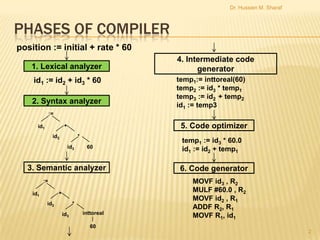
PHASES OF COMPILER
position := initial + rate * 60
1. Lexical analyzer
id1 := id2 + id3 * 60
2. Syntax analyzer

4. Intermediate code
generator
temp1:= inttoreal(60)
temp2 := id3 * temp1
temp3 := id2 + temp2
id1 := temp3

:=

5. Code optimizer

+

id1

*

id2
id3

60

3. Semantic analyzer
:=
+

id1

*

id2
id3

inttoreal

temp1 := id3 * 60.0
id1 := id2 + temp1

6. Code generator
MOVF id3 , R2
MULF #60.0 , R2
MOVF id2 , R1
ADDF R2, R1
MOVF R1, id1

60
2
Dr. Hussien M. Sharaf

3. SEMANTIC ANALYZER
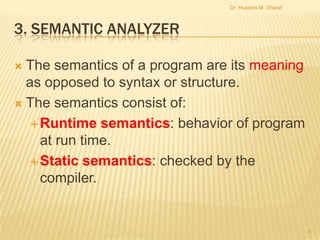
The semantics of a program are its meaning
as opposed to syntax or structure.
 The semantics consist of:
 Runtime semantics: behavior of program
at run time.
 Static semantics: checked by the
compiler.


3
Dr. Hussien M. Sharaf

STATIC SEMANTICS


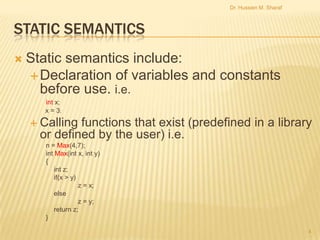
Static semantics include:
 Declaration of variables and constants
before use. i.e.
int x;
x = 3;

 Calling

functions that exist (predefined in a library
or defined by the user) i.e.
n = Max(4,7);
int Max(int x, int y)
{
int z;
if(x > y)
z = x;
else
z = y;
return z;
}
4
Dr. Hussien M. Sharaf

STATIC SEMANTICS
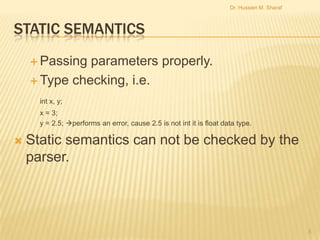
 Passing

parameters properly.
 Type checking, i.e.
int x, y;
x = 3;
y = 2.5; performs an error, cause 2.5 is not int it is float data type.



Static semantics can not be checked by the
parser.

5
Dr. Hussien M. Sharaf

SEMANTIC ANALYZER (CONT.)


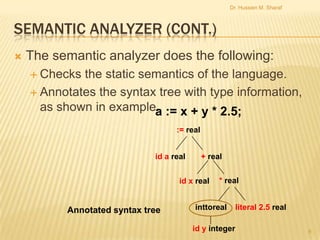
The semantic analyzer does the following:
 Checks

the static semantics of the language.
 Annotates the syntax tree with type information,
as shown in example. := x + y * 2.5;
a
:= real
id a real

+ real

id x real

Annotated syntax tree

* real

inttoreal

id y integer

literal 2.5 real
6
Dr. Hussien M. Sharaf

4. INTERMEDIATE CODE GENERATOR
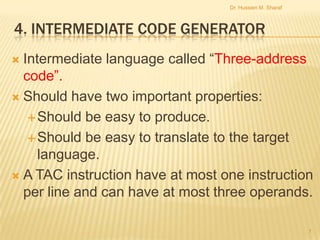
Intermediate language called “Three-address
code”.
 Should have two important properties:
 Should be easy to produce.
 Should be easy to translate to the target
language.
 A TAC instruction have at most one instruction
per line and can have at most three operands.


7
Dr. Hussien M. Sharaf

INTERMEDIATE CODE GENERATOR


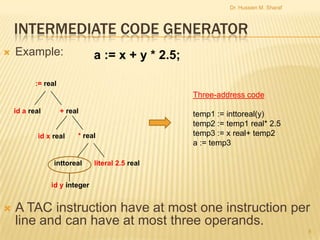
Example:

a := x + y * 2.5;

:= real

Three-address code
id a real

+ real

id x real

* real

inttoreal

temp1 := inttoreal(y)
temp2 := temp1 real* 2.5
temp3 := x real+ temp2
a := temp3

literal 2.5 real

id y integer



A TAC instruction have at most one instruction per
line and can have at most three operands.
8
Dr. Hussien M. Sharaf

5. CODE OPTIMIZER
 Code optimization can be applied to:
code – independent of the
target machine.
 Target code – dependent on the target
machine.
 Intermediate

9
Dr. Hussien M. Sharaf

INTERMEDIATE CODE OPTIMIZATION


Intermediate code optimization include:
A.

B.
C.

D.
E.

Constant folding.
Elimination of common sub- expressions.
Identification and elimination of unreachable
code (called dead code).
Improving loops.
Improving function calls.

10
Dr. Hussien M. Sharaf

A. CONSTANT FOLDING
Simplifying constant expressions at compile
time.
 Example:
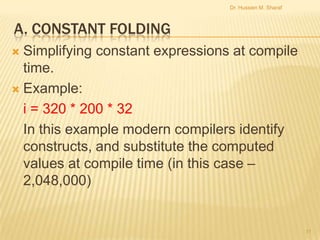
i = 320 * 200 * 32
In this example modern compilers identify
constructs, and substitute the computed
values at compile time (in this case –
2,048,000)


11
Dr. Hussien M. Sharaf

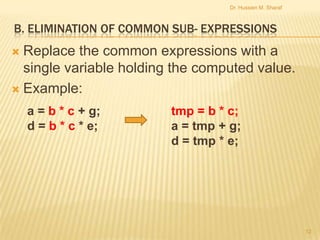
B. ELIMINATION OF COMMON SUB- EXPRESSIONS

Replace the common expressions with a
single variable holding the computed value.
 Example:


a = b * c + g;
d = b * c * e;

tmp = b * c;
a = tmp + g;
d = tmp * e;

12
Dr. Hussien M. Sharaf

C. IDENTIFICATION AND ELIMINATION OF DEAD CODE

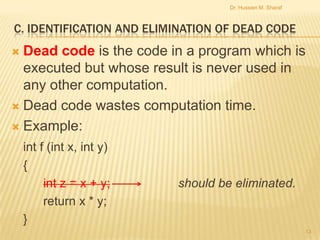
Dead code is the code in a program which is
executed but whose result is never used in
any other computation.
 Dead code wastes computation time.
 Example:


int f (int x, int y)
{
int z = x + y;
return x * y;
}

should be eliminated.

13
Dr. Hussien M. Sharaf

D. IMPROVING LOOPS





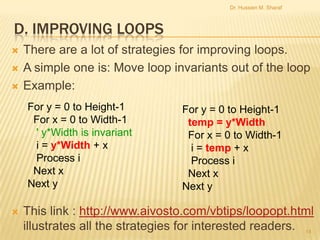
There are a lot of strategies for improving loops.
A simple one is: Move loop invariants out of the loop
Example:
For y = 0 to Height-1
For x = 0 to Width-1
' y*Width is invariant
i = y*Width + x
Process i
Next x
Next y



For y = 0 to Height-1
temp = y*Width
For x = 0 to Width-1
i = temp + x
Process i
Next x
Next y

This link : http://www.aivosto.com/vbtips/loopopt.html
illustrates all the strategies for interested readers. 14
Dr. Hussien M. Sharaf

E. IMPROVING FUNCTION CALLS





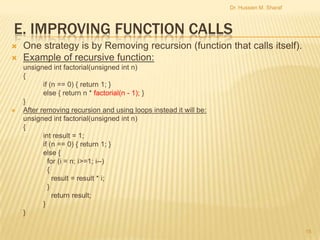
One strategy is by Removing recursion (function that calls itself).
Example of recursive function:
unsigned int factorial(unsigned int n)
{
if (n == 0) { return 1; }
else { return n * factorial(n - 1); }
}
After removing recursion and using loops instead it will be:
unsigned int factorial(unsigned int n)
{
int result = 1;
if (n == 0) { return 1; }
else {
for (i = n; i>=1; i--)
{
result = result * i;
}
return result;
}
}
15
Dr. Hussien M. Sharaf

TARGET CODE OPTIMIZATION


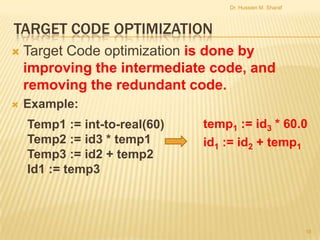
Target Code optimization is done by
improving the intermediate code, and
removing the redundant code.



Example:
Temp1 := int-to-real(60)
Temp2 := id3 * temp1
Temp3 := id2 + temp2
Id1 := temp3

temp1 := id3 * 60.0
id1 := id2 + temp1

16
Dr. Hussien M. Sharaf

TARGET CODE OPTIMIZATION


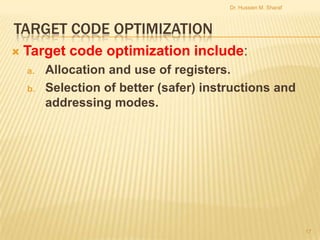
Target code optimization include:
a.

b.

Allocation and use of registers.
Selection of better (safer) instructions and
addressing modes.

17
Dr. Hussien M. Sharaf

6. CODE GENERATOR
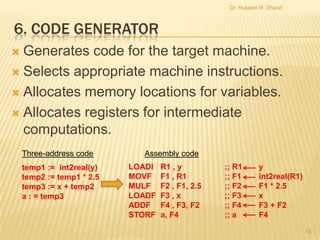
Generates code for the target machine.
 Selects appropriate machine instructions.
 Allocates memory locations for variables.
 Allocates registers for intermediate
computations.


Three-address code
temp1 := int2real(y)
temp2 := temp1 * 2.5
temp3 := x + temp2
a : = temp3

Assembly code
LOADI
MOVF
MULF
LOADF
ADDF
STORF

R1 , y
F1 , R1
F2 , F1, 2.5
F3 , x
F4 , F3, F2
a, F4

;; R1
;; F1
;; F2
;; F3
;; F4
;; a

y
int2real(R1)
F1 * 2.5
x
F3 + F2
F4
18
Dr. Hussien M. Sharaf

CODE GENERATOR


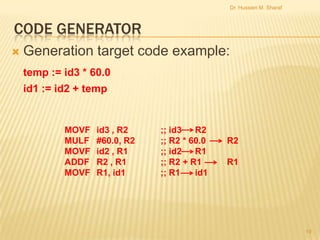
Generation target code example:
temp := id3 * 60.0

id1 := id2 + temp

MOVF
MULF
MOVF
ADDF
MOVF

id3 , R2
#60.0, R2
id2 , R1
R2 , R1
R1, id1

;; id3 R2
;; R2 * 60.0
;; id2 R1
;; R2 + R1
;; R1
id1

R2
R1

19
Dr. Hussien M. Sharaf

THANK YOU

Cs419 lec12 semantic analyzer

  • 1.
    WELCOME TO A JOURNEYTO CS419 Dr. Hussien Sharaf Computer Science Department dr.sharaf@from-masr.com
  • 2.
    Dr. Hussien M.Sharaf PHASES OF COMPILER position := initial + rate * 60 1. Lexical analyzer id1 := id2 + id3 * 60 2. Syntax analyzer 4. Intermediate code generator temp1:= inttoreal(60) temp2 := id3 * temp1 temp3 := id2 + temp2 id1 := temp3 := 5. Code optimizer + id1 * id2 id3 60 3. Semantic analyzer := + id1 * id2 id3 inttoreal temp1 := id3 * 60.0 id1 := id2 + temp1 6. Code generator MOVF id3 , R2 MULF #60.0 , R2 MOVF id2 , R1 ADDF R2, R1 MOVF R1, id1 60 2
  • 3.
    Dr. Hussien M.Sharaf 3. SEMANTIC ANALYZER The semantics of a program are its meaning as opposed to syntax or structure.  The semantics consist of:  Runtime semantics: behavior of program at run time.  Static semantics: checked by the compiler.  3
  • 4.
    Dr. Hussien M.Sharaf STATIC SEMANTICS  Static semantics include:  Declaration of variables and constants before use. i.e. int x; x = 3;  Calling functions that exist (predefined in a library or defined by the user) i.e. n = Max(4,7); int Max(int x, int y) { int z; if(x > y) z = x; else z = y; return z; } 4
  • 5.
    Dr. Hussien M.Sharaf STATIC SEMANTICS  Passing parameters properly.  Type checking, i.e. int x, y; x = 3; y = 2.5; performs an error, cause 2.5 is not int it is float data type.  Static semantics can not be checked by the parser. 5
  • 6.
    Dr. Hussien M.Sharaf SEMANTIC ANALYZER (CONT.)  The semantic analyzer does the following:  Checks the static semantics of the language.  Annotates the syntax tree with type information, as shown in example. := x + y * 2.5; a := real id a real + real id x real Annotated syntax tree * real inttoreal id y integer literal 2.5 real 6
  • 7.
    Dr. Hussien M.Sharaf 4. INTERMEDIATE CODE GENERATOR Intermediate language called “Three-address code”.  Should have two important properties:  Should be easy to produce.  Should be easy to translate to the target language.  A TAC instruction have at most one instruction per line and can have at most three operands.  7
  • 8.
    Dr. Hussien M.Sharaf INTERMEDIATE CODE GENERATOR  Example: a := x + y * 2.5; := real Three-address code id a real + real id x real * real inttoreal temp1 := inttoreal(y) temp2 := temp1 real* 2.5 temp3 := x real+ temp2 a := temp3 literal 2.5 real id y integer  A TAC instruction have at most one instruction per line and can have at most three operands. 8
  • 9.
    Dr. Hussien M.Sharaf 5. CODE OPTIMIZER  Code optimization can be applied to: code – independent of the target machine.  Target code – dependent on the target machine.  Intermediate 9
  • 10.
    Dr. Hussien M.Sharaf INTERMEDIATE CODE OPTIMIZATION  Intermediate code optimization include: A. B. C. D. E. Constant folding. Elimination of common sub- expressions. Identification and elimination of unreachable code (called dead code). Improving loops. Improving function calls. 10
  • 11.
    Dr. Hussien M.Sharaf A. CONSTANT FOLDING Simplifying constant expressions at compile time.  Example: i = 320 * 200 * 32 In this example modern compilers identify constructs, and substitute the computed values at compile time (in this case – 2,048,000)  11
  • 12.
    Dr. Hussien M.Sharaf B. ELIMINATION OF COMMON SUB- EXPRESSIONS Replace the common expressions with a single variable holding the computed value.  Example:  a = b * c + g; d = b * c * e; tmp = b * c; a = tmp + g; d = tmp * e; 12
  • 13.
    Dr. Hussien M.Sharaf C. IDENTIFICATION AND ELIMINATION OF DEAD CODE Dead code is the code in a program which is executed but whose result is never used in any other computation.  Dead code wastes computation time.  Example:  int f (int x, int y) { int z = x + y; return x * y; } should be eliminated. 13
  • 14.
    Dr. Hussien M.Sharaf D. IMPROVING LOOPS    There are a lot of strategies for improving loops. A simple one is: Move loop invariants out of the loop Example: For y = 0 to Height-1 For x = 0 to Width-1 ' y*Width is invariant i = y*Width + x Process i Next x Next y  For y = 0 to Height-1 temp = y*Width For x = 0 to Width-1 i = temp + x Process i Next x Next y This link : http://www.aivosto.com/vbtips/loopopt.html illustrates all the strategies for interested readers. 14
  • 15.
    Dr. Hussien M.Sharaf E. IMPROVING FUNCTION CALLS    One strategy is by Removing recursion (function that calls itself). Example of recursive function: unsigned int factorial(unsigned int n) { if (n == 0) { return 1; } else { return n * factorial(n - 1); } } After removing recursion and using loops instead it will be: unsigned int factorial(unsigned int n) { int result = 1; if (n == 0) { return 1; } else { for (i = n; i>=1; i--) { result = result * i; } return result; } } 15
  • 16.
    Dr. Hussien M.Sharaf TARGET CODE OPTIMIZATION  Target Code optimization is done by improving the intermediate code, and removing the redundant code.  Example: Temp1 := int-to-real(60) Temp2 := id3 * temp1 Temp3 := id2 + temp2 Id1 := temp3 temp1 := id3 * 60.0 id1 := id2 + temp1 16
  • 17.
    Dr. Hussien M.Sharaf TARGET CODE OPTIMIZATION  Target code optimization include: a. b. Allocation and use of registers. Selection of better (safer) instructions and addressing modes. 17
  • 18.
    Dr. Hussien M.Sharaf 6. CODE GENERATOR Generates code for the target machine.  Selects appropriate machine instructions.  Allocates memory locations for variables.  Allocates registers for intermediate computations.  Three-address code temp1 := int2real(y) temp2 := temp1 * 2.5 temp3 := x + temp2 a : = temp3 Assembly code LOADI MOVF MULF LOADF ADDF STORF R1 , y F1 , R1 F2 , F1, 2.5 F3 , x F4 , F3, F2 a, F4 ;; R1 ;; F1 ;; F2 ;; F3 ;; F4 ;; a y int2real(R1) F1 * 2.5 x F3 + F2 F4 18
  • 19.
    Dr. Hussien M.Sharaf CODE GENERATOR  Generation target code example: temp := id3 * 60.0 id1 := id2 + temp MOVF MULF MOVF ADDF MOVF id3 , R2 #60.0, R2 id2 , R1 R2 , R1 R1, id1 ;; id3 R2 ;; R2 * 60.0 ;; id2 R1 ;; R2 + R1 ;; R1 id1 R2 R1 19
  • 20.
    Dr. Hussien M.Sharaf THANK YOU