CRYPTOGRAPHY


Henry Osborne
Technology Specialist
Northern Caribbean University
Presenter Profile
 Education
   Dip. Applied Computer Science, Jamaica Advanced Computer Systems
   B.Sc. Information Science, Northern Caribbean University
   M.Sc. Management Information System (Security Concentration), Nova
    Southeastern University – candidate
   Security+ candidate

 Professional Experience
   Technology Specialist: Dept. of Computer & Information Sciences
    (NCU)
   Instructor: NCU, VTDI
   Internet Services Coordinator: Round Hill Hotel & Villas
                                                     Henry Osborne    11/11/2012   2
Outline
 What is cryptography?
 Terminology
 Cipher Methods
   Substitution Cipher
   Transposition Cipher
   Exclusive OR
   Vernam Cipher


                           Henry Osborne   11/11/2012   3
What is Cryptography?
           Henry Osborne   11/11/2012   4
Cryptography, which comes from the
Greek     words    kryptos,   meaning
“hidden,” and graphein, meaning “to
write,” is the process of making and
using codes to secure the transmission
of information.


                          Henry Osborne   11/11/2012   5
Yet it may roundly be asserted that human
ingenuity cannot concoct a cipher which human
ingenuity cannot resolve.
                     EDGAR ALLAN POE, THE GOLD BUG


                                  Henry Osborne   11/11/2012   6
Terminology
 Algorithm                   Key or Cryptovariable
 Cipher or Crypotosystem     Keyspace
 Ciphertext or Cryptogram    Link Encryption
 Code                        Plaintext or Cleartext
 Decode                      Steganography
 Decipher                    Work factor
 Encipher


                                       Henry Osborne    11/11/2012   7
Cipher Methods
                    Image source: howstuffworks
    Henry Osborne               11/11/2012    8
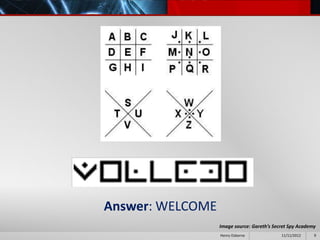
Answer: WELCOME
                  Image source: Gareth’s Secret Spy Academy
                  Henry Osborne             11/11/2012    9
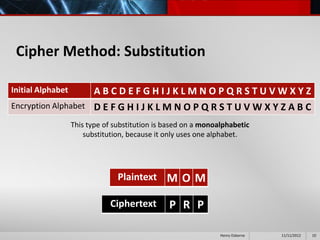
Cipher Method: Substitution

Initial Alphabet    ABCDEFGHIJKLMNOPQRSTUVWXYZ
Encryption Alphabet D E F G H I J K L M N O P Q R S T U V W X Y Z A B C

                   This type of substitution is based on a monoalphabetic
                       substitution, because it only uses one alphabet.


                                 Plaintext M O M

                              Ciphertext        P R P

                                                                Henry Osborne   11/11/2012   10
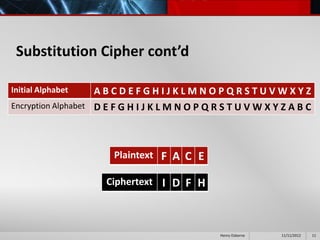
Substitution Cipher cont’d

Initial Alphabet    ABCDEFGHIJKLMNOPQRSTUVWXYZ
Encryption Alphabet D E F G H I J K L M N O P Q R S T U V W X Y Z A B C


                        Plaintext F A C E

                      Ciphertext I D F H


                                                 Henry Osborne   11/11/2012   11
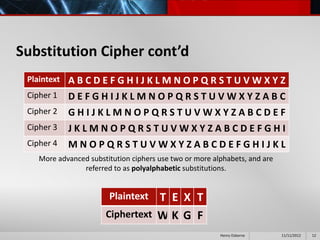
Substitution Cipher cont’d
 Plaintext A B C D E F G H I J K L M N O P Q R S T U V W X Y Z
 Cipher 1   DEFGHIJKLMNOPQRSTUVWXYZABC
 Cipher 2   GHIJKLMNOPQRSTUVWXYZABCDEF
 Cipher 3   JKLMNOPQRSTUVWXYZABCDEFGHI
 Cipher 4   MNOPQRSTUVWXYZABCDEFGHIJKL
    More advanced substitution ciphers use two or more alphabets, and are
                referred to as polyalphabetic substitutions.


                        Plaintext T E X T
                       Ciphertext W K G F
                                                         Henry Osborne      11/11/2012   12
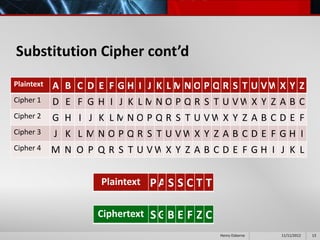
Substitution Cipher cont’d
Plaintext   A   B   C D E F G H I J K L MN O P Q R S T U VWX Y              Z
Cipher 1    D   E   F G H I J K L MN O P Q R S T U VW X Y Z A B             C
Cipher 2    G   H   I J K L MN O P Q R S T U VW X Y Z A B C D E             F
Cipher 3    J   K   L M N O P Q R S T U VWX Y Z A B C D E F G H             I
Cipher 4    M   N   O P Q R S T U VWX Y Z A B C D E F G H I J K             L


                        Plaintext P A S S C T T


                        Ciphertext S G B E F Z C
                                                   Henry Osborne   11/11/2012   13
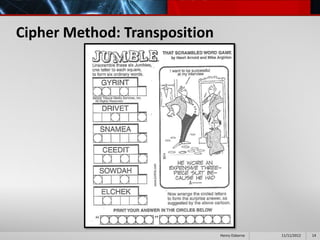
Cipher Method: Transposition


                               Henry Osborne   11/11/2012   14
Transposition Cipher cont’d
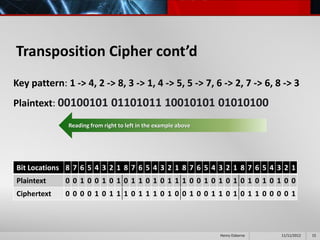
Key pattern: 1 -> 4, 2 -> 8, 3 -> 1, 4 -> 5, 5 -> 7, 6 -> 2, 7 -> 6, 8 -> 3
Plaintext: 00100101 01101011 10010101 01010100
              Reading from right to left in the example above


Bit Locations 8 7 6 5 4 3 2 1 8 7 6 5 4 3 2 1 8 7 6 5 4 3 2 1 8 7 6 5 4 3 2 1
Plaintext    0 0 1 0 0 1 0 1 0 1 1 0 1 0 1 1 1 0 0 1 0 1 0 1 0 1 0 1 0 1 0 0
Ciphertext   0 0 0 0 1 0 1 1 1 0 1 1 1 0 1 0 0 1 0 0 1 1 0 1 0 1 1 0 0 0 0 1


                                                                Henry Osborne   11/11/2012   15
Transposition Cipher cont’d

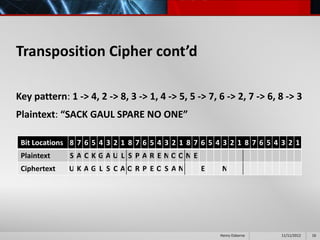
Key pattern: 1 -> 4, 2 -> 8, 3 -> 1, 4 -> 5, 5 -> 7, 6 -> 2, 7 -> 6, 8 -> 3
Plaintext: “SACK GAUL SPARE NO ONE”

 Bit Locations 8 7 6 5 4 3 2 1 8 7 6 5 4 3 2 1 8 7 6 5 4 3 2 1 8 7 6 5 4 3 2 1
 Plaintext    S A C K GAU L S P A R E NOON E
 Ciphertext   UKAG L S CAOR P EOS AN              E      N


                                                        Henry Osborne   11/11/2012   16
Question
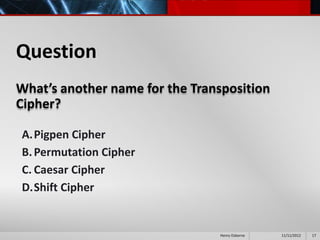
What’s another name for the Transposition
Cipher?

A.Pigpen Cipher
B. Permutation Cipher
C. Caesar Cipher
D.Shift Cipher


                                Henry Osborne   11/11/2012   17
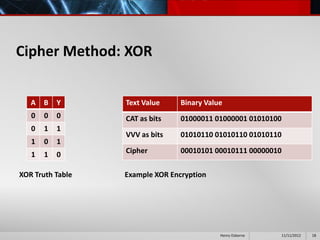
Cipher Method: XOR


   A   B   Y      Text Value     Binary Value
   0   0   0      CAT as bits    01000011 01000001 01010100
   0   1   1
                  VVV as bits    01010110 01010110 01010110
   1   0   1
   1   1   0      Cipher         00010101 00010111 00000010


XOR Truth Table   Example XOR Encryption


                                            Henry Osborne     11/11/2012   18
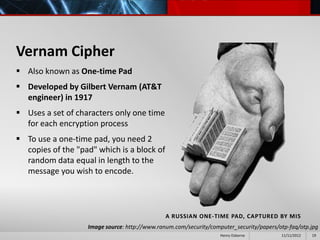
Vernam Cipher
 Also known as One-time Pad
 Developed by Gilbert Vernam (AT&T
  engineer) in 1917
 Uses a set of characters only one time
  for each encryption process
 To use a one-time pad, you need 2
  copies of the "pad" which is a block of
  random data equal in length to the
  message you wish to encode.


                                               A RUSSIAN ONE-TIME PAD, CAPTURED BY MI5
                   Image source: http://www.ranum.com/security/computer_security/papers/otp-faq/otp.jpg
                                                                   Henry Osborne         11/11/2012   19
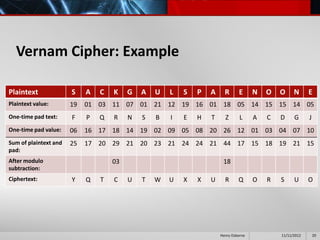
Vernam Cipher: Example

Plaintext              S    A   C   K    G   A   U   L   S   P   A     R      E      N   O   O     N      E
Plaintext value:       19   01 03 11 07 01 21 12 19 16 01 18 05 14 15 15 14 05
One-time pad text:     F    P   Q   R    N   S   B   I   E   H   T     Z       L     A   C   D     G      J
One-time pad value:    06   16 17 18 14 19 02 09 05 08 20 26 12 01 03 04 07 10
Sum of plaintext and   25   17 20 29 21 20 23 21 24 24 21 44 17 15 18 19 21 15
pad:
After modulo                        03                                18
subtraction:
Ciphertext:            Y    Q   T   C    U   T   W   U   X   X   U     R      Q      O   R   S     U      O


                                                                     Henry Osborne           11/11/2012       20
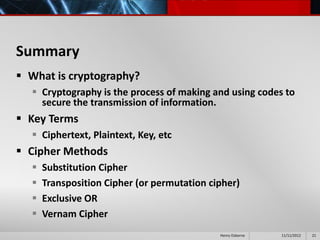
Summary
 What is cryptography?
   Cryptography is the process of making and using codes to
    secure the transmission of information.
 Key Terms
   Ciphertext, Plaintext, Key, etc
 Cipher Methods
     Substitution Cipher
     Transposition Cipher (or permutation cipher)
     Exclusive OR
     Vernam Cipher
                                             Henry Osborne   11/11/2012   21
Henry Osborne
                         Technology Specialist
                     Northern Caribbean University
                               963-7282

henry.osborne@ncu.edu.jm           @sicarii13        gplus.to/sicarii13

Cryptography

  • 1.
  • 2.
    Presenter Profile  Education  Dip. Applied Computer Science, Jamaica Advanced Computer Systems  B.Sc. Information Science, Northern Caribbean University  M.Sc. Management Information System (Security Concentration), Nova Southeastern University – candidate  Security+ candidate  Professional Experience  Technology Specialist: Dept. of Computer & Information Sciences (NCU)  Instructor: NCU, VTDI  Internet Services Coordinator: Round Hill Hotel & Villas Henry Osborne 11/11/2012 2
  • 3.
    Outline  What iscryptography?  Terminology  Cipher Methods  Substitution Cipher  Transposition Cipher  Exclusive OR  Vernam Cipher Henry Osborne 11/11/2012 3
  • 4.
    What is Cryptography? Henry Osborne 11/11/2012 4
  • 5.
    Cryptography, which comesfrom the Greek words kryptos, meaning “hidden,” and graphein, meaning “to write,” is the process of making and using codes to secure the transmission of information. Henry Osborne 11/11/2012 5
  • 6.
    Yet it mayroundly be asserted that human ingenuity cannot concoct a cipher which human ingenuity cannot resolve. EDGAR ALLAN POE, THE GOLD BUG Henry Osborne 11/11/2012 6
  • 7.
    Terminology  Algorithm  Key or Cryptovariable  Cipher or Crypotosystem  Keyspace  Ciphertext or Cryptogram  Link Encryption  Code  Plaintext or Cleartext  Decode  Steganography  Decipher  Work factor  Encipher Henry Osborne 11/11/2012 7
  • 8.
    Cipher Methods Image source: howstuffworks Henry Osborne 11/11/2012 8
  • 9.
    Answer: WELCOME Image source: Gareth’s Secret Spy Academy Henry Osborne 11/11/2012 9
  • 10.
    Cipher Method: Substitution InitialAlphabet ABCDEFGHIJKLMNOPQRSTUVWXYZ Encryption Alphabet D E F G H I J K L M N O P Q R S T U V W X Y Z A B C This type of substitution is based on a monoalphabetic substitution, because it only uses one alphabet. Plaintext M O M Ciphertext P R P Henry Osborne 11/11/2012 10
  • 11.
    Substitution Cipher cont’d InitialAlphabet ABCDEFGHIJKLMNOPQRSTUVWXYZ Encryption Alphabet D E F G H I J K L M N O P Q R S T U V W X Y Z A B C Plaintext F A C E Ciphertext I D F H Henry Osborne 11/11/2012 11
  • 12.
    Substitution Cipher cont’d Plaintext A B C D E F G H I J K L M N O P Q R S T U V W X Y Z Cipher 1 DEFGHIJKLMNOPQRSTUVWXYZABC Cipher 2 GHIJKLMNOPQRSTUVWXYZABCDEF Cipher 3 JKLMNOPQRSTUVWXYZABCDEFGHI Cipher 4 MNOPQRSTUVWXYZABCDEFGHIJKL More advanced substitution ciphers use two or more alphabets, and are referred to as polyalphabetic substitutions. Plaintext T E X T Ciphertext W K G F Henry Osborne 11/11/2012 12
  • 13.
    Substitution Cipher cont’d Plaintext A B C D E F G H I J K L MN O P Q R S T U VWX Y Z Cipher 1 D E F G H I J K L MN O P Q R S T U VW X Y Z A B C Cipher 2 G H I J K L MN O P Q R S T U VW X Y Z A B C D E F Cipher 3 J K L M N O P Q R S T U VWX Y Z A B C D E F G H I Cipher 4 M N O P Q R S T U VWX Y Z A B C D E F G H I J K L Plaintext P A S S C T T Ciphertext S G B E F Z C Henry Osborne 11/11/2012 13
  • 14.
    Cipher Method: Transposition Henry Osborne 11/11/2012 14
  • 15.
    Transposition Cipher cont’d Keypattern: 1 -> 4, 2 -> 8, 3 -> 1, 4 -> 5, 5 -> 7, 6 -> 2, 7 -> 6, 8 -> 3 Plaintext: 00100101 01101011 10010101 01010100 Reading from right to left in the example above Bit Locations 8 7 6 5 4 3 2 1 8 7 6 5 4 3 2 1 8 7 6 5 4 3 2 1 8 7 6 5 4 3 2 1 Plaintext 0 0 1 0 0 1 0 1 0 1 1 0 1 0 1 1 1 0 0 1 0 1 0 1 0 1 0 1 0 1 0 0 Ciphertext 0 0 0 0 1 0 1 1 1 0 1 1 1 0 1 0 0 1 0 0 1 1 0 1 0 1 1 0 0 0 0 1 Henry Osborne 11/11/2012 15
  • 16.
    Transposition Cipher cont’d Keypattern: 1 -> 4, 2 -> 8, 3 -> 1, 4 -> 5, 5 -> 7, 6 -> 2, 7 -> 6, 8 -> 3 Plaintext: “SACK GAUL SPARE NO ONE” Bit Locations 8 7 6 5 4 3 2 1 8 7 6 5 4 3 2 1 8 7 6 5 4 3 2 1 8 7 6 5 4 3 2 1 Plaintext S A C K GAU L S P A R E NOON E Ciphertext UKAG L S CAOR P EOS AN E N Henry Osborne 11/11/2012 16
  • 17.
    Question What’s another namefor the Transposition Cipher? A.Pigpen Cipher B. Permutation Cipher C. Caesar Cipher D.Shift Cipher Henry Osborne 11/11/2012 17
  • 18.
    Cipher Method: XOR A B Y Text Value Binary Value 0 0 0 CAT as bits 01000011 01000001 01010100 0 1 1 VVV as bits 01010110 01010110 01010110 1 0 1 1 1 0 Cipher 00010101 00010111 00000010 XOR Truth Table Example XOR Encryption Henry Osborne 11/11/2012 18
  • 19.
    Vernam Cipher  Alsoknown as One-time Pad  Developed by Gilbert Vernam (AT&T engineer) in 1917  Uses a set of characters only one time for each encryption process  To use a one-time pad, you need 2 copies of the "pad" which is a block of random data equal in length to the message you wish to encode. A RUSSIAN ONE-TIME PAD, CAPTURED BY MI5 Image source: http://www.ranum.com/security/computer_security/papers/otp-faq/otp.jpg Henry Osborne 11/11/2012 19
  • 20.
    Vernam Cipher: Example Plaintext S A C K G A U L S P A R E N O O N E Plaintext value: 19 01 03 11 07 01 21 12 19 16 01 18 05 14 15 15 14 05 One-time pad text: F P Q R N S B I E H T Z L A C D G J One-time pad value: 06 16 17 18 14 19 02 09 05 08 20 26 12 01 03 04 07 10 Sum of plaintext and 25 17 20 29 21 20 23 21 24 24 21 44 17 15 18 19 21 15 pad: After modulo 03 18 subtraction: Ciphertext: Y Q T C U T W U X X U R Q O R S U O Henry Osborne 11/11/2012 20
  • 21.
    Summary  What iscryptography?  Cryptography is the process of making and using codes to secure the transmission of information.  Key Terms  Ciphertext, Plaintext, Key, etc  Cipher Methods  Substitution Cipher  Transposition Cipher (or permutation cipher)  Exclusive OR  Vernam Cipher Henry Osborne 11/11/2012 21
  • 22.
    Henry Osborne Technology Specialist Northern Caribbean University 963-7282 henry.osborne@ncu.edu.jm @sicarii13 gplus.to/sicarii13

Editor's Notes

  • #3 NCU -> Data Security, Java, C++, Networking, PC Repair, Computer ApplicationsVTDI -> Web Programming
  • #4 If you have any relevant questions during the presentation please feel free to ask….
  • #7 In light of the increase in computer usage and online activities, the need for the safe and secure transmission of data is paramount. This is where cryptography comes into play.Today, many common IT tools use embedded encryption technologies to protect sensitive information within applications. For example, all the popular Web browsers use built-in encryption features to enable secure e-commerce, such as online banking and Web shopping.
  • #8 In the study of cryptography there some terms you will need to be acquainted with….Definitions are on the handout that you received earlier….Ciphertextor cryptogram: The encoded message resulting from an encryptionPlaintext or cleartext: The original unencrypted message, or a message that has been successfully decrypted
  • #10 The Pigpen cipher (sometimes called the Masonic cipher or Freemason's cipher) is a simple substitution cipher exchanging letters for symbols based on a grid (or the "pigpen") surrounding it.
  • #11 To use a substitution cipher, you substitute one value for another, for example a letter in the alphabet with the letter three values to the right. Or you can substitute one bit for another bit that is four places to its left.Within this substitution scheme, the plaintext MOM would be encrypted into the ciphertext PRP.
  • #12 The plaintext FACE would be encrypted into the ciphertext IDFH.
  • #13 Encoding the word TEXT with this cipher yields the ciphertextWKGF
  • #15 Like the substitution operation, the transposition cipher is simple to understand, but it can, if properly used, produce ciphertext that is difficult to decipher.The transposition cipher (or permutation cipher) simply rearranges the values within a block to create the ciphertext. This can be done at the bit level or at the byte (character) level.
  • #16 The first bit of plaintext (position 1 of the first byte) becomes the fourth bit (in position 4) of the first byte of the ciphertext. Similarly, the second bit of the plaintext (position 2) becomes the eighth bit (position 8) of the cipher-text, and so on.
  • #17 To examine further how this transposition key works, look at its effects on a plaintext message comprised of letters instead of bits. Replacing the 8-bit block of plaintext with the example plaintext message presented earlier, “SACK GAUL SPARE NO ONE,” yields the following:
  • #18 Permutation Cipher
  • #19 The exclusive OR operation (XOR) is a function of Boolean algebra in which two bits are compared, and if the two bits are identical, the result is a binary 0. If the two bits are not the same, the result is a binary 1.To see how XOR works, consider an example in which the plaintext is the word “CAT.” The ASCII binary representation of the plaintext is “01000011 01000001 01010100”. In order to encrypt the plaintext, a key value should be selected. In this case, the bit pattern for the letter “V” (01010110) is used, and is repeated for each character to be encrypted, written left to right. Performing the XOR operation on the two bit streams (the plaintext and the key) produces the cipher as shown.
  • #20 The pad in the name comes from the days of manual encryption and decryption when the key values for each ciphering session were prepared by hand and bound into an easy-to-use form—that is, a pad of paper.A one-time pad is a cryptosystem invented by Vernam. It's a very simple system and is unbreakable if used correctly.
  • #21 Using the pad values and the ciphertext, the decryption process works as follows: “Y” becomes the number 25, from which we subtract the pad value for the first letter of the message, 06. This yields a value of 19, or the letter “S”. Where the ciphertext letter is “C” and the pad value is 18. Subtracting 18 from 3 yields negative 15. Since modulo 26 is employed, which requires that all numbers are in the range of 1–26, you must add 26 to the negative 15. This operations gives a sum of 11, which means that fourth letter of the message is “K.”
  • #22 To use a substitution cipher, you substitute one value for another, or you can substitute one bit for another bit x places to its left or right.The transposition cipher simply rearranges the values within a blockThe exclusive OR (XOR) operation is a function of Boolean algebra in which two bits are compared, and if the two bits are identical, the result is a binary 0