Cryptocurrencies Hardware Wallets
33C3 Bitcoin Assembly
@btchip
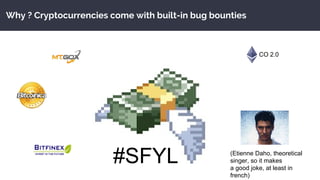
Why ? Cryptocurrencies come with built-in bug bounties
#SFYL
CO 2.0
(Etienne Daho, theoretical
singer, so it makes
a good joke, at least in
french)
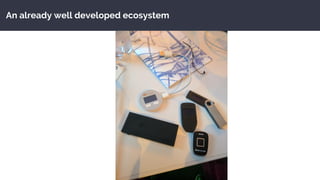
An already well developed ecosystem
Owning cryptocurrencies == owning private keys (on secp256k1)
Owning private keys is a complicated problem
Many possible attacks
Online : plain old scam, exchange security problem, outdated security (hello SMS
2FA)
Software : non creative (sweeping keys) or more creative malware, bad crypto,
phishing
Need for a new device class
Protect private keys (basic functionality)
Protect against creative malware
Easy to install, easy to use, easy to recover, as plug & play as possible
Easy to audit (don’t trust, verify)
Easy to tinker (cryptocurrencies are a continuous R&D effort)
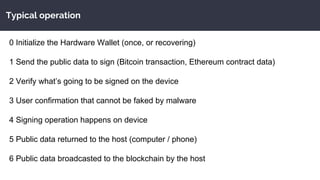
Typical operation
0 Initialize the Hardware Wallet (once, or recovering)
1 Send the public data to sign (Bitcoin transaction, Ethereum contract data)
2 Verify what’s going to be signed on the device
3 User confirmation that cannot be faked by malware
4 Signing operation happens on device
5 Public data returned to the host (computer / phone)
6 Public data broadcasted to the blockchain by the host
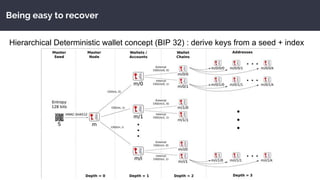
Being easy to recover
Hierarchical Deterministic wallet concept (BIP 32) : derive keys from a seed + index
Being easy to recover
Optionally BIP 39 and BIP 44 on top of it : encode the seed into mnemonic words
https://iancoleman.github.io/bip39/
Providing good crypto
Limit dependencies on randomness as much as possible
- Hierarchical Deterministic wallets
- Deterministic signing (RFC 6979), avoids ECDSA nonce reuse by design
Limit side channel attacks
- Constant time signing (https://github.com/bitcoin-core/secp256k1)
- For more complex DPA, YMMV. Still a lot of specialized work per chip.
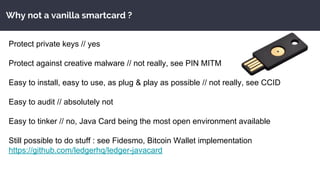
Why not a vanilla smartcard ?
Protect private keys // yes
Protect against creative malware // not really, see PIN MITM
Easy to install, easy to use, as plug & play as possible // not really, see CCID
Easy to audit // absolutely not
Easy to tinker // no, Java Card being the most open environment available
Still possible to do stuff : see Fidesmo, Bitcoin Wallet implementation
https://github.com/ledgerhq/ledger-javacard
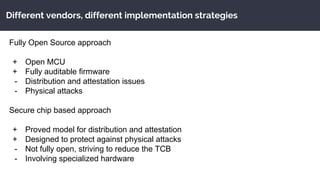
Different vendors, different implementation strategies
Fully Open Source approach
+ Open MCU
+ Fully auditable firmware
- Distribution and attestation issues
- Physical attacks
Secure chip based approach
+ Proved model for distribution and attestation
+ Designed to protect against physical attacks
- Not fully open, striving to reduce the TCB
- Involving specialized hardware
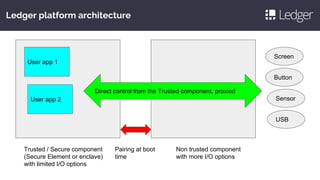
Ledger platform architecture
Trusted / Secure component
(Secure Element or enclave)
with limited I/O options
Non trusted component
with more I/O options
Screen
Direct control from the Trusted component, proxied
Pairing at boot
time
User app 1
User app 2
Button
Sensor
USB
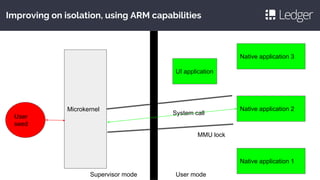
Improving on isolation, using ARM capabilities
Native application 1
Native application 2
Native application 3
Microkernel
User
seed
MMU lock
User modeSupervisor mode
System call
UI application

Cryptocurrencies Hardware Wallets - 33C3 Bitcoin Assembly

  • 1.
  • 2.
    Why ? Cryptocurrenciescome with built-in bug bounties #SFYL CO 2.0 (Etienne Daho, theoretical singer, so it makes a good joke, at least in french)
  • 3.
    An already welldeveloped ecosystem
  • 4.
    Owning cryptocurrencies ==owning private keys (on secp256k1) Owning private keys is a complicated problem Many possible attacks Online : plain old scam, exchange security problem, outdated security (hello SMS 2FA) Software : non creative (sweeping keys) or more creative malware, bad crypto, phishing
  • 5.
    Need for anew device class Protect private keys (basic functionality) Protect against creative malware Easy to install, easy to use, easy to recover, as plug & play as possible Easy to audit (don’t trust, verify) Easy to tinker (cryptocurrencies are a continuous R&D effort)
  • 6.
    Typical operation 0 Initializethe Hardware Wallet (once, or recovering) 1 Send the public data to sign (Bitcoin transaction, Ethereum contract data) 2 Verify what’s going to be signed on the device 3 User confirmation that cannot be faked by malware 4 Signing operation happens on device 5 Public data returned to the host (computer / phone) 6 Public data broadcasted to the blockchain by the host
  • 7.
    Being easy torecover Hierarchical Deterministic wallet concept (BIP 32) : derive keys from a seed + index
  • 8.
    Being easy torecover Optionally BIP 39 and BIP 44 on top of it : encode the seed into mnemonic words https://iancoleman.github.io/bip39/
  • 9.
    Providing good crypto Limitdependencies on randomness as much as possible - Hierarchical Deterministic wallets - Deterministic signing (RFC 6979), avoids ECDSA nonce reuse by design Limit side channel attacks - Constant time signing (https://github.com/bitcoin-core/secp256k1) - For more complex DPA, YMMV. Still a lot of specialized work per chip.
  • 10.
    Why not avanilla smartcard ? Protect private keys // yes Protect against creative malware // not really, see PIN MITM Easy to install, easy to use, as plug & play as possible // not really, see CCID Easy to audit // absolutely not Easy to tinker // no, Java Card being the most open environment available Still possible to do stuff : see Fidesmo, Bitcoin Wallet implementation https://github.com/ledgerhq/ledger-javacard
  • 11.
    Different vendors, differentimplementation strategies Fully Open Source approach + Open MCU + Fully auditable firmware - Distribution and attestation issues - Physical attacks Secure chip based approach + Proved model for distribution and attestation + Designed to protect against physical attacks - Not fully open, striving to reduce the TCB - Involving specialized hardware
  • 12.
    Ledger platform architecture Trusted/ Secure component (Secure Element or enclave) with limited I/O options Non trusted component with more I/O options Screen Direct control from the Trusted component, proxied Pairing at boot time User app 1 User app 2 Button Sensor USB
  • 13.
    Improving on isolation,using ARM capabilities Native application 1 Native application 2 Native application 3 Microkernel User seed MMU lock User modeSupervisor mode System call UI application