IoT/M2M Security
Yu-Hsin Hung, Chun-Kuei Huang
1
Outline
• Background
• Paper: Distributed Capability-based Access Control
for the Internet of Things
• Security solution in open source IoT platform
• OM2M
• AllJoyn
• Discussion
2
Background
• More connected devices mean more attack vectors
and more possibilities for hackers to target us
• e.g. Internet-connected cars
• Huge data with privacy information recorded by
IoT devices
• e.g. health data from health tracker
3
Distributed Capability-based Access
Control for the Internet of Things
José L. Hernández-Ramos, Antonio J. Jara, Leandro Maŕın, and Antonio F. Skarmeta
Department of Information and Communications Engineering

Computer Science Faculty
University of Murcia, 30100 Murcia, Spain
4
Introduction
• Previous works
• centralized approaches
• Access control mechanism
• Role-Based Access Control (RBAC)
• Attribute-Based Access Control (ABAC)
5
Introduction
• This work
• capability-based access control
• principle of least privilege
• greater adaptation
• distributed approach
• public-key cryptography (optimized ECDSA)
6
Access Control
architectures for IoT
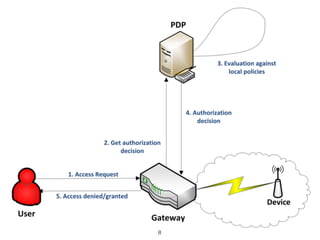
• Centralized approach
• central PDP (Policy Decision Point) is responsible for
filtering access requests based on their authorization
policies
• end-devices play a role limited to as information
providers
7
8
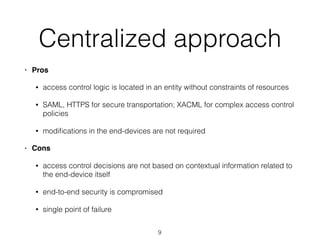
Centralized approach
• Pros
• access control logic is located in an entity without constraints of resources
• SAML, HTTPS for secure transportation; XACML for complex access control
policies
• modifications in the end-devices are not required
• Cons
• access control decisions are not based on contextual information related to
the end-device itself
• end-to-end security is compromised
• single point of failure
9
Access Control
architectures for IoT
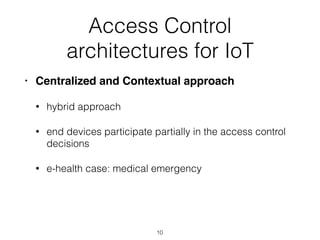
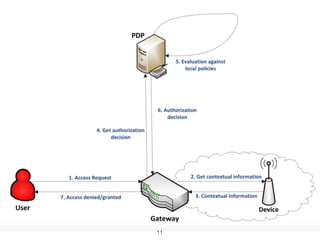
• Centralized and Contextual approach
• hybrid approach
• end devices participate partially in the access control
decisions
• e-health case: medical emergency
10
11
Centralized and Contextual
approach
• Pros
• use standard technologies to perform the authorization
process
• Cons
• trust relationship is assumed between the devices and
the central entity
• delay of contextual information
• end-to-end security can not be achieved
12
Access Control
architectures for IoT
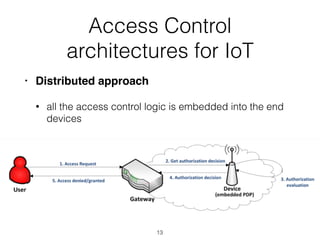
• Distributed approach
• all the access control logic is embedded into the end
devices
13
Distributed approach
• Pros
• end-devices are no longer passive entities
• devices are able to send information just when necessary
• end-to-end security
• scalability, interoperability and context-awareness
• Cons
• RBAC and ABAC may need high computational cost
• symmetric-key cryptography does not satisfy the principle of scalability
for IoT scenarios
14
Design
• Capability-based access control (CapBAC)
• capability: ”token, ticket, or key that gives the
possessor permission to access an entity or object
in a computer system”
• tamper-proof and unequivocally identified
• send a token together the request
• the entity that receives the capability already knows
the right level (i.e., permissions)
15
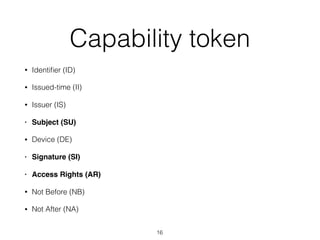
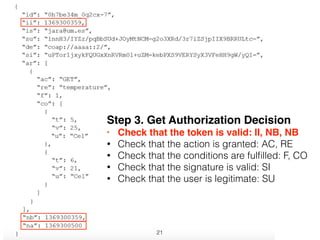
Capability token
• Identifier (ID)
• Issued-time (II)
• Issuer (IS)
• Subject (SU)
• Device (DE)
• Signature (SI)
• Access Rights (AR)
• Not Before (NB)
• Not After (NA) 
16
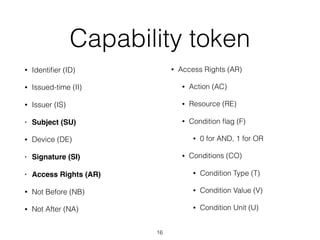
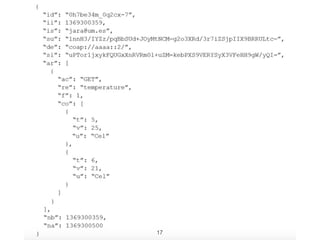
Capability token
• Identifier (ID)
• Issued-time (II)
• Issuer (IS)
• Subject (SU)
• Device (DE)
• Signature (SI)
• Access Rights (AR)
• Not Before (NB)
• Not After (NA) 
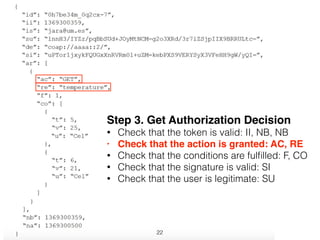
• Access Rights (AR)
• Action (AC)
• Resource (RE)
• Condition flag (F)
• 0 for AND, 1 for OR
• Conditions (CO)
• Condition Type (T)
• Condition Value (V)
• Condition Unit (U)
16
17
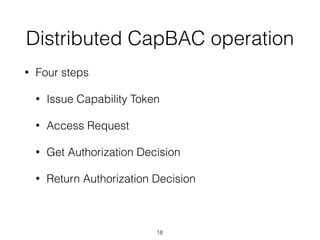
Distributed CapBAC operation
• Four steps
• Issue Capability Token
• Access Request
• Get Authorization Decision
• Return Authorization Decision
18
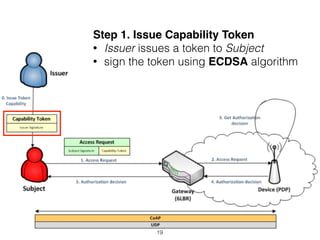
Step 1. Issue Capability Token
• Issuer issues a token to Subject
• sign the token using ECDSA algorithm
19
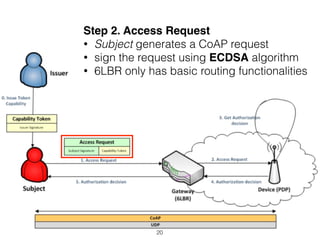
Step 2. Access Request
• Subject generates a CoAP request
• sign the request using ECDSA algorithm
• 6LBR only has basic routing functionalities
20
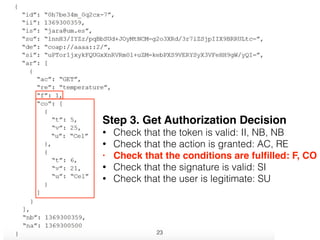
Step 3. Get Authorization Decision
• Check that the token is valid: II, NB, NB
• Check that the action is granted: AC, RE
• Check that the conditions are fulfilled: F, CO
• Check that the signature is valid: SI
• Check that the user is legitimate: SU
21
Step 3. Get Authorization Decision
• Check that the token is valid: II, NB, NB
• Check that the action is granted: AC, RE
• Check that the conditions are fulfilled: F, CO
• Check that the signature is valid: SI
• Check that the user is legitimate: SU
22
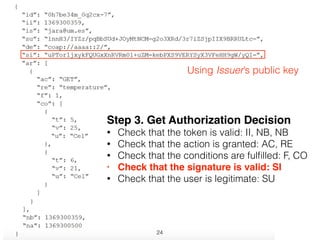
Step 3. Get Authorization Decision
• Check that the token is valid: II, NB, NB
• Check that the action is granted: AC, RE
• Check that the conditions are fulfilled: F, CO
• Check that the signature is valid: SI
• Check that the user is legitimate: SU
23
Step 3. Get Authorization Decision
• Check that the token is valid: II, NB, NB
• Check that the action is granted: AC, RE
• Check that the conditions are fulfilled: F, CO
• Check that the signature is valid: SI
• Check that the user is legitimate: SU
Using Issuer’s public key
24
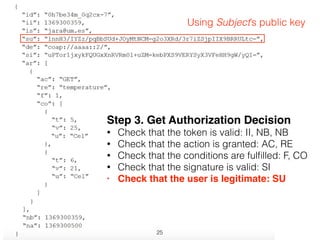
Step 3. Get Authorization Decision
• Check that the token is valid: II, NB, NB
• Check that the action is granted: AC, RE
• Check that the conditions are fulfilled: F, CO
• Check that the signature is valid: SI
• Check that the user is legitimate: SU
Using Subject’s public key
25
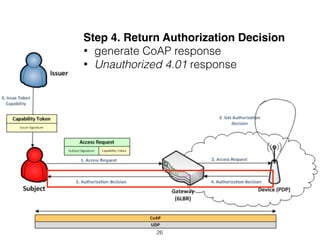
Step 4. Return Authorization Decision
• generate CoAP response
• Unauthorized 4.01 response
26
Evaluation
• Test bed
• JN5139 MCU with Contiki OS
• low power, low cost, suitable for IEEE802.15.4
• 96KB RAM, 192KB ROM
• Subject written in Java on a common computer
• 6LBR for forwarding the access requests
27
Evaluation
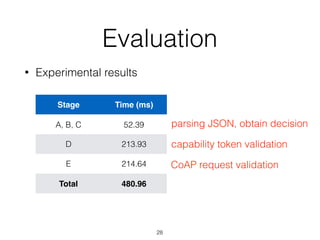
• Experimental results
Stage Time (ms)
A, B, C 52.39
D 213.93
E 214.64
Total 480.96
capability token validation
CoAP request validation
parsing JSON, obtain decision
28
Conclusion
• CapBAC with distributed approach
• scalability
• end-to-end security
• optimized ECDSA implementation for constrained
devices based on shifting primes
• requires the definition of a model for dynamic and
context-based management of the conditions in order
to reach a real market
29
Security solution in
open source IoT platform
30
OM2M
• Centralized approach
• Devices report data to GSCL, act as passive units
• DSCL is not released yet
• Basic access control implemented on GSCL/NSCL
• End-to-end security is not achieved
31
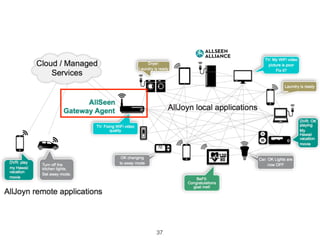
AllJoyn
• Qualcomm lead the development, with 200+
partners
• The AllJoyn framework runs on the local network
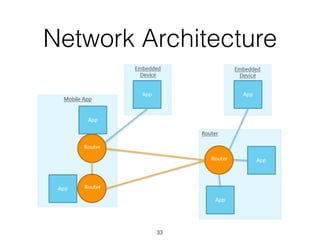
• AllJoyn Apps and AllJoyn Routers
• Apps can only communicate with other Apps by
going through a Router
32
Network Architecture
33
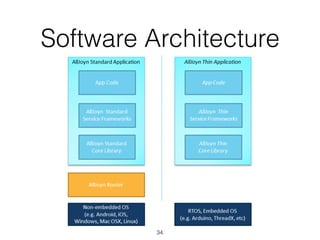
Software Architecture
34
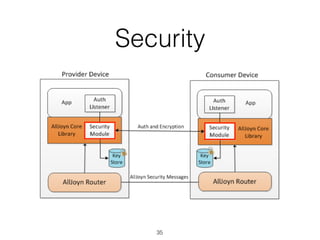
Security
35
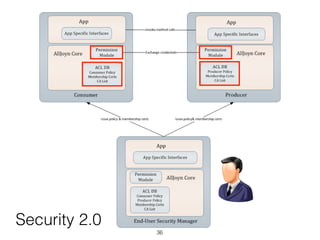
Security 2.0
36
37
Summary
• ACL model
• distributed, end-to-end security
• policies stored on device end, decisions are made
locally
38
Discussion
• [paper] access rights on token
• flexible but difficult to manage
• private key leakage
• [AllJoyn] access rights on device
• limitation on constrained device
• easy to manage
• [OM2M] access rights on GSCL/NSCL
• centralized approach
39
Reference
• Why IoT Security Is So Critical, TechCrunch
• Distributed Capability-based Access Control for the
Internet of Things [2013]
• A decentralized approach for Security and Privacy
challenges in the Internet of Things [2014]
• OM2M, http://www.eclipse.org/om2m/
• AllJoyn, https://allseenalliance.org/
Thank you
41

IoT/M2M Security

  • 1.
  • 2.
    Outline • Background • Paper:Distributed Capability-based Access Control for the Internet of Things • Security solution in open source IoT platform • OM2M • AllJoyn • Discussion 2
  • 3.
    Background • More connecteddevices mean more attack vectors and more possibilities for hackers to target us • e.g. Internet-connected cars • Huge data with privacy information recorded by IoT devices • e.g. health data from health tracker 3
  • 4.
    Distributed Capability-based Access Controlfor the Internet of Things José L. Hernández-Ramos, Antonio J. Jara, Leandro Maŕın, and Antonio F. Skarmeta Department of Information and Communications Engineering
 Computer Science Faculty University of Murcia, 30100 Murcia, Spain 4
  • 5.
    Introduction • Previous works •centralized approaches • Access control mechanism • Role-Based Access Control (RBAC) • Attribute-Based Access Control (ABAC) 5
  • 6.
    Introduction • This work •capability-based access control • principle of least privilege • greater adaptation • distributed approach • public-key cryptography (optimized ECDSA) 6
  • 7.
    Access Control architectures forIoT • Centralized approach • central PDP (Policy Decision Point) is responsible for filtering access requests based on their authorization policies • end-devices play a role limited to as information providers 7
  • 8.
  • 9.
    Centralized approach • Pros •access control logic is located in an entity without constraints of resources • SAML, HTTPS for secure transportation; XACML for complex access control policies • modifications in the end-devices are not required • Cons • access control decisions are not based on contextual information related to the end-device itself • end-to-end security is compromised • single point of failure 9
  • 10.
    Access Control architectures forIoT • Centralized and Contextual approach • hybrid approach • end devices participate partially in the access control decisions • e-health case: medical emergency 10
  • 11.
  • 12.
    Centralized and Contextual approach •Pros • use standard technologies to perform the authorization process • Cons • trust relationship is assumed between the devices and the central entity • delay of contextual information • end-to-end security can not be achieved 12
  • 13.
    Access Control architectures forIoT • Distributed approach • all the access control logic is embedded into the end devices 13
  • 14.
    Distributed approach • Pros •end-devices are no longer passive entities • devices are able to send information just when necessary • end-to-end security • scalability, interoperability and context-awareness • Cons • RBAC and ABAC may need high computational cost • symmetric-key cryptography does not satisfy the principle of scalability for IoT scenarios 14
  • 15.
    Design • Capability-based accesscontrol (CapBAC) • capability: ”token, ticket, or key that gives the possessor permission to access an entity or object in a computer system” • tamper-proof and unequivocally identified • send a token together the request • the entity that receives the capability already knows the right level (i.e., permissions) 15
  • 16.
    Capability token • Identifier(ID) • Issued-time (II) • Issuer (IS) • Subject (SU) • Device (DE) • Signature (SI) • Access Rights (AR) • Not Before (NB) • Not After (NA)  16
  • 17.
    Capability token • Identifier(ID) • Issued-time (II) • Issuer (IS) • Subject (SU) • Device (DE) • Signature (SI) • Access Rights (AR) • Not Before (NB) • Not After (NA)  • Access Rights (AR) • Action (AC) • Resource (RE) • Condition flag (F) • 0 for AND, 1 for OR • Conditions (CO) • Condition Type (T) • Condition Value (V) • Condition Unit (U) 16
  • 18.
  • 19.
    Distributed CapBAC operation •Four steps • Issue Capability Token • Access Request • Get Authorization Decision • Return Authorization Decision 18
  • 20.
    Step 1. IssueCapability Token • Issuer issues a token to Subject • sign the token using ECDSA algorithm 19
  • 21.
    Step 2. AccessRequest • Subject generates a CoAP request • sign the request using ECDSA algorithm • 6LBR only has basic routing functionalities 20
  • 22.
    Step 3. GetAuthorization Decision • Check that the token is valid: II, NB, NB • Check that the action is granted: AC, RE • Check that the conditions are fulfilled: F, CO • Check that the signature is valid: SI • Check that the user is legitimate: SU 21
  • 23.
    Step 3. GetAuthorization Decision • Check that the token is valid: II, NB, NB • Check that the action is granted: AC, RE • Check that the conditions are fulfilled: F, CO • Check that the signature is valid: SI • Check that the user is legitimate: SU 22
  • 24.
    Step 3. GetAuthorization Decision • Check that the token is valid: II, NB, NB • Check that the action is granted: AC, RE • Check that the conditions are fulfilled: F, CO • Check that the signature is valid: SI • Check that the user is legitimate: SU 23
  • 25.
    Step 3. GetAuthorization Decision • Check that the token is valid: II, NB, NB • Check that the action is granted: AC, RE • Check that the conditions are fulfilled: F, CO • Check that the signature is valid: SI • Check that the user is legitimate: SU Using Issuer’s public key 24
  • 26.
    Step 3. GetAuthorization Decision • Check that the token is valid: II, NB, NB • Check that the action is granted: AC, RE • Check that the conditions are fulfilled: F, CO • Check that the signature is valid: SI • Check that the user is legitimate: SU Using Subject’s public key 25
  • 27.
    Step 4. ReturnAuthorization Decision • generate CoAP response • Unauthorized 4.01 response 26
  • 28.
    Evaluation • Test bed •JN5139 MCU with Contiki OS • low power, low cost, suitable for IEEE802.15.4 • 96KB RAM, 192KB ROM • Subject written in Java on a common computer • 6LBR for forwarding the access requests 27
  • 29.
    Evaluation • Experimental results StageTime (ms) A, B, C 52.39 D 213.93 E 214.64 Total 480.96 capability token validation CoAP request validation parsing JSON, obtain decision 28
  • 30.
    Conclusion • CapBAC withdistributed approach • scalability • end-to-end security • optimized ECDSA implementation for constrained devices based on shifting primes • requires the definition of a model for dynamic and context-based management of the conditions in order to reach a real market 29
  • 31.
    Security solution in opensource IoT platform 30
  • 32.
    OM2M • Centralized approach •Devices report data to GSCL, act as passive units • DSCL is not released yet • Basic access control implemented on GSCL/NSCL • End-to-end security is not achieved 31
  • 33.
    AllJoyn • Qualcomm leadthe development, with 200+ partners • The AllJoyn framework runs on the local network • AllJoyn Apps and AllJoyn Routers • Apps can only communicate with other Apps by going through a Router 32
  • 34.
  • 35.
  • 36.
  • 37.
  • 38.
  • 39.
    Summary • ACL model •distributed, end-to-end security • policies stored on device end, decisions are made locally 38
  • 40.
    Discussion • [paper] accessrights on token • flexible but difficult to manage • private key leakage • [AllJoyn] access rights on device • limitation on constrained device • easy to manage • [OM2M] access rights on GSCL/NSCL • centralized approach 39
  • 41.
    Reference • Why IoTSecurity Is So Critical, TechCrunch • Distributed Capability-based Access Control for the Internet of Things [2013] • A decentralized approach for Security and Privacy challenges in the Internet of Things [2014] • OM2M, http://www.eclipse.org/om2m/ • AllJoyn, https://allseenalliance.org/
  • 42.