Bitcoin Meetup
Eric Voskuil<eric@voskuil.org>
3CD8C07F0B5CE14E
Libbitcoin
C++ Bitcoin Development Toolkit and Applications
github.com/libbitcoin
Agenda
• Security concepts
• Wallet attack surface
• General purpose platforms
• Fun with hardware wallets
Agenda
• Security concepts
• Wallet attack surface
• General purpose platforms
• Fun with hardware wallets
Wallet Security
• Security
– Preventing involuntary loss of property.
– Fundamentally, the reason for Bitcoin.
• Wallet
– Bitcoin does not have banks.
– It’s wallets all the way down.
CIA
• Confidentiality
– How might unintended people get it?
• Integrity
– How might the system fail on its own?
• Availability
– How might intended people not get it?
Agenda
• Security concepts
• Wallet attack surface
• General purpose platforms
• Fun with hardware wallets
Wallet Types
• Full Chain
• Partial Chain (SPV)
• No Chain (trusting)
• Off Chain (custodial)
Full Chain - Defined
• Builds a chain of complete blocks
• Validates chain against consensus
• Validates payments against chain
• Chain and private keys are co-located
• May also
– send new transactions to peers
– get unmined transactions from peers
Full Chain – Attack Surface
• Mining
– Finney Attack (double spend)
– 51% Attack (double spend, DoS)
• Network
– Sybil Attack (double spend, DoS, privacy)
– Eavesdropping (privacy)
• Platform
– Total loss
– See Pony Botnet
Partial Chain - Defined
• Simple Payment Verification
– Actually more complex, just less data
• Like full chain except
– Validates block headers not full blocks
– Requests only transactions of interest
Partial Chain – Attack Surface
• Same as full chain except
– Omission of transactions possible
– Privacy loss extends to validation
• This is a design and implementation issue
• Validation can be achieved privately
No Chain - Defined
• Gets summary information from server
• Spends are typically relayed by server
• Server is presumed to be honest
• Private keys are retained by the wallet
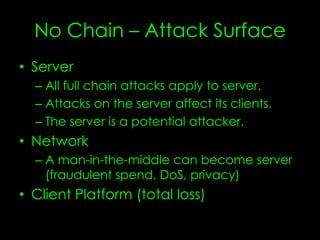
No Chain – Attack Surface
• Server
– All full chain attacks apply to server
– Attacks on the server affect its clients
– The server is a potential attacker
• Network
– A man-in-the-middle can become server
(fraudulent spend, DoS, privacy)
• Client Platform
– Total loss
– Multifactor auth?
Off Chain - Defined
• A gold certificate is not gold.
• Custodial accounts are not Bitcoin.
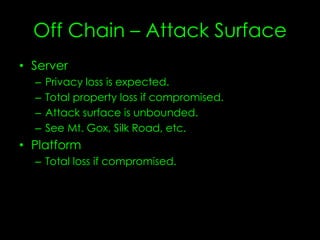
Off Chain – Attack Surface
• Server
– Privacy loss is expected.
– Total property loss if compromised.
– Attack surface is unbounded.
– See Mt. Gox, Silk Road, etc.
• Platform
– Total loss
Agenda
• Security concepts
• Wallet attack surface
• General purpose platforms
• Fun with hardware wallets
General Purpose Platforms
• Personal Computer
– Malware
• Mobile Device
– Malware
– Loss and theft
– Baseband attack
• Trusted Computing?
– “When you think about a secure computer, the
first question you should ask is: "Secure for
whom?" ” – Bruce Schneier
Agenda
• Security concepts
• Wallet attack surface
• General purpose platforms
• Fun with hardware wallets
Hardware Wallets
• Case
– “You press the bitcoin button, scan the QR code with
the camera, swipe your finger and you’re done.
Everything happens on the device; you don’t have to
log in with a complicated password or use a
smartphone app.“
• Ledger
– “[T]he initial setup should be safe as the ECDH is done
against a static public dongle key.”
• Trezor
– “It took only a single recording of the computation of
the public key, to recover the private key.”
Case
• Seems to do the right stuff
– Biometrics (fingerprint)
– Multisig (2 of 3)
– Encryption (“encrypted online database”)
– Key escrow (“offline vault”)
• “Insanely Secure” – TechCrunch
• But…
Ledger
• Seems to do the right stuff
– Secure element
– Multifactor (card, phone)
– Multisig (via Coinkite)
• “Malware Proof” – ledgerwallet.com
• But…
Trezor
• Secures money, not privacy
– Use a full chain wallet.
– Beware of address reuse.
– Send transactions via Tor (client-server).
• Seems to do everything wrong
– No biometrics
– No encryption
– No secure element
• But…
Decentralization

Seattle Bitcoin Meetup

  • 1.
  • 2.
    Libbitcoin C++ Bitcoin DevelopmentToolkit and Applications github.com/libbitcoin
  • 3.
    Agenda • Security concepts •Wallet attack surface • General purpose platforms • Fun with hardware wallets
  • 4.
    Agenda • Security concepts •Wallet attack surface • General purpose platforms • Fun with hardware wallets
  • 5.
    Wallet Security • Security –Preventing involuntary loss of property. – Fundamentally, the reason for Bitcoin. • Wallet – Bitcoin does not have banks. – It’s wallets all the way down.
  • 6.
    CIA • Confidentiality – Howmight unintended people get it? • Integrity – How might the system fail on its own? • Availability – How might intended people not get it?
  • 7.
    Agenda • Security concepts •Wallet attack surface • General purpose platforms • Fun with hardware wallets
  • 8.
    Wallet Types • FullChain • Partial Chain (SPV) • No Chain (trusting) • Off Chain (custodial)
  • 9.
    Full Chain -Defined • Builds a chain of complete blocks • Validates chain against consensus • Validates payments against chain • Chain and private keys are co-located • May also – send new transactions to peers – get unmined transactions from peers
  • 10.
    Full Chain –Attack Surface • Mining – Finney Attack (double spend) – 51% Attack (double spend, DoS) • Network – Sybil Attack (double spend, DoS, privacy) – Eavesdropping (privacy) • Platform – Total loss – See Pony Botnet
  • 11.
    Partial Chain -Defined • Simple Payment Verification – Actually more complex, just less data • Like full chain except – Validates block headers not full blocks – Requests only transactions of interest
  • 12.
    Partial Chain –Attack Surface • Same as full chain except – Omission of transactions possible – Privacy loss extends to validation • This is a design and implementation issue • Validation can be achieved privately
  • 13.
    No Chain -Defined • Gets summary information from server • Spends are typically relayed by server • Server is presumed to be honest • Private keys are retained by the wallet
  • 14.
    No Chain –Attack Surface • Server – All full chain attacks apply to server – Attacks on the server affect its clients – The server is a potential attacker • Network – A man-in-the-middle can become server (fraudulent spend, DoS, privacy) • Client Platform – Total loss – Multifactor auth?
  • 15.
    Off Chain -Defined • A gold certificate is not gold. • Custodial accounts are not Bitcoin.
  • 16.
    Off Chain –Attack Surface • Server – Privacy loss is expected. – Total property loss if compromised. – Attack surface is unbounded. – See Mt. Gox, Silk Road, etc. • Platform – Total loss
  • 17.
    Agenda • Security concepts •Wallet attack surface • General purpose platforms • Fun with hardware wallets
  • 18.
    General Purpose Platforms •Personal Computer – Malware • Mobile Device – Malware – Loss and theft – Baseband attack • Trusted Computing? – “When you think about a secure computer, the first question you should ask is: "Secure for whom?" ” – Bruce Schneier
  • 19.
    Agenda • Security concepts •Wallet attack surface • General purpose platforms • Fun with hardware wallets
  • 20.
    Hardware Wallets • Case –“You press the bitcoin button, scan the QR code with the camera, swipe your finger and you’re done. Everything happens on the device; you don’t have to log in with a complicated password or use a smartphone app.“ • Ledger – “[T]he initial setup should be safe as the ECDH is done against a static public dongle key.” • Trezor – “It took only a single recording of the computation of the public key, to recover the private key.”
  • 21.
    Case • Seems todo the right stuff – Biometrics (fingerprint) – Multisig (2 of 3) – Encryption (“encrypted online database”) – Key escrow (“offline vault”) • “Insanely Secure” – TechCrunch • But…
  • 22.
    Ledger • Seems todo the right stuff – Secure element – Multifactor (card, phone) – Multisig (via Coinkite) • “Malware Proof” – ledgerwallet.com • But…
  • 23.
    Trezor • Secures money,not privacy – Use a full chain wallet. – Beware of address reuse. – Send transactions via Tor (client-server). • Seems to do everything wrong – No biometrics – No encryption – No secure element • But…
  • 24.

Editor's Notes

  • #2 Seattle Bitcoin Meetup, Bellevue Microsoft Store, 8/19/2015
  • #19 https://www.schneier.com/crypto-gram/archives/2002/0815.html
  • #21 http://techcrunch.com/2015/05/04/case-is-an-insanely-secure-hardware-bitcoin-wallet https://www.reddit.com/r/Bitcoin/comments/2s2iym/trezor_vs_ledger_wallet http://johoe.mooo.com/trezor-power-analysis
  • #22 http://techcrunch.com/2015/05/04/case-is-an-insanely-secure-hardware-bitcoin-wallet http://www.coindesk.com/case-bitcoin-wallet-pre-order
  • #23 http://www.coindesk.com/ledger-launches-usb-bitcoin-wallet-bank-grade-security http://www.coindesk.com/case-bitcoin-wallet-pre-order
  • #24 https://doc.satoshilabs.com/trezor-faq/threats.html