Submitted by- ASMITA PAL
0201CS141017
Submitted to- Asst. Prof. Deepti Tamrakar
Dept. of Computer Science & Engg.
Overview
Security
Security Threats
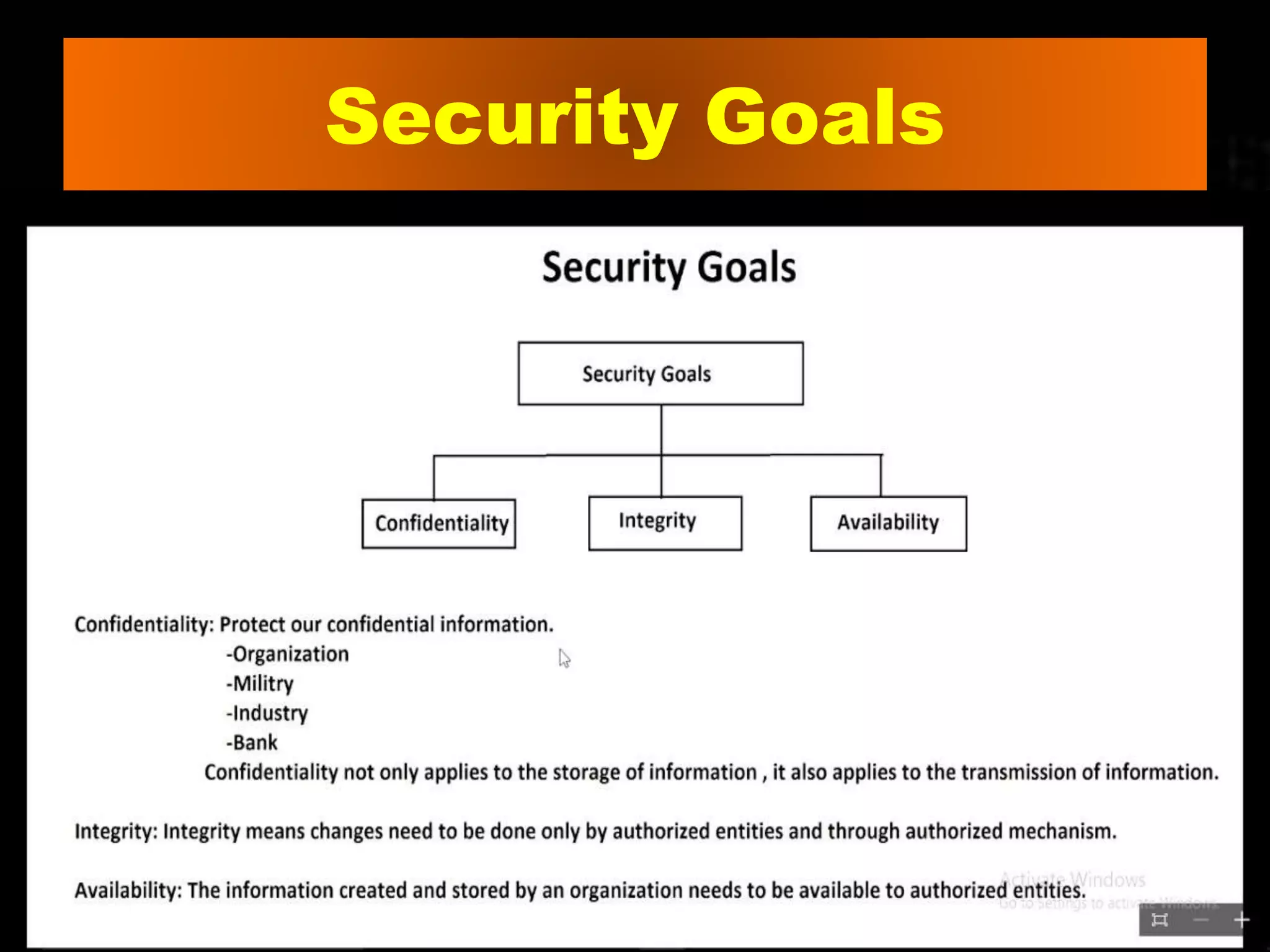
Security Goals
What is Cryptography
Basic Terms
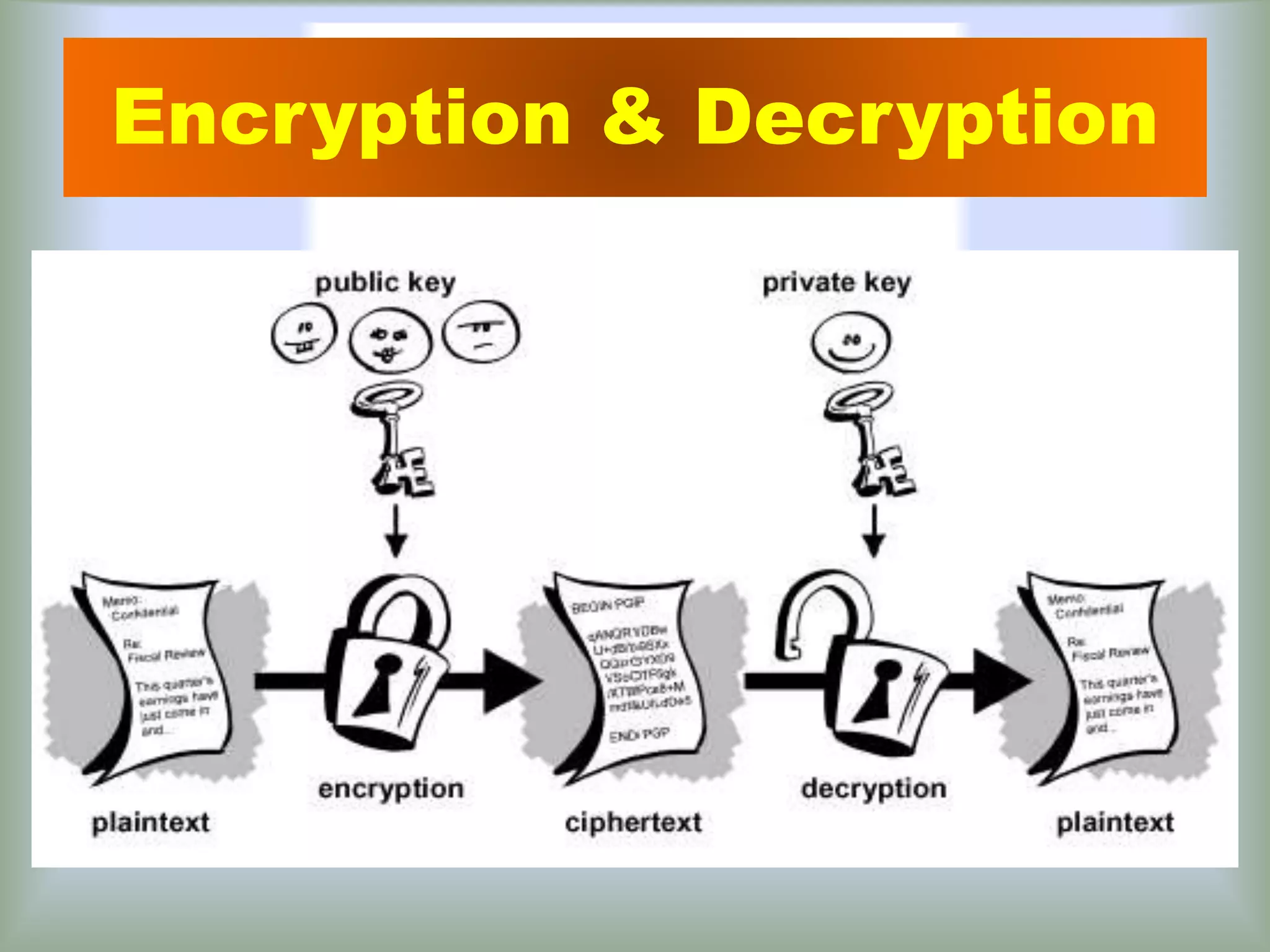
Encryption & Decryption
Transmission Techniques
Categories of Cryptography
Comparison
Conclusion
Security Threats
Security Goals
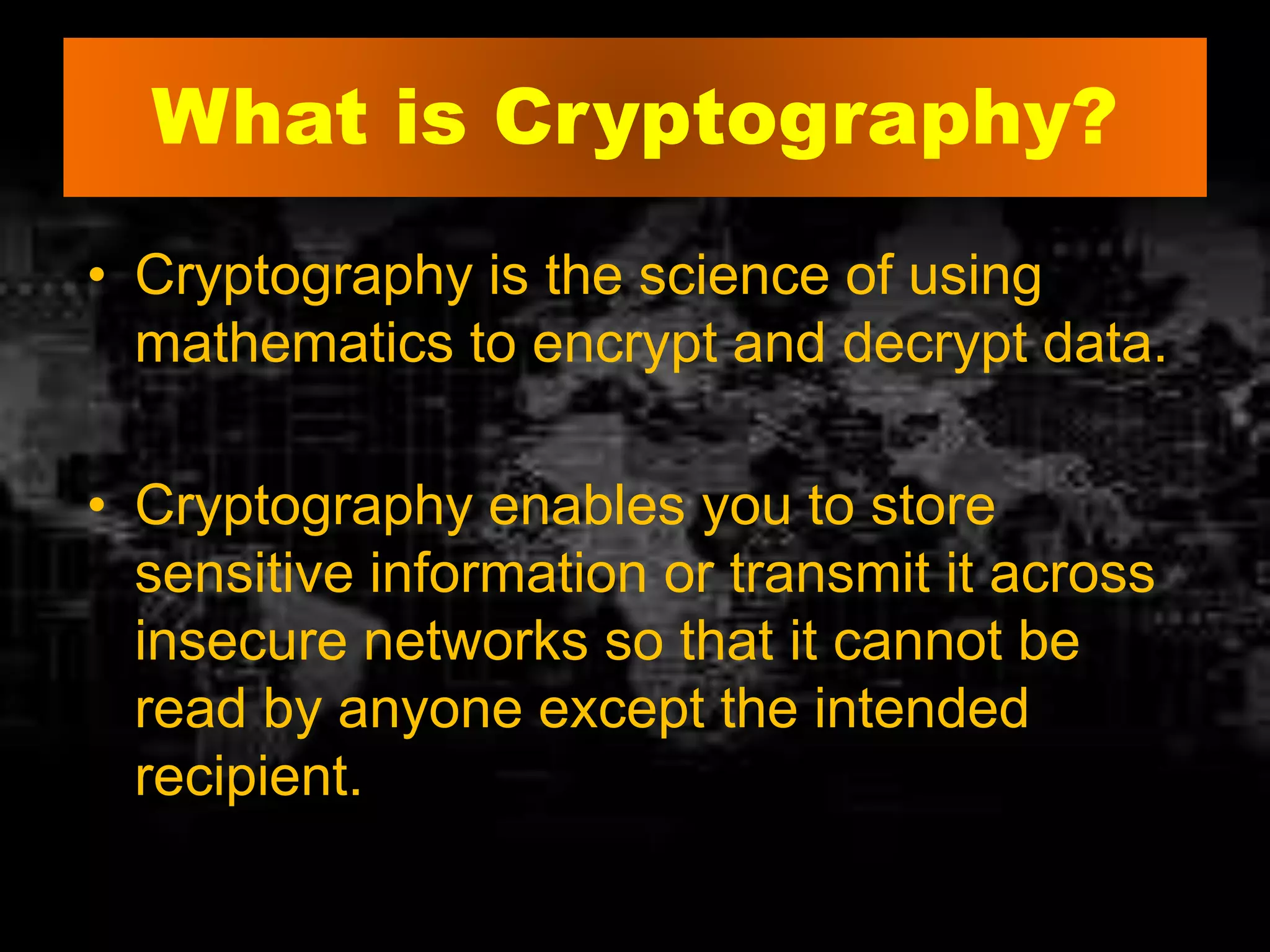
What is Cryptography?
• Cryptography is the science of using
mathematics to encrypt and decrypt data.
• Cryptography enables you to store
sensitive information or transmit it across
insecure networks so that it cannot be
read by anyone except the intended
recipient.
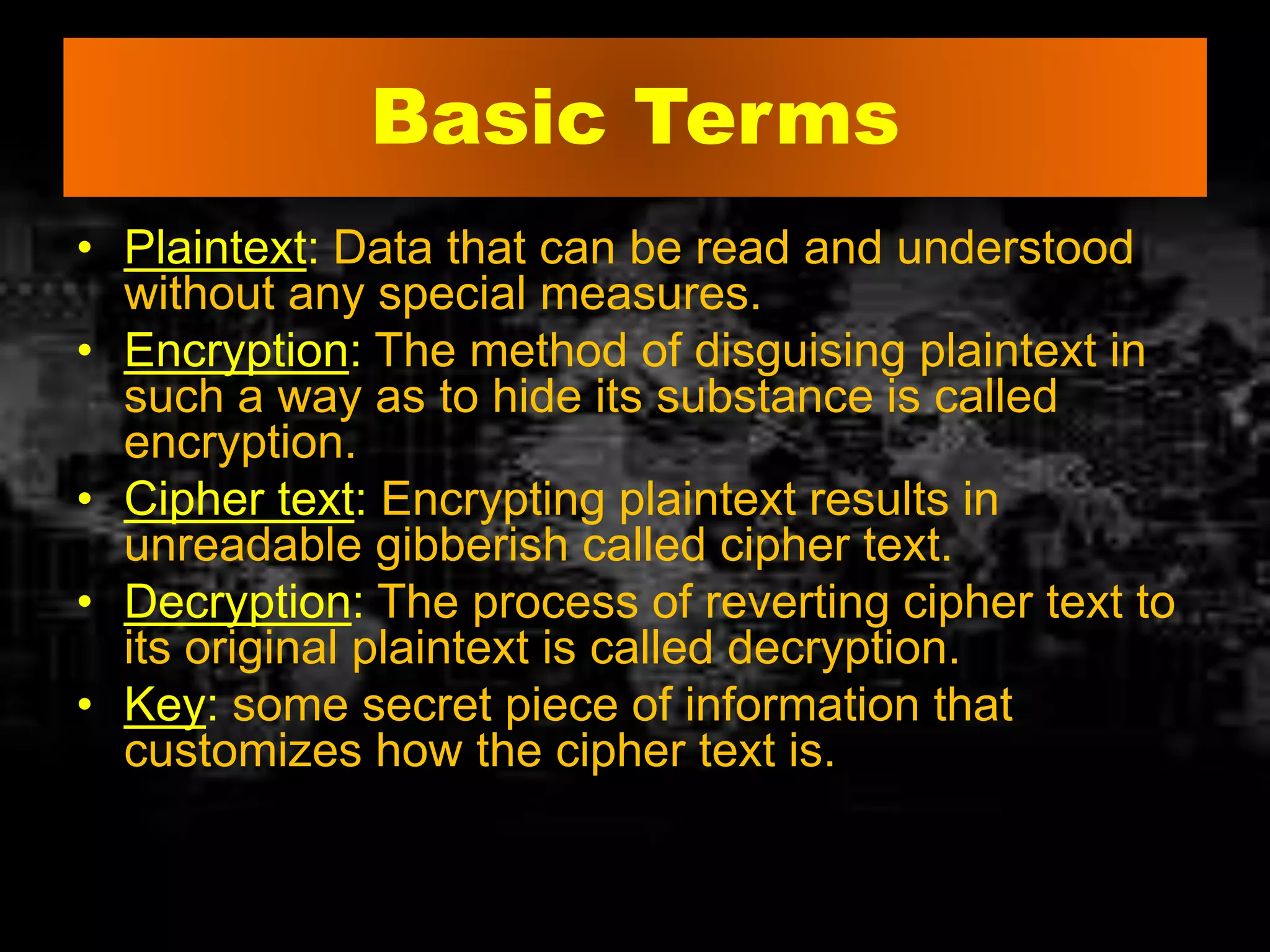
Basic Terms
• Plaintext: Data that can be read and understood
without any special measures.
• Encryption: The method of disguising plaintext in
such a way as to hide its substance is called
encryption.
• Cipher text: Encrypting plaintext results in
unreadable gibberish called cipher text.
• Decryption: The process of reverting cipher text to
its original plaintext is called decryption.
• Key: some secret piece of information that
customizes how the cipher text is.
Basic Terms cont.
• Cryptanalysis: The art of breaking ciphers,
i.e. retrieving the plaintext without knowing
the proper key.
• Cryptographers: People who do
cryptography.
• Cryptanalysts: Practitioners of cryptanalysis.
• Cryptology: The branch of mathematics that
studies the mathematical foundations of
cryptographic methods.
Encryption & Decryption
Why Use Cryptography?
• For “secret writing”
• To establish a shared secret when
other people (eavesdroppers) are
listening.
• TYPES
Mainly classified into two types:
1. Symmetric key cryptography
2. 2. Asymmetric key cryptography
Transmission Techniques
Categories of Cryptography
Symmetric Key Cryptography
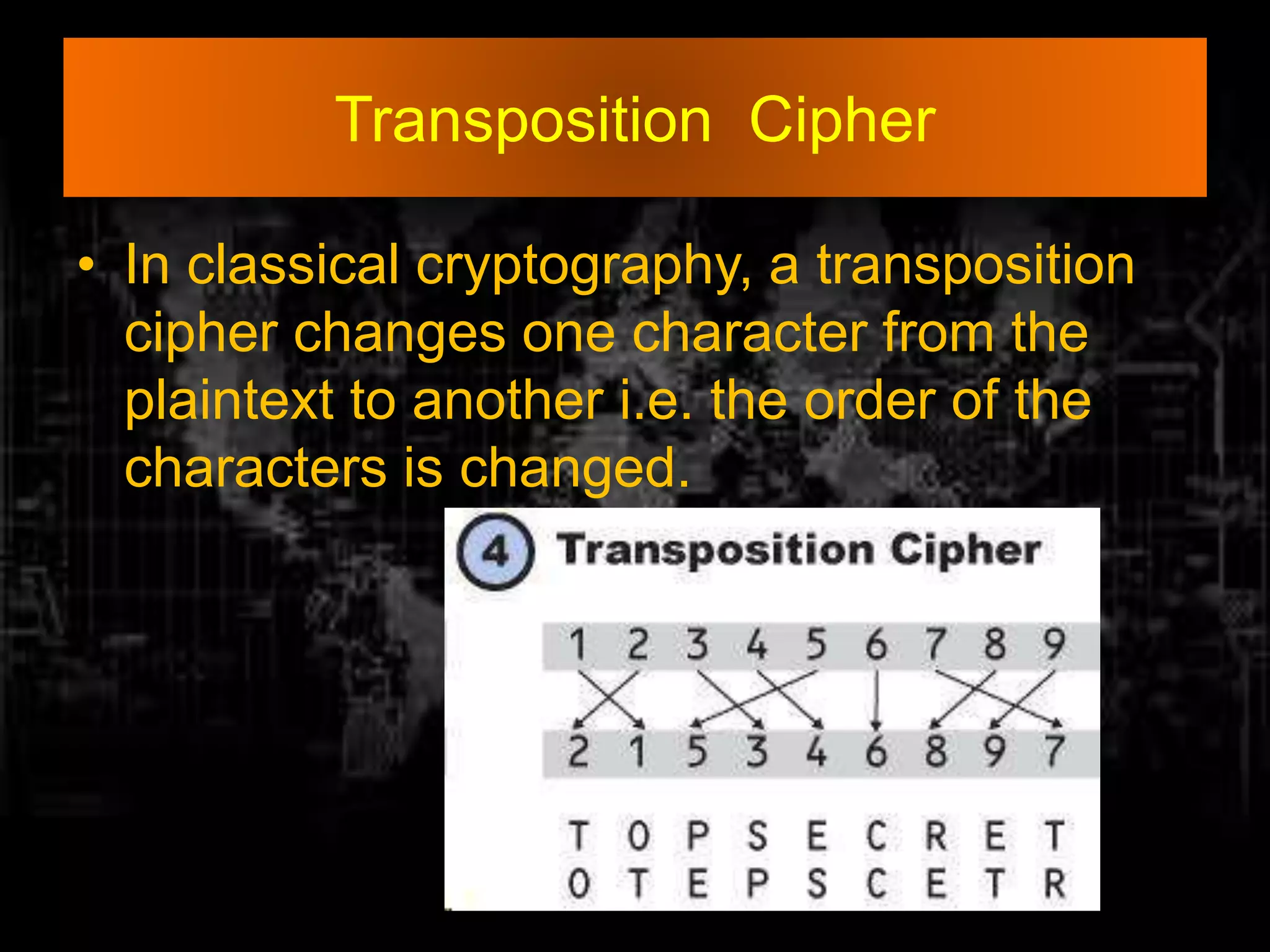
Transposition Cipher
• In classical cryptography, a transposition
cipher changes one character from the
plaintext to another i.e. the order of the
characters is changed.
Substitution Cipher
• Substitution cipher is a method of
encryption by which units of plaintext are
substituted with cipher text according to a
regular system.
Stream Cipher
• A Stream Cipher is a symmetric or secret key encryption
algorithm that encrypts a single bit at a time. With a
Stream Cipher, the same plaintext bit or byte will encrypt
to a different bit or byte every time it is encrypted.
• e.g. : Plain text: Pay 100
Binary of plain text: 010111101
(hypothetical)
Key: 100101011 --
---
Perform XOR
____________________
Cipher text 110010110 ----
-
Block Cipher
• Block cipher technique involves encryption of
one block of text at a time. Decryption also takes
one block of encrypted text at a time. Length of
the block is usually 64 or 128 bits.
• e.g. : Plain text: four and five
Four and five
Key Key Key
wvfa ast wvfa ---
cipher text
Asymmetric Key Cryptography
Public key cryptography is an asymmetric scheme that uses a Pair of
keys for encryption: a Public key, which encrypts
data, and a corresponding Private key (secret key) for decryption.
Keys Used In
Cryptography
Conclusion
• Cryptography, being an art of encrypting and
decrypting confidential information and private
messages, should be implemented in the network
security to prevent any leakage and threat.
• It can be done by using any of these techniques
discussed above for fortifying the personal data
transmission as well as for secure transaction.
• By using of encryption & decryption techniques a fair
unit of Confidentiality, Authentication, Integrity, Access
control and Availability of data is maintained.
Crpto ppt

Crpto ppt

  • 1.
    Submitted by- ASMITAPAL 0201CS141017 Submitted to- Asst. Prof. Deepti Tamrakar Dept. of Computer Science & Engg.
  • 2.
    Overview Security Security Threats Security Goals Whatis Cryptography Basic Terms Encryption & Decryption Transmission Techniques Categories of Cryptography Comparison Conclusion
  • 4.
  • 5.
  • 6.
    What is Cryptography? •Cryptography is the science of using mathematics to encrypt and decrypt data. • Cryptography enables you to store sensitive information or transmit it across insecure networks so that it cannot be read by anyone except the intended recipient.
  • 7.
    Basic Terms • Plaintext:Data that can be read and understood without any special measures. • Encryption: The method of disguising plaintext in such a way as to hide its substance is called encryption. • Cipher text: Encrypting plaintext results in unreadable gibberish called cipher text. • Decryption: The process of reverting cipher text to its original plaintext is called decryption. • Key: some secret piece of information that customizes how the cipher text is.
  • 8.
    Basic Terms cont. •Cryptanalysis: The art of breaking ciphers, i.e. retrieving the plaintext without knowing the proper key. • Cryptographers: People who do cryptography. • Cryptanalysts: Practitioners of cryptanalysis. • Cryptology: The branch of mathematics that studies the mathematical foundations of cryptographic methods.
  • 9.
  • 10.
    Why Use Cryptography? •For “secret writing” • To establish a shared secret when other people (eavesdroppers) are listening. • TYPES Mainly classified into two types: 1. Symmetric key cryptography 2. 2. Asymmetric key cryptography
  • 11.
  • 12.
  • 13.
  • 14.
    Transposition Cipher • Inclassical cryptography, a transposition cipher changes one character from the plaintext to another i.e. the order of the characters is changed.
  • 15.
    Substitution Cipher • Substitutioncipher is a method of encryption by which units of plaintext are substituted with cipher text according to a regular system.
  • 16.
    Stream Cipher • AStream Cipher is a symmetric or secret key encryption algorithm that encrypts a single bit at a time. With a Stream Cipher, the same plaintext bit or byte will encrypt to a different bit or byte every time it is encrypted. • e.g. : Plain text: Pay 100 Binary of plain text: 010111101 (hypothetical) Key: 100101011 -- --- Perform XOR ____________________ Cipher text 110010110 ---- -
  • 17.
    Block Cipher • Blockcipher technique involves encryption of one block of text at a time. Decryption also takes one block of encrypted text at a time. Length of the block is usually 64 or 128 bits. • e.g. : Plain text: four and five Four and five Key Key Key wvfa ast wvfa --- cipher text
  • 18.
    Asymmetric Key Cryptography Publickey cryptography is an asymmetric scheme that uses a Pair of keys for encryption: a Public key, which encrypts data, and a corresponding Private key (secret key) for decryption.
  • 19.
  • 20.
    Conclusion • Cryptography, beingan art of encrypting and decrypting confidential information and private messages, should be implemented in the network security to prevent any leakage and threat. • It can be done by using any of these techniques discussed above for fortifying the personal data transmission as well as for secure transaction. • By using of encryption & decryption techniques a fair unit of Confidentiality, Authentication, Integrity, Access control and Availability of data is maintained.