Aman Kumar Modanwal
Roll No.:
202010101150065
B.Tech CSE DS
Cryptography
BCS6003-DE3
CRYPTOGRA
PHY
Presentation
on
Index
● Introduction
● What is Cryptography?
● Purpose Of cryptography
● Architecture of cryptography
● Types of Cryptography
● Process of cryptography
● Types Of cryptography Algorithms
Attacks of cryptography
● Conclusion
● References
INTRODUCTION
● The Internet or the global Internet is the internationally connected
network of computer networks with addresses that are
administrated by IANA (Internet address and Naming Authority).
● There are many aspects to security and many applications, ranging
from secure commerce and payments to private communications
and protecting passwords. One essential aspect for secure
communications is that of cryptography.
What is Cryptography?
● Cryptography derived its name from a Greek word called
“krypto’s” which means “Hidden Secrets”.
● Cryptography is the practice and study of hiding information. It is
the Art or Science of converting a plain intelligible data into an
unintelligible data and again retransforming that message into its
original form.
● It provides Confidentiality, Integrity, and Accuracy.
PURPOSE OF CRYPTOGRAPHY
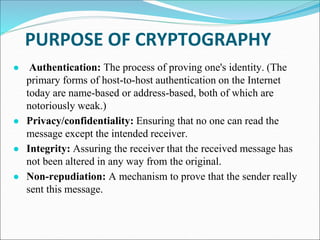
● Authentication: The process of proving one's identity. (The
primary forms of host-to-host authentication on the Internet
today are name-based or address-based, both of which are
notoriously weak.)
● Privacy/confidentiality: Ensuring that no one can read the
message except the intended receiver.
● Integrity: Assuring the receiver that the received message has
not been altered in any way from the original.
● Non-repudiation: A mechanism to prove that the sender really
sent this message.
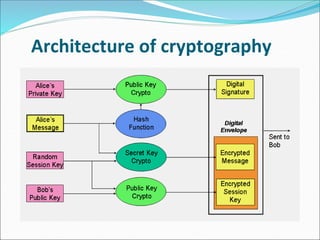
Architecture of cryptography
Types of Cryptography
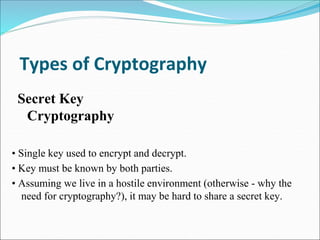
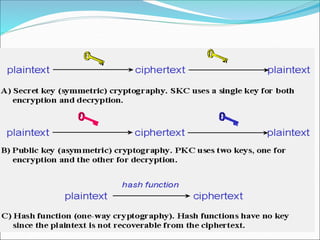
• Single key used to encrypt and decrypt.
• Key must be known by both parties.
• Assuming we live in a hostile environment (otherwise - why the
need for cryptography?), it may be hard to share a secret key.
Secret Key
Cryptography
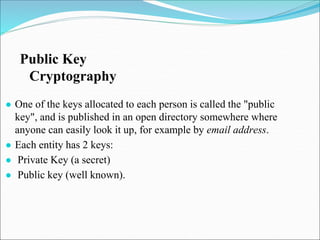
● One of the keys allocated to each person is called the "public
key", and is published in an open directory somewhere where
anyone can easily look it up, for example by email address.
● Each entity has 2 keys:
● Private Key (a secret)
● Public key (well known).
Public Key
Cryptography
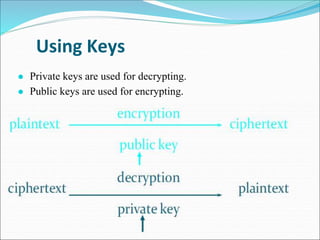
Using Keys
● Private keys are used for decrypting.
● Public keys are used for encrypting.
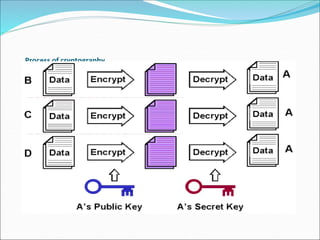
Process of cryptography
TYPES OF CRYPTOGRAPHIC ALGORITHMS
Public/Private Key Cryptography
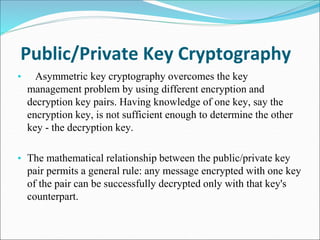
▪ Asymmetric key cryptography overcomes the key
management problem by using different encryption and
decryption key pairs. Having knowledge of one key, say the
encryption key, is not sufficient enough to determine the other
key - the decryption key.
▪ The mathematical relationship between the public/private key
pair permits a general rule: any message encrypted with one key
of the pair can be successfully decrypted only with that key's
counterpart.
Hash functions
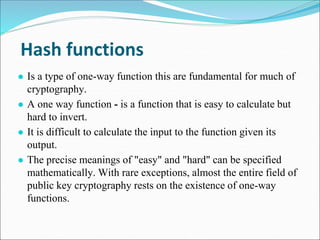
● Is a type of one-way function this are fundamental for much of
cryptography.
● A one way function - is a function that is easy to calculate but
hard to invert.
● It is difficult to calculate the input to the function given its
output.
● The precise meanings of "easy" and "hard" can be specified
mathematically. With rare exceptions, almost the entire field of
public key cryptography rests on the existence of one-way
functions.
Attacks of cryptography
Cipher text only attack
▪ The only data available is a target cipher text
Known plaintext attack
▪ A target cipher text
▪ Pairs of other cipher text and plaintext (say, previously
broken or guessing)
Attacks of cryptography…
Chosen plaintext attacks
▪ A target cipher text
 Can feed encryption algorithm with plaintexts and obtain
the matching cipher texts
Chosen cipher text attack
▪ A target cipher text
▪ Can feed decryption algorithm with cipher texts and obtain
the matching plaintext matching cipher texts
CONCLUSION
● We use different types of algorithms to establish security
services in different service mechanisms.
● We use either private key cryptography or public key
cryptography according to requirement.
● If we want to send message quickly we use private key
algorithm and if we want to send messages secretly we use
public key algorithm.
References
● www.researchgate.net
● www.swayam.com
● www.wikipedia.com
Thanks…!!!

PresentationonCRYPTOGRAPHY.pptx

  • 1.
    Aman Kumar Modanwal RollNo.: 202010101150065 B.Tech CSE DS Cryptography BCS6003-DE3 CRYPTOGRA PHY Presentation on
  • 2.
    Index ● Introduction ● Whatis Cryptography? ● Purpose Of cryptography ● Architecture of cryptography ● Types of Cryptography ● Process of cryptography ● Types Of cryptography Algorithms Attacks of cryptography ● Conclusion ● References
  • 3.
    INTRODUCTION ● The Internetor the global Internet is the internationally connected network of computer networks with addresses that are administrated by IANA (Internet address and Naming Authority). ● There are many aspects to security and many applications, ranging from secure commerce and payments to private communications and protecting passwords. One essential aspect for secure communications is that of cryptography.
  • 4.
    What is Cryptography? ●Cryptography derived its name from a Greek word called “krypto’s” which means “Hidden Secrets”. ● Cryptography is the practice and study of hiding information. It is the Art or Science of converting a plain intelligible data into an unintelligible data and again retransforming that message into its original form. ● It provides Confidentiality, Integrity, and Accuracy.
  • 5.
    PURPOSE OF CRYPTOGRAPHY ●Authentication: The process of proving one's identity. (The primary forms of host-to-host authentication on the Internet today are name-based or address-based, both of which are notoriously weak.) ● Privacy/confidentiality: Ensuring that no one can read the message except the intended receiver. ● Integrity: Assuring the receiver that the received message has not been altered in any way from the original. ● Non-repudiation: A mechanism to prove that the sender really sent this message.
  • 6.
  • 7.
    Types of Cryptography •Single key used to encrypt and decrypt. • Key must be known by both parties. • Assuming we live in a hostile environment (otherwise - why the need for cryptography?), it may be hard to share a secret key. Secret Key Cryptography
  • 8.
    ● One ofthe keys allocated to each person is called the "public key", and is published in an open directory somewhere where anyone can easily look it up, for example by email address. ● Each entity has 2 keys: ● Private Key (a secret) ● Public key (well known). Public Key Cryptography
  • 9.
    Using Keys ● Privatekeys are used for decrypting. ● Public keys are used for encrypting.
  • 10.
  • 11.
  • 12.
    Public/Private Key Cryptography ▪Asymmetric key cryptography overcomes the key management problem by using different encryption and decryption key pairs. Having knowledge of one key, say the encryption key, is not sufficient enough to determine the other key - the decryption key. ▪ The mathematical relationship between the public/private key pair permits a general rule: any message encrypted with one key of the pair can be successfully decrypted only with that key's counterpart.
  • 13.
    Hash functions ● Isa type of one-way function this are fundamental for much of cryptography. ● A one way function - is a function that is easy to calculate but hard to invert. ● It is difficult to calculate the input to the function given its output. ● The precise meanings of "easy" and "hard" can be specified mathematically. With rare exceptions, almost the entire field of public key cryptography rests on the existence of one-way functions.
  • 14.
    Attacks of cryptography Ciphertext only attack ▪ The only data available is a target cipher text Known plaintext attack ▪ A target cipher text ▪ Pairs of other cipher text and plaintext (say, previously broken or guessing)
  • 15.
    Attacks of cryptography… Chosenplaintext attacks ▪ A target cipher text  Can feed encryption algorithm with plaintexts and obtain the matching cipher texts Chosen cipher text attack ▪ A target cipher text ▪ Can feed decryption algorithm with cipher texts and obtain the matching plaintext matching cipher texts
  • 16.
    CONCLUSION ● We usedifferent types of algorithms to establish security services in different service mechanisms. ● We use either private key cryptography or public key cryptography according to requirement. ● If we want to send message quickly we use private key algorithm and if we want to send messages secretly we use public key algorithm.
  • 17.
  • 18.