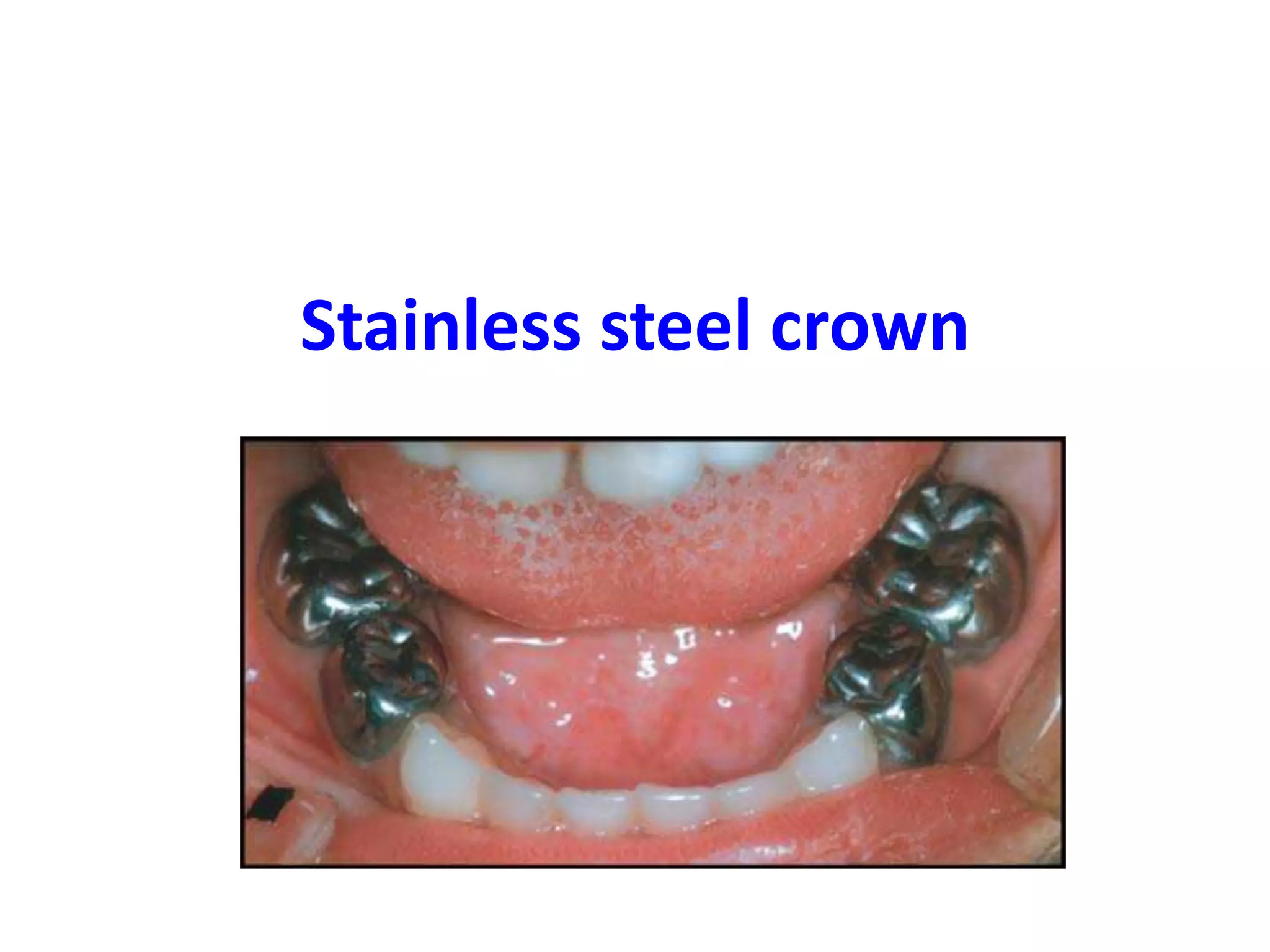
Stainless steel crown
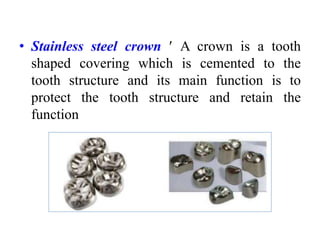
• Stainless steel crown  A crown is a tooth
shaped covering which is cemented to the
tooth structure and its main function is to
protect the tooth structure and retain the
function
History
• Chrome steel crowns, introduced by
Humphrey in 1950, have proved to be
serviceable restorations for children and
adolescents and are now commonly called
stainless-steel crowns
• 1950 Humphrey and Engel recommended
stainless steel crowns
• 1968 Mink and Bennett encouraged familiar
treatment modality
• 1960s significantly improved crown
Classification: based on composition
1. Stainless Steel crown (Unitek and Rocky
Mountain crowns)
2. Nickel-Base crowns (Ion Ni-chro from 3M )
3. Tin –base crowns
4. Aluminum -base crowns
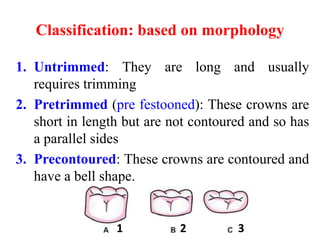
Classification: based on morphology
1. Untrimmed: They are long and usually
requires trimming
2. Pretrimmed (pre festooned): These crowns are
short in length but are not contoured and so has
a parallel sides
3. Precontoured: These crowns are contoured and
have a bell shape.
1 2 3
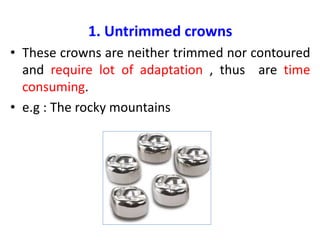
1. Untrimmed crowns
• These crowns are neither trimmed nor contoured
and require lot of adaptation , thus are time
consuming.
• e.g : The rocky mountains
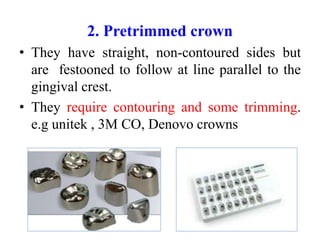
2. Pretrimmed crown
• They have straight, non-contoured sides but
are festooned to follow at line parallel to the
gingival crest.
• They require contouring and some trimming.
e.g unitek , 3M CO, Denovo crowns
3. Precontoured crown
• These crowns are festooned and are also
precontoured through a minimal amount of
festooning and trimming may be necessary.
• e.g : Unitek stainless steel crown, Ni-Chro ion
crowns
Indications
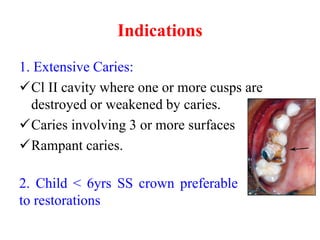
1. Extensive Caries:
Cl II cavity where one or more cusps are
destroyed or weakened by caries.
Caries involving 3 or more surfaces
Rampant caries.
2. Child < 6yrs SS crown preferable
to restorations
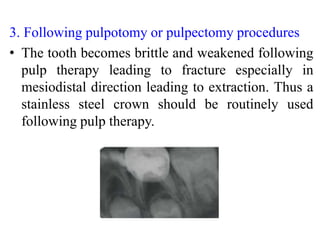
3. Following pulpotomy or pulpectomy procedures
• The tooth becomes brittle and weakened following
pulp therapy leading to fracture especially in
mesiodistal direction leading to extraction. Thus a
stainless steel crown should be routinely used
following pulp therapy.
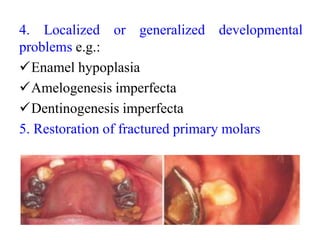
4. Localized or generalized developmental
problems e.g.:
Enamel hypoplasia
Amelogenesis imperfecta
Dentinogenesis imperfecta
5. Restoration of fractured primary molars
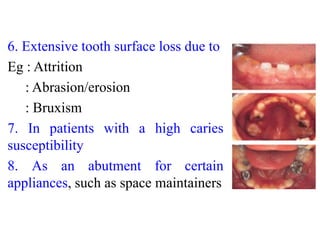
6. Extensive tooth surface loss due to
Eg : Attrition
: Abrasion/erosion
: Bruxism
7. In patients with a high caries
susceptibility
8. As an abutment for certain
appliances, such as space maintainers
9. Handicapped Children:
Oral hygiene maintenance is difficult, so stainless
steel crowns are preferred to restore carious tooth
than amalgam restorations
Contraindications
1. If the primary molar is close to exfoliation with
more than half the roots resorbed or exfoliation
within 6-12 months
2. Tooth exhibits excessive mobility
3. Partially erupted teeth
4. As a permanent restoration in a permanent
dentition
Equipment used
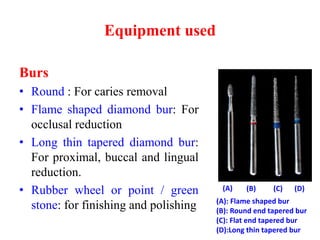
Burs
• Round : For caries removal
• Flame shaped diamond bur: For
occlusal reduction
• Long thin tapered diamond bur:
For proximal, buccal and lingual
reduction.
• Rubber wheel or point / green
stone: for finishing and polishing (A): Flame shaped bur
(B): Round end tapered bur
(C): Flat end tapered bur
(D):Long thin tapered bur
(A) (B) (C) (D)
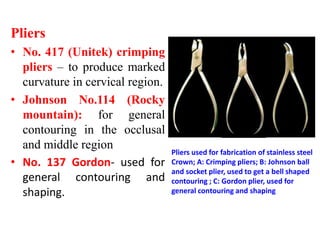
Pliers
• No. 417 (Unitek) crimping
pliers – to produce marked
curvature in cervical region.
• Johnson No.114 (Rocky
mountain): for general
contouring in the occlusal
and middle region
• No. 137 Gordon- used for
general contouring and
shaping.
Pliers used for fabrication of stainless steel
Crown; A: Crimping pliers; B: Johnson ball
and socket plier, used to get a bell shaped
contouring ; C: Gordon plier, used for
general contouring and shaping
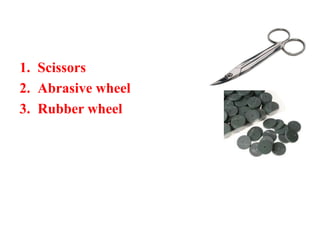
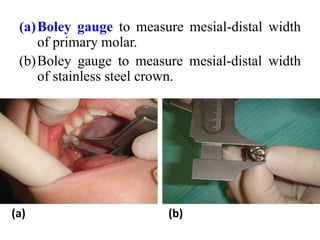
1. Scissors
2. Abrasive wheel
3. Rubber wheel
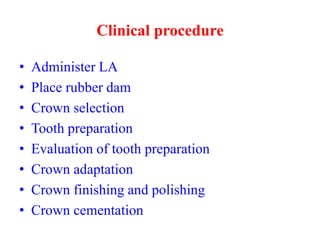
(a)Boley gauge to measure mesial-distal width
of primary molar.
(b)Boley gauge to measure mesial-distal width
of stainless steel crown.
(a) (b)
Clinical procedure
• Administer LA
• Place rubber dam
• Crown selection
• Tooth preparation
• Evaluation of tooth preparation
• Crown adaptation
• Crown finishing and polishing
• Crown cementation
Clinical procedures
• Irrespective of whether the tooth to be restored is vital
or non-vital, local anaesthesia should be used when
placing a stainless steel crown because of the soft-
tissue manipulation.
• Rubber dam, although sometimes difficult to place in
the broken down dentition, should be used where
possible.
1. Restore the tooth using a GIC prior to preparation for
the stainless steel crown.
2. Reduce the occlusal surface by about 1.5 mm using a
flame-shaped or tapered diamond bur.
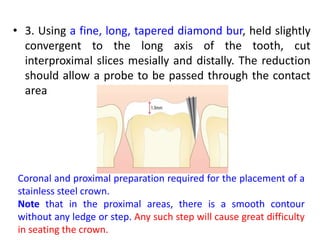
• 3. Using a fine, long, tapered diamond bur, held slightly
convergent to the long axis of the tooth, cut
interproximal slices mesially and distally. The reduction
should allow a probe to be passed through the contact
area
Coronal and proximal preparation required for the placement of a
stainless steel crown.
Note that in the proximal areas, there is a smooth contour
without any ledge or step. Any such step will cause great difficulty
in seating the crown.
• 4. Buccolingual reduction should be kept to a
minimum, as these surfaces are important for
retention. However, reduction may be needed when
there has been significant proximal space loss or
anatomical features, such as a prominent Carabelli’s
cusp.
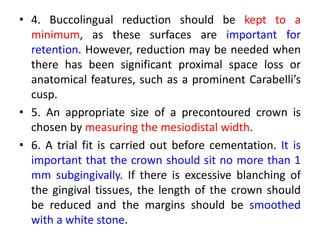
• 5. An appropriate size of a precontoured crown is
chosen by measuring the mesiodistal width.
• 6. A trial fit is carried out before cementation. It is
important that the crown should sit no more than 1
mm subgingivally. If there is excessive blanching of
the gingival tissues, the length of the crown should
be reduced and the margins should be smoothed
with a white stone.
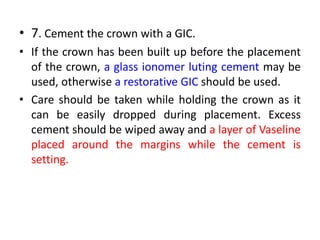
• 7. Cement the crown with a GIC.
• If the crown has been built up before the placement
of the crown, a glass ionomer luting cement may be
used, otherwise a restorative GIC should be used.
• Care should be taken while holding the crown as it
can be easily dropped during placement. Excess
cement should be wiped away and a layer of Vaseline
placed around the margins while the cement is
setting.
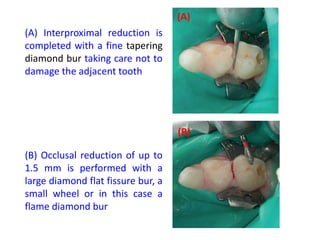
(A) Interproximal reduction is
completed with a fine tapering
diamond bur taking care not to
damage the adjacent tooth
(B) Occlusal reduction of up to
1.5 mm is performed with a
large diamond flat fissure bur, a
small wheel or in this case a
flame diamond bur
(A)
(B)
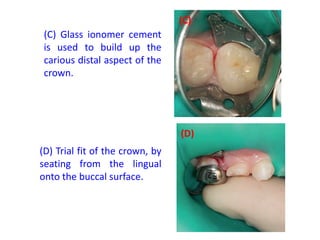
(C) Glass ionomer cement
is used to build up the
carious distal aspect of the
crown.
(D) Trial fit of the crown, by
seating from the lingual
onto the buccal surface.
(C)
(D)
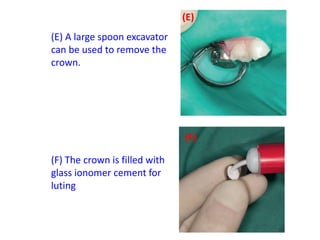
(E) A large spoon excavator
can be used to remove the
crown.
(F) The crown is filled with
glass ionomer cement for
luting
(E)
(F)
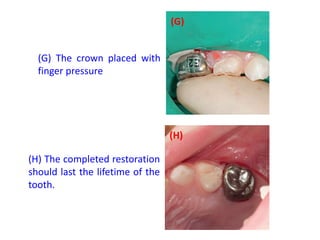
(G) The crown placed with
finger pressure
(H) The completed restoration
should last the lifetime of the
tooth.
(G)
(H)
The Hall crown technique
• The Hall crown technique involves the placement of
stainless steel crowns, directly over carious lesions in
primary molars with little or no tooth preparation or
caries removal.
• indeed the technique not only outperformed
conventional restorations but was preferred by the
children and clinicians.
• It is not appropriate in all cases and in particular
should only be used for teeth that are symptom free
and without signs or symptoms of pulpal pathology.
Indications
 Primary molar teeth with moderate decay, but no
clinical signs or symptoms of pulpal pathology
 Dentitions of children with limited cooperation, who
are unable to accept conventional restorative
treatment with local anaesthesia.
 Healthy children.
Success
• In a prospective, randomized control clinical trial, the
Hall technique, statistically, significantly outperformed
standard restorations at 5 years.
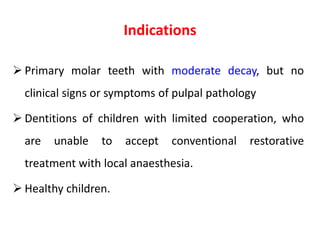
• Any disruption of the occlusion following crown
placement, will usually self-correct within a few
weeks.
Clinical procedure
This technique is used without local anaesthetic:
1. Pre-procedure radiograph and examination to exclude
pulpal pathology.
2. Orthodontic separators may be placed at a prior
appointment, to ease placement of the crown.
3. Child should be sat upright or semi-reclined, but not
supine and gauze may be used to protect the airway.
4. The tooth can be cleaned with a toothbrush and if
desired gross caries may be removed with a hand
excavator.
5. A stainless steel crown is selected, which will fit over
the tooth without any preparation.
6. A GIC cement is placed in the crown which is bitten
into place by the child.
7. Excess cement may be washed or wiped away, before
it has set.
Stainless steel crown .pptx

Stainless steel crown .pptx

  • 1.
  • 2.
    • Stainless steelcrown  A crown is a tooth shaped covering which is cemented to the tooth structure and its main function is to protect the tooth structure and retain the function
  • 3.
    History • Chrome steelcrowns, introduced by Humphrey in 1950, have proved to be serviceable restorations for children and adolescents and are now commonly called stainless-steel crowns • 1950 Humphrey and Engel recommended stainless steel crowns • 1968 Mink and Bennett encouraged familiar treatment modality • 1960s significantly improved crown
  • 4.
    Classification: based oncomposition 1. Stainless Steel crown (Unitek and Rocky Mountain crowns) 2. Nickel-Base crowns (Ion Ni-chro from 3M ) 3. Tin –base crowns 4. Aluminum -base crowns
  • 5.
    Classification: based onmorphology 1. Untrimmed: They are long and usually requires trimming 2. Pretrimmed (pre festooned): These crowns are short in length but are not contoured and so has a parallel sides 3. Precontoured: These crowns are contoured and have a bell shape. 1 2 3
  • 6.
    1. Untrimmed crowns •These crowns are neither trimmed nor contoured and require lot of adaptation , thus are time consuming. • e.g : The rocky mountains
  • 7.
    2. Pretrimmed crown •They have straight, non-contoured sides but are festooned to follow at line parallel to the gingival crest. • They require contouring and some trimming. e.g unitek , 3M CO, Denovo crowns
  • 8.
    3. Precontoured crown •These crowns are festooned and are also precontoured through a minimal amount of festooning and trimming may be necessary. • e.g : Unitek stainless steel crown, Ni-Chro ion crowns
  • 9.
    Indications 1. Extensive Caries: ClII cavity where one or more cusps are destroyed or weakened by caries. Caries involving 3 or more surfaces Rampant caries. 2. Child < 6yrs SS crown preferable to restorations
  • 10.
    3. Following pulpotomyor pulpectomy procedures • The tooth becomes brittle and weakened following pulp therapy leading to fracture especially in mesiodistal direction leading to extraction. Thus a stainless steel crown should be routinely used following pulp therapy.
  • 11.
    4. Localized orgeneralized developmental problems e.g.: Enamel hypoplasia Amelogenesis imperfecta Dentinogenesis imperfecta 5. Restoration of fractured primary molars
  • 12.
    6. Extensive toothsurface loss due to Eg : Attrition : Abrasion/erosion : Bruxism 7. In patients with a high caries susceptibility 8. As an abutment for certain appliances, such as space maintainers
  • 13.
    9. Handicapped Children: Oralhygiene maintenance is difficult, so stainless steel crowns are preferred to restore carious tooth than amalgam restorations
  • 14.
    Contraindications 1. If theprimary molar is close to exfoliation with more than half the roots resorbed or exfoliation within 6-12 months 2. Tooth exhibits excessive mobility 3. Partially erupted teeth 4. As a permanent restoration in a permanent dentition
  • 15.
    Equipment used Burs • Round: For caries removal • Flame shaped diamond bur: For occlusal reduction • Long thin tapered diamond bur: For proximal, buccal and lingual reduction. • Rubber wheel or point / green stone: for finishing and polishing (A): Flame shaped bur (B): Round end tapered bur (C): Flat end tapered bur (D):Long thin tapered bur (A) (B) (C) (D)
  • 16.
    Pliers • No. 417(Unitek) crimping pliers – to produce marked curvature in cervical region. • Johnson No.114 (Rocky mountain): for general contouring in the occlusal and middle region • No. 137 Gordon- used for general contouring and shaping. Pliers used for fabrication of stainless steel Crown; A: Crimping pliers; B: Johnson ball and socket plier, used to get a bell shaped contouring ; C: Gordon plier, used for general contouring and shaping
  • 17.
    1. Scissors 2. Abrasivewheel 3. Rubber wheel
  • 18.
    (a)Boley gauge tomeasure mesial-distal width of primary molar. (b)Boley gauge to measure mesial-distal width of stainless steel crown. (a) (b)
  • 19.
    Clinical procedure • AdministerLA • Place rubber dam • Crown selection • Tooth preparation • Evaluation of tooth preparation • Crown adaptation • Crown finishing and polishing • Crown cementation
  • 20.
    Clinical procedures • Irrespectiveof whether the tooth to be restored is vital or non-vital, local anaesthesia should be used when placing a stainless steel crown because of the soft- tissue manipulation. • Rubber dam, although sometimes difficult to place in the broken down dentition, should be used where possible. 1. Restore the tooth using a GIC prior to preparation for the stainless steel crown. 2. Reduce the occlusal surface by about 1.5 mm using a flame-shaped or tapered diamond bur.
  • 21.
    • 3. Usinga fine, long, tapered diamond bur, held slightly convergent to the long axis of the tooth, cut interproximal slices mesially and distally. The reduction should allow a probe to be passed through the contact area Coronal and proximal preparation required for the placement of a stainless steel crown. Note that in the proximal areas, there is a smooth contour without any ledge or step. Any such step will cause great difficulty in seating the crown.
  • 22.
    • 4. Buccolingualreduction should be kept to a minimum, as these surfaces are important for retention. However, reduction may be needed when there has been significant proximal space loss or anatomical features, such as a prominent Carabelli’s cusp. • 5. An appropriate size of a precontoured crown is chosen by measuring the mesiodistal width. • 6. A trial fit is carried out before cementation. It is important that the crown should sit no more than 1 mm subgingivally. If there is excessive blanching of the gingival tissues, the length of the crown should be reduced and the margins should be smoothed with a white stone.
  • 23.
    • 7. Cementthe crown with a GIC. • If the crown has been built up before the placement of the crown, a glass ionomer luting cement may be used, otherwise a restorative GIC should be used. • Care should be taken while holding the crown as it can be easily dropped during placement. Excess cement should be wiped away and a layer of Vaseline placed around the margins while the cement is setting.
  • 24.
    (A) Interproximal reductionis completed with a fine tapering diamond bur taking care not to damage the adjacent tooth (B) Occlusal reduction of up to 1.5 mm is performed with a large diamond flat fissure bur, a small wheel or in this case a flame diamond bur (A) (B)
  • 25.
    (C) Glass ionomercement is used to build up the carious distal aspect of the crown. (D) Trial fit of the crown, by seating from the lingual onto the buccal surface. (C) (D)
  • 26.
    (E) A largespoon excavator can be used to remove the crown. (F) The crown is filled with glass ionomer cement for luting (E) (F)
  • 27.
    (G) The crownplaced with finger pressure (H) The completed restoration should last the lifetime of the tooth. (G) (H)
  • 28.
    The Hall crowntechnique • The Hall crown technique involves the placement of stainless steel crowns, directly over carious lesions in primary molars with little or no tooth preparation or caries removal. • indeed the technique not only outperformed conventional restorations but was preferred by the children and clinicians. • It is not appropriate in all cases and in particular should only be used for teeth that are symptom free and without signs or symptoms of pulpal pathology.
  • 29.
    Indications  Primary molarteeth with moderate decay, but no clinical signs or symptoms of pulpal pathology  Dentitions of children with limited cooperation, who are unable to accept conventional restorative treatment with local anaesthesia.  Healthy children.
  • 30.
    Success • In aprospective, randomized control clinical trial, the Hall technique, statistically, significantly outperformed standard restorations at 5 years. • Any disruption of the occlusion following crown placement, will usually self-correct within a few weeks.
  • 31.
    Clinical procedure This techniqueis used without local anaesthetic: 1. Pre-procedure radiograph and examination to exclude pulpal pathology. 2. Orthodontic separators may be placed at a prior appointment, to ease placement of the crown. 3. Child should be sat upright or semi-reclined, but not supine and gauze may be used to protect the airway. 4. The tooth can be cleaned with a toothbrush and if desired gross caries may be removed with a hand excavator.
  • 32.
    5. A stainlesssteel crown is selected, which will fit over the tooth without any preparation. 6. A GIC cement is placed in the crown which is bitten into place by the child. 7. Excess cement may be washed or wiped away, before it has set.