
The Pragmatics of Cross-
 Cultural Communication

Levels of Communication Differences


         By Mr. Sunan Fathet          1
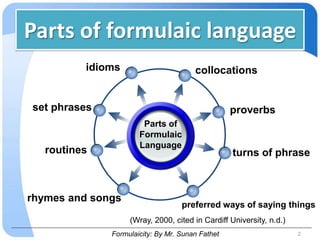
Parts of formulaic language
          idioms                       collocations


set phrases                                       proverbs
                       Parts of
                      Formulaic
                      Language
   routines                                       turns of phrase


rhymes and songs
                                   preferred ways of saying things
                   (Wray, 2000, cited in Cardiff University, n.d.)
              Formulaicity: By Mr. Sunan Fathet                      2
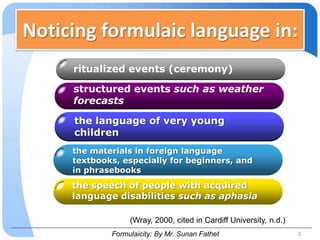
Noticing formulaic language in:
     ritualized events (ceremony)

     structured events such as weather
     forecasts

     the language of very young
     children
     the materials in foreign language
      the materials
     2. Strategy in foreign language
     textbooks, especially for beginners, and in
      textbooks, especially for beginners, and
      phrasebooks
     in phrasebooks
     the speech of people with acquired
     language disabilities such as aphasia

                  (Wray, 2000, cited in Cardiff University, n.d.)
             Formulaicity: By Mr. Sunan Fathet                      3
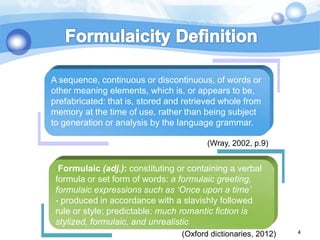
A sequence, continuous or discontinuous, of words or
other meaning elements, which is, or appears to be,
prefabricated: that is, stored and retrieved whole from
memory at the time of use, rather than being subject
to generation or analysis by the language grammar.

                                         (Wray, 2002, p.9)


  Formulaic (adj.): constituting or containing a verbal
 formula or set form of words: a formulaic greeting,
 formulaic expressions such as ‘Once upon a time’
 - produced in accordance with a slavishly followed
 rule or style; predictable: much romantic fiction is
 stylized, formulaic, and unrealistic
                                  (Oxford dictionaries, 2012)   4
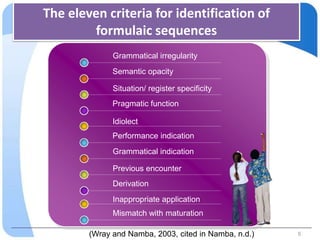
The eleven criteria for identification of
        formulaic sequences
              Grammatical irregularity
              Semantic opacity

              Situation/ register specificity
              Pragmatic function

              Idiolect
              Performance indication
              Grammatical indication

              Previous encounter
              Derivation
              Inappropriate application
              Mismatch with maturation

        (Wray and Namba, 2003, cited in Namba, n.d.)   5
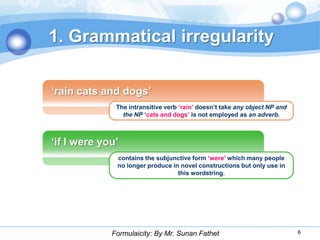
1. Grammatical irregularity

„rain cats and dogs‟
              The intransitive verb „rain‟ doesn‟t take any object NP and
                the NP „cats and dogs‟ is not employed as an adverb.


„if I were you‟
              contains the subjunctive form „were‟ which many people
              no longer produce in novel constructions but only use in
                                  this wordstring.


             Formulaicity: By Mr. Sunan Fathet                              6
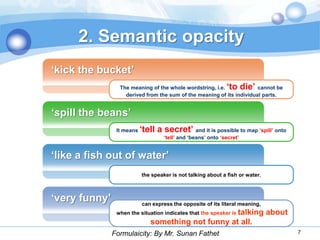
2. Semantic opacity
„kick the bucket‟
                 The meaning of the whole wordstring, i.e.    „to die‟ cannot be
                   derived from the sum of the meaning of its individual parts.


„spill the beans‟
                It means   „tell a secret‟ and it is possible to map „spill‟ onto
                                    „tell‟ and „beans‟ onto „secret‟


„like a fish out of water‟
                           the speaker is not talking about a fish or water.


„very funny‟               can express the opposite of its literal meaning,
                when the situation indicates that the speaker is talking       about
                               something not funny at all.
               Formulaicity: By Mr. Sunan Fathet                                       7
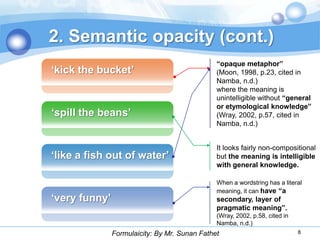
2. Semantic opacity (cont.)
                                               “opaque metaphor”
„kick the bucket‟                              (Moon, 1998, p.23, cited in
                                               Namba, n.d.)
                                               where the meaning is
                                               unintelligible without “general
                                               or etymological knowledge”
„spill the beans‟                              (Wray, 2002, p.57, cited in
                                               Namba, n.d.)


                                               It looks fairly non-compositional
„like a fish out of water‟                     but the meaning is intelligible
                                               with general knowledge.

                                               When a wordstring has a literal
                                               meaning, it can have “a
„very funny‟                                   secondary, layer of
                                               pragmatic meaning”.
                                               (Wray, 2002, p.58, cited in
                                               Namba, n.d.)
               Formulaicity: By Mr. Sunan Fathet                             8
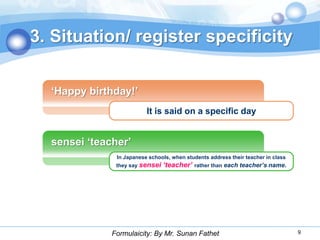
3. Situation/ register specificity

  „Happy birthday!‟
                          It is said on a specific day


  sensei „teacher‟
               In Japanese schools, when students address their teacher in class
               they say sensei   ‘teacher’   rather than each teacher’s name.


              Formulaicity: By Mr. Sunan Fathet                                    9
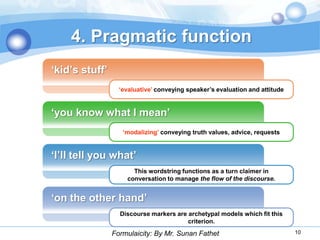
4. Pragmatic function
„kid‟s stuff‟
                  „evaluative‟ conveying speaker‟s evaluation and attitude


„you know what I mean‟
                   „modalizing‟ conveying truth values, advice, requests


„I‟ll tell you what‟
                      This wordstring functions as a turn claimer in
                    conversation to manage the flow of the discourse.


„on the other hand‟
                  Discourse markers are archetypal models which fit this
                                        criterion.
                Formulaicity: By Mr. Sunan Fathet                            10
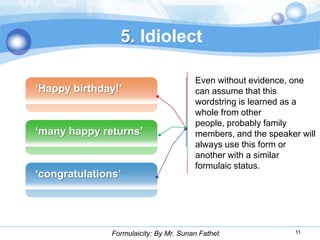
5. Idiolect

                                        Even without evidence, one
„Happy birthday!‟                       can assume that this
                                        wordstring is learned as a
                                        whole from other
                                        people, probably family
„many happy returns‟                    members, and the speaker will
                                        always use this form or
                                        another with a similar
                                        formulaic status.
„congratulations‟


               Formulaicity: By Mr. Sunan Fathet                11
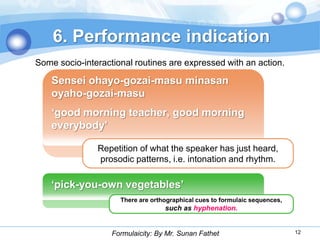
6. Performance indication
Some socio-interactional routines are expressed with an action.

    Sensei ohayo-gozai-masu minasan
    oyaho-gozai-masu
    „good morning teacher, good morning
    everybody‟

               Repetition of what the speaker has just heard,
               prosodic patterns, i.e. intonation and rhythm.

    „pick-you-own vegetables‟
                     There are orthographical cues to formulaic sequences,
                                   such as hyphenation.


                   Formulaicity: By Mr. Sunan Fathet                         12
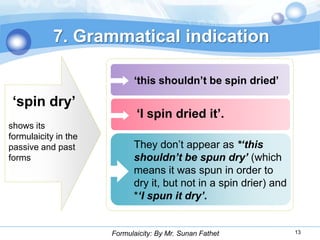
7. Grammatical indication

                            „this shouldn‟t be spin dried‟

 „spin dry‟
                             „I spin dried it‟.
shows its
formulaicity in the
passive and past            They don’t appear as *‘this
forms                       shouldn’t be spun dry’ (which
                            means it was spun in order to
                            dry it, but not in a spin drier) and
                            *‘I spun it dry’.


                      Formulaicity: By Mr. Sunan Fathet            13
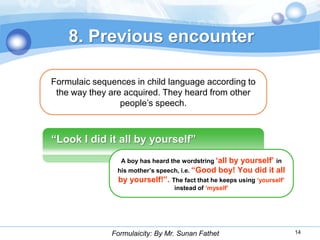
8. Previous encounter

Formulaic sequences in child language according to
 the way they are acquired. They heard from other
                 people’s speech.


“Look I did it all by yourself”
                 A boy has heard the wordstring „all
                                                   by yourself‟ in
                his mother‟s speech, i.e. “Good boy! You did it all
                by yourself!”. The fact that he keeps using „yourself‟
                                  instead of „myself‟


              Formulaicity: By Mr. Sunan Fathet                          14
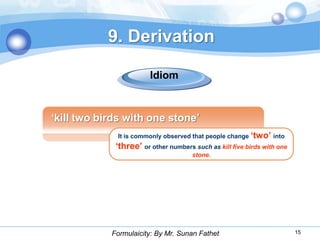
9. Derivation

                        Idiom


„kill two birds with one stone‟
             It is commonly observed that people change „two‟ into
             „three‟ or other numbers such as kill five birds with one
                                      stone.


            Formulaicity: By Mr. Sunan Fathet                            15
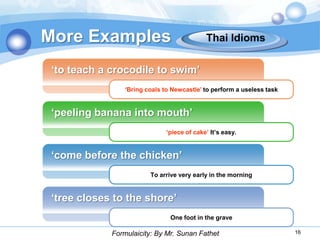
More Examples                                Thai Idioms


 „to teach a crocodile to swim‟
                 „Bring coals to Newcastle‟ to perform a useless task


 „peeling banana into mouth‟
                               „piece of cake‟ It‟s easy.


 „come before the chicken‟
                         To arrive very early in the morning


 „tree closes to the shore‟
                                One foot in the grave

             Formulaicity: By Mr. Sunan Fathet                          16
References
Cardiff University. (n.d.). What is formulaic language?.
       Retrieved September 3, 2012, from
       http://www.cardiff.ac.uk/encap/research/networks/flarn/
       whatis/index.html
Namba, K. (n.d.). Formulaicity in Code-Switching: Theory. Retrieved
       September 3, 2012, from http://www.senri.ed.jp/site/attachments/
        172_06KNamba12.pdf
Wray, A. (2002). Formulaic language and the lexicon. Cambridge:
       Cambridge University Press.


                                                                     17

                     Formulaicity: By Mr. Sunan Fathet
LOGO

Cross cultural communication formulaicity

  • 1.
    The Pragmatics ofCross- Cultural Communication Levels of Communication Differences By Mr. Sunan Fathet 1
  • 2.
    Parts of formulaiclanguage idioms collocations set phrases proverbs Parts of Formulaic Language routines turns of phrase rhymes and songs preferred ways of saying things (Wray, 2000, cited in Cardiff University, n.d.) Formulaicity: By Mr. Sunan Fathet 2
  • 3.
    Noticing formulaic languagein: ritualized events (ceremony) structured events such as weather forecasts the language of very young children the materials in foreign language the materials 2. Strategy in foreign language textbooks, especially for beginners, and in textbooks, especially for beginners, and phrasebooks in phrasebooks the speech of people with acquired language disabilities such as aphasia (Wray, 2000, cited in Cardiff University, n.d.) Formulaicity: By Mr. Sunan Fathet 3
  • 4.
    A sequence, continuousor discontinuous, of words or other meaning elements, which is, or appears to be, prefabricated: that is, stored and retrieved whole from memory at the time of use, rather than being subject to generation or analysis by the language grammar. (Wray, 2002, p.9) Formulaic (adj.): constituting or containing a verbal formula or set form of words: a formulaic greeting, formulaic expressions such as ‘Once upon a time’ - produced in accordance with a slavishly followed rule or style; predictable: much romantic fiction is stylized, formulaic, and unrealistic (Oxford dictionaries, 2012) 4
  • 5.
    The eleven criteriafor identification of formulaic sequences Grammatical irregularity Semantic opacity Situation/ register specificity Pragmatic function Idiolect Performance indication Grammatical indication Previous encounter Derivation Inappropriate application Mismatch with maturation (Wray and Namba, 2003, cited in Namba, n.d.) 5
  • 6.
    1. Grammatical irregularity „raincats and dogs‟ The intransitive verb „rain‟ doesn‟t take any object NP and the NP „cats and dogs‟ is not employed as an adverb. „if I were you‟ contains the subjunctive form „were‟ which many people no longer produce in novel constructions but only use in this wordstring. Formulaicity: By Mr. Sunan Fathet 6
  • 7.
    2. Semantic opacity „kickthe bucket‟ The meaning of the whole wordstring, i.e. „to die‟ cannot be derived from the sum of the meaning of its individual parts. „spill the beans‟ It means „tell a secret‟ and it is possible to map „spill‟ onto „tell‟ and „beans‟ onto „secret‟ „like a fish out of water‟ the speaker is not talking about a fish or water. „very funny‟ can express the opposite of its literal meaning, when the situation indicates that the speaker is talking about something not funny at all. Formulaicity: By Mr. Sunan Fathet 7
  • 8.
    2. Semantic opacity(cont.) “opaque metaphor” „kick the bucket‟ (Moon, 1998, p.23, cited in Namba, n.d.) where the meaning is unintelligible without “general or etymological knowledge” „spill the beans‟ (Wray, 2002, p.57, cited in Namba, n.d.) It looks fairly non-compositional „like a fish out of water‟ but the meaning is intelligible with general knowledge. When a wordstring has a literal meaning, it can have “a „very funny‟ secondary, layer of pragmatic meaning”. (Wray, 2002, p.58, cited in Namba, n.d.) Formulaicity: By Mr. Sunan Fathet 8
  • 9.
    3. Situation/ registerspecificity „Happy birthday!‟ It is said on a specific day sensei „teacher‟ In Japanese schools, when students address their teacher in class they say sensei ‘teacher’ rather than each teacher’s name. Formulaicity: By Mr. Sunan Fathet 9
  • 10.
    4. Pragmatic function „kid‟sstuff‟ „evaluative‟ conveying speaker‟s evaluation and attitude „you know what I mean‟ „modalizing‟ conveying truth values, advice, requests „I‟ll tell you what‟ This wordstring functions as a turn claimer in conversation to manage the flow of the discourse. „on the other hand‟ Discourse markers are archetypal models which fit this criterion. Formulaicity: By Mr. Sunan Fathet 10
  • 11.
    5. Idiolect Even without evidence, one „Happy birthday!‟ can assume that this wordstring is learned as a whole from other people, probably family „many happy returns‟ members, and the speaker will always use this form or another with a similar formulaic status. „congratulations‟ Formulaicity: By Mr. Sunan Fathet 11
  • 12.
    6. Performance indication Somesocio-interactional routines are expressed with an action. Sensei ohayo-gozai-masu minasan oyaho-gozai-masu „good morning teacher, good morning everybody‟ Repetition of what the speaker has just heard, prosodic patterns, i.e. intonation and rhythm. „pick-you-own vegetables‟ There are orthographical cues to formulaic sequences, such as hyphenation. Formulaicity: By Mr. Sunan Fathet 12
  • 13.
    7. Grammatical indication „this shouldn‟t be spin dried‟ „spin dry‟ „I spin dried it‟. shows its formulaicity in the passive and past They don’t appear as *‘this forms shouldn’t be spun dry’ (which means it was spun in order to dry it, but not in a spin drier) and *‘I spun it dry’. Formulaicity: By Mr. Sunan Fathet 13
  • 14.
    8. Previous encounter Formulaicsequences in child language according to the way they are acquired. They heard from other people’s speech. “Look I did it all by yourself” A boy has heard the wordstring „all by yourself‟ in his mother‟s speech, i.e. “Good boy! You did it all by yourself!”. The fact that he keeps using „yourself‟ instead of „myself‟ Formulaicity: By Mr. Sunan Fathet 14
  • 15.
    9. Derivation Idiom „kill two birds with one stone‟ It is commonly observed that people change „two‟ into „three‟ or other numbers such as kill five birds with one stone. Formulaicity: By Mr. Sunan Fathet 15
  • 16.
    More Examples Thai Idioms „to teach a crocodile to swim‟ „Bring coals to Newcastle‟ to perform a useless task „peeling banana into mouth‟ „piece of cake‟ It‟s easy. „come before the chicken‟ To arrive very early in the morning „tree closes to the shore‟ One foot in the grave Formulaicity: By Mr. Sunan Fathet 16
  • 17.
    References Cardiff University. (n.d.).What is formulaic language?. Retrieved September 3, 2012, from http://www.cardiff.ac.uk/encap/research/networks/flarn/ whatis/index.html Namba, K. (n.d.). Formulaicity in Code-Switching: Theory. Retrieved September 3, 2012, from http://www.senri.ed.jp/site/attachments/ 172_06KNamba12.pdf Wray, A. (2002). Formulaic language and the lexicon. Cambridge: Cambridge University Press. 17 Formulaicity: By Mr. Sunan Fathet
  • 18.