JAWAHARLAL NEHRU KRISHI VISHWA VIDYALYA
JABALPUR, M.P
Doctoral Seminar
on
Crop Simulation Model in Vegetable
Production
Seminar In charge:
Dr. S.K. Pandey
Professor and Head
Department of Horticulture
Presented by
Shubham Ahirwar
Ph.D. Horticulture (Veg. Sci.)
Enrollment No: 220132004
CONTENT
Introduction
Steps in modeling
Significance of Crop Simulation Models (CSMs)
Need of CSMs in Vegetable Production
What can Crop simulation produce?
Comparison with other crop models
Different Types of CSMs use in Vegetable Production
Limitations
Future Enhancement
Case Study
Conclusion
INTRODUCTION
Crop modeling involves the use of computational techniques to
simulate the growth, development and yield of crops under various
environmental conditions.
In vegetable production, crop modeling helps predict how different
factors such as weather, soil and management practices influence crop
growth and yield.
Crop modeling
• Aggregation of individual plant species grown in a
unit area for economic purpose
Crop
• It is based on the assumption that any given process can
be expressed in formal mathematical statement or set of
statements.
Modeling
• It is the simple representation of a crop
Crop Model
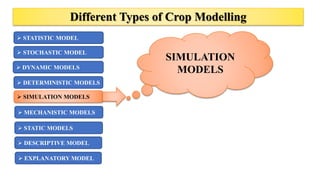
Different Types of Crop Modelling
 STATISTIC MODEL
 DETERMINISTIC MODELS
 DYNAMIC MODELS
 STOCHASTIC MODEL
 DESCRIPTIVE MODEL
 SIMULATION MODELS
 STATIC MODELS
 MECHANISTIC MODELS
 EXPLANATORY MODEL
SIMULATION
MODELS
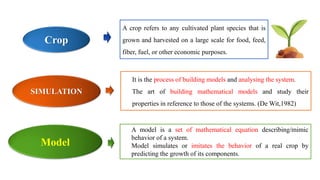
A crop refers to any cultivated plant species that is
grown and harvested on a large scale for food, feed,
fiber, fuel, or other economic purposes.
Crop
SIMULATION
It is the process of building models and analysing the system.
The art of building mathematical models and study their
properties in reference to those of the systems. (De Wit,1982)
Model
A model is a set of mathematical equation describing/mimic
behavior of a system.
Model simulates or imitates the behavior of a real crop by
predicting the growth of its components.
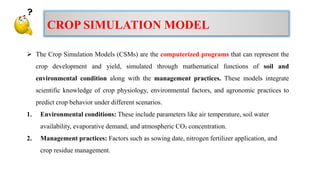
 The Crop Simulation Models (CSMs) are the computerized programs that can represent the
crop development and yield, simulated through mathematical functions of soil and
environmental condition along with the management practices. These models integrate
scientific knowledge of crop physiology, environmental factors, and agronomic practices to
predict crop behavior under different scenarios.
1. Environmental conditions: These include parameters like air temperature, soil water
availability, evaporative demand, and atmospheric CO₂ concentration.
2. Management practices: Factors such as sowing date, nitrogen fertilizer application, and
crop residue management.
CROP SIMULATION MODEL
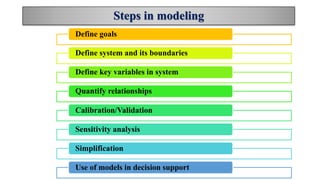
Steps in modeling
Define goals
Define system and its boundaries
Define key variables in system
Quantify relationships
Calibration/Validation
Sensitivity analysis
Simplification
Use of models in decision support
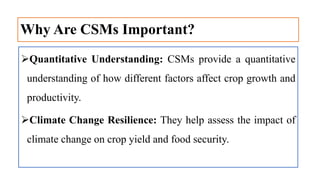
Why Are CSMs Important?
Quantitative Understanding: CSMs provide a quantitative
understanding of how different factors affect crop growth and
productivity.
Climate Change Resilience: They help assess the impact of
climate change on crop yield and food security.
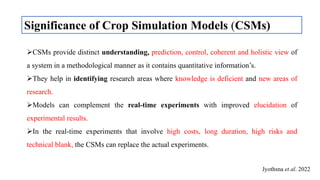
CSMs provide distinct understanding, prediction, control, coherent and holistic view of
a system in a methodological manner as it contains quantitative information’s.
They help in identifying research areas where knowledge is deficient and new areas of
research.
Models can complement the real-time experiments with improved elucidation of
experimental results.
In the real-time experiments that involve high costs, long duration, high risks and
technical blank, the CSMs can replace the actual experiments.
Significance of Crop Simulation Models (CSMs)
Jyothsna et al. 2022
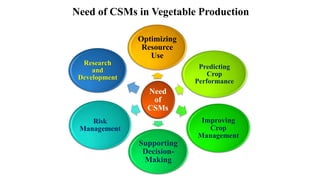
Need of CSMs in Vegetable Production
Need
of
CSMs
Optimizing
Resource
Use
Predicting
Crop
Performance
Improving
Crop
Management
Supporting
Decision-
Making
Risk
Management
Research
and
Development
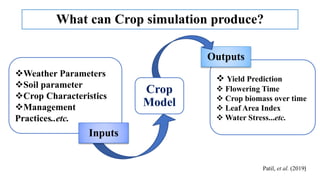
What can Crop simulation produce?
Weather Parameters
Soil parameter
Crop Characteristics
Management
Practices..etc.
 Yield Prediction
 Flowering Time
 Crop biomass over time
 Leaf Area Index
 Water Stress...etc.
Outputs
Inputs
Crop
Model
Patil, et al. (2019)
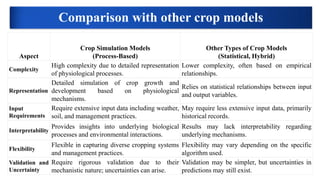
Aspect
Crop Simulation Models
(Process-Based)
Other Types of Crop Models
(Statistical, Hybrid)
Complexity
High complexity due to detailed representation
of physiological processes.
Lower complexity, often based on empirical
relationships.
Representation
Detailed simulation of crop growth and
development based on physiological
mechanisms.
Relies on statistical relationships between input
and output variables.
Input
Requirements
Require extensive input data including weather,
soil, and management practices.
May require less extensive input data, primarily
historical records.
Interpretability
Provides insights into underlying biological
processes and environmental interactions.
Results may lack interpretability regarding
underlying mechanisms.
Flexibility
Flexible in capturing diverse cropping systems
and management practices.
Flexibility may vary depending on the specific
algorithm used.
Validation and
Uncertainty
Require rigorous validation due to their
mechanistic nature; uncertainties can arise.
Validation may be simpler, but uncertainties in
predictions may still exist.
Comparison with other crop models
Different Types of CSMs use in Vegetable Production
DSSAT (Decision Support System for Agro-technology Transfer)
The Decision Support System for Agro-technology Transfer (DSSAT) is an application software program that
includes crop simulation models for more than 42 crops to make more reliable predictions. Its includes several
models for simulating vegetable crops such as tomatoes, peppers, cucurbits, and leafy greens. These models,
including CROPGRO, SUBSTOR, and CSM-CROPGRO-Vegetable, simulate the growth, development, and yield
of vegetable crops under varying environmental conditions (soil and plant water) and management practices
(nitrogen and carbon balances).
DSSAT was developed by Dr. Gerrit Hoogenboom at the University of Florida
Yield prediction for crop management
Water and irrigation management
Soil fertility management
Adaptive management using climate forecasts
Precision agriculture
Climate variability and Climate change
Soil carbon sequestration
Land use change analysis
Plant breeding and Genotype
Applications of DSSAT
VegSyst
VegSyst is a crop simulation model specifically designed for vegetable
production, focusing on crops like tomatoes and peppers.
It assists growers in making informed decisions regarding irrigation scheduling
to optimize water use efficiency and maximize crop yield and quality.
Developed by
Dr. Eric Simonne University of Florida's
Institute of Food and Agricultural
Sciences (UF/IFAS).
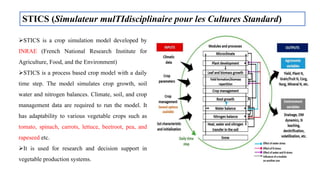
STICS (Simulateur mulTIdisciplinaire pour les Cultures Standard)
STICS is a crop simulation model developed by
INRAE (French National Research Institute for
Agriculture, Food, and the Environment)
STICS is a process based crop model with a daily
time step. The model simulates crop growth, soil
water and nitrogen balances. Climate, soil, and crop
management data are required to run the model. It
has adaptability to various vegetable crops such as
tomato, spinach, carrots, lettuce, beetroot, pea, and
rapeseed etc.
It is used for research and decision support in
vegetable production systems.
CropGro-Garden
It is used to assess the impact of interventions and technologies on vegetable productivity, food
security, and nutrition.
CropGro-Garden allows users to assess the impact of various management practices, such as
irrigation scheduling, fertilizer application, and planting density, on the productivity and food
security of vegetable crops. It takes into account factors such as climate, soil properties, crop
characteristics, and management practices to simulate crop growth and yield under different
scenarios.
CROPGRO was developed by Dr. Gerrit Hoogenboom and his colleagues at the USDAARS.
The model is part of the Decision Support System for Agrotechnology Transfer (DSSAT), a suite
of crop models used for agricultural research and decision support.
ALMANAC (Agricultural Land Management Alternatives with
Numerical Assessment Criteria)
ALMANAC is a plant-oriented process-based model that simulates a large variety of crops and
grasses. This model is sensitive to changes in soil properties, weather, and cropping management that
affect water and nutrient supplies to plants. The model operates on a daily time step. The model
simulates competition for light, water, and nutrients between plant species
The model uses more than 50 plant parameters representative of various crops, grasses, shrubs, and
trees. A set of parameters for each of the studied vegetables, including bush bean, green bean,
peppermint, spearmint, cabbage, straight neck squash, zucchini, and bell pepper.
Agricultural Production Systems Simulator (APSIM)
The Agricultural Production Systems Simulator is comprehensive model developed to simulate
biophysical processes in farming systems, particularly as it relates to the economic and ecological
outcomes of management practices in the face of climate risk.
It can simulate the growth, development, and yield of various vegetable crops under different
climates, soils, and management scenarios.
Applications
Support for on-farm decision making,
Farming systems design for production or resource management
Assessment of the value of seasonal climate forecasting
Analysis of supply chain issues in agribusiness
Development of waste management guidelines
Risk assessment for policy making
As a guide for research and educational activities
SALUS (System Approach to Land Use
Sustainability)
SALUS is a process-based crop model developed by Texas
A&M University that can simulate the growth, development,
and yield of various vegetable crops. It is used for research and
decision support in sustainable vegetable production systems.
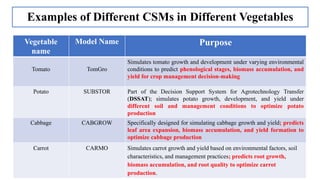
Examples of Different CSMs in Different Vegetables
Vegetable
name
Model Name Purpose
Tomato TomGro
Simulates tomato growth and development under varying environmental
conditions to predict phenological stages, biomass accumulation, and
yield for crop management decision-making
Potato SUBSTOR Part of the Decision Support System for Agrotechnology Transfer
(DSSAT); simulates potato growth, development, and yield under
different soil and management conditions to optimize potato
production
Cabbage CABGROW Specifically designed for simulating cabbage growth and yield; predicts
leaf area expansion, biomass accumulation, and yield formation to
optimize cabbage production
Carrot CARMO Simulates carrot growth and yield based on environmental factors, soil
characteristics, and management practices; predicts root growth,
biomass accumulation, and root quality to optimize carrot
production.
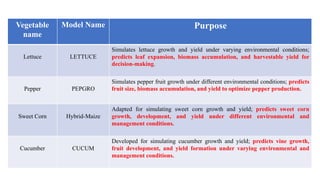
Vegetable
name
Model Name Purpose
Lettuce LETTUCE
Simulates lettuce growth and yield under varying environmental conditions;
predicts leaf expansion, biomass accumulation, and harvestable yield for
decision-making.
Pepper PEPGRO
Simulates pepper fruit growth under different environmental conditions; predicts
fruit size, biomass accumulation, and yield to optimize pepper production.
Sweet Corn Hybrid-Maize
Adapted for simulating sweet corn growth and yield; predicts sweet corn
growth, development, and yield under different environmental and
management conditions.
Cucumber CUCUM
Developed for simulating cucumber growth and yield; predicts vine growth,
fruit development, and yield formation under varying environmental and
management conditions.
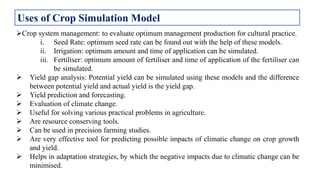
Crop system management: to evaluate optimum management production for cultural practice.
i. Seed Rate: optimum seed rate can be found out with the help of these models.
ii. Irrigation: optimum amount and time of application can be simulated.
iii. Fertiliser: optimum amount of fertiliser and time of application of the fertiliser can
be simulated.
 Yield gap analysis: Potential yield can be simulated using these models and the difference
between potential yield and actual yield is the yield gap.
 Yield prediction and forecasting.
 Evaluation of climate change.
 Useful for solving various practical problems in agriculture.
 Are resource conserving tools.
 Can be used in precision farming studies.
 Are very effective tool for predicting possible impacts of climatic change on crop growth
and yield.
 Helps in adaptation strategies, by which the negative impacts due to climatic change can be
minimised.
Uses of Crop Simulation Model
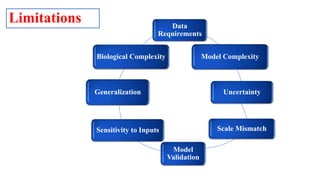
Limitations Data
Requirements
Model Complexity
Uncertainty
Scale Mismatch
Model
Validation
Sensitivity to Inputs
Generalization
Biological Complexity
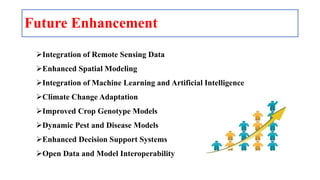
Future Enhancement
Integration of Remote Sensing Data
Enhanced Spatial Modeling
Integration of Machine Learning and Artificial Intelligence
Climate Change Adaptation
Improved Crop Genotype Models
Dynamic Pest and Disease Models
Enhanced Decision Support Systems
Open Data and Model Interoperability
Case Study 1
SIMULATING THE EFFECT OF THERMAL ENVIRONMENT ON
TOMATO WITHCROPGRO (DSSAT V4) MODEL
Source: SUNIL K.M., SUNDARA SARMAAND K.S. BALRAJ SINGH, 2006. Ann. Agric. Res. New Series Vol. 27 (1) : 63-66
The study was to evaluate the performance of DSSAT-CROPGRO-Tomato in
predicting tomato yield under different thermal environment
Sunil et. al. 2006
RESULT :-
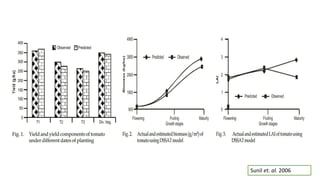
Fig.1. it is very clear that simulated yields and observed yields are sufficiently close so that it can
be used for predicting the yield of tomato. For further evaluation of the model, yield data of the
same variety of tomato obtained from a study conducted by Pachauri et al. (1986) at Division of
Vegetable Crops, Indian Agricultural Research Institute, New Delhi wasused.
It is clear from the Figures (2 and 3) that DSSAT was model able to predict both biomass and LAI
more precisely. The DSSAT model is able to predict LAI and biomass with sufficient accuracy.
The model correctly predicted biomass, leaf area index (LAI) and total yield. The model estimated
the yield with in a mean error of 4.5 per cent. So the model should be a useful tool evaluating the
potential yield of tomato under various thermal environments.
Sunil et. al. 2006
Case Study 2
Use of the VegSyst model to calculate crop N uptake and ETc of different
vegetable species grown in Mediterranean greenhouses
Source: M. Gallardo, C. Gimenez, M.D. Fernández, F.M. Padilla, and R.B. Thompson. 2018. Acta Hortic. 1192. ISHS 2018. DOI
10.17660/ActaHortic.2018.1192.12
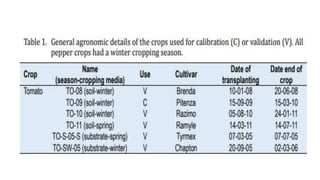
The objectives of this work were, for the VegSyst model, to (a) revise and adapt the calibration for tomato, pepper
and melon to simulate seasonal dry matter production (DMP), critical N uptake and ETc based on the Almeria
Radiation method, and (b) validate the model to simulate DMP, critical N uptake and ETc in several crops grown
in greenhouses in SE Spain. An example of the use of the VegSyst‐DSS in tomato will be presented.
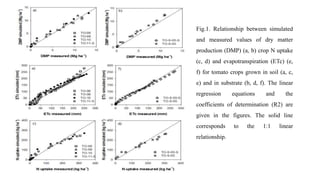
Fig.1. Relationship between simulated
and measured values of dry matter
production (DMP) (a, b) crop N uptake
(c, d) and evapotranspiration (ETc) (e,
f) for tomato crops grown in soil (a, c,
e) and in substrate (b, d, f). The linear
regression equations and the
coefficients of determination (R2) are
given in the figures. The solid line
corresponds to the 1:1 linear
relationship.
RESULTS
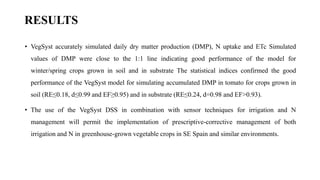
• VegSyst accurately simulated daily dry matter production (DMP), N uptake and ETc Simulated
values of DMP were close to the 1:1 line indicating good performance of the model for
winter/spring crops grown in soil and in substrate The statistical indices confirmed the good
performance of the VegSyst model for simulating accumulated DMP in tomato for crops grown in
soil (RE≤0.18, d≤0.99 and EF≥0.95) and in substrate (RE≤0.24, d=0.98 and EF>0.93).
• The use of the VegSyst DSS in combination with sensor techniques for irrigation and N
management will permit the implementation of prescriptive-corrective management of both
irrigation and N in greenhouse-grown vegetable crops in SE Spain and similar environments.
Crop Modeling Application to Improve Irrigation Efficiency in Year-
Round Vegetable Production in the Texas Winter Garden Region
Case Study 3
In this study, we proposed using the cropping system model ALMANAC (Agricultural Land
Management Alternatives with Numerical Assessment Criteria) that is capable of providing information
on water requirements to grow vegetables.
Source: Sumin Kim, Manyowa N. Meki, Sojung Kim, and James R. Kiniry. Agronomy 2020, 10, 1525; doi:10.3390/agronomy10101525
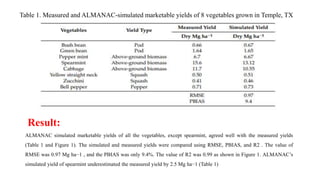
Table 1. Measured and ALMANAC-simulated marketable yields of 8 vegetables grown in Temple, TX
ALMANAC simulated marketable yields of all the vegetables, except spearmint, agreed well with the measured yields
(Table 1 and Figure 1). The simulated and measured yields were compared using RMSE, PBIAS, and R2 . The value of
RMSE was 0.97 Mg ha−1 , and the PBIAS was only 9.4%. The value of R2 was 0.99 as shown in Figure 1. ALMANAC’s
simulated yield of spearmint underestimated the measured yield by 2.5 Mg ha−1 (Table 1)
Result:
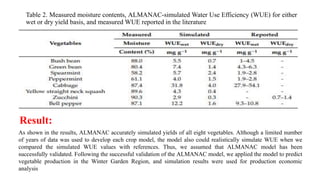
Table 2. Measured moisture contents, ALMANAC-simulated Water Use Efficiency (WUE) for either
wet or dry yield basis, and measured WUE reported in the literature
As shown in the results, ALMANAC accurately simulated yields of all eight vegetables. Although a limited number
of years of data was used to develop each crop model, the model also could realistically simulate WUE when we
compared the simulated WUE values with references. Thus, we assumed that ALMANAC model has been
successfully validated. Following the successful validation of the ALMANAC model, we applied the model to predict
vegetable production in the Winter Garden Region, and simulation results were used for production economic
analysis
Result:
How to build a crop model. A review
Source: Heather Pasley, Hamish Brown, Dean Holzworth, Jeremy Whish, Lindsay Bell, Neil Huth. Agronomy for Sustainable Development (2023) 43:2
Crop models have the potential to transcend our understanding of how crops interact with agronomic
management across space and time. Models have been accepted as useful tools that help agronomists,
farmers, policy makers, and other researchers make more informed decisions and recommendations. In this
paper, we provide a guide on how to build a process-based crop model within a larger cropping system
framework.
Case Study 4
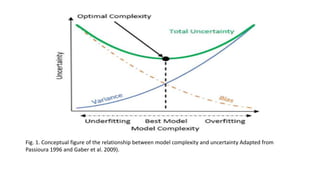
Fig. 1. Conceptual figure of the relationship between model complexity and uncertainty Adapted from
Passioura 1996 and Gaber et al. 2009).
Crop Simulation Models (CSMs) play a vital role in vegetable production by providing
researchers, and growers with valuable insights into crop growth, development, and yield under
varying environmental conditions and management practices. Through the integration of weather
data, soil characteristics, crop genetics, and management inputs, CSMs enable informed decision-
making for optimizing irrigation scheduling, fertilizer management, and pest and disease control.
Models such as DSSAT, VegSyst, STICS, CropGro-Garden, ALMANAC, APSIM and SALUS
offer valuable tools for assessing the impact of interventions on vegetable productivity, food
security, and environmental sustainability.
As vegetable production faces increasing challenges from climate variability, resource constraints,
and changing consumer demands, CSMs will continue to be indispensable tools for enhancing
productivity, resilience, and profitability in vegetable farming.
CONCLUSION
REFERENCES
• De Wit, C.T., 1982. Simulation of living systems. In Simulation of plant growth and crop production (pp. 3-8). Pudoc.
• Dourado-Neto, D., Teruel, D.A., Reichardt, K., Nielsen, D.R., Frizzone, J.A. and Bacchi, O.O.S., 1998. Principles of crop modelling and
simulation: II. The implications of the objective in model development. Scientia Agricola, 55, pp.51-57.
• Gaber N, Foley G, Pascual P, Stiber N, Sunderland E, Cope B, Nold A, Saleem Z (2009) Guidance on the development, evaluation, and
application of environmental models. Office of the Science Advisor, United States. Environmental Protection Agency. EPA/100/K-09/003
• Gallardo, M., Gimenez, C., Fernandez, M.D., Padilla, F.M., & Thompson, B.R. 2018. Use of the VegSyst model to calculate crop N uptake
and ETc of different vegetable species grown in Mediterranean greenhouses. Acta Hortic.1192. Proc. V Int. Symp. on Ecologically Sound
Fertilization Strategies for Field Vegetable Production.
• Gallardo, M., Thompson, R.B., Giménez, C., Padilla, F.M., Stöckle, C.O., 2014. Prototype decision support system based on the VegSyst
simulation model to calculate crop N and water requirements for tomato under plastic cover. Irrig. Sci. 32, 237–253.
https://doi.org/10.1007/s00271-014-0427-3.
• Jyothsna J, J. Dhakshayani , Reena Nair, B. Surendiran. 2022 Crop Simulation Models for Precision Farming of Vegetable Crops : A Review.
Adv. Biores. Vol 13 [6]. 44-49.
• Kim, S., Meki, M.N., Kim, S. and Kiniry, J.R., 2020. Crop modeling application to improve irrigation efficiency in year-round vegetable
production in the Texas winter garden region. Agronomy, 10(10), p.1525.
• Pasley, H., Brown, H., Holzworth, D., Whish, J., Bell, L. and Huth, N., 2023. How to build a crop model. A review. Agronomy for Sustainable
Development, 43(1), p.2.
• Passioura JB (1996) Simulation models: science, snake oil, education, or engineering? Agron J 88(5):690–694.
• Patil, R.H., 2019. Applications of crop simulation models in global agriculture research: A review. J Farm Sci, 32(4), pp.377-387.
• Sunil, K.M., SARMA, S. and SINGH, K.B., 2006. Simulating the effect of thermal environment on tomato with CROPGRO (DSSAT V4)
model. Annals of Agricultural Research, 27(1).
• Vegetable Crops Production PPT-1 | PDF | Vegetables | Plant Nursery (scribd.com)
Crop_Simulation_model_in_Vegetable_Production.pptx

Crop_Simulation_model_in_Vegetable_Production.pptx

  • 1.
    JAWAHARLAL NEHRU KRISHIVISHWA VIDYALYA JABALPUR, M.P Doctoral Seminar on Crop Simulation Model in Vegetable Production Seminar In charge: Dr. S.K. Pandey Professor and Head Department of Horticulture Presented by Shubham Ahirwar Ph.D. Horticulture (Veg. Sci.) Enrollment No: 220132004
  • 2.
    CONTENT Introduction Steps in modeling Significanceof Crop Simulation Models (CSMs) Need of CSMs in Vegetable Production What can Crop simulation produce? Comparison with other crop models Different Types of CSMs use in Vegetable Production Limitations Future Enhancement Case Study Conclusion
  • 3.
    INTRODUCTION Crop modeling involvesthe use of computational techniques to simulate the growth, development and yield of crops under various environmental conditions. In vegetable production, crop modeling helps predict how different factors such as weather, soil and management practices influence crop growth and yield. Crop modeling • Aggregation of individual plant species grown in a unit area for economic purpose Crop • It is based on the assumption that any given process can be expressed in formal mathematical statement or set of statements. Modeling • It is the simple representation of a crop Crop Model
  • 4.
    Different Types ofCrop Modelling  STATISTIC MODEL  DETERMINISTIC MODELS  DYNAMIC MODELS  STOCHASTIC MODEL  DESCRIPTIVE MODEL  SIMULATION MODELS  STATIC MODELS  MECHANISTIC MODELS  EXPLANATORY MODEL SIMULATION MODELS
  • 5.
    A crop refersto any cultivated plant species that is grown and harvested on a large scale for food, feed, fiber, fuel, or other economic purposes. Crop SIMULATION It is the process of building models and analysing the system. The art of building mathematical models and study their properties in reference to those of the systems. (De Wit,1982) Model A model is a set of mathematical equation describing/mimic behavior of a system. Model simulates or imitates the behavior of a real crop by predicting the growth of its components.
  • 6.
     The CropSimulation Models (CSMs) are the computerized programs that can represent the crop development and yield, simulated through mathematical functions of soil and environmental condition along with the management practices. These models integrate scientific knowledge of crop physiology, environmental factors, and agronomic practices to predict crop behavior under different scenarios. 1. Environmental conditions: These include parameters like air temperature, soil water availability, evaporative demand, and atmospheric CO₂ concentration. 2. Management practices: Factors such as sowing date, nitrogen fertilizer application, and crop residue management. CROP SIMULATION MODEL
  • 7.
    Steps in modeling Definegoals Define system and its boundaries Define key variables in system Quantify relationships Calibration/Validation Sensitivity analysis Simplification Use of models in decision support
  • 8.
    Why Are CSMsImportant? Quantitative Understanding: CSMs provide a quantitative understanding of how different factors affect crop growth and productivity. Climate Change Resilience: They help assess the impact of climate change on crop yield and food security.
  • 9.
    CSMs provide distinctunderstanding, prediction, control, coherent and holistic view of a system in a methodological manner as it contains quantitative information’s. They help in identifying research areas where knowledge is deficient and new areas of research. Models can complement the real-time experiments with improved elucidation of experimental results. In the real-time experiments that involve high costs, long duration, high risks and technical blank, the CSMs can replace the actual experiments. Significance of Crop Simulation Models (CSMs) Jyothsna et al. 2022
  • 10.
    Need of CSMsin Vegetable Production Need of CSMs Optimizing Resource Use Predicting Crop Performance Improving Crop Management Supporting Decision- Making Risk Management Research and Development
  • 11.
    What can Cropsimulation produce? Weather Parameters Soil parameter Crop Characteristics Management Practices..etc.  Yield Prediction  Flowering Time  Crop biomass over time  Leaf Area Index  Water Stress...etc. Outputs Inputs Crop Model Patil, et al. (2019)
  • 12.
    Aspect Crop Simulation Models (Process-Based) OtherTypes of Crop Models (Statistical, Hybrid) Complexity High complexity due to detailed representation of physiological processes. Lower complexity, often based on empirical relationships. Representation Detailed simulation of crop growth and development based on physiological mechanisms. Relies on statistical relationships between input and output variables. Input Requirements Require extensive input data including weather, soil, and management practices. May require less extensive input data, primarily historical records. Interpretability Provides insights into underlying biological processes and environmental interactions. Results may lack interpretability regarding underlying mechanisms. Flexibility Flexible in capturing diverse cropping systems and management practices. Flexibility may vary depending on the specific algorithm used. Validation and Uncertainty Require rigorous validation due to their mechanistic nature; uncertainties can arise. Validation may be simpler, but uncertainties in predictions may still exist. Comparison with other crop models
  • 13.
    Different Types ofCSMs use in Vegetable Production
  • 14.
    DSSAT (Decision SupportSystem for Agro-technology Transfer) The Decision Support System for Agro-technology Transfer (DSSAT) is an application software program that includes crop simulation models for more than 42 crops to make more reliable predictions. Its includes several models for simulating vegetable crops such as tomatoes, peppers, cucurbits, and leafy greens. These models, including CROPGRO, SUBSTOR, and CSM-CROPGRO-Vegetable, simulate the growth, development, and yield of vegetable crops under varying environmental conditions (soil and plant water) and management practices (nitrogen and carbon balances). DSSAT was developed by Dr. Gerrit Hoogenboom at the University of Florida Yield prediction for crop management Water and irrigation management Soil fertility management Adaptive management using climate forecasts Precision agriculture Climate variability and Climate change Soil carbon sequestration Land use change analysis Plant breeding and Genotype Applications of DSSAT
  • 15.
    VegSyst VegSyst is acrop simulation model specifically designed for vegetable production, focusing on crops like tomatoes and peppers. It assists growers in making informed decisions regarding irrigation scheduling to optimize water use efficiency and maximize crop yield and quality. Developed by Dr. Eric Simonne University of Florida's Institute of Food and Agricultural Sciences (UF/IFAS).
  • 16.
    STICS (Simulateur mulTIdisciplinairepour les Cultures Standard) STICS is a crop simulation model developed by INRAE (French National Research Institute for Agriculture, Food, and the Environment) STICS is a process based crop model with a daily time step. The model simulates crop growth, soil water and nitrogen balances. Climate, soil, and crop management data are required to run the model. It has adaptability to various vegetable crops such as tomato, spinach, carrots, lettuce, beetroot, pea, and rapeseed etc. It is used for research and decision support in vegetable production systems.
  • 17.
    CropGro-Garden It is usedto assess the impact of interventions and technologies on vegetable productivity, food security, and nutrition. CropGro-Garden allows users to assess the impact of various management practices, such as irrigation scheduling, fertilizer application, and planting density, on the productivity and food security of vegetable crops. It takes into account factors such as climate, soil properties, crop characteristics, and management practices to simulate crop growth and yield under different scenarios. CROPGRO was developed by Dr. Gerrit Hoogenboom and his colleagues at the USDAARS. The model is part of the Decision Support System for Agrotechnology Transfer (DSSAT), a suite of crop models used for agricultural research and decision support.
  • 18.
    ALMANAC (Agricultural LandManagement Alternatives with Numerical Assessment Criteria) ALMANAC is a plant-oriented process-based model that simulates a large variety of crops and grasses. This model is sensitive to changes in soil properties, weather, and cropping management that affect water and nutrient supplies to plants. The model operates on a daily time step. The model simulates competition for light, water, and nutrients between plant species The model uses more than 50 plant parameters representative of various crops, grasses, shrubs, and trees. A set of parameters for each of the studied vegetables, including bush bean, green bean, peppermint, spearmint, cabbage, straight neck squash, zucchini, and bell pepper.
  • 19.
    Agricultural Production SystemsSimulator (APSIM) The Agricultural Production Systems Simulator is comprehensive model developed to simulate biophysical processes in farming systems, particularly as it relates to the economic and ecological outcomes of management practices in the face of climate risk. It can simulate the growth, development, and yield of various vegetable crops under different climates, soils, and management scenarios. Applications Support for on-farm decision making, Farming systems design for production or resource management Assessment of the value of seasonal climate forecasting Analysis of supply chain issues in agribusiness Development of waste management guidelines Risk assessment for policy making As a guide for research and educational activities
  • 20.
    SALUS (System Approachto Land Use Sustainability) SALUS is a process-based crop model developed by Texas A&M University that can simulate the growth, development, and yield of various vegetable crops. It is used for research and decision support in sustainable vegetable production systems.
  • 21.
    Examples of DifferentCSMs in Different Vegetables Vegetable name Model Name Purpose Tomato TomGro Simulates tomato growth and development under varying environmental conditions to predict phenological stages, biomass accumulation, and yield for crop management decision-making Potato SUBSTOR Part of the Decision Support System for Agrotechnology Transfer (DSSAT); simulates potato growth, development, and yield under different soil and management conditions to optimize potato production Cabbage CABGROW Specifically designed for simulating cabbage growth and yield; predicts leaf area expansion, biomass accumulation, and yield formation to optimize cabbage production Carrot CARMO Simulates carrot growth and yield based on environmental factors, soil characteristics, and management practices; predicts root growth, biomass accumulation, and root quality to optimize carrot production.
  • 22.
    Vegetable name Model Name Purpose LettuceLETTUCE Simulates lettuce growth and yield under varying environmental conditions; predicts leaf expansion, biomass accumulation, and harvestable yield for decision-making. Pepper PEPGRO Simulates pepper fruit growth under different environmental conditions; predicts fruit size, biomass accumulation, and yield to optimize pepper production. Sweet Corn Hybrid-Maize Adapted for simulating sweet corn growth and yield; predicts sweet corn growth, development, and yield under different environmental and management conditions. Cucumber CUCUM Developed for simulating cucumber growth and yield; predicts vine growth, fruit development, and yield formation under varying environmental and management conditions.
  • 23.
    Crop system management:to evaluate optimum management production for cultural practice. i. Seed Rate: optimum seed rate can be found out with the help of these models. ii. Irrigation: optimum amount and time of application can be simulated. iii. Fertiliser: optimum amount of fertiliser and time of application of the fertiliser can be simulated.  Yield gap analysis: Potential yield can be simulated using these models and the difference between potential yield and actual yield is the yield gap.  Yield prediction and forecasting.  Evaluation of climate change.  Useful for solving various practical problems in agriculture.  Are resource conserving tools.  Can be used in precision farming studies.  Are very effective tool for predicting possible impacts of climatic change on crop growth and yield.  Helps in adaptation strategies, by which the negative impacts due to climatic change can be minimised. Uses of Crop Simulation Model
  • 24.
    Limitations Data Requirements Model Complexity Uncertainty ScaleMismatch Model Validation Sensitivity to Inputs Generalization Biological Complexity
  • 25.
    Future Enhancement Integration ofRemote Sensing Data Enhanced Spatial Modeling Integration of Machine Learning and Artificial Intelligence Climate Change Adaptation Improved Crop Genotype Models Dynamic Pest and Disease Models Enhanced Decision Support Systems Open Data and Model Interoperability
  • 26.
    Case Study 1 SIMULATINGTHE EFFECT OF THERMAL ENVIRONMENT ON TOMATO WITHCROPGRO (DSSAT V4) MODEL Source: SUNIL K.M., SUNDARA SARMAAND K.S. BALRAJ SINGH, 2006. Ann. Agric. Res. New Series Vol. 27 (1) : 63-66 The study was to evaluate the performance of DSSAT-CROPGRO-Tomato in predicting tomato yield under different thermal environment
  • 27.
  • 28.
    RESULT :- Fig.1. itis very clear that simulated yields and observed yields are sufficiently close so that it can be used for predicting the yield of tomato. For further evaluation of the model, yield data of the same variety of tomato obtained from a study conducted by Pachauri et al. (1986) at Division of Vegetable Crops, Indian Agricultural Research Institute, New Delhi wasused. It is clear from the Figures (2 and 3) that DSSAT was model able to predict both biomass and LAI more precisely. The DSSAT model is able to predict LAI and biomass with sufficient accuracy. The model correctly predicted biomass, leaf area index (LAI) and total yield. The model estimated the yield with in a mean error of 4.5 per cent. So the model should be a useful tool evaluating the potential yield of tomato under various thermal environments. Sunil et. al. 2006
  • 29.
    Case Study 2 Useof the VegSyst model to calculate crop N uptake and ETc of different vegetable species grown in Mediterranean greenhouses Source: M. Gallardo, C. Gimenez, M.D. Fernández, F.M. Padilla, and R.B. Thompson. 2018. Acta Hortic. 1192. ISHS 2018. DOI 10.17660/ActaHortic.2018.1192.12 The objectives of this work were, for the VegSyst model, to (a) revise and adapt the calibration for tomato, pepper and melon to simulate seasonal dry matter production (DMP), critical N uptake and ETc based on the Almeria Radiation method, and (b) validate the model to simulate DMP, critical N uptake and ETc in several crops grown in greenhouses in SE Spain. An example of the use of the VegSyst‐DSS in tomato will be presented.
  • 31.
    Fig.1. Relationship betweensimulated and measured values of dry matter production (DMP) (a, b) crop N uptake (c, d) and evapotranspiration (ETc) (e, f) for tomato crops grown in soil (a, c, e) and in substrate (b, d, f). The linear regression equations and the coefficients of determination (R2) are given in the figures. The solid line corresponds to the 1:1 linear relationship.
  • 32.
    RESULTS • VegSyst accuratelysimulated daily dry matter production (DMP), N uptake and ETc Simulated values of DMP were close to the 1:1 line indicating good performance of the model for winter/spring crops grown in soil and in substrate The statistical indices confirmed the good performance of the VegSyst model for simulating accumulated DMP in tomato for crops grown in soil (RE≤0.18, d≤0.99 and EF≥0.95) and in substrate (RE≤0.24, d=0.98 and EF>0.93). • The use of the VegSyst DSS in combination with sensor techniques for irrigation and N management will permit the implementation of prescriptive-corrective management of both irrigation and N in greenhouse-grown vegetable crops in SE Spain and similar environments.
  • 33.
    Crop Modeling Applicationto Improve Irrigation Efficiency in Year- Round Vegetable Production in the Texas Winter Garden Region Case Study 3 In this study, we proposed using the cropping system model ALMANAC (Agricultural Land Management Alternatives with Numerical Assessment Criteria) that is capable of providing information on water requirements to grow vegetables. Source: Sumin Kim, Manyowa N. Meki, Sojung Kim, and James R. Kiniry. Agronomy 2020, 10, 1525; doi:10.3390/agronomy10101525
  • 34.
    Table 1. Measuredand ALMANAC-simulated marketable yields of 8 vegetables grown in Temple, TX ALMANAC simulated marketable yields of all the vegetables, except spearmint, agreed well with the measured yields (Table 1 and Figure 1). The simulated and measured yields were compared using RMSE, PBIAS, and R2 . The value of RMSE was 0.97 Mg ha−1 , and the PBIAS was only 9.4%. The value of R2 was 0.99 as shown in Figure 1. ALMANAC’s simulated yield of spearmint underestimated the measured yield by 2.5 Mg ha−1 (Table 1) Result:
  • 35.
    Table 2. Measuredmoisture contents, ALMANAC-simulated Water Use Efficiency (WUE) for either wet or dry yield basis, and measured WUE reported in the literature As shown in the results, ALMANAC accurately simulated yields of all eight vegetables. Although a limited number of years of data was used to develop each crop model, the model also could realistically simulate WUE when we compared the simulated WUE values with references. Thus, we assumed that ALMANAC model has been successfully validated. Following the successful validation of the ALMANAC model, we applied the model to predict vegetable production in the Winter Garden Region, and simulation results were used for production economic analysis Result:
  • 36.
    How to builda crop model. A review Source: Heather Pasley, Hamish Brown, Dean Holzworth, Jeremy Whish, Lindsay Bell, Neil Huth. Agronomy for Sustainable Development (2023) 43:2 Crop models have the potential to transcend our understanding of how crops interact with agronomic management across space and time. Models have been accepted as useful tools that help agronomists, farmers, policy makers, and other researchers make more informed decisions and recommendations. In this paper, we provide a guide on how to build a process-based crop model within a larger cropping system framework. Case Study 4
  • 37.
    Fig. 1. Conceptualfigure of the relationship between model complexity and uncertainty Adapted from Passioura 1996 and Gaber et al. 2009).
  • 38.
    Crop Simulation Models(CSMs) play a vital role in vegetable production by providing researchers, and growers with valuable insights into crop growth, development, and yield under varying environmental conditions and management practices. Through the integration of weather data, soil characteristics, crop genetics, and management inputs, CSMs enable informed decision- making for optimizing irrigation scheduling, fertilizer management, and pest and disease control. Models such as DSSAT, VegSyst, STICS, CropGro-Garden, ALMANAC, APSIM and SALUS offer valuable tools for assessing the impact of interventions on vegetable productivity, food security, and environmental sustainability. As vegetable production faces increasing challenges from climate variability, resource constraints, and changing consumer demands, CSMs will continue to be indispensable tools for enhancing productivity, resilience, and profitability in vegetable farming. CONCLUSION
  • 39.
    REFERENCES • De Wit,C.T., 1982. Simulation of living systems. In Simulation of plant growth and crop production (pp. 3-8). Pudoc. • Dourado-Neto, D., Teruel, D.A., Reichardt, K., Nielsen, D.R., Frizzone, J.A. and Bacchi, O.O.S., 1998. Principles of crop modelling and simulation: II. The implications of the objective in model development. Scientia Agricola, 55, pp.51-57. • Gaber N, Foley G, Pascual P, Stiber N, Sunderland E, Cope B, Nold A, Saleem Z (2009) Guidance on the development, evaluation, and application of environmental models. Office of the Science Advisor, United States. Environmental Protection Agency. EPA/100/K-09/003 • Gallardo, M., Gimenez, C., Fernandez, M.D., Padilla, F.M., & Thompson, B.R. 2018. Use of the VegSyst model to calculate crop N uptake and ETc of different vegetable species grown in Mediterranean greenhouses. Acta Hortic.1192. Proc. V Int. Symp. on Ecologically Sound Fertilization Strategies for Field Vegetable Production. • Gallardo, M., Thompson, R.B., Giménez, C., Padilla, F.M., Stöckle, C.O., 2014. Prototype decision support system based on the VegSyst simulation model to calculate crop N and water requirements for tomato under plastic cover. Irrig. Sci. 32, 237–253. https://doi.org/10.1007/s00271-014-0427-3. • Jyothsna J, J. Dhakshayani , Reena Nair, B. Surendiran. 2022 Crop Simulation Models for Precision Farming of Vegetable Crops : A Review. Adv. Biores. Vol 13 [6]. 44-49. • Kim, S., Meki, M.N., Kim, S. and Kiniry, J.R., 2020. Crop modeling application to improve irrigation efficiency in year-round vegetable production in the Texas winter garden region. Agronomy, 10(10), p.1525. • Pasley, H., Brown, H., Holzworth, D., Whish, J., Bell, L. and Huth, N., 2023. How to build a crop model. A review. Agronomy for Sustainable Development, 43(1), p.2. • Passioura JB (1996) Simulation models: science, snake oil, education, or engineering? Agron J 88(5):690–694. • Patil, R.H., 2019. Applications of crop simulation models in global agriculture research: A review. J Farm Sci, 32(4), pp.377-387. • Sunil, K.M., SARMA, S. and SINGH, K.B., 2006. Simulating the effect of thermal environment on tomato with CROPGRO (DSSAT V4) model. Annals of Agricultural Research, 27(1). • Vegetable Crops Production PPT-1 | PDF | Vegetables | Plant Nursery (scribd.com)