EWHiZSALES.COM
What is CRM?
 Customer Relationship Management is a comprehensive
strategy and process of acquiring, retaining and
partnering with selective customers to create superior
value for the company and the customer.
 CRM is a management approach a model that puts a customer
at the core of a company processes and practices.
 CRM leverages cutting edge technology integrated strategic
planning up-close and personal marketing techniques and
Organization development tools to build internal external
relationships that increase profit margins and productivity
within a company.
Need For CRM
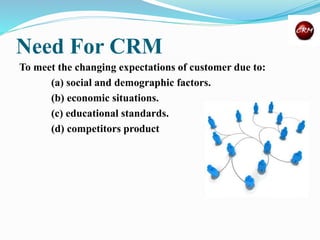
To meet the changing expectations of customer due to:
(a) social and demographic factors.
(b) economic situations.
(c) educational standards.
(d) competitors product
Typically a call center is a place that encourages customers to make calls in order to
facilitate their easy usage of the product/service offered by the organization. All calls
from customers regarding their queries, problems, suggestions are entertained.
Call Centers Phenomenal Success - CRM Plays a Part!
It consists of a group of personnel that are specifically trained in handling inbound and
outbound customer calls thus catering to customer service needs. Call center services
include:
• tele -calling
• e-mail campaign
• market research
A call center has the immense capacity to handle huge amounts of calls at all times.
Generally qualified personnel who are imminently capable of dealing with the call in
the right manner, handle them. All calls are monitored and logged and used for future
reference.
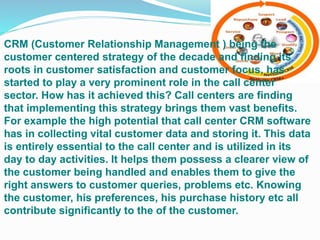
CRM (Customer Relationship Management ) being the
customer centered strategy of the decade and finding its
roots in customer satisfaction and customer focus, has
started to play a very prominent role in the call center
sector. How has it achieved this? Call centers are finding
that implementing this strategy brings them vast benefits.
For example the high potential that call center CRM software
has in collecting vital customer data and storing it. This data
is entirely essential to the call center and is utilized in its
day to day activities. It helps them possess a clearer view of
the customer being handled and enables them to give the
right answers to customer queries, problems etc. Knowing
the customer, his preferences, his purchase history etc all
contribute significantly to the of the customer.
What Benefits can CRM offer the Call Center Sector?
Call center CRM software benefits the call center through its provision and storage of
valuable customer data , increased automation, visible reduction in call center costs
and its potential to boost customer service levels thereby increasing productivity and
customer satisfaction.
It helps in assisting call centers with shorter call durations, reduction in holding time
and the decrease of misrouted calls. Since the need for CRM is of extreme importance
in the call center spectrum, CRM provides the call center with a complete and
accurate picture of the customer. CRM enables the appropriate and most productive
usage of customer information thereby helping to build better relationships with
customers.
CRM provides the call center professional with valuable customer data providing him
with a information about the customers history and before he makes a call. He is thus
in a position to know and understand the customer preferences providing added
information to the sales industry sector. It enables customer databases to be kept up to
date at all times.
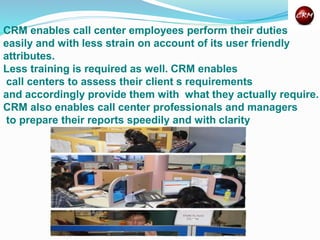
CRM enables call center employees perform their duties
easily and with less strain on account of its user friendly
attributes.
Less training is required as well. CRM enables
call centers to assess their client s requirements
and accordingly provide them with what they actually require.
CRM also enables call center professionals and managers
to prepare their reports speedily and with clarity
CRM Components
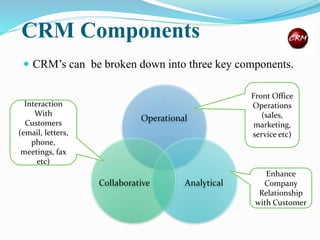
 CRM’s can be broken down into three key components.
Operational
AnalyticalCollaborative
Enhance
Company
Relationship
with Customer
Front Office
Operations
(sales,
marketing,
service etc)
Interaction
With
Customers
(email, letters,
phone,
meetings, fax
etc)
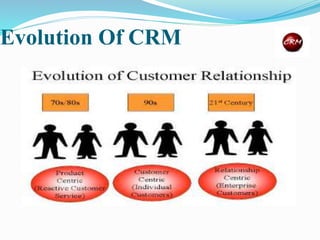
Evolution Of CRM
NEED OF e-CRM
 Due to the introduction of new technology
 To satisfy the customers at global level.
(Sometimes customer itself prefer to do online
purchasing.)
 Basically e-CRM is concerned with attracting & keeping
economically valuable customers & eliminating less
profitable ones.
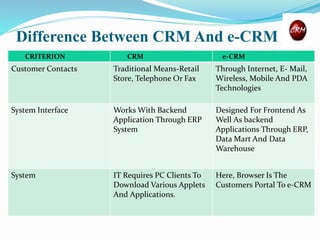
Difference Between CRM And e-CRM
CRITERION CRM e-CRM
Customer Contacts Traditional Means-Retail
Store, Telephone Or Fax
Through Internet, E- Mail,
Wireless, Mobile And PDA
Technologies
System Interface Works With Backend
Application Through ERP
System
Designed For Frontend As
Well As backend
Applications Through ERP,
Data Mart And Data
Warehouse
System IT Requires PC Clients To
Download Various Applets
And Applications.
Here, Browser Is The
Customers Portal To e-CRM
Contd..
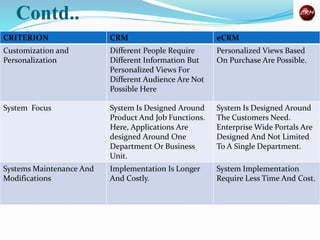
CRITERION CRM eCRM
Customization and
Personalization
Different People Require
Different Information But
Personalized Views For
Different Audience Are Not
Possible Here
Personalized Views Based
On Purchase Are Possible.
System Focus System Is Designed Around
Product And Job Functions.
Here, Applications Are
designed Around One
Department Or Business
Unit.
System Is Designed Around
The Customers Need.
Enterprise Wide Portals Are
Designed And Not Limited
To A Single Department.
Systems Maintenance And
Modifications
Implementation Is Longer
And Costly.
System Implementation
Require Less Time And Cost.
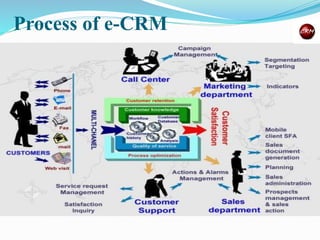
Process of e-CRM
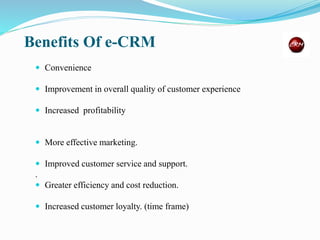
Benefits Of e-CRM
 Convenience
 Improvement in overall quality of customer experience
 Increased profitability
 More effective marketing.
 Improved customer service and support.
.
 Greater efficiency and cost reduction.
 Increased customer loyalty. (time frame)
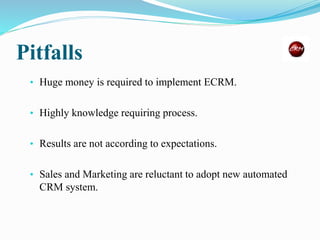
Pitfalls
• Huge money is required to implement ECRM.
• Highly knowledge requiring process.
• Results are not according to expectations.
• Sales and Marketing are reluctant to adopt new automated
CRM system.
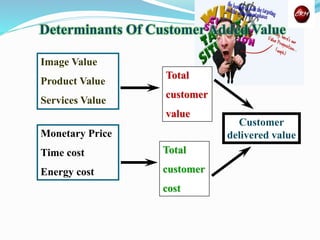
Image Value
Product Value
Services Value
Monetary Price
Time cost
Energy cost
Total
customer
value
Total
customer
cost
Customer
delivered value
Determinants Of Customer Added Value
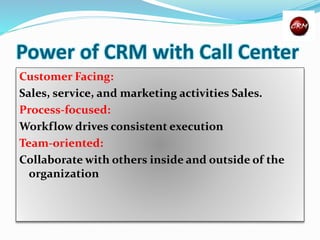
Power of CRM with Call Center
Customer Facing:
Sales, service, and marketing activities Sales.
Process-focused:
Workflow drives consistent execution
Team-oriented:
Collaborate with others inside and outside of the
organization
Group - 5

Call Centre CRM

  • 1.
  • 2.
    What is CRM? Customer Relationship Management is a comprehensive strategy and process of acquiring, retaining and partnering with selective customers to create superior value for the company and the customer.  CRM is a management approach a model that puts a customer at the core of a company processes and practices.  CRM leverages cutting edge technology integrated strategic planning up-close and personal marketing techniques and Organization development tools to build internal external relationships that increase profit margins and productivity within a company.
  • 3.
    Need For CRM Tomeet the changing expectations of customer due to: (a) social and demographic factors. (b) economic situations. (c) educational standards. (d) competitors product
  • 4.
    Typically a callcenter is a place that encourages customers to make calls in order to facilitate their easy usage of the product/service offered by the organization. All calls from customers regarding their queries, problems, suggestions are entertained. Call Centers Phenomenal Success - CRM Plays a Part! It consists of a group of personnel that are specifically trained in handling inbound and outbound customer calls thus catering to customer service needs. Call center services include: • tele -calling • e-mail campaign • market research A call center has the immense capacity to handle huge amounts of calls at all times. Generally qualified personnel who are imminently capable of dealing with the call in the right manner, handle them. All calls are monitored and logged and used for future reference.
  • 5.
    CRM (Customer RelationshipManagement ) being the customer centered strategy of the decade and finding its roots in customer satisfaction and customer focus, has started to play a very prominent role in the call center sector. How has it achieved this? Call centers are finding that implementing this strategy brings them vast benefits. For example the high potential that call center CRM software has in collecting vital customer data and storing it. This data is entirely essential to the call center and is utilized in its day to day activities. It helps them possess a clearer view of the customer being handled and enables them to give the right answers to customer queries, problems etc. Knowing the customer, his preferences, his purchase history etc all contribute significantly to the of the customer.
  • 6.
    What Benefits canCRM offer the Call Center Sector? Call center CRM software benefits the call center through its provision and storage of valuable customer data , increased automation, visible reduction in call center costs and its potential to boost customer service levels thereby increasing productivity and customer satisfaction. It helps in assisting call centers with shorter call durations, reduction in holding time and the decrease of misrouted calls. Since the need for CRM is of extreme importance in the call center spectrum, CRM provides the call center with a complete and accurate picture of the customer. CRM enables the appropriate and most productive usage of customer information thereby helping to build better relationships with customers. CRM provides the call center professional with valuable customer data providing him with a information about the customers history and before he makes a call. He is thus in a position to know and understand the customer preferences providing added information to the sales industry sector. It enables customer databases to be kept up to date at all times.
  • 7.
    CRM enables callcenter employees perform their duties easily and with less strain on account of its user friendly attributes. Less training is required as well. CRM enables call centers to assess their client s requirements and accordingly provide them with what they actually require. CRM also enables call center professionals and managers to prepare their reports speedily and with clarity
  • 8.
    CRM Components  CRM’scan be broken down into three key components. Operational AnalyticalCollaborative Enhance Company Relationship with Customer Front Office Operations (sales, marketing, service etc) Interaction With Customers (email, letters, phone, meetings, fax etc)
  • 9.
  • 10.
    NEED OF e-CRM Due to the introduction of new technology  To satisfy the customers at global level. (Sometimes customer itself prefer to do online purchasing.)  Basically e-CRM is concerned with attracting & keeping economically valuable customers & eliminating less profitable ones.
  • 11.
    Difference Between CRMAnd e-CRM CRITERION CRM e-CRM Customer Contacts Traditional Means-Retail Store, Telephone Or Fax Through Internet, E- Mail, Wireless, Mobile And PDA Technologies System Interface Works With Backend Application Through ERP System Designed For Frontend As Well As backend Applications Through ERP, Data Mart And Data Warehouse System IT Requires PC Clients To Download Various Applets And Applications. Here, Browser Is The Customers Portal To e-CRM
  • 12.
    Contd.. CRITERION CRM eCRM Customizationand Personalization Different People Require Different Information But Personalized Views For Different Audience Are Not Possible Here Personalized Views Based On Purchase Are Possible. System Focus System Is Designed Around Product And Job Functions. Here, Applications Are designed Around One Department Or Business Unit. System Is Designed Around The Customers Need. Enterprise Wide Portals Are Designed And Not Limited To A Single Department. Systems Maintenance And Modifications Implementation Is Longer And Costly. System Implementation Require Less Time And Cost.
  • 13.
  • 14.
    Benefits Of e-CRM Convenience  Improvement in overall quality of customer experience  Increased profitability  More effective marketing.  Improved customer service and support. .  Greater efficiency and cost reduction.  Increased customer loyalty. (time frame)
  • 15.
    Pitfalls • Huge moneyis required to implement ECRM. • Highly knowledge requiring process. • Results are not according to expectations. • Sales and Marketing are reluctant to adopt new automated CRM system.
  • 16.
    Image Value Product Value ServicesValue Monetary Price Time cost Energy cost Total customer value Total customer cost Customer delivered value Determinants Of Customer Added Value
  • 17.
    Power of CRMwith Call Center Customer Facing: Sales, service, and marketing activities Sales. Process-focused: Workflow drives consistent execution Team-oriented: Collaborate with others inside and outside of the organization
  • 18.

Editor's Notes

  • #9 Collaborative CRM (Communication with Clients) Focus on customer interaction Efficient Communication on all medias (Email, Fax, Letter) Sending the correct information Latest Version – Only having one Wine Price List – Instead of a couple lying around the office Many account managers – Someone else can instantly pick up the customers account Providing online services to reduce CUSTOMER Service costs (Customer can update there accounts details, see the latest invoices etc) Operational CRM (Basic Business Processes) I think of this as one way process, you are dealing with the customer but not directly So for example you maybe update order than has be dispatched, the CRM process with log this in the customers history record. This component can be broken down further into three areas Sales Force Automation