

Subrata Kumar Sarker
ID: 151014002
Department of Textile Engineering
Name of My Presentation
CRL & CRE METHOD
LOAD: The application of a load to a specimen in its axil
direction causes a tension to be developed in the specimen.
The load is usually expressed in gm wt or pounds wt.
Breaking load: The load at which material breaks is
called breaking load. It is usually expressed in gm-wt.
Breaking length: the breaking length is length of the
specimen which will just break under weight when hang
vertically. Units of braking length is kilogram.
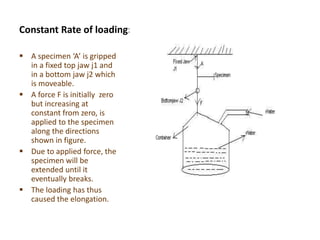
Constant Rate of loading:
 A specimen ‘A’ is gripped
in a fixed top jaw j1 and
in a bottom jaw j2 which
is moveable.
 A force F is initially zero
but increasing at
constant from zero, is
applied to the specimen
along the directions
shown in figure.
 Due to applied force, the
specimen will be
extended until it
eventually breaks.
 The loading has thus
caused the elongation.
Constant rate of Elongation
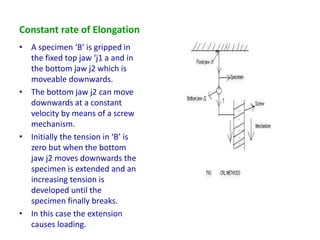
• A specimen ‘B’ is gripped in
the fixed top jaw ‘j1 a and in
the bottom jaw j2 which is
moveable downwards.
• The bottom jaw j2 can move
downwards at a constant
velocity by means of a screw
mechanism.
• Initially the tension in ‘B’ is
zero but when the bottom
jaw j2 moves downwards the
specimen is extended and an
increasing tension is
developed until the
specimen finally breaks.
• In this case the extension
causes loading.
Crl & cre method 151014002

Crl & cre method 151014002

  • 2.
    Subrata Kumar Sarker ID:151014002 Department of Textile Engineering
  • 3.
    Name of MyPresentation CRL & CRE METHOD
  • 4.
    LOAD: The applicationof a load to a specimen in its axil direction causes a tension to be developed in the specimen. The load is usually expressed in gm wt or pounds wt.
  • 5.
    Breaking load: Theload at which material breaks is called breaking load. It is usually expressed in gm-wt.
  • 6.
    Breaking length: thebreaking length is length of the specimen which will just break under weight when hang vertically. Units of braking length is kilogram.
  • 7.
    Constant Rate ofloading:  A specimen ‘A’ is gripped in a fixed top jaw j1 and in a bottom jaw j2 which is moveable.  A force F is initially zero but increasing at constant from zero, is applied to the specimen along the directions shown in figure.  Due to applied force, the specimen will be extended until it eventually breaks.  The loading has thus caused the elongation.
  • 8.
    Constant rate ofElongation • A specimen ‘B’ is gripped in the fixed top jaw ‘j1 a and in the bottom jaw j2 which is moveable downwards. • The bottom jaw j2 can move downwards at a constant velocity by means of a screw mechanism. • Initially the tension in ‘B’ is zero but when the bottom jaw j2 moves downwards the specimen is extended and an increasing tension is developed until the specimen finally breaks. • In this case the extension causes loading.