Chapter 2 
Identifying Premises and 
Conclusions 
This tutorial will give you practice in 
distinguishing premises from 
conclusions.
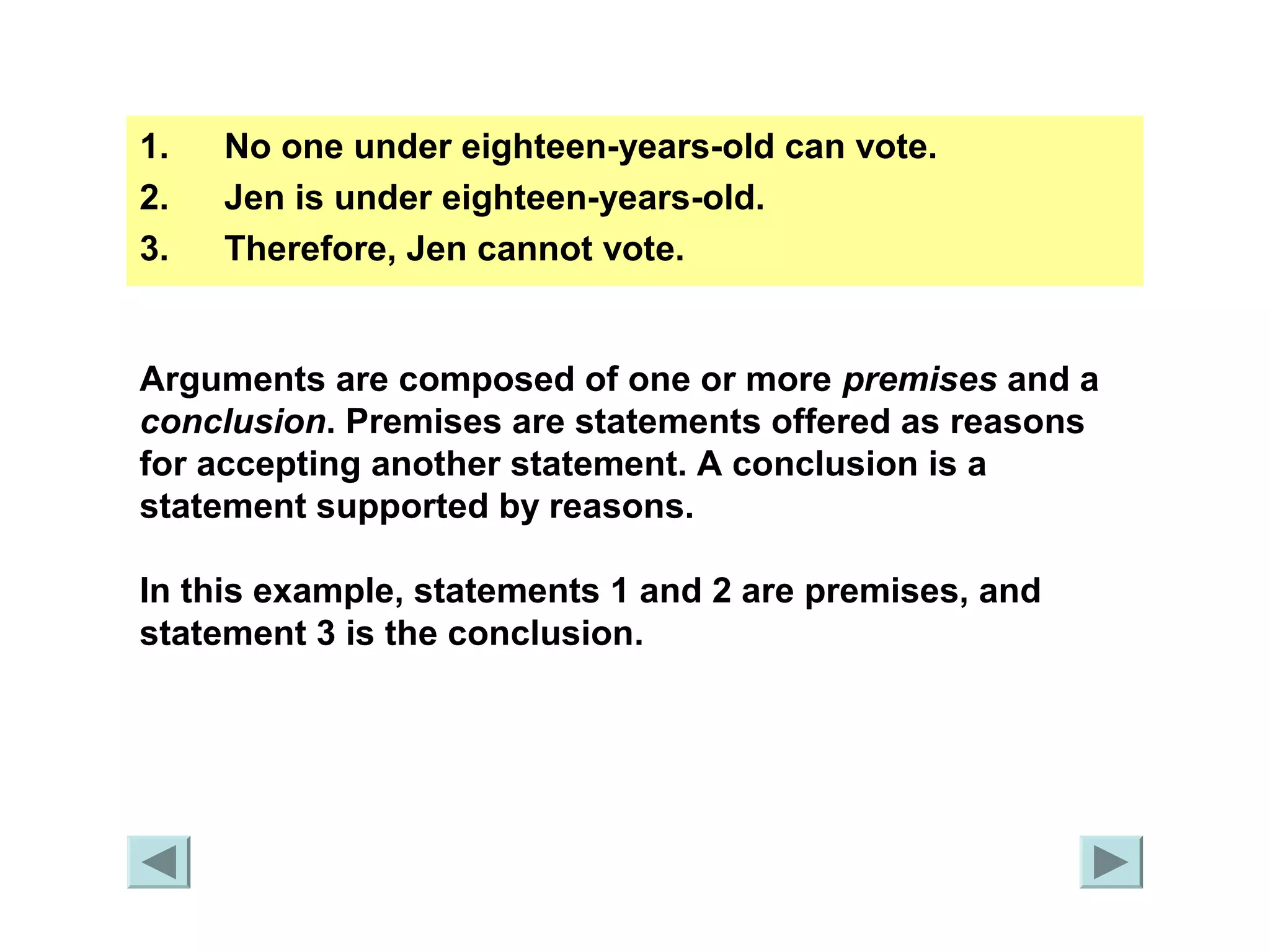
1. No one under eighteen-years-old can vote. 
2. Jen is under eighteen-years-old. 
3. Therefore, Jen cannot vote. 
Arguments are composed of one or more premises and a 
conclusion. Premises are statements offered as reasons 
for accepting another statement. A conclusion is a 
statement supported by reasons. 
In this example, statements 1 and 2 are premises, and 
statement 3 is the conclusion.
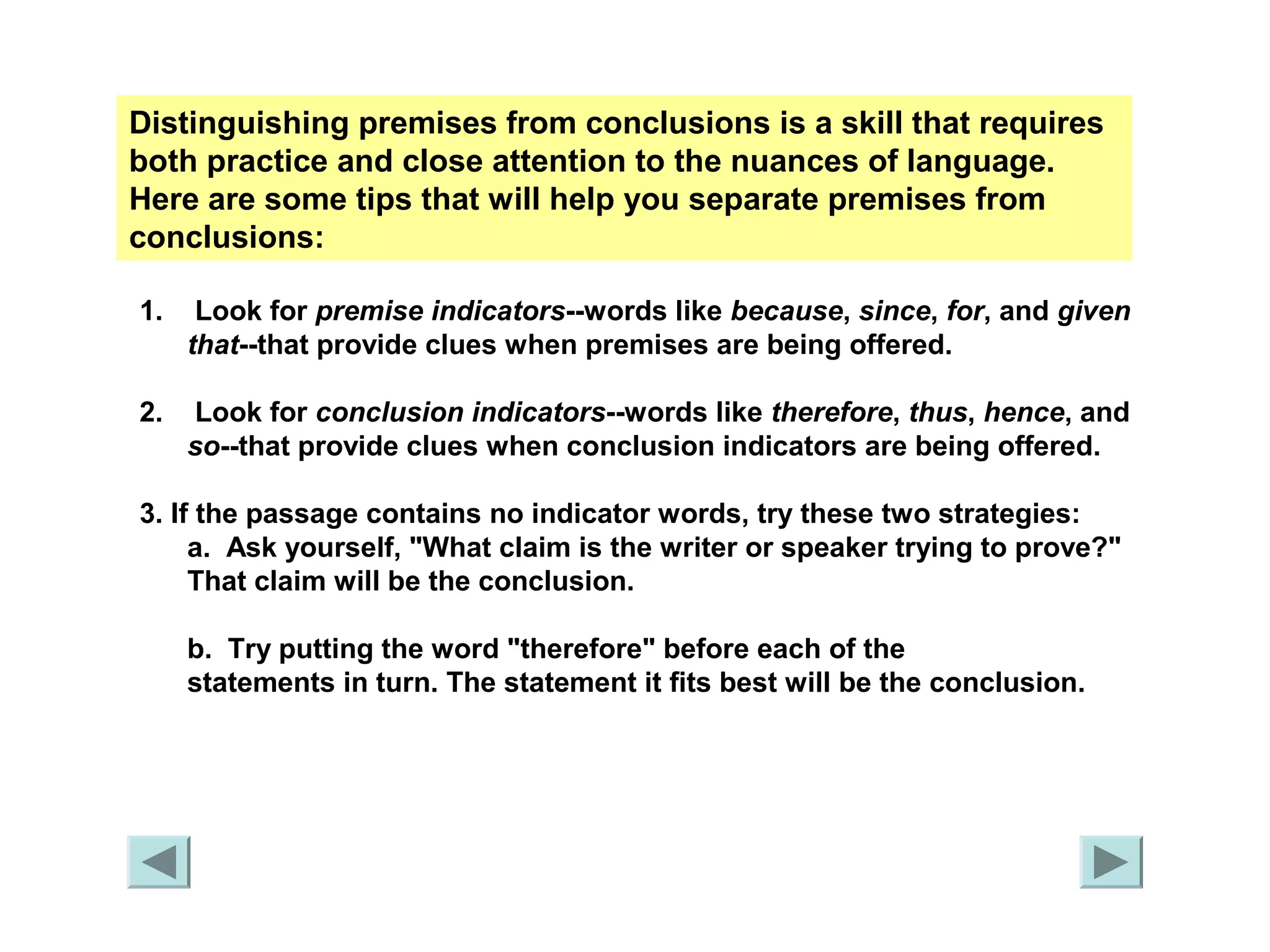
Distinguishing premises from conclusions is a skill that requires 
both practice and close attention to the nuances of language. 
Here are some tips that will help you separate premises from 
conclusions: 
1. Look for premise indicators--words like because, since, for, and given 
that--that provide clues when premises are being offered. 
2. Look for conclusion indicators--words like therefore, thus, hence, and 
so--that provide clues when conclusion indicators are being offered. 
3. If the passage contains no indicator words, try these two strategies: 
a. Ask yourself, "What claim is the writer or speaker trying to prove?" 
That claim will be the conclusion. 
b. Try putting the word "therefore" before each of the 
statements in turn. The statement it fits best will be the conclusion.
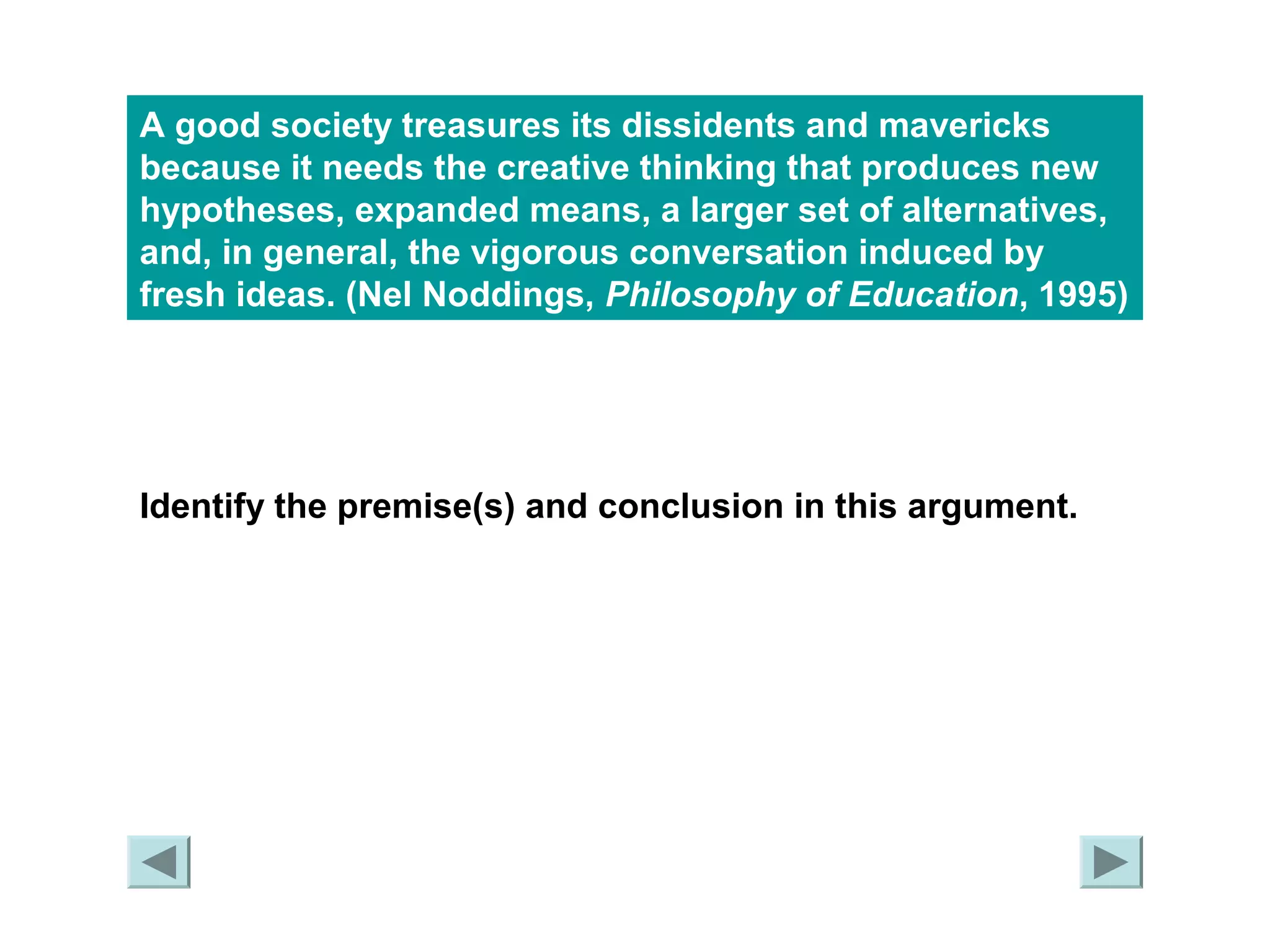
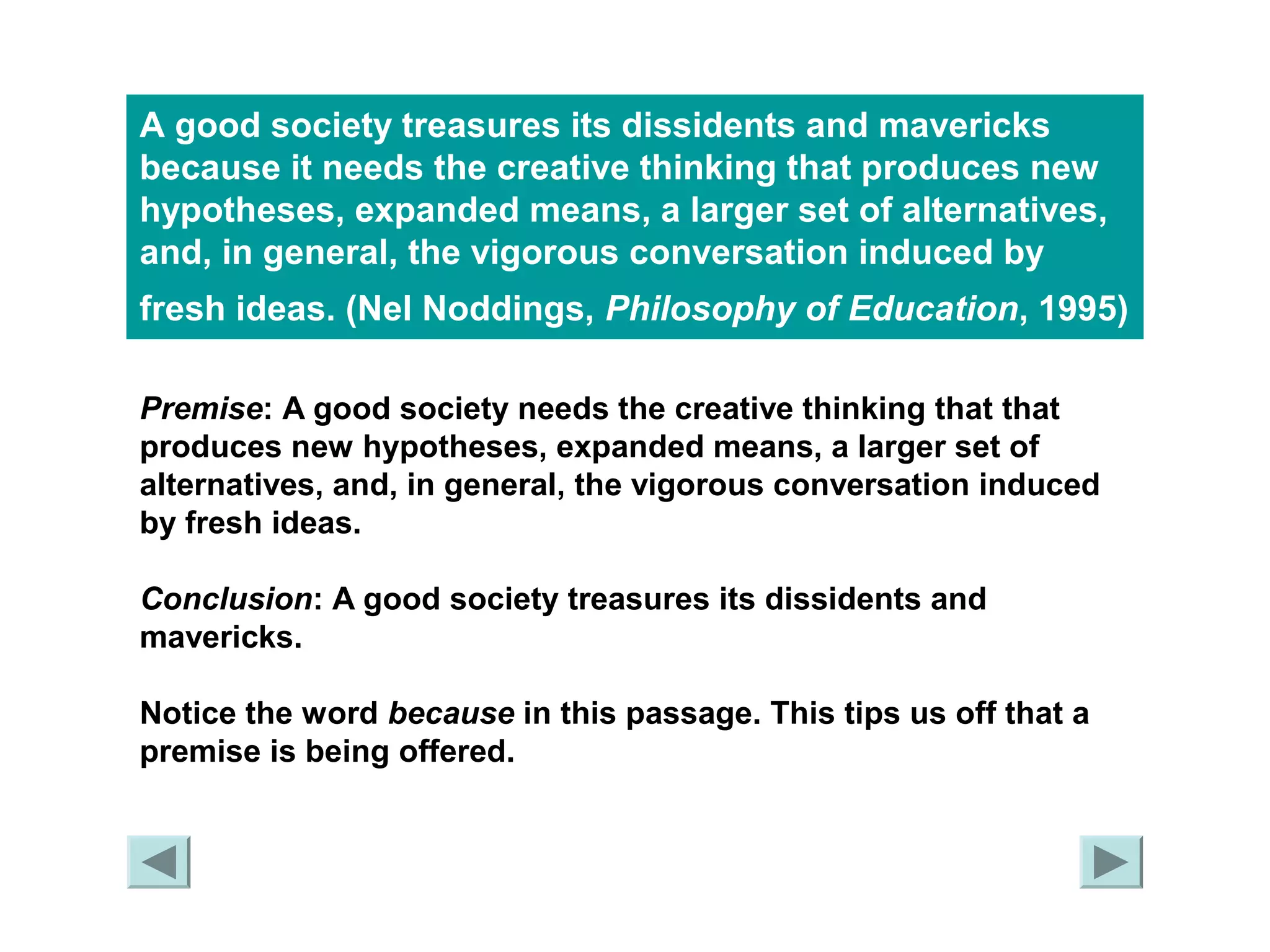
A good society treasures its dissidents and mavericks 
because it needs the creative thinking that produces new 
hypotheses, expanded means, a larger set of alternatives, 
and, in general, the vigorous conversation induced by 
fresh ideas. (Nel Noddings, Philosophy of Education, 1995) 
Identify the premise(s) and conclusion in this argument.
A good society treasures its dissidents and mavericks 
because it needs the creative thinking that produces new 
hypotheses, expanded means, a larger set of alternatives, 
and, in general, the vigorous conversation induced by 
fresh ideas. (Nel Noddings, Philosophy of Education, 1995) 
Premise: A good society needs the creative thinking that that 
produces new hypotheses, expanded means, a larger set of 
alternatives, and, in general, the vigorous conversation induced 
by fresh ideas. 
Conclusion: A good society treasures its dissidents and 
mavericks. 
Notice the word because in this passage. This tips us off that a 
premise is being offered.
Since in American schools every child is unique and of 
equal worth with every other child, academic competition, 
which subverts this egalitarian and individualist creed, 
must be discouraged. (Stated but not endorsed in E.D. 
Hirsch, Jr., The Schools We Need and Why We Don’t Have 
Them, 1996) 
Identify the premise(s) and conclusion in this argument.
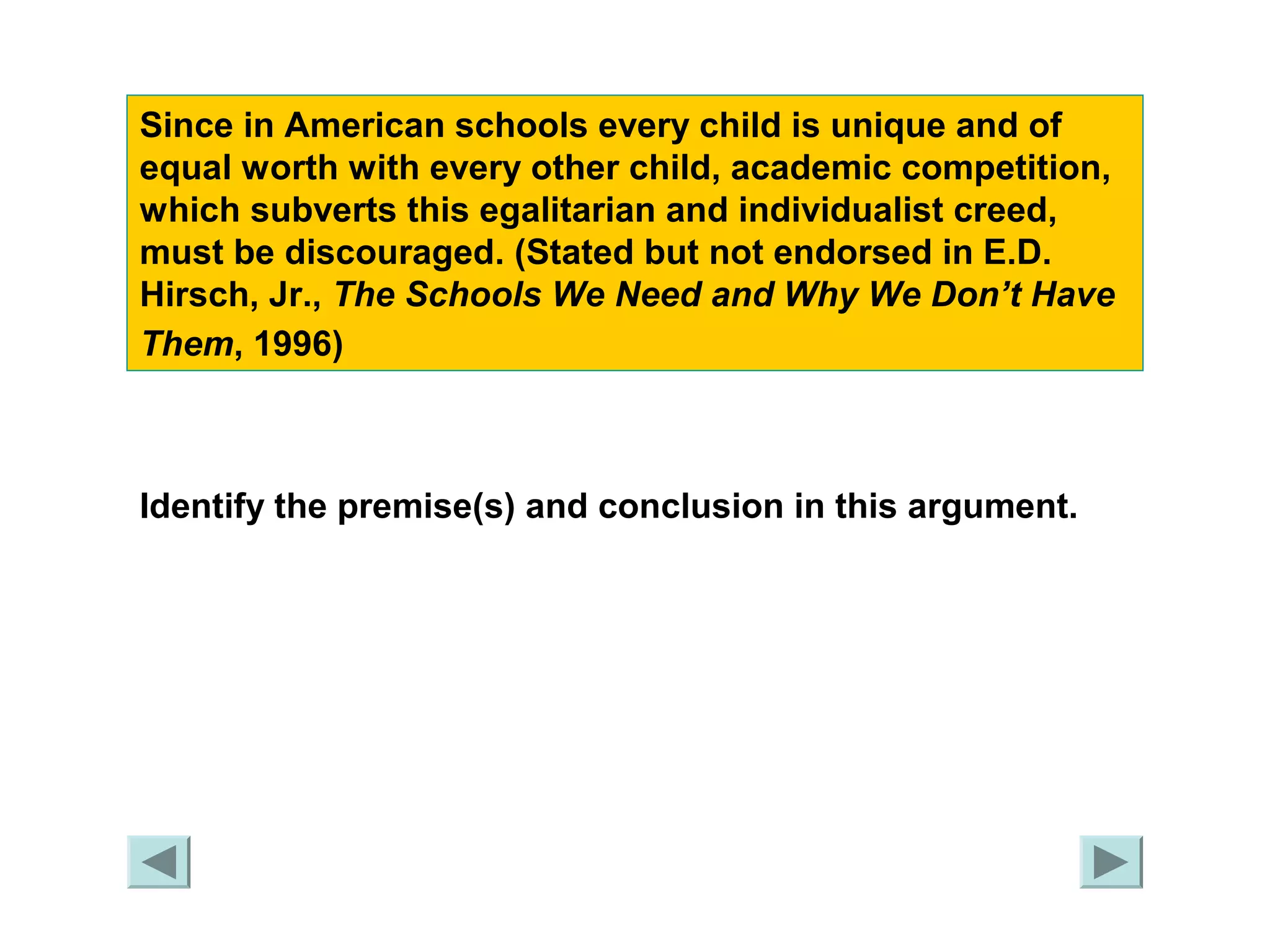
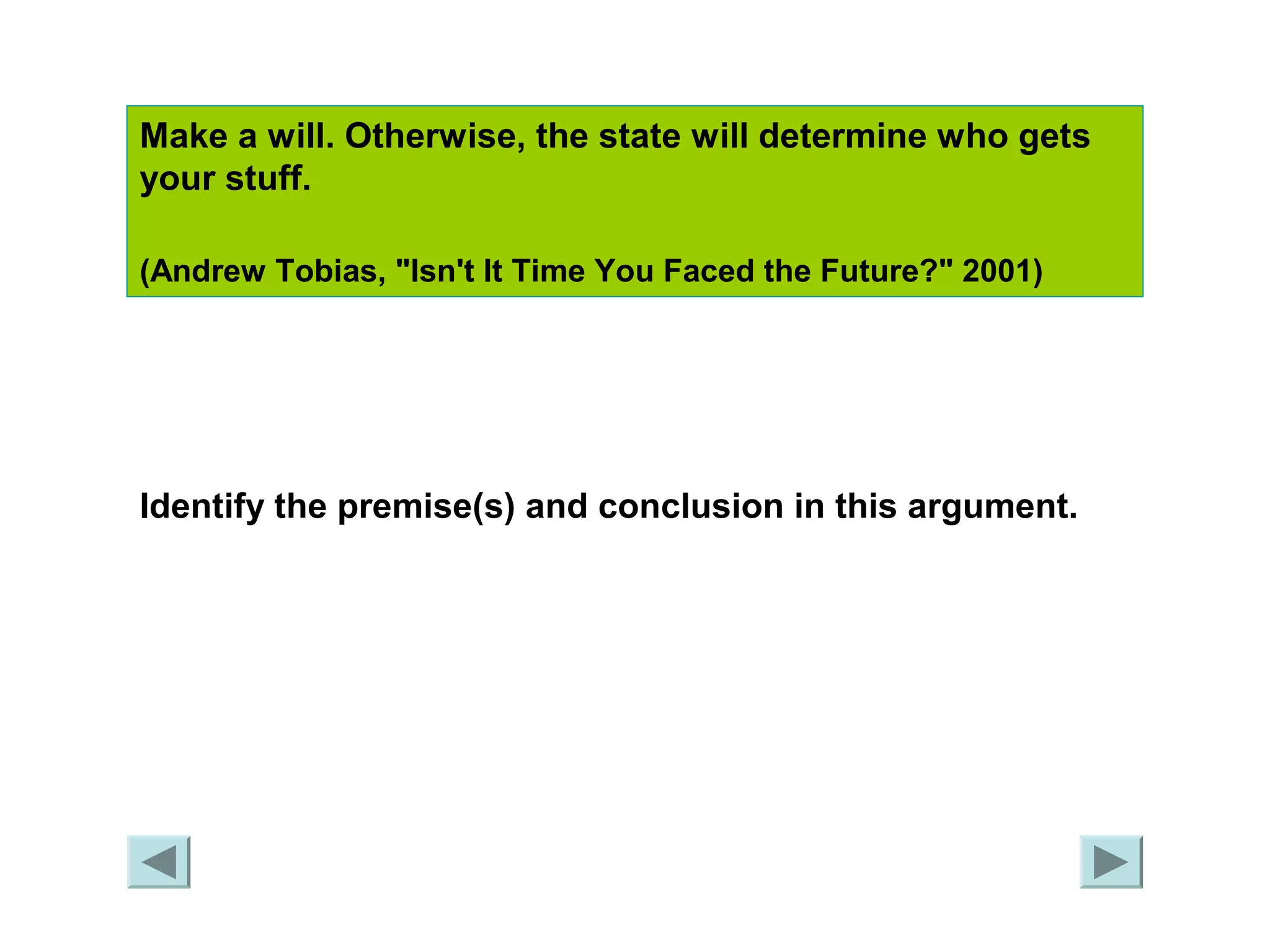
Since in American schools every child is unique and of 
equal worth with every other child, academic competition, 
which subverts this egalitarian and individualist creed, 
must be discouraged. (Stated but not endorsed in E.D. 
Hirsch, Jr., The Schools We Need and Why We Don’t Have 
Them, 1996) 
Premise 1: In American schools every child is unique and of 
equal worth with every other child. 
Premise 2: Academic competition subverts this egalitarian and 
individualist creed. 
Conclusion: Academic competition must be discouraged. 
Here the premise indicator since helps us to identify the first 
premise.
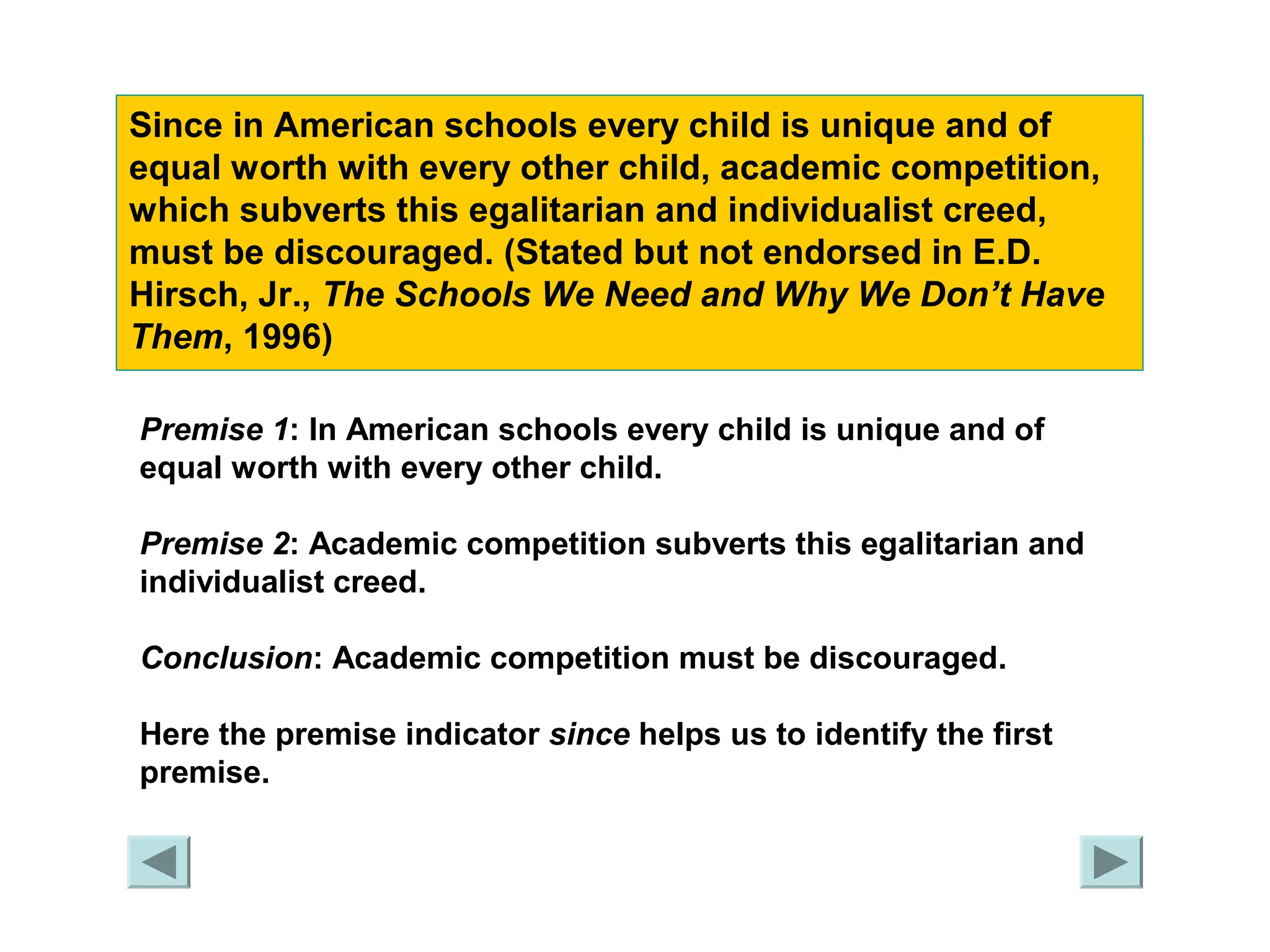
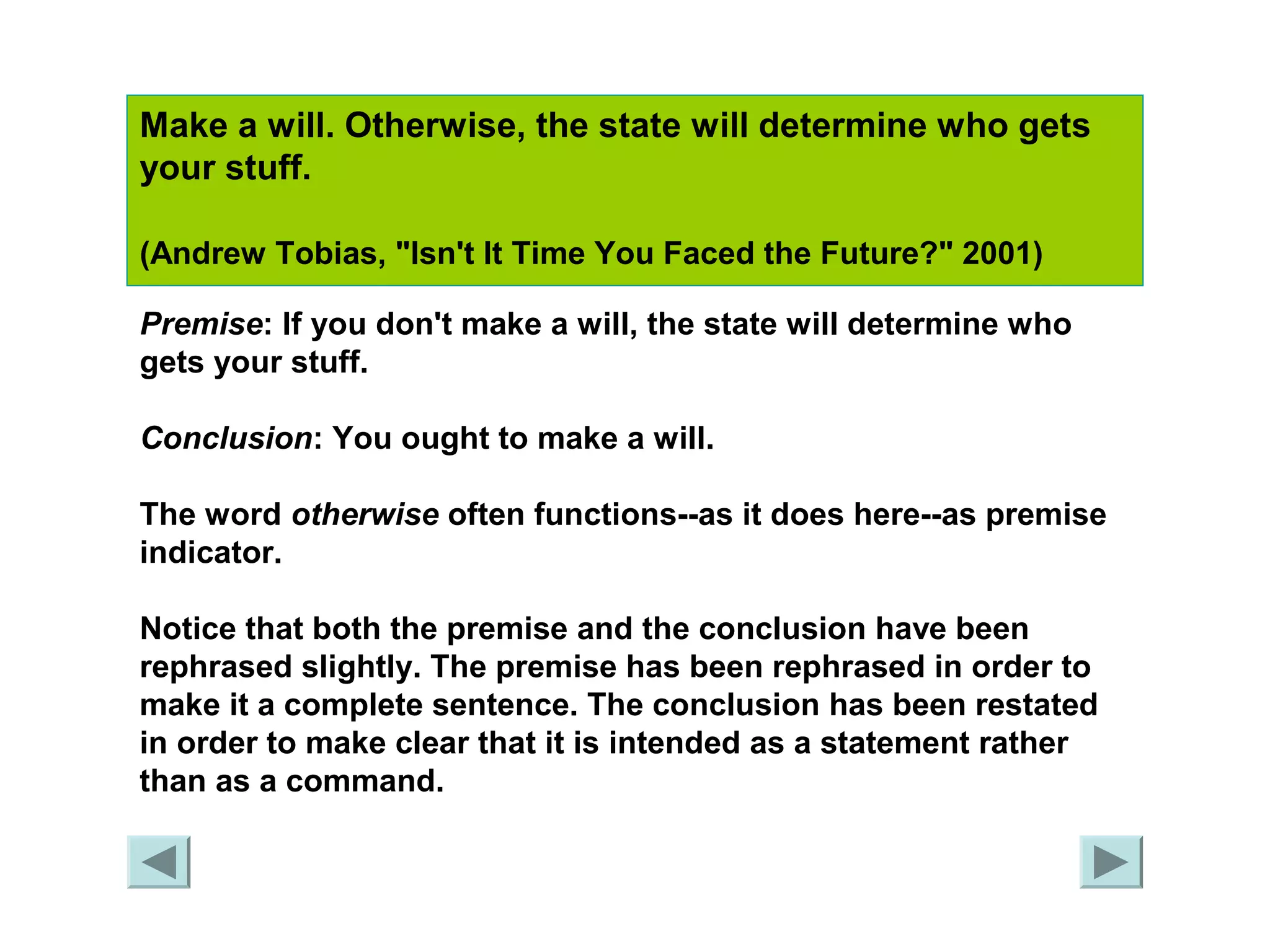
Make a will. Otherwise, the state will determine who gets 
your stuff. 
(Andrew Tobias, "Isn't It Time You Faced the Future?" 2001) 
Identify the premise(s) and conclusion in this argument.
Make a will. Otherwise, the state will determine who gets 
your stuff. 
(Andrew Tobias, "Isn't It Time You Faced the Future?" 2001) 
Premise: If you don't make a will, the state will determine who 
gets your stuff. 
Conclusion: You ought to make a will. 
The word otherwise often functions--as it does here--as premise 
indicator. 
Notice that both the premise and the conclusion have been 
rephrased slightly. The premise has been rephrased in order to 
make it a complete sentence. The conclusion has been restated 
in order to make clear that it is intended as a statement rather 
than as a command.
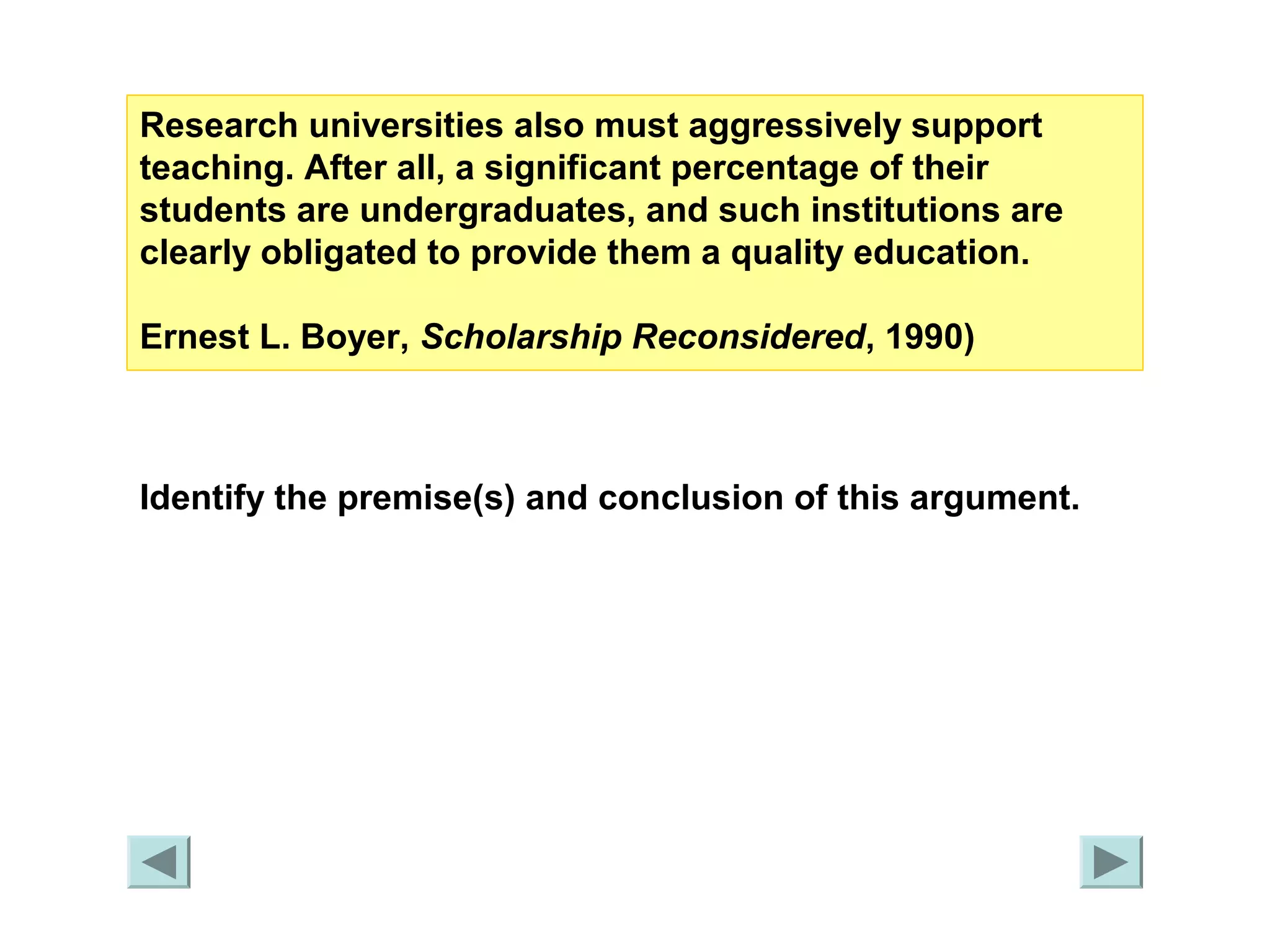
Research universities also must aggressively support 
teaching. After all, a significant percentage of their 
students are undergraduates, and such institutions are 
clearly obligated to provide them a quality education. 
Ernest L. Boyer, Scholarship Reconsidered, 1990) 
Identify the premise(s) and conclusion of this argument.
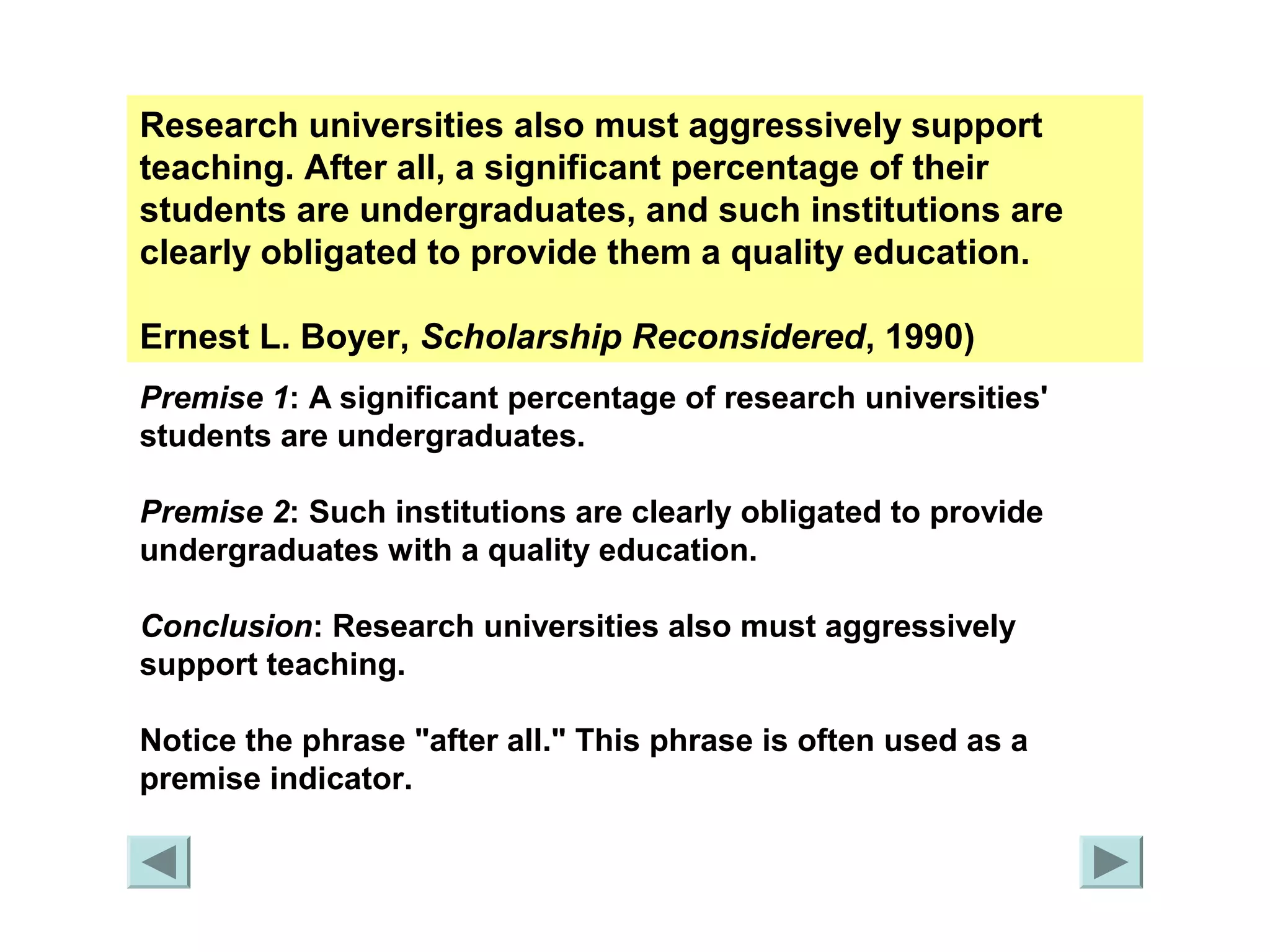
Research universities also must aggressively support 
teaching. After all, a significant percentage of their 
students are undergraduates, and such institutions are 
clearly obligated to provide them a quality education. 
Ernest L. Boyer, Scholarship Reconsidered, 1990) 
Premise 1: A significant percentage of research universities' 
students are undergraduates. 
Premise 2: Such institutions are clearly obligated to provide 
undergraduates with a quality education. 
Conclusion: Research universities also must aggressively 
support teaching. 
Notice the phrase "after all." This phrase is often used as a 
premise indicator.
The Jews and Arabs have been fighting for centuries and I 
seriously doubt this will ever be resolved. The United 
States should get out of this never-ending fight, or the 
next terrorist bomb might be in Washington--and it just 
might be nuclear. 
(John G. Ferguson III, Letter to the Editor, USA Today, February 12, 2001) 
Identify the premise(s) and conclusion in this argument.
The Jews and Arabs have been fighting for centuries and I 
seriously doubt this will ever be resolved. The United States 
should get out of this never-ending fight, or the next terrorist 
bomb might be in Washington--and it just might be nuclear. 
(John G. Ferguson III, Letter to the Editor, USA Today, February 12, 2001) 
• Premise 1: The Jews and Arabs have been fighting for centuries. 
• Premise 2: There is serious doubt this will ever be resolved. 
• Premise 3: If the United States does not get out of this never-ending 
fight, the next terrorist bomb might be in Washington--and it might be 
nuclear. 
• Conclusion: The United States should get out of the never-ending 
fight between the Jews and the Arabs. 
• In this passage, there are no indicator words to assist us, however the 
form of the last sentence ("X should do Y, or else Z will happen") is a 
common conclusion-premise pattern.
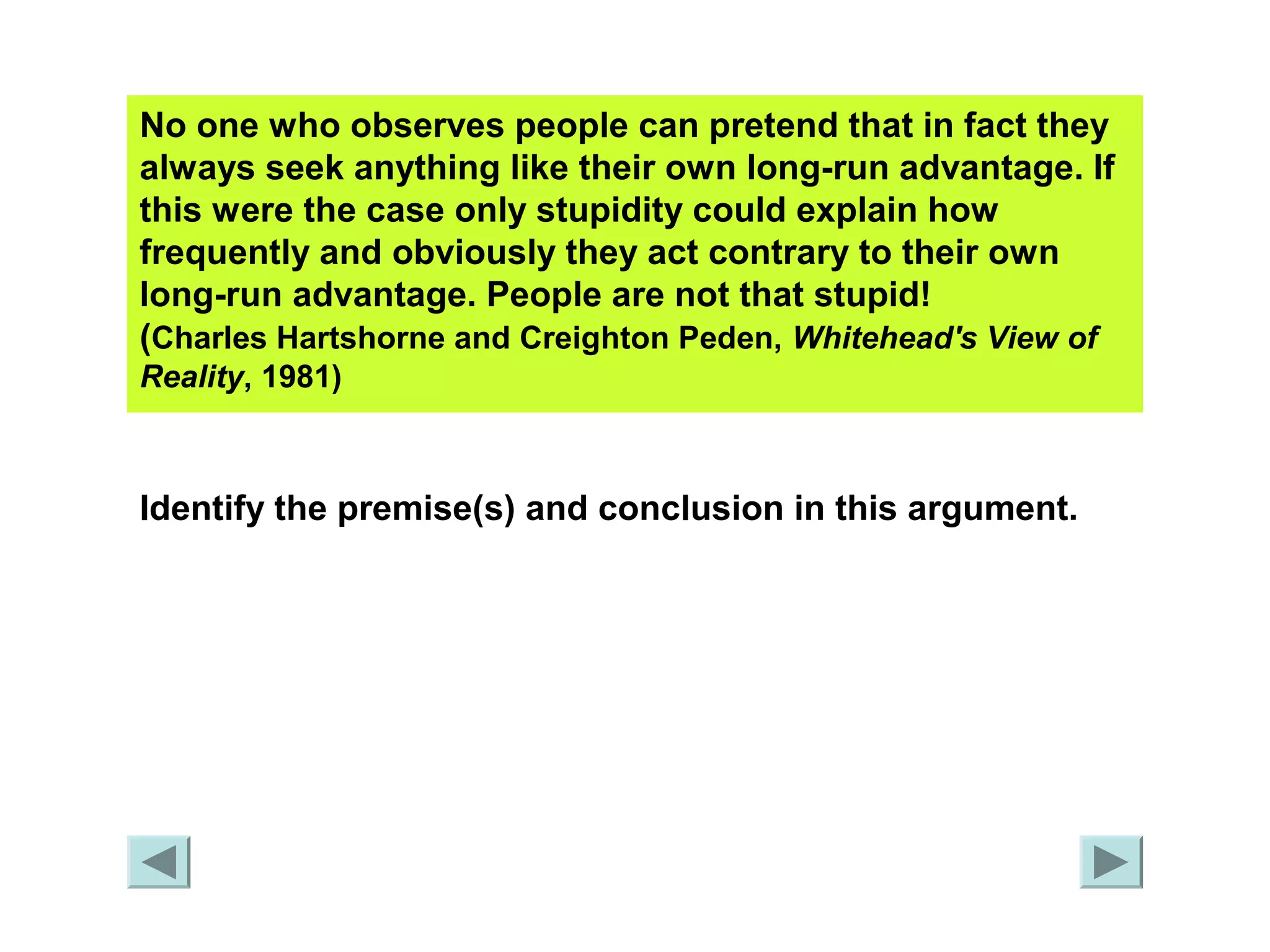
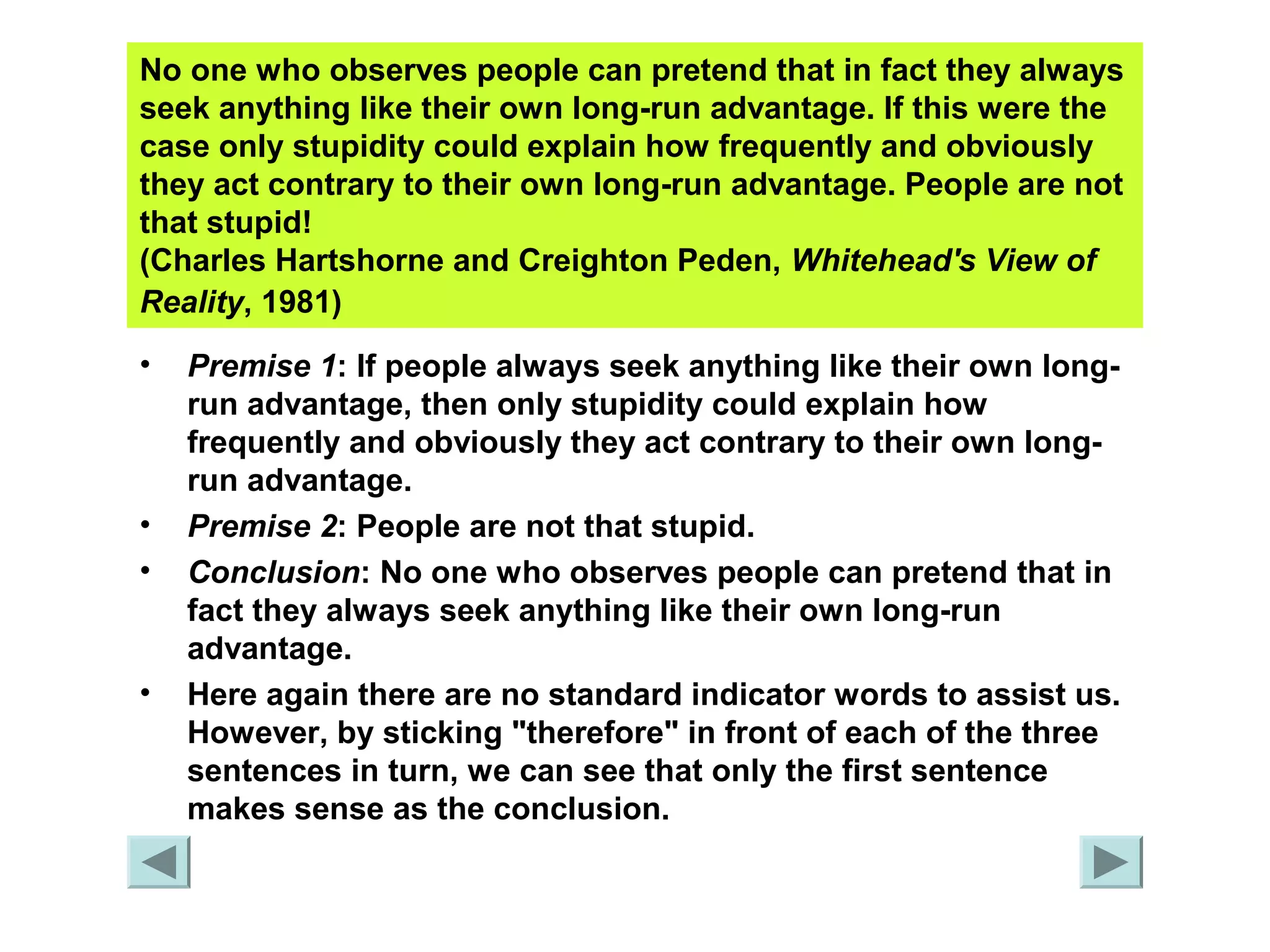
No one who observes people can pretend that in fact they 
always seek anything like their own long-run advantage. If 
this were the case only stupidity could explain how 
frequently and obviously they act contrary to their own 
long-run advantage. People are not that stupid! 
(Charles Hartshorne and Creighton Peden, Whitehead's View of 
Reality, 1981) 
Identify the premise(s) and conclusion in this argument.
No one who observes people can pretend that in fact they always 
seek anything like their own long-run advantage. If this were the 
case only stupidity could explain how frequently and obviously 
they act contrary to their own long-run advantage. People are not 
that stupid! 
(Charles Hartshorne and Creighton Peden, Whitehead's View of 
Reality, 1981) 
• Premise 1: If people always seek anything like their own long-run 
advantage, then only stupidity could explain how 
frequently and obviously they act contrary to their own long-run 
advantage. 
• Premise 2: People are not that stupid. 
• Conclusion: No one who observes people can pretend that in 
fact they always seek anything like their own long-run 
advantage. 
• Here again there are no standard indicator words to assist us. 
However, by sticking "therefore" in front of each of the three 
sentences in turn, we can see that only the first sentence 
makes sense as the conclusion.
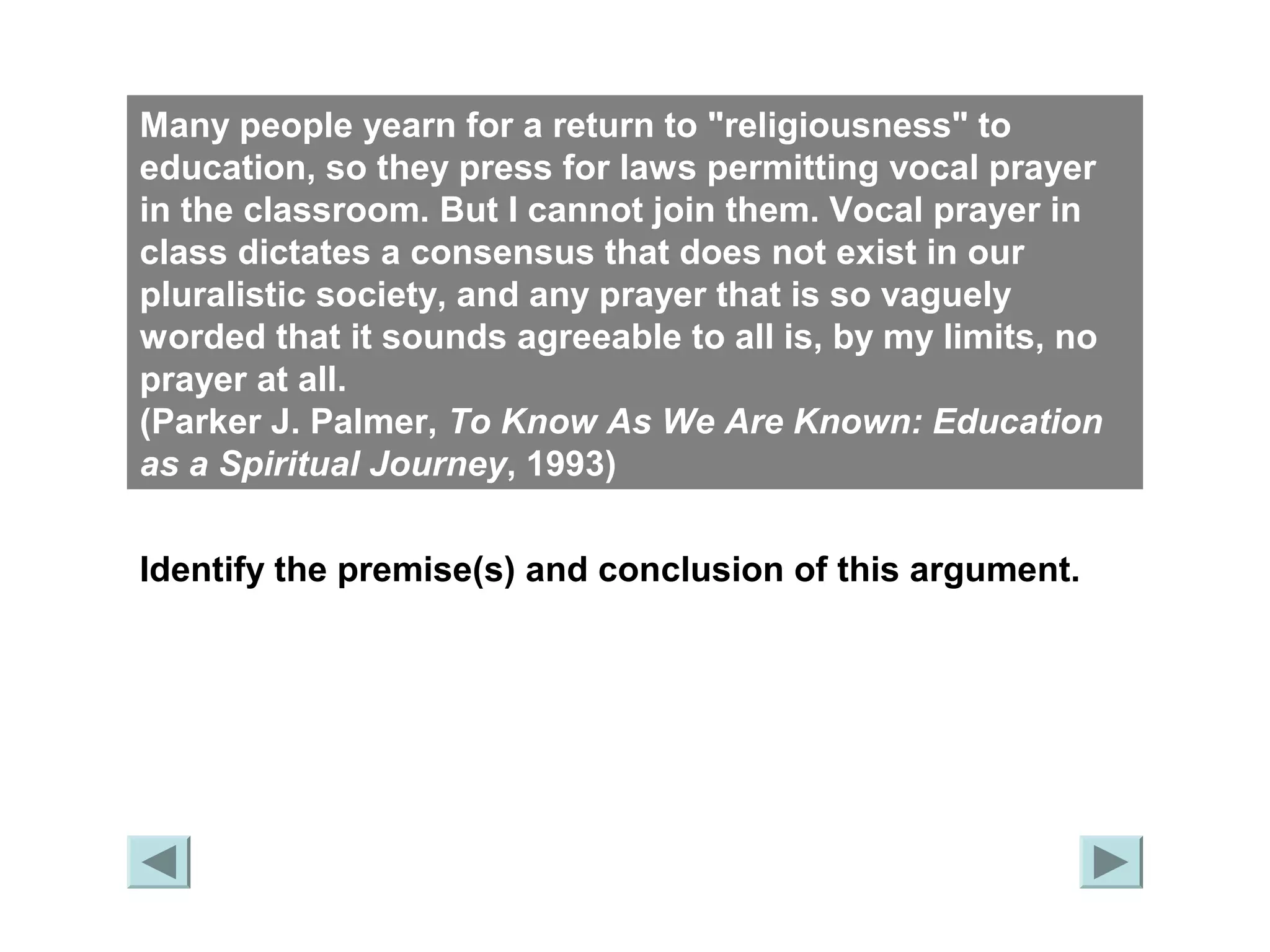
Many people yearn for a return to "religiousness" to 
education, so they press for laws permitting vocal prayer 
in the classroom. But I cannot join them. Vocal prayer in 
class dictates a consensus that does not exist in our 
pluralistic society, and any prayer that is so vaguely 
worded that it sounds agreeable to all is, by my limits, no 
prayer at all. 
(Parker J. Palmer, To Know As We Are Known: Education 
as a Spiritual Journey, 1993) 
Identify the premise(s) and conclusion of this argument.
Many people yearn for a return to "religiousness" to education, 
so they press for laws permitting vocal prayer in the classroom. 
But I cannot join them. Vocal prayer in class dictates a 
consensus that does not exist in our pluralistic society, and any 
prayer that is so vaguely worded that it sounds agreeable to all 
is, by my limits, no prayer at all. 
(Parker J. Palmer, To Know As We Are Known: Education as a 
Spiritual Journey, 1993) 
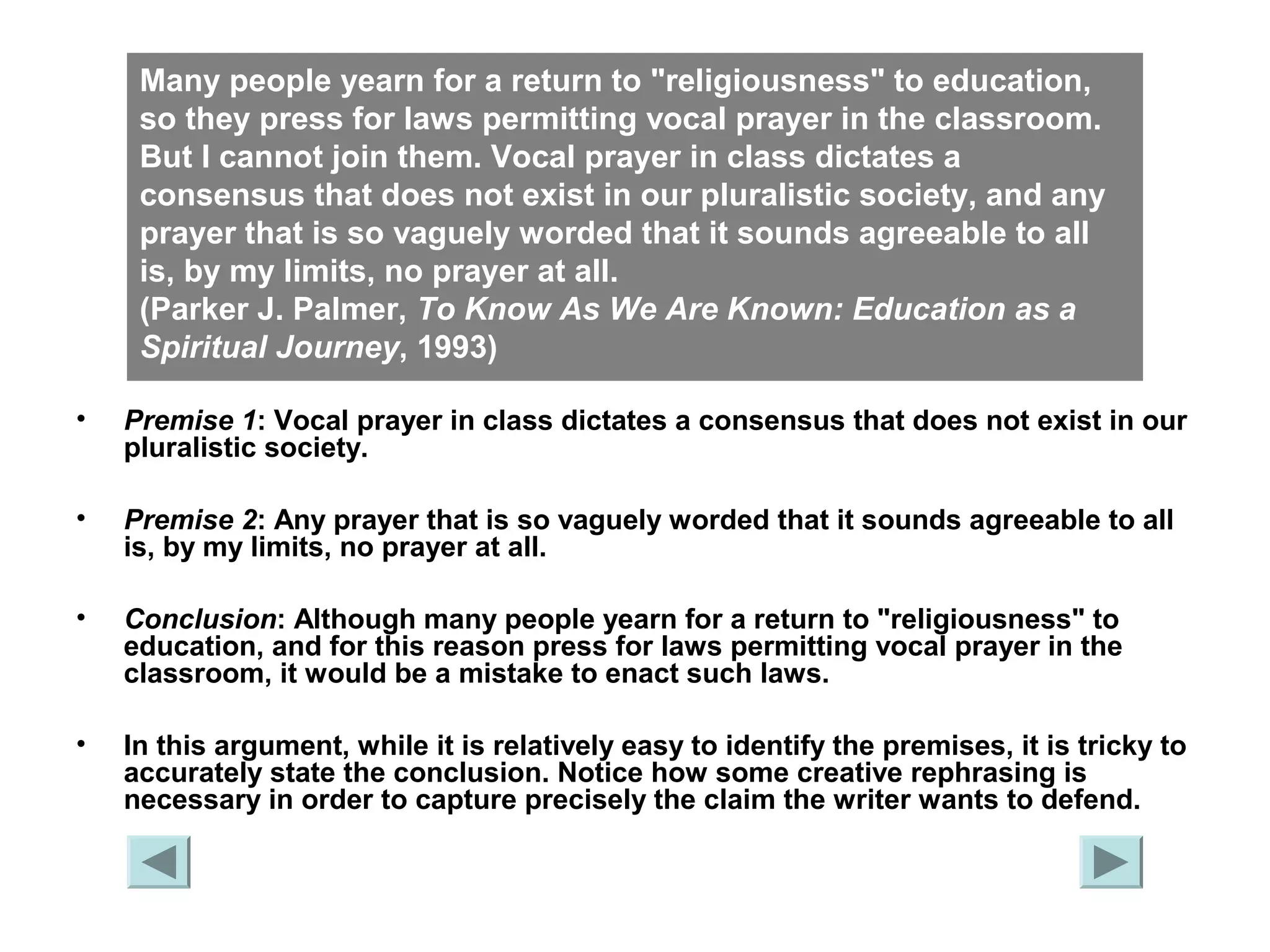
• Premise 1: Vocal prayer in class dictates a consensus that does not exist in our 
pluralistic society. 
• Premise 2: Any prayer that is so vaguely worded that it sounds agreeable to all 
is, by my limits, no prayer at all. 
• Conclusion: Although many people yearn for a return to "religiousness" to 
education, and for this reason press for laws permitting vocal prayer in the 
classroom, it would be a mistake to enact such laws. 
• In this argument, while it is relatively easy to identify the premises, it is tricky to 
accurately state the conclusion. Notice how some creative rephrasing is 
necessary in order to capture precisely the claim the writer wants to defend.
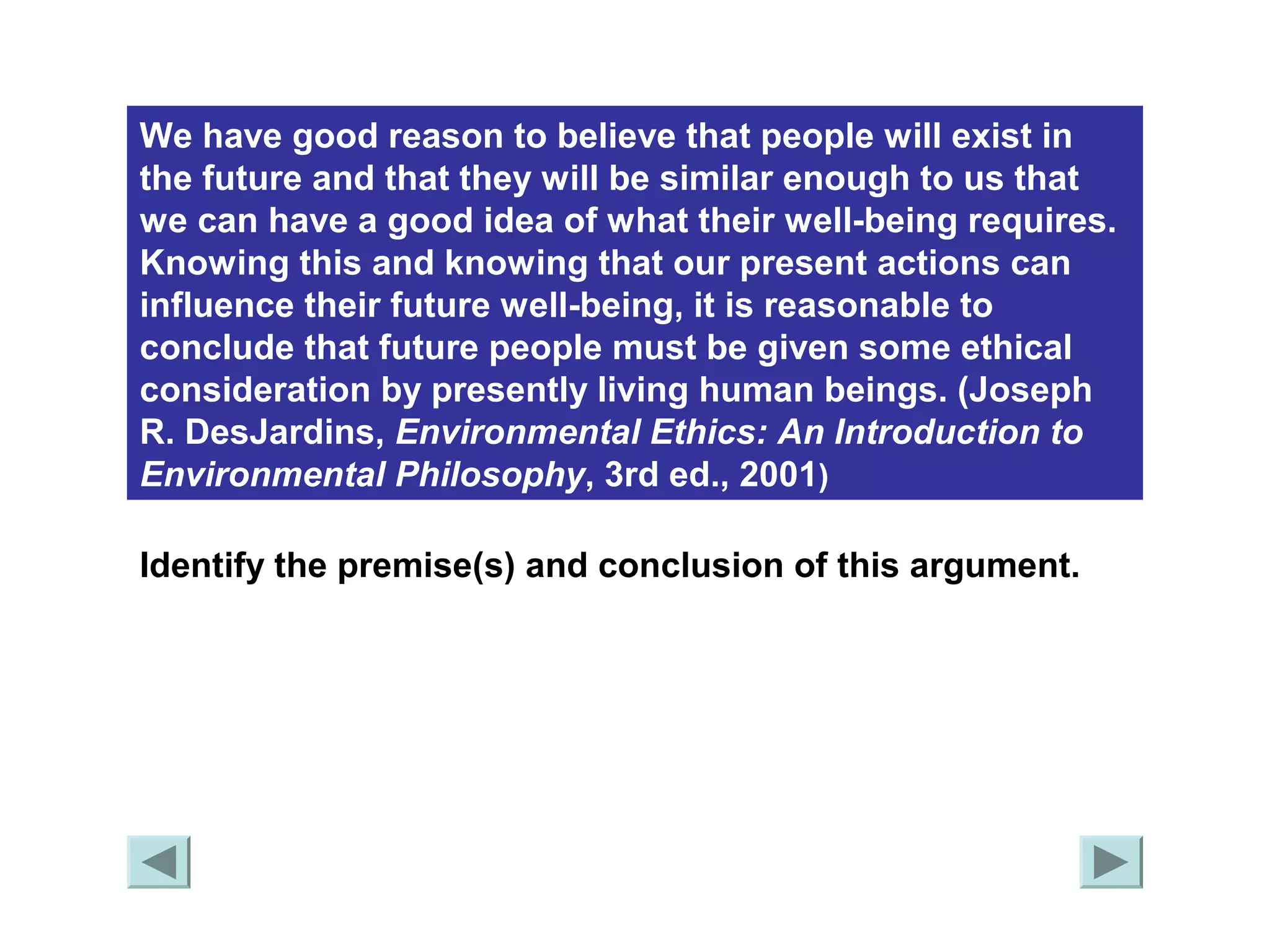
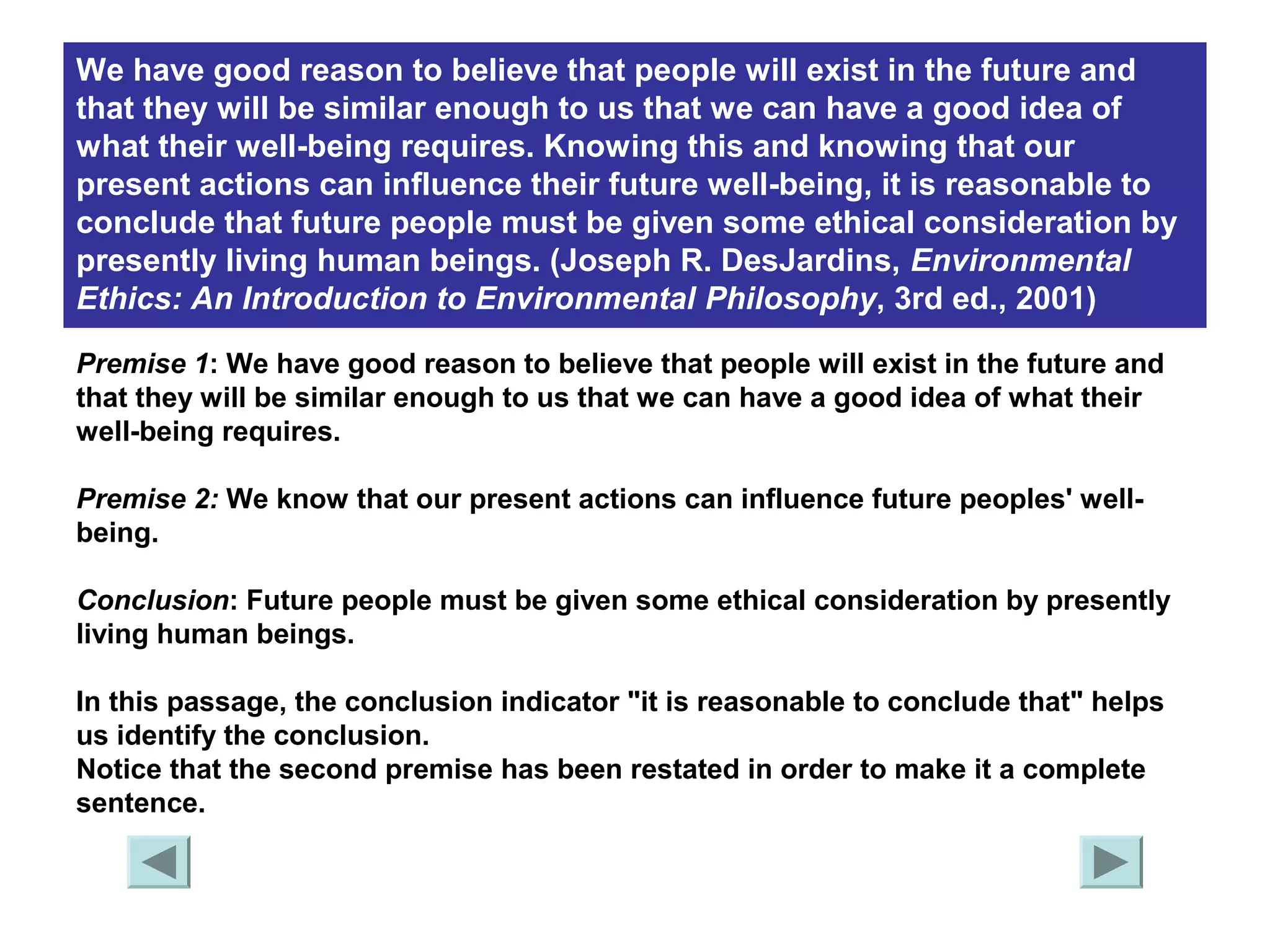
We have good reason to believe that people will exist in 
the future and that they will be similar enough to us that 
we can have a good idea of what their well-being requires. 
Knowing this and knowing that our present actions can 
influence their future well-being, it is reasonable to 
conclude that future people must be given some ethical 
consideration by presently living human beings. (Joseph 
R. DesJardins, Environmental Ethics: An Introduction to 
Environmental Philosophy, 3rd ed., 2001) 
Identify the premise(s) and conclusion of this argument.
We have good reason to believe that people will exist in the future and 
that they will be similar enough to us that we can have a good idea of 
what their well-being requires. Knowing this and knowing that our 
present actions can influence their future well-being, it is reasonable to 
conclude that future people must be given some ethical consideration by 
presently living human beings. (Joseph R. DesJardins, Environmental 
Ethics: An Introduction to Environmental Philosophy, 3rd ed., 2001) 
Premise 1: We have good reason to believe that people will exist in the future and 
that they will be similar enough to us that we can have a good idea of what their 
well-being requires. 
Premise 2: We know that our present actions can influence future peoples' well-being. 
Conclusion: Future people must be given some ethical consideration by presently 
living human beings. 
In this passage, the conclusion indicator "it is reasonable to conclude that" helps 
us identify the conclusion. 
Notice that the second premise has been restated in order to make it a complete 
sentence.
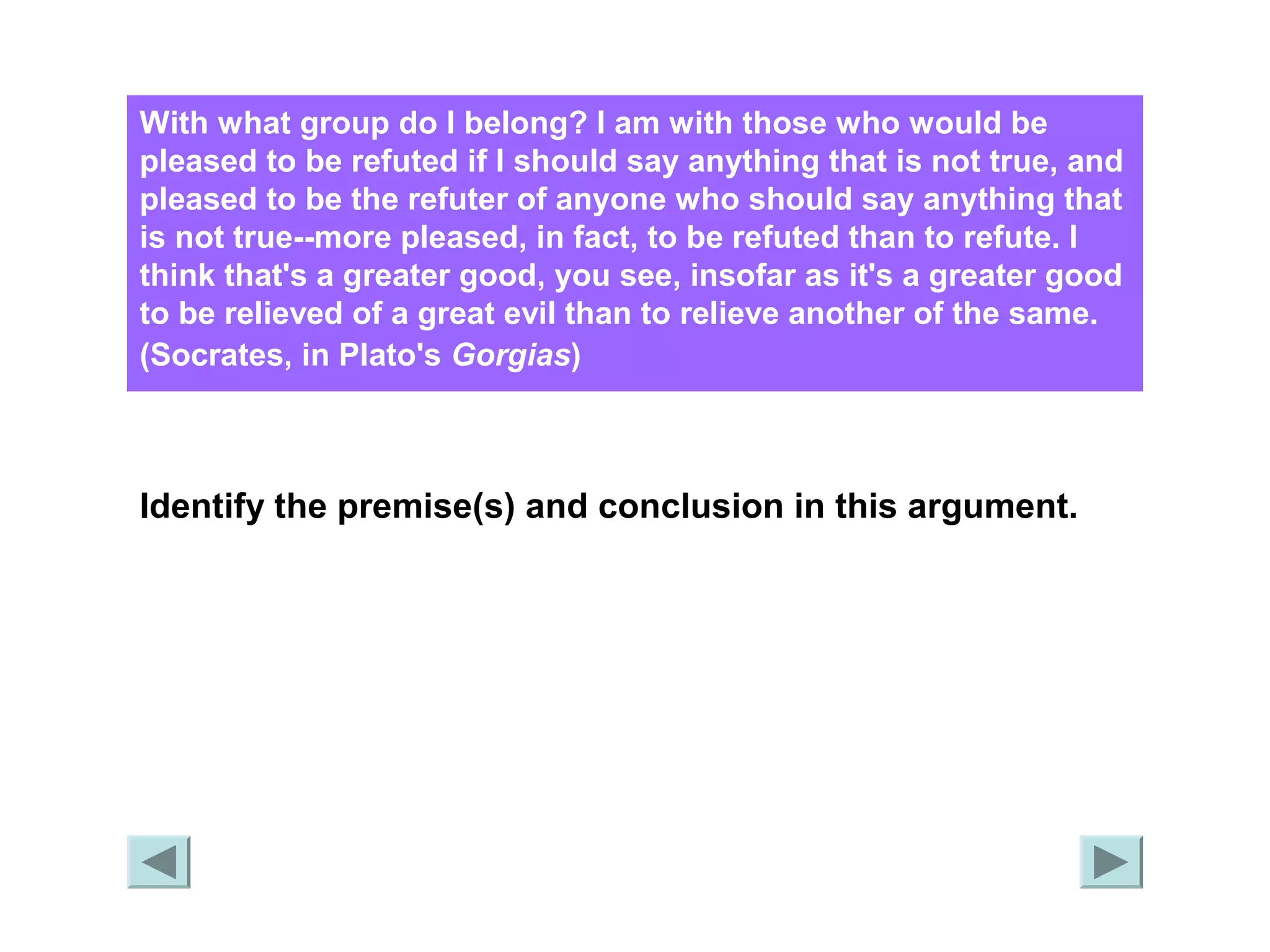
With what group do I belong? I am with those who would be 
pleased to be refuted if I should say anything that is not true, and 
pleased to be the refuter of anyone who should say anything that 
is not true--more pleased, in fact, to be refuted than to refute. I 
think that's a greater good, you see, insofar as it's a greater good 
to be relieved of a great evil than to relieve another of the same. 
(Socrates, in Plato's Gorgias) 
Identify the premise(s) and conclusion in this argument.
With what group do I belong? I am with those who would be 
pleased to be refuted if I should say anything that is not true, and 
pleased to be the refuter of anyone who should say anything that 
is not true--more pleased, in fact, to be refuted than to refute. I 
think that's a greater good, you see, insofar as it's a greater good 
to be relieved of a great evil than to relieve another of the same. 
(Socrates, in Plato's Gorgias) 
Premise: It is a greater good to be relieved of a great evil than to 
relieve another of the same. 
Conclusion: It is a greater good to be refuted than to refute. 
In this passage, the premise indicator "insofar as" helps us to 
identify the premise. 
Notice that the first two sentences aren't strictly part of the 
argument. Their function, instead, is to provide background or 
contextual information necessary to understand the argument. 
[This is the end of the tutorial] X

Premises and Conclusions

  • 1.
    Chapter 2 IdentifyingPremises and Conclusions This tutorial will give you practice in distinguishing premises from conclusions.
  • 2.
    1. No oneunder eighteen-years-old can vote. 2. Jen is under eighteen-years-old. 3. Therefore, Jen cannot vote. Arguments are composed of one or more premises and a conclusion. Premises are statements offered as reasons for accepting another statement. A conclusion is a statement supported by reasons. In this example, statements 1 and 2 are premises, and statement 3 is the conclusion.
  • 3.
    Distinguishing premises fromconclusions is a skill that requires both practice and close attention to the nuances of language. Here are some tips that will help you separate premises from conclusions: 1. Look for premise indicators--words like because, since, for, and given that--that provide clues when premises are being offered. 2. Look for conclusion indicators--words like therefore, thus, hence, and so--that provide clues when conclusion indicators are being offered. 3. If the passage contains no indicator words, try these two strategies: a. Ask yourself, "What claim is the writer or speaker trying to prove?" That claim will be the conclusion. b. Try putting the word "therefore" before each of the statements in turn. The statement it fits best will be the conclusion.
  • 4.
    A good societytreasures its dissidents and mavericks because it needs the creative thinking that produces new hypotheses, expanded means, a larger set of alternatives, and, in general, the vigorous conversation induced by fresh ideas. (Nel Noddings, Philosophy of Education, 1995) Identify the premise(s) and conclusion in this argument.
  • 5.
    A good societytreasures its dissidents and mavericks because it needs the creative thinking that produces new hypotheses, expanded means, a larger set of alternatives, and, in general, the vigorous conversation induced by fresh ideas. (Nel Noddings, Philosophy of Education, 1995) Premise: A good society needs the creative thinking that that produces new hypotheses, expanded means, a larger set of alternatives, and, in general, the vigorous conversation induced by fresh ideas. Conclusion: A good society treasures its dissidents and mavericks. Notice the word because in this passage. This tips us off that a premise is being offered.
  • 6.
    Since in Americanschools every child is unique and of equal worth with every other child, academic competition, which subverts this egalitarian and individualist creed, must be discouraged. (Stated but not endorsed in E.D. Hirsch, Jr., The Schools We Need and Why We Don’t Have Them, 1996) Identify the premise(s) and conclusion in this argument.
  • 7.
    Since in Americanschools every child is unique and of equal worth with every other child, academic competition, which subverts this egalitarian and individualist creed, must be discouraged. (Stated but not endorsed in E.D. Hirsch, Jr., The Schools We Need and Why We Don’t Have Them, 1996) Premise 1: In American schools every child is unique and of equal worth with every other child. Premise 2: Academic competition subverts this egalitarian and individualist creed. Conclusion: Academic competition must be discouraged. Here the premise indicator since helps us to identify the first premise.
  • 8.
    Make a will.Otherwise, the state will determine who gets your stuff. (Andrew Tobias, "Isn't It Time You Faced the Future?" 2001) Identify the premise(s) and conclusion in this argument.
  • 9.
    Make a will.Otherwise, the state will determine who gets your stuff. (Andrew Tobias, "Isn't It Time You Faced the Future?" 2001) Premise: If you don't make a will, the state will determine who gets your stuff. Conclusion: You ought to make a will. The word otherwise often functions--as it does here--as premise indicator. Notice that both the premise and the conclusion have been rephrased slightly. The premise has been rephrased in order to make it a complete sentence. The conclusion has been restated in order to make clear that it is intended as a statement rather than as a command.
  • 10.
    Research universities alsomust aggressively support teaching. After all, a significant percentage of their students are undergraduates, and such institutions are clearly obligated to provide them a quality education. Ernest L. Boyer, Scholarship Reconsidered, 1990) Identify the premise(s) and conclusion of this argument.
  • 11.
    Research universities alsomust aggressively support teaching. After all, a significant percentage of their students are undergraduates, and such institutions are clearly obligated to provide them a quality education. Ernest L. Boyer, Scholarship Reconsidered, 1990) Premise 1: A significant percentage of research universities' students are undergraduates. Premise 2: Such institutions are clearly obligated to provide undergraduates with a quality education. Conclusion: Research universities also must aggressively support teaching. Notice the phrase "after all." This phrase is often used as a premise indicator.
  • 12.
    The Jews andArabs have been fighting for centuries and I seriously doubt this will ever be resolved. The United States should get out of this never-ending fight, or the next terrorist bomb might be in Washington--and it just might be nuclear. (John G. Ferguson III, Letter to the Editor, USA Today, February 12, 2001) Identify the premise(s) and conclusion in this argument.
  • 13.
    The Jews andArabs have been fighting for centuries and I seriously doubt this will ever be resolved. The United States should get out of this never-ending fight, or the next terrorist bomb might be in Washington--and it just might be nuclear. (John G. Ferguson III, Letter to the Editor, USA Today, February 12, 2001) • Premise 1: The Jews and Arabs have been fighting for centuries. • Premise 2: There is serious doubt this will ever be resolved. • Premise 3: If the United States does not get out of this never-ending fight, the next terrorist bomb might be in Washington--and it might be nuclear. • Conclusion: The United States should get out of the never-ending fight between the Jews and the Arabs. • In this passage, there are no indicator words to assist us, however the form of the last sentence ("X should do Y, or else Z will happen") is a common conclusion-premise pattern.
  • 14.
    No one whoobserves people can pretend that in fact they always seek anything like their own long-run advantage. If this were the case only stupidity could explain how frequently and obviously they act contrary to their own long-run advantage. People are not that stupid! (Charles Hartshorne and Creighton Peden, Whitehead's View of Reality, 1981) Identify the premise(s) and conclusion in this argument.
  • 15.
    No one whoobserves people can pretend that in fact they always seek anything like their own long-run advantage. If this were the case only stupidity could explain how frequently and obviously they act contrary to their own long-run advantage. People are not that stupid! (Charles Hartshorne and Creighton Peden, Whitehead's View of Reality, 1981) • Premise 1: If people always seek anything like their own long-run advantage, then only stupidity could explain how frequently and obviously they act contrary to their own long-run advantage. • Premise 2: People are not that stupid. • Conclusion: No one who observes people can pretend that in fact they always seek anything like their own long-run advantage. • Here again there are no standard indicator words to assist us. However, by sticking "therefore" in front of each of the three sentences in turn, we can see that only the first sentence makes sense as the conclusion.
  • 16.
    Many people yearnfor a return to "religiousness" to education, so they press for laws permitting vocal prayer in the classroom. But I cannot join them. Vocal prayer in class dictates a consensus that does not exist in our pluralistic society, and any prayer that is so vaguely worded that it sounds agreeable to all is, by my limits, no prayer at all. (Parker J. Palmer, To Know As We Are Known: Education as a Spiritual Journey, 1993) Identify the premise(s) and conclusion of this argument.
  • 17.
    Many people yearnfor a return to "religiousness" to education, so they press for laws permitting vocal prayer in the classroom. But I cannot join them. Vocal prayer in class dictates a consensus that does not exist in our pluralistic society, and any prayer that is so vaguely worded that it sounds agreeable to all is, by my limits, no prayer at all. (Parker J. Palmer, To Know As We Are Known: Education as a Spiritual Journey, 1993) • Premise 1: Vocal prayer in class dictates a consensus that does not exist in our pluralistic society. • Premise 2: Any prayer that is so vaguely worded that it sounds agreeable to all is, by my limits, no prayer at all. • Conclusion: Although many people yearn for a return to "religiousness" to education, and for this reason press for laws permitting vocal prayer in the classroom, it would be a mistake to enact such laws. • In this argument, while it is relatively easy to identify the premises, it is tricky to accurately state the conclusion. Notice how some creative rephrasing is necessary in order to capture precisely the claim the writer wants to defend.
  • 18.
    We have goodreason to believe that people will exist in the future and that they will be similar enough to us that we can have a good idea of what their well-being requires. Knowing this and knowing that our present actions can influence their future well-being, it is reasonable to conclude that future people must be given some ethical consideration by presently living human beings. (Joseph R. DesJardins, Environmental Ethics: An Introduction to Environmental Philosophy, 3rd ed., 2001) Identify the premise(s) and conclusion of this argument.
  • 19.
    We have goodreason to believe that people will exist in the future and that they will be similar enough to us that we can have a good idea of what their well-being requires. Knowing this and knowing that our present actions can influence their future well-being, it is reasonable to conclude that future people must be given some ethical consideration by presently living human beings. (Joseph R. DesJardins, Environmental Ethics: An Introduction to Environmental Philosophy, 3rd ed., 2001) Premise 1: We have good reason to believe that people will exist in the future and that they will be similar enough to us that we can have a good idea of what their well-being requires. Premise 2: We know that our present actions can influence future peoples' well-being. Conclusion: Future people must be given some ethical consideration by presently living human beings. In this passage, the conclusion indicator "it is reasonable to conclude that" helps us identify the conclusion. Notice that the second premise has been restated in order to make it a complete sentence.
  • 20.
    With what groupdo I belong? I am with those who would be pleased to be refuted if I should say anything that is not true, and pleased to be the refuter of anyone who should say anything that is not true--more pleased, in fact, to be refuted than to refute. I think that's a greater good, you see, insofar as it's a greater good to be relieved of a great evil than to relieve another of the same. (Socrates, in Plato's Gorgias) Identify the premise(s) and conclusion in this argument.
  • 21.
    With what groupdo I belong? I am with those who would be pleased to be refuted if I should say anything that is not true, and pleased to be the refuter of anyone who should say anything that is not true--more pleased, in fact, to be refuted than to refute. I think that's a greater good, you see, insofar as it's a greater good to be relieved of a great evil than to relieve another of the same. (Socrates, in Plato's Gorgias) Premise: It is a greater good to be relieved of a great evil than to relieve another of the same. Conclusion: It is a greater good to be refuted than to refute. In this passage, the premise indicator "insofar as" helps us to identify the premise. Notice that the first two sentences aren't strictly part of the argument. Their function, instead, is to provide background or contextual information necessary to understand the argument. [This is the end of the tutorial] X