Critical Thinking
“The intellectually disciplined
process of actively and skillfully
Conceptualizing, applying,
analyzing, synthesizing and
evaluating information.”*
“Critical thinking is the art of
analyzing
and evaluating thinking with a
view
to improving it.”*
Critical Thinking
Critical thinking is an intellectually
disciplined process of actively and skilfully
conceptualizing, applying, analyzing,
synthesizing and evaluating information
gathered from or generated by observation,
experience, reflection, reasoning or
communication as a guide to belief and
action.
 Is the ability to analyze information and
experiences. It can help us recognize and
assess the factors that influence our
attitude and behavior
 Case study 1
Seema belong to a very poor family. She
completed her 12th . One day a distant
relative visits them and promises their
parents of good job for their daughter in
Mumbai. The girls had earlier heard about
stories of unfortunate girls falling prey to
such false promises and ending up their
life . Their parents are adamant to send
them to solve their poverty. Discuss what
should girls do to save themselves.
 Case study 2
Ashish and Rohit are good friends studying in
degree first year in a local college of Laxmi Nagar.
Rohit’s uncle belongs to a local outfit and earns a
good money living a lavish life through unlawful
activities . He asks Rohit to enrol new cadres into
the outfit. Ashish belongs to a poor family. Rohit
knowing Ashish’s financial condition, pressurises
him to join them and promises to pay a good sum
of money if takes some explosives to be blown in
Delhi. Ashish knows it to be unlawful work but is
afraid. He also wants to change his good friend
Rohit. Discuss what should Ashish do?
 Case study 3
Sanjana and Rahul are two young friends of
Baroda . Sanjana is good in studies and works
very hard. Rahul even if a good student,
gradually he falls into the company of some
youth who are engaged in unlawful activities.
He starts taking drugs , alcohol etc and wants
Sanjana to join them and enjoy life by easy
money through nabbing money. He threatens
Sanjana to break the friendship if she doesn’t
join them. Sanjana knows that Rahul is basically
a good boy who has been mislead. Discuss what
should sanjana do to help Rahul...
Case study 4
 Roshan was part of a big group of friends.
All his friends wanted to try alcohol on the
last day of school. They told Roshan that it
was a rare opportunity because all of them
may not come together again after that day.
Roshan is confused whether it is right or
wrong. How you can help him to solve his
problem.
What is Critical Thinking?
 A set of skills needed to assess ideas (Robert Ennis).
 For example:
 – Comparing/Contrasting
 – Classifying
 – Analysing
 – Causal Explanation
 – Evaluating (Robert Swartz)
 The ability and intellectual commitment, to use those skills to
guide behaviour (Scriven and Paul, 2004).
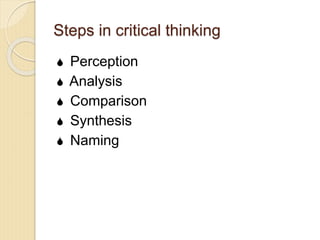
Steps in critical thinking
 Perception
 Analysis
 Comparison
 Synthesis
 Naming
TIME PERMITTING, WORK THROUGH
ACTIVITIES IN YOUR BOOKLET.
BE SURE TO THINK CRITICALLY!
Why is Critical Thinking
Important?
Critical thinkers . . .
Goal: to become critical thinkers
Raise vital questions
Formulate questions
and problems clearly, precisely
By :
--raising vital questions
--formulating questions clearly
and precisely
•Gather information
•Analyze and assess it
• Evaluate it
By:
--gathering information, then
assessing it and determining
what it means and what it is
worth
--Gathers and assesses relevant
information, using abstract ideas
to interpret it effectively,
Draw conclusions
Find solutions
Use relevant criteria
to test them
By:
--drawing conclusions
from the information
presented
--finding possible
solutions and testing
them with relevant
criteria
Keep an open
mind
By
--maintaining an open mind
Network w/others;
keep lines of
communication open
By networking with others
and maintaining
open lines of communication
with them
and others.
How to develop?
• Develop a sense of observation and curiosity
• Become interested in finding new solutions
• Share ideas
• Ask pertinent questions
• Assess statements and arguments
• Seek understanding and information
Also . . .
• Examine beliefs, assumptions, and
opinions
• Listen to others, think about what
they say, give feedback
• Become an open-minded listener and
reader
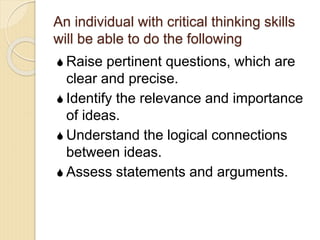
An individual with critical thinking skills
will be able to do the following
 Raise pertinent questions, which are
clear and precise.
 Identify the relevance and importance
of ideas.
 Understand the logical connections
between ideas.
 Assess statements and arguments.
Contd..
Detect inconsistencies and common
mistakes in reasoning.
Examine beliefs, assumptions, and
options and weigh them against facts.
Listen carefully to others and give feed
back.
Suspend judgement until all facts have
been gathered and considered.
Contd..
 Look for evidence to support
assumptions and beliefs.
 Adjust opinions when new facts are
found.
 Reject information that is incorrect or
irrelevant.
 Interested in finding new solutions.
Barriers to Critical Thinking
 Egocentrism (self-centered thinking):
 The one thing that unites all human beings,
regardless of age, gender, religion, economic
status, or ethnic background, is that deep down
inside, we all believe that we are better than
average drivers (Dave Barry).
 Socio centrism (group-centered thinking): When all
think alike, no one is thinking (Walter Lippmann)
Bassham et al., 2002
Nurturing critical thinking
 Encourage thinking + reflection with
prediction questions
 Setting tasks/tests which will require to
exercise their choice + use suitable
strategies
 Encourage with positive feedback on
their effort.
Contd..
 Create opportunities to problem-solve
+ to justify their choice with good
reasons
 To understand that many solutions
are there for a problem + seek
alternative solutions
Thank You

Critical Thinking

  • 1.
  • 4.
    “The intellectually disciplined processof actively and skillfully Conceptualizing, applying, analyzing, synthesizing and evaluating information.”*
  • 5.
    “Critical thinking isthe art of analyzing and evaluating thinking with a view to improving it.”*
  • 6.
    Critical Thinking Critical thinkingis an intellectually disciplined process of actively and skilfully conceptualizing, applying, analyzing, synthesizing and evaluating information gathered from or generated by observation, experience, reflection, reasoning or communication as a guide to belief and action.  Is the ability to analyze information and experiences. It can help us recognize and assess the factors that influence our attitude and behavior
  • 7.
     Case study1 Seema belong to a very poor family. She completed her 12th . One day a distant relative visits them and promises their parents of good job for their daughter in Mumbai. The girls had earlier heard about stories of unfortunate girls falling prey to such false promises and ending up their life . Their parents are adamant to send them to solve their poverty. Discuss what should girls do to save themselves.
  • 8.
     Case study2 Ashish and Rohit are good friends studying in degree first year in a local college of Laxmi Nagar. Rohit’s uncle belongs to a local outfit and earns a good money living a lavish life through unlawful activities . He asks Rohit to enrol new cadres into the outfit. Ashish belongs to a poor family. Rohit knowing Ashish’s financial condition, pressurises him to join them and promises to pay a good sum of money if takes some explosives to be blown in Delhi. Ashish knows it to be unlawful work but is afraid. He also wants to change his good friend Rohit. Discuss what should Ashish do?
  • 9.
     Case study3 Sanjana and Rahul are two young friends of Baroda . Sanjana is good in studies and works very hard. Rahul even if a good student, gradually he falls into the company of some youth who are engaged in unlawful activities. He starts taking drugs , alcohol etc and wants Sanjana to join them and enjoy life by easy money through nabbing money. He threatens Sanjana to break the friendship if she doesn’t join them. Sanjana knows that Rahul is basically a good boy who has been mislead. Discuss what should sanjana do to help Rahul...
  • 10.
    Case study 4 Roshan was part of a big group of friends. All his friends wanted to try alcohol on the last day of school. They told Roshan that it was a rare opportunity because all of them may not come together again after that day. Roshan is confused whether it is right or wrong. How you can help him to solve his problem.
  • 11.
    What is CriticalThinking?  A set of skills needed to assess ideas (Robert Ennis).  For example:  – Comparing/Contrasting  – Classifying  – Analysing  – Causal Explanation  – Evaluating (Robert Swartz)  The ability and intellectual commitment, to use those skills to guide behaviour (Scriven and Paul, 2004).
  • 12.
    Steps in criticalthinking  Perception  Analysis  Comparison  Synthesis  Naming
  • 13.
    TIME PERMITTING, WORKTHROUGH ACTIVITIES IN YOUR BOOKLET. BE SURE TO THINK CRITICALLY! Why is Critical Thinking Important?
  • 14.
    Critical thinkers .. . Goal: to become critical thinkers
  • 15.
    Raise vital questions Formulatequestions and problems clearly, precisely By : --raising vital questions --formulating questions clearly and precisely
  • 16.
    •Gather information •Analyze andassess it • Evaluate it By: --gathering information, then assessing it and determining what it means and what it is worth --Gathers and assesses relevant information, using abstract ideas to interpret it effectively,
  • 17.
    Draw conclusions Find solutions Userelevant criteria to test them By: --drawing conclusions from the information presented --finding possible solutions and testing them with relevant criteria
  • 18.
  • 19.
    Network w/others; keep linesof communication open By networking with others and maintaining open lines of communication with them and others.
  • 20.
    How to develop? •Develop a sense of observation and curiosity • Become interested in finding new solutions • Share ideas • Ask pertinent questions • Assess statements and arguments • Seek understanding and information
  • 21.
    Also . .. • Examine beliefs, assumptions, and opinions • Listen to others, think about what they say, give feedback • Become an open-minded listener and reader
  • 22.
    An individual withcritical thinking skills will be able to do the following  Raise pertinent questions, which are clear and precise.  Identify the relevance and importance of ideas.  Understand the logical connections between ideas.  Assess statements and arguments.
  • 23.
    Contd.. Detect inconsistencies andcommon mistakes in reasoning. Examine beliefs, assumptions, and options and weigh them against facts. Listen carefully to others and give feed back. Suspend judgement until all facts have been gathered and considered.
  • 24.
    Contd..  Look forevidence to support assumptions and beliefs.  Adjust opinions when new facts are found.  Reject information that is incorrect or irrelevant.  Interested in finding new solutions.
  • 25.
    Barriers to CriticalThinking  Egocentrism (self-centered thinking):  The one thing that unites all human beings, regardless of age, gender, religion, economic status, or ethnic background, is that deep down inside, we all believe that we are better than average drivers (Dave Barry).  Socio centrism (group-centered thinking): When all think alike, no one is thinking (Walter Lippmann) Bassham et al., 2002
  • 26.
    Nurturing critical thinking Encourage thinking + reflection with prediction questions  Setting tasks/tests which will require to exercise their choice + use suitable strategies  Encourage with positive feedback on their effort.
  • 27.
    Contd..  Create opportunitiesto problem-solve + to justify their choice with good reasons  To understand that many solutions are there for a problem + seek alternative solutions
  • 28.