Name of Test: Motives, Values, Preferences Inventory
Definition of Test
The Motives, Values, Preferences Inventory (MVPI) is designed to serve two very important
goals. First, the MVPI permits an evaluation of the fit between an individual and the
organizational culture. This is quite important because, no matter how talented and
hardworking a person may be, if his or her values are incompatible with the values of the larger
culture-and the culture is usually defined by the values of top management-then he or she will
not do well in the organization. Second, the MVPI is unique among the inventories that are
currently available in that it allows assessment of a person’s motives directly. The standard
interest measures allow inference about a person’s motives on the basis of his or her expressed
occupational choices. But from the MVPI, one can determine immediately the degree to which,
for example, a person is motivated by money, security or fun. The only alternative to the MVPI
for directly assessing a person’s motives is to use a projective measure. Values, preferences
and interests are all motivational concepts; they differ primarily in terms of their generality-
values are the broadest and most abstract kind of motive, and interests are the narrowest and
most concrete kind of motive. These motivational concepts tells us about a person’s desires
and plans, and they examine the long term themes and tendencies in a person’s life.
Introduction about Test
The MVPI contains 200 items in the form of statements to which a respondent indicates
“agree”, “uncertain” or “disagree”. Each scale contains 20 items that were derived rationally
from hypotheses about the likes, dislikes and aversions of the “ideal’ exemplar of each motive.
Each scale is composed of 5 themes: (a) Lifestyles which concern the manner in which a person
would like to live; suppose “(b) Beliefs which involve “should’ , ideals and ultimate life goals;
(c) Occupational Preferences which include the work an individual would like to do, what
constitutes a good job and preferred work materials; (d) Aversions which reflect attitudes and
behaviors that are either disliked or distressing and (e) Preferred Associates which include the
kind of persons desired as coworkers and friends.
There are no correct or incorrect responses for the MVPI scales; therefore there is no need for
validity or faking keys. There is no item overlap among the 10 scales. The items were screened
for content that might seem offensive or to invade privacy. There are no items concerning
sexual preferences, religious beliefs, criminal or illegal behavior, racial/ethnic attitudes or
attitudes about disabled individuals. There are no items that could be used to determine physical
or mental disabilities, the MVPI is not a medical examination. Like other interest measures,
the MVPI items are content valid. The test items represent the motives, values and interests
that are being measured. Responses to the items provide a direct index of a person’s feelings
about the subject. For example, the answer to the item “In my spare time I would like to go to
art museums or listen to classical music” directly reflects the respondent’s aesthetic values and
interests. Each MVPI scale was constructed to reflect 5 themes, and items were written to
represent the expression of the motive construct through the theme. Consider the Aesthetic
scale, the following items express the 5 themes: (a) Lifestyles –“I like to spend my free time
reading novels and listening to classical music’; (b) Beliefs- “ A dedication to art is the highest
calling in life”; (c) Occupational Preferences- “I would like to be an artist or a musician”; (d)
Aversions- “I dislike being with people who have no interest in the arts”; and (e0 Preferred
Associates-“I like to be around artists and writers”.
Attributes of Test
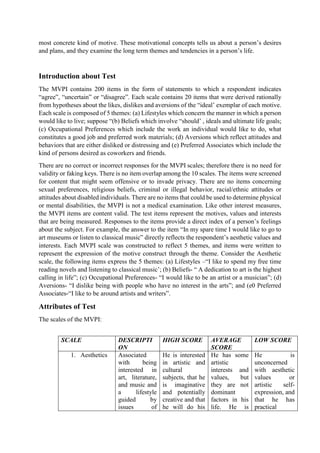
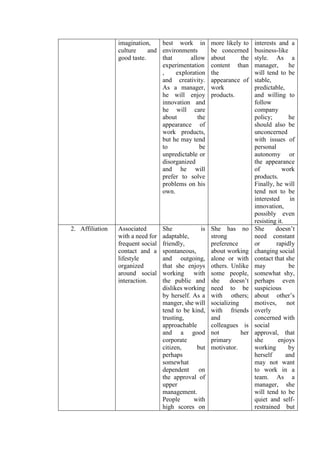
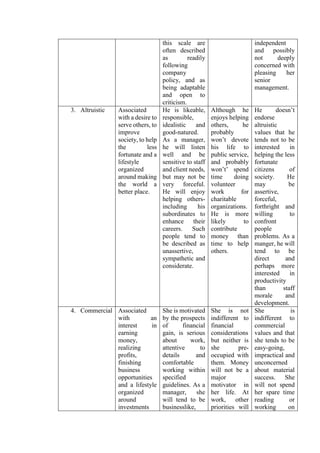
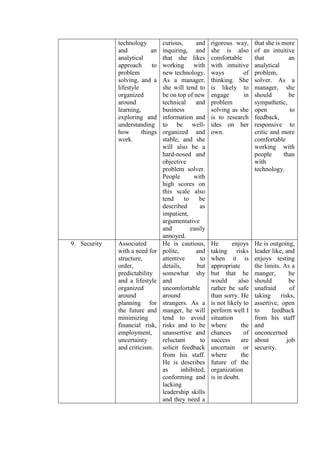
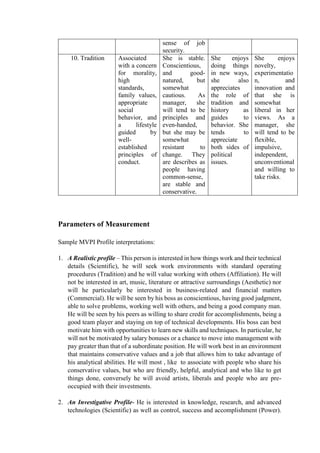
The scales of the MVPI:
SCALE DESCRIPTI
ON
HIGH SCORE AVERAGE
SCORE
LOW SCORE
1. Aesthetics Associated
with being
interested in
art, literature,
and music and
a lifestyle
guided by
issues of
He is interested
in artistic and
cultural
subjects, that he
is imaginative
and potentially
creative and that
he will do his
He has some
artistic
interests and
values, but
they are not
dominant
factors in his
life. He is
He is
unconcerned
with aesthetic
values or
artistic self-
expression, and
that he has
practical
imagination,
culture and
good taste.
best work in
environments
that allow
experimentation
, exploration
and creativity.
As a manager,
he will enjoy
innovation and
he will care
about the
appearance of
work products,
but he may tend
to be
unpredictable or
disorganized
and he will
prefer to solve
problems on his
own.
more likely to
be concerned
about the
content than
the
appearance of
work
products.
interests and a
business-like
style. As a
manager, he
will tend to be
stable,
predictable,
and willing to
follow
company
policy; he
should also be
unconcerned
with issues of
personal
autonomy or
the appearance
of work
products.
Finally, he will
tend not to be
interested in
innovation,
possibly even
resisting it.
2. Affiliation Associated
with a need for
frequent social
contact and a
lifestyle
organized
around social
interaction.
She is
adaptable,
friendly,
spontaneous,
and outgoing,
that she enjoys
working with
the public and
dislikes working
by herself. As a
manger, she will
tend to be kind,
trusting,
approachable
and a good
corporate
citizen, but
perhaps
somewhat
dependent on
the approval of
upper
management.
People with
high scores on
She has no
strong
preference
about working
alone or with
others. Unlike
some people,
she doesn’t
need to be
with others;
socializing
with friends
and
colleagues is
not her
primary
motivator.
She doesn’t
need constant
or rapidly
changing social
contact that she
may be
somewhat shy,
perhaps even
suspicious
about other’s
motives, not
overly
concerned with
social
approval, that
she enjoys
working by
herself and
may not want
to work in a
team. As a
manager, she
will tend to be
quiet and self-
restrained but
this scale are
often described
as readily
following
company
policy, and as
being adaptable
and open to
criticism.
independent
and possibly
not deeply
concerned with
pleasing her
senior
management.
3. Altruistic Associated
with a desire to
serve others, to
improve
society, to help
the less
fortunate and a
lifestyle
organized
around making
the world a
better place.
He is likeable,
responsible,
idealistic and
good-natured.
As a manager,
he will listen
well and be
sensitive to staff
and client needs,
but may not be
very forceful.
He will enjoy
helping others-
including his
subordinates to
enhance their
careers. Such
people tend to
be described as
unassertive,
sympathetic and
considerate.
Although he
enjoys helping
others, he
probably
won’t devote
his life to
public service,
and probably
won’t’ spend
time doing
volunteer
work for
charitable
organizations.
He is more
likely to
contribute
money than
time to help
others.
He doesn’t
endorse
altruistic
values that he
tends not to be
interested in
helping the less
fortunate
citizens of
society. He
may be
assertive,
forceful,
forthright and
willing to
confront
people
problems. As a
manger, he will
tend to be
direct and
perhaps more
interested in
productivity
than staff
morale and
development.
4. Commercial Associated
with an
interest in
earning
money,
realizing
profits,
finishing
business
opportunities
and a lifestyle
organized
around
investments
She is motivated
by the prospects
of financial
gain, is serious
about work,
attentive to
details and
comfortable
working within
specified
guidelines. As a
manager, she
will tend to be
businesslike,
She is not
indifferent to
financial
considerations
but neither is
she pre-
occupied with
them. Money
will not be a
major
motivator in
her life. At
work, other
priorities will
She is
indifferent to
commercial
values and that
she tends to be
easy-going,
impractical and
unconcerned
about material
success. She
will not spend
her spare time
reading or
working on
and financial
planning.
direct and
focused on the
bottom line.
People with
high scores on
this scale tend to
be described as
task-oriented,
socially adroit
and serious.
interest her
more than
compensation.
finance-related
issues. As a
manager, she
will be
sympathetic,
relaxed, and
loyal to her
subordinates.
5. Hedonistic Associated
with a desire
for pleasure,
excitement,
variety and a
lifestyle
organized
around good
food, good
drinks,
entertaining
friends and fun
times. Ideal
occupations
include
restaurant
critic, travel
reviewer, wine
taster, race car
driver- any
occupation
that involves
entertainment
and recreation.
He is
expressive,
playful, and
changeable, and
that he will
prefer to work in
a dynamic and
fluid
environment.
As a manager,
he will be
colorful and
entertaining, but
unconcerned
with details and
he may not learn
from his
mistakes. They
tend to be lively,
fun-loving and
jolly and have a
well-developed
capacity for
enjoyment.
Although he
likes to have a
good time, he
will usually
put business
before
pleasure. He
has a normal
appetite for
socializing
and rarely
engages in
excess. He
won’t spend
much time
day-dreaming
about his next
vacation.
He tends to be
self-
disciplined,
formal,
reserved and
careful about
what he says or
does. As a
manager, he
will be alert
and concerned
about details;
he may also
seem reluctant
to relax and
have a good
time, especially
when there is
work to be
done.
6. Power Associated
with a desire
for challenge,
competition
and
achievement.
She is
competitive,
achievement-
oriented,
ambitious, and
strategic about
her career. As a
manger, she will
tend to be
energetic,
visionary,
leader-like and
controlling and
she will be
willing to
disagree with
Although she
takes pride in
her
achievements,
there is also
more to her
life than he
job. She is
also willing to
listen and to
let others
describe their
accomplishme
nts. Although
normally
cooperative,
She is
uninterested in
competition,
achievement
and personal
advancement
and that she
may be
somewhat
modest,
unassertive and
not very
strategic about
her career. As a
manger, she
will tend to be
her superiors.
People with
high scores tend
to be described
as having
leadership
skills, as
challenging
limits, and as
socially
competent.
They are most
happy working
in organizations
where there are
opportunities
for upward
mobility, and
will tend to
leave when such
opportunities
don’t exist.
she will take a
stand if she
feels strongly
about an issue.
quiet, careful
about
following
procedures,
and she won’t
often disagree
with her
superiors.
7. Recognition Associated
with desire to
be known,
recognized,
visible, and
even famous
and with a
lifestyle
guided by
opportunities
for self-
display and
dreams of
achievement.
He is colorful,
socially self-
confident and
impulsive, and
that he handles
pressure and
criticism well.
As a manager,
he will prefer to
work in teams,
communicate
very well with
this staff, have
lots of ideas, but
he may have
trouble
admitting his
mistakes. They
tend to be
described as a
dramatic,
unusual and
reluctant to
share credit.
Although he
wants to be
recognized for
his
achievements,
he is also
willing to
share credit
with others.
Although
public
recognition is
not the
primary
motivator in
his life, he is
not likely to
remain silent
when he is due
some credit
for important
accomplish-
ments.
He tends to be
modest and
reserved and
avoids calling
attention to
himself. As a
manger, he will
be quiet,
perhaps
somewhat
uncommunicati
ve, but willing
to share credit
with others,
including
subordinates.
8. Scientific Associated
with an
interest in new
ideas, new
She is
intellectually
motivated,
analytical,
Although she
analyzes
problems in
logical and
She is
uninterested in
science and
technology and
technology
and an
analytical
approach to
problem
solving, and a
lifestyle
organized
around
learning,
exploring and
understanding
how things
work.
curious, and
inquiring, and
that she likes
working with
new technology.
As a manager,
she will tend to
be on top of new
technical and
business
information and
to be well-
organized and
stable, and she
will also be a
hard-nosed and
objective
problem solver.
People with
high scores on
this scale also
tend to be
described as
impatient,
argumentative
and easily
annoyed.
rigorous way,
she is also
comfortable
with intuitive
ways of
thinking. She
is likely to
engage in
problem
solving as she
is to research
ides on her
own.
that she is more
of an intuitive
that an
analytical
problem,
solver. As a
manager, she
should be
sympathetic,
open to
feedback,
responsive to
critic and more
comfortable
working with
people than
with
technology.
9. Security Associated
with a need for
structure,
order,
predictability
and a lifestyle
organized
around
planning for
the future and
minimizing
financial risk,
employment,
uncertainty
and criticism.
He is cautious,
polite, and
attentive to
details, but
somewhat shy
and
uncomfortable
around
strangers. As a
manger, he will
tend to avoid
risks and to be
unassertive and
reluctant to
solicit feedback
from his staff.
He is describes
as inhibited,
conforming and
lacking
leadership skills
and they need a
He enjoys
taking risks
when it is
appropriate
but that he
would also
rather be safe
than sorry. He
is not likely to
perform well I
situation
where the
chances of
success are
uncertain or
where the
future of the
organization
is in doubt.
He is outgoing,
leader like, and
enjoys testing
the limits. As a
manger, he
should be
unafraid of
taking risks,
assertive, open
to feedback
from his staff
and
unconcerned
about job
security.
sense of job
security.
10. Tradition Associated
with a concern
for morality,
high
standards,
family values,
appropriate
social
behavior, and
a lifestyle
guided by
well-
established
principles of
conduct.
She is stable.
Conscientious,
and good-
natured, but
somewhat
cautious. As
manager, she
will tend to be
principles and
even-handed,
but she may be
somewhat
resistant to
change. They
are describes as
people having
common-sense,
are stable and
conservative.
She enjoys
doing things
in new ways,
she also
appreciates
the role of
tradition and
history as
guides to
behavior. She
tends to
appreciate
both sides of
political
issues.
She enjoys
novelty,
experimentatio
n, and
innovation and
that she is
somewhat
liberal in her
views. As a
manager, she
will tend to be
flexible,
impulsive,
independent,
unconventional
and willing to
take risks.
Parameters of Measurement
Sample MVPI Profile interpretations:
1. A Realistic profile – This person is interested in how things work and their technical
details (Scientific), he will seek work environments with standard operating
procedures (Tradition) and he will value working with others (Affiliation). He will
not be interested in art, music, literature or attractive surroundings (Aesthetic) nor
will he particularly be interested in business-related and financial matters
(Commercial). He will be seen by his boss as conscientious, having good judgment,
able to solve problems, working well with others, and being a good company man.
He will be seen by his peers as willing to share credit for accomplishments, being a
good team player and staying on top of technical developments. His boss can best
motivate him with opportunities to learn new skills and techniques. In particular, he
will not be motivated by salary bonuses or a chance to move into management with
pay greater than that of a subordinate position. He will work best in an environment
that maintains conservative values and a job that allows him to take advantage of
his analytical abilities. He will most , like to associate with people who share his
conservative values, but who are friendly, helpful, analytical and who like to get
things done, conversely he will avoid artists, liberals and people who are pre-
occupied with their investments.
2. An Investigative Profile- He is interested in knowledge, research, and advanced
technologies (Scientific) as well as control, success and accomplishment (Power).
In addition, he is careful, conservative and uncomfortable with testing the limits
(Security). He will not be interested in working closely with other people
(Affiliation) and is not particularly sympathetic to the plight of the downtrodden
(Altruistic) or concerned about staff morale. He will be seen by his boss as having
good judgment, being predictable, quiet, and socially appropriate and a good
company citizen. He will be seen by his staff as having a vision for the department,
accepting challenges and a good organizational citizen. However, they also will see
him as avoiding close relationships, competitive and lacking a sense of humor. His
boss can best motivate him by giving him opportunities for intellectual growth and
greater responsibility with the promise that these efforts will enhance his future. If
his boss had a vision for the future, then a role can be promised in the succession
plan for him upon the boss’s retirement. Although he needs a job position in which
he can contribute and make a difference, he also needs job security. He is not
particularly responsive to attention – although he is not indifferent to money. He
will work best in a corporate culture that emphasizes security and a dedication to
old fashioned values. The people with whom he will most like to associate will be
other ambitious, status seeking types; conversely he will avoid artists, entertainers
and dilettantes.
3. An Artistic Profile – She will be interested in artistic activities and will enjoy
creative self-expression (Aesthetic). In addition, she is also interested in creative
problem solving (Scientific), especially when it requires working with others to
generate solutions (Affiliation). She is not interested in conventional rituals,
organized religion (Tradition) or projects that require following procedures and
‘painting by the numbers” (Security). She will be seen by her boss as easily bored,
testing the limits, non-conforming, but interested in success. She will be seen by
her co-workers as flexible, curious, a source of ideas, fun to be around and flighty.
Customers like working with her. Her boss can best motivate her through
opportunities to solve difficult design problems using her independent creative
resources for people who appreciate her talents. She will not be motivated by money
or the assurance of enough projects to cover the employment needs of her
immediate future. She will work best in a corporate climate that allow her to
exercise her imagination through designs where product appearance is a central
value. The people with whom she will most like to associate are other creative types
who also like people and environment that are pleasurable and fun. She will avoid
preachers, conservative politicians and bureaucrats.
4. A Social Profile - She is primarily interested in caring for people’s needs
(Altruistic) and she enjoys social interaction (Affiliation). She is clearly not
interested in money (Commercial), authority (Power), or attention from others
(Recognition). He will be seen by her boss as sympathetic and trusting as well as
working well with new people and willing to confide in others. She will be seen by
her co-workers as calm under pressure and willing to give feedback that makes
others feel good. She will spend time getting others to work together and to keep
them informed. Her boss can best motivate her by providing opportunities to make
other people feel good and contribute to their development. She will not be
motivated by money, awards, citations or opportunities to assume leadership roles.
She will work best in a corporate climate where the welfare of others is the shared
mission. The people with whom she will most like to associate are altruistic types
who dedicate themselves to improving the lives of others. She will avoid
accountants, regulators, politicians and mean-spirited gossipers.
5. An Enterprising Profile – He will enjoy getting things done (Power), working on
financial (Commercial) problems (Scientific), and working with others
(Affiliation). He will not be interested in cultural events (Aesthetic). Charitable
activities (Altruism), or partying (Hedonistic). He will be seen by his boss as having
leadership skills, being assertive and testing the limits having social skills, and
being a strategic problem solver. He will be seen by his subordinates as being hard
working, an innovator, impatient and inconsiderable when the work load is heavy
and serious (probably not a lot of fun). His boss can best motivate him by providing
opportunities to solve difficult problems that have financial implications. He will
not be motivated by opportunities to accrue more vacation time. He will work best
in a corporate culture that emphasizes productivity, accomplishment and attainment
of financial goals. The people he will most like to associate with will be other high
status, ambitious people, financial analysts and entrepreneurs, conversely he will
avoid artists, social workers and anyone who doesn’t seem serious about his or her
career.
6. A Conventional Profile- He is interested in conservative politics and religious
activities (Tradition), financial matters and opportunities to save or make money
(Commercial) and he values achievement and advancement (Power). Conversely
he is not particularly interested in social interaction and will not seek opportunities
to meet new people (Affiliation), or fighting human rights abuses (Altruistic). He
will be seen by his boss as serious, tough-minded, predictable, hard-working,
responsible and having good judgment. He will be seen by his subordinates as
impatient, disagreeable with clients, non-communicative and unconcerned with
helping others; learn new skills. Although subordinates may describe him as having
a vision for the company, they will also say that they are not proud to be part of his
team. His boss can best motivate him by providing opportunities for him to continue
expanding the business where the expansion is deliberate, conservative and well-
planned. He will also be motivated by financial rewards and successes. He will not
be concerned about staff morale. In addition, he seems not to require recognition
for his accomplishments which is probably why he is not particularly sensitive to
signs of disrespect from others. He will perform best in a climate that allows him to
work hard, analyze financial problems and make money. The people with whom he
will most like to associate are conservative, political and religious players with
some status. He will not enjoy interacting with social workers, human resource
specialists, psychologists and environmentalists.
Applications in Organizational Context
There are two ways this motivational information can be useful. First, it can be used to evaluate
the fit between a person’s interests and the psychological requirements of jobs; thus the MVPI
can be used to help people choose occupations or careers. Second, the inventory can be used
to evaluate the fit between a person’s values and the climate of a particular organization, thus,
the MVPI can be used to help people think strategically about their current careers.
Measures of motives, values and interests are somewhat different from personality measures.
Personality measures tell us what a person may do in certain situations, whereas value and
interest inventories tell us what a person wants to do. Moreover, people tend not to distort their
answers on interest measures because their values and aspirations are part of their identity and
they are normally eager to discuss them. Finally, motives, values and preferences are
remarkably stable; they tend to change very little as a person grows older-what interests you
now will probably interest you later.
1. Career Planning: Each scale on the inventory contains a subscale for vocational
choice. Thus, persons with high scores for Aesthetic motives should choose a career
that includes opportunities for creative self-expression. Persons with high scores for
Altruistic motives should choose a career that provides opportunities to help others.
The Hedonistic, Power, Security and Tradition scales don’t lead to clear vocational
recommendations, rather they concern people’s needs for fun, achievement,
security and liberal versus conservative values. The other scales make straight-
forward career recommendations.
2. Matching human resources to organizational culture: Research by Holland,
Schneider and others shows that people are happiest working in environments that
are compatible or consistent with heir core values. So, for example, a person with
strong Altruistic motives will tend to be uncomfortable working in a financial
services company where the orientation is toward profit rather than staff morale.
Similarly, a person with strong Security needs would be uncomfortable working in
a company like a securities trading firm where taking risks is part of the business.
3. Staff Development: People with low scores on the Commercial scale are not
interested in or motivated by money. A smart manager will find some other way to
motivate these people. Similarly, a person with string Power needs will be
motivated by opportunities to get things done and make a mark on an organization
whereas persons with weak Power needs are indifferent to such considerations.

MVPI

  • 1.
    Name of Test:Motives, Values, Preferences Inventory Definition of Test The Motives, Values, Preferences Inventory (MVPI) is designed to serve two very important goals. First, the MVPI permits an evaluation of the fit between an individual and the organizational culture. This is quite important because, no matter how talented and hardworking a person may be, if his or her values are incompatible with the values of the larger culture-and the culture is usually defined by the values of top management-then he or she will not do well in the organization. Second, the MVPI is unique among the inventories that are currently available in that it allows assessment of a person’s motives directly. The standard interest measures allow inference about a person’s motives on the basis of his or her expressed occupational choices. But from the MVPI, one can determine immediately the degree to which, for example, a person is motivated by money, security or fun. The only alternative to the MVPI for directly assessing a person’s motives is to use a projective measure. Values, preferences and interests are all motivational concepts; they differ primarily in terms of their generality- values are the broadest and most abstract kind of motive, and interests are the narrowest and
  • 2.
    most concrete kindof motive. These motivational concepts tells us about a person’s desires and plans, and they examine the long term themes and tendencies in a person’s life. Introduction about Test The MVPI contains 200 items in the form of statements to which a respondent indicates “agree”, “uncertain” or “disagree”. Each scale contains 20 items that were derived rationally from hypotheses about the likes, dislikes and aversions of the “ideal’ exemplar of each motive. Each scale is composed of 5 themes: (a) Lifestyles which concern the manner in which a person would like to live; suppose “(b) Beliefs which involve “should’ , ideals and ultimate life goals; (c) Occupational Preferences which include the work an individual would like to do, what constitutes a good job and preferred work materials; (d) Aversions which reflect attitudes and behaviors that are either disliked or distressing and (e) Preferred Associates which include the kind of persons desired as coworkers and friends. There are no correct or incorrect responses for the MVPI scales; therefore there is no need for validity or faking keys. There is no item overlap among the 10 scales. The items were screened for content that might seem offensive or to invade privacy. There are no items concerning sexual preferences, religious beliefs, criminal or illegal behavior, racial/ethnic attitudes or attitudes about disabled individuals. There are no items that could be used to determine physical or mental disabilities, the MVPI is not a medical examination. Like other interest measures, the MVPI items are content valid. The test items represent the motives, values and interests that are being measured. Responses to the items provide a direct index of a person’s feelings about the subject. For example, the answer to the item “In my spare time I would like to go to art museums or listen to classical music” directly reflects the respondent’s aesthetic values and interests. Each MVPI scale was constructed to reflect 5 themes, and items were written to represent the expression of the motive construct through the theme. Consider the Aesthetic scale, the following items express the 5 themes: (a) Lifestyles –“I like to spend my free time reading novels and listening to classical music’; (b) Beliefs- “ A dedication to art is the highest calling in life”; (c) Occupational Preferences- “I would like to be an artist or a musician”; (d) Aversions- “I dislike being with people who have no interest in the arts”; and (e0 Preferred Associates-“I like to be around artists and writers”. Attributes of Test The scales of the MVPI: SCALE DESCRIPTI ON HIGH SCORE AVERAGE SCORE LOW SCORE 1. Aesthetics Associated with being interested in art, literature, and music and a lifestyle guided by issues of He is interested in artistic and cultural subjects, that he is imaginative and potentially creative and that he will do his He has some artistic interests and values, but they are not dominant factors in his life. He is He is unconcerned with aesthetic values or artistic self- expression, and that he has practical
  • 3.
    imagination, culture and good taste. bestwork in environments that allow experimentation , exploration and creativity. As a manager, he will enjoy innovation and he will care about the appearance of work products, but he may tend to be unpredictable or disorganized and he will prefer to solve problems on his own. more likely to be concerned about the content than the appearance of work products. interests and a business-like style. As a manager, he will tend to be stable, predictable, and willing to follow company policy; he should also be unconcerned with issues of personal autonomy or the appearance of work products. Finally, he will tend not to be interested in innovation, possibly even resisting it. 2. Affiliation Associated with a need for frequent social contact and a lifestyle organized around social interaction. She is adaptable, friendly, spontaneous, and outgoing, that she enjoys working with the public and dislikes working by herself. As a manger, she will tend to be kind, trusting, approachable and a good corporate citizen, but perhaps somewhat dependent on the approval of upper management. People with high scores on She has no strong preference about working alone or with others. Unlike some people, she doesn’t need to be with others; socializing with friends and colleagues is not her primary motivator. She doesn’t need constant or rapidly changing social contact that she may be somewhat shy, perhaps even suspicious about other’s motives, not overly concerned with social approval, that she enjoys working by herself and may not want to work in a team. As a manager, she will tend to be quiet and self- restrained but
  • 4.
    this scale are oftendescribed as readily following company policy, and as being adaptable and open to criticism. independent and possibly not deeply concerned with pleasing her senior management. 3. Altruistic Associated with a desire to serve others, to improve society, to help the less fortunate and a lifestyle organized around making the world a better place. He is likeable, responsible, idealistic and good-natured. As a manager, he will listen well and be sensitive to staff and client needs, but may not be very forceful. He will enjoy helping others- including his subordinates to enhance their careers. Such people tend to be described as unassertive, sympathetic and considerate. Although he enjoys helping others, he probably won’t devote his life to public service, and probably won’t’ spend time doing volunteer work for charitable organizations. He is more likely to contribute money than time to help others. He doesn’t endorse altruistic values that he tends not to be interested in helping the less fortunate citizens of society. He may be assertive, forceful, forthright and willing to confront people problems. As a manger, he will tend to be direct and perhaps more interested in productivity than staff morale and development. 4. Commercial Associated with an interest in earning money, realizing profits, finishing business opportunities and a lifestyle organized around investments She is motivated by the prospects of financial gain, is serious about work, attentive to details and comfortable working within specified guidelines. As a manager, she will tend to be businesslike, She is not indifferent to financial considerations but neither is she pre- occupied with them. Money will not be a major motivator in her life. At work, other priorities will She is indifferent to commercial values and that she tends to be easy-going, impractical and unconcerned about material success. She will not spend her spare time reading or working on
  • 5.
    and financial planning. direct and focusedon the bottom line. People with high scores on this scale tend to be described as task-oriented, socially adroit and serious. interest her more than compensation. finance-related issues. As a manager, she will be sympathetic, relaxed, and loyal to her subordinates. 5. Hedonistic Associated with a desire for pleasure, excitement, variety and a lifestyle organized around good food, good drinks, entertaining friends and fun times. Ideal occupations include restaurant critic, travel reviewer, wine taster, race car driver- any occupation that involves entertainment and recreation. He is expressive, playful, and changeable, and that he will prefer to work in a dynamic and fluid environment. As a manager, he will be colorful and entertaining, but unconcerned with details and he may not learn from his mistakes. They tend to be lively, fun-loving and jolly and have a well-developed capacity for enjoyment. Although he likes to have a good time, he will usually put business before pleasure. He has a normal appetite for socializing and rarely engages in excess. He won’t spend much time day-dreaming about his next vacation. He tends to be self- disciplined, formal, reserved and careful about what he says or does. As a manager, he will be alert and concerned about details; he may also seem reluctant to relax and have a good time, especially when there is work to be done. 6. Power Associated with a desire for challenge, competition and achievement. She is competitive, achievement- oriented, ambitious, and strategic about her career. As a manger, she will tend to be energetic, visionary, leader-like and controlling and she will be willing to disagree with Although she takes pride in her achievements, there is also more to her life than he job. She is also willing to listen and to let others describe their accomplishme nts. Although normally cooperative, She is uninterested in competition, achievement and personal advancement and that she may be somewhat modest, unassertive and not very strategic about her career. As a manger, she will tend to be
  • 6.
    her superiors. People with highscores tend to be described as having leadership skills, as challenging limits, and as socially competent. They are most happy working in organizations where there are opportunities for upward mobility, and will tend to leave when such opportunities don’t exist. she will take a stand if she feels strongly about an issue. quiet, careful about following procedures, and she won’t often disagree with her superiors. 7. Recognition Associated with desire to be known, recognized, visible, and even famous and with a lifestyle guided by opportunities for self- display and dreams of achievement. He is colorful, socially self- confident and impulsive, and that he handles pressure and criticism well. As a manager, he will prefer to work in teams, communicate very well with this staff, have lots of ideas, but he may have trouble admitting his mistakes. They tend to be described as a dramatic, unusual and reluctant to share credit. Although he wants to be recognized for his achievements, he is also willing to share credit with others. Although public recognition is not the primary motivator in his life, he is not likely to remain silent when he is due some credit for important accomplish- ments. He tends to be modest and reserved and avoids calling attention to himself. As a manger, he will be quiet, perhaps somewhat uncommunicati ve, but willing to share credit with others, including subordinates. 8. Scientific Associated with an interest in new ideas, new She is intellectually motivated, analytical, Although she analyzes problems in logical and She is uninterested in science and technology and
  • 7.
    technology and an analytical approach to problem solving,and a lifestyle organized around learning, exploring and understanding how things work. curious, and inquiring, and that she likes working with new technology. As a manager, she will tend to be on top of new technical and business information and to be well- organized and stable, and she will also be a hard-nosed and objective problem solver. People with high scores on this scale also tend to be described as impatient, argumentative and easily annoyed. rigorous way, she is also comfortable with intuitive ways of thinking. She is likely to engage in problem solving as she is to research ides on her own. that she is more of an intuitive that an analytical problem, solver. As a manager, she should be sympathetic, open to feedback, responsive to critic and more comfortable working with people than with technology. 9. Security Associated with a need for structure, order, predictability and a lifestyle organized around planning for the future and minimizing financial risk, employment, uncertainty and criticism. He is cautious, polite, and attentive to details, but somewhat shy and uncomfortable around strangers. As a manger, he will tend to avoid risks and to be unassertive and reluctant to solicit feedback from his staff. He is describes as inhibited, conforming and lacking leadership skills and they need a He enjoys taking risks when it is appropriate but that he would also rather be safe than sorry. He is not likely to perform well I situation where the chances of success are uncertain or where the future of the organization is in doubt. He is outgoing, leader like, and enjoys testing the limits. As a manger, he should be unafraid of taking risks, assertive, open to feedback from his staff and unconcerned about job security.
  • 8.
    sense of job security. 10.Tradition Associated with a concern for morality, high standards, family values, appropriate social behavior, and a lifestyle guided by well- established principles of conduct. She is stable. Conscientious, and good- natured, but somewhat cautious. As manager, she will tend to be principles and even-handed, but she may be somewhat resistant to change. They are describes as people having common-sense, are stable and conservative. She enjoys doing things in new ways, she also appreciates the role of tradition and history as guides to behavior. She tends to appreciate both sides of political issues. She enjoys novelty, experimentatio n, and innovation and that she is somewhat liberal in her views. As a manager, she will tend to be flexible, impulsive, independent, unconventional and willing to take risks. Parameters of Measurement Sample MVPI Profile interpretations: 1. A Realistic profile – This person is interested in how things work and their technical details (Scientific), he will seek work environments with standard operating procedures (Tradition) and he will value working with others (Affiliation). He will not be interested in art, music, literature or attractive surroundings (Aesthetic) nor will he particularly be interested in business-related and financial matters (Commercial). He will be seen by his boss as conscientious, having good judgment, able to solve problems, working well with others, and being a good company man. He will be seen by his peers as willing to share credit for accomplishments, being a good team player and staying on top of technical developments. His boss can best motivate him with opportunities to learn new skills and techniques. In particular, he will not be motivated by salary bonuses or a chance to move into management with pay greater than that of a subordinate position. He will work best in an environment that maintains conservative values and a job that allows him to take advantage of his analytical abilities. He will most , like to associate with people who share his conservative values, but who are friendly, helpful, analytical and who like to get things done, conversely he will avoid artists, liberals and people who are pre- occupied with their investments. 2. An Investigative Profile- He is interested in knowledge, research, and advanced technologies (Scientific) as well as control, success and accomplishment (Power).
  • 9.
    In addition, heis careful, conservative and uncomfortable with testing the limits (Security). He will not be interested in working closely with other people (Affiliation) and is not particularly sympathetic to the plight of the downtrodden (Altruistic) or concerned about staff morale. He will be seen by his boss as having good judgment, being predictable, quiet, and socially appropriate and a good company citizen. He will be seen by his staff as having a vision for the department, accepting challenges and a good organizational citizen. However, they also will see him as avoiding close relationships, competitive and lacking a sense of humor. His boss can best motivate him by giving him opportunities for intellectual growth and greater responsibility with the promise that these efforts will enhance his future. If his boss had a vision for the future, then a role can be promised in the succession plan for him upon the boss’s retirement. Although he needs a job position in which he can contribute and make a difference, he also needs job security. He is not particularly responsive to attention – although he is not indifferent to money. He will work best in a corporate culture that emphasizes security and a dedication to old fashioned values. The people with whom he will most like to associate will be other ambitious, status seeking types; conversely he will avoid artists, entertainers and dilettantes. 3. An Artistic Profile – She will be interested in artistic activities and will enjoy creative self-expression (Aesthetic). In addition, she is also interested in creative problem solving (Scientific), especially when it requires working with others to generate solutions (Affiliation). She is not interested in conventional rituals, organized religion (Tradition) or projects that require following procedures and ‘painting by the numbers” (Security). She will be seen by her boss as easily bored, testing the limits, non-conforming, but interested in success. She will be seen by her co-workers as flexible, curious, a source of ideas, fun to be around and flighty. Customers like working with her. Her boss can best motivate her through opportunities to solve difficult design problems using her independent creative resources for people who appreciate her talents. She will not be motivated by money or the assurance of enough projects to cover the employment needs of her immediate future. She will work best in a corporate climate that allow her to exercise her imagination through designs where product appearance is a central value. The people with whom she will most like to associate are other creative types who also like people and environment that are pleasurable and fun. She will avoid preachers, conservative politicians and bureaucrats. 4. A Social Profile - She is primarily interested in caring for people’s needs (Altruistic) and she enjoys social interaction (Affiliation). She is clearly not interested in money (Commercial), authority (Power), or attention from others (Recognition). He will be seen by her boss as sympathetic and trusting as well as working well with new people and willing to confide in others. She will be seen by her co-workers as calm under pressure and willing to give feedback that makes others feel good. She will spend time getting others to work together and to keep
  • 10.
    them informed. Herboss can best motivate her by providing opportunities to make other people feel good and contribute to their development. She will not be motivated by money, awards, citations or opportunities to assume leadership roles. She will work best in a corporate climate where the welfare of others is the shared mission. The people with whom she will most like to associate are altruistic types who dedicate themselves to improving the lives of others. She will avoid accountants, regulators, politicians and mean-spirited gossipers. 5. An Enterprising Profile – He will enjoy getting things done (Power), working on financial (Commercial) problems (Scientific), and working with others (Affiliation). He will not be interested in cultural events (Aesthetic). Charitable activities (Altruism), or partying (Hedonistic). He will be seen by his boss as having leadership skills, being assertive and testing the limits having social skills, and being a strategic problem solver. He will be seen by his subordinates as being hard working, an innovator, impatient and inconsiderable when the work load is heavy and serious (probably not a lot of fun). His boss can best motivate him by providing opportunities to solve difficult problems that have financial implications. He will not be motivated by opportunities to accrue more vacation time. He will work best in a corporate culture that emphasizes productivity, accomplishment and attainment of financial goals. The people he will most like to associate with will be other high status, ambitious people, financial analysts and entrepreneurs, conversely he will avoid artists, social workers and anyone who doesn’t seem serious about his or her career. 6. A Conventional Profile- He is interested in conservative politics and religious activities (Tradition), financial matters and opportunities to save or make money (Commercial) and he values achievement and advancement (Power). Conversely he is not particularly interested in social interaction and will not seek opportunities to meet new people (Affiliation), or fighting human rights abuses (Altruistic). He will be seen by his boss as serious, tough-minded, predictable, hard-working, responsible and having good judgment. He will be seen by his subordinates as impatient, disagreeable with clients, non-communicative and unconcerned with helping others; learn new skills. Although subordinates may describe him as having a vision for the company, they will also say that they are not proud to be part of his team. His boss can best motivate him by providing opportunities for him to continue expanding the business where the expansion is deliberate, conservative and well- planned. He will also be motivated by financial rewards and successes. He will not be concerned about staff morale. In addition, he seems not to require recognition for his accomplishments which is probably why he is not particularly sensitive to signs of disrespect from others. He will perform best in a climate that allows him to work hard, analyze financial problems and make money. The people with whom he will most like to associate are conservative, political and religious players with some status. He will not enjoy interacting with social workers, human resource specialists, psychologists and environmentalists.
  • 11.
    Applications in OrganizationalContext There are two ways this motivational information can be useful. First, it can be used to evaluate the fit between a person’s interests and the psychological requirements of jobs; thus the MVPI can be used to help people choose occupations or careers. Second, the inventory can be used to evaluate the fit between a person’s values and the climate of a particular organization, thus, the MVPI can be used to help people think strategically about their current careers. Measures of motives, values and interests are somewhat different from personality measures. Personality measures tell us what a person may do in certain situations, whereas value and interest inventories tell us what a person wants to do. Moreover, people tend not to distort their answers on interest measures because their values and aspirations are part of their identity and they are normally eager to discuss them. Finally, motives, values and preferences are remarkably stable; they tend to change very little as a person grows older-what interests you now will probably interest you later. 1. Career Planning: Each scale on the inventory contains a subscale for vocational choice. Thus, persons with high scores for Aesthetic motives should choose a career that includes opportunities for creative self-expression. Persons with high scores for Altruistic motives should choose a career that provides opportunities to help others. The Hedonistic, Power, Security and Tradition scales don’t lead to clear vocational recommendations, rather they concern people’s needs for fun, achievement, security and liberal versus conservative values. The other scales make straight- forward career recommendations. 2. Matching human resources to organizational culture: Research by Holland, Schneider and others shows that people are happiest working in environments that are compatible or consistent with heir core values. So, for example, a person with strong Altruistic motives will tend to be uncomfortable working in a financial services company where the orientation is toward profit rather than staff morale. Similarly, a person with strong Security needs would be uncomfortable working in a company like a securities trading firm where taking risks is part of the business. 3. Staff Development: People with low scores on the Commercial scale are not interested in or motivated by money. A smart manager will find some other way to motivate these people. Similarly, a person with string Power needs will be motivated by opportunities to get things done and make a mark on an organization whereas persons with weak Power needs are indifferent to such considerations.