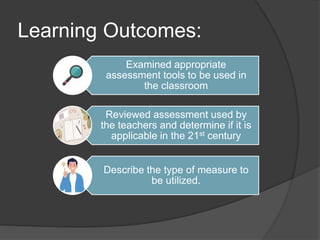
Learning Outcomes:
Examined appropriate
assessment tools to be used in
the classroom
Reviewed assessment used by
the teachers and determine if it is
applicable in the 21st century
Describe the type of measure to
be utilized.
 These are the strategies, techniques,
tools and instruments for collecting
information to determine the extent to
which students demonstrate desired
learning outcomes.
 What is Assessment
method?
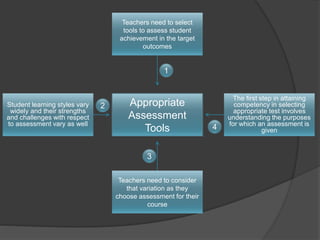
Appropriate
Assessment
Tools
Teachers need to select
tools to assess student
achievement in the target
outcomes
Student learning styles vary
widely and their strengths
and challenges with respect
to assessment vary as well
Teachers need to consider
that variation as they
choose assessment for their
course
The first step in attaining
competency in selecting
appropriate test involves
understanding the purposes
for which an assessment is
given
1
2
3
4
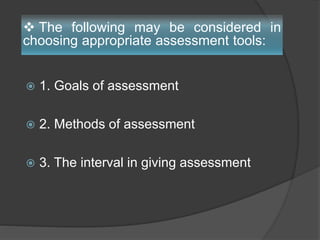
 1. Goals of assessment
 2. Methods of assessment
 3. The interval in giving assessment
 The following may be considered in
choosing appropriate assessment tools:
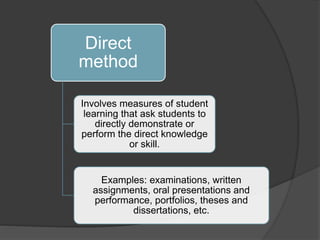
Direct
method
Involves measures of student
learning that ask students to
directly demonstrate or
perform the direct knowledge
or skill.
Examples: examinations, written
assignments, oral presentations and
performance, portfolios, theses and
dissertations, etc.
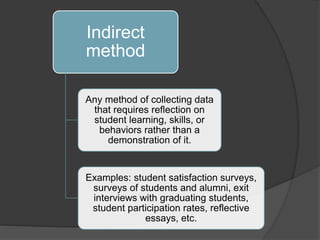
Indirect
method
Any method of collecting data
that requires reflection on
student learning, skills, or
behaviors rather than a
demonstration of it.
Examples: student satisfaction surveys,
surveys of students and alumni, exit
interviews with graduating students,
student participation rates, reflective
essays, etc.
Characteristics in selecting appropriate
assessment tools whether conventional
or ICT-Based assessment:
1. Measure the desired level of performance
(level of satisfaction, productivity, efficiency,
student performance)
2. Cost effective in terms of effort, time and
money
3. Produce results that provide information to
improve student learning
4. Reasonably accurate and truthful
5. Dependable, consistent responses over time
6. Evidence of being on-going, not once and
done.
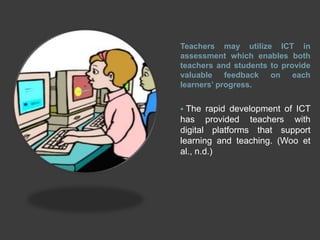
Teachers may utilize ICT in
assessment which enables both
teachers and students to provide
valuable feedback on each
learners’ progress.
 The rapid development of ICT
has provided teachers with
digital platforms that support
learning and teaching. (Woo et
al., n.d.)
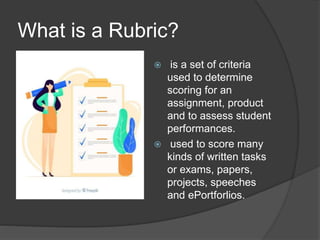
What is a Rubric?
 is a set of criteria
used to determine
scoring for an
assignment, product
and to assess student
performances.
 used to score many
kinds of written tasks
or exams, papers,
projects, speeches
and ePortforlios.
There are two types of
rubric:
 ANALYTIC
RUBRICS
o describe work on each
criterion separately.
o utilizes separate, holistic
ratings or specific
characteristics,
products, or behaviors.
 HOLISTICS
RUBRICS
o describe the work by
applying all the criteria
at the same time and
enabling an overall
judgement about the
quality of the work.
o utilizes holistic rating for
a product or behavior.
What is an Electronic examination?
 it is also called Computer-Based Assessment
(CBA), Computer-Based Test (CBT) or e-exams.
 it is a test conducted through personal
computer (PC) or any electronic device, where
the delivery, responses and assessment are
effected electronically.
 Computer-Based Testing is more efficient than
Paper-based test because it is an individualized
testing and has faster score reporting within few
minutes after last submission.
Advantages of computerized
delivery of objective tests:
1. The creation of item bank of questions invites the
possibility of each student being presented with a
paper made up of different questions, but of an
equivalent standard.
2. Automatic computerized marking facilities immediate
feedback for the students.
3. Students can be invited to sit tests as frequently as
they find useful.
4. Computerized recording of results facilitates the
analysis of groups’ responses to questions.
What is Paper-and-pencil
Testing?
 it is the most common assessment
procedure utilized by teacher to
gather formal evidences about
students’ learning.
Examples: tests (knowledge and
ability tests), inventories (personality
and interest inventories)
What is Electronic Portfolio?
 it is also known as an ePortfolio, digital portfolio,
or online portfolio.
 a collection of electronic evidence assembled and
managed by a user, usually on the Web
(Zimmerman, 2012).
 it is both demonstrations of the users’ abilities and
platforms for self-expression.
Examples: input texts, electronic files, images,
multimedia, blog entries and hyperlinks.
Types of ePortfolios:
1. Ideal portfolio – contains all work of students and not given to
provide students a grade.
2. Documentation portfolio – a collection of work over time
showing growth and improvement reflecting students’ learning
of identified outcomes.
3. Learning ePortfolio – created as part of a learning activity as
a way to demonstrate learning and the learning process.
4. Showcase/Professional ePortfolio – a way to demonstrate
(showcase) the highlights of a students’ academic career.
5. Evaluation/Assessment ePortfolios – teacher may utilize
this for both formative and summative assessments feedback.
THANK YOU
FOR
LISTENING!

Criteria-in-Choosing-Appropriate-Assessment-Tools.pptx

  • 2.
    Learning Outcomes: Examined appropriate assessmenttools to be used in the classroom Reviewed assessment used by the teachers and determine if it is applicable in the 21st century Describe the type of measure to be utilized.
  • 3.
     These arethe strategies, techniques, tools and instruments for collecting information to determine the extent to which students demonstrate desired learning outcomes.  What is Assessment method?
  • 4.
    Appropriate Assessment Tools Teachers need toselect tools to assess student achievement in the target outcomes Student learning styles vary widely and their strengths and challenges with respect to assessment vary as well Teachers need to consider that variation as they choose assessment for their course The first step in attaining competency in selecting appropriate test involves understanding the purposes for which an assessment is given 1 2 3 4
  • 5.
     1. Goalsof assessment  2. Methods of assessment  3. The interval in giving assessment  The following may be considered in choosing appropriate assessment tools:
  • 6.
    Direct method Involves measures ofstudent learning that ask students to directly demonstrate or perform the direct knowledge or skill. Examples: examinations, written assignments, oral presentations and performance, portfolios, theses and dissertations, etc.
  • 7.
    Indirect method Any method ofcollecting data that requires reflection on student learning, skills, or behaviors rather than a demonstration of it. Examples: student satisfaction surveys, surveys of students and alumni, exit interviews with graduating students, student participation rates, reflective essays, etc.
  • 8.
    Characteristics in selectingappropriate assessment tools whether conventional or ICT-Based assessment: 1. Measure the desired level of performance (level of satisfaction, productivity, efficiency, student performance) 2. Cost effective in terms of effort, time and money 3. Produce results that provide information to improve student learning 4. Reasonably accurate and truthful 5. Dependable, consistent responses over time 6. Evidence of being on-going, not once and done.
  • 9.
    Teachers may utilizeICT in assessment which enables both teachers and students to provide valuable feedback on each learners’ progress.  The rapid development of ICT has provided teachers with digital platforms that support learning and teaching. (Woo et al., n.d.)
  • 10.
    What is aRubric?  is a set of criteria used to determine scoring for an assignment, product and to assess student performances.  used to score many kinds of written tasks or exams, papers, projects, speeches and ePortforlios.
  • 11.
    There are twotypes of rubric:  ANALYTIC RUBRICS o describe work on each criterion separately. o utilizes separate, holistic ratings or specific characteristics, products, or behaviors.  HOLISTICS RUBRICS o describe the work by applying all the criteria at the same time and enabling an overall judgement about the quality of the work. o utilizes holistic rating for a product or behavior.
  • 12.
    What is anElectronic examination?
  • 13.
     it isalso called Computer-Based Assessment (CBA), Computer-Based Test (CBT) or e-exams.  it is a test conducted through personal computer (PC) or any electronic device, where the delivery, responses and assessment are effected electronically.  Computer-Based Testing is more efficient than Paper-based test because it is an individualized testing and has faster score reporting within few minutes after last submission.
  • 14.
    Advantages of computerized deliveryof objective tests: 1. The creation of item bank of questions invites the possibility of each student being presented with a paper made up of different questions, but of an equivalent standard. 2. Automatic computerized marking facilities immediate feedback for the students. 3. Students can be invited to sit tests as frequently as they find useful. 4. Computerized recording of results facilitates the analysis of groups’ responses to questions.
  • 15.
  • 16.
     it isthe most common assessment procedure utilized by teacher to gather formal evidences about students’ learning. Examples: tests (knowledge and ability tests), inventories (personality and interest inventories)
  • 17.
    What is ElectronicPortfolio?  it is also known as an ePortfolio, digital portfolio, or online portfolio.  a collection of electronic evidence assembled and managed by a user, usually on the Web (Zimmerman, 2012).  it is both demonstrations of the users’ abilities and platforms for self-expression. Examples: input texts, electronic files, images, multimedia, blog entries and hyperlinks.
  • 18.
    Types of ePortfolios: 1.Ideal portfolio – contains all work of students and not given to provide students a grade. 2. Documentation portfolio – a collection of work over time showing growth and improvement reflecting students’ learning of identified outcomes. 3. Learning ePortfolio – created as part of a learning activity as a way to demonstrate learning and the learning process. 4. Showcase/Professional ePortfolio – a way to demonstrate (showcase) the highlights of a students’ academic career. 5. Evaluation/Assessment ePortfolios – teacher may utilize this for both formative and summative assessments feedback.
  • 19.