Part I → Part II → Part III → Part IV → Part V

         Data and Software
Part II: Outline
       Types of datasets

       Propagation of information “memes”

       Propagation of other actions

       Synthetic datasets

       Software tools


2
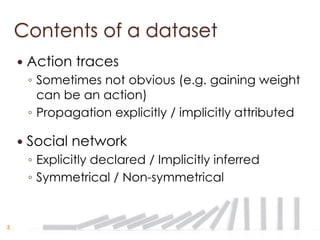
Contents of a dataset
       Action traces
        ◦ Sometimes not obvious (e.g. gaining weight
          can be an action)
        ◦ Propagation explicitly / implicitly attributed

       Social network
        ◦ Explicitly declared / Implicitly inferred
        ◦ Symmetrical / Non-symmetrical


3
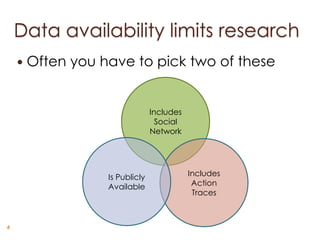
Data availability limits research
       Often you have to pick two of these


                                 Includes
                                   Social
                                 Network


                   Is Publicly              Includes
                   Available                 Action
                                             Traces


4
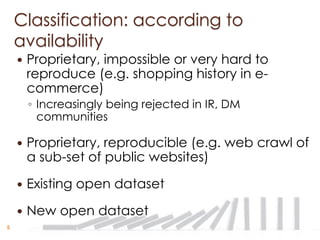
Classification: according to
    availability
       Proprietary, impossible or very hard to
        reproduce (e.g. shopping history in e-
        commerce)
        ◦ Increasingly being rejected in IR, DM
          communities

       Proprietary, reproducible (e.g. web crawl of
        a sub-set of public websites)

       Existing open dataset

       New open dataset
5
Propagation of Information
           “Memes”


6
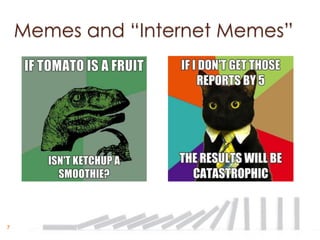
Memes and “Internet Memes”


7
Microblogging data
       Providers: Twitter, Identi.ca, Diaspora, etc.
        ◦ Directly or through data re-sellers

       Actions: posting a message

       Connections: explicitly declared, non-
        symmetrical

       Propagations: explicitly linked (in principle),
        but implicitly linked (in practice) due to
        client implementations
8
Extracting info. propagations
       Idea: start from a large corpus and then
        extract information propagations
        ◦ Blogs, news articles, academic papers, generic
          web pages, etc.
        ◦ Simple in theory, extremely difficult in practice

       Looking for citations doesn't work
        ◦ People on the web seldom attribute explicitly

       Keywords and phrases
        ◦ Usually end up with a mixture of too broad (e.g.
          stylistic idioms) and/or too narrow (e.g. one
          specific copy of a news item) “topics”
9
Using #hashtags and URLs
        Twitter: #hashtags and URLs

        With some exceptions
         ◦ #hashtags are too broad,
         ◦ URLs are too narrow

        Let's propose two methods that can
         alleviate these problems ...


10
Extracting info. propagations:
     Meme tracker
        Public dataset: http://memetracker.org/

        Tracks “mutated” key phrases in a
         document collection, example cluster:
           the fundamentals of our economy are strong
           the fundamentals of the economy are strong
           i promise you we will never put america in this position again we will clean up wall street
           the fundamentals of our economy are strong but these are very very difficult times and i
           promise you we will never put america in this position again
           but these are very very difficult times


        No a-priori network exists. Inference
         methods are used.
11                                                                      [Leskovec et al. KDD 2009]
Extracting info. propagations:
     Meme tracker


12                          [Leskovec et al. KDD 2009]
Extracting info. propagation:
     Trending topics
        Method
         ◦ Look for “bursty” (spiky, trending) topics,
           represented e.g. as a collection of keywords
         ◦ Track the propagation of those topics

        Rely on a proven method for burst
           detection
         ◦ The tricky part is not to detect the burst, but
           to represent it (e.g. as a query) e.g. Haiti
           earthquake tweets might not include “Haiti”
           or “earthquake”
13                             [Mathioudakis and Koudas, SIGMOD 2010]
Extracting information
     propagations: Other methods
        Internet chain letters; look for copies
         online of petition letters


14                           [Liben-Nowell and Kleinberg, PNAS 2008]
Sampling issues
   Issues with recall along information
    cascades
    ◦ e.g. twitter stream 1% sample gardenhose


                                [Sadikov et al. WSDM 2011]
Propagation of Other Actions


16
Consuming media and products
        Media consumption/appraisal platforms
         ◦ Examples: Flixter / Last.fm / GoodReads
           Action: rating, watching, listening or reading a
            movie, a song, or a book
           Connections: Explicit friendships
         ◦ Propagations: usually implicitly linked unless
           “recommend to a friend” feature is used and
           publicly available

        Product recommendations
         ◦ Example: @cosme cosmetics
           recommendations
17
@cosme recommendations


18                [Matsuo and Yamamoto, WWW 2009]
Cross-provider data
        One provides the network, the other the
         actions

        MSN + Bing: Social network is MSN IM,
         actions are searches

        YIM + YMovies


19                [Singla and Richardson, WWW 2008] [Goyal et al. CIKM 2008]
Phone calls
        Social networks are calls, actions are
         leaving the company (“churning”)

        Some call datasets are available for
         academic labs (not for industrial ones)


20                                  [Dasgupta et al. EDBT 2008]
Phone calls


21                 [Senseable City Lab, MIT, 2009]
Community membership
        DBLP/Arnetminer
         ◦ Social network is co-authorship
         ◦ Action is publishing in a conference or
           publishing on a topic

        Livejournal / Flickr
         ◦ Social network is friendship graph
         ◦ Action is joining a community/group

        Bloglines
         ◦ Action is subscribing to a rss feed
22
Other datasets
        Flickr
         ◦ Explicit friendship, action is (1) favoring a
           photo or (2) using a tag

        Digg/Reddit votes
           Explicit friendship, action is vote-up


23
Off-line datasets
        Participation of women in 14 social
         activities over 9 months in US south (n=18)

        Romantic network in a high school (n=288)

        Medical records during 32 years (n=12,067)

        Network only
         ◦ Zachary's Karate club
         ◦ Presumed acquaintances links between terrorist
           suspects (n=74, n=63 if main CC is used)
24
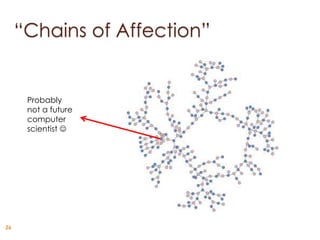
“Chains of Affection”


25               [Bearman et al. Amer. Journal of Sociology 2004]
“Chains of Affection”


      Probably
      not a future
      computer
      scientist 


26
Size proportional to BMI, yellow fill indicates obesity. Blue border=men, Red border=women

27                        [Christakis and Fowler, New England Journal of Medicine 2007]
Synthetic Datasets


28
Network data are widely available
        Domains
         ◦ Online social networks: slashdot, epinions, …
         ◦ Communication: internet as, p2p, roads, …
         ◦ Collaboration: scientists, actors, jazz
           musicians, wikipedia editors, ...
         ◦ Citations: web graphs, academic
           publications, patents, …
         ◦ References: linked data in
           freebase/dbpedia, protein interactions,
           metabolic networks, ...
29
Publishing your own datasets
        Document every step of sampling, filtering,
         processing methodology
        CC0 (public domain) data releases
        Ad-hoc data releases: look at items in example
         agreements (duration, purpose, warranties, item
         deletion policies, etc.)
        Privacy concerns
        It may take some extra work, but remember that
         it is also in YOUR interest that your data is used
         by others
30
Software


31
Graph software Tools
        Software
         ◦ SNAP [GPL] Gephi [GPL, gui]
         ◦ Pajek [Free for non-commercial use, Windows, gui
         ◦ Webgraph [GPL] Graphviz [GPL]

        Graph generation, transformation,
         ◦ SNAP, Gephi, Pajek, Webgraph [compress], ...

        Subgraphs: clustering, connected components, etc. Node
         metrics: centrality, local clustering coeff.
         ◦ SNAP, Gephi, Pajek

        Graph visualization: Gephi, Pajek, Graphviz

        Other:
         https://sites.google.com/site/ucinetsoftware/downloads
32
Propagation software tools
        SPINE software
         ◦ IC model
         ◦ Inference with given social network
         ◦ Sparsification of influence models

        Internet network simulator

        Ask authors, some software is known to
         be available on request

33
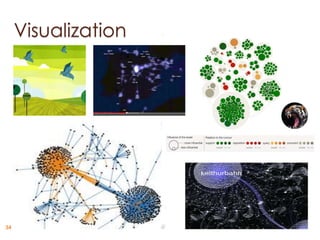
Visualization


34
Visualization


35                   [Project Cascade by NYT Labs 2011]
Key takeaways of part II
        Data availability affects our research

        Current alternatives are not good
         ◦ Results on proprietary data sources are not
           reproducible
         ◦ Synthetic information propagations might
           not be realistic

        Software is not readily available

        This is something to work on collectively!
36

Kdd12 tutorial-inf-part-ii

  • 1.
    Part I →Part II → Part III → Part IV → Part V Data and Software
  • 2.
    Part II: Outline  Types of datasets  Propagation of information “memes”  Propagation of other actions  Synthetic datasets  Software tools 2
  • 3.
    Contents of adataset  Action traces ◦ Sometimes not obvious (e.g. gaining weight can be an action) ◦ Propagation explicitly / implicitly attributed  Social network ◦ Explicitly declared / Implicitly inferred ◦ Symmetrical / Non-symmetrical 3
  • 4.
    Data availability limitsresearch  Often you have to pick two of these Includes Social Network Is Publicly Includes Available Action Traces 4
  • 5.
    Classification: according to availability  Proprietary, impossible or very hard to reproduce (e.g. shopping history in e- commerce) ◦ Increasingly being rejected in IR, DM communities  Proprietary, reproducible (e.g. web crawl of a sub-set of public websites)  Existing open dataset  New open dataset 5
  • 6.
  • 7.
  • 8.
    Microblogging data  Providers: Twitter, Identi.ca, Diaspora, etc. ◦ Directly or through data re-sellers  Actions: posting a message  Connections: explicitly declared, non- symmetrical  Propagations: explicitly linked (in principle), but implicitly linked (in practice) due to client implementations 8
  • 9.
    Extracting info. propagations  Idea: start from a large corpus and then extract information propagations ◦ Blogs, news articles, academic papers, generic web pages, etc. ◦ Simple in theory, extremely difficult in practice  Looking for citations doesn't work ◦ People on the web seldom attribute explicitly  Keywords and phrases ◦ Usually end up with a mixture of too broad (e.g. stylistic idioms) and/or too narrow (e.g. one specific copy of a news item) “topics” 9
  • 10.
    Using #hashtags andURLs  Twitter: #hashtags and URLs  With some exceptions ◦ #hashtags are too broad, ◦ URLs are too narrow  Let's propose two methods that can alleviate these problems ... 10
  • 11.
    Extracting info. propagations: Meme tracker  Public dataset: http://memetracker.org/  Tracks “mutated” key phrases in a document collection, example cluster: the fundamentals of our economy are strong the fundamentals of the economy are strong i promise you we will never put america in this position again we will clean up wall street the fundamentals of our economy are strong but these are very very difficult times and i promise you we will never put america in this position again but these are very very difficult times  No a-priori network exists. Inference methods are used. 11 [Leskovec et al. KDD 2009]
  • 12.
    Extracting info. propagations: Meme tracker 12 [Leskovec et al. KDD 2009]
  • 13.
    Extracting info. propagation: Trending topics  Method ◦ Look for “bursty” (spiky, trending) topics, represented e.g. as a collection of keywords ◦ Track the propagation of those topics  Rely on a proven method for burst detection ◦ The tricky part is not to detect the burst, but to represent it (e.g. as a query) e.g. Haiti earthquake tweets might not include “Haiti” or “earthquake” 13 [Mathioudakis and Koudas, SIGMOD 2010]
  • 14.
    Extracting information propagations: Other methods  Internet chain letters; look for copies online of petition letters 14 [Liben-Nowell and Kleinberg, PNAS 2008]
  • 15.
    Sampling issues  Issues with recall along information cascades ◦ e.g. twitter stream 1% sample gardenhose [Sadikov et al. WSDM 2011]
  • 16.
  • 17.
    Consuming media andproducts  Media consumption/appraisal platforms ◦ Examples: Flixter / Last.fm / GoodReads  Action: rating, watching, listening or reading a movie, a song, or a book  Connections: Explicit friendships ◦ Propagations: usually implicitly linked unless “recommend to a friend” feature is used and publicly available  Product recommendations ◦ Example: @cosme cosmetics recommendations 17
  • 18.
    @cosme recommendations 18 [Matsuo and Yamamoto, WWW 2009]
  • 19.
    Cross-provider data  One provides the network, the other the actions  MSN + Bing: Social network is MSN IM, actions are searches  YIM + YMovies 19 [Singla and Richardson, WWW 2008] [Goyal et al. CIKM 2008]
  • 20.
    Phone calls  Social networks are calls, actions are leaving the company (“churning”)  Some call datasets are available for academic labs (not for industrial ones) 20 [Dasgupta et al. EDBT 2008]
  • 21.
    Phone calls 21 [Senseable City Lab, MIT, 2009]
  • 22.
    Community membership  DBLP/Arnetminer ◦ Social network is co-authorship ◦ Action is publishing in a conference or publishing on a topic  Livejournal / Flickr ◦ Social network is friendship graph ◦ Action is joining a community/group  Bloglines ◦ Action is subscribing to a rss feed 22
  • 23.
    Other datasets  Flickr ◦ Explicit friendship, action is (1) favoring a photo or (2) using a tag  Digg/Reddit votes  Explicit friendship, action is vote-up 23
  • 24.
    Off-line datasets  Participation of women in 14 social activities over 9 months in US south (n=18)  Romantic network in a high school (n=288)  Medical records during 32 years (n=12,067)  Network only ◦ Zachary's Karate club ◦ Presumed acquaintances links between terrorist suspects (n=74, n=63 if main CC is used) 24
  • 25.
    “Chains of Affection” 25 [Bearman et al. Amer. Journal of Sociology 2004]
  • 26.
    “Chains of Affection” Probably not a future computer scientist  26
  • 27.
    Size proportional toBMI, yellow fill indicates obesity. Blue border=men, Red border=women 27 [Christakis and Fowler, New England Journal of Medicine 2007]
  • 28.
  • 29.
    Network data arewidely available  Domains ◦ Online social networks: slashdot, epinions, … ◦ Communication: internet as, p2p, roads, … ◦ Collaboration: scientists, actors, jazz musicians, wikipedia editors, ... ◦ Citations: web graphs, academic publications, patents, … ◦ References: linked data in freebase/dbpedia, protein interactions, metabolic networks, ... 29
  • 30.
    Publishing your owndatasets  Document every step of sampling, filtering, processing methodology  CC0 (public domain) data releases  Ad-hoc data releases: look at items in example agreements (duration, purpose, warranties, item deletion policies, etc.)  Privacy concerns  It may take some extra work, but remember that it is also in YOUR interest that your data is used by others 30
  • 31.
  • 32.
    Graph software Tools  Software ◦ SNAP [GPL] Gephi [GPL, gui] ◦ Pajek [Free for non-commercial use, Windows, gui ◦ Webgraph [GPL] Graphviz [GPL]  Graph generation, transformation, ◦ SNAP, Gephi, Pajek, Webgraph [compress], ...  Subgraphs: clustering, connected components, etc. Node metrics: centrality, local clustering coeff. ◦ SNAP, Gephi, Pajek  Graph visualization: Gephi, Pajek, Graphviz  Other: https://sites.google.com/site/ucinetsoftware/downloads 32
  • 33.
    Propagation software tools  SPINE software ◦ IC model ◦ Inference with given social network ◦ Sparsification of influence models  Internet network simulator  Ask authors, some software is known to be available on request 33
  • 34.
  • 35.
    Visualization 35 [Project Cascade by NYT Labs 2011]
  • 36.
    Key takeaways ofpart II  Data availability affects our research  Current alternatives are not good ◦ Results on proprietary data sources are not reproducible ◦ Synthetic information propagations might not be realistic  Software is not readily available  This is something to work on collectively! 36