Emergent Trends and Tools in
Crisis Informatics
Adam Papendieck
Jan 30, 2014
Objectives
1. Gain an understanding of key trends in ICT
innovation which are influencing/disrupting
crisis informatics.
2. Be able to trace these trends through
discussions later this semester, and
understand their influence and potential.
3. Introduce visualization lab
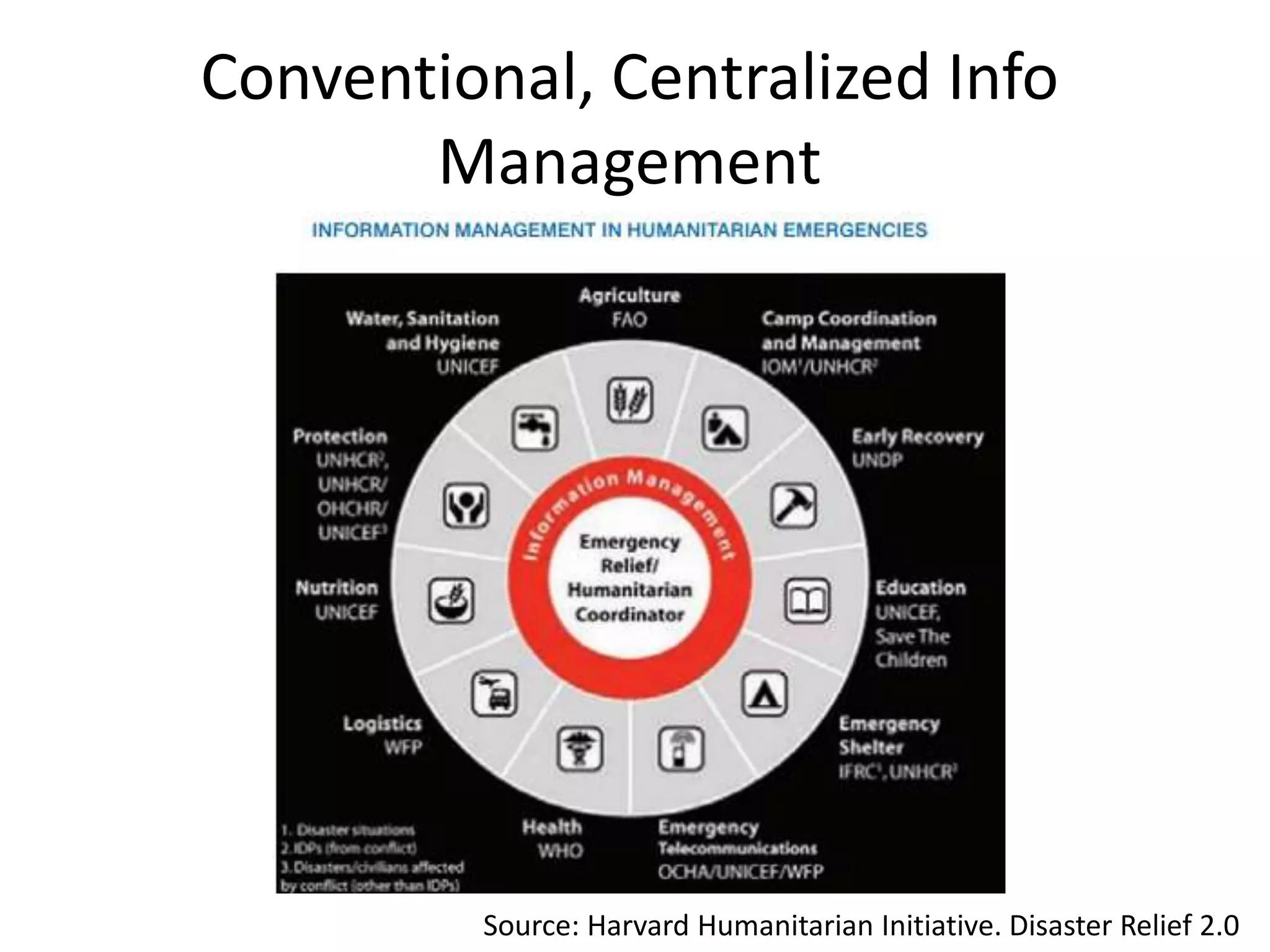
Conventional, Centralized Info
Management
Source: Harvard Humanitarian Initiative. Disaster Relief 2.0
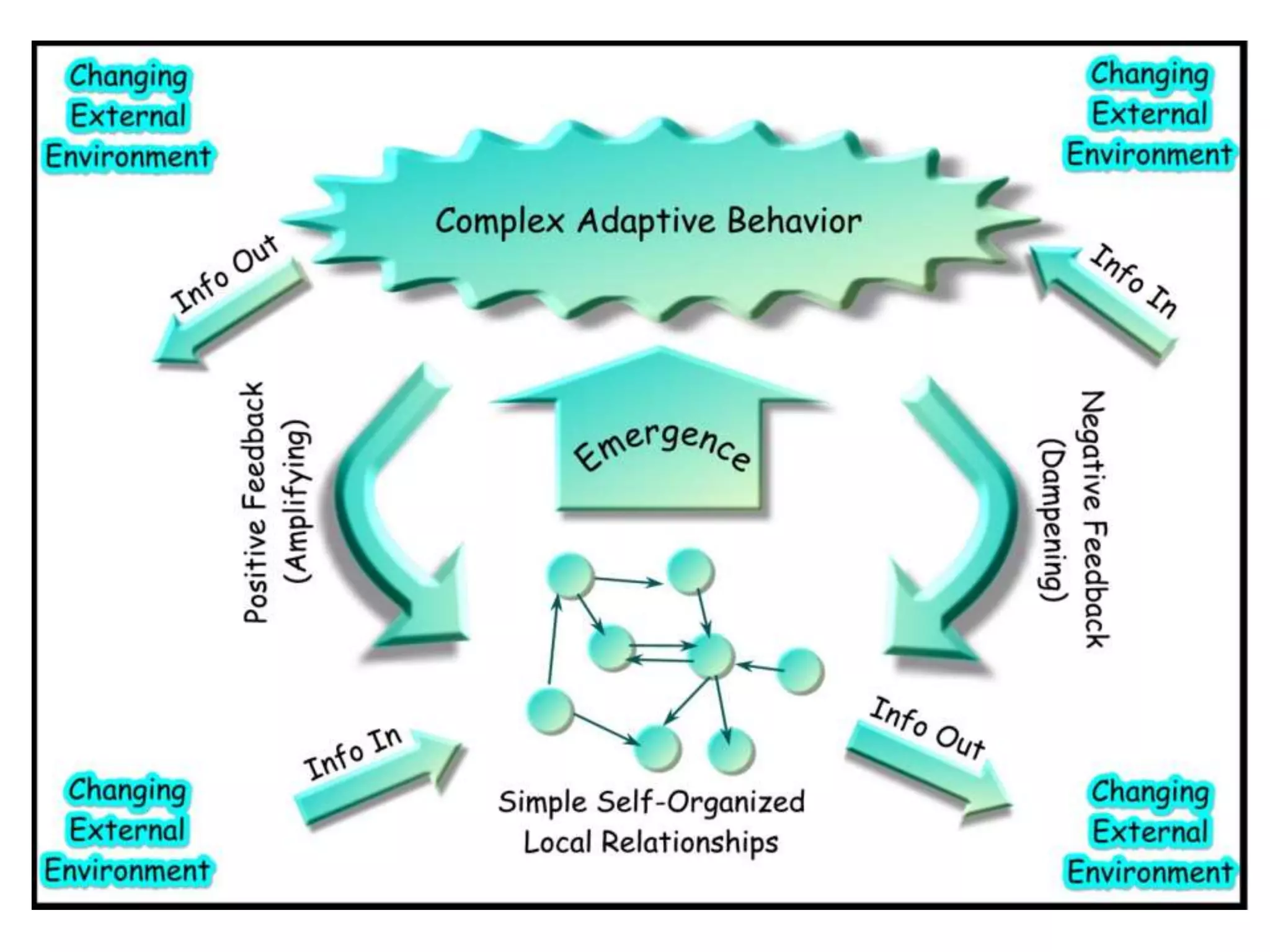
Crisis Information Ecosystem:
Complex Adaptive System
• Some information needs are clear and
structured.
• But the actual information ecosystems in
emergencies are complex and changing
rapidly.
• Individual technologies, information
systems and their relationship to others are
ephemeral, even in the short-to-medium
term. They evolve.
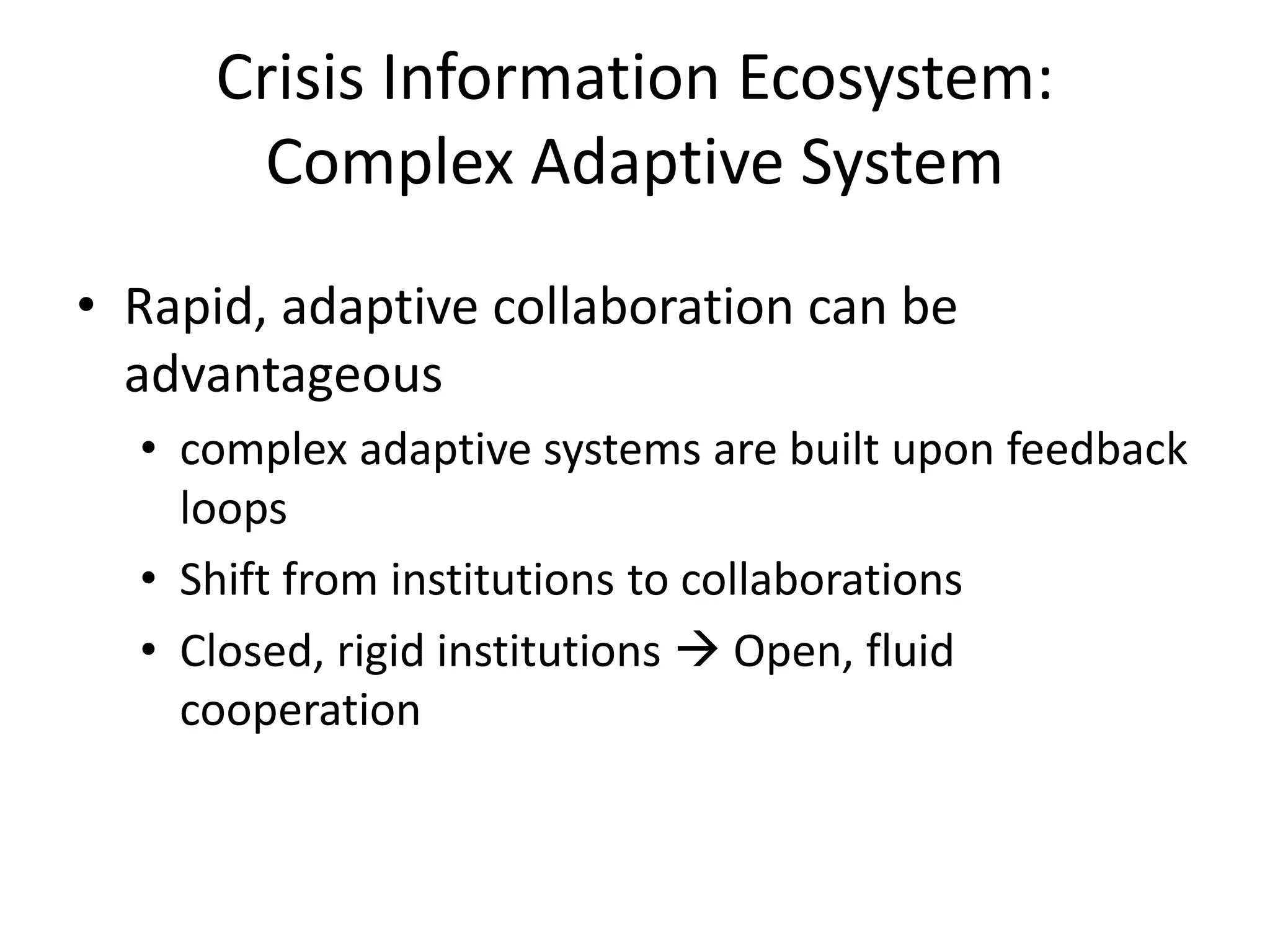
Crisis Information Ecosystem:
Complex Adaptive System
• Rapid, adaptive collaboration can be
advantageous
• complex adaptive systems are built upon feedback
loops
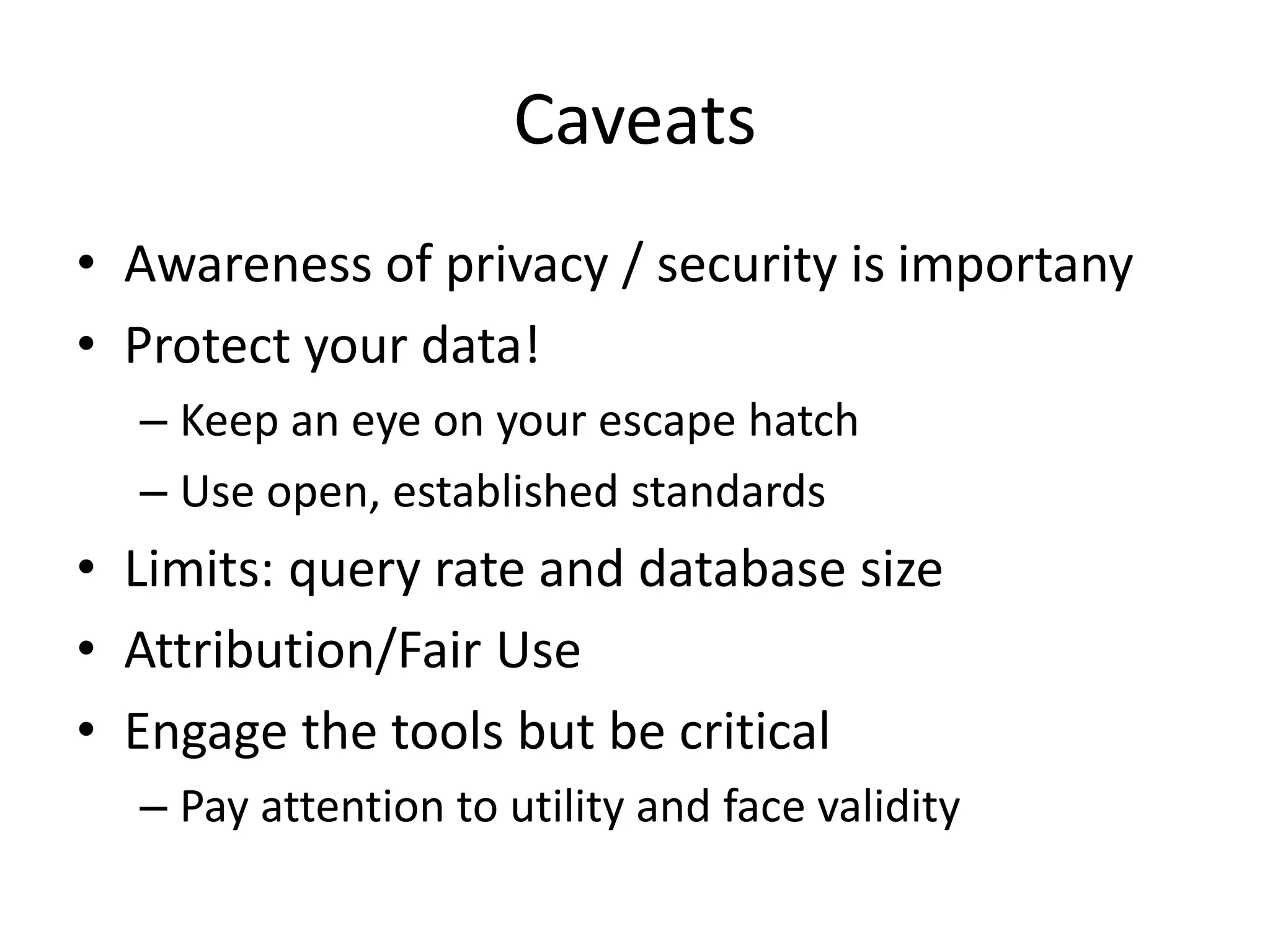
• Shift from institutions to collaborations
• Closed, rigid institutions  Open, fluid
cooperation
0
100
200
300
400
500
600
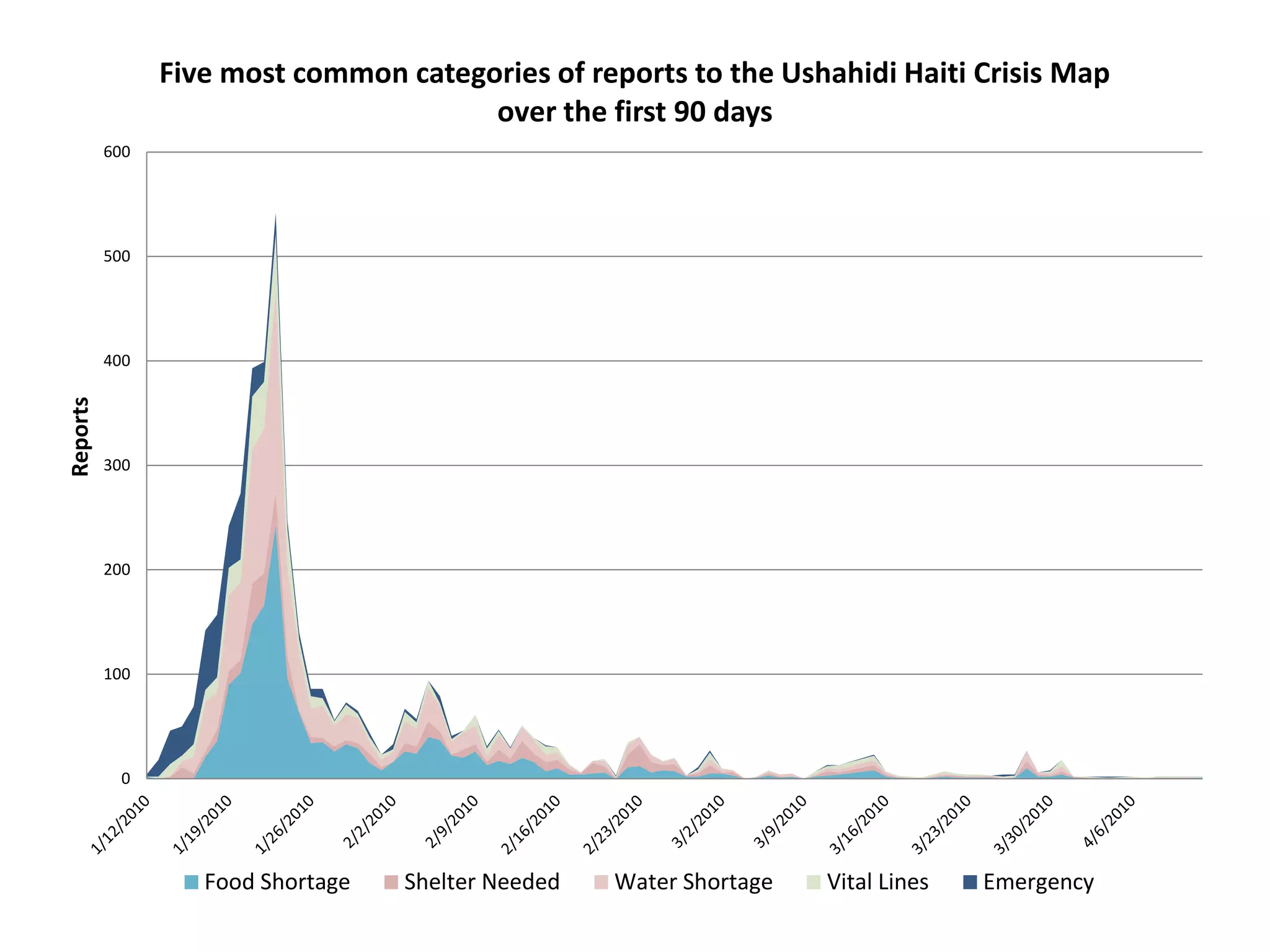
Five most common categories of reports to the Ushahidi Haiti Crisis Map
over the first 90 days
Food Shortage Shelter Needed Water Shortage Vital Lines Emergency
Reports
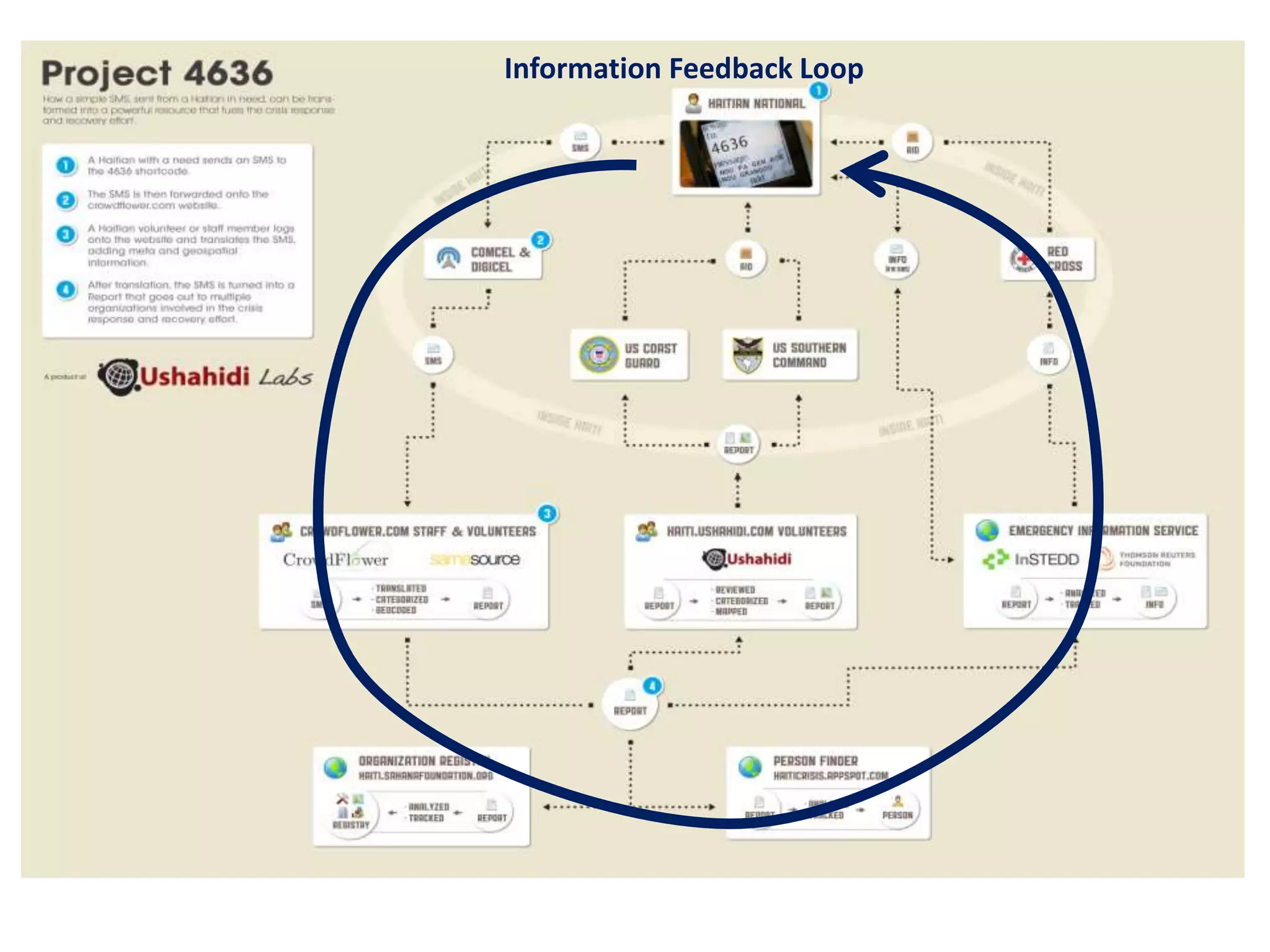
Information Feedback Loop
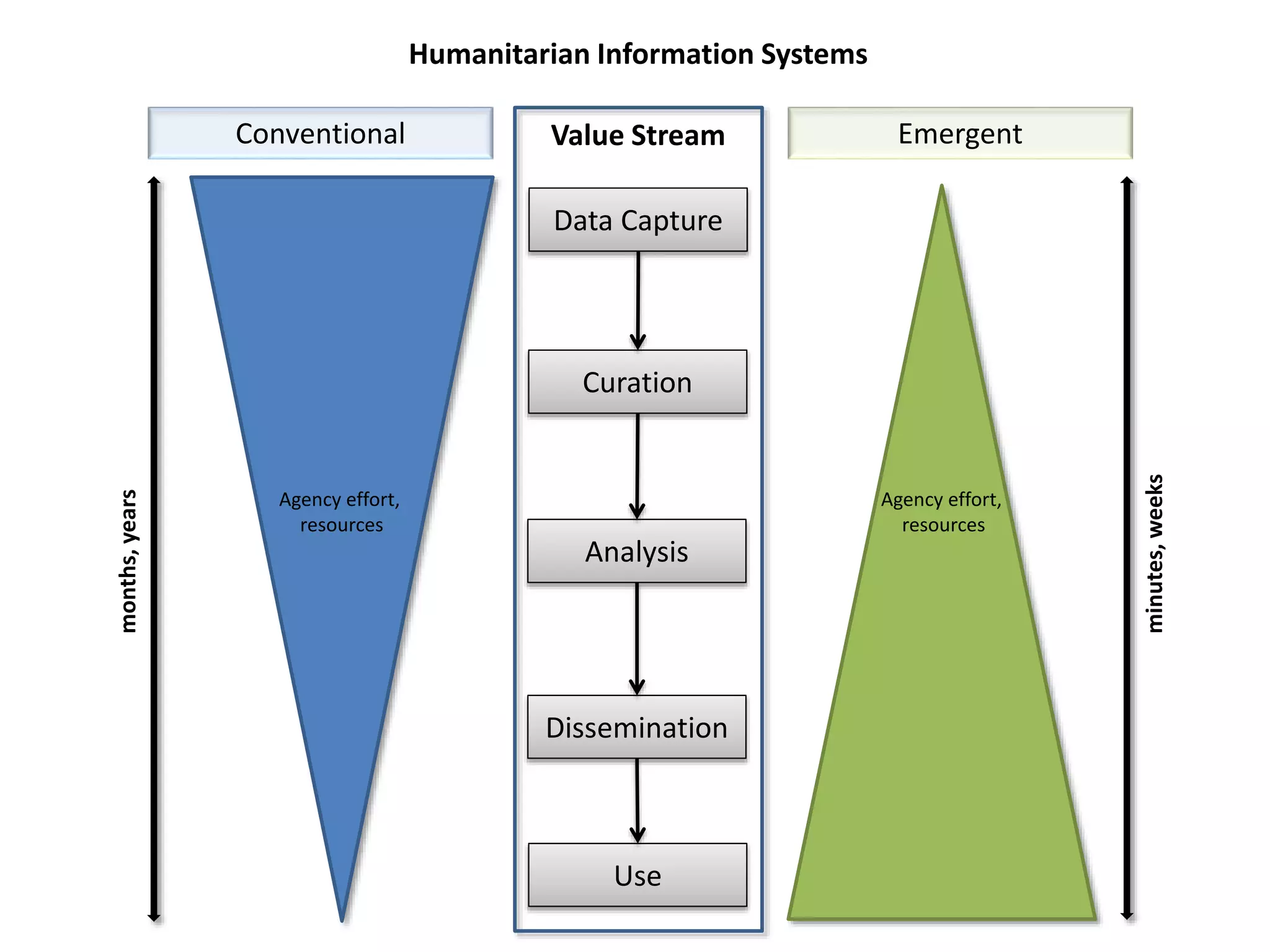
Data Capture
Curation
Analysis
Dissemination
Use
months,years
minutes,weeks
Agency effort,
resources
Agency effort,
resources
Value StreamConventional Emergent
Humanitarian Information Systems
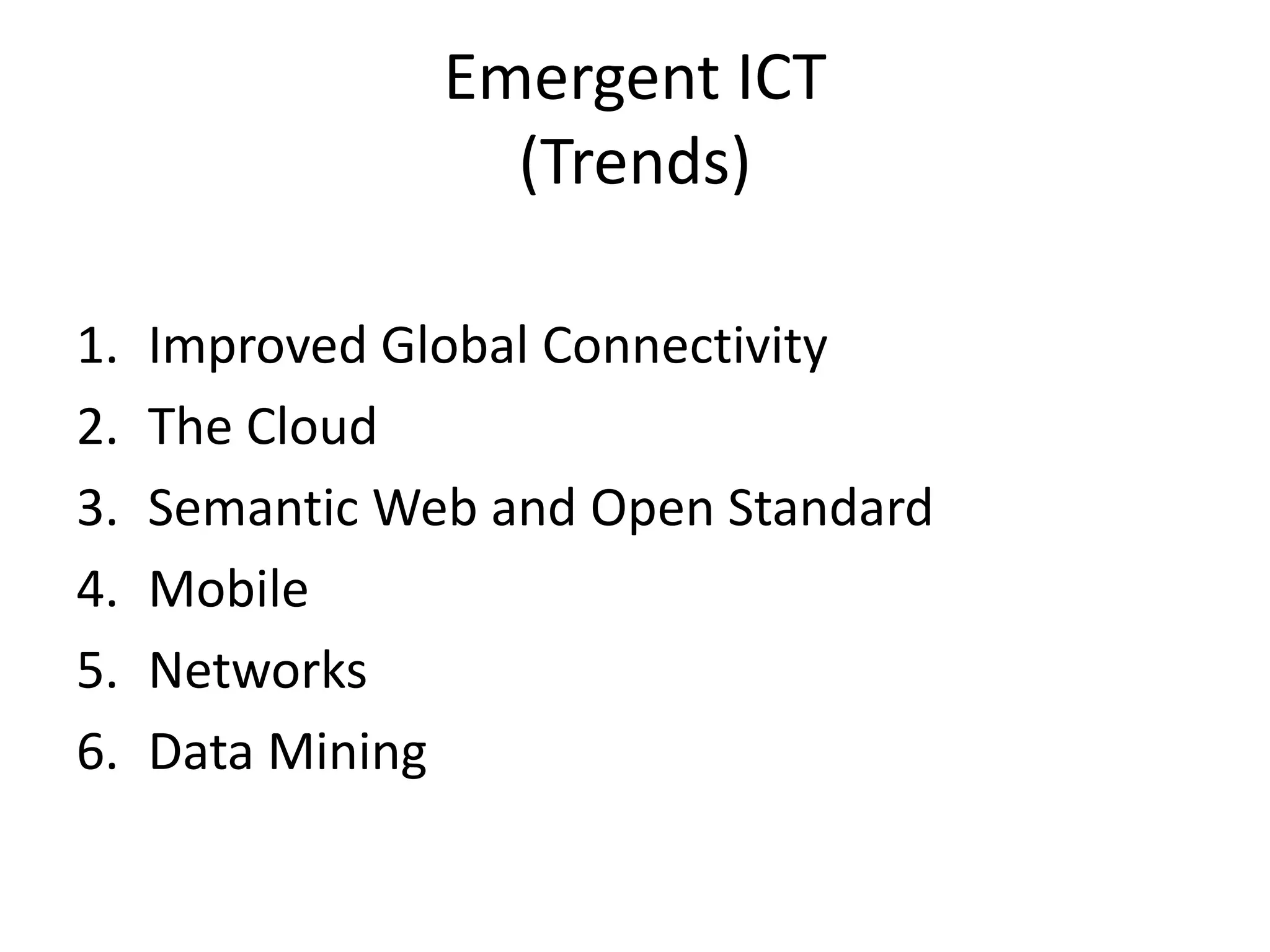
Emergent ICT
(Trends)
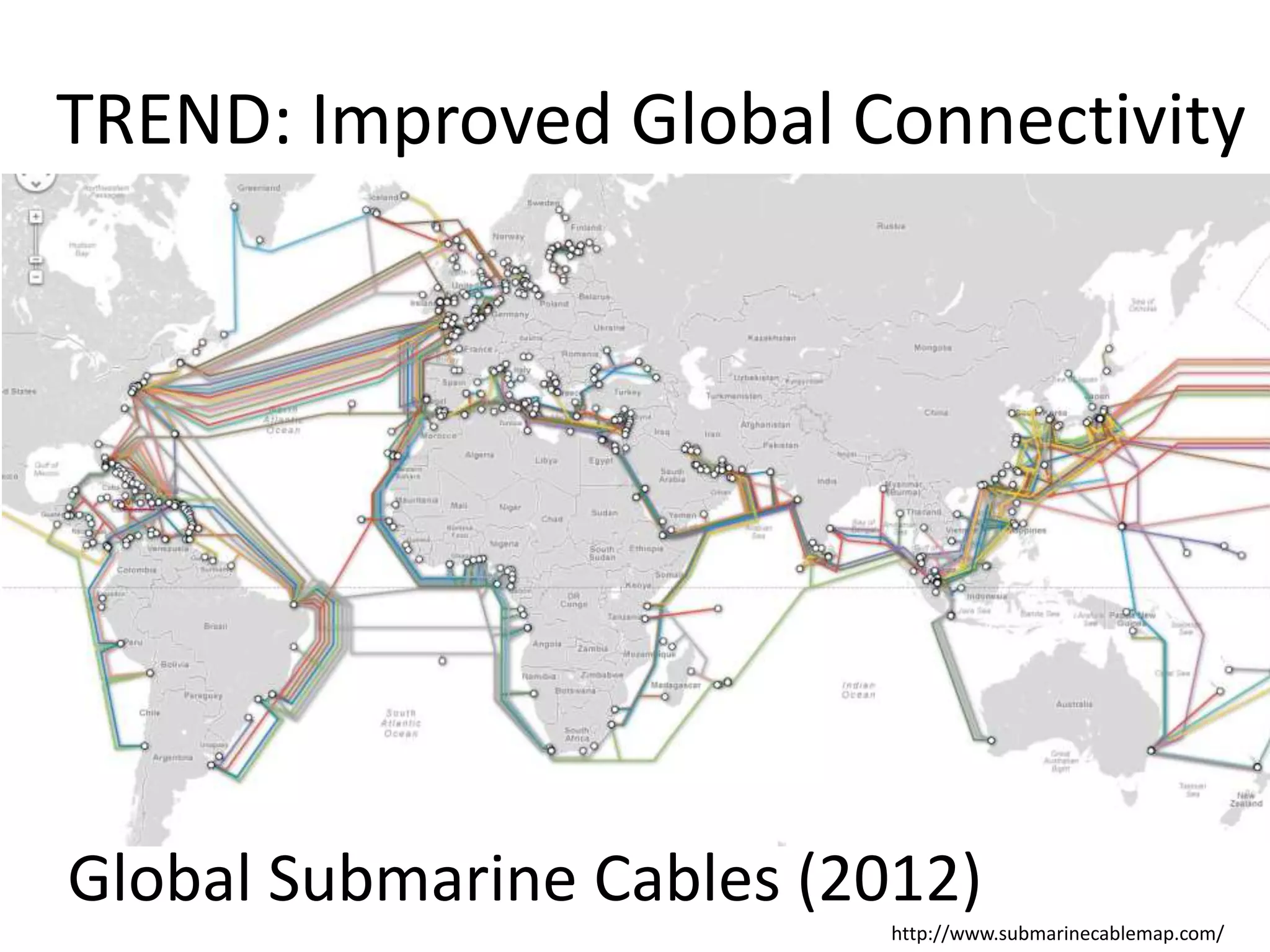
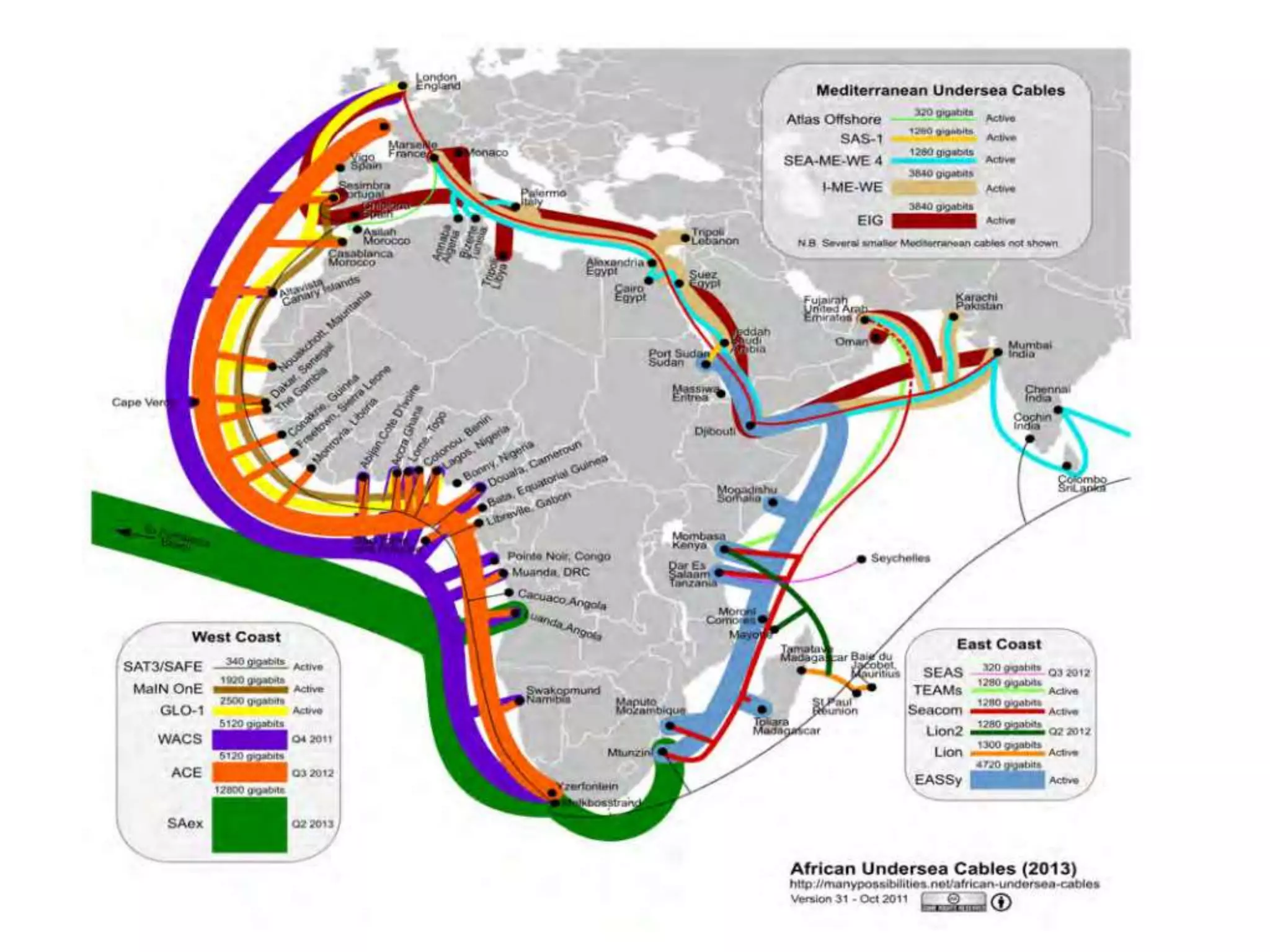
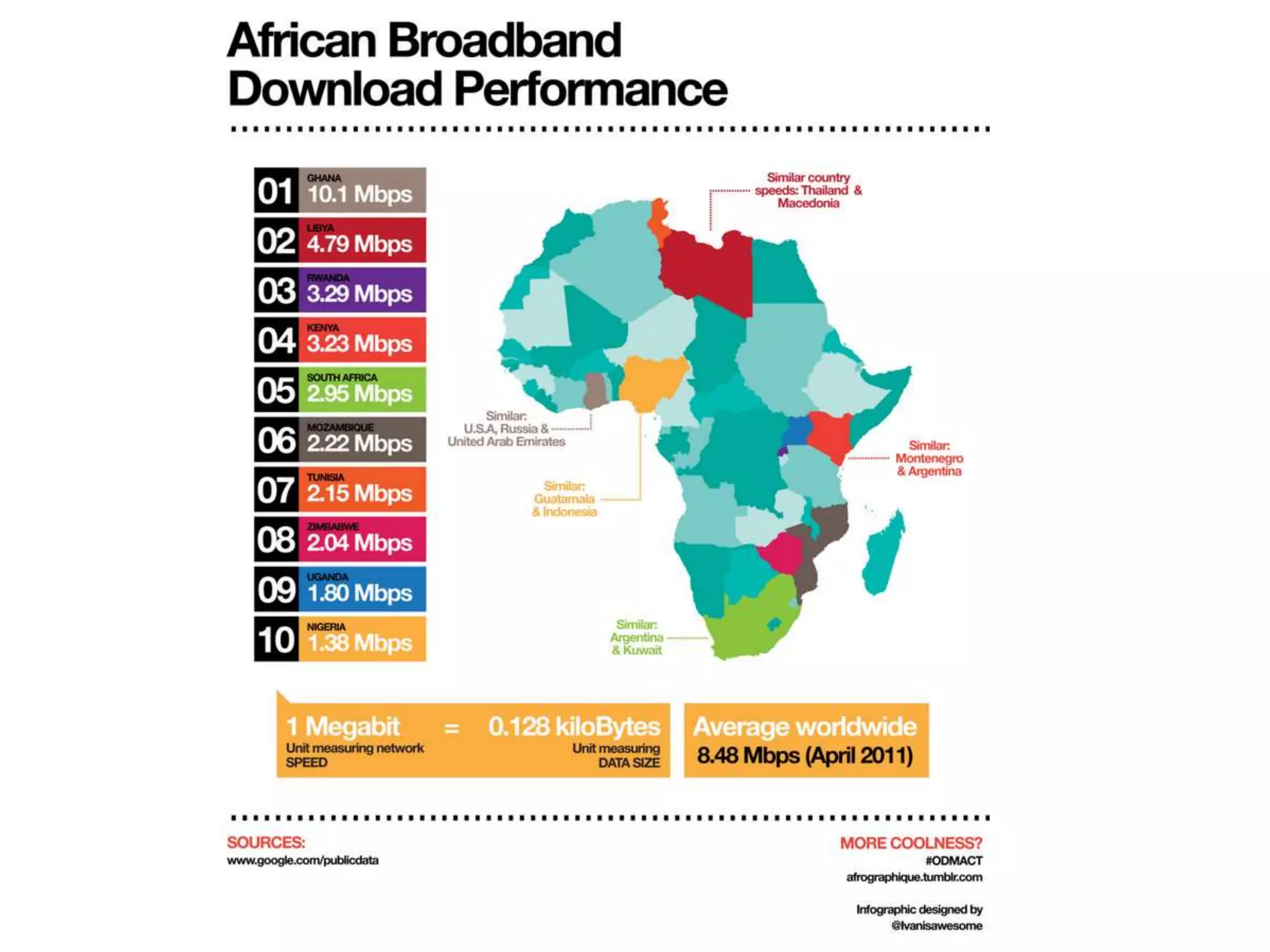
1. Improved Global Connectivity
2. The Cloud
3. Semantic Web and Open Standard
4. Mobile
5. Networks
6. Data Mining
http://www.submarinecablemap.com/
TREND: Improved Global Connectivity
Global Submarine Cables (2012)
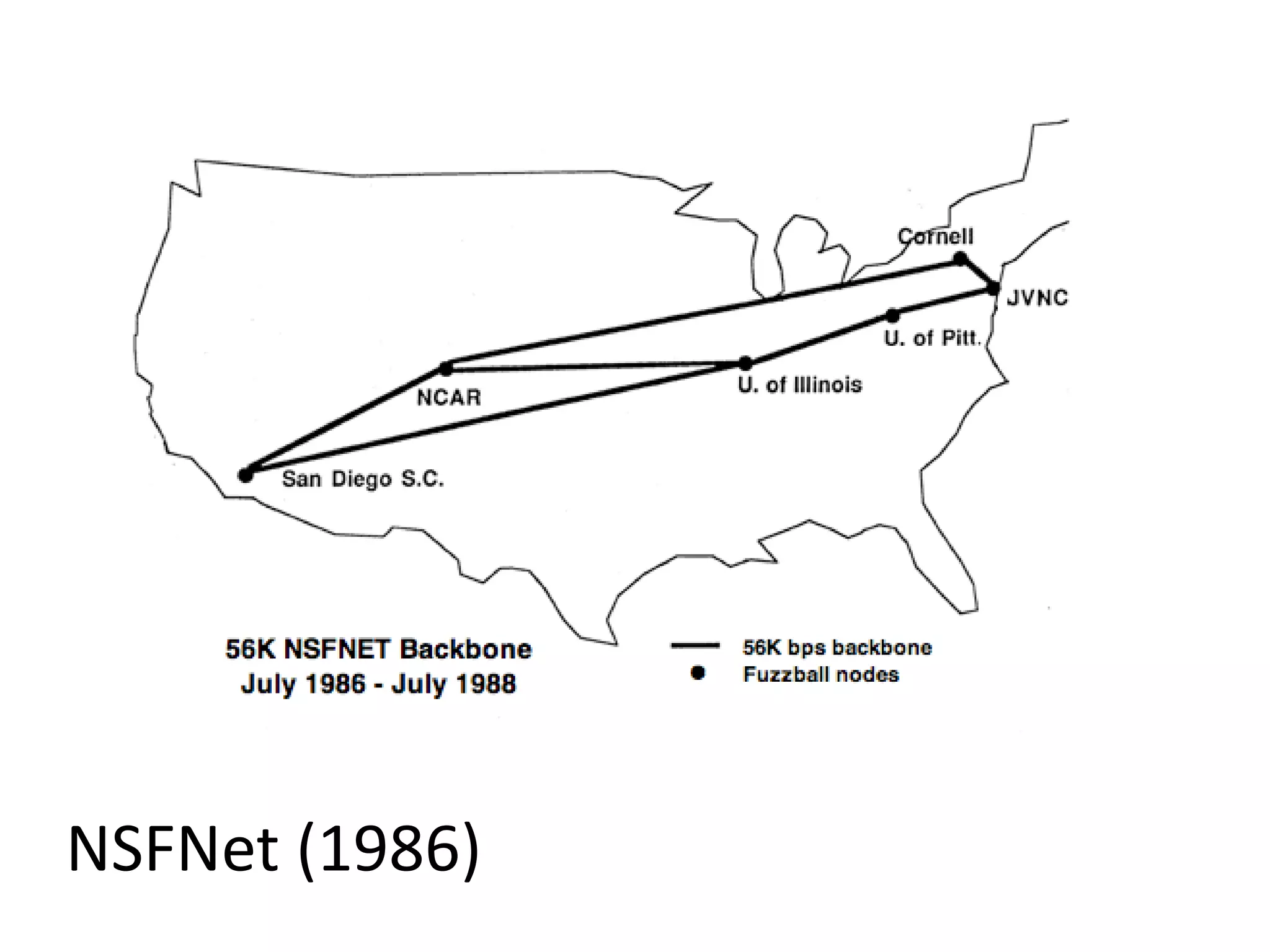
NSFNet (1986)
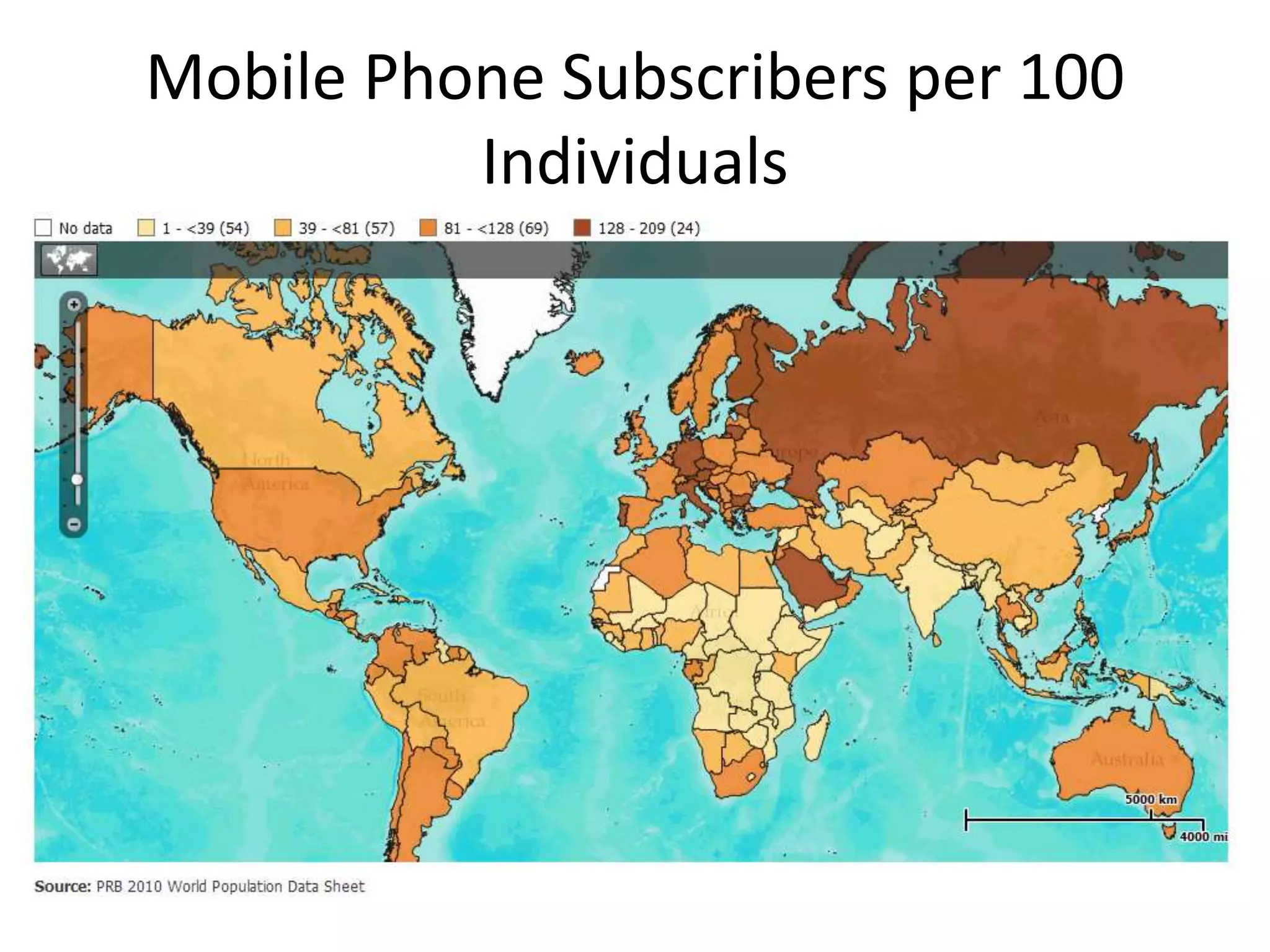
Mobile Phone Subscribers per 100
Individuals
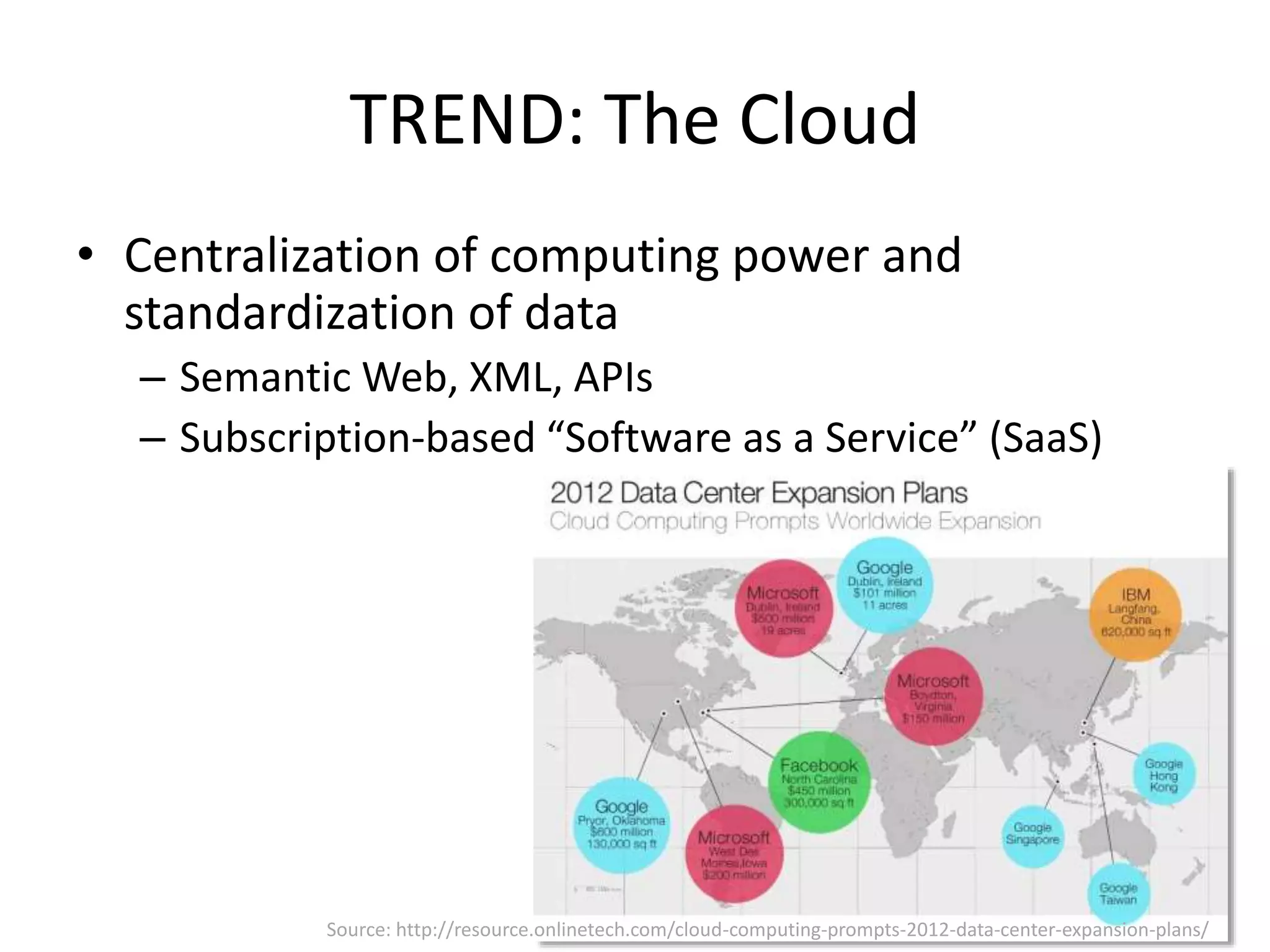
TREND: The Cloud
• Centralization of computing power and
standardization of data
– Semantic Web, XML, APIs
– Subscription-based “Software as a Service” (SaaS)
Source: http://resource.onlinetech.com/cloud-computing-prompts-2012-data-center-expansion-plans/
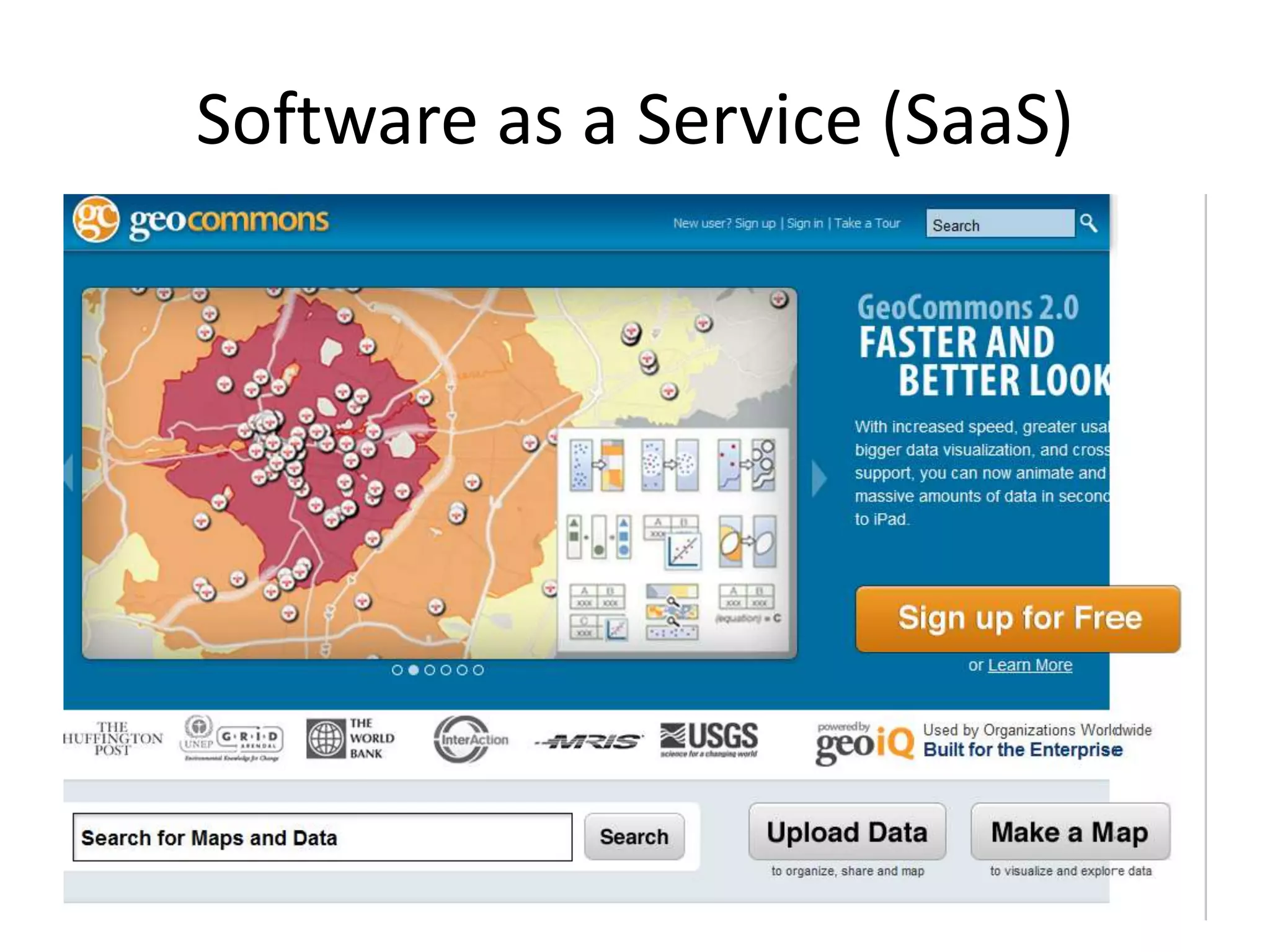
Software as a Service (SaaS)
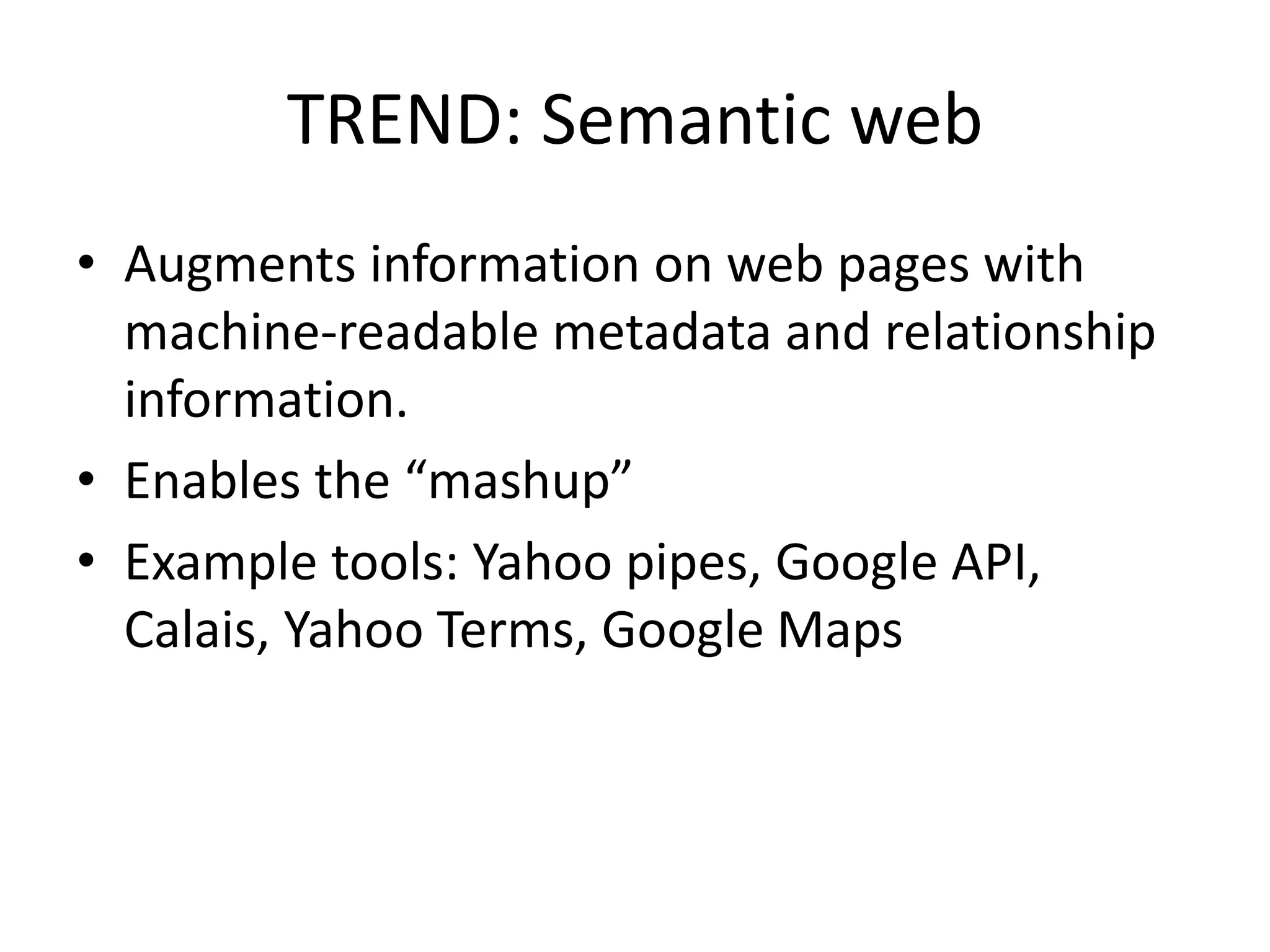
TREND: Semantic web
• Old characteristics of the web: HTML, text,
individual static web pages
• New characteristics: XML, APIs (Application
Programming Interfaces), webservices, open
standards, dynamic and interactive web pages
TREND: Semantic web
• Augments information on web pages with
machine-readable metadata and relationship
information.
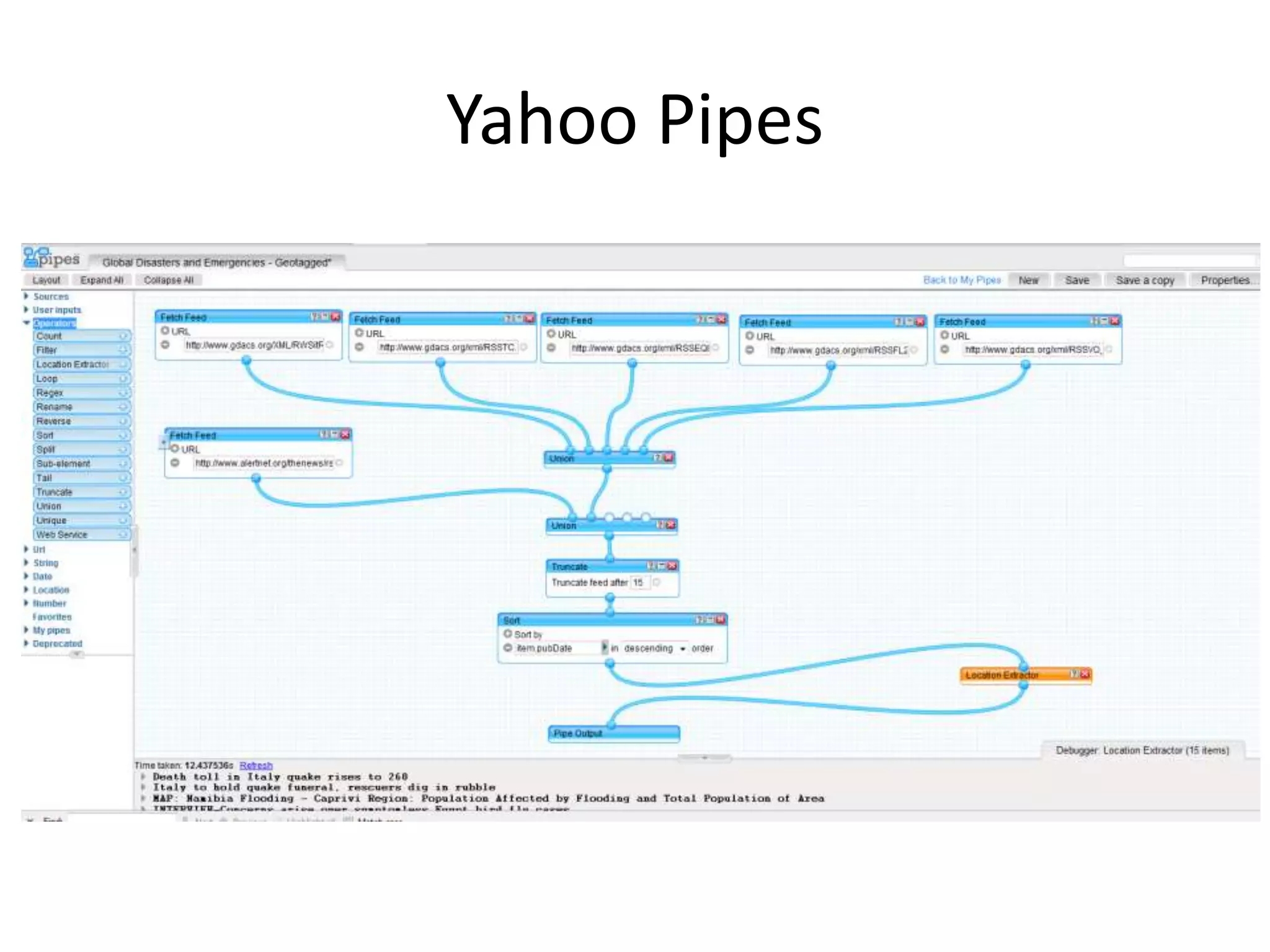
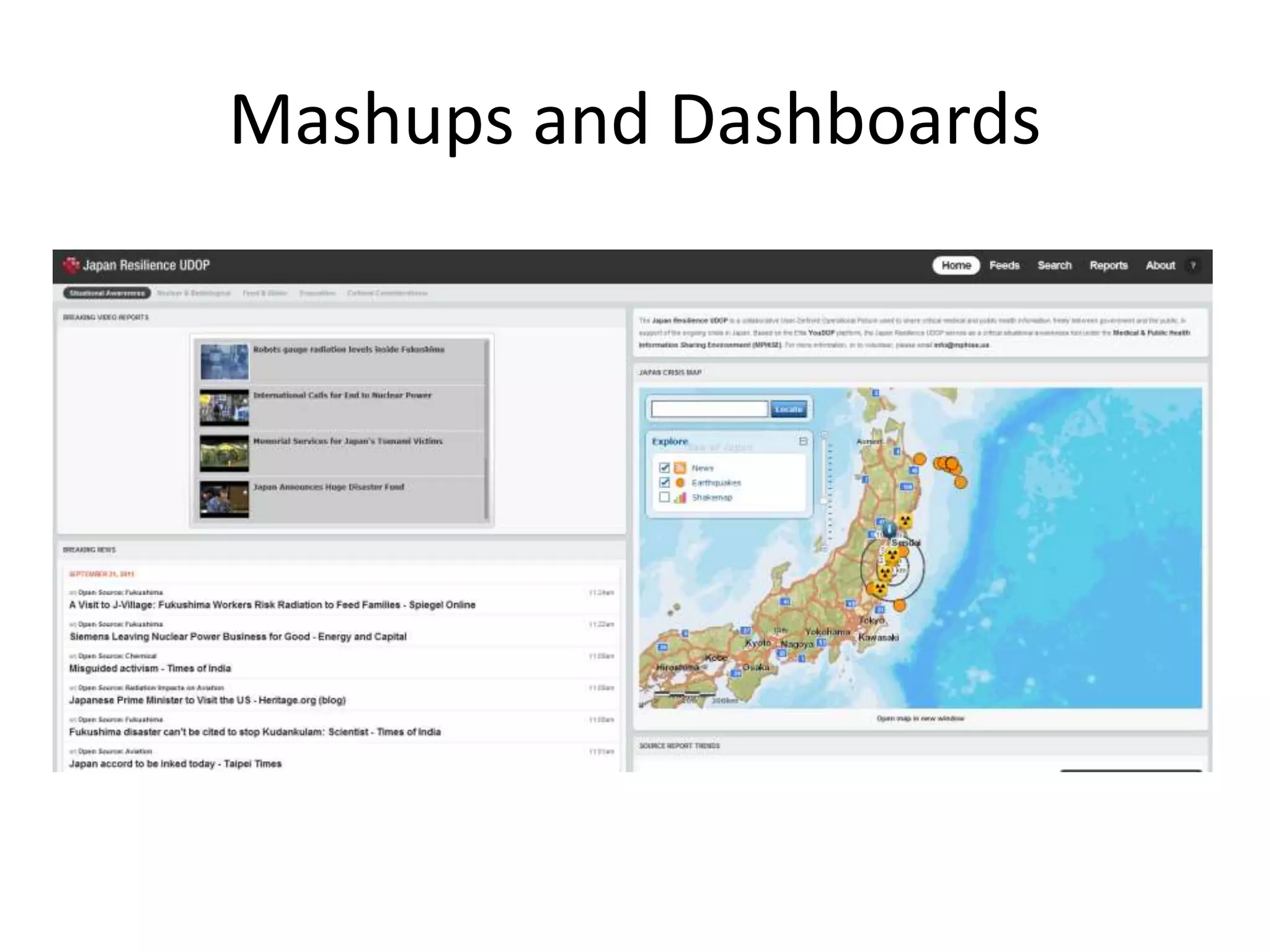
• Enables the “mashup”
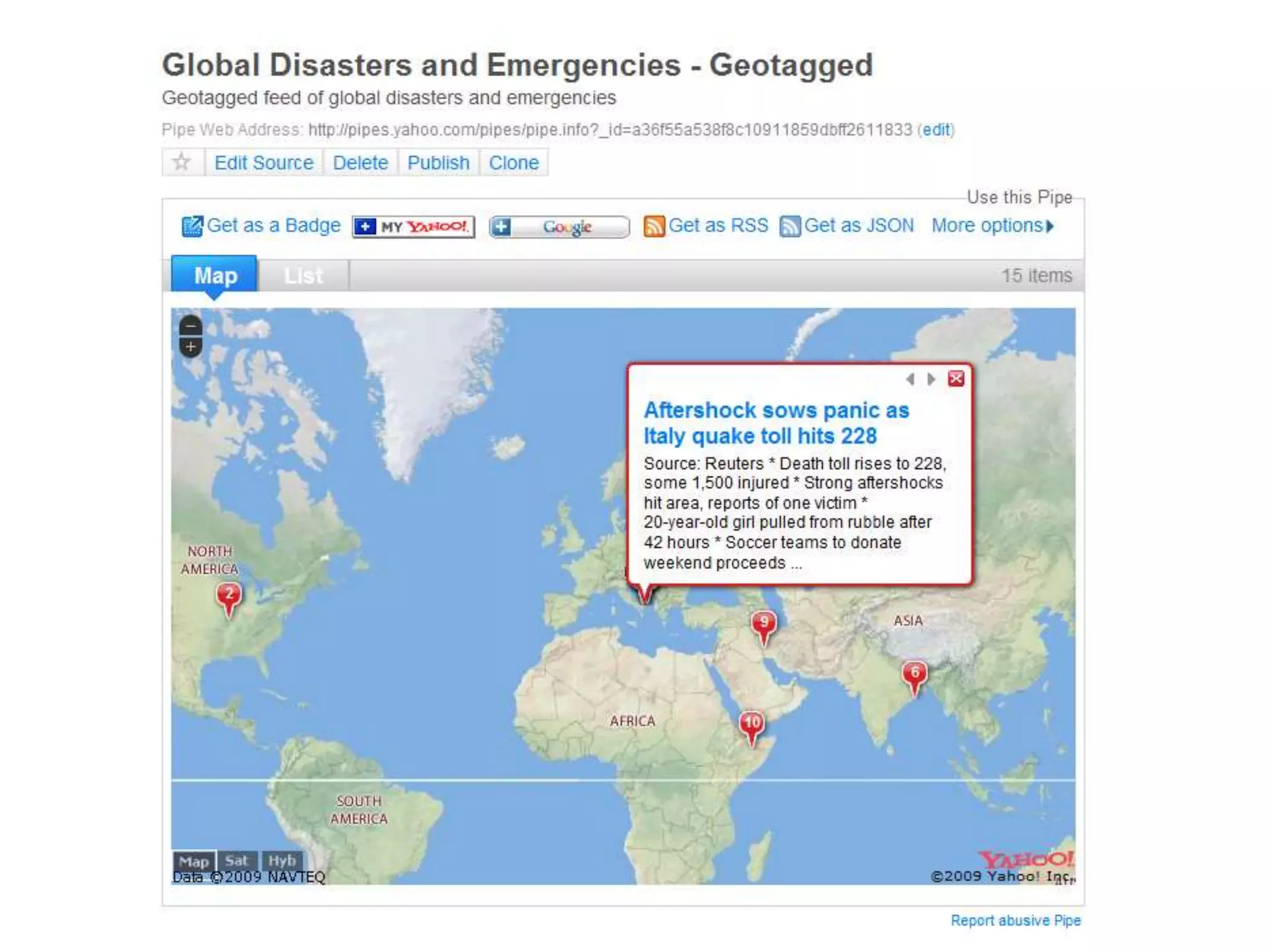
• Example tools: Yahoo pipes, Google API,
Calais, Yahoo Terms, Google Maps
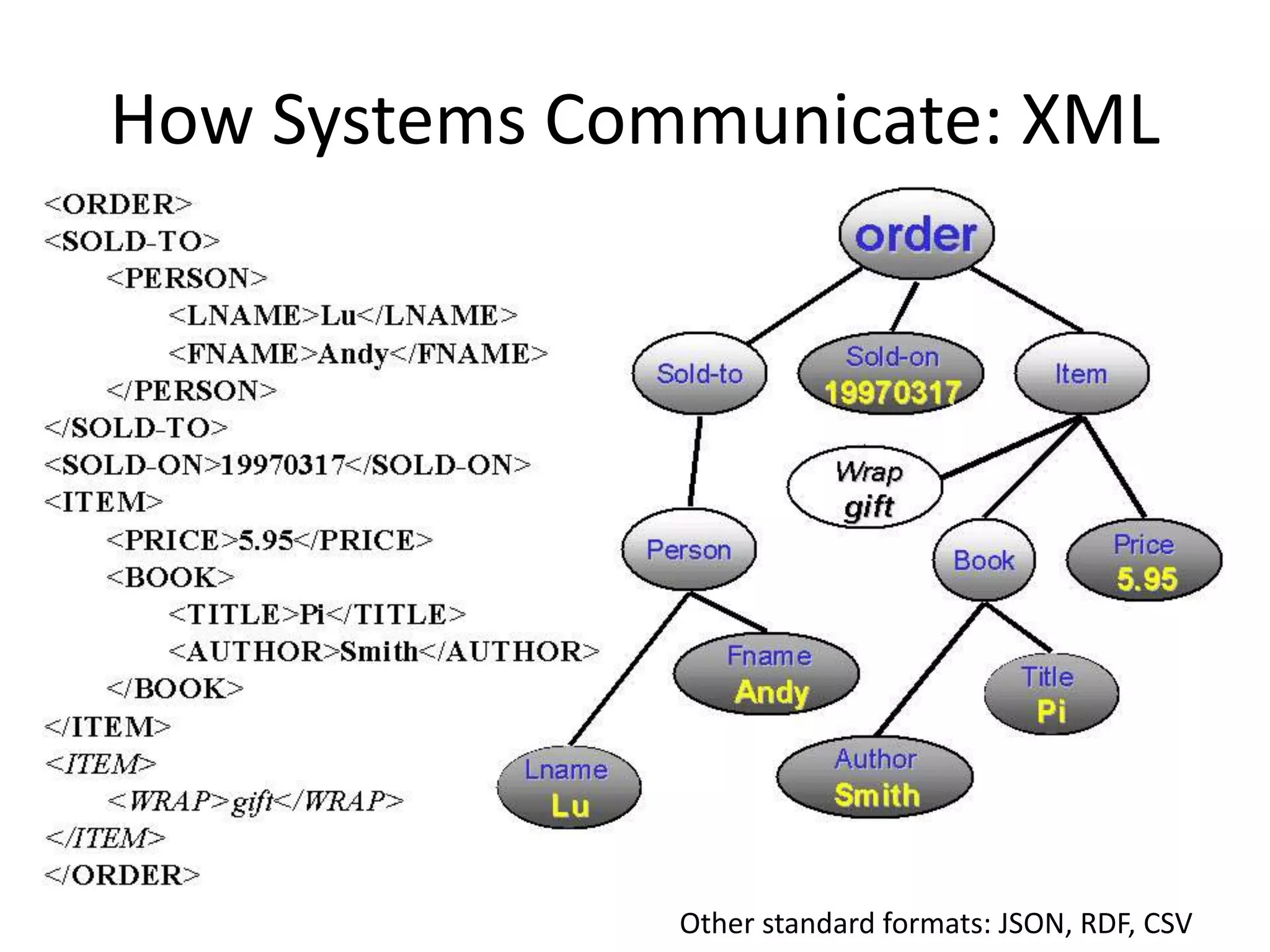
How Systems Communicate: XML
Other standard formats: JSON, RDF, CSV
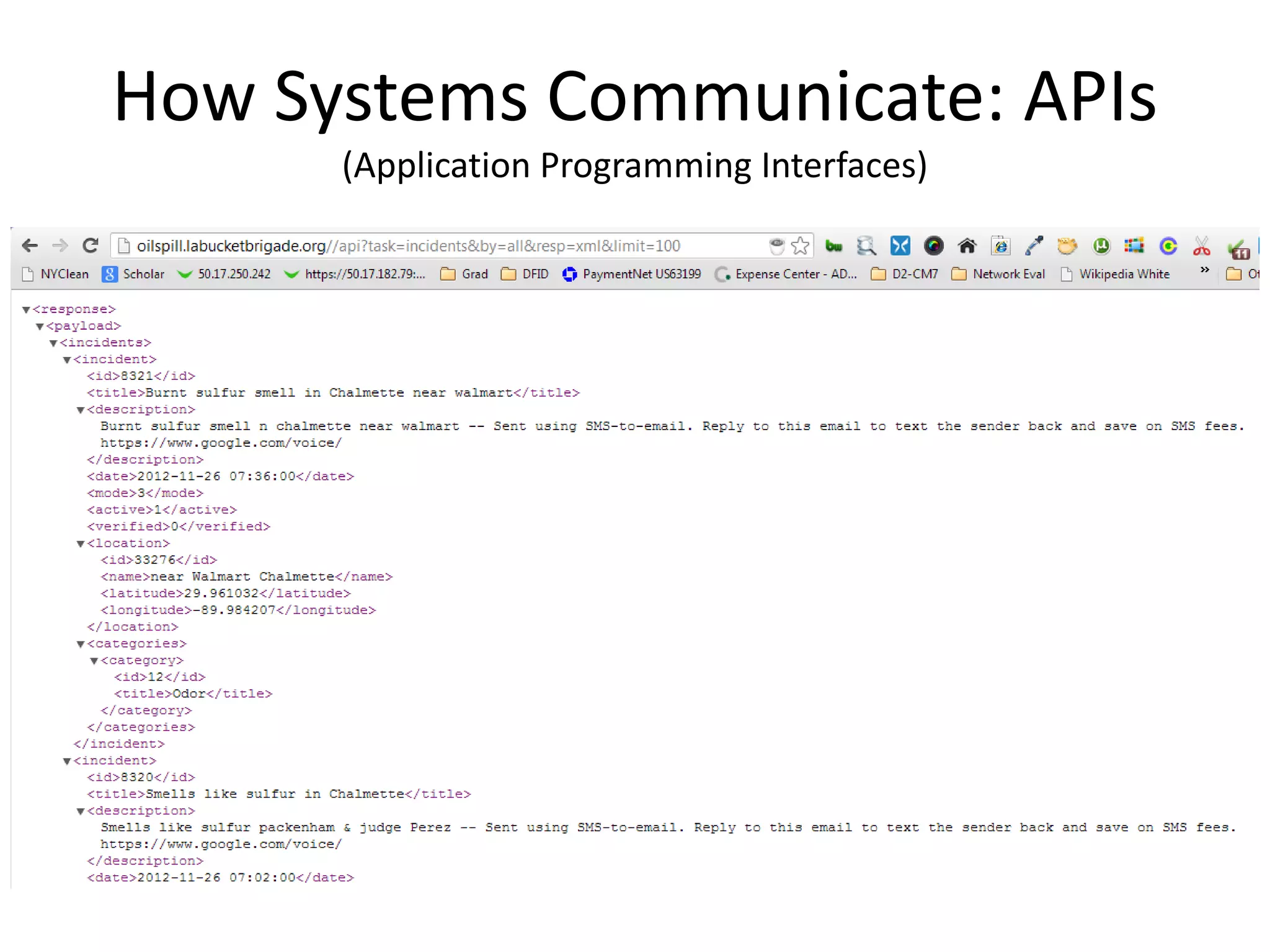
How Systems Communicate: APIs
(Application Programming Interfaces)
Yahoo Pipes
Mashups and Dashboards
TREND: Mobile Computing
• Proliferation of thin clients (our various
“screens”) to access cloud
– API’s, XML etc.
• Sensor devices connected to the cloud
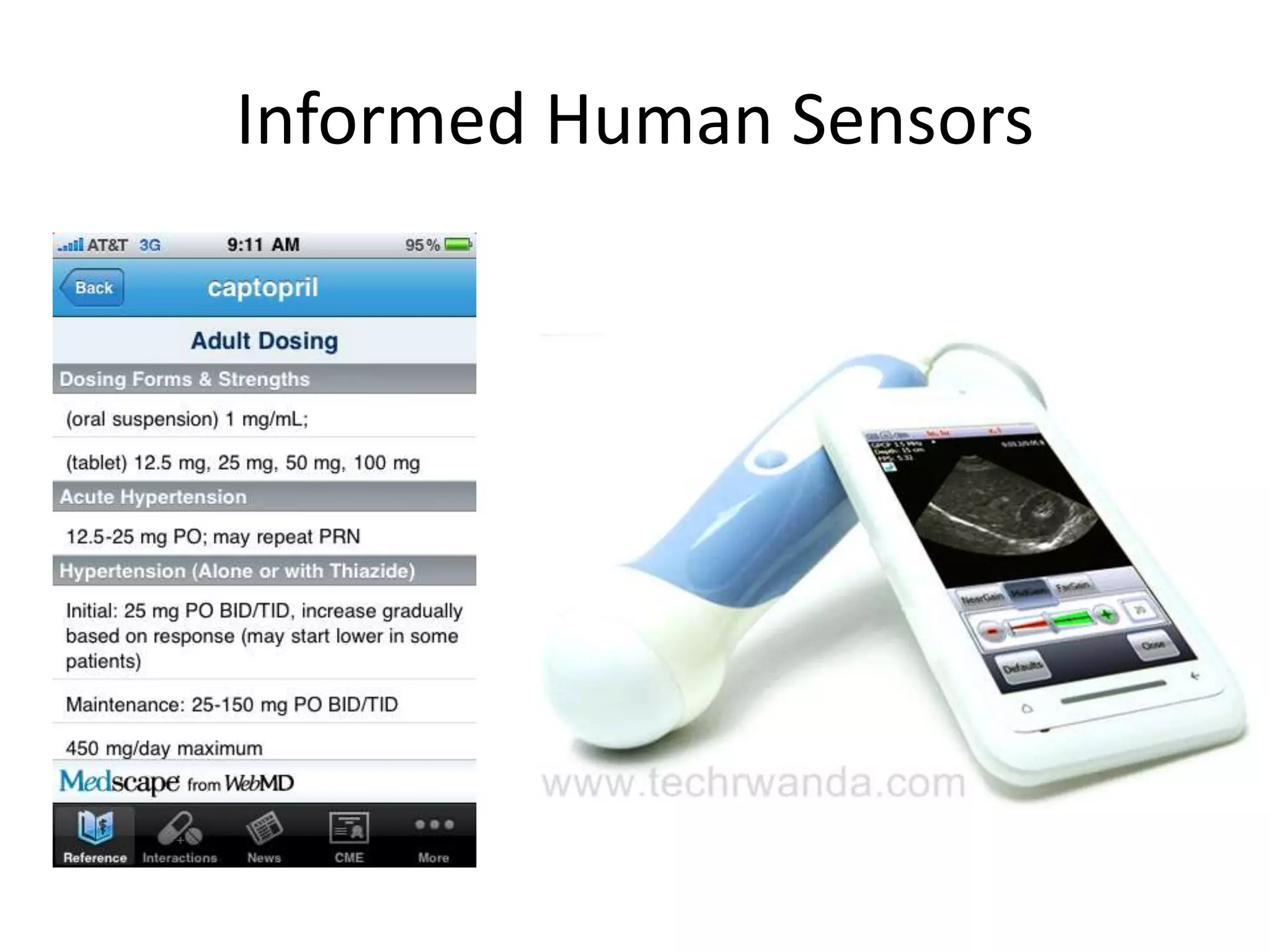
– human sensors
– internet of things
– enables more continuous assessment across time
and geography than ever before
Informed Human Sensors
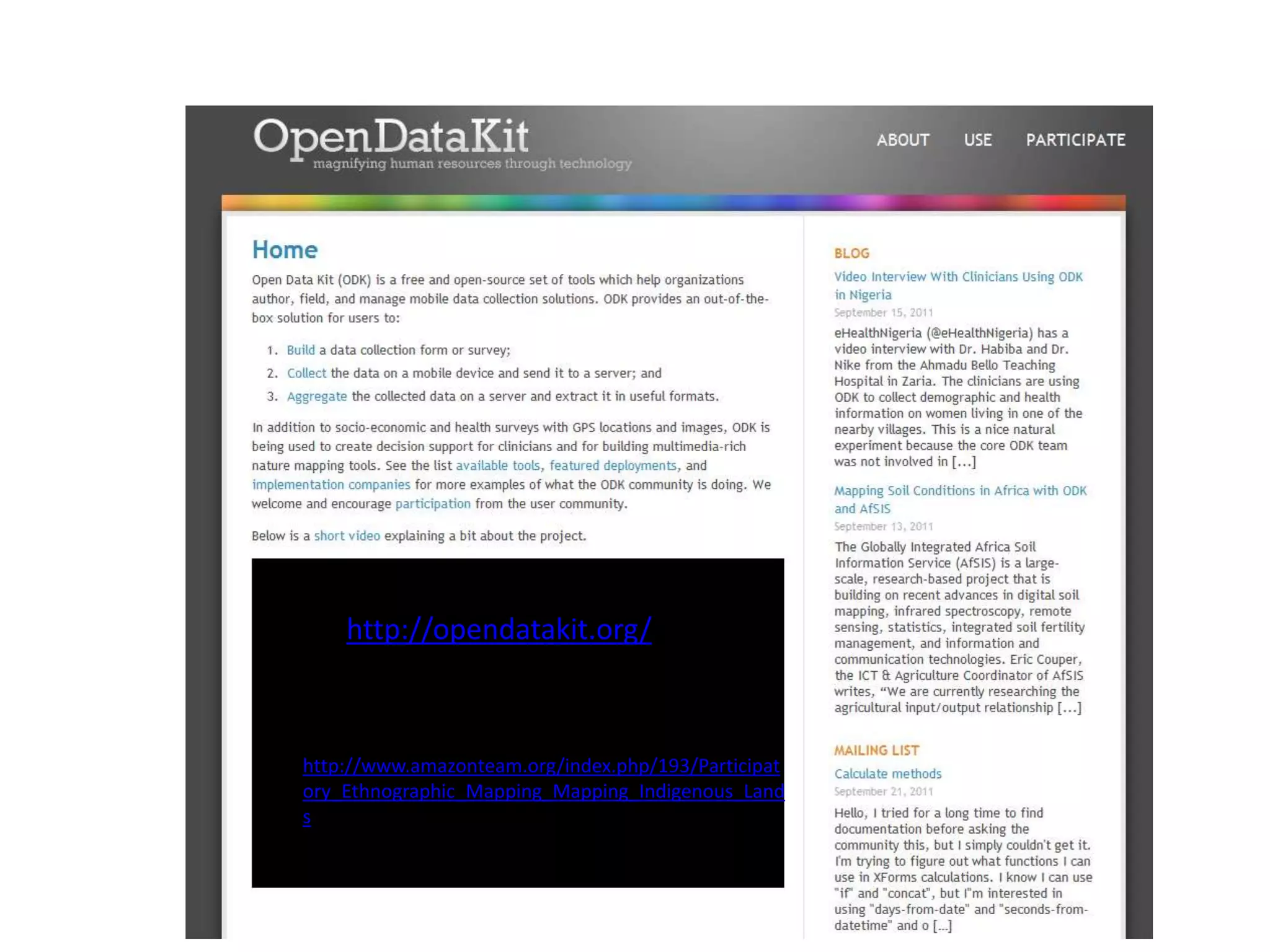
http://opendatakit.org/
http://www.amazonteam.org/index.php/193/Participat
ory_Ethnographic_Mapping_Mapping_Indigenous_Land
s
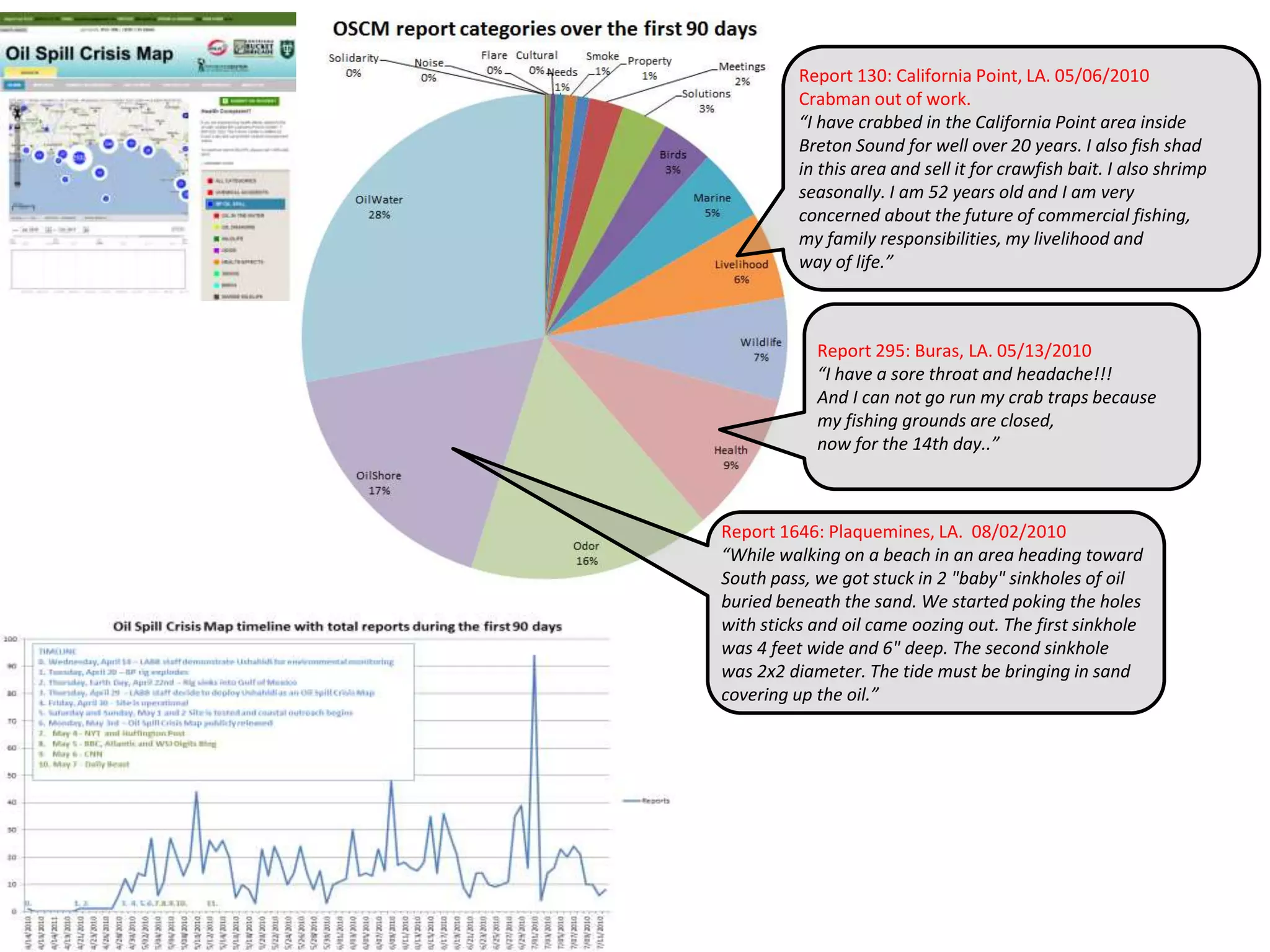
Report 295: Buras, LA. 05/13/2010
“I have a sore throat and headache!!!
And I can not go run my crab traps because
my fishing grounds are closed,
now for the 14th day..”
Report 1646: Plaquemines, LA. 08/02/2010
“While walking on a beach in an area heading toward
South pass, we got stuck in 2 "baby" sinkholes of oil
buried beneath the sand. We started poking the holes
with sticks and oil came oozing out. The first sinkhole
was 4 feet wide and 6" deep. The second sinkhole
was 2x2 diameter. The tide must be bringing in sand
covering up the oil.”
Report 130: California Point, LA. 05/06/2010
Crabman out of work.
“I have crabbed in the California Point area inside
Breton Sound for well over 20 years. I also fish shad
in this area and sell it for crawfish bait. I also shrimp
seasonally. I am 52 years old and I am very
concerned about the future of commercial fishing,
my family responsibilities, my livelihood and
way of life.”
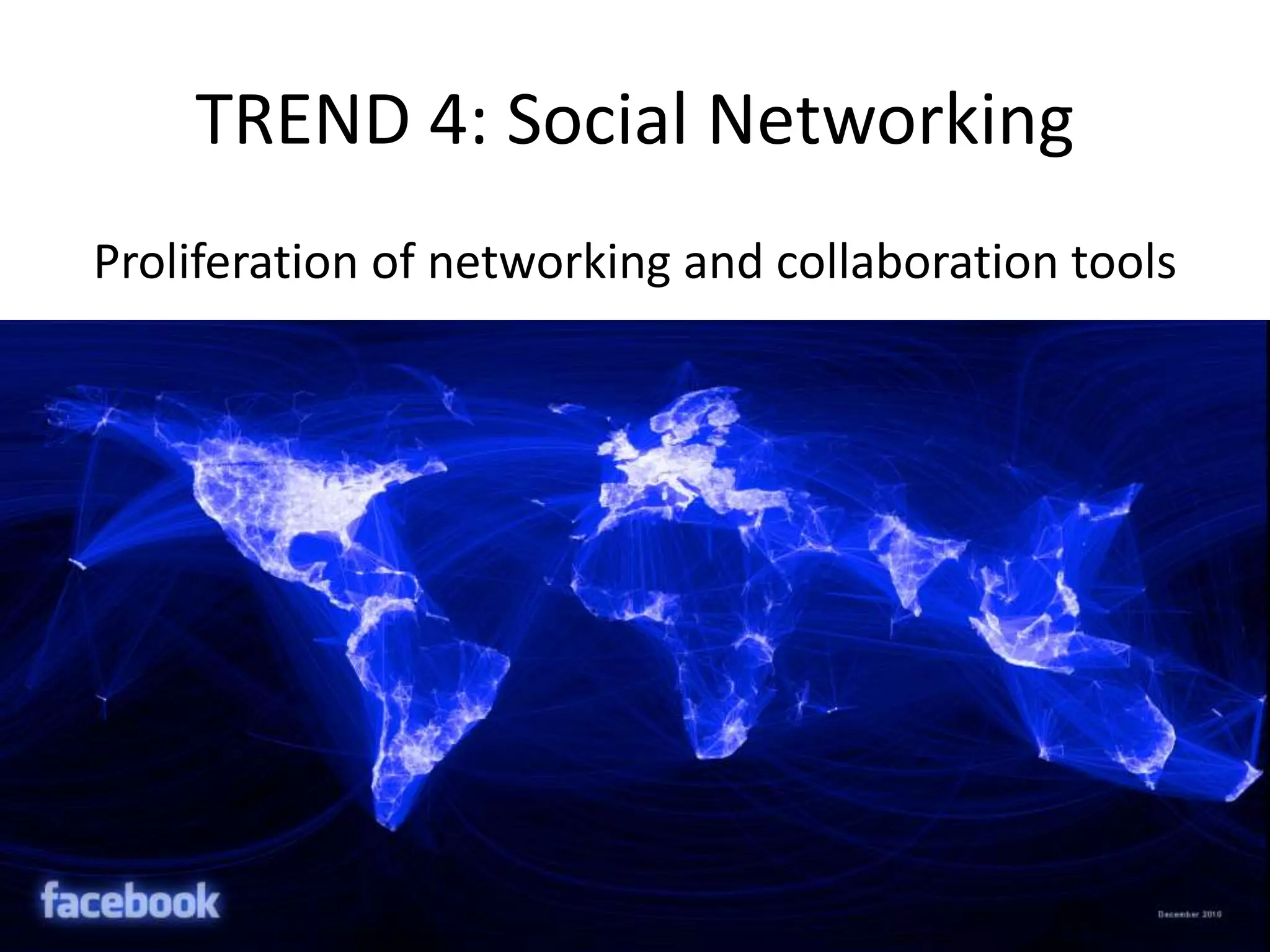
TREND 4: Social Networking
Proliferation of networking and collaboration tools
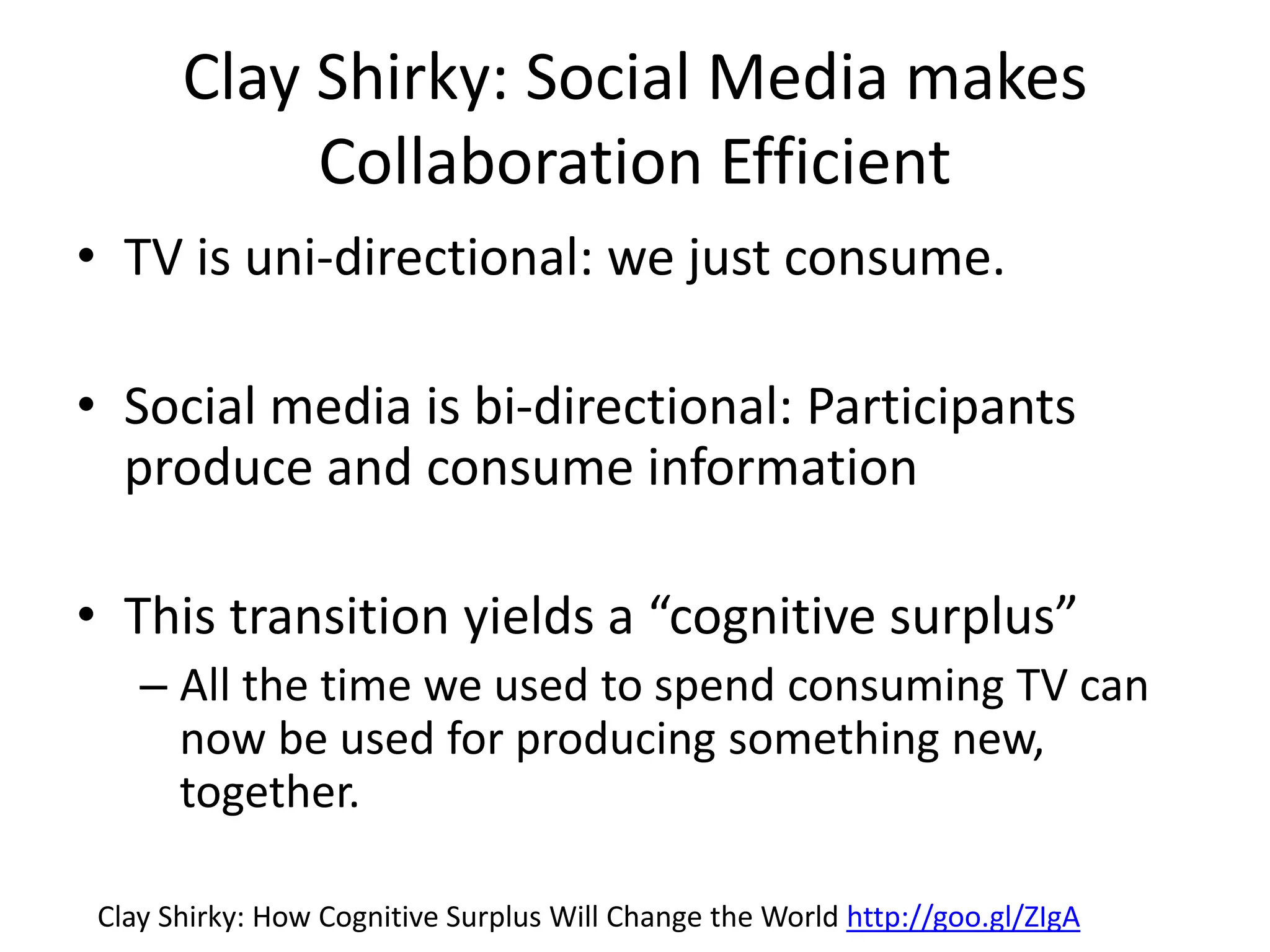
Clay Shirky: Social Media makes
Collaboration Efficient
• TV is uni-directional: we just consume.
• Social media is bi-directional: Participants
produce and consume information
• This transition yields a “cognitive surplus”
– All the time we used to spend consuming TV can
now be used for producing something new,
together.
Clay Shirky: How Cognitive Surplus Will Change the World http://goo.gl/ZIgA
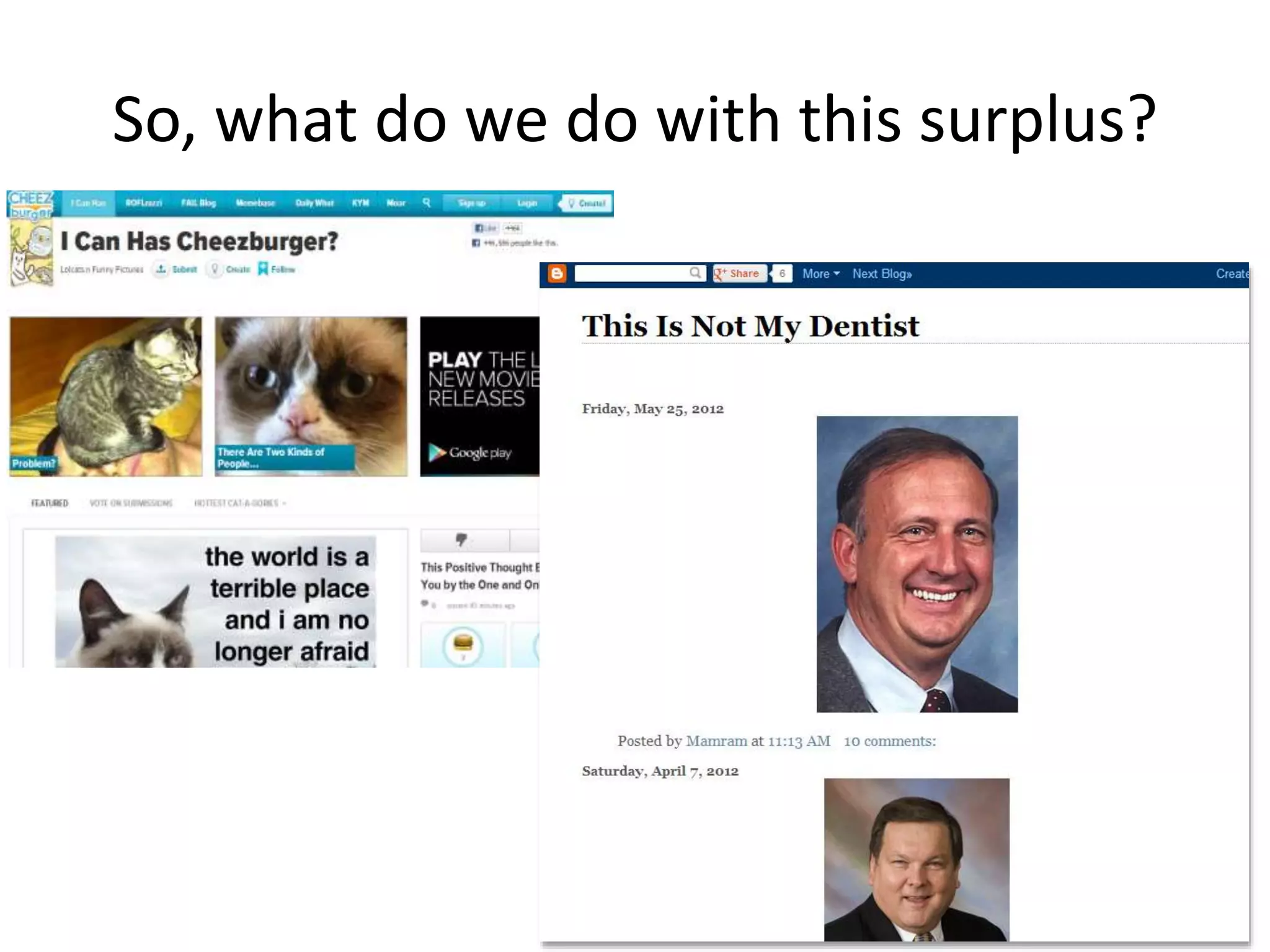
So, what do we do with this surplus?
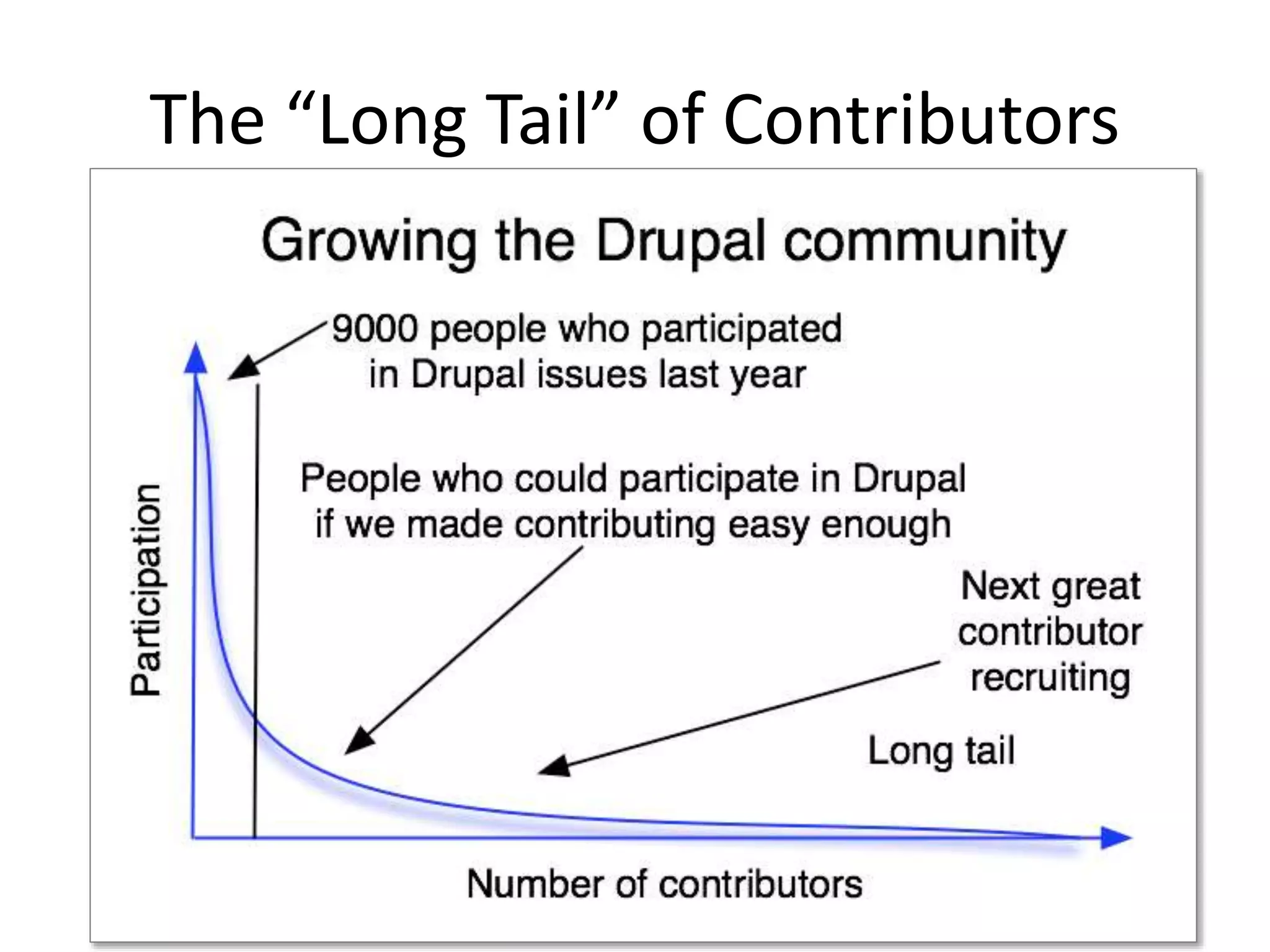
The “Long Tail” of Contributors
Institutions vs. Collaboration
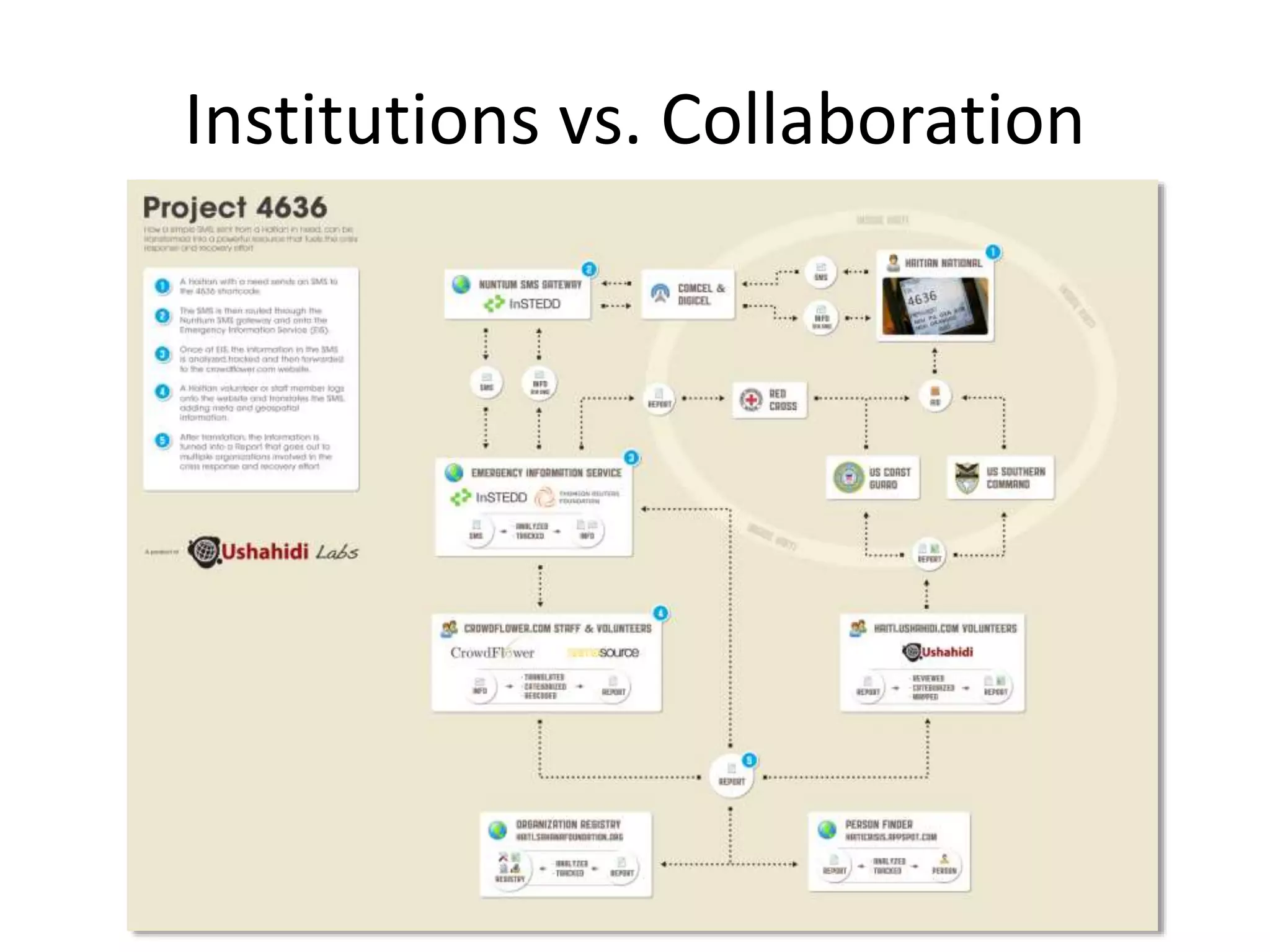
Crowdsourcing and Micro-tasking
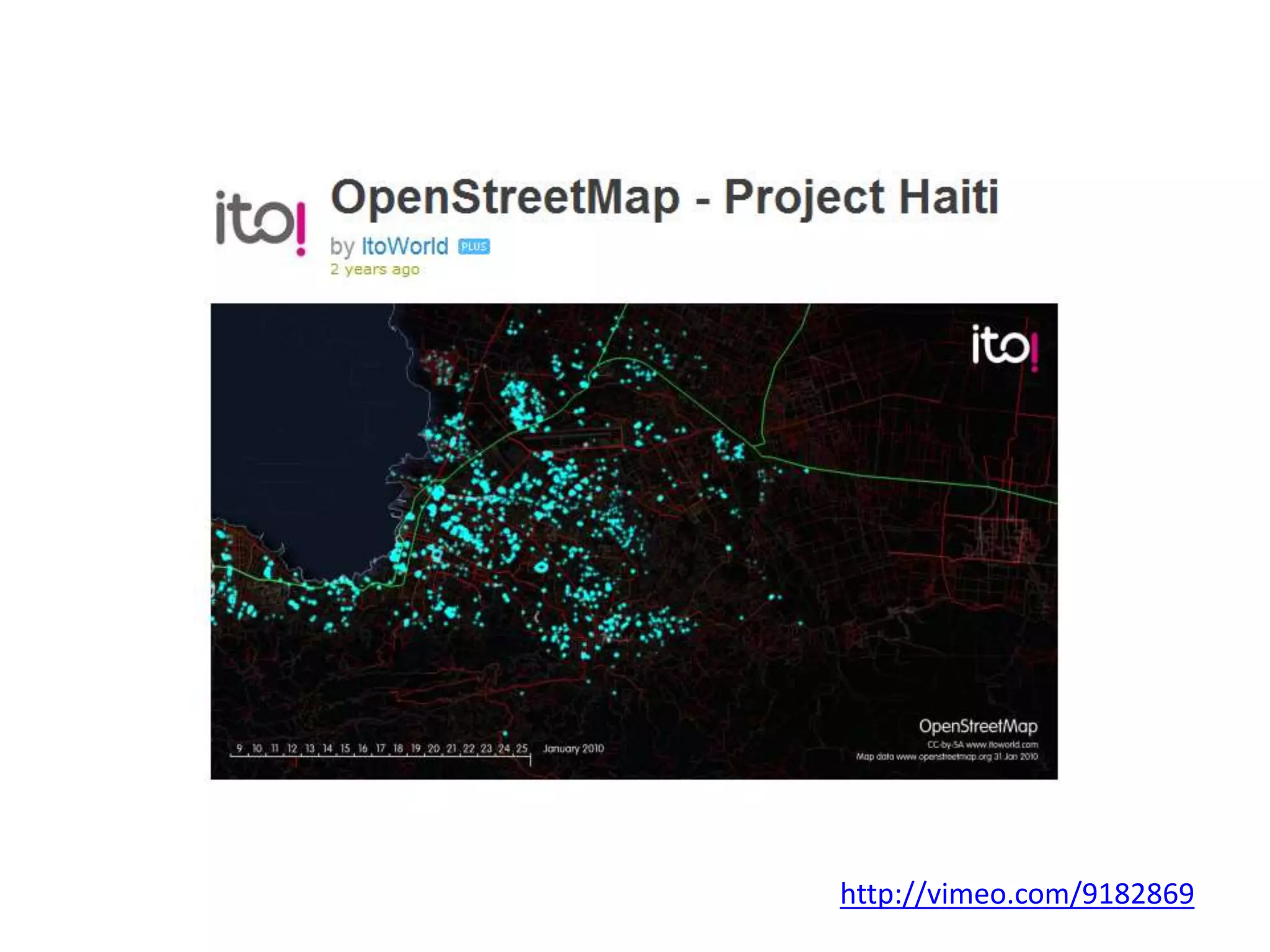
http://vimeo.com/9182869
Collaborative, Community-driven and
Open Source Development Models
• Depend upon:
– feedback loops
– some level of openness and sharing
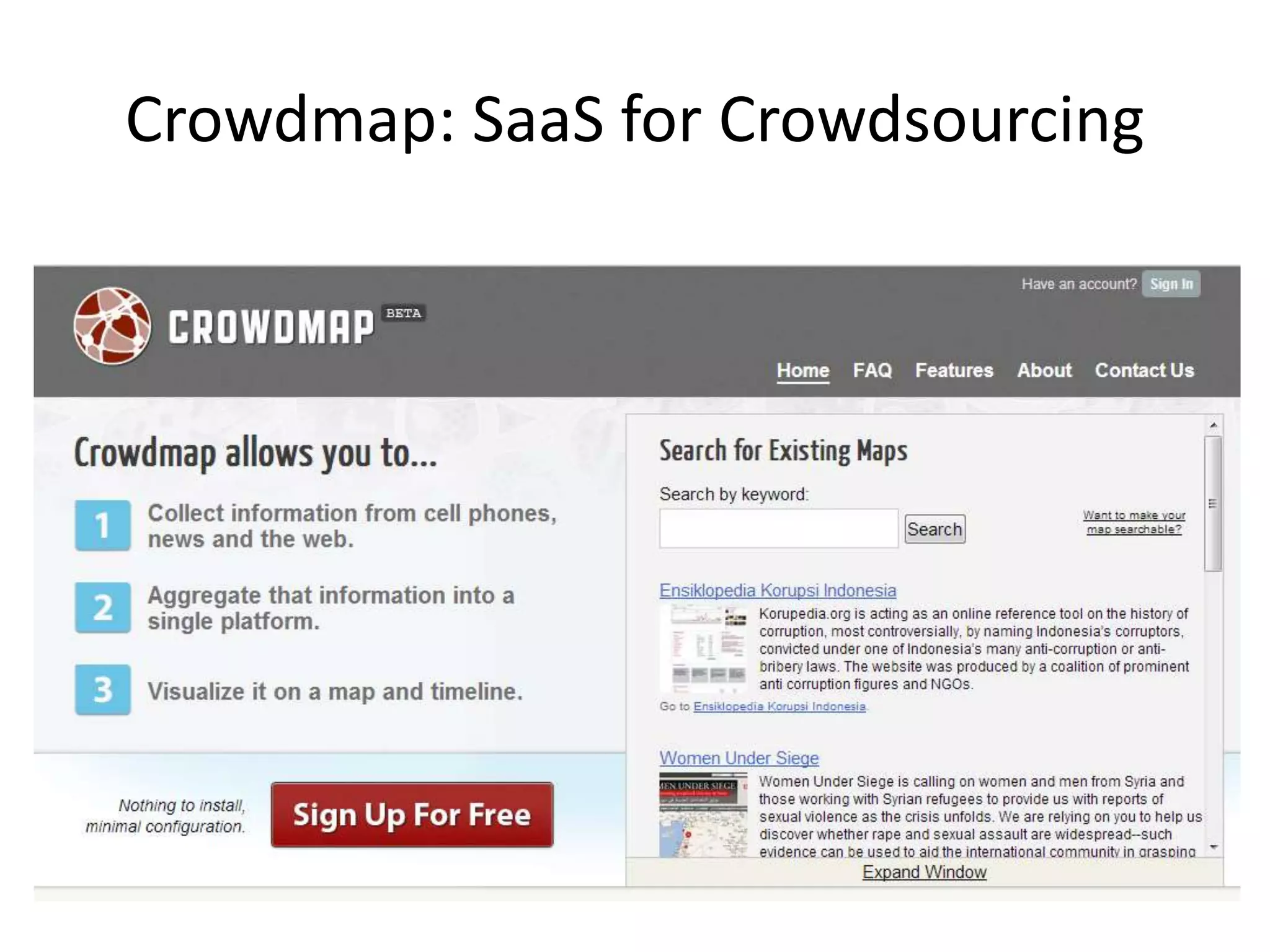
Crowdmap: SaaS for Crowdsourcing
TREND: Data Mining
• Open data
• Big Data
– Our “digital exhaust”
• Emphasis on Trend Visualization
– Dynamic
– Info-graphics
Open Data
• Standardized formats, APIs
• Share, Share Alike
– CRED EM-DAT
– World Bank http://data.worldbank.org
– USG
– Ushahidi
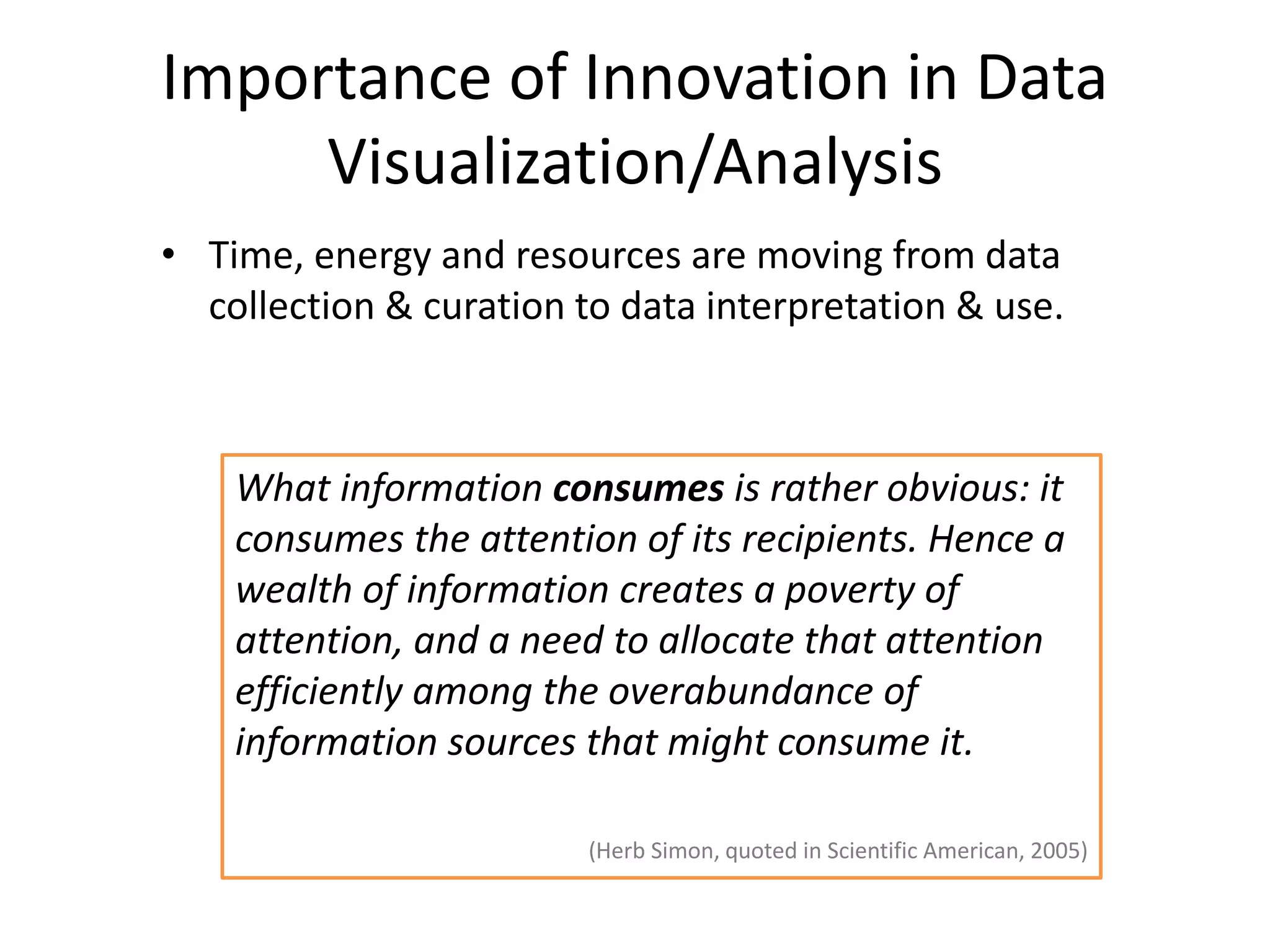
Big Data
• web logs
• sensor networks (e.g. mobile phones, RFIDs)
• social networks (who’s connected to who)
• social data (what’s being shared and generated)
• teaching and learning management systems
• financial transaction data and large-scale e-commerce
• Internet text and documents
• Internet search indexing
• call detail records
• military surveillance;
• medical records;
• photography archives;
• video archives;
• astronomy, atmospheric science, genomics, biogeochemical, biological, and
other complex and/or interdisciplinary scientific research;
Importance of Innovation in Data
Visualization/Analysis
• Time, energy and resources are moving from data
collection & curation to data interpretation & use.
What information consumes is rather obvious: it
consumes the attention of its recipients. Hence a
wealth of information creates a poverty of
attention, and a need to allocate that attention
efficiently among the overabundance of
information sources that might consume it.
(Herb Simon, quoted in Scientific American, 2005)
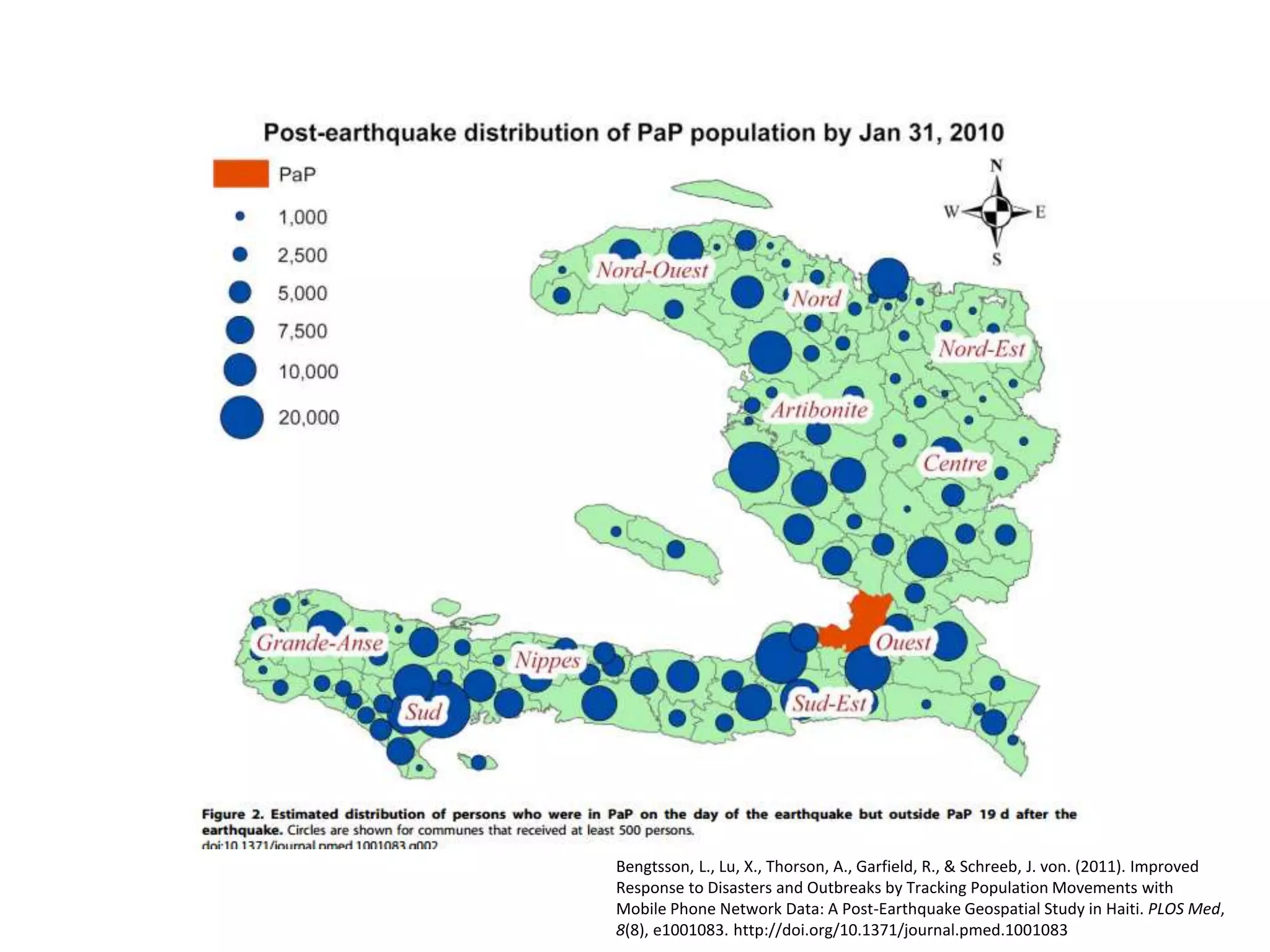
Bengtsson, L., Lu, X., Thorson, A., Garfield, R., & Schreeb, J. von. (2011). Improved
Response to Disasters and Outbreaks by Tracking Population Movements with
Mobile Phone Network Data: A Post-Earthquake Geospatial Study in Haiti. PLOS Med,
8(8), e1001083. http://doi.org/10.1371/journal.pmed.1001083
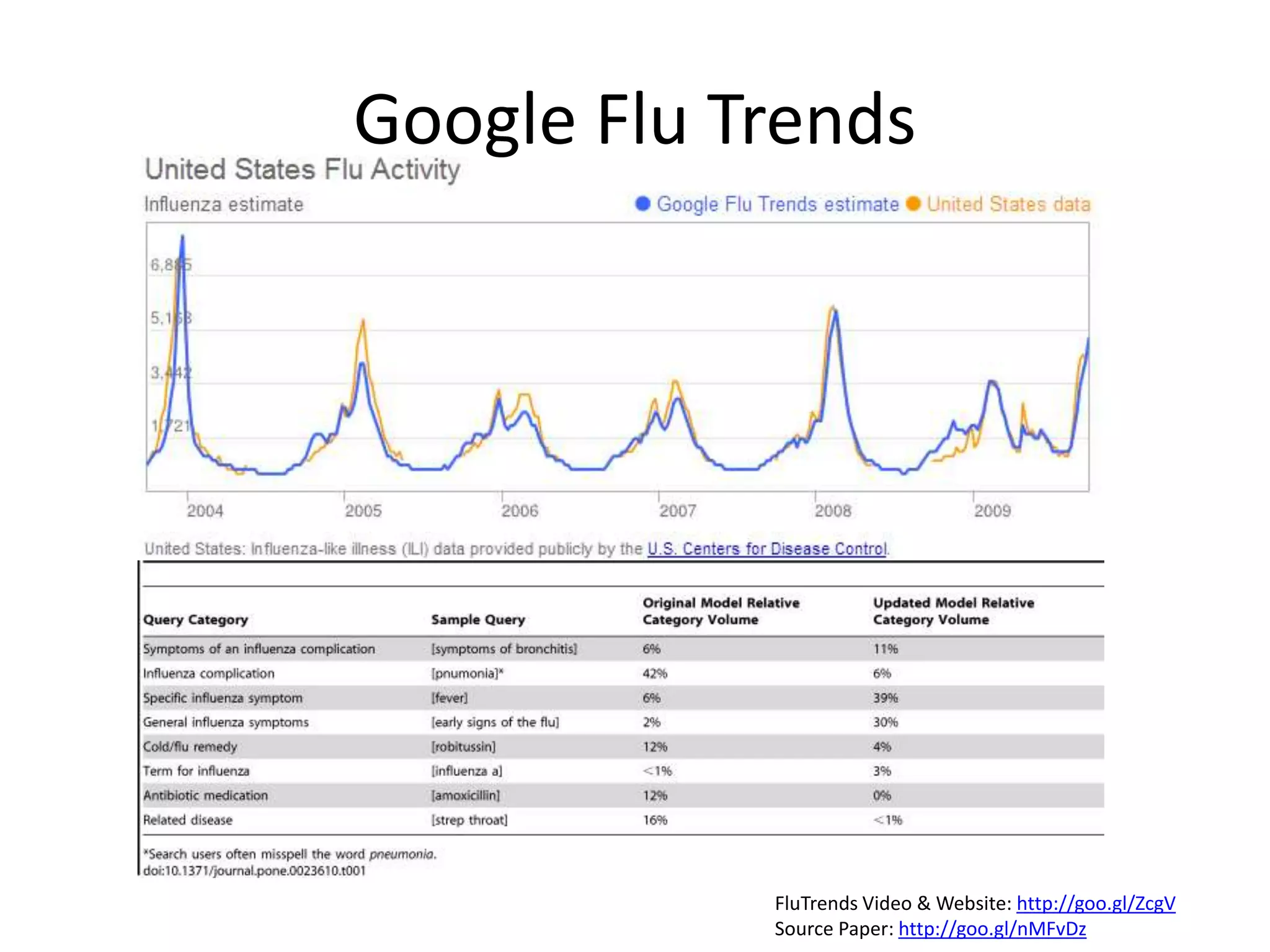
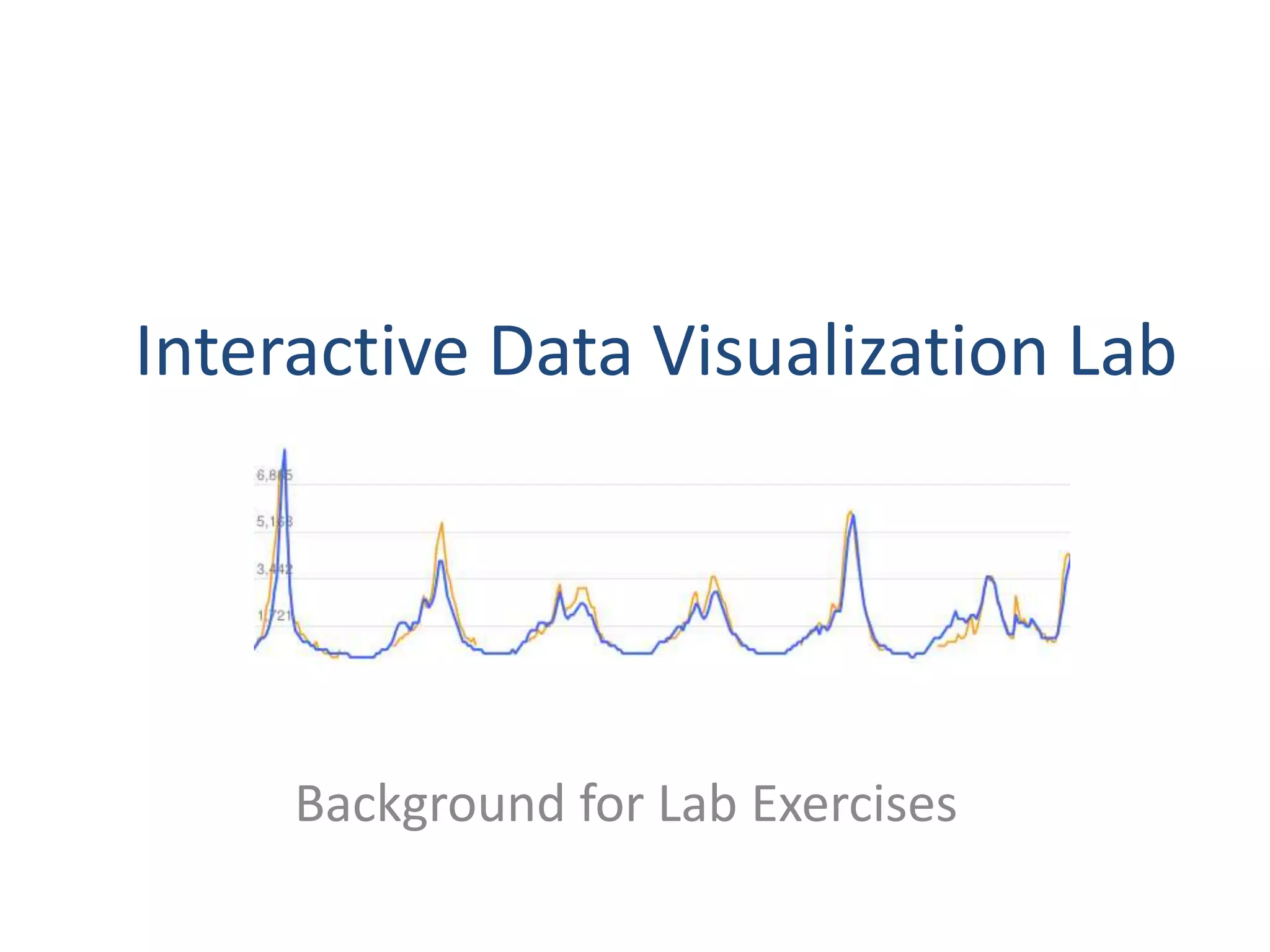
FluTrends Video & Website: http://goo.gl/ZcgV
Source Paper: http://goo.gl/nMFvDz
Google Flu Trends
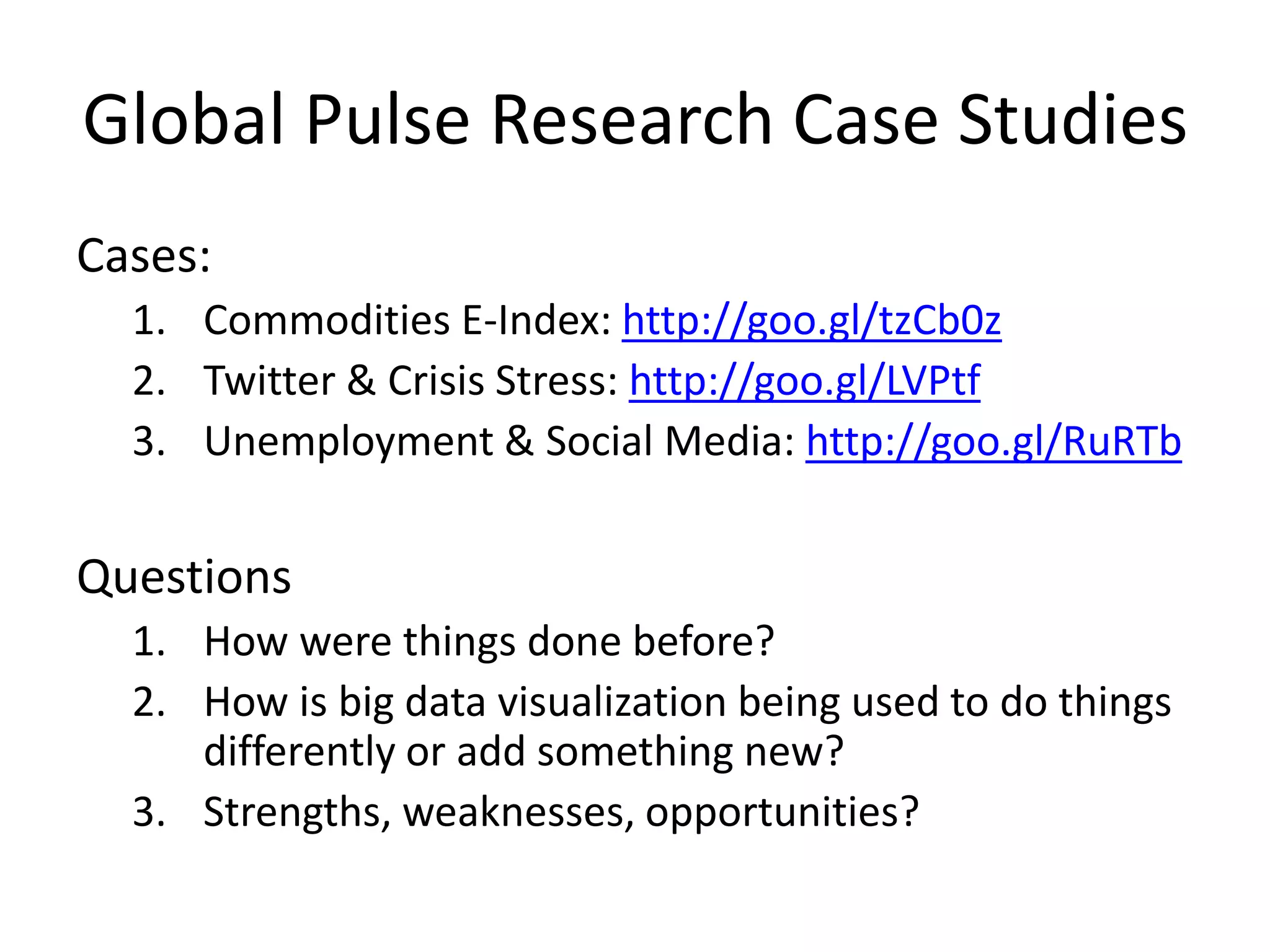
Global Pulse Research Case Studies
Cases:
1. Commodities E-Index: http://goo.gl/tzCb0z
2. Twitter & Crisis Stress: http://goo.gl/LVPtf
3. Unemployment & Social Media: http://goo.gl/RuRTb
Questions
1. How were things done before?
2. How is big data visualization being used to do things
differently or add something new?
3. Strengths, weaknesses, opportunities?
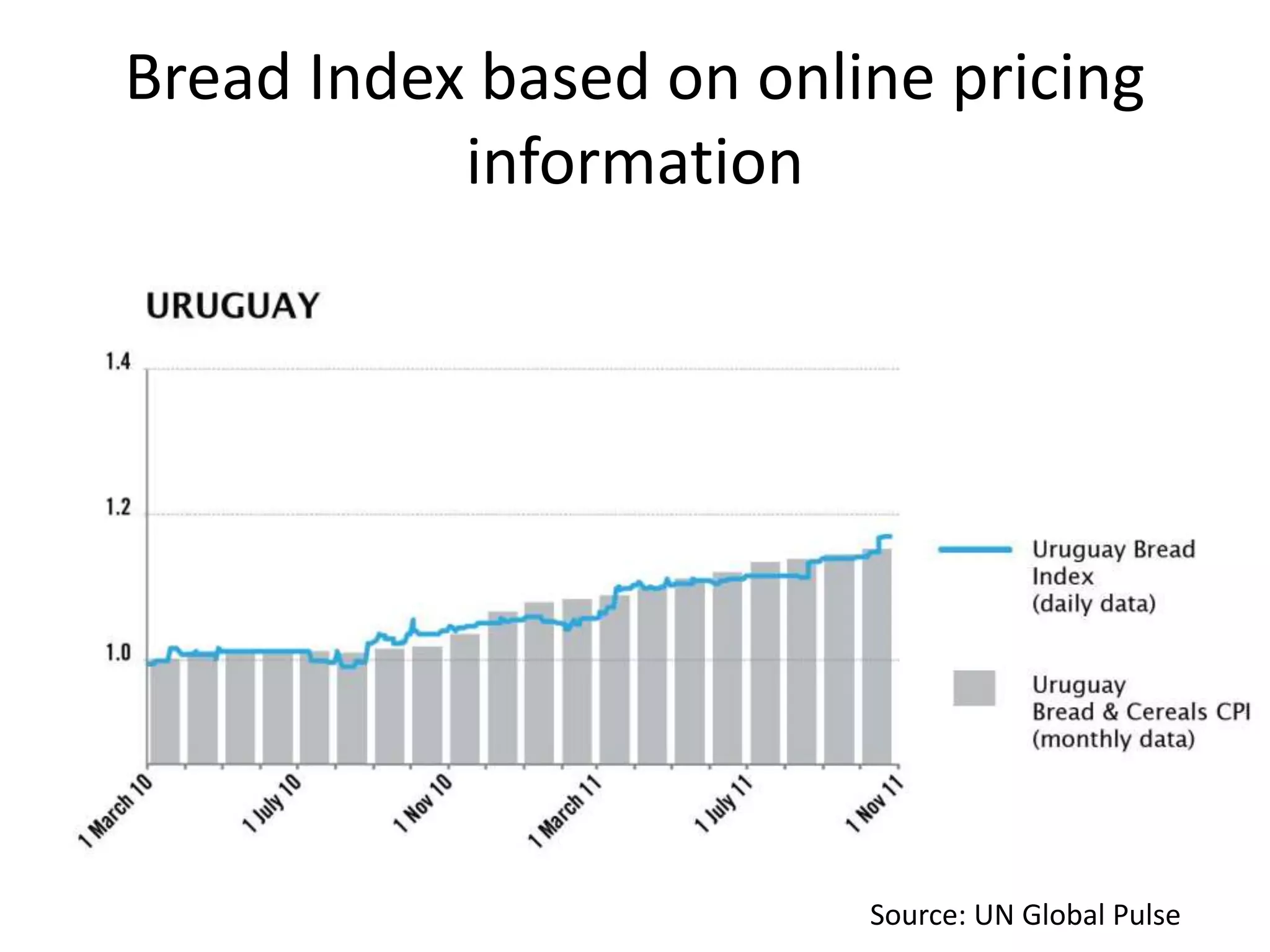
Bread Index based on online pricing
information
Source: UN Global Pulse
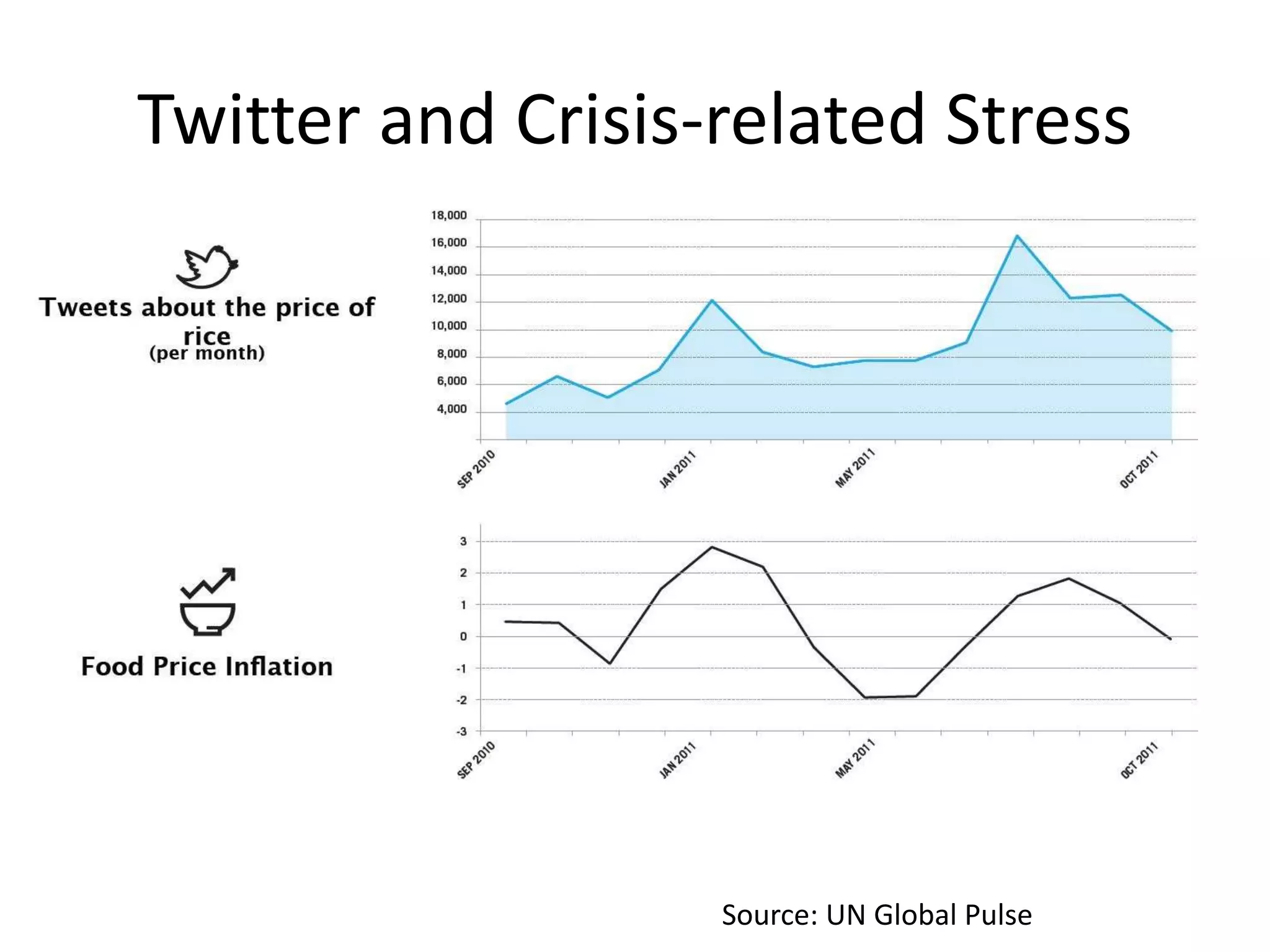
Twitter and Crisis-related Stress
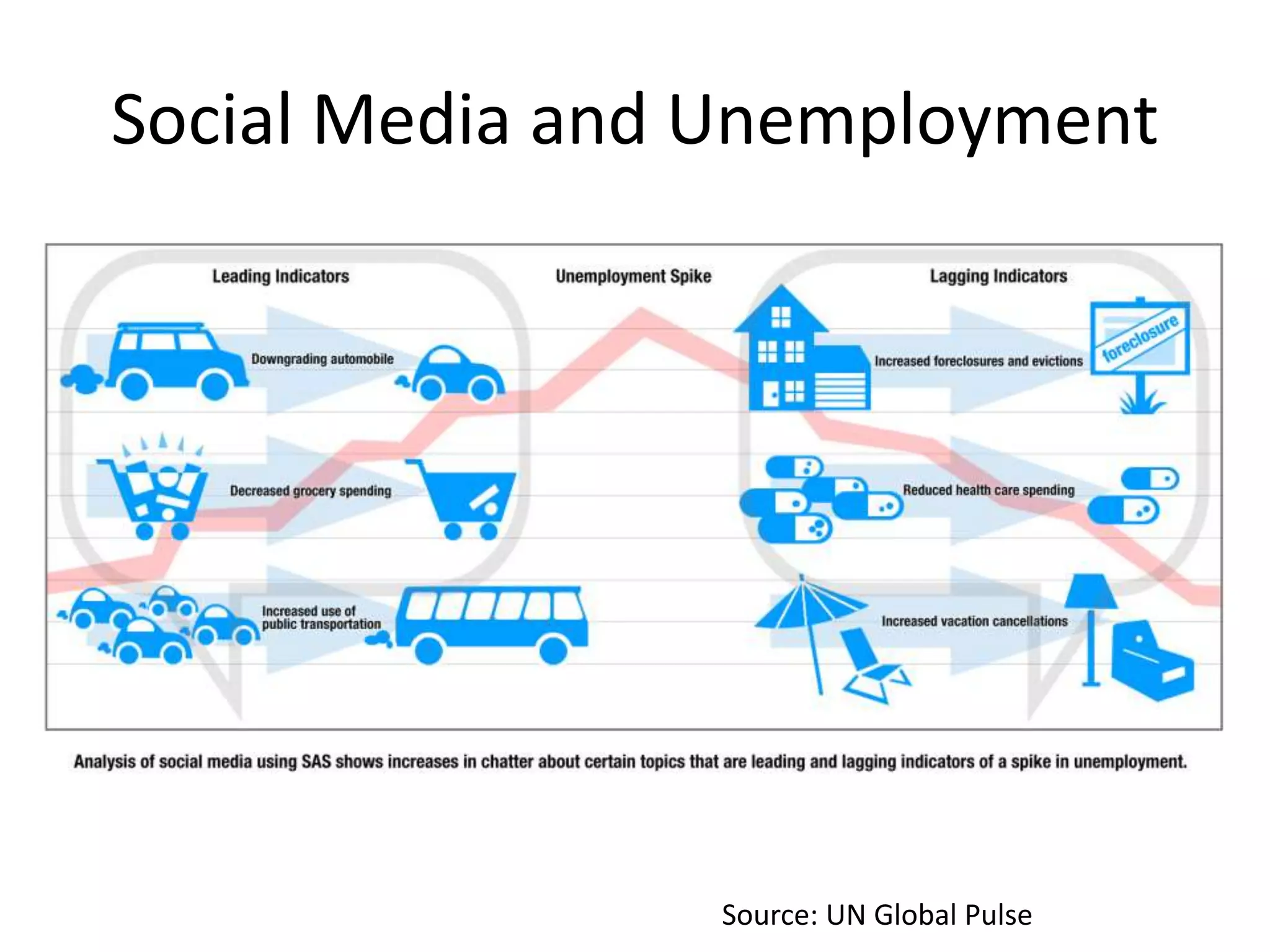
Social Media and Unemployment
Source: UN Global Pulse
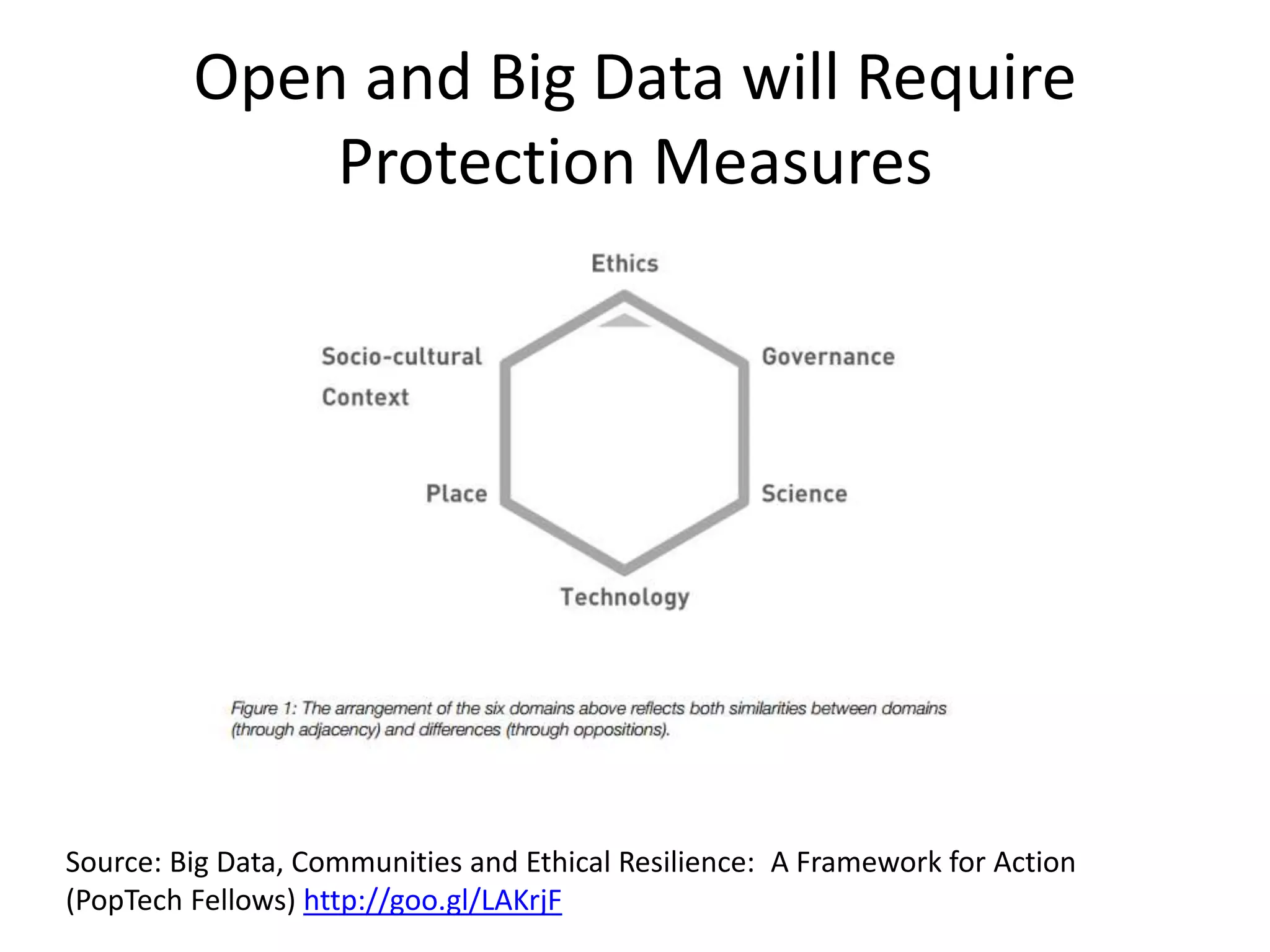
Open and Big Data will Require
Protection Measures
Source: Big Data, Communities and Ethical Resilience: A Framework for Action
(PopTech Fellows) http://goo.gl/LAKrjF
Interactive Data Visualization Lab
Background for Lab Exercises
Two Parts
1. Individual Assignment - Today
– Get to know software and data site
– Get started with independent work – Due Wed
2. Group Synthesis – Next week
– Expand on visualization types, data, tools
– Integrate with RLP
Visualization Lab Exercise
• On Blackboard:
– All instructions, links and submission details
• http://goo.gl/eZlh8z
– Visualization Lab Discussion Forum is for asking
questions and posting data and other resources.
• http://goo.gl/1VFHX6
Next time: Visualization Tools
• End-user cloud databases and services
– Google Maps, Google Spreadsheets,
– Zoho Creator
• Visualization APIs and Kits for the web
– D3, MIT Simile Project
• Web-based end-user geodata and mapping platforms
– Geocommons
• Web-based dynamic visualization platforms:
– IBM Many Eyes
– Infogr.am
• Desktop platforms for creating dynamic visualization
– Tableau (Windows only, OSX soon)
• Big Data open to the public
– http://www.quora.com/Data/Where-can-I-find-
large-datasets-open-to-the-public
Caveats
• Awareness of privacy / security is importany
• Protect your data!
– Keep an eye on your escape hatch
– Use open, established standards
• Limits: query rate and database size
• Attribution/Fair Use
• Engage the tools but be critical
– Pay attention to utility and face validity
Thanks!
• Adam Papendieck
• apapendieck@gmail.com
• 200 Broadway, Suite 203

Emerging Trends in Crisis Informatics

  • 1.
    Emergent Trends andTools in Crisis Informatics Adam Papendieck Jan 30, 2014
  • 2.
    Objectives 1. Gain anunderstanding of key trends in ICT innovation which are influencing/disrupting crisis informatics. 2. Be able to trace these trends through discussions later this semester, and understand their influence and potential. 3. Introduce visualization lab
  • 3.
    Conventional, Centralized Info Management Source:Harvard Humanitarian Initiative. Disaster Relief 2.0
  • 4.
    Crisis Information Ecosystem: ComplexAdaptive System • Some information needs are clear and structured. • But the actual information ecosystems in emergencies are complex and changing rapidly. • Individual technologies, information systems and their relationship to others are ephemeral, even in the short-to-medium term. They evolve.
  • 6.
    Crisis Information Ecosystem: ComplexAdaptive System • Rapid, adaptive collaboration can be advantageous • complex adaptive systems are built upon feedback loops • Shift from institutions to collaborations • Closed, rigid institutions  Open, fluid cooperation
  • 8.
    0 100 200 300 400 500 600 Five most commoncategories of reports to the Ushahidi Haiti Crisis Map over the first 90 days Food Shortage Shelter Needed Water Shortage Vital Lines Emergency Reports
  • 9.
  • 10.
    Data Capture Curation Analysis Dissemination Use months,years minutes,weeks Agency effort, resources Agencyeffort, resources Value StreamConventional Emergent Humanitarian Information Systems
  • 12.
    Emergent ICT (Trends) 1. ImprovedGlobal Connectivity 2. The Cloud 3. Semantic Web and Open Standard 4. Mobile 5. Networks 6. Data Mining
  • 13.
    http://www.submarinecablemap.com/ TREND: Improved GlobalConnectivity Global Submarine Cables (2012)
  • 14.
  • 17.
    Mobile Phone Subscribersper 100 Individuals
  • 18.
    TREND: The Cloud •Centralization of computing power and standardization of data – Semantic Web, XML, APIs – Subscription-based “Software as a Service” (SaaS) Source: http://resource.onlinetech.com/cloud-computing-prompts-2012-data-center-expansion-plans/
  • 19.
    Software as aService (SaaS)
  • 20.
    TREND: Semantic web •Old characteristics of the web: HTML, text, individual static web pages • New characteristics: XML, APIs (Application Programming Interfaces), webservices, open standards, dynamic and interactive web pages
  • 21.
    TREND: Semantic web •Augments information on web pages with machine-readable metadata and relationship information. • Enables the “mashup” • Example tools: Yahoo pipes, Google API, Calais, Yahoo Terms, Google Maps
  • 22.
    How Systems Communicate:XML Other standard formats: JSON, RDF, CSV
  • 23.
    How Systems Communicate:APIs (Application Programming Interfaces)
  • 24.
  • 26.
  • 27.
    TREND: Mobile Computing •Proliferation of thin clients (our various “screens”) to access cloud – API’s, XML etc. • Sensor devices connected to the cloud – human sensors – internet of things – enables more continuous assessment across time and geography than ever before
  • 28.
  • 29.
  • 31.
    Report 295: Buras,LA. 05/13/2010 “I have a sore throat and headache!!! And I can not go run my crab traps because my fishing grounds are closed, now for the 14th day..” Report 1646: Plaquemines, LA. 08/02/2010 “While walking on a beach in an area heading toward South pass, we got stuck in 2 "baby" sinkholes of oil buried beneath the sand. We started poking the holes with sticks and oil came oozing out. The first sinkhole was 4 feet wide and 6" deep. The second sinkhole was 2x2 diameter. The tide must be bringing in sand covering up the oil.” Report 130: California Point, LA. 05/06/2010 Crabman out of work. “I have crabbed in the California Point area inside Breton Sound for well over 20 years. I also fish shad in this area and sell it for crawfish bait. I also shrimp seasonally. I am 52 years old and I am very concerned about the future of commercial fishing, my family responsibilities, my livelihood and way of life.”
  • 32.
    TREND 4: SocialNetworking Proliferation of networking and collaboration tools
  • 33.
    Clay Shirky: SocialMedia makes Collaboration Efficient • TV is uni-directional: we just consume. • Social media is bi-directional: Participants produce and consume information • This transition yields a “cognitive surplus” – All the time we used to spend consuming TV can now be used for producing something new, together. Clay Shirky: How Cognitive Surplus Will Change the World http://goo.gl/ZIgA
  • 34.
    So, what dowe do with this surplus?
  • 35.
    The “Long Tail”of Contributors
  • 36.
  • 37.
  • 38.
  • 39.
    Collaborative, Community-driven and OpenSource Development Models • Depend upon: – feedback loops – some level of openness and sharing
  • 40.
    Crowdmap: SaaS forCrowdsourcing
  • 41.
    TREND: Data Mining •Open data • Big Data – Our “digital exhaust” • Emphasis on Trend Visualization – Dynamic – Info-graphics
  • 42.
    Open Data • Standardizedformats, APIs • Share, Share Alike – CRED EM-DAT – World Bank http://data.worldbank.org – USG – Ushahidi
  • 43.
    Big Data • weblogs • sensor networks (e.g. mobile phones, RFIDs) • social networks (who’s connected to who) • social data (what’s being shared and generated) • teaching and learning management systems • financial transaction data and large-scale e-commerce • Internet text and documents • Internet search indexing • call detail records • military surveillance; • medical records; • photography archives; • video archives; • astronomy, atmospheric science, genomics, biogeochemical, biological, and other complex and/or interdisciplinary scientific research;
  • 44.
    Importance of Innovationin Data Visualization/Analysis • Time, energy and resources are moving from data collection & curation to data interpretation & use. What information consumes is rather obvious: it consumes the attention of its recipients. Hence a wealth of information creates a poverty of attention, and a need to allocate that attention efficiently among the overabundance of information sources that might consume it. (Herb Simon, quoted in Scientific American, 2005)
  • 45.
    Bengtsson, L., Lu,X., Thorson, A., Garfield, R., & Schreeb, J. von. (2011). Improved Response to Disasters and Outbreaks by Tracking Population Movements with Mobile Phone Network Data: A Post-Earthquake Geospatial Study in Haiti. PLOS Med, 8(8), e1001083. http://doi.org/10.1371/journal.pmed.1001083
  • 46.
    FluTrends Video &Website: http://goo.gl/ZcgV Source Paper: http://goo.gl/nMFvDz Google Flu Trends
  • 47.
    Global Pulse ResearchCase Studies Cases: 1. Commodities E-Index: http://goo.gl/tzCb0z 2. Twitter & Crisis Stress: http://goo.gl/LVPtf 3. Unemployment & Social Media: http://goo.gl/RuRTb Questions 1. How were things done before? 2. How is big data visualization being used to do things differently or add something new? 3. Strengths, weaknesses, opportunities?
  • 48.
    Bread Index basedon online pricing information Source: UN Global Pulse
  • 49.
    Source: UN GlobalPulse Twitter and Crisis-related Stress
  • 50.
    Social Media andUnemployment Source: UN Global Pulse
  • 51.
    Open and BigData will Require Protection Measures Source: Big Data, Communities and Ethical Resilience: A Framework for Action (PopTech Fellows) http://goo.gl/LAKrjF
  • 52.
    Interactive Data VisualizationLab Background for Lab Exercises
  • 53.
    Two Parts 1. IndividualAssignment - Today – Get to know software and data site – Get started with independent work – Due Wed 2. Group Synthesis – Next week – Expand on visualization types, data, tools – Integrate with RLP
  • 54.
    Visualization Lab Exercise •On Blackboard: – All instructions, links and submission details • http://goo.gl/eZlh8z – Visualization Lab Discussion Forum is for asking questions and posting data and other resources. • http://goo.gl/1VFHX6
  • 55.
    Next time: VisualizationTools • End-user cloud databases and services – Google Maps, Google Spreadsheets, – Zoho Creator • Visualization APIs and Kits for the web – D3, MIT Simile Project • Web-based end-user geodata and mapping platforms – Geocommons • Web-based dynamic visualization platforms: – IBM Many Eyes – Infogr.am • Desktop platforms for creating dynamic visualization – Tableau (Windows only, OSX soon)
  • 56.
    • Big Dataopen to the public – http://www.quora.com/Data/Where-can-I-find- large-datasets-open-to-the-public
  • 57.
    Caveats • Awareness ofprivacy / security is importany • Protect your data! – Keep an eye on your escape hatch – Use open, established standards • Limits: query rate and database size • Attribution/Fair Use • Engage the tools but be critical – Pay attention to utility and face validity
  • 58.
    Thanks! • Adam Papendieck •apapendieck@gmail.com • 200 Broadway, Suite 203

Editor's Notes

  • #7 Closed groups and companies are often giving way to looser networks where small contributors (long tail contributors) have big roles and fluid cooperation replaces rigid planning. Example: Steve Balmer’s criticism of Linux development model: most of the patches contributed by people who have only done one thing.
  • #11 Abundance of Information
  • #14 http://www.submarinecablemap.com/ More happens online
  • #15 First high speed internet backbone was created by the National science foundation through as series of projects starting in 1986. was a research network created to link institutions to government-funded supercomputing centers. Initial speed was between six backbone site was 56 kbs
  • #20 Examples of SaaS?
  • #21 Semantic web: activates the content and data on web pages by adding metadata on the information and related to other things. The metadata is "machine-readable, meaning we can begin to use computing powered to help us dynamically organize the information into colelctions with specific purposes, themes and for specific users (which may or may not ahve been envisioned originally). The application of metadata (thematic text analysis, geocoding) is also becoming automated. Components: XML, APIs, open standards Examples tools: Yahoo pipes, Google API, Open Calais Example applications: ManagingNews, Dashboards, Diigo Enables us to more intelligently and perform tasks on behalf of users.
  • #22 Semantic web: activates the content and data on web pages by adding metadata on the information and related to other things. The metadata is "machine-readable, meaning we can begin to use computing powered to help us dynamically organize the information into colelctions with specific purposes, themes and for specific users (which may or may not ahve been envisioned originally). The application of metadata (thematic text analysis, geocoding) is also becoming automated. Components: XML, APIs, open standards Examples tools: Yahoo pipes, Google API, Open Calais Example applications: ManagingNews, Dashboards, Diigo Enables us to more intelligently and perform tasks on behalf of users.
  • #27 Semantic web: activates the content and data on web pages by adding metadata on the information and related to other things. The metadata is "machine-readable, meaning we can begin to use computing powered to help us dynamically organize the information into colelctions with specific purposes, themes and for specific users (which may or may not ahve been envisioned originally). The application of metadata (thematic text analysis, geocoding) is also becoming automated. Components: XML, APIs, open standards Examples tools: Yahoo pipes, Google API, Open Calais Example applications: ManagingNews, Dashboards, Diigo Enables us to more intelligently and perform tasks on behalf of users.
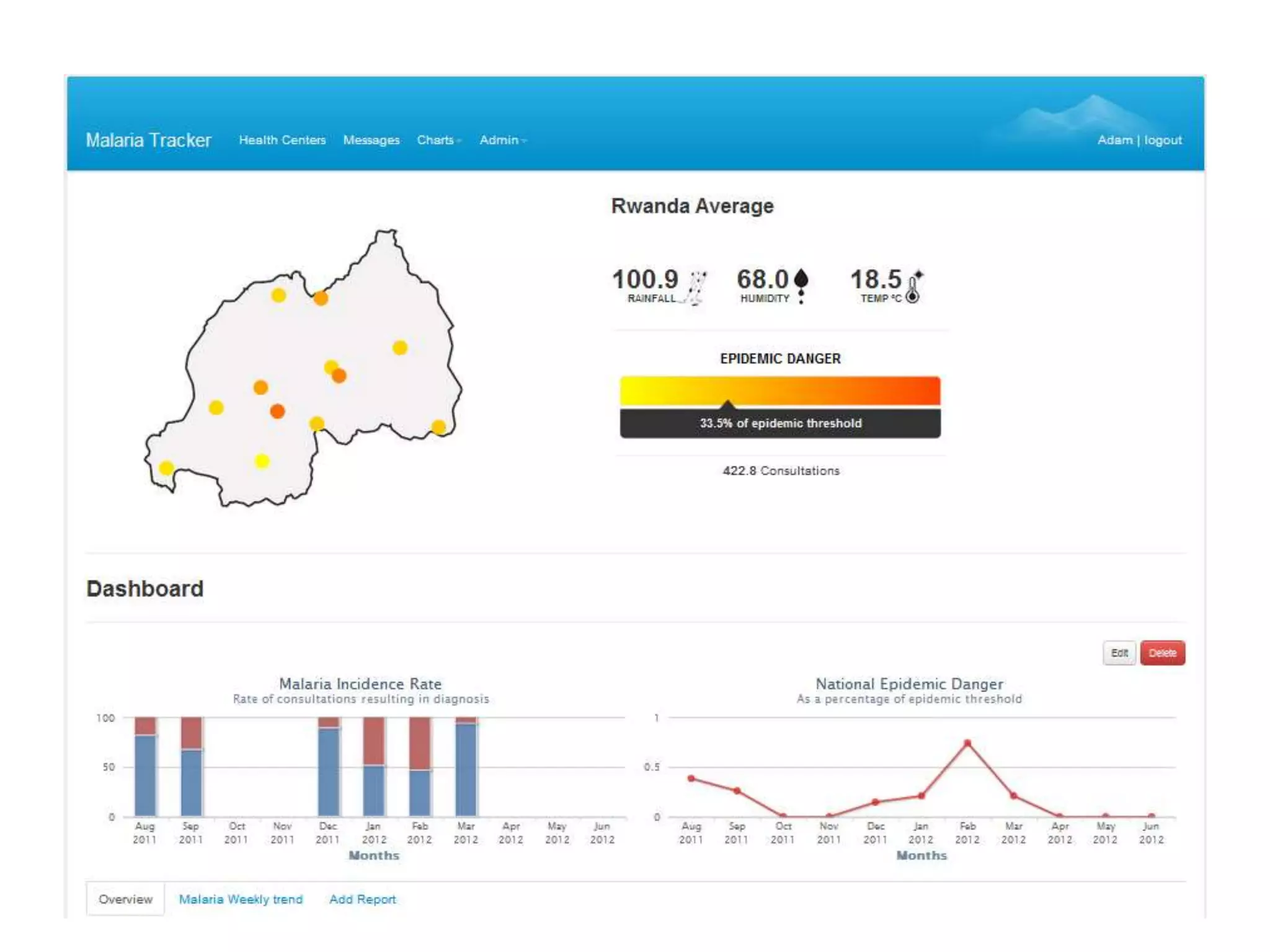
  • #29 mHealth or m-Health: includes the use of mobile devices in collecting aggregate and patient level health data, providing healthcare information to practitioners, researchers, and patients, real-time monitoring of patient vitals, and direct provision of care (via mobile telemedicine);
  • #31 Dashboard of content collected via mobile phones and synced to the cloud
  • #36 Steve Balmer - Microsoft
  • #38 Open Street Map in Haiti: http://vimeo.com/9182869
  • #46 Based on Sim card locations
  • #49 CPI-consumer price index
  • #56 ABC