Unit 3
Criminalistics
Classification of physical evidence
Physical Evidence- encompasses any and all
objects that can establish that a crime has
been committed or can provide a link between
a crime and its victim or a crime and its
perpetrator; anything that is tangible, can be
seen or measured, with or without
magnification
So why aren’t all crimes solved?
If physical evidence is to be used effectively for aiding the
investigator, its presence first must be recognized at the
crime scene.
If the investigator cannot recognize physical evidence or
cannot properly preserve it for laboratory examination,
no amount of sophisticated laboratory instrumentation
or technical expertise can salvage the situation.
It must be emphasized that the techniques of crime-
scene investigation are not difficult to master and
certainly lie within the bounds of comprehension of the
average police officer.
Classification of physical evidence
 A woman visiting a large metropolitan city for a professional conference was
attacked at the door of her 17th-floor hotel room, struck on the head, and forced
into her room. Once inside the room, the assailants bound her hands and began
searching the room for property. The victim overheard an assailant say they only
had one condom. She was then raped by both assailants and sodomized by one.
After the sexual assaults, the suspects washed the victim with several towels and
washcloths and wiped the surfaces of the room. They bound her legs with cut-up
bed sheets and covered her with the mattress of the bed. Before leaving, they
stole her cellular phone and a couple hundred dollars in cash from her purse. The
victim was able to free herself and immediately ran to an adjacent room to dial
911. The police responded and took her to a hospital for medical attention and a
rape examination. Her clothing and evidence of the sexual assault were collected
from her body.
Classification of physical evidence
 Numerous items of value were collected from the crime scene. The sheets
used as bindings, the towels used to wash the victim, a condom wrapper,
the victim’s purse, and several fingerprint lifts were collected. The used
condom was found floating on the surface of the toilet bowl water. Transfer
bloodstains were observed on the bindings, particularly in the areas where
knots had been tied. When the knots were untied, foreign hair and a piece
of chewed gum were located. Blood was also found on the victim’s purse.
No semen was located on the towels or sheets. Additional foreign hairs
were found. A partial fingerprint was developed on the condom wrapper.
Examination of the rape kit revealed the presence of semen on the rectal
samples only. Also, condom trace evidence was found on the vaginal
samples but not on the rectal samples.
Classification of physical evidence
 The chewed gum, rectal samples, and blood lifted from several items resulted in a DNA
profile of one male. Several attempts to detect a DNA profile on the condom produced
the victim’s profile and a partial profile of the second assailant. The fingerprint evidence
matched the suspect whose DNA was found on the condom. Questioned hair was also
consistent with the second assailant. All of this evidence was crucial to the prosecution
because the victim was unable to identify her attackers.
 One suspect was quickly apprehended after he used the victim’s cellular phone to make
several calls before he sold the phone. The tracing of the cellular phone calls and
subsequent alerting of the police by the phone purchaser resulted in apprehension of
the suspects. Collectively, the physical evidence identifying the suspects was
overwhelming but both suspects chose jury trials. The law precluded trying the
defendants together so all of the evidence, including the victim’s testimony, had to be
presented twice. Both trials resulted in convictions on burglary, kidnapping, forcible
rape, forcible sodomy, and sexual abuse charges. The defendants were given multiple
life sentences.
What are the various evidence that you
have noticed?
 Biological evidence—Typically, human (or occasionally other)
tissues used for identification and individualization of human
tissues constitute the focus of forensic biology.
 Chemical evidence—Primarily, forensic chemistry deals with seized
drugs, toxicological samples, materials chemistry, and explosives.
 Trace evidence—Locard’s exchange principle basically states that,
whenever two objects come in contact with one another, a transfer
of material will occur. The transfer may be tenuous, but it will
certainly occur. In other words, a suspect will leave something at
and take something away from a crime scene.
 Fingerprint evidence—Two aspects of fingerprinting are generally associated with the
forensic laboratory: latent print development and fingerprint identification
 Impression evidence—Footwear and tire impressions are examples of impression
evidence examined in the forensic laboratory (see Figure 2.6). Impression evidence can
provide substantial information, including identification, depending upon the quality of
the impression and the number of unique features present.
 Firearm and tool mark evidence—Considered a type of impression evidence, firearm and
tool mark evidence encompasses fired bullets, cartridge casings, and shot shells. A variety
of markings or impressions are left on these items when a firearm is discharged, and the
markings provide points of comparison to other ammunition fired from the same weapon.
 Questioned documents—A variety of examinations can be performed in the analysis of
questioned documents. The more common examinations include handwriting
comparisons, alterations, obliterations, and erasures. Characterization of inks and paper
may also provide valuable information.
Procedures for evidence collection
Procedures for Evidence Collection
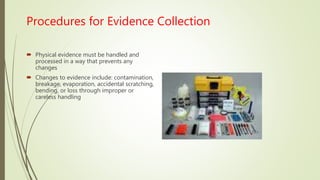
 Physical evidence must be handled and
processed in a way that prevents any
changes
 Changes to evidence include: contamination,
breakage, evaporation, accidental scratching,
bending, or loss through improper or
careless handling
Evidence Collection
 Item should be kept in as
original condition as possible
 Evidence should be submitted
as intact as possible
 Each item collected should be
bagged separately
 Bloodstains and other biological
evidence should be collected in paper
bags, envelopes or druggist folds to
prevent the growth of mold.
 Stained clothing should be air dried
before wrapping
 Charred debris from a fire must be
placed in airtight containers
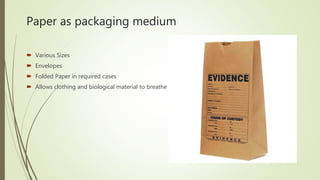
Paper as packaging medium
 Various Sizes
 Envelopes
 Folded Paper in required cases
 Allows clothing and biological material to breathe
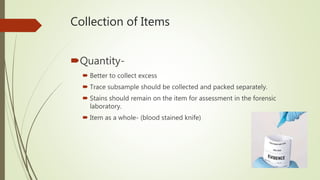
Collection of Items
Quantity-
 Better to collect excess
 Trace subsample should be collected and packed separately.
 Stains should remain on the item for assessment in the forensic
laboratory.
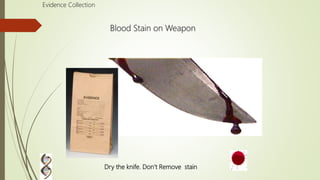
 Item as a whole- (blood stained knife)
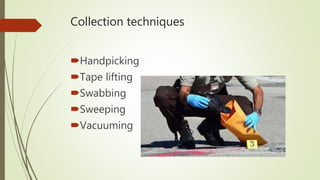
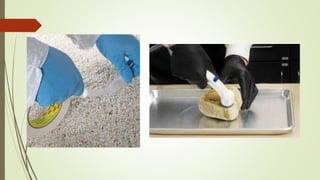
Collection techniques
Handpicking
Tape lifting
Swabbing
Sweeping
Vacuuming
https://www.youtube.com/watch?v=yeAwJwu
UQH8
Control Sample
Collection is very important
To ensure the material does not interfere with the
analysis.
Sufficient reference sample to be provided.
Should be sent with the actual sample but packed
separately.
Reference sample should be representative of the
source from where the test sample is taken.
Labelling
Nature of contents
Source, Date and Time
Sequential Number, Case identifying number
Signature of the collector with name
Purpose
 To identify the nature and source of the item
 To establish chain of custody
Labelling
 To be completed at the time of collection.
 a) The investigating agency’s case number
 b) the scene site (especially if more than one scene is
involved)
 c) a brief description of the evidence or the evidence
item number which correlates to an evidence log
 d) the location where the evidence was obtained
within the scene
 e) the collector’s name or badge no. and initials
 f) the date and time collected
Beware of Contamination
Contamination occurs when DNA from another source
gets mixed in with the sample being collected.
 An investigator touches, sneezes, bleeds on a sample.
 Wear gloves and use disposable instruments
 Package items separately.
 Especially, do not mix known samples (from victim or
suspect) with unknown samples.
Blood
Evidence Collection
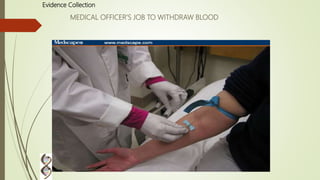
MEDICAL OFFICER’S JOB TO WITHDRAW BLOOD
Evidence Collection
Evidence Collection
LIQUID BLOOD AND FRESH
BLOOD STAINS
Blood that is in liquid pools should be picked up on a gauze pad or other
clean sterile cotton cloth and allowed to air dry thoroughly, at room
temperature.
It should be refrigerated or frozen as soon as possible and brought to the
Laboratory as quickly as possible. Delays beyond 48 hours may make the
samples useless.
If close to the Laboratory, deliver stained object immediately.
If unable to deliver to the Laboratory, or if the object must be mailed,
the stain to air dry completely before packaging.
LIQUID BLOOD AND FRESH
BLOOD STAINS
Do not heat stained material or place it in bright sunlight to
dry. Hang clothing and similar articles in a room where
there is adequate ventilation.
If not completely dry, label and roll in paper or place in a
brown paper bag or box and seal and label container. Place
only one item in each container.
Do not use plastic containers.
Evidence Collection
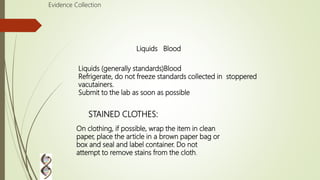
Liquids (generally standards)Blood
Refrigerate, do not freeze standards collected in stoppered
vacutainers.
Submit to the lab as soon as possible
Evidence Collection
On clothing, if possible, wrap the item in clean
paper, place the article in a brown paper bag or
box and seal and label container. Do not
attempt to remove stains from the cloth.
STAINED CLOTHES:
Liquids Blood
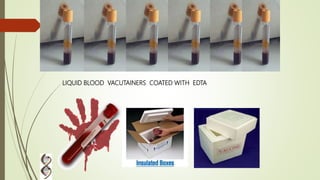
LIQUID BLOOD VACUTAINERS COATED WITH EDTA
Evidence Collection
FTA CARD FOR BLOOD STAIN COLLECTIOON
Whatman™ Whatman International Ltd.
1 Case detail marking
Provision
2.One Circle for one
specimen
BLOOD STAIN COLLECTIOON
Evidence Collection
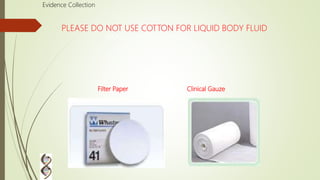
Filter Paper Clinical Gauze
PLEASE DO NOT USE COTTON FOR LIQUID BODY FLUID
Evidence Collection
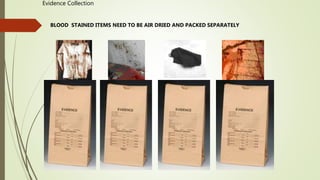
BLOOD STAINED ITEMS NEED TO BE AIR DRIED AND PACKED SEPARATELY
Blood Stain on Weapon
Evidence Collection
Dry the knife. Don’t Remove stain
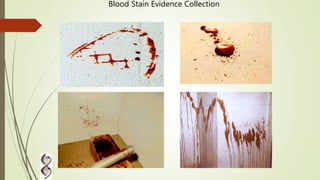
Blood Stain Evidence Collection
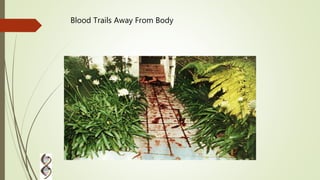
Blood Trails Away From Body
Blood stains on wall/floor/hard surface and other material
On small solid objects, send the whole stained object to the Laboratory, after
labeling and packaging.
On large solid objects, cover the stained area with clean paper and seal the
edges down with tape to prevent loss or contamination. If impractical to deliver
the whole object to the Laboratory, scrape the stain onto a clean piece of paper,
which can be folded and placed in an envelope. Do not scrape directly into
evidence envelope. Scrape blood from objects using a freshly washed and dried
knife or similar tool. Wash and dry the tool before each stain is scraped off. Seal
and mark the envelope.
Do not mix dried stains. Place each stain in a separate envelope.
REMEMBER: Never attempt to wipe dried stains from an object using a
moistened cloth or paper.
Procedure for rape victim examination:
 Police advise victim not to change clothes, bathe before
Medical Examination.
 Should not be examined without authority of investigating
PO/ magistrate.
 Consent of victim/ guardian, date/ time, identified by
escorting female PO. Examine in POs presence.
 Examine without delay – vulva tenderness, detection of
spermatozoa.
Evidence Collection
Moisture allows for bacterial growth and
destroys DNA. Therefore:
 Foreign hair preserved and compared with accused.
 Saliva / lipstick marks etc be carefully collected.
Semen and Vaginal Secretion stains are
the two most commonly tested biological
evidence.
Forensic search of of Semen Stains
Evidence Collection
At the scene of a sexual assault, the search for
semen includes the corpse or victim, underwear, bed
sheets and mattresses, carpeting, and flooring.
 Clothes are examined for the presence of blood and
seminal stains, tears and mud.
 Any marks or suspicious stains are preserved for
examination by the chemical examiner.
 Stands on clean sheet of paper, and anything that falls is
preserved – earth, buttons, hair.
 Foreign hair preserved and compared with accused.
Semen
1.Locate semen stain – often visible  exhibit a
stiff, crusty appearance identify stain.
2.Possibly, blood stains may be found type
immediately
Remember: If not willfully removed from the
vaginal tract semen can be detected up to 72
hours. It is advised to get patient examined
before 72 hrs.
Specimens to be collected
Head hairs
Pubic hair
Blood group
Urine drug screening
Nail scrapings for blood or tissue
Swabs - soiled areas of skin, anal, rectum
Swab - penis of accused.
Evidence Collection
Clothes
 Clothes are examined for the presence of blood and
seminal stains, tears and mud.
 Any marks or suspicious stains are preserved for
examination by the chemical examiner.
 Stands on clean sheet of paper, and anything that falls is
preserved – earth, buttons, hair.
 Foreign hair preserved to be compared with accused.
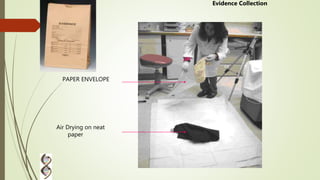
PAPER ENVELOPE
Air Drying on neat
paper
Evidence Collection
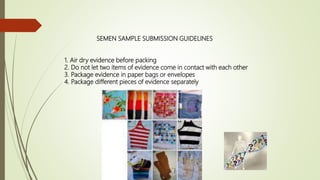
SEMEN SAMPLE SUBMISSION GUIDELINES
1. Air dry evidence before packing
2. Do not let two items of evidence come in contact with each other
3. Package evidence in paper bags or envelopes
4. Package different pieces of evidence separately
FORENSIC HAIR EVIDENCE
COLLECTION
HAIR SAMPLE STANDARDS: Whenever hair is collected the roots should be included
because considerable information can be obtained from the root material.
HEAD OR SCALP HAIR The hair should be representative of the center, front, back
(including nape of the neck), and both sides of the scalp. Approximately 50 head hairs
should be collected. The sample should include both pulled and combed hairs and
include any variations in color and length. If additional facial hairs are collected (i.e.
sideburn or beard hairs), these should be packaged separately.
PUBIC HAIR: When indicated by the circumstances, collect pubic hair. Approximately 30
pubic hairs should be collected. The sample should be collected and packaged in the
same manner described above.
Evidence Collection
Collection and preservation of hair
evidence
• Have questioned and standard/reference
hairs come from same area of body and
adequate number of hair samples of each
• Forensic hair comparisons involve either
head hair or pubic hair
• Collection of 50 full-length hairs from all
areas of the scalp
• Minimum of 24 full-length hairs from pubic
area
Collection and preservation of hair evidence
continued
• Entire hair length collected because of variance
in morphological characteristics
like color
• Pull hair out of skin or clipping at skin line
• Hair samples collected from victim(s)
suspicious death during autopsy
COLLECTION, PRESERVATION AND MARKING OF HAIR
EVIDENCE
Before attempting specific procedures listed below, note the following
general precautions:
1. The size of the container should correspond to the size of the object.
2. Do not package wet evidence. Hair or objects containing hair evidence
should be air dried before being placed in sealed containers. Biological
stains degrade with time. This process is accelerated when items are
wet and sealed in airtight containers.
3 Do not package items on a surface without first thoroughly cleaning that
surface. Avoiding cross contamination between all evidence and
standards is imperative!
4. All seams of the packaging must be sealed to prevent the loss of trace
evidence.
5. Label all evidence containers with submitter’s initials, ID/badge number,
agency name, case number, item number, source, and date.
Check list
No.
Item
1 Brief history of the case. Yes/No
2 Duly sealed and marked exhibits and controls. Yes/No
3 List of exhibits/controls forwarded with details of collection and seals Yes/No
4 Duly filled "Biological Sample Donor Card", in duplicate for control samples.
(DNA Cases only)
Yes/No
5 Relevant questions for examination asked Yes/No
6 Sample seal(s) in sealing wax on parcels/packets intact and legible. Yes/No
7 Copy of Post- mortem or medico- legal report of victim(s) & suspect(s), if
conducted.
Yes/No
8 Letter of authority in favour of Director, Forensic Science Laboratory “to
examine the exhibits, and if necessary, to take them to places or remove
portions for the purpose of examination”.
Yes/No
9 Case forwarded by an officer not below the rank of Superintendent of
Police/Deputy Commissiner of Police (SP/DCP) or officer of equivalent rank
from Military, Custom and other agencies.
Yes/No
COME TO CFSL WITH ALL THESE EXHIBITS AND DOCUMENTS:
https://www.youtube.com/watch?v=2HPeZWG
tjD0
Skeletal Remains
Clean and air-dry bones, if possible. Pack in
paper bags and wrap in protective material
such as Bubble Wrap or paper. If tissue is
present on the skeletal material, refrigerate
until mailing, and then ship in a Styrofoam
cooler.
Insects
Collect insect samples found on the remains in
leakproof containers such as film canisters or
plastic pill bottles
Ammunition
Projectiles, cartridges, shots , wads
Wrap in tissue paper
Place each item in separate plastic or paper
(cardboard) container.
Wash if recovered during autopsy.
Bite Marks
Photograph at 90 degrees with and without ABFO
Scale.
Make a cast after wiping the area with distilled
water
Cast to be placed in a rigid plastic container.
Suspect-
 Photograph teeth, dental records
 Obtain saliva sample.
 Casts of teeth can also be taken
Clothing
Photograph, note, describe
Remove clothing over clean white paper, air
dry and pack.
Remove obvious trace material – and pack
them separately.
Use paper bags, large paper sheets.
https://www.youtube.com/watch?v=cfWsgS0I
D-s
Documents
Wear white cotton gloves
Use tweezers
Package separately.
Use thick plastic sheet for support
Use cardboard boxes to pack documents.
Fibers
Collect fibers using tweezers
Send whole item where fibers are adhered to
Use tape-lifting method to extract the fibers
from the surface
Pack in envelops, paper bags
Fire debris
Large pieces to be cut and packed
Control samples to be collected from various
places
Metal paint cans, nylon bags, Polvinylidene
chloride bags (PVDC)
GSR
On hands-
Photography
Collect from web of the hand using adhesive material
Take control sample
On clothing-
Photograph visible evidence and then package.
Protect bullet hole by pinning paper over it.
Glass
Photograph both sides before removing it
from the frame
Collect fragile fragments first
Wrap each separately to protect edges
Collect all pieces if possible
If present on clothing collect fragile fragments
and then pack the clothing.
Hair
Collect and protect the complete item if present
on movable objects.
Otherwise use plastic disposable tweezers
Use folded paper inserted into an envelope.
Control-
 Head- 30-40 samples from various areas.
 Pubic- 20-30
 Others – 10-12
Paint
Collect the item, tool, vehicle containing the
evidence if possible.
Collect paint chips separately
Should not fragment paint chips.
Reference samples of each colour should be
taken.
Folded paper inserted into an envelope should be
used for packaging.
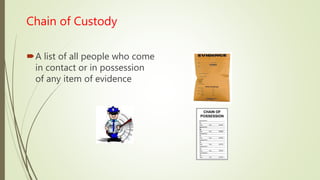
Chain of Custody
A list of all people who come
in contact or in possession
of any item of evidence
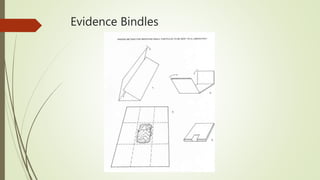
Evidence Bindles

Criminalistics Unit 3

  • 1.
  • 2.
  • 3.
    Physical Evidence- encompassesany and all objects that can establish that a crime has been committed or can provide a link between a crime and its victim or a crime and its perpetrator; anything that is tangible, can be seen or measured, with or without magnification
  • 4.
    So why aren’tall crimes solved? If physical evidence is to be used effectively for aiding the investigator, its presence first must be recognized at the crime scene. If the investigator cannot recognize physical evidence or cannot properly preserve it for laboratory examination, no amount of sophisticated laboratory instrumentation or technical expertise can salvage the situation. It must be emphasized that the techniques of crime- scene investigation are not difficult to master and certainly lie within the bounds of comprehension of the average police officer.
  • 5.
    Classification of physicalevidence  A woman visiting a large metropolitan city for a professional conference was attacked at the door of her 17th-floor hotel room, struck on the head, and forced into her room. Once inside the room, the assailants bound her hands and began searching the room for property. The victim overheard an assailant say they only had one condom. She was then raped by both assailants and sodomized by one. After the sexual assaults, the suspects washed the victim with several towels and washcloths and wiped the surfaces of the room. They bound her legs with cut-up bed sheets and covered her with the mattress of the bed. Before leaving, they stole her cellular phone and a couple hundred dollars in cash from her purse. The victim was able to free herself and immediately ran to an adjacent room to dial 911. The police responded and took her to a hospital for medical attention and a rape examination. Her clothing and evidence of the sexual assault were collected from her body.
  • 6.
    Classification of physicalevidence  Numerous items of value were collected from the crime scene. The sheets used as bindings, the towels used to wash the victim, a condom wrapper, the victim’s purse, and several fingerprint lifts were collected. The used condom was found floating on the surface of the toilet bowl water. Transfer bloodstains were observed on the bindings, particularly in the areas where knots had been tied. When the knots were untied, foreign hair and a piece of chewed gum were located. Blood was also found on the victim’s purse. No semen was located on the towels or sheets. Additional foreign hairs were found. A partial fingerprint was developed on the condom wrapper. Examination of the rape kit revealed the presence of semen on the rectal samples only. Also, condom trace evidence was found on the vaginal samples but not on the rectal samples.
  • 7.
    Classification of physicalevidence  The chewed gum, rectal samples, and blood lifted from several items resulted in a DNA profile of one male. Several attempts to detect a DNA profile on the condom produced the victim’s profile and a partial profile of the second assailant. The fingerprint evidence matched the suspect whose DNA was found on the condom. Questioned hair was also consistent with the second assailant. All of this evidence was crucial to the prosecution because the victim was unable to identify her attackers.  One suspect was quickly apprehended after he used the victim’s cellular phone to make several calls before he sold the phone. The tracing of the cellular phone calls and subsequent alerting of the police by the phone purchaser resulted in apprehension of the suspects. Collectively, the physical evidence identifying the suspects was overwhelming but both suspects chose jury trials. The law precluded trying the defendants together so all of the evidence, including the victim’s testimony, had to be presented twice. Both trials resulted in convictions on burglary, kidnapping, forcible rape, forcible sodomy, and sexual abuse charges. The defendants were given multiple life sentences.
  • 8.
    What are thevarious evidence that you have noticed?  Biological evidence—Typically, human (or occasionally other) tissues used for identification and individualization of human tissues constitute the focus of forensic biology.  Chemical evidence—Primarily, forensic chemistry deals with seized drugs, toxicological samples, materials chemistry, and explosives.  Trace evidence—Locard’s exchange principle basically states that, whenever two objects come in contact with one another, a transfer of material will occur. The transfer may be tenuous, but it will certainly occur. In other words, a suspect will leave something at and take something away from a crime scene.
  • 9.
     Fingerprint evidence—Twoaspects of fingerprinting are generally associated with the forensic laboratory: latent print development and fingerprint identification  Impression evidence—Footwear and tire impressions are examples of impression evidence examined in the forensic laboratory (see Figure 2.6). Impression evidence can provide substantial information, including identification, depending upon the quality of the impression and the number of unique features present.  Firearm and tool mark evidence—Considered a type of impression evidence, firearm and tool mark evidence encompasses fired bullets, cartridge casings, and shot shells. A variety of markings or impressions are left on these items when a firearm is discharged, and the markings provide points of comparison to other ammunition fired from the same weapon.
  • 10.
     Questioned documents—Avariety of examinations can be performed in the analysis of questioned documents. The more common examinations include handwriting comparisons, alterations, obliterations, and erasures. Characterization of inks and paper may also provide valuable information.
  • 11.
  • 12.
    Procedures for EvidenceCollection  Physical evidence must be handled and processed in a way that prevents any changes  Changes to evidence include: contamination, breakage, evaporation, accidental scratching, bending, or loss through improper or careless handling
  • 13.
    Evidence Collection  Itemshould be kept in as original condition as possible  Evidence should be submitted as intact as possible  Each item collected should be bagged separately  Bloodstains and other biological evidence should be collected in paper bags, envelopes or druggist folds to prevent the growth of mold.  Stained clothing should be air dried before wrapping  Charred debris from a fire must be placed in airtight containers
  • 14.
    Paper as packagingmedium  Various Sizes  Envelopes  Folded Paper in required cases  Allows clothing and biological material to breathe
  • 15.
    Collection of Items Quantity- Better to collect excess  Trace subsample should be collected and packed separately.  Stains should remain on the item for assessment in the forensic laboratory.  Item as a whole- (blood stained knife)
  • 16.
  • 17.
  • 19.
    Control Sample Collection isvery important To ensure the material does not interfere with the analysis. Sufficient reference sample to be provided. Should be sent with the actual sample but packed separately. Reference sample should be representative of the source from where the test sample is taken.
  • 20.
    Labelling Nature of contents Source,Date and Time Sequential Number, Case identifying number Signature of the collector with name Purpose  To identify the nature and source of the item  To establish chain of custody
  • 21.
    Labelling  To becompleted at the time of collection.  a) The investigating agency’s case number  b) the scene site (especially if more than one scene is involved)  c) a brief description of the evidence or the evidence item number which correlates to an evidence log  d) the location where the evidence was obtained within the scene  e) the collector’s name or badge no. and initials  f) the date and time collected
  • 22.
    Beware of Contamination Contaminationoccurs when DNA from another source gets mixed in with the sample being collected.  An investigator touches, sneezes, bleeds on a sample.  Wear gloves and use disposable instruments  Package items separately.  Especially, do not mix known samples (from victim or suspect) with unknown samples.
  • 23.
  • 24.
    MEDICAL OFFICER’S JOBTO WITHDRAW BLOOD Evidence Collection
  • 25.
    Evidence Collection LIQUID BLOODAND FRESH BLOOD STAINS Blood that is in liquid pools should be picked up on a gauze pad or other clean sterile cotton cloth and allowed to air dry thoroughly, at room temperature. It should be refrigerated or frozen as soon as possible and brought to the Laboratory as quickly as possible. Delays beyond 48 hours may make the samples useless. If close to the Laboratory, deliver stained object immediately. If unable to deliver to the Laboratory, or if the object must be mailed, the stain to air dry completely before packaging.
  • 26.
    LIQUID BLOOD ANDFRESH BLOOD STAINS Do not heat stained material or place it in bright sunlight to dry. Hang clothing and similar articles in a room where there is adequate ventilation. If not completely dry, label and roll in paper or place in a brown paper bag or box and seal and label container. Place only one item in each container. Do not use plastic containers. Evidence Collection
  • 27.
    Liquids (generally standards)Blood Refrigerate,do not freeze standards collected in stoppered vacutainers. Submit to the lab as soon as possible Evidence Collection On clothing, if possible, wrap the item in clean paper, place the article in a brown paper bag or box and seal and label container. Do not attempt to remove stains from the cloth. STAINED CLOTHES: Liquids Blood
  • 28.
    LIQUID BLOOD VACUTAINERSCOATED WITH EDTA
  • 29.
    Evidence Collection FTA CARDFOR BLOOD STAIN COLLECTIOON Whatman™ Whatman International Ltd. 1 Case detail marking Provision 2.One Circle for one specimen
  • 30.
    BLOOD STAIN COLLECTIOON EvidenceCollection Filter Paper Clinical Gauze PLEASE DO NOT USE COTTON FOR LIQUID BODY FLUID
  • 31.
    Evidence Collection BLOOD STAINEDITEMS NEED TO BE AIR DRIED AND PACKED SEPARATELY
  • 32.
    Blood Stain onWeapon Evidence Collection Dry the knife. Don’t Remove stain
  • 33.
  • 34.
  • 35.
    Blood stains onwall/floor/hard surface and other material On small solid objects, send the whole stained object to the Laboratory, after labeling and packaging. On large solid objects, cover the stained area with clean paper and seal the edges down with tape to prevent loss or contamination. If impractical to deliver the whole object to the Laboratory, scrape the stain onto a clean piece of paper, which can be folded and placed in an envelope. Do not scrape directly into evidence envelope. Scrape blood from objects using a freshly washed and dried knife or similar tool. Wash and dry the tool before each stain is scraped off. Seal and mark the envelope. Do not mix dried stains. Place each stain in a separate envelope. REMEMBER: Never attempt to wipe dried stains from an object using a moistened cloth or paper.
  • 36.
    Procedure for rapevictim examination:  Police advise victim not to change clothes, bathe before Medical Examination.  Should not be examined without authority of investigating PO/ magistrate.  Consent of victim/ guardian, date/ time, identified by escorting female PO. Examine in POs presence.  Examine without delay – vulva tenderness, detection of spermatozoa.
  • 37.
    Evidence Collection Moisture allowsfor bacterial growth and destroys DNA. Therefore:  Foreign hair preserved and compared with accused.  Saliva / lipstick marks etc be carefully collected. Semen and Vaginal Secretion stains are the two most commonly tested biological evidence.
  • 38.
    Forensic search ofof Semen Stains Evidence Collection At the scene of a sexual assault, the search for semen includes the corpse or victim, underwear, bed sheets and mattresses, carpeting, and flooring.  Clothes are examined for the presence of blood and seminal stains, tears and mud.  Any marks or suspicious stains are preserved for examination by the chemical examiner.  Stands on clean sheet of paper, and anything that falls is preserved – earth, buttons, hair.  Foreign hair preserved and compared with accused.
  • 39.
    Semen 1.Locate semen stain– often visible  exhibit a stiff, crusty appearance identify stain. 2.Possibly, blood stains may be found type immediately Remember: If not willfully removed from the vaginal tract semen can be detected up to 72 hours. It is advised to get patient examined before 72 hrs.
  • 40.
    Specimens to becollected Head hairs Pubic hair Blood group Urine drug screening Nail scrapings for blood or tissue Swabs - soiled areas of skin, anal, rectum Swab - penis of accused. Evidence Collection
  • 41.
    Clothes  Clothes areexamined for the presence of blood and seminal stains, tears and mud.  Any marks or suspicious stains are preserved for examination by the chemical examiner.  Stands on clean sheet of paper, and anything that falls is preserved – earth, buttons, hair.  Foreign hair preserved to be compared with accused.
  • 42.
    PAPER ENVELOPE Air Dryingon neat paper Evidence Collection
  • 43.
    SEMEN SAMPLE SUBMISSIONGUIDELINES 1. Air dry evidence before packing 2. Do not let two items of evidence come in contact with each other 3. Package evidence in paper bags or envelopes 4. Package different pieces of evidence separately
  • 44.
    FORENSIC HAIR EVIDENCE COLLECTION HAIRSAMPLE STANDARDS: Whenever hair is collected the roots should be included because considerable information can be obtained from the root material. HEAD OR SCALP HAIR The hair should be representative of the center, front, back (including nape of the neck), and both sides of the scalp. Approximately 50 head hairs should be collected. The sample should include both pulled and combed hairs and include any variations in color and length. If additional facial hairs are collected (i.e. sideburn or beard hairs), these should be packaged separately. PUBIC HAIR: When indicated by the circumstances, collect pubic hair. Approximately 30 pubic hairs should be collected. The sample should be collected and packaged in the same manner described above. Evidence Collection
  • 45.
    Collection and preservationof hair evidence • Have questioned and standard/reference hairs come from same area of body and adequate number of hair samples of each • Forensic hair comparisons involve either head hair or pubic hair • Collection of 50 full-length hairs from all areas of the scalp • Minimum of 24 full-length hairs from pubic area
  • 46.
    Collection and preservationof hair evidence continued • Entire hair length collected because of variance in morphological characteristics like color • Pull hair out of skin or clipping at skin line • Hair samples collected from victim(s) suspicious death during autopsy
  • 47.
    COLLECTION, PRESERVATION ANDMARKING OF HAIR EVIDENCE Before attempting specific procedures listed below, note the following general precautions: 1. The size of the container should correspond to the size of the object. 2. Do not package wet evidence. Hair or objects containing hair evidence should be air dried before being placed in sealed containers. Biological stains degrade with time. This process is accelerated when items are wet and sealed in airtight containers. 3 Do not package items on a surface without first thoroughly cleaning that surface. Avoiding cross contamination between all evidence and standards is imperative! 4. All seams of the packaging must be sealed to prevent the loss of trace evidence. 5. Label all evidence containers with submitter’s initials, ID/badge number, agency name, case number, item number, source, and date.
  • 48.
    Check list No. Item 1 Briefhistory of the case. Yes/No 2 Duly sealed and marked exhibits and controls. Yes/No 3 List of exhibits/controls forwarded with details of collection and seals Yes/No 4 Duly filled "Biological Sample Donor Card", in duplicate for control samples. (DNA Cases only) Yes/No 5 Relevant questions for examination asked Yes/No 6 Sample seal(s) in sealing wax on parcels/packets intact and legible. Yes/No 7 Copy of Post- mortem or medico- legal report of victim(s) & suspect(s), if conducted. Yes/No 8 Letter of authority in favour of Director, Forensic Science Laboratory “to examine the exhibits, and if necessary, to take them to places or remove portions for the purpose of examination”. Yes/No 9 Case forwarded by an officer not below the rank of Superintendent of Police/Deputy Commissiner of Police (SP/DCP) or officer of equivalent rank from Military, Custom and other agencies. Yes/No COME TO CFSL WITH ALL THESE EXHIBITS AND DOCUMENTS:
  • 49.
  • 50.
    Skeletal Remains Clean andair-dry bones, if possible. Pack in paper bags and wrap in protective material such as Bubble Wrap or paper. If tissue is present on the skeletal material, refrigerate until mailing, and then ship in a Styrofoam cooler.
  • 51.
    Insects Collect insect samplesfound on the remains in leakproof containers such as film canisters or plastic pill bottles
  • 52.
    Ammunition Projectiles, cartridges, shots, wads Wrap in tissue paper Place each item in separate plastic or paper (cardboard) container. Wash if recovered during autopsy.
  • 53.
    Bite Marks Photograph at90 degrees with and without ABFO Scale. Make a cast after wiping the area with distilled water Cast to be placed in a rigid plastic container. Suspect-  Photograph teeth, dental records  Obtain saliva sample.  Casts of teeth can also be taken
  • 54.
    Clothing Photograph, note, describe Removeclothing over clean white paper, air dry and pack. Remove obvious trace material – and pack them separately. Use paper bags, large paper sheets.
  • 55.
  • 56.
    Documents Wear white cottongloves Use tweezers Package separately. Use thick plastic sheet for support Use cardboard boxes to pack documents.
  • 57.
    Fibers Collect fibers usingtweezers Send whole item where fibers are adhered to Use tape-lifting method to extract the fibers from the surface Pack in envelops, paper bags
  • 58.
    Fire debris Large piecesto be cut and packed Control samples to be collected from various places Metal paint cans, nylon bags, Polvinylidene chloride bags (PVDC)
  • 59.
    GSR On hands- Photography Collect fromweb of the hand using adhesive material Take control sample On clothing- Photograph visible evidence and then package. Protect bullet hole by pinning paper over it.
  • 60.
    Glass Photograph both sidesbefore removing it from the frame Collect fragile fragments first Wrap each separately to protect edges Collect all pieces if possible If present on clothing collect fragile fragments and then pack the clothing.
  • 61.
    Hair Collect and protectthe complete item if present on movable objects. Otherwise use plastic disposable tweezers Use folded paper inserted into an envelope. Control-  Head- 30-40 samples from various areas.  Pubic- 20-30  Others – 10-12
  • 62.
    Paint Collect the item,tool, vehicle containing the evidence if possible. Collect paint chips separately Should not fragment paint chips. Reference samples of each colour should be taken. Folded paper inserted into an envelope should be used for packaging.
  • 63.
    Chain of Custody Alist of all people who come in contact or in possession of any item of evidence
  • 64.