Economics of Crime Victoria Vernon, Ph.D. Empire State College
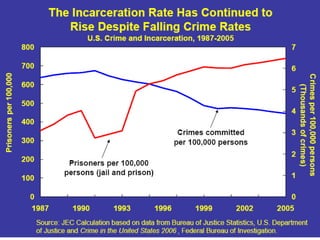
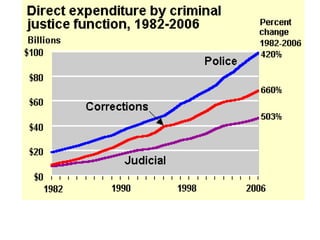
Examples of economic questions in this course: Are we getting our money’s worth for the dollars we spend on police, jails, and prisons? If crime is going down, why are we devoting more resources to its control? If drug offenders are mostly non-violent, why do we send them to state prison? Legalize drugs? Death penalty?
Outline for  Today What is Economics? What is crime? Rational criminals How much crime is there?  What is the economic impact of crime? Graphs Correlation vs causal link
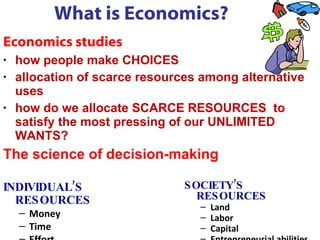
What is Economics? Economics studies  how people make CHOICES allocation of scarce resources among alternative uses  how do we allocate SCARCE RESOURCES  to satisfy the most pressing of our UNLIMITED WANTS?  The science of decision-making  INDIVIDUAL’S  RESOURCES Money Time Effort SOCIETY’S  RESOURCES Land Labor Capital Entrepreneurial abilities
How do we make choices?  (Economics Philosophy) People are  SELFISH Maximize our own joy, happiness UTILITY= subjective measure of joy, pleasure,  happiness, satisfaction from consuming  goods/services People are   RATIONAL compare  COSTS  and  BENEFITS  of alternatives, Examples of decisions: Buying a cup of coffee Going to college Committing a crime People respond to incentives All choices involve OPPORTUNITY COSTS the next best alternative foregone
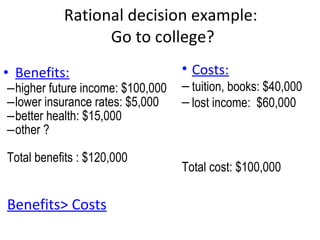
Rational decision example:  Go to college? Benefits: higher future income: $100,000 lower insurance rates: $5,000 better health: $15,000 other ? Total benefits : $120,000 Benefits> Costs Costs: tuition, books: $40,000 lost income:  $60,000 Total cost: $100,000
Rational decision example:  Steel a car? Benefits (expected): Benefits  >  Costs  ? Costs (expected):
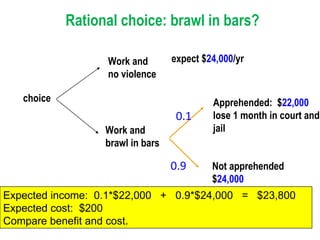
choice Work and  no violence Work and brawl in bars expect $ 24,000 /yr Apprehended:  $ 22,000 lose 1 month in court and jail 0.1 0.9 Not apprehended $ 24,000 Expected income:  0.1*$22,000  +  0.9*$24,000  =  $23,800 Expected cost:  $200 Compare benefit and cost. Rational choice: brawl in bars?
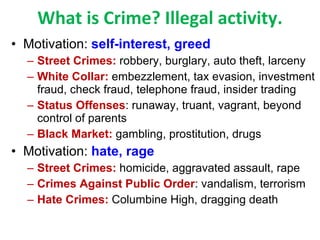
What is Crime? Illegal activity. Motivation:  self-interest, greed Street Crimes:  robbery, burglary, auto theft, larceny White Collar:  embezzlement, tax evasion, investment fraud, check fraud, telephone fraud, insider trading Status Offenses : runaway, truant, vagrant, beyond control of parents Black Market:  gambling, prostitution, drugs Motivation:  hate, rage Street Crimes:  homicide, aggravated assault, rape Crimes Against Public Order : vandalism, terrorism Hate Crimes:  Columbine High, dragging death
Crime?  Selling/buying human organs Discrimination of minorities Collusive business agreements, monopolies Breach of contract Breaking Food and Drug Admin regulations Spam emails, hackers attacks File sharing Jaywalking Illegal parking Racial profiling
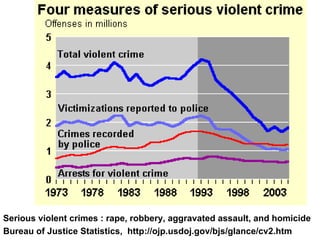
                                                            [   Serious violent crimes : rape, robbery, aggravated assault, and homicide Bureau of Justice Statistics,  http://ojp.usdoj.gov/bjs/glance/cv2.htm
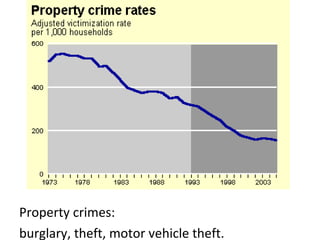
Property crimes:  burglary, theft, motor vehicle theft.
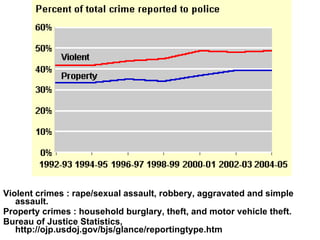
Violent crimes : rape/sexual assault, robbery, aggravated and simple assault.  Property crimes : household burglary, theft, and motor vehicle theft. Bureau of Justice Statistics, http://ojp.usdoj.gov/bjs/glance/reportingtype.htm
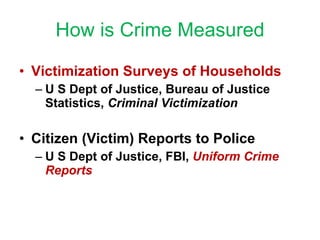
How is Crime Measured Victimization Surveys of Households U S Dept of Justice, Bureau of Justice Statistics,  Criminal Victimization Citizen (Victim) Reports to Police U S Dept of Justice, FBI,  Uniform Crime Reports
 
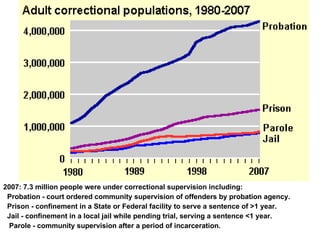
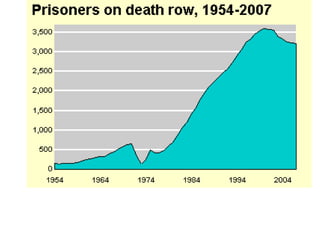
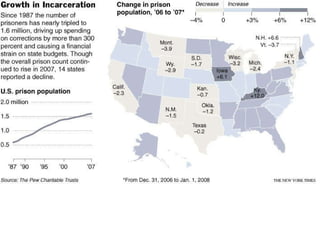
2007: 7.3 million people were under correctional supervision including:  Probation - court ordered community supervision of offenders by probation agency. Prison - confinement in a State or Federal facility to serve a sentence of >1 year. Jail - confinement in a local jail while pending trial, serving a sentence <1 year. Parole - community supervision after a period of incarceration.
 
 
February 28, 2008     


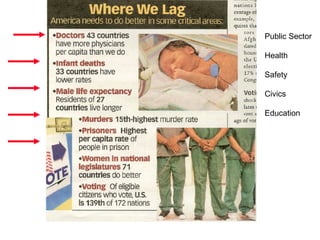
Public Sector Health Safety Civics Education
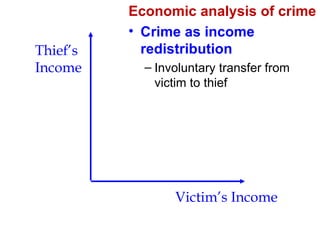
Victim’s Income Thief’s Income Economic analysis of crime Crime as income redistribution Involuntary transfer from victim to thief
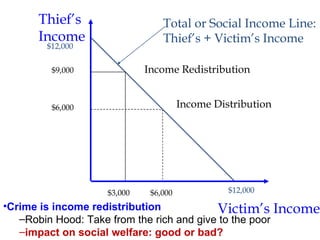
Victim’s Income Thief’s Income $6,000 $6,000 Income Distribution $12,000 Total or Social Income Line: Thief’s + Victim’s Income $12,000 Income Redistribution $9,000 $3,000 Crime is income redistribution Robin Hood: Take from the rich and give to the poor impact on social welfare: good or bad?
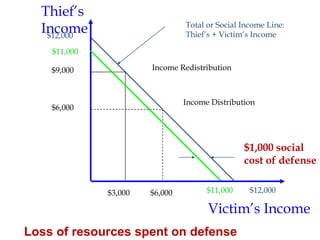
Victim’s Income Thief’s Income $6,000 $6,000 Income Distribution $12,000 Total or Social Income Line: Thief’s + Victim’s Income $12,000 Income Redistribution $9,000 $3,000 $11,000 $1,000 social cost of defense $11,000 Loss of resources spent on defense
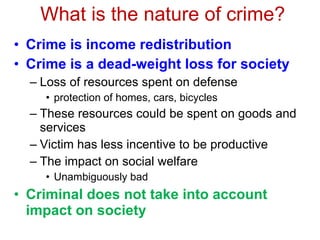
What is the nature of crime? Crime is income redistribution Crime is a dead-weight loss for society Loss of resources spent on defense protection of homes, cars, bicycles These resources could be spent on goods and services  Victim has less incentive to be productive The impact on social welfare Unambiguously bad Criminal does not take into account impact on society
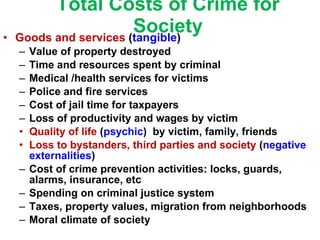
Total Costs of Crime for Society Goods and services  ( tangible ) Value of property destroyed Time and resources spent by criminal Medical /health services for victims Police and fire services Cost of jail time for taxpayers Loss of productivity and wages by victim  Quality of life  ( psychic )  by victim, family, friends Loss to bystanders, third parties and society  ( negative externalities ) Cost of crime prevention activities: locks, guards, alarms, insurance, etc Spending on criminal justice system Taxes, property values, migration from neighborhoods Moral climate of society
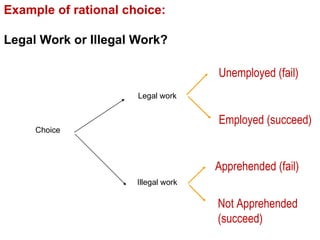
Choice Legal work Illegal work Unemployed (fail) Employed (succeed) Apprehended (fail) Not Apprehended (succeed) Example of rational choice: Legal Work or Illegal Work?
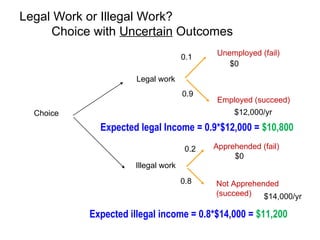
Expected legal Income = 0.9*$12,000 =  $10,800 Legal Work or Illegal Work?  Choice with  Uncertain  Outcomes Choice Legal work Illegal work Unemployed (fail) Employed (succeed) Apprehended (fail) Not Apprehended (succeed) 0.1 0.9 $0 $12,000/yr 0.2 0.8 $0 $14,000/yr Expected illegal income = 0.8*$14,000 =  $11,200
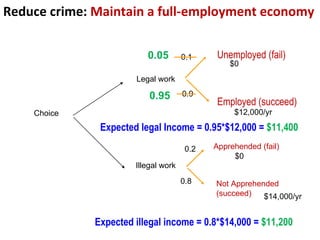
Expected legal Income = 0.95*$12,000 =  $11,400 Choice Legal work Illegal work Unemployed (fail) Employed (succeed) Apprehended (fail) Not Apprehended (succeed) 0.1 0.9 $0 $12,000/yr 0.2 0.8 $0 $14,000/yr Expected illegal income = 0.8*$14,000 =  $11,200 0.05 0.95 Reduce crime:  Maintain a full-employment economy
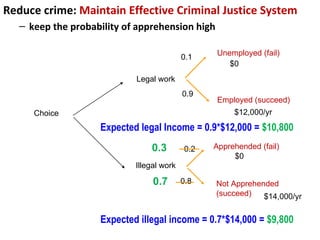
Expected legal Income = 0.9*$12,000 =  $10,800 Choice Legal work Illegal work Unemployed (fail) Employed (succeed) Apprehended (fail) Not Apprehended (succeed) 0.1 0.9 $0 $12,000/yr 0.2 0.8 $0 $14,000/yr Expected illegal income = 0.7*$14,000 =  $9,800 0.3 0.7 Reduce crime:  Maintain Effective Criminal Justice System keep the probability of apprehension high
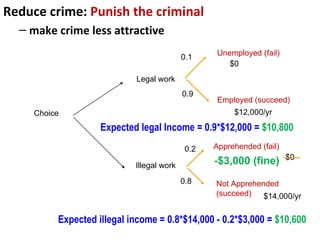
Expected legal Income = 0.9*$12,000 =  $10,800 Choice Legal work Illegal work Unemployed (fail) Employed (succeed) Apprehended (fail) Not Apprehended (succeed) 0.1 0.9 $0 $12,000/yr 0.2 0.8 -$3,000 (fine) $14,000/yr Expected illegal income = 0.8*$14,000 - 0.2*$3,000 =  $10,600 $0 Reduce crime:  Punish the criminal make crime less attractive
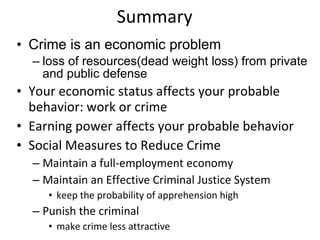
Summary Crime is an economic problem loss of resources(dead weight loss) from private and public defense Your economic status affects your probable behavior: work or crime Earning power affects your probable behavior Social Measures to Reduce Crime Maintain a full-employment economy Maintain an Effective Criminal Justice System keep the probability of apprehension high Punish the criminal make crime less attractive

Crime1

  • 1.
    Economics of CrimeVictoria Vernon, Ph.D. Empire State College
  • 2.
    Examples of economicquestions in this course: Are we getting our money’s worth for the dollars we spend on police, jails, and prisons? If crime is going down, why are we devoting more resources to its control? If drug offenders are mostly non-violent, why do we send them to state prison? Legalize drugs? Death penalty?
  • 3.
    Outline for Today What is Economics? What is crime? Rational criminals How much crime is there? What is the economic impact of crime? Graphs Correlation vs causal link
  • 4.
    What is Economics?Economics studies how people make CHOICES allocation of scarce resources among alternative uses how do we allocate SCARCE RESOURCES to satisfy the most pressing of our UNLIMITED WANTS? The science of decision-making INDIVIDUAL’S RESOURCES Money Time Effort SOCIETY’S RESOURCES Land Labor Capital Entrepreneurial abilities
  • 5.
    How do wemake choices? (Economics Philosophy) People are SELFISH Maximize our own joy, happiness UTILITY= subjective measure of joy, pleasure, happiness, satisfaction from consuming goods/services People are RATIONAL compare COSTS and BENEFITS of alternatives, Examples of decisions: Buying a cup of coffee Going to college Committing a crime People respond to incentives All choices involve OPPORTUNITY COSTS the next best alternative foregone
  • 6.
    Rational decision example: Go to college? Benefits: higher future income: $100,000 lower insurance rates: $5,000 better health: $15,000 other ? Total benefits : $120,000 Benefits> Costs Costs: tuition, books: $40,000 lost income: $60,000 Total cost: $100,000
  • 7.
    Rational decision example: Steel a car? Benefits (expected): Benefits > Costs ? Costs (expected):
  • 8.
    choice Work and no violence Work and brawl in bars expect $ 24,000 /yr Apprehended: $ 22,000 lose 1 month in court and jail 0.1 0.9 Not apprehended $ 24,000 Expected income: 0.1*$22,000 + 0.9*$24,000 = $23,800 Expected cost: $200 Compare benefit and cost. Rational choice: brawl in bars?
  • 9.
    What is Crime?Illegal activity. Motivation: self-interest, greed Street Crimes: robbery, burglary, auto theft, larceny White Collar: embezzlement, tax evasion, investment fraud, check fraud, telephone fraud, insider trading Status Offenses : runaway, truant, vagrant, beyond control of parents Black Market: gambling, prostitution, drugs Motivation: hate, rage Street Crimes: homicide, aggravated assault, rape Crimes Against Public Order : vandalism, terrorism Hate Crimes: Columbine High, dragging death
  • 10.
    Crime? Selling/buyinghuman organs Discrimination of minorities Collusive business agreements, monopolies Breach of contract Breaking Food and Drug Admin regulations Spam emails, hackers attacks File sharing Jaywalking Illegal parking Racial profiling
  • 11.
                                                             [ Serious violent crimes : rape, robbery, aggravated assault, and homicide Bureau of Justice Statistics, http://ojp.usdoj.gov/bjs/glance/cv2.htm
  • 12.
    Property crimes: burglary, theft, motor vehicle theft.
  • 13.
    Violent crimes :rape/sexual assault, robbery, aggravated and simple assault. Property crimes : household burglary, theft, and motor vehicle theft. Bureau of Justice Statistics, http://ojp.usdoj.gov/bjs/glance/reportingtype.htm
  • 14.
    How is CrimeMeasured Victimization Surveys of Households U S Dept of Justice, Bureau of Justice Statistics, Criminal Victimization Citizen (Victim) Reports to Police U S Dept of Justice, FBI, Uniform Crime Reports
  • 15.
  • 16.
    2007: 7.3 millionpeople were under correctional supervision including: Probation - court ordered community supervision of offenders by probation agency. Prison - confinement in a State or Federal facility to serve a sentence of >1 year. Jail - confinement in a local jail while pending trial, serving a sentence <1 year. Parole - community supervision after a period of incarceration.
  • 17.
  • 18.
  • 19.
  • 20.
  • 21.
  • 22.
  • 23.
  • 24.
  • 25.
  • 26.
    Public Sector HealthSafety Civics Education
  • 27.
    Victim’s Income Thief’sIncome Economic analysis of crime Crime as income redistribution Involuntary transfer from victim to thief
  • 28.
    Victim’s Income Thief’sIncome $6,000 $6,000 Income Distribution $12,000 Total or Social Income Line: Thief’s + Victim’s Income $12,000 Income Redistribution $9,000 $3,000 Crime is income redistribution Robin Hood: Take from the rich and give to the poor impact on social welfare: good or bad?
  • 29.
    Victim’s Income Thief’sIncome $6,000 $6,000 Income Distribution $12,000 Total or Social Income Line: Thief’s + Victim’s Income $12,000 Income Redistribution $9,000 $3,000 $11,000 $1,000 social cost of defense $11,000 Loss of resources spent on defense
  • 30.
    What is thenature of crime? Crime is income redistribution Crime is a dead-weight loss for society Loss of resources spent on defense protection of homes, cars, bicycles These resources could be spent on goods and services Victim has less incentive to be productive The impact on social welfare Unambiguously bad Criminal does not take into account impact on society
  • 31.
    Total Costs ofCrime for Society Goods and services ( tangible ) Value of property destroyed Time and resources spent by criminal Medical /health services for victims Police and fire services Cost of jail time for taxpayers Loss of productivity and wages by victim Quality of life ( psychic ) by victim, family, friends Loss to bystanders, third parties and society ( negative externalities ) Cost of crime prevention activities: locks, guards, alarms, insurance, etc Spending on criminal justice system Taxes, property values, migration from neighborhoods Moral climate of society
  • 32.
    Choice Legal workIllegal work Unemployed (fail) Employed (succeed) Apprehended (fail) Not Apprehended (succeed) Example of rational choice: Legal Work or Illegal Work?
  • 33.
    Expected legal Income= 0.9*$12,000 = $10,800 Legal Work or Illegal Work? Choice with Uncertain Outcomes Choice Legal work Illegal work Unemployed (fail) Employed (succeed) Apprehended (fail) Not Apprehended (succeed) 0.1 0.9 $0 $12,000/yr 0.2 0.8 $0 $14,000/yr Expected illegal income = 0.8*$14,000 = $11,200
  • 34.
    Expected legal Income= 0.95*$12,000 = $11,400 Choice Legal work Illegal work Unemployed (fail) Employed (succeed) Apprehended (fail) Not Apprehended (succeed) 0.1 0.9 $0 $12,000/yr 0.2 0.8 $0 $14,000/yr Expected illegal income = 0.8*$14,000 = $11,200 0.05 0.95 Reduce crime: Maintain a full-employment economy
  • 35.
    Expected legal Income= 0.9*$12,000 = $10,800 Choice Legal work Illegal work Unemployed (fail) Employed (succeed) Apprehended (fail) Not Apprehended (succeed) 0.1 0.9 $0 $12,000/yr 0.2 0.8 $0 $14,000/yr Expected illegal income = 0.7*$14,000 = $9,800 0.3 0.7 Reduce crime: Maintain Effective Criminal Justice System keep the probability of apprehension high
  • 36.
    Expected legal Income= 0.9*$12,000 = $10,800 Choice Legal work Illegal work Unemployed (fail) Employed (succeed) Apprehended (fail) Not Apprehended (succeed) 0.1 0.9 $0 $12,000/yr 0.2 0.8 -$3,000 (fine) $14,000/yr Expected illegal income = 0.8*$14,000 - 0.2*$3,000 = $10,600 $0 Reduce crime: Punish the criminal make crime less attractive
  • 37.
    Summary Crime isan economic problem loss of resources(dead weight loss) from private and public defense Your economic status affects your probable behavior: work or crime Earning power affects your probable behavior Social Measures to Reduce Crime Maintain a full-employment economy Maintain an Effective Criminal Justice System keep the probability of apprehension high Punish the criminal make crime less attractive