ECONOMIC
OFFENCES
WHAT IS ECONOMIC
OFFENSES????
•Economic and financial
offences cover fraud, forgery
and counterfeiting, offences
against the legislation
governing cheques (in
particular forgery or use of
stolen cheques), forgery or
use of credit cards,
undeclared employment,
offences against companies
(such as misuse of company
assets).
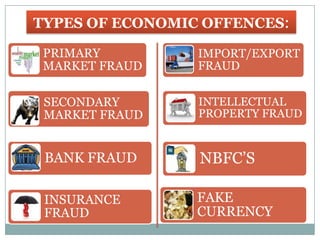
TYPES OF ECONOMIC OFFENCES:
PRIMARY
MARKET FRAUD

IMPORT/EXPORT
FRAUD

SECONDARY
MARKET FRAUD

INTELLECTUAL
PROPERTY FRAUD

BANK FRAUD

NBFC’S

INSURANCE
FRAUD

FAKE
CURRENCY
BANK FRAUD
Bank fraud is the use of potentially illegal means to obtain money, assets, or
other property owned or held by a financial institution, or to obtain money
from depositors by fraudulently posing as a bank or other financial institution.

Types Of Banking Fraud
ELECTRONIC FRAUD
CREDIT/DEBIT CARD FRAUD
IDENTITY THEFT
CHEQUE FRAUD
INSIDER TRADING
Insider trading is the trading of a corporation's stock or other security
by corporate insiders such as officers, key employees, directors, or holders

of more than ten percent of the firm's shares.
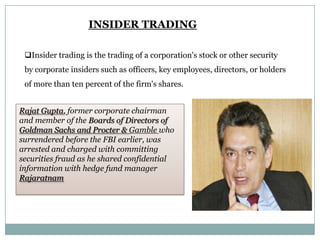
Rajat Gupta, former corporate chairman
and member of the Boards of Directors of
Goldman Sachs and Procter & Gamble who
surrendered before the FBI earlier, was
arrested and charged with committing
securities fraud as he shared confidential
information with hedge fund manager
Rajaratnam
MONEY LAUNDERING
Money laundering is the process of cleaning dirty money with the objective of
hiding its source and enabling it to be used later in a legal form.
This process creates a web to hide the origin/true nature of these funds.
Prior this crime was covered (FERA) & (FEMA).
The Prevention of Money Laundering Act (PML), 2002 was passed to combat
money laundering in India .

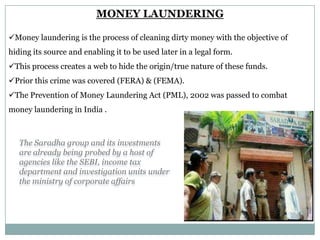
The Saradha group and its investments
are already being probed by a host of
agencies like the SEBI, income tax
department and investigation units under
the ministry of corporate affairs
STEPS TAKEN BY THE GOVERNMENT TO CURB MONEY
LAUNDERING
The Reserve Bank of India, which is the Central Bank for the country, has
issued directions to be strictly followed by the Banks regarding the standard

practices under the ‘Know Your Customer’ (KYC) guidelines.
The banks are required to obtain all information necessary to establish the
identity/legal existence of each new customer.
The PMLA makes it mandatory for every banking company, financial

institution and intermediary to maintain records of transactions for a period
of ten years.
In case of any violation of this legal obligation, these institutions have to
face penal consequences.
BANK & STOCK MARKET SCAM:
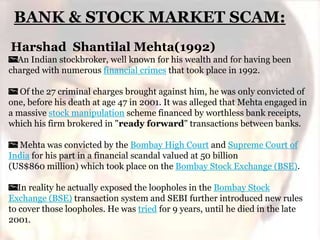
Harshad Shantilal Mehta(1992)
An Indian stockbroker, well known for his wealth and for having been
charged with numerous financial crimes that took place in 1992.
Of the 27 criminal charges brought against him, he was only convicted of
one, before his death at age 47 in 2001. It was alleged that Mehta engaged in
a massive stock manipulation scheme financed by worthless bank receipts,
which his firm brokered in "ready forward" transactions between banks.
Mehta was convicted by the Bombay High Court and Supreme Court of
India for his part in a financial scandal valued at 50 billion
(US$860 million) which took place on the Bombay Stock Exchange (BSE).
In reality he actually exposed the loopholes in the Bombay Stock
Exchange (BSE) transaction system and SEBI further introduced new rules
to cover those loopholes. He was tried for 9 years, until he died in the late
2001.
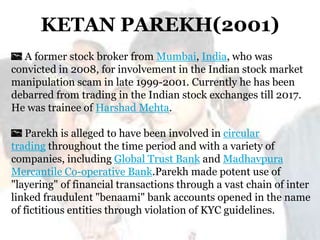
KETAN PAREKH(2001)
A former stock broker from Mumbai, India, who was
convicted in 2008, for involvement in the Indian stock market
manipulation scam in late 1999-2001. Currently he has been
debarred from trading in the Indian stock exchanges till 2017.
He was trainee of Harshad Mehta.

Parekh is alleged to have been involved in circular
trading throughout the time period and with a variety of
companies, including Global Trust Bank and Madhavpura
Mercantile Co-operative Bank.Parekh made potent use of
"layering" of financial transactions through a vast chain of inter
linked fraudulent "benaami" bank accounts opened in the name
of fictitious entities through violation of KYC guidelines.
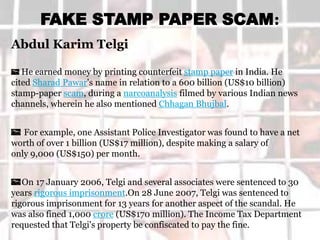
FAKE STAMP PAPER SCAM:
Abdul Karim Telgi
He earned money by printing counterfeit stamp paper in India. He
cited Sharad Pawar's name in relation to a 600 billion (US$10 billion)
stamp-paper scam, during a narcoanalysis filmed by various Indian news
channels, wherein he also mentioned Chhagan Bhujbal.
For example, one Assistant Police Investigator was found to have a net
worth of over 1 billion (US$17 million), despite making a salary of
only 9,000 (US$150) per month.
On 17 January 2006, Telgi and several associates were sentenced to 30
years rigorous imprisonment.On 28 June 2007, Telgi was sentenced to
rigorous imprisonment for 13 years for another aspect of the scandal. He
was also fined 1,000 crore (US$170 million). The Income Tax Department
requested that Telgi's property be confiscated to pay the fine.
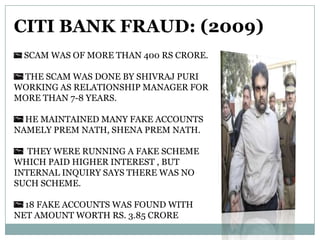
CITI BANK FRAUD: (2009)
SCAM WAS OF MORE THAN 400 RS CRORE.
THE SCAM WAS DONE BY SHIVRAJ PURI
WORKING AS RELATIONSHIP MANAGER FOR
MORE THAN 7-8 YEARS.
HE MAINTAINED MANY FAKE ACCOUNTS
NAMELY PREM NATH, SHENA PREM NATH.
THEY WERE RUNNING A FAKE SCHEME
WHICH PAID HIGHER INTEREST , BUT
INTERNAL INQUIRY SAYS THERE WAS NO
SUCH SCHEME.
18 FAKE ACCOUNTS WAS FOUND WITH
NET AMOUNT WORTH RS. 3.85 CRORE
Palmolein Oil Import Scam (91-92)
Kerala government decided to import palm oil from
a Malaysian company in Singapore named "Power and
Energy Ltd" above the international price which was
approved by the Kerala Cabinet. The price of import was
fixed to $405.0 per ton which was higher than the
international price of $392.25 per ton.
The decision was to import 15,000 tonnes of palm oil.
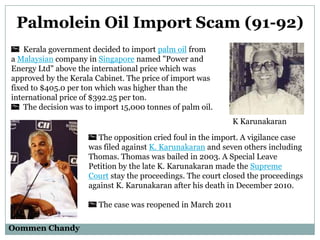
K Karunakaran

The opposition cried foul in the import. A vigilance case
was filed against K. Karunakaran and seven others including
Thomas. Thomas was bailed in 2003. A Special Leave
Petition by the late K. Karunakaran made the Supreme
Court stay the proceedings. The court closed the proceedings
against K. Karunakaran after his death in December 2010.
The case was reopened in March 2011
Oommen Chandy
2G SPECTRUM SCAM
It is about selling the Communication Bandwidth for lower than the market
value.
This has created a great damage to country’s economy.
 This scam amounted to Rs.1,76,000 crores

The key players involved in this scam are:
A.Raja, M.K.Kanimozhi,Nira Radia and many telecommunication
companies.
This scam is also responsible for present economic and financial crisis in

India
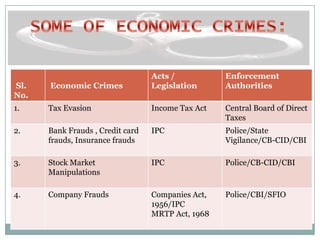
Sl.
No.

Economic Crimes

Acts /
Legislation

Enforcement
Authorities

1.

Tax Evasion

Income Tax Act

Central Board of Direct
Taxes

2.

Bank Frauds , Credit card
frauds, Insurance frauds

IPC

Police/State
Vigilance/CB-CID/CBI

3.

Stock Market
Manipulations

IPC

Police/CB-CID/CBI

4.

Company Frauds

Companies Act,
1956/IPC
MRTP Act, 1968

Police/CBI/SFIO
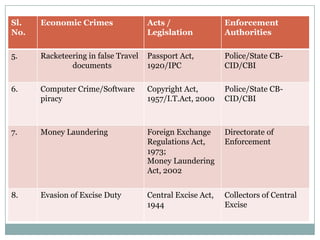
Sl.
No.

Economic Crimes

Acts /
Legislation

Enforcement
Authorities

5.

Racketeering in false Travel
documents

Passport Act,
1920/IPC

Police/State CBCID/CBI

6.

Computer Crime/Software
piracy

Copyright Act,
1957/I.T.Act, 2000

Police/State CBCID/CBI

7.

Money Laundering

Foreign Exchange
Regulations Act,
1973;
Money Laundering
Act, 2002

Directorate of
Enforcement

8.

Evasion of Excise Duty

Central Excise Act,
1944

Collectors of Central
Excise
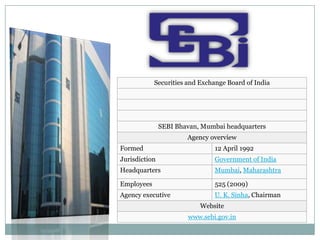
Securities and Exchange Board of India

SEBI Bhavan, Mumbai headquarters
Agency overview
Formed

12 April 1992

Jurisdiction

Government of India

Headquarters

Mumbai, Maharashtra

Employees

525 (2009)

Agency executive

U. K. Sinha, Chairman
Website
www.sebi.gov.in
POWERS OF SEBI:
For the discharge of its functions efficiently, SEBI has
been vested with the following powers:
To approve by−laws of stock exchanges.Sebi.
To require the stock exchange to amend their by−laws.

Inspect the books of accounts and call for periodical returns
from recognized stock exchanges.
Inspect the books of accounts of a financial intermediaries.

Compel certain companies to list their shares in one or more
stock exchanges.
SEBI COMMITTEES
Technical Advisory
Committee

Primary Market Advisory
Committee (PMAC)

Committee for review of
structure of market
infrastructure institutions

Secondary Market
Advisory Committee
(SMAC)

Members of the Advisory
Committee for the SEBI
Investor Protection and
Education Fund

Mutual Fund Advisory
Committee

Takeover Regulations
Advisory Committe

Corporate Bonds &
Securitization Advisory
Committee
MAJOR
SEBI is credited for quick movement towards making the
markets electronic and paperless by introducing T+5 rolling
cycle from July 2001 and T+3 in April 2002 and further to
T+2 in April 2003
SEBI did away with physical certificates that were prone to
postal delays, theft and forgery, apart from making the
settlement process slow and cumbersome by passing
Depositories Act, 1996.

SEBI has increased the application limit for retail
investors to Rs 2 lakh, from Rs 1 lakh at present.
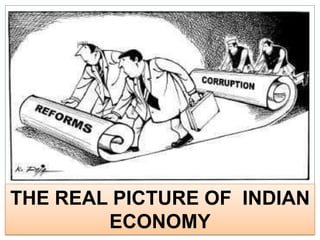
THE REAL PICTURE OF INDIAN
ECONOMY
SAHARA V/S SEBI CASE
In the high profile Sahara case involving over Rs. 24,000 crore raised through
‘various illegalities’, market regulator SEBI has begun the process of refund to
individual investors who have been verified by it.
The money so far deposited by Sahara be permitted to be refunded to the
genuine investors, with interest, after verifying the genuineness of the
documents
SEBI has also filed a contempt petition against Sahara, accusing them of not
following court directions, while it has also sought orders for arrest of group
chief Subrata Roy and his debarment from leaving the country. These matters
are also likely to be heard by the court on July 17.
Administrative costs and expenses relating to the case would also be incurred
by Sahara and Besides, another contract of Rs. 29.88 crore was given to UTI
Infrastructure Technology and Services for the work relating to redemption
related activities in this case.
economic offences in India

economic offences in India

  • 1.
  • 2.
    WHAT IS ECONOMIC OFFENSES???? •Economicand financial offences cover fraud, forgery and counterfeiting, offences against the legislation governing cheques (in particular forgery or use of stolen cheques), forgery or use of credit cards, undeclared employment, offences against companies (such as misuse of company assets).
  • 3.
    TYPES OF ECONOMICOFFENCES: PRIMARY MARKET FRAUD IMPORT/EXPORT FRAUD SECONDARY MARKET FRAUD INTELLECTUAL PROPERTY FRAUD BANK FRAUD NBFC’S INSURANCE FRAUD FAKE CURRENCY
  • 4.
    BANK FRAUD Bank fraudis the use of potentially illegal means to obtain money, assets, or other property owned or held by a financial institution, or to obtain money from depositors by fraudulently posing as a bank or other financial institution. Types Of Banking Fraud ELECTRONIC FRAUD CREDIT/DEBIT CARD FRAUD IDENTITY THEFT CHEQUE FRAUD
  • 5.
    INSIDER TRADING Insider tradingis the trading of a corporation's stock or other security by corporate insiders such as officers, key employees, directors, or holders of more than ten percent of the firm's shares. Rajat Gupta, former corporate chairman and member of the Boards of Directors of Goldman Sachs and Procter & Gamble who surrendered before the FBI earlier, was arrested and charged with committing securities fraud as he shared confidential information with hedge fund manager Rajaratnam
  • 6.
    MONEY LAUNDERING Money launderingis the process of cleaning dirty money with the objective of hiding its source and enabling it to be used later in a legal form. This process creates a web to hide the origin/true nature of these funds. Prior this crime was covered (FERA) & (FEMA). The Prevention of Money Laundering Act (PML), 2002 was passed to combat money laundering in India . The Saradha group and its investments are already being probed by a host of agencies like the SEBI, income tax department and investigation units under the ministry of corporate affairs
  • 7.
    STEPS TAKEN BYTHE GOVERNMENT TO CURB MONEY LAUNDERING The Reserve Bank of India, which is the Central Bank for the country, has issued directions to be strictly followed by the Banks regarding the standard practices under the ‘Know Your Customer’ (KYC) guidelines. The banks are required to obtain all information necessary to establish the identity/legal existence of each new customer. The PMLA makes it mandatory for every banking company, financial institution and intermediary to maintain records of transactions for a period of ten years. In case of any violation of this legal obligation, these institutions have to face penal consequences.
  • 9.
    BANK & STOCKMARKET SCAM: Harshad Shantilal Mehta(1992) An Indian stockbroker, well known for his wealth and for having been charged with numerous financial crimes that took place in 1992. Of the 27 criminal charges brought against him, he was only convicted of one, before his death at age 47 in 2001. It was alleged that Mehta engaged in a massive stock manipulation scheme financed by worthless bank receipts, which his firm brokered in "ready forward" transactions between banks. Mehta was convicted by the Bombay High Court and Supreme Court of India for his part in a financial scandal valued at 50 billion (US$860 million) which took place on the Bombay Stock Exchange (BSE). In reality he actually exposed the loopholes in the Bombay Stock Exchange (BSE) transaction system and SEBI further introduced new rules to cover those loopholes. He was tried for 9 years, until he died in the late 2001.
  • 10.
    KETAN PAREKH(2001) A formerstock broker from Mumbai, India, who was convicted in 2008, for involvement in the Indian stock market manipulation scam in late 1999-2001. Currently he has been debarred from trading in the Indian stock exchanges till 2017. He was trainee of Harshad Mehta. Parekh is alleged to have been involved in circular trading throughout the time period and with a variety of companies, including Global Trust Bank and Madhavpura Mercantile Co-operative Bank.Parekh made potent use of "layering" of financial transactions through a vast chain of inter linked fraudulent "benaami" bank accounts opened in the name of fictitious entities through violation of KYC guidelines.
  • 11.
    FAKE STAMP PAPERSCAM: Abdul Karim Telgi He earned money by printing counterfeit stamp paper in India. He cited Sharad Pawar's name in relation to a 600 billion (US$10 billion) stamp-paper scam, during a narcoanalysis filmed by various Indian news channels, wherein he also mentioned Chhagan Bhujbal. For example, one Assistant Police Investigator was found to have a net worth of over 1 billion (US$17 million), despite making a salary of only 9,000 (US$150) per month. On 17 January 2006, Telgi and several associates were sentenced to 30 years rigorous imprisonment.On 28 June 2007, Telgi was sentenced to rigorous imprisonment for 13 years for another aspect of the scandal. He was also fined 1,000 crore (US$170 million). The Income Tax Department requested that Telgi's property be confiscated to pay the fine.
  • 12.
    CITI BANK FRAUD:(2009) SCAM WAS OF MORE THAN 400 RS CRORE. THE SCAM WAS DONE BY SHIVRAJ PURI WORKING AS RELATIONSHIP MANAGER FOR MORE THAN 7-8 YEARS. HE MAINTAINED MANY FAKE ACCOUNTS NAMELY PREM NATH, SHENA PREM NATH. THEY WERE RUNNING A FAKE SCHEME WHICH PAID HIGHER INTEREST , BUT INTERNAL INQUIRY SAYS THERE WAS NO SUCH SCHEME. 18 FAKE ACCOUNTS WAS FOUND WITH NET AMOUNT WORTH RS. 3.85 CRORE
  • 13.
    Palmolein Oil ImportScam (91-92) Kerala government decided to import palm oil from a Malaysian company in Singapore named "Power and Energy Ltd" above the international price which was approved by the Kerala Cabinet. The price of import was fixed to $405.0 per ton which was higher than the international price of $392.25 per ton. The decision was to import 15,000 tonnes of palm oil. K Karunakaran The opposition cried foul in the import. A vigilance case was filed against K. Karunakaran and seven others including Thomas. Thomas was bailed in 2003. A Special Leave Petition by the late K. Karunakaran made the Supreme Court stay the proceedings. The court closed the proceedings against K. Karunakaran after his death in December 2010. The case was reopened in March 2011 Oommen Chandy
  • 14.
    2G SPECTRUM SCAM Itis about selling the Communication Bandwidth for lower than the market value. This has created a great damage to country’s economy.  This scam amounted to Rs.1,76,000 crores The key players involved in this scam are: A.Raja, M.K.Kanimozhi,Nira Radia and many telecommunication companies. This scam is also responsible for present economic and financial crisis in India
  • 15.
    Sl. No. Economic Crimes Acts / Legislation Enforcement Authorities 1. TaxEvasion Income Tax Act Central Board of Direct Taxes 2. Bank Frauds , Credit card frauds, Insurance frauds IPC Police/State Vigilance/CB-CID/CBI 3. Stock Market Manipulations IPC Police/CB-CID/CBI 4. Company Frauds Companies Act, 1956/IPC MRTP Act, 1968 Police/CBI/SFIO
  • 16.
    Sl. No. Economic Crimes Acts / Legislation Enforcement Authorities 5. Racketeeringin false Travel documents Passport Act, 1920/IPC Police/State CBCID/CBI 6. Computer Crime/Software piracy Copyright Act, 1957/I.T.Act, 2000 Police/State CBCID/CBI 7. Money Laundering Foreign Exchange Regulations Act, 1973; Money Laundering Act, 2002 Directorate of Enforcement 8. Evasion of Excise Duty Central Excise Act, 1944 Collectors of Central Excise
  • 17.
    Securities and ExchangeBoard of India SEBI Bhavan, Mumbai headquarters Agency overview Formed 12 April 1992 Jurisdiction Government of India Headquarters Mumbai, Maharashtra Employees 525 (2009) Agency executive U. K. Sinha, Chairman Website www.sebi.gov.in
  • 18.
    POWERS OF SEBI: Forthe discharge of its functions efficiently, SEBI has been vested with the following powers: To approve by−laws of stock exchanges.Sebi. To require the stock exchange to amend their by−laws. Inspect the books of accounts and call for periodical returns from recognized stock exchanges. Inspect the books of accounts of a financial intermediaries. Compel certain companies to list their shares in one or more stock exchanges.
  • 19.
    SEBI COMMITTEES Technical Advisory Committee PrimaryMarket Advisory Committee (PMAC) Committee for review of structure of market infrastructure institutions Secondary Market Advisory Committee (SMAC) Members of the Advisory Committee for the SEBI Investor Protection and Education Fund Mutual Fund Advisory Committee Takeover Regulations Advisory Committe Corporate Bonds & Securitization Advisory Committee
  • 20.
    MAJOR SEBI is creditedfor quick movement towards making the markets electronic and paperless by introducing T+5 rolling cycle from July 2001 and T+3 in April 2002 and further to T+2 in April 2003 SEBI did away with physical certificates that were prone to postal delays, theft and forgery, apart from making the settlement process slow and cumbersome by passing Depositories Act, 1996. SEBI has increased the application limit for retail investors to Rs 2 lakh, from Rs 1 lakh at present.
  • 21.
    THE REAL PICTUREOF INDIAN ECONOMY
  • 22.
    SAHARA V/S SEBICASE In the high profile Sahara case involving over Rs. 24,000 crore raised through ‘various illegalities’, market regulator SEBI has begun the process of refund to individual investors who have been verified by it. The money so far deposited by Sahara be permitted to be refunded to the genuine investors, with interest, after verifying the genuineness of the documents SEBI has also filed a contempt petition against Sahara, accusing them of not following court directions, while it has also sought orders for arrest of group chief Subrata Roy and his debarment from leaving the country. These matters are also likely to be heard by the court on July 17. Administrative costs and expenses relating to the case would also be incurred by Sahara and Besides, another contract of Rs. 29.88 crore was given to UTI Infrastructure Technology and Services for the work relating to redemption related activities in this case.