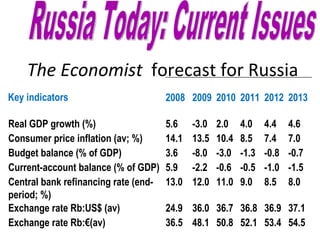
The Economist  forecast for Russia Russia Today: Current Issues Key indicators 2008 2009 2010 2011 2012 2013 Real GDP growth (%) 5.6 -3.0 2.0 4.0 4.4 4.6 Consumer price inflation (av; %) 14.1 13.5 10.4 8.5 7.4 7.0 Budget balance (% of GDP) 3.6 -8.0 -3.0 -1.3 -0.8 -0.7 Current-account balance (% of GDP) 5.9 -2.2 -0.6 -0.5 -1.0 -1.5 Central bank refinancing rate (end-period; %) 13.0 12.0 11.0 9.0 8.5 8.0 Exchange rate Rb:US$ (av) 24.9 36.0 36.7 36.8 36.9 37.1 Exchange rate Rb:€(av) 36.5 48.1 50.8 52.1 53.4 54.5
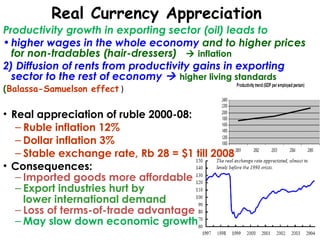
Real Currency Appreciation  Productivity growth in exporting sector (oil) leads to  higher wages in the whole economy  and to higher prices for non-tradables (hair-dressers)    inflation  2) Diffusion of rents from productivity gains in exporting sector to the rest of economy     higher living standards  ( Balassa-Samuelson effect  ) Real appreciation of ruble 2000-08: Ruble inflation 12%  Dollar inflation 3% Stable exchange rate, Rb 28 = $1 till 2008 Consequences: Imported goods more affordable Export industries hurt by  lower international demand Loss of terms-of-trade advantage May slow down economic growth
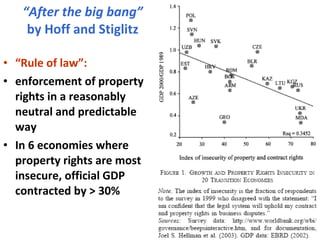
“ After the big bang”  by Hoff and Stiglitz “ Rule of law”:  enforcement of property rights in a reasonably neutral and predictable way  In 6 economies where property rights are most insecure, official GDP contracted by > 30%
How to Exploit Energy Energy (and resources) key to Russia’s role Russia should focus on its abundance, but how? Two approaches Top-down Oil is a strategic asset Secrecy, government direction, control of pipelines View of energy as rent to be exploited Energy as foreign policy resource Useful for propping up dinosaurs Bottom Up Market driven, private ownership Maximize number of actors involved Competition Share in world technology  Develop complementary industries  Rule of law, functioning institutions, less corruption
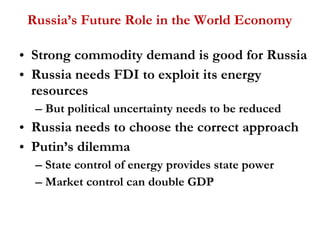
Russia’s Future Role in the World Economy Strong commodity demand is good for Russia Russia needs FDI to exploit its energy resources But political uncertainty needs to be reduced Russia needs to choose the correct approach Putin’s dilemma State control of energy provides state power Market control can double GDP
Legal system Democratic market-oriented laws exist Institutions to enforce them are weak No good guarantees of ownership  1990s: contracts enforced by thugs with guns 2000s: more businesses turn to courts to resolve disputes Police:  under-funded, under-staffed, corrupt Crime and corruption is costly for businesses Inhibits investment, domestic & foreign Judges and lawyers  poorly paid, vulnerable to corruption no independent judiciary system - prosecutor's office, courts & police are subordinate to Kremlin  Merger of businesses and authorities  Every bureaucrat represents business interests No public control over secret services and law enforcement http://www.transparency.org/news_room/in_focus/2008/cpi2008/cpi_2008_table Russia’s 2005 corruption  ranking by Transparency  International:   126 of 159 countries
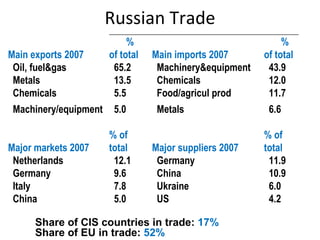
Russian Trade Share of CIS countries in trade:  17%  Share of EU in trade:  52% Main exports 2007       % of total          Main imports 2007         % of total     Oil, fuel&gas     65.2          Machinery&equipment        43.9     Metals     13.5          Chemicals          12.0     Chemicals     5.5          Food/agricul prod         11.7     Machinery/equipment     5.0          Metals          6.6     Major markets 2007     % of total          Major suppliers 2007          % of total     Netherlands     12.1          Germany          11.9     Germany     9.6          China          10.9     Italy     7.8          Ukraine          6.0     China     5.0          US          4.2 
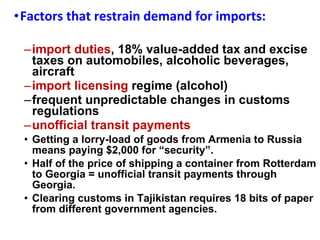
Factors that restrain demand for imports:  import duties , 18% value-added tax and excise taxes on automobiles, alcoholic beverages, aircraft  import licensing  regime (alcohol)  frequent unpredictable changes in customs regulations unofficial transit payments Getting a lorry-load of goods from Armenia to Russia means paying $2,000 for “security”.  Half of the price of shipping a container from Rotterdam to Georgia = unofficial transit payments through Georgia.  Clearing customs in Tajikistan requires 18 bits of paper from different government agencies.
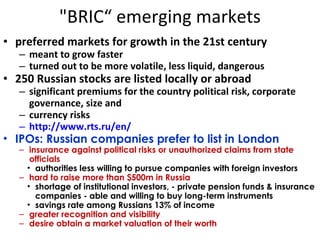
"BRIC“ emerging markets preferred markets for growth in the 21st century meant to grow faster turned out to be more volatile, less liquid, dangerous 250 Russian stocks are listed locally or abroad significant premiums for the country political risk, corporate governance, size and currency risks http://www.rts.ru/en/ IPOs: Russian companies prefer to list in London insurance against political risks or unauthorized claims from state officials authorities less willing to pursue companies with foreign investors hard to raise more than $500m in Russia  shortage of institutional investors, - private pension funds & insurance companies - able and willing to buy long-term instruments savings rate among Russians 13% of income greater recognition and visibility  desire obtain a market valuation of their worth
 
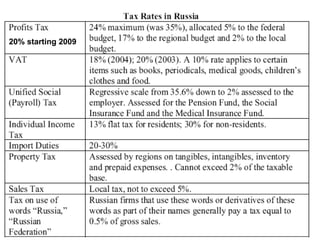
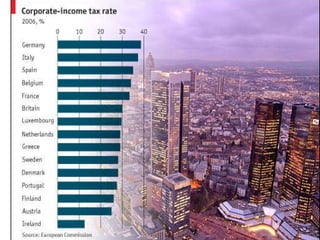
20% starting 2009
 
Intellectual property rights Copyrights  Pirated are 80% DVDs, 60% of CDs 2008: allofMP3.com shut down, US companies dropped charges Trade mark violations Counterfeiting  Consumer goods, tobacco, alcohol Smirnoff vodka owned by US United Distillers and Vintners Phillip Morris >25% products are counterfeits
Intellectual property rights http://www.wipo.int http://www.cipr.org “ Underrated public policy priority” Weak laws and penalties, no criminal convictions Need stricter standards for WTO membership Deliberate inaction by Russian government Crackdown is costly  Benefits?  who is hurt?  foreign firms, Russian firms, consumers, government?
Demographic Crisis Fertility rate  1986-7:  2.19 births per woman  2001-2:  1.3 births per woman  1981 – 2001:   30% drop in marriage rates  30% increase in divorce rates Challenge of shrinking population: post-war “baby boom” generation retires - workforce drops – firms need employers – GDP falls Measures: plan $140bn spending  over 20 years on  financial support for families with > 1 child education programs to reduce abortions and alcohol-induced deaths, car accidents and unhealthy lifestyles Low life expectancy Tobacco, vodka, poor diet  Environmental pollution  HIV/Aids  Poor health care  Stress of transition – unemployment,  loss of status  Road accidents
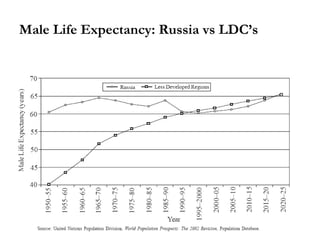
Male Life Expectancy: Russia vs LDC’s
Moscow vs. Rest: Life Expectancy
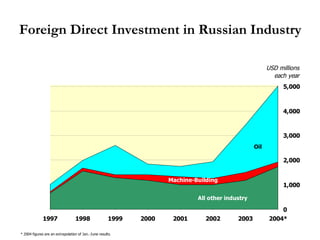
Foreign Direct Investment in Russian Industry
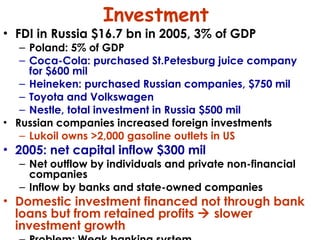
Investment FDI in Russia $16.7 bn in 2005, 3% of GDP Poland: 5% of GDP Coca-Cola: purchased St.Petesburg juice company for $600 mil Heineken: purchased Russian companies, $750 mil Toyota and Volkswagen Nestle, total investment in Russia $500 mil Russian companies increased foreign investments Lukoil owns >2,000 gasoline outlets in US 2005: net capital inflow $300 mil Net outflow by individuals and private non-financial companies  Inflow by banks and state-owned companies Domestic investment financed not through bank loans but from retained profits    slower investment growth Problem: Weak banking system
Problems foreign direct investors in Russia Starting with the most pressing: Inadequate and ever changing tax law Property and creditor rights Customs Risk of political change Macroeconomic instability Weak banking sector Russian accounting system Corruption  Risk of expropriation Harassment from federal and local government Payment arrears from clients  Problems with workforce or management Russian suppliers Crime, racket  Barter
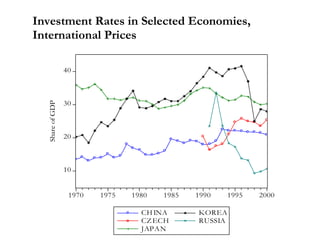
Investment Rates in Selected Economies, International Prices
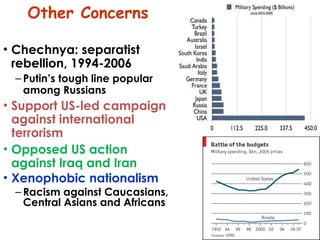
Chechnya: separatist rebellion, 1994-2006  Putin’s tough line popular  among Russians Support US-led campaign against international terrorism  Opposed US action against Iraq and Iran Xenophobic nationalism Racism against Caucasians, Central Asians and Africans Other Concerns
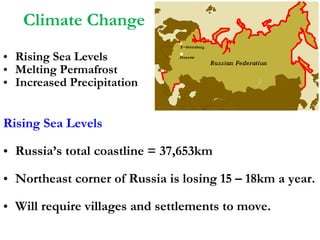
Climate Change Rising Sea Levels Melting Permafrost Increased Precipitation Rising Sea Levels Russia’s total coastline = 37,653km Northeast corner of Russia is losing 15 – 18km a year. Will require villages and settlements to move.
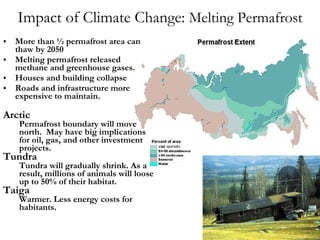
Impact of Climate Change:  Melting Permafrost More than ½ permafrost area can thaw by 2050 Melting permafrost released methane and greenhouse gases.  Houses and building collapse Roads and infrastructure more expensive to maintain. Arctic  Permafrost boundary will move north.  May have big implications for oil, gas, and other investment projects.  Tundra Tundra will gradually shrink. As a result, millions of animals will loose up to 50% of their habitat.  Taiga Warmer. Less energy costs for habitants.
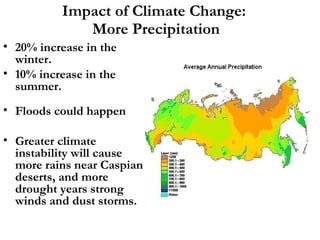
Impact of Climate Change:  More Precipitation 20% increase in the winter. 10% increase in the summer. Floods could happen Greater climate instability will cause more rains near Caspian deserts, and more drought years strong winds and dust storms.
Climate Impacts Industries - Oil Pros Easier to drill for oil with melting permafrost. Cons Expensive underpinning of refineries. Increase costs of pipeline construction because extensive trenching needed to combat the effects of coastal instability and erosion. Increase costs  of oil extraction.
Industries - Timber Pros Easier to get to forests with warming temperatures. Extended seasons will allow for additional harvesting. Cons Ecosystems will not have time to adapt to the changes causing outbursts of forest diseases.
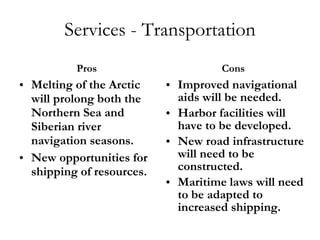
Services - Transportation Pros Melting of the Arctic will prolong both the Northern Sea and Siberian river navigation seasons. New opportunities for shipping of resources. Cons Improved navigational aids will be needed. Harbor facilities will have to be developed. New road infrastructure will need to be constructed. Maritime laws will need to be adapted to increased shipping.
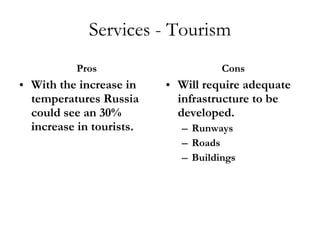
Services - Tourism Pros With the increase in temperatures Russia could see an 30% increase in tourists. Cons Will require adequate infrastructure to be developed. Runways Roads Buildings
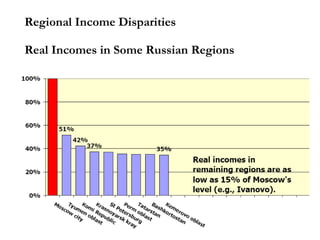
Regional Income Disparities  Real Incomes in Some Russian Regions
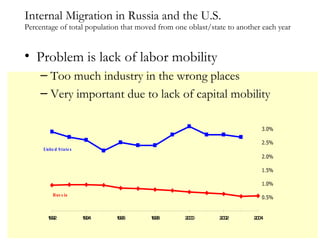
Internal Migration in Russia and the U.S.  Percentage of total population that moved from one oblast/state to another each year Problem is lack of labor mobility Too much industry in the wrong places Very important due to lack of capital mobility
Economic Priorities Vulnerable to swings in world prices   of oil, natural gas, metals, timber High-technology & consumer goods = small part of economy Diversifying the economy away from commodity dependence Innovation Need more investment Massive lending of foreign banks to large oil and gas companies Smaller companies and other industries short of cash Poor infrastructure in regions South Russia has better climate but high corruption Poor medical care Bad roads International business Forbes Best Countries for Business  Rank   Reducing political uncertainty  Reducing the state's role in the economy Travel restrictions for foreigners Poverty:  20% of population  monthly income under 1,000 rubles ($35)

10 Russia Current

  • 1.
    The Economist forecast for Russia Russia Today: Current Issues Key indicators 2008 2009 2010 2011 2012 2013 Real GDP growth (%) 5.6 -3.0 2.0 4.0 4.4 4.6 Consumer price inflation (av; %) 14.1 13.5 10.4 8.5 7.4 7.0 Budget balance (% of GDP) 3.6 -8.0 -3.0 -1.3 -0.8 -0.7 Current-account balance (% of GDP) 5.9 -2.2 -0.6 -0.5 -1.0 -1.5 Central bank refinancing rate (end-period; %) 13.0 12.0 11.0 9.0 8.5 8.0 Exchange rate Rb:US$ (av) 24.9 36.0 36.7 36.8 36.9 37.1 Exchange rate Rb:€(av) 36.5 48.1 50.8 52.1 53.4 54.5
  • 2.
    Real Currency Appreciation Productivity growth in exporting sector (oil) leads to higher wages in the whole economy and to higher prices for non-tradables (hair-dressers)  inflation 2) Diffusion of rents from productivity gains in exporting sector to the rest of economy  higher living standards ( Balassa-Samuelson effect ) Real appreciation of ruble 2000-08: Ruble inflation 12% Dollar inflation 3% Stable exchange rate, Rb 28 = $1 till 2008 Consequences: Imported goods more affordable Export industries hurt by lower international demand Loss of terms-of-trade advantage May slow down economic growth
  • 3.
    “ After thebig bang” by Hoff and Stiglitz “ Rule of law”: enforcement of property rights in a reasonably neutral and predictable way In 6 economies where property rights are most insecure, official GDP contracted by > 30%
  • 4.
    How to ExploitEnergy Energy (and resources) key to Russia’s role Russia should focus on its abundance, but how? Two approaches Top-down Oil is a strategic asset Secrecy, government direction, control of pipelines View of energy as rent to be exploited Energy as foreign policy resource Useful for propping up dinosaurs Bottom Up Market driven, private ownership Maximize number of actors involved Competition Share in world technology Develop complementary industries Rule of law, functioning institutions, less corruption
  • 5.
    Russia’s Future Rolein the World Economy Strong commodity demand is good for Russia Russia needs FDI to exploit its energy resources But political uncertainty needs to be reduced Russia needs to choose the correct approach Putin’s dilemma State control of energy provides state power Market control can double GDP
  • 6.
    Legal system Democraticmarket-oriented laws exist Institutions to enforce them are weak No good guarantees of ownership 1990s: contracts enforced by thugs with guns 2000s: more businesses turn to courts to resolve disputes Police: under-funded, under-staffed, corrupt Crime and corruption is costly for businesses Inhibits investment, domestic & foreign Judges and lawyers poorly paid, vulnerable to corruption no independent judiciary system - prosecutor's office, courts & police are subordinate to Kremlin Merger of businesses and authorities Every bureaucrat represents business interests No public control over secret services and law enforcement http://www.transparency.org/news_room/in_focus/2008/cpi2008/cpi_2008_table Russia’s 2005 corruption ranking by Transparency International: 126 of 159 countries
  • 7.
    Russian Trade Shareof CIS countries in trade: 17% Share of EU in trade: 52% Main exports 2007      % of total        Main imports 2007        % of total    Oil, fuel&gas    65.2        Machinery&equipment       43.9    Metals    13.5        Chemicals        12.0    Chemicals    5.5        Food/agricul prod       11.7    Machinery/equipment    5.0        Metals        6.6    Major markets 2007    % of total        Major suppliers 2007        % of total    Netherlands    12.1        Germany        11.9    Germany    9.6        China        10.9    Italy    7.8        Ukraine        6.0    China    5.0        US        4.2 
  • 8.
    Factors that restraindemand for imports: import duties , 18% value-added tax and excise taxes on automobiles, alcoholic beverages, aircraft import licensing regime (alcohol) frequent unpredictable changes in customs regulations unofficial transit payments Getting a lorry-load of goods from Armenia to Russia means paying $2,000 for “security”. Half of the price of shipping a container from Rotterdam to Georgia = unofficial transit payments through Georgia. Clearing customs in Tajikistan requires 18 bits of paper from different government agencies.
  • 9.
    "BRIC“ emerging marketspreferred markets for growth in the 21st century meant to grow faster turned out to be more volatile, less liquid, dangerous 250 Russian stocks are listed locally or abroad significant premiums for the country political risk, corporate governance, size and currency risks http://www.rts.ru/en/ IPOs: Russian companies prefer to list in London insurance against political risks or unauthorized claims from state officials authorities less willing to pursue companies with foreign investors hard to raise more than $500m in Russia shortage of institutional investors, - private pension funds & insurance companies - able and willing to buy long-term instruments savings rate among Russians 13% of income greater recognition and visibility desire obtain a market valuation of their worth
  • 10.
  • 11.
  • 12.
  • 13.
    Intellectual property rightsCopyrights Pirated are 80% DVDs, 60% of CDs 2008: allofMP3.com shut down, US companies dropped charges Trade mark violations Counterfeiting Consumer goods, tobacco, alcohol Smirnoff vodka owned by US United Distillers and Vintners Phillip Morris >25% products are counterfeits
  • 14.
    Intellectual property rightshttp://www.wipo.int http://www.cipr.org “ Underrated public policy priority” Weak laws and penalties, no criminal convictions Need stricter standards for WTO membership Deliberate inaction by Russian government Crackdown is costly Benefits? who is hurt? foreign firms, Russian firms, consumers, government?
  • 15.
    Demographic Crisis Fertilityrate 1986-7: 2.19 births per woman 2001-2: 1.3 births per woman 1981 – 2001: 30% drop in marriage rates 30% increase in divorce rates Challenge of shrinking population: post-war “baby boom” generation retires - workforce drops – firms need employers – GDP falls Measures: plan $140bn spending over 20 years on financial support for families with > 1 child education programs to reduce abortions and alcohol-induced deaths, car accidents and unhealthy lifestyles Low life expectancy Tobacco, vodka, poor diet Environmental pollution HIV/Aids Poor health care Stress of transition – unemployment, loss of status Road accidents
  • 16.
    Male Life Expectancy:Russia vs LDC’s
  • 17.
    Moscow vs. Rest:Life Expectancy
  • 18.
    Foreign Direct Investmentin Russian Industry
  • 19.
    Investment FDI inRussia $16.7 bn in 2005, 3% of GDP Poland: 5% of GDP Coca-Cola: purchased St.Petesburg juice company for $600 mil Heineken: purchased Russian companies, $750 mil Toyota and Volkswagen Nestle, total investment in Russia $500 mil Russian companies increased foreign investments Lukoil owns >2,000 gasoline outlets in US 2005: net capital inflow $300 mil Net outflow by individuals and private non-financial companies Inflow by banks and state-owned companies Domestic investment financed not through bank loans but from retained profits  slower investment growth Problem: Weak banking system
  • 20.
    Problems foreign directinvestors in Russia Starting with the most pressing: Inadequate and ever changing tax law Property and creditor rights Customs Risk of political change Macroeconomic instability Weak banking sector Russian accounting system Corruption Risk of expropriation Harassment from federal and local government Payment arrears from clients Problems with workforce or management Russian suppliers Crime, racket Barter
  • 21.
    Investment Rates inSelected Economies, International Prices
  • 22.
    Chechnya: separatist rebellion,1994-2006 Putin’s tough line popular among Russians Support US-led campaign against international terrorism Opposed US action against Iraq and Iran Xenophobic nationalism Racism against Caucasians, Central Asians and Africans Other Concerns
  • 23.
    Climate Change RisingSea Levels Melting Permafrost Increased Precipitation Rising Sea Levels Russia’s total coastline = 37,653km Northeast corner of Russia is losing 15 – 18km a year. Will require villages and settlements to move.
  • 24.
    Impact of ClimateChange: Melting Permafrost More than ½ permafrost area can thaw by 2050 Melting permafrost released methane and greenhouse gases. Houses and building collapse Roads and infrastructure more expensive to maintain. Arctic Permafrost boundary will move north. May have big implications for oil, gas, and other investment projects. Tundra Tundra will gradually shrink. As a result, millions of animals will loose up to 50% of their habitat. Taiga Warmer. Less energy costs for habitants.
  • 25.
    Impact of ClimateChange: More Precipitation 20% increase in the winter. 10% increase in the summer. Floods could happen Greater climate instability will cause more rains near Caspian deserts, and more drought years strong winds and dust storms.
  • 26.
    Climate Impacts Industries- Oil Pros Easier to drill for oil with melting permafrost. Cons Expensive underpinning of refineries. Increase costs of pipeline construction because extensive trenching needed to combat the effects of coastal instability and erosion. Increase costs of oil extraction.
  • 27.
    Industries - TimberPros Easier to get to forests with warming temperatures. Extended seasons will allow for additional harvesting. Cons Ecosystems will not have time to adapt to the changes causing outbursts of forest diseases.
  • 28.
    Services - TransportationPros Melting of the Arctic will prolong both the Northern Sea and Siberian river navigation seasons. New opportunities for shipping of resources. Cons Improved navigational aids will be needed. Harbor facilities will have to be developed. New road infrastructure will need to be constructed. Maritime laws will need to be adapted to increased shipping.
  • 29.
    Services - TourismPros With the increase in temperatures Russia could see an 30% increase in tourists. Cons Will require adequate infrastructure to be developed. Runways Roads Buildings
  • 30.
    Regional Income Disparities Real Incomes in Some Russian Regions
  • 31.
    Internal Migration inRussia and the U.S. Percentage of total population that moved from one oblast/state to another each year Problem is lack of labor mobility Too much industry in the wrong places Very important due to lack of capital mobility
  • 32.
    Economic Priorities Vulnerableto swings in world prices of oil, natural gas, metals, timber High-technology & consumer goods = small part of economy Diversifying the economy away from commodity dependence Innovation Need more investment Massive lending of foreign banks to large oil and gas companies Smaller companies and other industries short of cash Poor infrastructure in regions South Russia has better climate but high corruption Poor medical care Bad roads International business Forbes Best Countries for Business Rank Reducing political uncertainty Reducing the state's role in the economy Travel restrictions for foreigners Poverty: 20% of population monthly income under 1,000 rubles ($35)