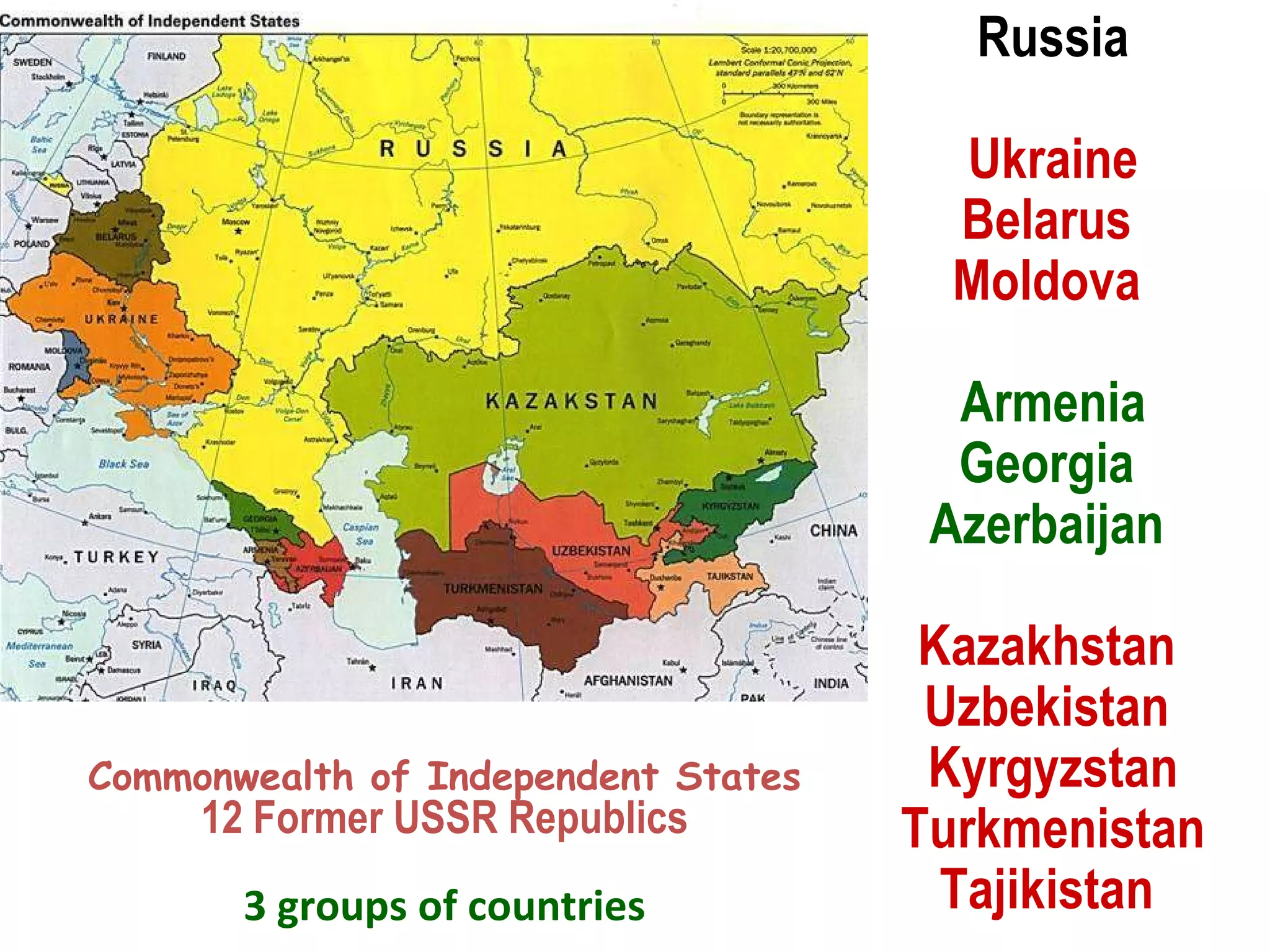
Commonwealth of Independent States 12 Former USSR Republics 3 groups of countries Russia Ukraine Belarus  Moldova   Armenia Georgia  Azerbaijan   Kazakhstan  Uzbekistan  Kyrgyzstan Turkmenistan Tajikistan
 
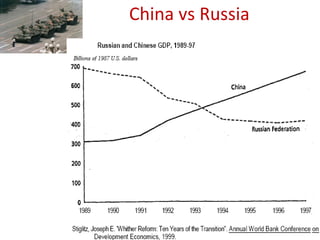
China vs Russia
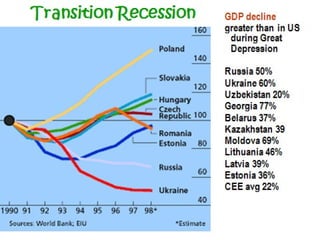
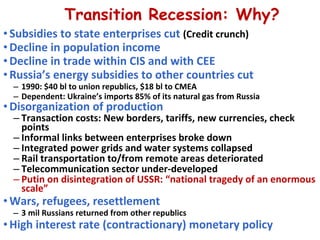
Transition Recession: Why? Subsidies to state enterprises cut  (Credit crunch) Decline in population income Decline in trade within CIS and with CEE Russia’s energy subsidies to other countries cut  1990: $40 bl to union republics, $18 bl to CMEA Dependent: Ukraine’s imports 85% of its natural gas from Russia  Disorganization of production Transaction costs: New borders, tariffs, new currencies, check points  Informal links between enterprises broke down Integrated power grids and water systems collapsed Rail transportation to/from remote areas deteriorated Telecommunication sector under-developed  Putin on disintegration of USSR: “national tragedy of an enormous scale” Wars, refugees, resettlement 3 mil Russians returned from other republics  High interest rate (contractionary) monetary policy
Lack of financial markets Restructuring shock, no entrepreneurial experience Defense spending cut– “bad” output Defense spending as share of GDP USSR  1987:  17%  1990:  12%  Russia  1992:  5.5%  1997:  3.8% Welfare higher even if output is lower? Production shifted to“good” output  No lines to purchase goods –high income consumers better off Official data overstates collapse  Informal sector Over-valued output at old prices USSR reported higher than actual growth Smaller recession  in countries that integrated in world economy faster  In non-reformers, Uzbekistan and Belarus Transition Recession: Why?
Informal Economy Unreported activities, not measured 50% of GDP, 40% of cash turnover Moonlighting, barter, unofficial production Household food production “ Shuttle trading“ by 5-10 million entrepreneurs   transport and sale of consumer goods  1995: some US$11 billion worth of goods  Why useful to know size of shadow economy?  Tax collection: informal economy erodes tax base and leads to higher government debt Official data underestimates household income Formulating policy Measuring Informal Economy  Direct estimates of income or household expenditure by survey not reliable, people conceal revenues Indirect methods demand for cash relative to broader monetary aggregates  electricity consumption - high correlation with GDP
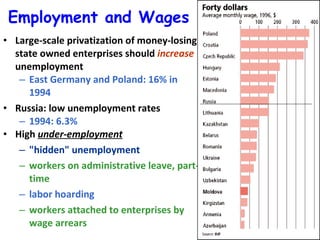
Employment and Wages Large-scale privatization of money-losing state owned enterprises should  increase  unemployment East Germany and Poland: 16% in 1994 Russia: low unemployment rates  1994: 6.3% High  under-employment "hidden" unemployment   workers on administrative leave, part-time labor hoarding workers attached to enterprises by wage arrears
 
 
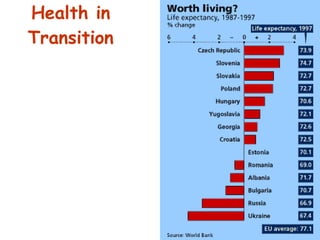
Health in Transition
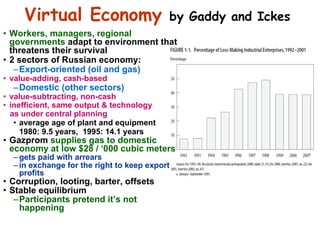
Virtual Economy  by Gaddy and Ickes Workers, managers, regional governments  adapt to environment that threatens their survival 2 sectors of Russian economy: Export-oriented (oil and gas) value-adding, cash-based  Domestic (other sectors) value-subtracting, non-cash inefficient, same output & technology  as under central planning average age of plant and equipment  1980: 9.5 years,  1995: 14.1 years Gazprom  supplies gas to domestic economy at low $28 / ‘000 cubic meters  gets paid with arrears in exchange for the right to keep export profits Corruption, looting, barter, offsets Stable equilibrium Participants pretend it’s not happening
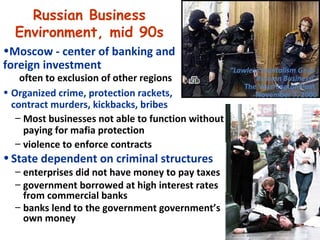
“ Lawless Capitalism Grips  Russian Business”   The Washington Post  November 7, 2000 - Moscow - center of banking and foreign investment often to exclusion of other regions Russian Business Environment, mid 90s Organized crime, protection rackets,  contract murders, kickbacks, bribes Most businesses not able to function without paying for mafia protection violence to enforce contracts  State dependent on criminal structures enterprises did not have money to pay taxes government borrowed at high interest rates from commercial banks  banks lend to the government government’s own money                                      
Ineffective financial intermediaries Adverse selection effect of high interest rates Only high risk individuals borrow Default if high risk project not successful  Low risk – low return projects not undertaken Bad loans for banks, low public confidence in banks  Government intervention possible - Interest rate subsidies, deposit insurance Bank runs, failures:  Latvia, Lithuania : 1995 Czech Republic,  Bulgaria,   Romania  : 1996-97 Russia:  1992 - savings in Sberbank frozen and destroyed by hyperinflation   1996-98 -  bank runs, withdrawal of deposits, failures  Financial scandals Russia, Albania, Romania, 1994-94 -  Collapse of financial pyramids   Causes of bank runs and financial scandals non-performing loans to state-owned enterprises quick financial liberalization allowed too many new banks inexperience of bank management with risk assessment deposit rates below inflation rate no deposit insurance
Exchange Rate Regimes Float (Flexible Rate):   value of national currency determined by market Peg (Fixed Rate):   central bank buys and sells domestic currency to maintain exchange rate against a foreign currency possible only if central bank has enough foreign exchange reserves to defend the peg helps fight inflation currency boards:  Latvia, Estonia, Bulgaria Managed (“dirty”) floats Adjustable (“crawling band”) pegs Poland, Hungary Russia : “crawling band" started at  4,300-4,900 Rb = $1 Slowly depreciating due to inflation 1997: 6,000 Rb = $1 1998 currency reform: 1 new Rb= 6,000 old Rb Success of transition is not crucially dependent on exchange rate regime
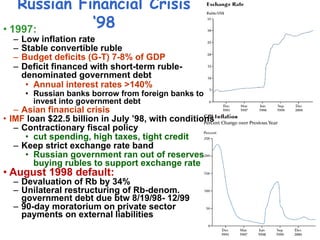
Russian Financial Crisis ‘98 1997:  Low inflation rate Stable convertible ruble Budget deficits (G-T) 7-8% of GDP Deficit financed with short-term ruble-denominated government debt Annual  interest rates  >140% Russian banks borrow from foreign banks to invest into government debt  Asian financial crisis  IMF  loan $22.5 billion in July ’98, with conditions Contractionary fiscal policy  cut spending, high taxes, tight credit Keep strict exchange rate band  Russian government ran out of reserves buying rubles to support exchange rate August 1998 default: Devaluation of Rb by 34% Unilateral restructuring of Rb-denom. government debt due btw 8/19/98- 12/99 90-day moratorium on private sector payments on external liabilities
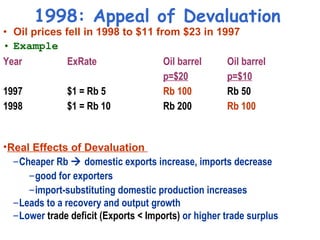
1998: Appeal of Devaluation Oil prices fell in 1998 to $11 from $23 in 1997 Example Year ExRate Oil barrel Oil barrel  p=$20 p=$10 1997 $1 = Rb 5 Rb 100 Rb 50 1998 $1 = Rb 10 Rb 200 Rb 100 Real Effects of Devaluation  Cheaper Rb    domestic exports increase, imports decrease good for exporters  import-substituting domestic production increases Leads to a recovery and output growth  Lower  trade deficit ( Exports < Imports)  or higher trade surplus
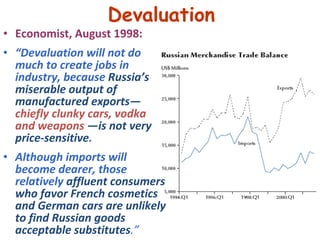
Devaluation Economist, August 1998:  “ Devaluation will not do much to create jobs in industry, because  Russia’s miserable output of manufactured exports—  chiefly clunky cars, vodka and weapons  —is not very price-sensitive .  Although imports will become dearer, those relatively  affluent consumers who favor French cosmetics and German cars are unlikely to find Russian goods acceptable substitutes .”
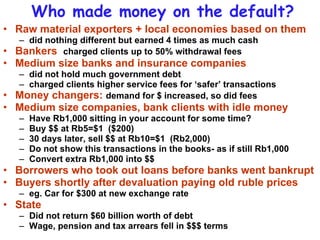
Who made money on the default? Raw material exporters + local economies based on them did nothing different but earned 4 times as much cash Bankers  charged clients up to 50% withdrawal fees Medium size banks and insurance companies  did not hold much government debt charged clients higher service fees for ‘safer’ transactions Money changers:  demand for $ increased, so did fees Medium size companies, bank clients with idle money Have Rb1,000 sitting in your account for some time? Buy $$ at Rb5=$1  ($200) 30 days later, sell $$ at Rb10=$1  (Rb2,000) Do not show this transactions in the books- as if still Rb1,000 Convert extra Rb1,000 into $$ Borrowers who took out loans before banks went bankrupt Buyers shortly after devaluation paying old ruble prices eg. Car for $300 at new exchange rate State Did not return $60 billion worth of debt Wage, pension and tax arrears fell in $$$ terms
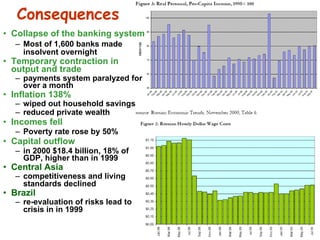
Consequences Collapse of the banking system   Most of 1,600 banks made insolvent overnight  Temporary contraction in output and trade  payments system paralyzed for over a month  Inflation 138% wiped out household savings reduced private wealth Incomes fell Poverty rate rose by 50% Capital outflow   in 2000 $18.4 billion, 18% of GDP, higher than in 1999 Central Asia  competitiveness and living standards declined Brazil re-evaluation of risks lead to crisis in in 1999
Could Have Avoided Crisis  with Right Policies? Gradual ruble depreciation: print rubles to pay off debts, stop convertibility for a while Inflation better that massive bankruptcies, loss of savings Capital controls to stop capital flight Public infrastructure investment  transportation, power, communication, railways, public buildings   Pay back wages to stimulate demand for Russian output Attract investment, domestic and foreign, for modernization Political instability  Functional legal system  Low cost credit for domestic production Renationalize enterprises that were sold at less true value  More public spending on science, technology, education Temporary protection of selected industries and agriculture Export less raw materials and energy, redirect more to domestic production – diversify economic base
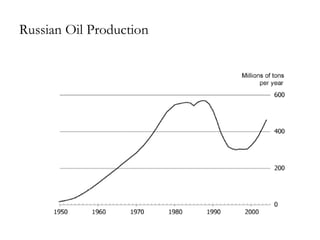
Russian Oil Production

8 Trans2

  • 1.
    Commonwealth of IndependentStates 12 Former USSR Republics 3 groups of countries Russia Ukraine Belarus Moldova Armenia Georgia Azerbaijan Kazakhstan Uzbekistan Kyrgyzstan Turkmenistan Tajikistan
  • 2.
  • 3.
  • 4.
    Transition Recession: Why?Subsidies to state enterprises cut (Credit crunch) Decline in population income Decline in trade within CIS and with CEE Russia’s energy subsidies to other countries cut 1990: $40 bl to union republics, $18 bl to CMEA Dependent: Ukraine’s imports 85% of its natural gas from Russia Disorganization of production Transaction costs: New borders, tariffs, new currencies, check points Informal links between enterprises broke down Integrated power grids and water systems collapsed Rail transportation to/from remote areas deteriorated Telecommunication sector under-developed Putin on disintegration of USSR: “national tragedy of an enormous scale” Wars, refugees, resettlement 3 mil Russians returned from other republics High interest rate (contractionary) monetary policy
  • 5.
    Lack of financialmarkets Restructuring shock, no entrepreneurial experience Defense spending cut– “bad” output Defense spending as share of GDP USSR 1987: 17% 1990: 12% Russia 1992: 5.5% 1997: 3.8% Welfare higher even if output is lower? Production shifted to“good” output No lines to purchase goods –high income consumers better off Official data overstates collapse Informal sector Over-valued output at old prices USSR reported higher than actual growth Smaller recession in countries that integrated in world economy faster In non-reformers, Uzbekistan and Belarus Transition Recession: Why?
  • 6.
    Informal Economy Unreportedactivities, not measured 50% of GDP, 40% of cash turnover Moonlighting, barter, unofficial production Household food production “ Shuttle trading“ by 5-10 million entrepreneurs transport and sale of consumer goods 1995: some US$11 billion worth of goods Why useful to know size of shadow economy? Tax collection: informal economy erodes tax base and leads to higher government debt Official data underestimates household income Formulating policy Measuring Informal Economy Direct estimates of income or household expenditure by survey not reliable, people conceal revenues Indirect methods demand for cash relative to broader monetary aggregates electricity consumption - high correlation with GDP
  • 7.
    Employment and WagesLarge-scale privatization of money-losing state owned enterprises should increase unemployment East Germany and Poland: 16% in 1994 Russia: low unemployment rates 1994: 6.3% High under-employment &quot;hidden&quot; unemployment workers on administrative leave, part-time labor hoarding workers attached to enterprises by wage arrears
  • 8.
  • 9.
  • 10.
  • 11.
    Virtual Economy by Gaddy and Ickes Workers, managers, regional governments adapt to environment that threatens their survival 2 sectors of Russian economy: Export-oriented (oil and gas) value-adding, cash-based Domestic (other sectors) value-subtracting, non-cash inefficient, same output & technology as under central planning average age of plant and equipment 1980: 9.5 years, 1995: 14.1 years Gazprom supplies gas to domestic economy at low $28 / ‘000 cubic meters gets paid with arrears in exchange for the right to keep export profits Corruption, looting, barter, offsets Stable equilibrium Participants pretend it’s not happening
  • 12.
    “ Lawless CapitalismGrips Russian Business” The Washington Post November 7, 2000 - Moscow - center of banking and foreign investment often to exclusion of other regions Russian Business Environment, mid 90s Organized crime, protection rackets, contract murders, kickbacks, bribes Most businesses not able to function without paying for mafia protection violence to enforce contracts State dependent on criminal structures enterprises did not have money to pay taxes government borrowed at high interest rates from commercial banks banks lend to the government government’s own money                                    
  • 13.
    Ineffective financial intermediariesAdverse selection effect of high interest rates Only high risk individuals borrow Default if high risk project not successful Low risk – low return projects not undertaken Bad loans for banks, low public confidence in banks Government intervention possible - Interest rate subsidies, deposit insurance Bank runs, failures: Latvia, Lithuania : 1995 Czech Republic, Bulgaria, Romania : 1996-97 Russia: 1992 - savings in Sberbank frozen and destroyed by hyperinflation 1996-98 - bank runs, withdrawal of deposits, failures Financial scandals Russia, Albania, Romania, 1994-94 - Collapse of financial pyramids Causes of bank runs and financial scandals non-performing loans to state-owned enterprises quick financial liberalization allowed too many new banks inexperience of bank management with risk assessment deposit rates below inflation rate no deposit insurance
  • 14.
    Exchange Rate RegimesFloat (Flexible Rate): value of national currency determined by market Peg (Fixed Rate): central bank buys and sells domestic currency to maintain exchange rate against a foreign currency possible only if central bank has enough foreign exchange reserves to defend the peg helps fight inflation currency boards: Latvia, Estonia, Bulgaria Managed (“dirty”) floats Adjustable (“crawling band”) pegs Poland, Hungary Russia : “crawling band&quot; started at 4,300-4,900 Rb = $1 Slowly depreciating due to inflation 1997: 6,000 Rb = $1 1998 currency reform: 1 new Rb= 6,000 old Rb Success of transition is not crucially dependent on exchange rate regime
  • 15.
    Russian Financial Crisis‘98 1997: Low inflation rate Stable convertible ruble Budget deficits (G-T) 7-8% of GDP Deficit financed with short-term ruble-denominated government debt Annual interest rates >140% Russian banks borrow from foreign banks to invest into government debt Asian financial crisis IMF loan $22.5 billion in July ’98, with conditions Contractionary fiscal policy cut spending, high taxes, tight credit Keep strict exchange rate band Russian government ran out of reserves buying rubles to support exchange rate August 1998 default: Devaluation of Rb by 34% Unilateral restructuring of Rb-denom. government debt due btw 8/19/98- 12/99 90-day moratorium on private sector payments on external liabilities
  • 16.
    1998: Appeal ofDevaluation Oil prices fell in 1998 to $11 from $23 in 1997 Example Year ExRate Oil barrel Oil barrel p=$20 p=$10 1997 $1 = Rb 5 Rb 100 Rb 50 1998 $1 = Rb 10 Rb 200 Rb 100 Real Effects of Devaluation Cheaper Rb  domestic exports increase, imports decrease good for exporters import-substituting domestic production increases Leads to a recovery and output growth Lower trade deficit ( Exports < Imports) or higher trade surplus
  • 17.
    Devaluation Economist, August1998: “ Devaluation will not do much to create jobs in industry, because Russia’s miserable output of manufactured exports— chiefly clunky cars, vodka and weapons —is not very price-sensitive . Although imports will become dearer, those relatively affluent consumers who favor French cosmetics and German cars are unlikely to find Russian goods acceptable substitutes .”
  • 18.
    Who made moneyon the default? Raw material exporters + local economies based on them did nothing different but earned 4 times as much cash Bankers charged clients up to 50% withdrawal fees Medium size banks and insurance companies did not hold much government debt charged clients higher service fees for ‘safer’ transactions Money changers: demand for $ increased, so did fees Medium size companies, bank clients with idle money Have Rb1,000 sitting in your account for some time? Buy $$ at Rb5=$1 ($200) 30 days later, sell $$ at Rb10=$1 (Rb2,000) Do not show this transactions in the books- as if still Rb1,000 Convert extra Rb1,000 into $$ Borrowers who took out loans before banks went bankrupt Buyers shortly after devaluation paying old ruble prices eg. Car for $300 at new exchange rate State Did not return $60 billion worth of debt Wage, pension and tax arrears fell in $$$ terms
  • 19.
    Consequences Collapse ofthe banking system Most of 1,600 banks made insolvent overnight Temporary contraction in output and trade payments system paralyzed for over a month Inflation 138% wiped out household savings reduced private wealth Incomes fell Poverty rate rose by 50% Capital outflow in 2000 $18.4 billion, 18% of GDP, higher than in 1999 Central Asia competitiveness and living standards declined Brazil re-evaluation of risks lead to crisis in in 1999
  • 20.
    Could Have AvoidedCrisis with Right Policies? Gradual ruble depreciation: print rubles to pay off debts, stop convertibility for a while Inflation better that massive bankruptcies, loss of savings Capital controls to stop capital flight Public infrastructure investment transportation, power, communication, railways, public buildings Pay back wages to stimulate demand for Russian output Attract investment, domestic and foreign, for modernization Political instability Functional legal system Low cost credit for domestic production Renationalize enterprises that were sold at less true value More public spending on science, technology, education Temporary protection of selected industries and agriculture Export less raw materials and energy, redirect more to domestic production – diversify economic base
  • 21.