STRICT LIABILITY OFFENCES
Mens rea is not always required






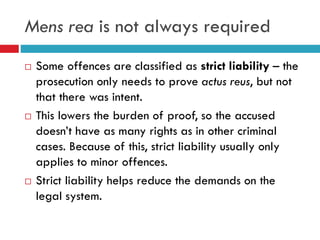
Some offences are classified as strict liability – the
prosecution only needs to prove actus reus, but not
that there was intent.
This lowers the burden of proof, so the accused
doesn’t have as many rights as in other criminal
cases. Because of this, strict liability usually only
applies to minor offences.
Strict liability helps reduce the demands on the
legal system.
Examples
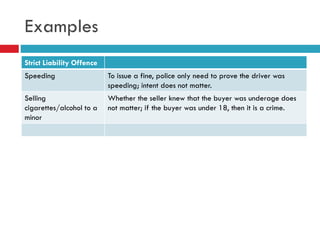
Strict Liability Offence
Speeding

To issue a fine, police only need to prove the driver was
speeding; intent does not matter.

Selling
cigarettes/alcohol to a
minor

Whether the seller knew that the buyer was underage does
not matter; if the buyer was under 18, then it is a crime.
Consider


What are the implications of strict
liability for:
 Victims
 Offenders
 Society?
CAUSATION




There must be a link between the accused’s actions
and the result (injury, etc)
The behaviour of the accused must have actually
led to the criminal act










The Appellant was acquitted of murder but
convicted of manslaughter. The victim was an
18 year-old girl.
The Appellant went to her house and
attempted to rape the victim and inflicted
serious wounds. The victim collapsed and was
taken to the hospital.
Because of her religious beliefs, the victim
refused a life saving blood transfusion and
died as a result.
The judge instructed the jury that they could
find that Appellant was the operative or
substantial cause of death and convict on
that basis.
The Appellant appealed, arguing that
because the victim refused life saving
medical treatment, his conviction for
manslaughter should be overturned.

Rv
Blaue
[1975]
Do you agree with the instructions to the jury?









The appeal failed.
He who inflicts a wound or injury which results
in death cannot excuse himself by pleading
that his victim could have avoided death by
taking better care of himself/herself.
A man who does a wrongful act is morally
responsible for the natural and probable
consequences of that act.
It has long been the policy of the law that
those who use violence on other people must
take their victims as they find them
Even though the acts of a hospital or the
victim themselves might be the actual cause
of death, a defendant’s act was the
operative cause and thus he can be held
liable.
If at the time of death the original
wound is still the operating cause
and a substantial cause, then the
death can properly be said to be
the result of the wound, albeit that
some other cause of death is also
operating.

Synopsis of Rule of Law


Other cases to investigate
March v Stramare (1991)

R v Cheshire (1991)

1.4 strict liability & causation

  • 1.
  • 2.
    Mens rea isnot always required    Some offences are classified as strict liability – the prosecution only needs to prove actus reus, but not that there was intent. This lowers the burden of proof, so the accused doesn’t have as many rights as in other criminal cases. Because of this, strict liability usually only applies to minor offences. Strict liability helps reduce the demands on the legal system.
  • 3.
    Examples Strict Liability Offence Speeding Toissue a fine, police only need to prove the driver was speeding; intent does not matter. Selling cigarettes/alcohol to a minor Whether the seller knew that the buyer was underage does not matter; if the buyer was under 18, then it is a crime.
  • 4.
    Consider  What are theimplications of strict liability for:  Victims  Offenders  Society?
  • 5.
  • 6.
      There must bea link between the accused’s actions and the result (injury, etc) The behaviour of the accused must have actually led to the criminal act
  • 7.
         The Appellant wasacquitted of murder but convicted of manslaughter. The victim was an 18 year-old girl. The Appellant went to her house and attempted to rape the victim and inflicted serious wounds. The victim collapsed and was taken to the hospital. Because of her religious beliefs, the victim refused a life saving blood transfusion and died as a result. The judge instructed the jury that they could find that Appellant was the operative or substantial cause of death and convict on that basis. The Appellant appealed, arguing that because the victim refused life saving medical treatment, his conviction for manslaughter should be overturned. Rv Blaue [1975]
  • 8.
    Do you agreewith the instructions to the jury?
  • 9.
         The appeal failed. Hewho inflicts a wound or injury which results in death cannot excuse himself by pleading that his victim could have avoided death by taking better care of himself/herself. A man who does a wrongful act is morally responsible for the natural and probable consequences of that act. It has long been the policy of the law that those who use violence on other people must take their victims as they find them Even though the acts of a hospital or the victim themselves might be the actual cause of death, a defendant’s act was the operative cause and thus he can be held liable.
  • 10.
    If at thetime of death the original wound is still the operating cause and a substantial cause, then the death can properly be said to be the result of the wound, albeit that some other cause of death is also operating. Synopsis of Rule of Law 
  • 11.
    Other cases toinvestigate March v Stramare (1991) R v Cheshire (1991)