“How Can weKnow Where We’re Going Without
Knowing First Where We ‘ve Been?”
Creativity; Past, Present & Future…..
3.
Creativity: What isit???……
“The ability to create and innovate has been observed
throughout history and even though the fundamental
tools may have changed the ability has been prevalent
in every civilisation” (Hisrich, Peters and
Shepherd, 2005, p. 8).
“May our species be resurrected and awakened
by the Spirit of Creativity for this coming century”
(Fox, 2002).
4.
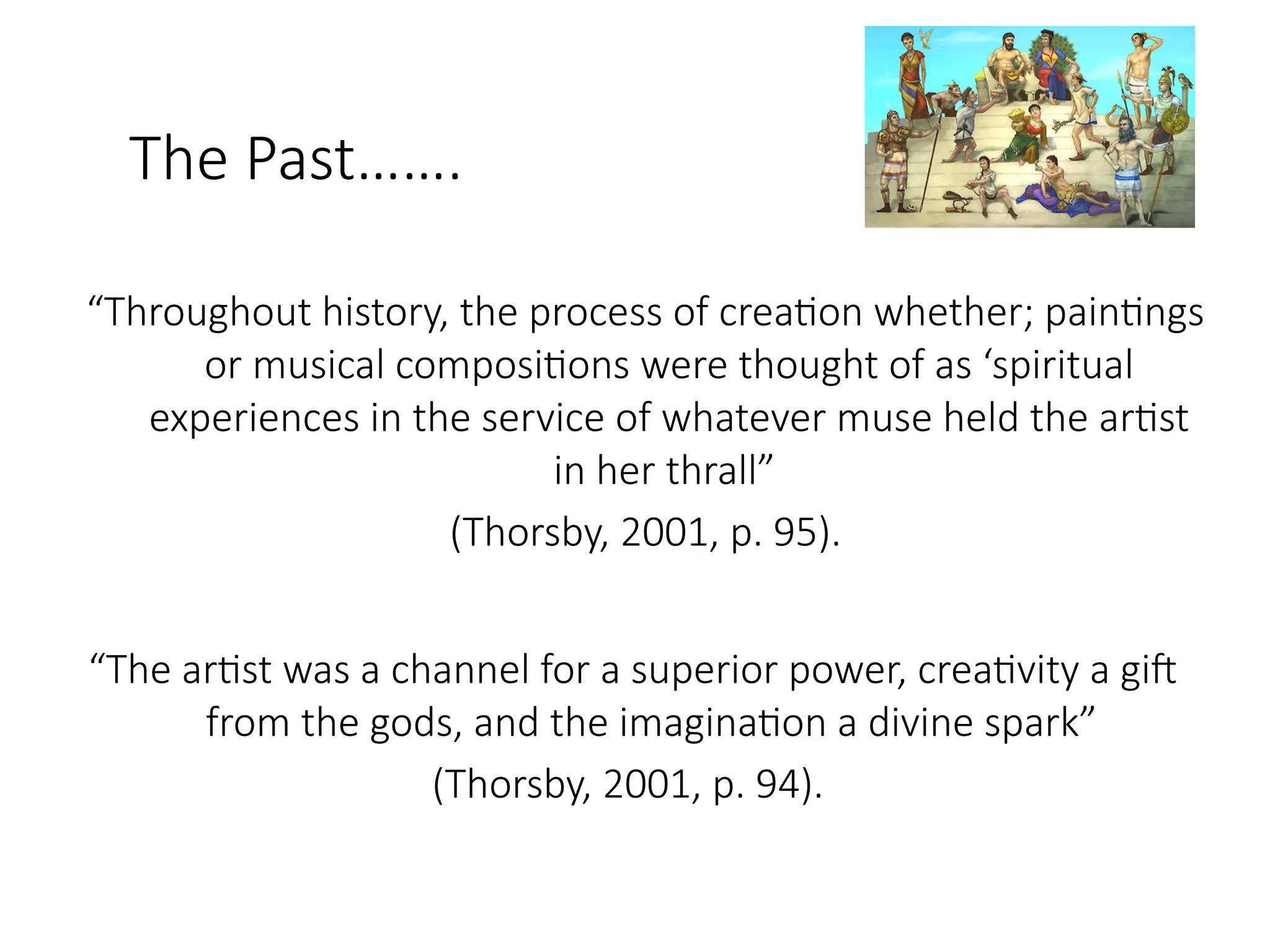
“Throughout history, theprocess of creation whether; paintings
or musical compositions were thought of as ‘spiritual
experiences in the service of whatever muse held the artist
in her thrall”
(Thorsby, 2001, p. 95).
“The artist was a channel for a superior power, creativity a gift
from the gods, and the imagination a divine spark”
(Thorsby, 2001, p. 94).
The Past…….
5.
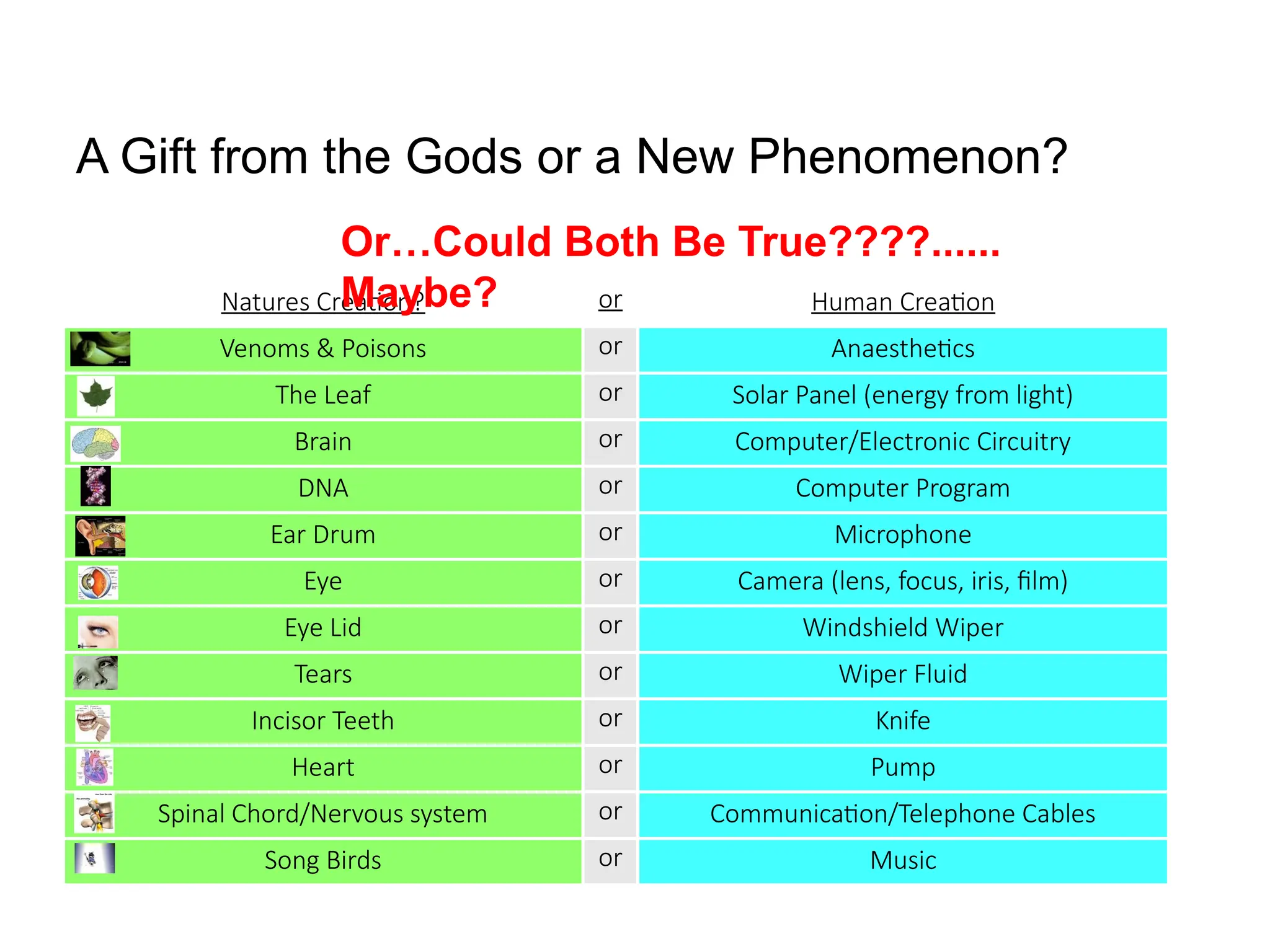
Natures Creation? orHuman Creation
Venoms & Poisons or Anaesthetics
The Leaf or Solar Panel (energy from light)
Brain or Computer/Electronic Circuitry
DNA or Computer Program
Ear Drum or Microphone
Eye or Camera (lens, focus, iris, film)
Eye Lid or Windshield Wiper
Tears or Wiper Fluid
Incisor Teeth or Knife
Heart or Pump
Spinal Chord/Nervous system or Communication/Telephone Cables
Song Birds or Music
A Gift from the Gods or a New Phenomenon?
Or…Could Both Be True????......
Maybe?
6.
Creativity
“There is nodoubt that creativity is the most important human
resource of all. Without creativity there would be no progress, and we
would be forever repeating the same patterns”
(Edward de Bono).
7.
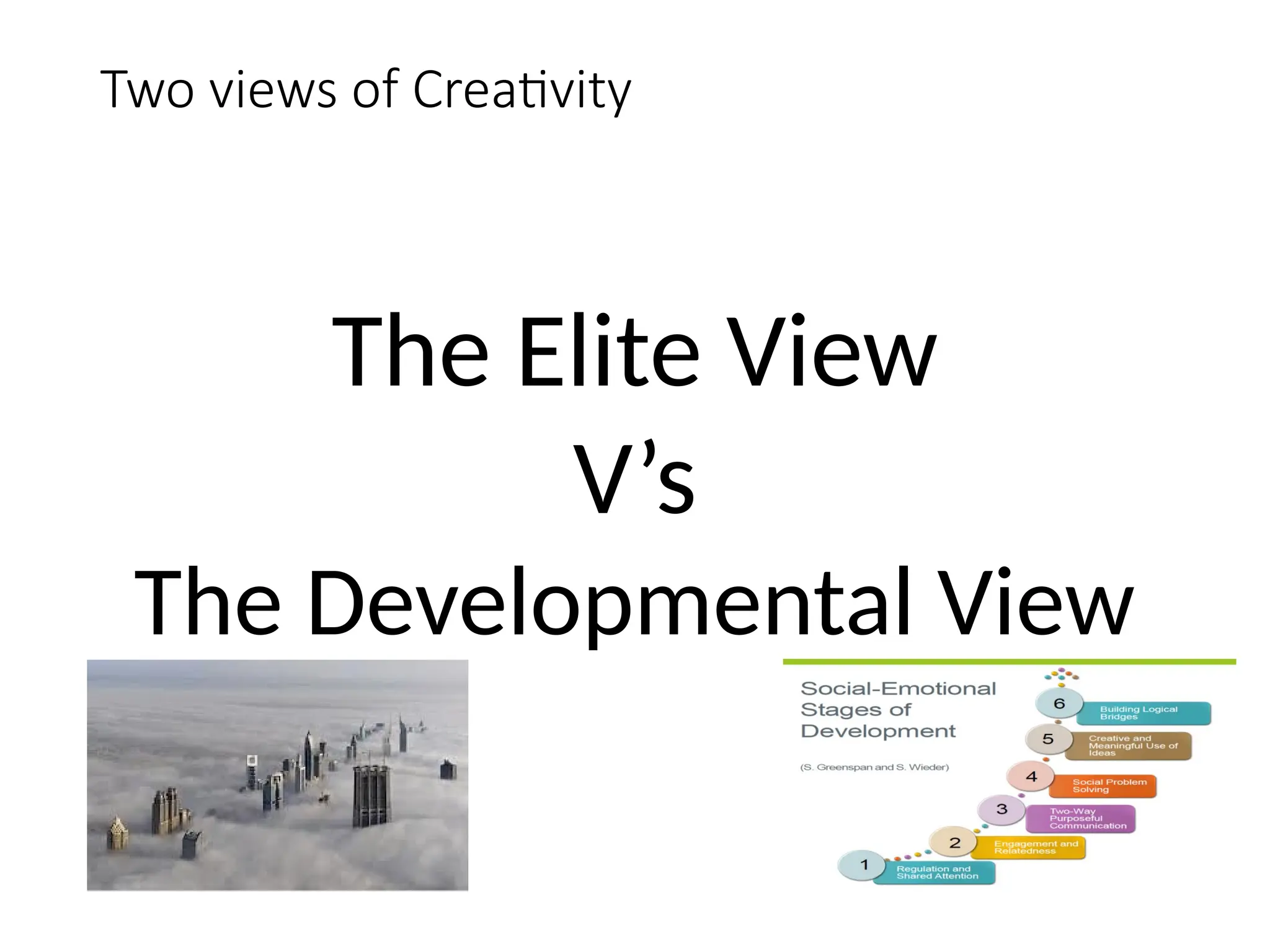
Two views ofCreativity
The Elite View
V’s
The Developmental View
8.
The Elitist View…
•Getting New & Valuable Ideas
• A Rare Talent
• Creating Great Works of Art or Scientific Discoveries
• Unable to be Taught
• Not Relevant in My Job/ Organisation
• A Lonely Individual Process
9.
The Developmental View…
•Availableto Everyone
•Evident in Personal & Modest Insights
•Released Through Training & Development of
Personal Potential
•Within the Scope of All Jobs
•Encouraged or Discouraged Within Groups
According to their Climate
•Escape from ‘Personal Stuckness’ & Reveals
Itself in Results Which are Original & Potentially
Valuable
The Reality…..
• CreativityIs Not Exclusively for ‘Elite’ People
• It Can be Developed in All Persons
• Creativity is a Personal Problem-solving Process of a Non-routine Kind
• It Can be Learned, Practiced & Successfully Applied by all – in Every
Walk of Life
Creativity
“There is nodoubt that creativity is the most important human
resource of all. Without creativity there would be no progress, and we
would be forever repeating the same patterns”
(Edward de Bono).
16.
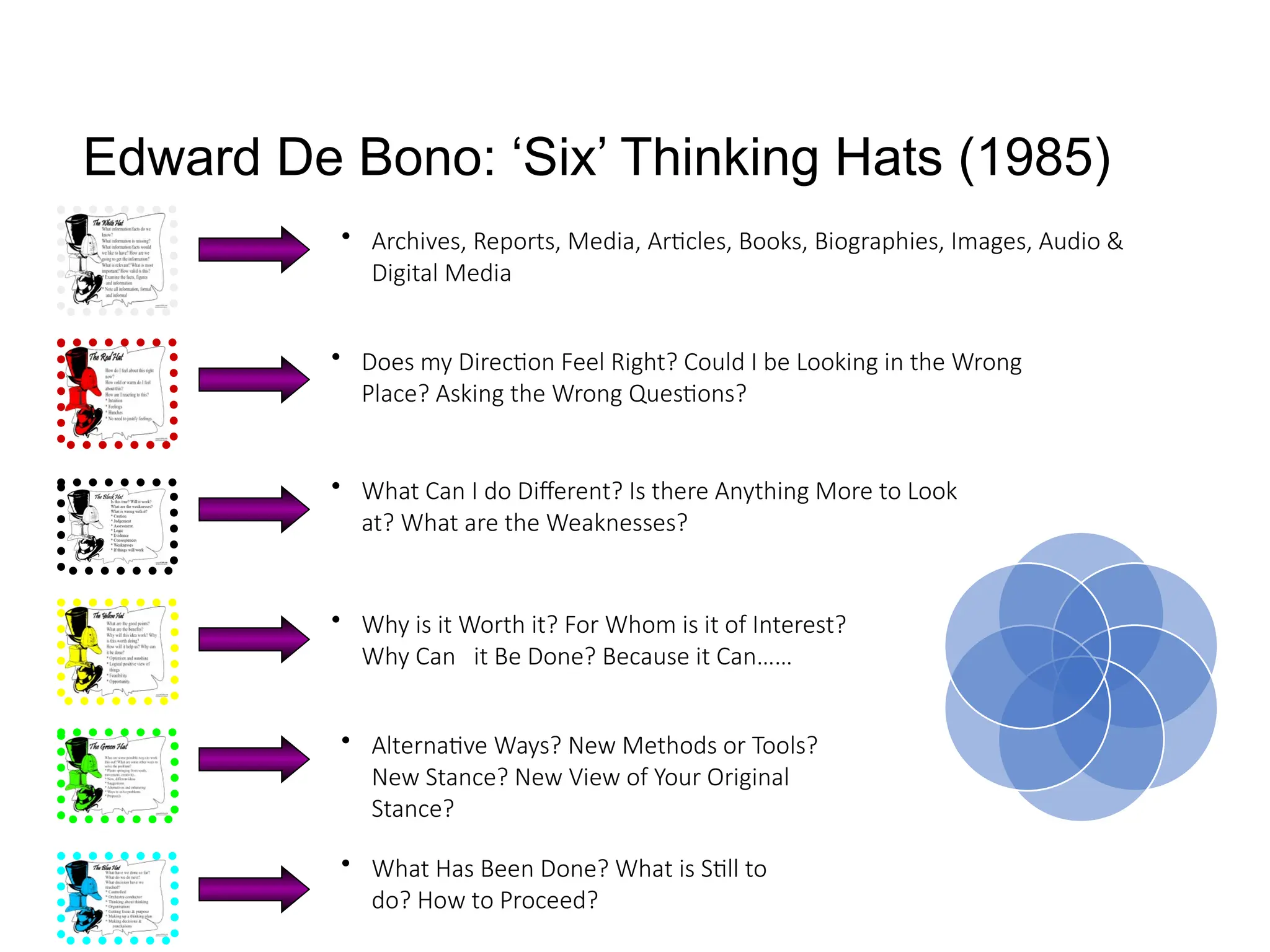
• Archives, Reports,Media, Articles, Books, Biographies, Images, Audio &
Digital Media
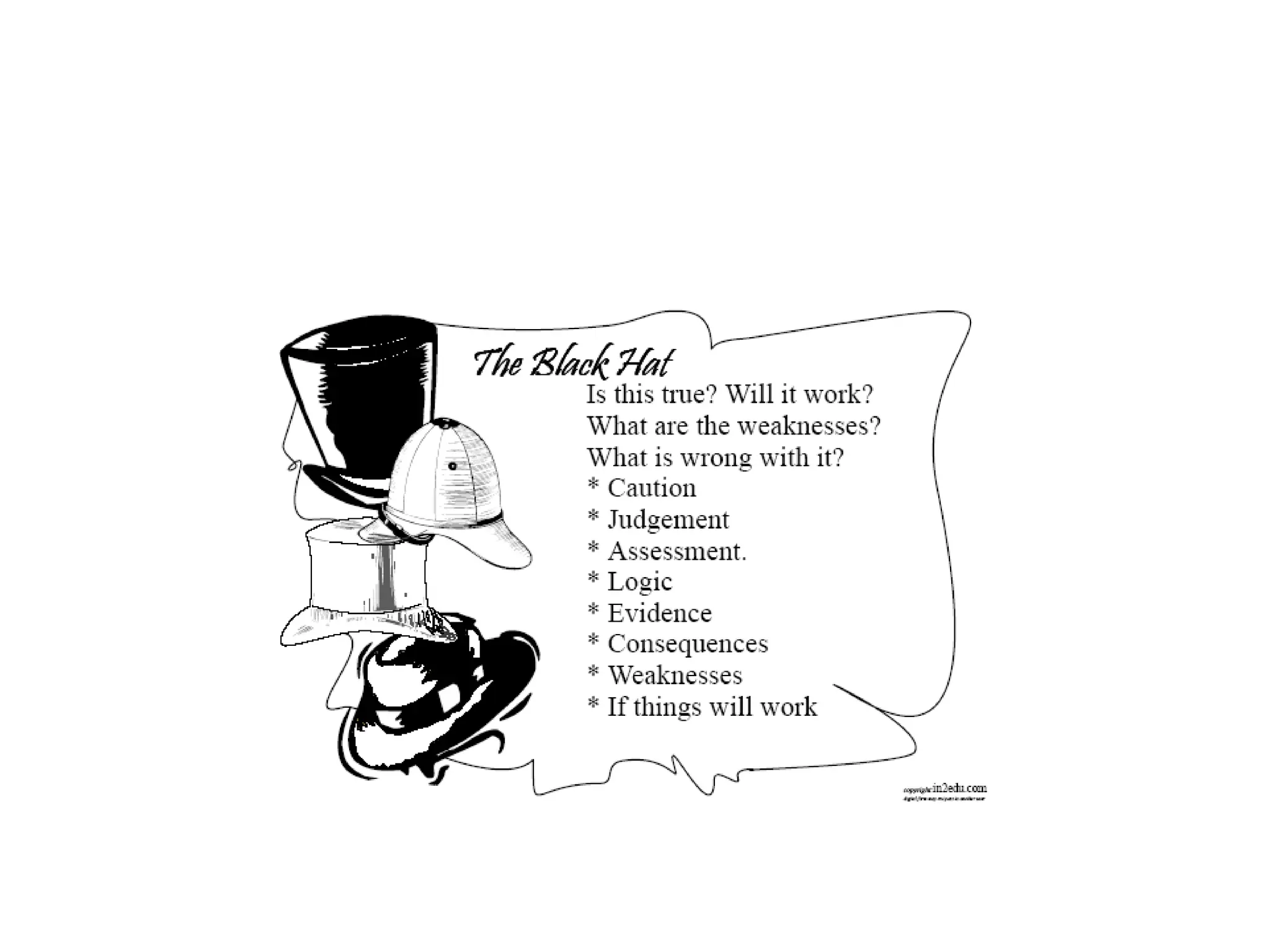
• Does my Direction Feel Right? Could I be Looking in the Wrong
Place? Asking the Wrong Questions?
• What Can I do Different? Is there Anything More to Look
at? What are the Weaknesses?
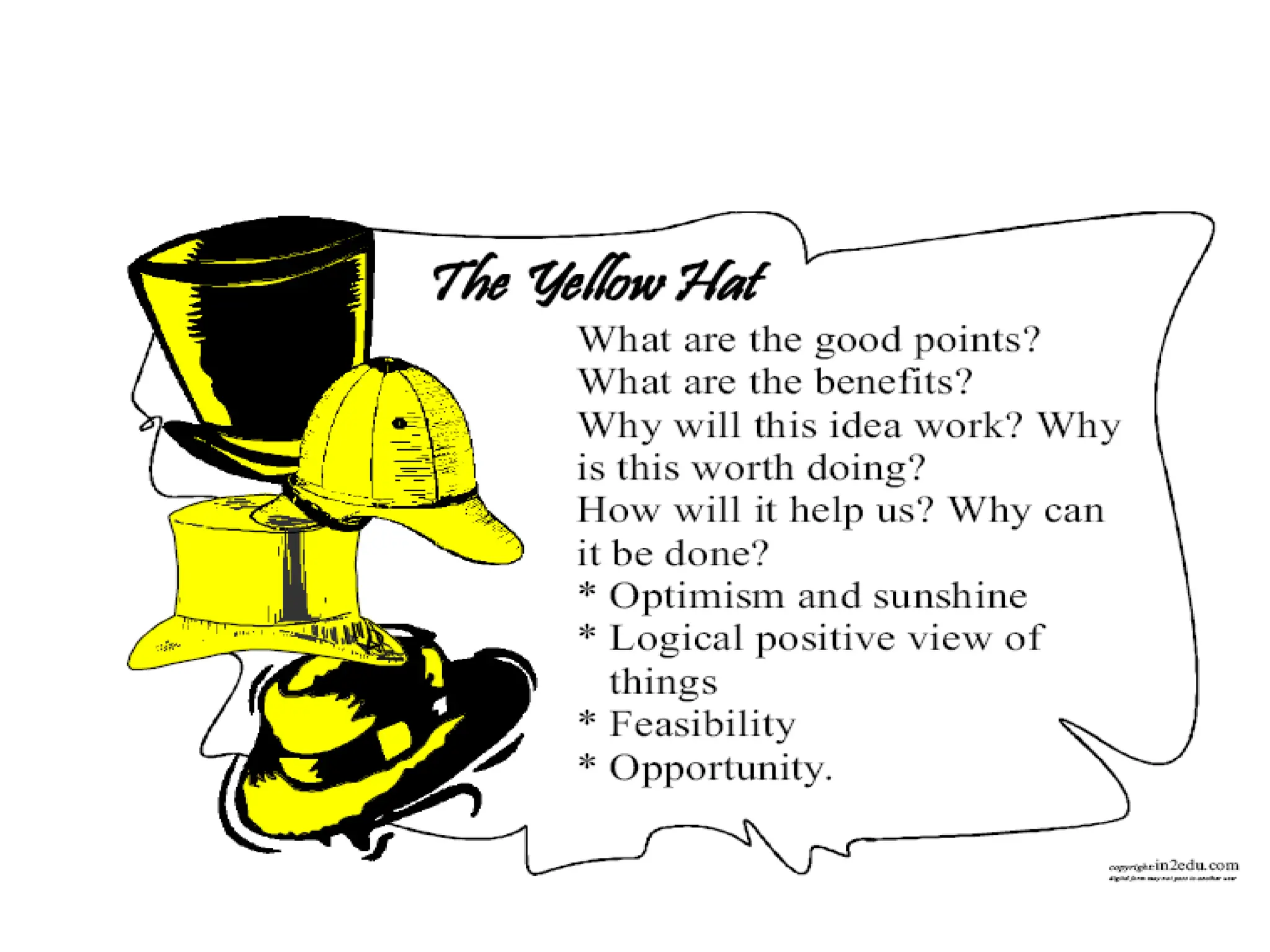
• Why is it Worth it? For Whom is it of Interest?
Why Can it Be Done? Because it Can……
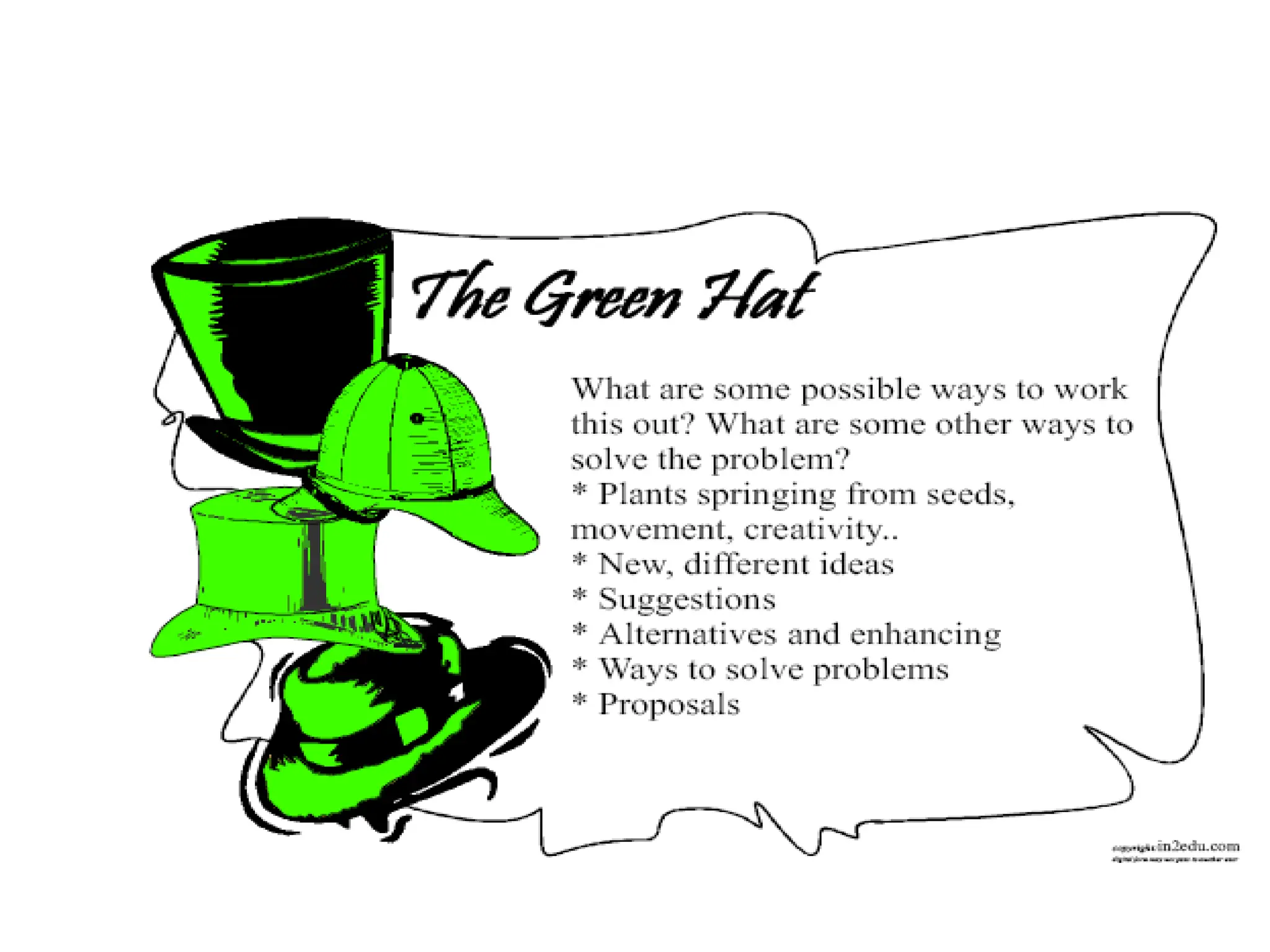
• Alternative Ways? New Methods or Tools?
New Stance? New View of Your Original
Stance?
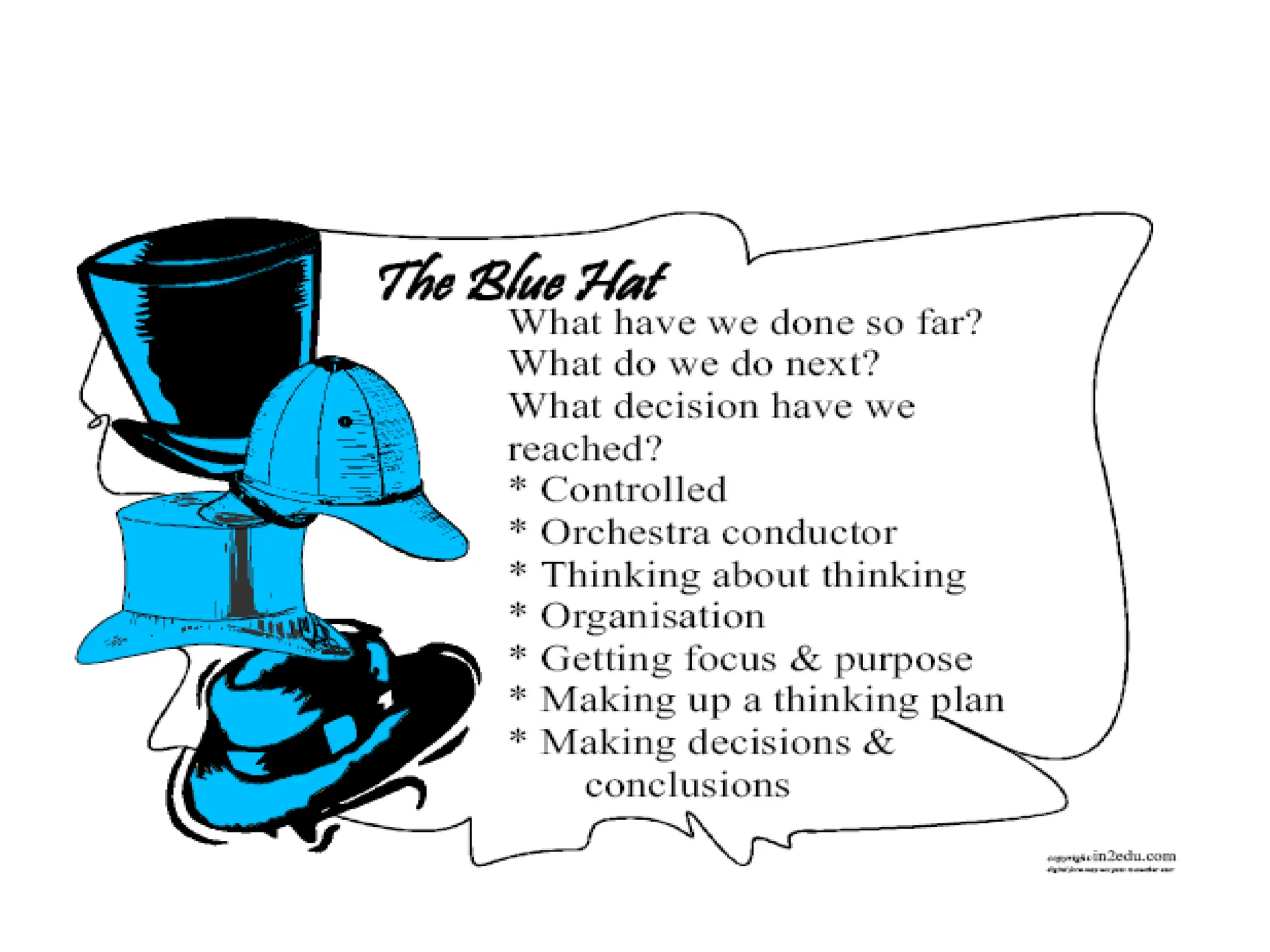
• What Has Been Done? What is Still to
do? How to Proceed?
Edward De Bono: ‘Six’ Thinking Hats (1985)
23.
The Unique BlueHat
• The blue hat is different from the other hats because it is
involved with directing the thinking process itself
• We use the blue hat whenever we suggest the next hat to be
used
• The blue hat need not be acknowledged at every turn however
there are some points which it is often helpful:
• At the outset of a discussion – Lets decide what we want to
think about and which hats we will use?
• At a midpoint to restate the thinking goal – I think we are
getting away from what we wanted to talk about. Can
someone recall what we decided to talk about?
• At the end to summarise what thinking has been done – Think
of a sentence that tells about what we have been doing today?
24.
Evaluation Sequence
•To discoverthe positive aspects and negative aspects
of an idea. You use the yellow hat (sunny optimism)
before the black hat (caution).
•You could follow up with the green hat (new ideas)
and red hat (emotion, feelings) thinking.
•Examples: Consider positive and negative
Not doing homework one night
25.
Caution Sequence
•Looking criticallyat situations. You are first
considering facts with the white hat.
•Then use the black hat to discover difficulties.
•This can be followed up with some blue hat or red
hat thinking.
•Examples: consider the consequences
Not letting someone know where you are going.
26.
Design Sequence
• Creating:
•New ideas
• Products
• Improvements to existing designs.
• For this, we could use the blue (control), green (creative new ideas) and
red (emotions, feelings) hats.
27.
Other Sequences
Red +White
• Comparing fact and opinion
Black + Yellow + Green
• Comparing and synthesising (coming up with new ideas from the
known)
White + Blue
• What do we know (facts) and where are we going (planning)
28.
1. Problem Definition
IUsed the Explorer Mindset To look at the Larger Issues Related to Entrepreneurship (Quadrant C and D thinking)
Then to find the main issues of interest the detective mindset was used (using Quadrant A and B thinking)
2. Idea Generation
In the second stage, brainstorming a multitude of
creative ideas using the imaginative, intuitive mindset
of an Artist (Quadrant C and D thinking)
3. Idea Synthesis
In the creative idea evaluation phase, I try to obtain
more practical, solutions using the mindset
of an engineer (Quadrants D and A thinking)
4. Idea Judgement
In the critical idea evaluation phase, I must determine
which ideas And solutions are best, thinking like a Judge
(Quadrants A and B)
5. Solution Implementation
Putting the solution into practice requires the mindset of the producer where the focus is primarily on carrying
out the data collection within the research project (Quadrant B and C are especially important, but the whole
brain must be used)
Example: Creative Problem Solving Steps
Prior
Literature
Is there
Another
Way?
Records,
Data
Collection
Reflect
Review
Methods
Who is
it For?
29.
Ideas Can Startwith Solving Problems
• Solving “Points of Pain”:
• To Notice Inefficiency, Inconveniences, & Other Forms of “Points of Pain” &
Use these to Build New Business Opportunities
30.
Idea Generation
• YourTask: Generate as many ideas for a new product or service to
improve student experience at HW as you can in 5 minutes
To Innovate….
• Accordingto the New Oxford Dictionary (2004, p. 942), innovation
means to be able to: “Make changes in something established, especially
by introducing new methods, ideas, or products”.
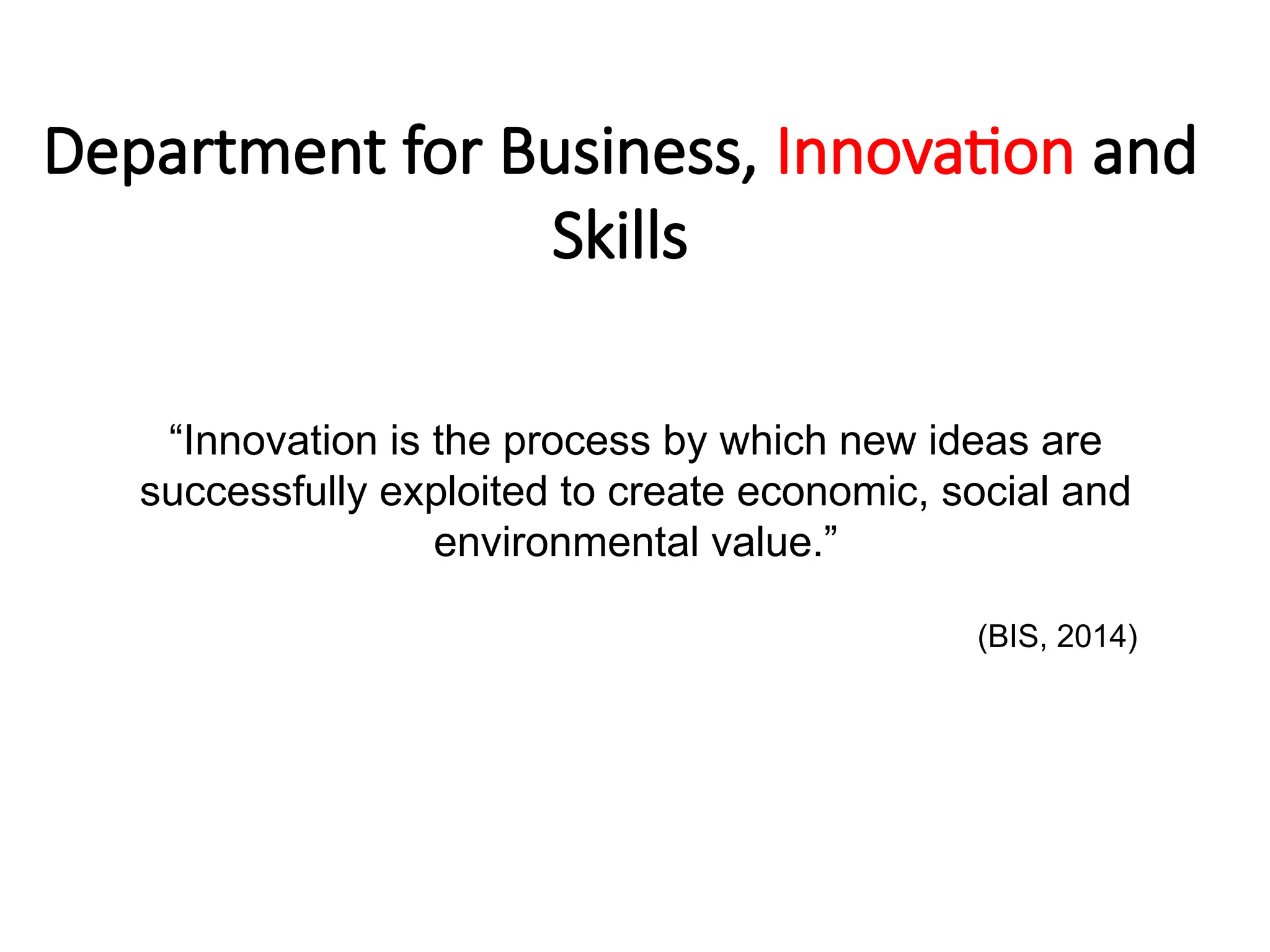
• According to the UK government, “innovation is the process by which
new ideas are successfully exploited to create economic, social and
environmental value” (BIS 2014, p.7).
• In the mid-twentieth century, economist Joseph Schumpeter (1950)
pioneered the categorisation of innovation as the creation of something
‘new’ that creates and adds value for those who interact with, or
consume, it. Something ‘new’ can also mean the updating of something
which already exists in order to take advantage of a specific segment or a
newly-identified or emerging market.
Disruptive and SustainingInnovations
• Christensen (1997), identified two types of innovations:
disruptive innovations and sustaining innovations.
• The former, disruptive innovations involve a new value
proposition by which new markets are created.
• In such instances, individuals or business organisations seize upon
basic inventions and transform them into economic innovations,
thereby disequilibrating and altering the existing market structure,
then waiting until the process eventually settles down before the
next wave of innovation begins.
• In contrast, the latter, sustaining innovations are best
thought of as improvements to existing products, processes
or markets.
35.
What is innovation?
“Whenan enterprise produces a good or service or uses a method or input that is
new to it, it makes a technical change. The first company to make a given
technical change is an innovator. Its action is innovation.”
Schmookler (1966)
“Innovation by definition must be successful in the market. “The test of innovation,
after all, lies not in its novelty, its scientific content, or its cleverness. It lies in its
success in the marketplace.”
Drucker (1993)
It is the creativity of an entrepreneur that results in invention [creation of new
knowledge] and innovation [application of knowledge] to create new products,
services or processes.
36.
Department for Business,Innovation and
Skills
“Innovation is the process by which new ideas are
successfully exploited to create economic, social and
environmental value.”
(BIS, 2014)
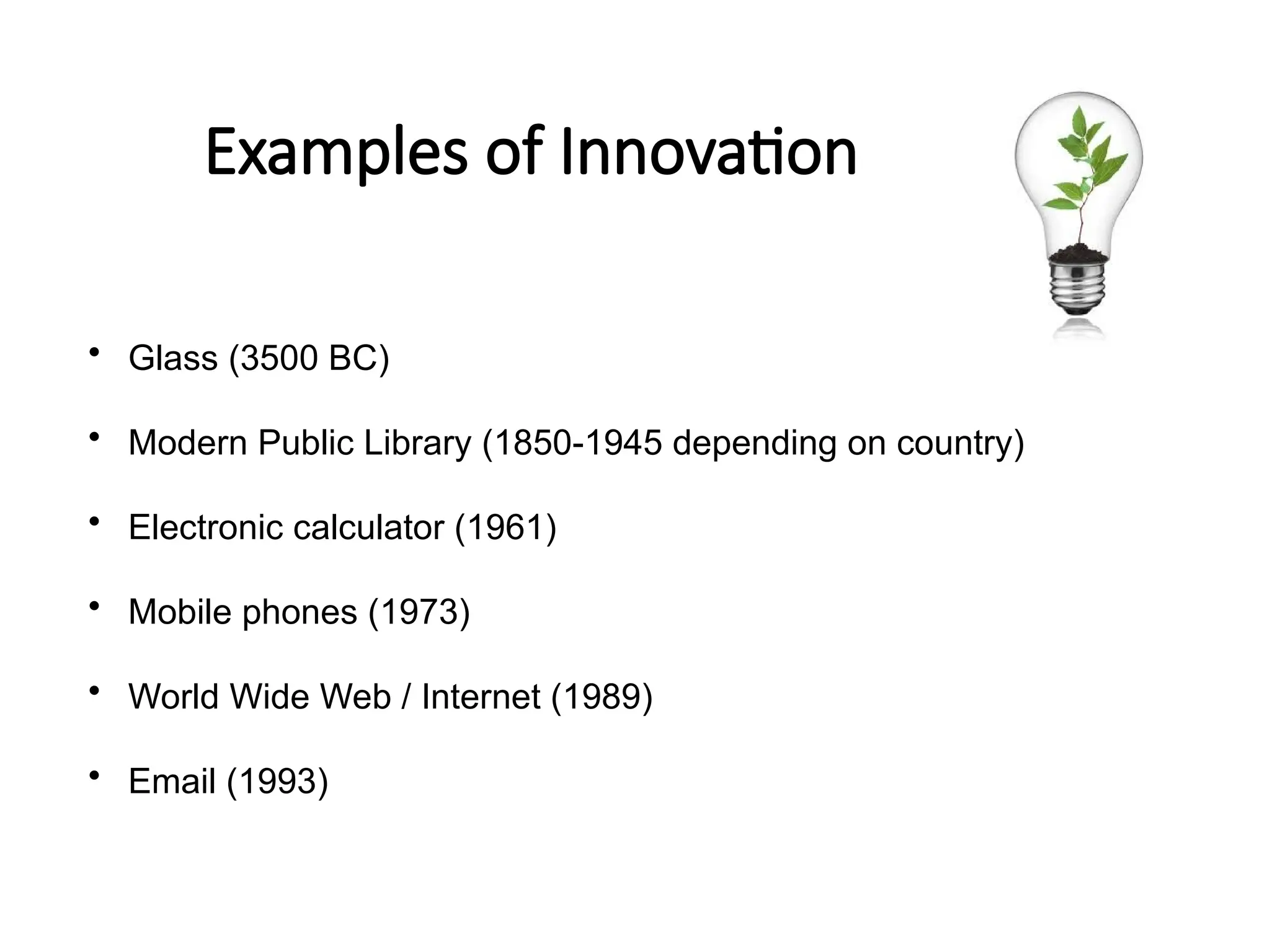
Examples of Innovation
•Glass (3500 BC)
• Modern Public Library (1850-1945 depending on country)
• Electronic calculator (1961)
• Mobile phones (1973)
• World Wide Web / Internet (1989)
• Email (1993)
39.
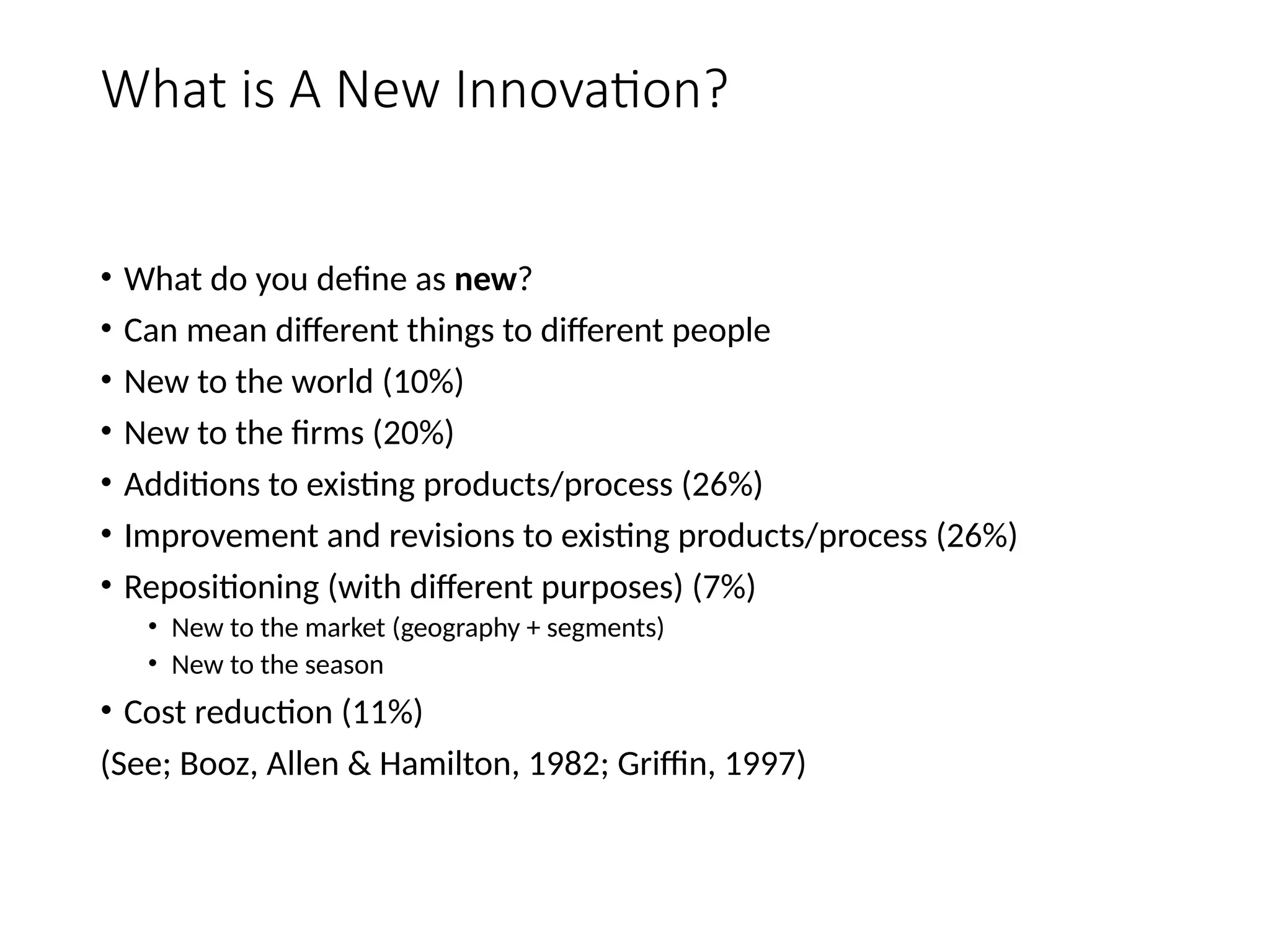
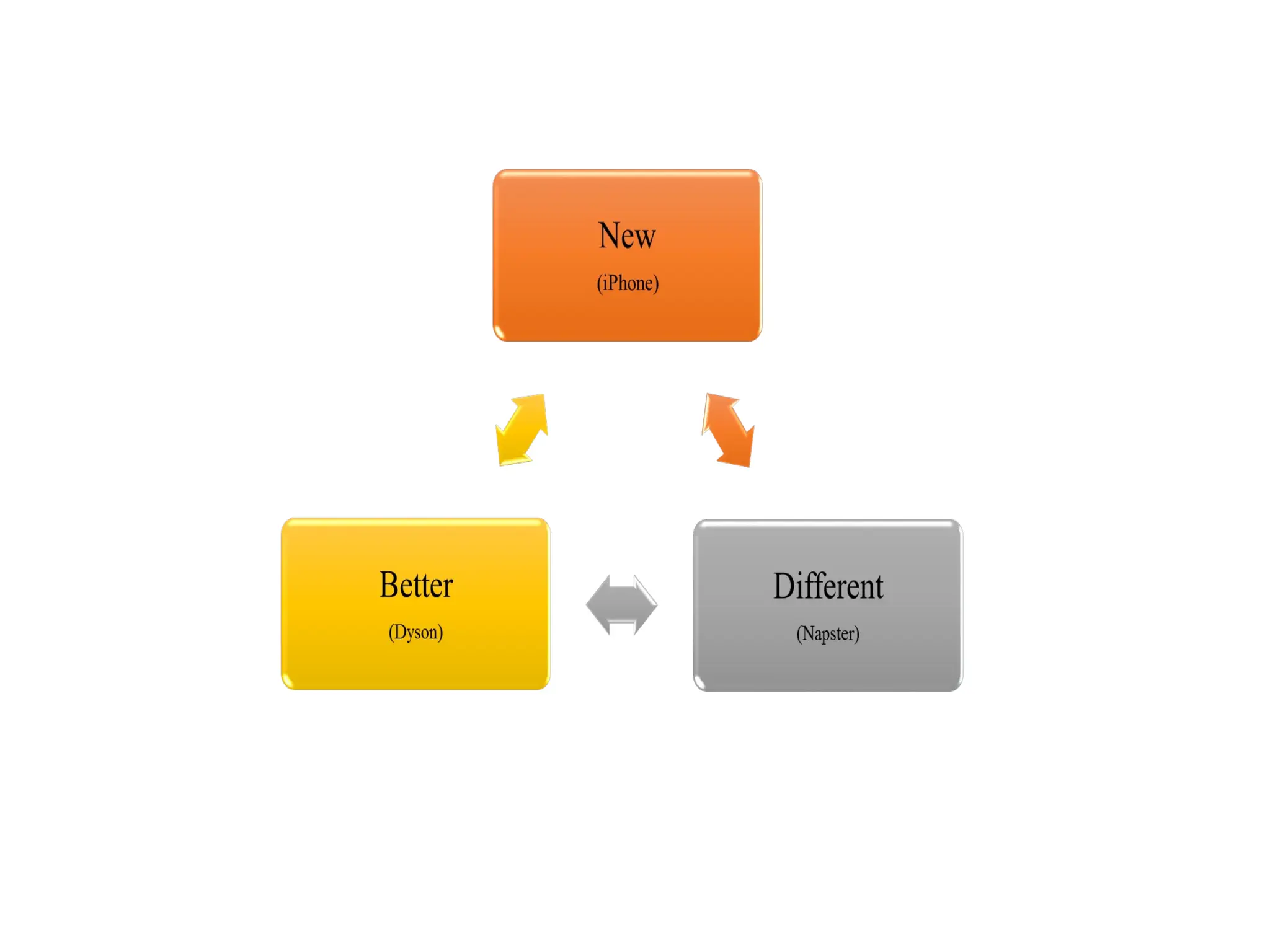
What is ANew Innovation?
• What do you define as new?
• Can mean different things to different people
• New to the world (10%)
• New to the firms (20%)
• Additions to existing products/process (26%)
• Improvement and revisions to existing products/process (26%)
• Repositioning (with different purposes) (7%)
• New to the market (geography + segments)
• New to the season
• Cost reduction (11%)
(See; Booz, Allen & Hamilton, 1982; Griffin, 1997)
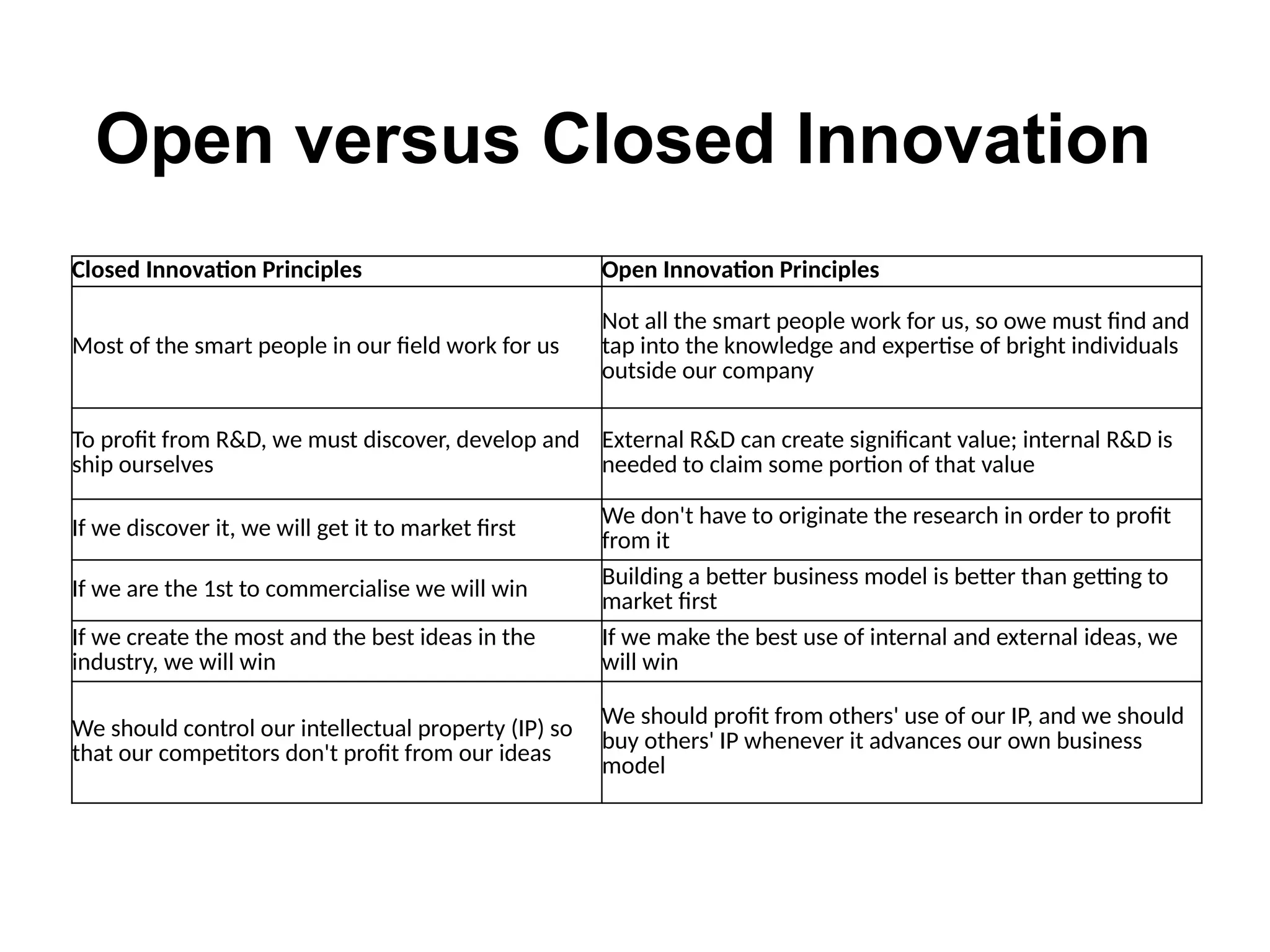
Closed Innovation PrinciplesOpen Innovation Principles
Most of the smart people in our field work for us
Not all the smart people work for us, so owe must find and
tap into the knowledge and expertise of bright individuals
outside our company
To profit from R&D, we must discover, develop and
ship ourselves
External R&D can create significant value; internal R&D is
needed to claim some portion of that value
If we discover it, we will get it to market first We don't have to originate the research in order to profit
from it
If we are the 1st to commercialise we will win
Building a better business model is better than getting to
market first
If we create the most and the best ideas in the
industry, we will win
If we make the best use of internal and external ideas, we
will win
We should control our intellectual property (IP) so
that our competitors don't profit from our ideas
We should profit from others' use of our IP, and we should
buy others' IP whenever it advances our own business
model
Open versus Closed Innovation
45.
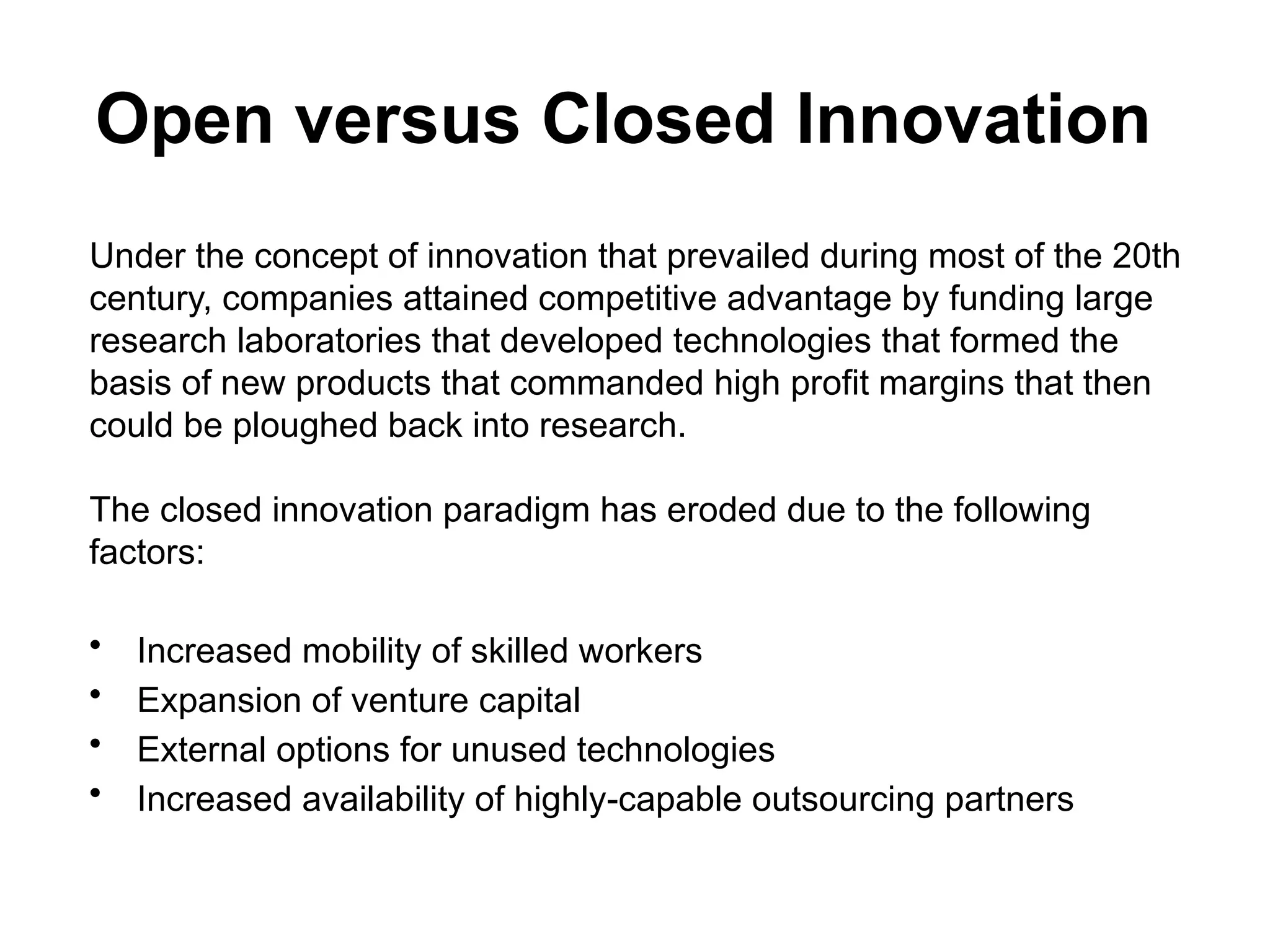
Open versus ClosedInnovation
Under the concept of innovation that prevailed during most of the 20th
century, companies attained competitive advantage by funding large
research laboratories that developed technologies that formed the
basis of new products that commanded high profit margins that then
could be ploughed back into research.
The closed innovation paradigm has eroded due to the following
factors:
• Increased mobility of skilled workers
• Expansion of venture capital
• External options for unused technologies
• Increased availability of highly-capable outsourcing partners
What’s an Opportunity?
“Anopportunity has the qualities of being attractive, desirable and timely and is
anchored in a product or service which creates value for buyer or end user”
• A new or improved product
• A new service
• A new means of production
• A new way of distributing the product or service
• An improved service
• New combinations
• Or a hybrid of the above
53.
So…
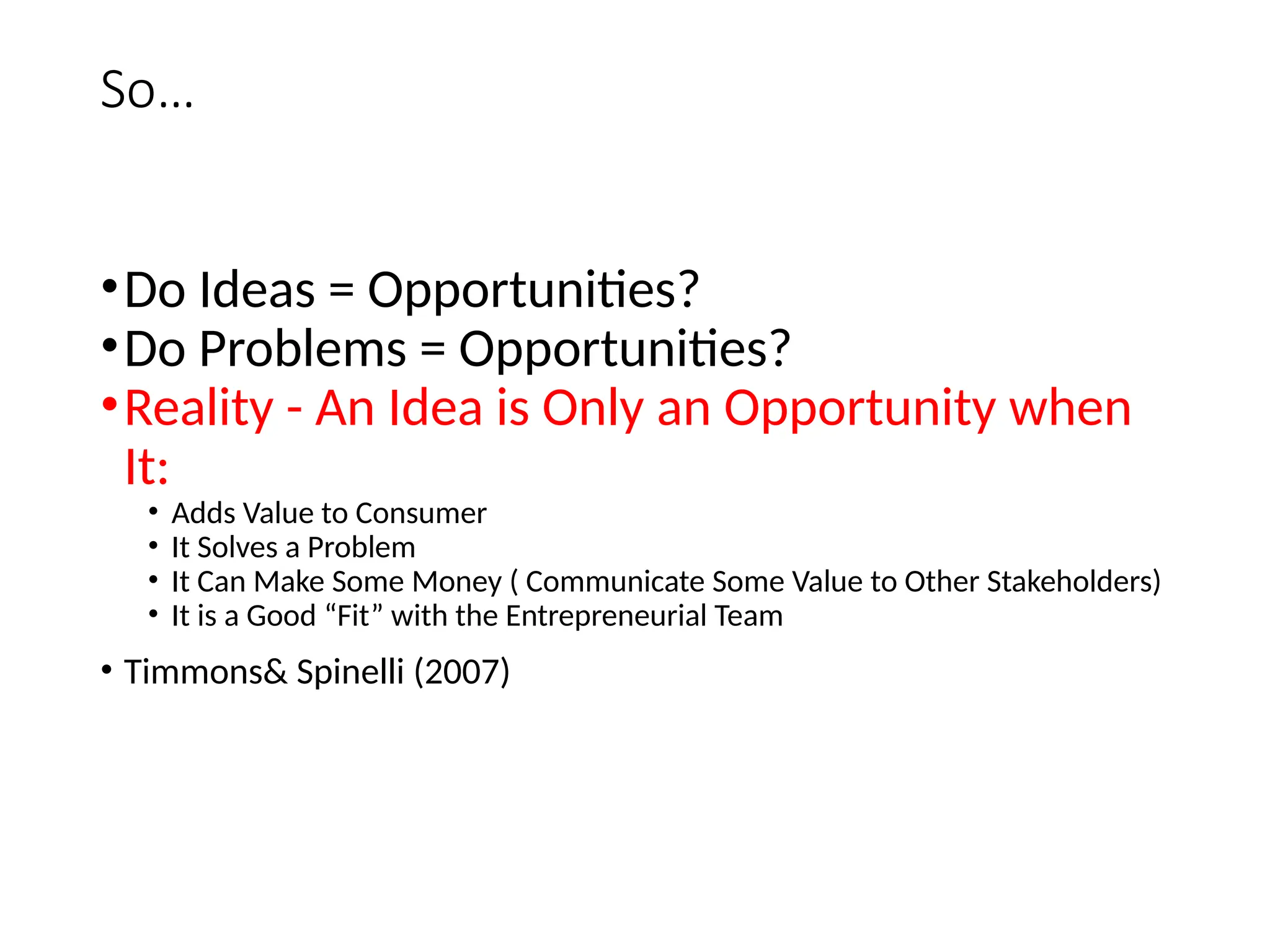
•Do Ideas =Opportunities?
•Do Problems = Opportunities?
•Reality - An Idea is Only an Opportunity when
It:
• Adds Value to Consumer
• It Solves a Problem
• It Can Make Some Money ( Communicate Some Value to Other Stakeholders)
• It is a Good “Fit” with the Entrepreneurial Team
• Timmons& Spinelli (2007)
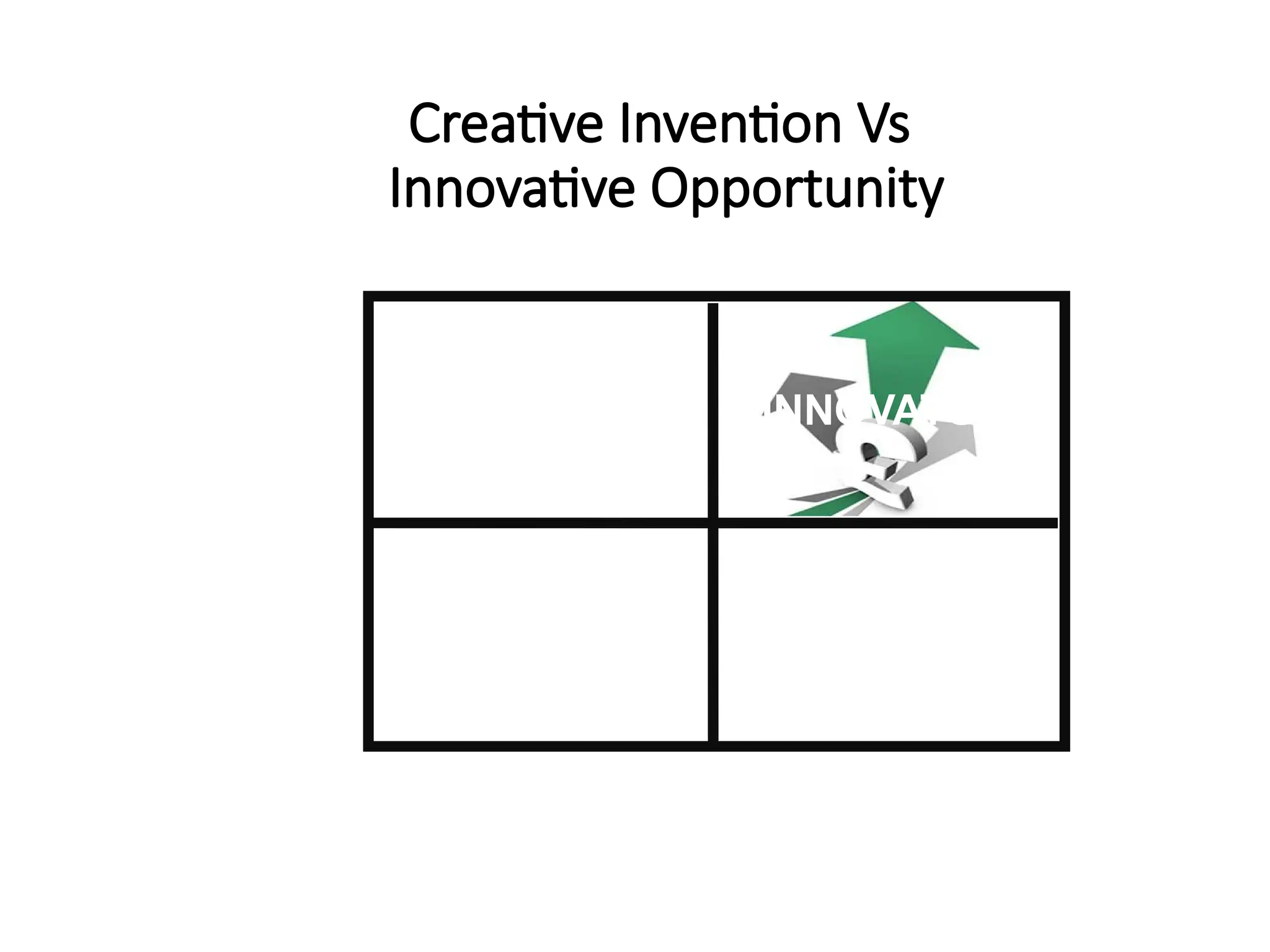
Creative Invention Vs
InnovativeOpportunity
STRUGGLER
COPIER
STAGNATOR
Creative
Invention
Innovative
Opportunity
Perception
High
Low
High
INNOVATOR
Low
56.
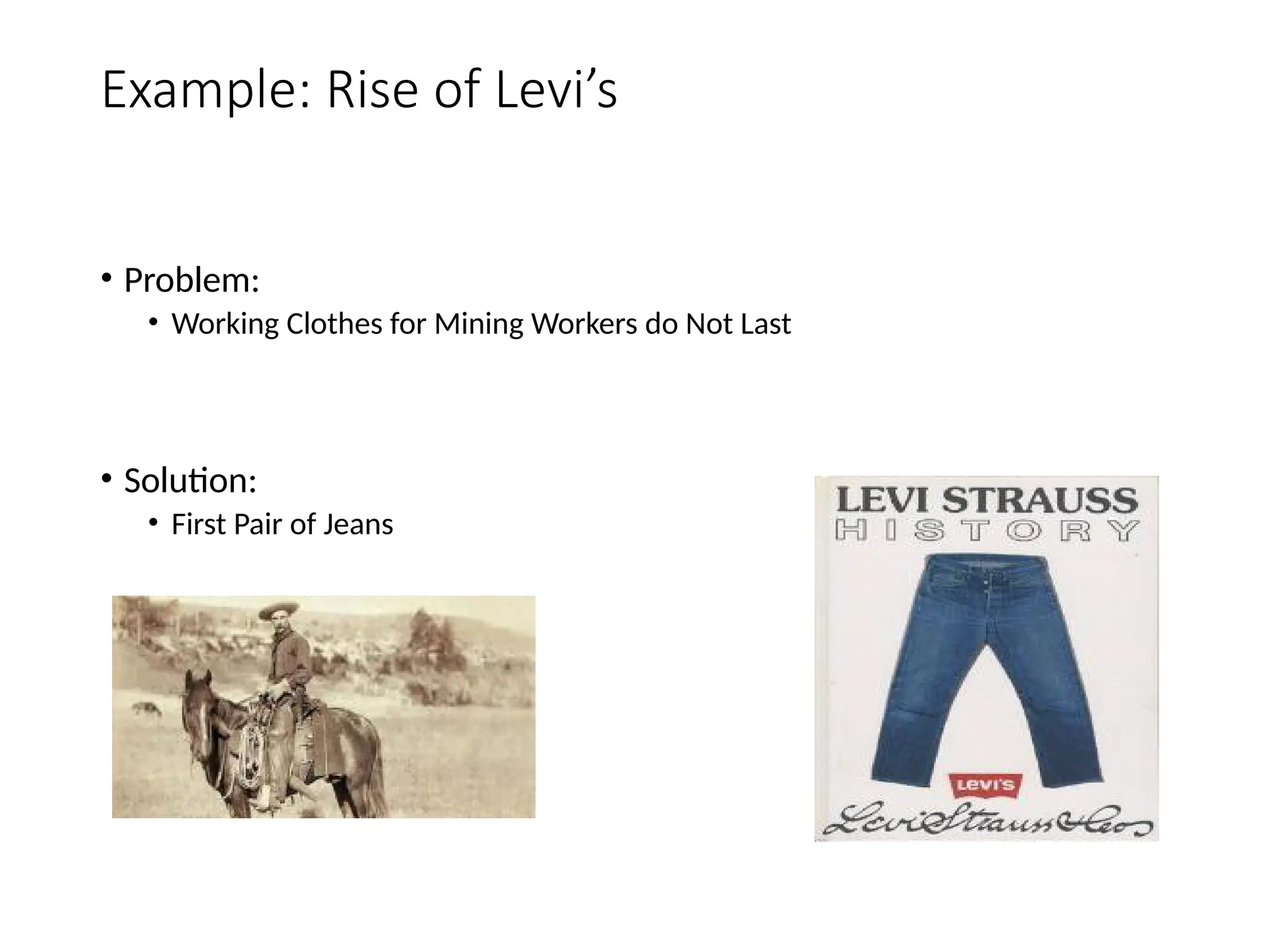
Example: Rise ofLevi’s
• Problem:
• Working Clothes for Mining Workers do Not Last
• Solution:
• First Pair of Jeans
57.
Ideas Start WithSolving Problems
• Remember… Ideas Start With Solving Problems
• Any Problems are Big Opportunities.
• No Problems, No Solutions, & No Reasons for Firms to Exist.
• No One Pays You to Solve a Non-exist Problem (Vinod Khosla, Sun
Microsystems)
58.
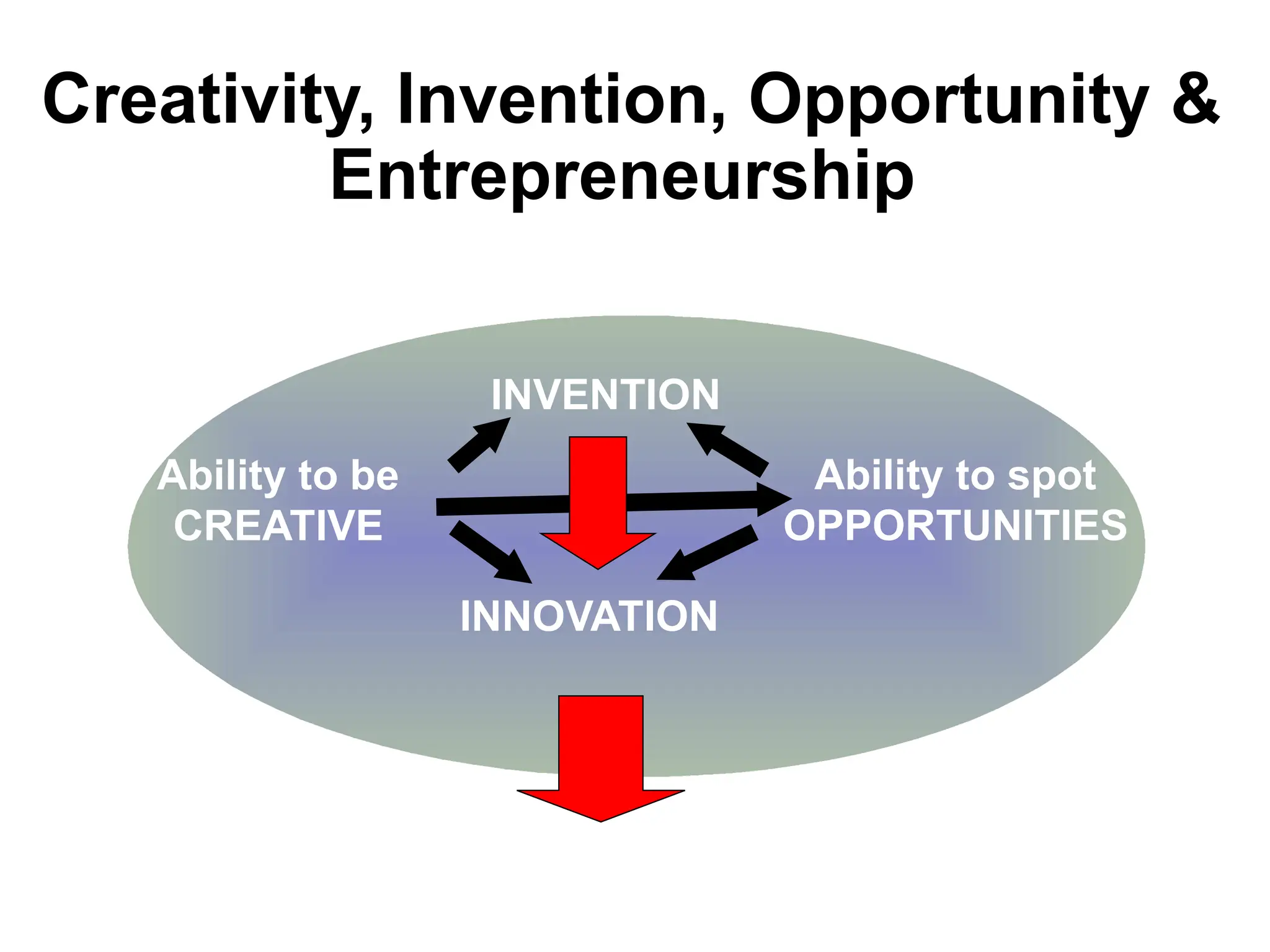
Ability to be
CREATIVE
Abilityto spot
OPPORTUNITIES
INVENTION
INNOVATION
SUCCESS
ENTREPRENEURIAL ENVIRONMENT
Creativity, Invention, Opportunity &
Entrepreneurship
59.
Creating Creativity
• CreativeIndividuals don’t just sit waiting for the “lightbulb moment”
• They approach a problem systematically
What Stops BusinessCreativity?
Barriers are understandable, but nevertheless can
prevent or slow the development of new ideas:
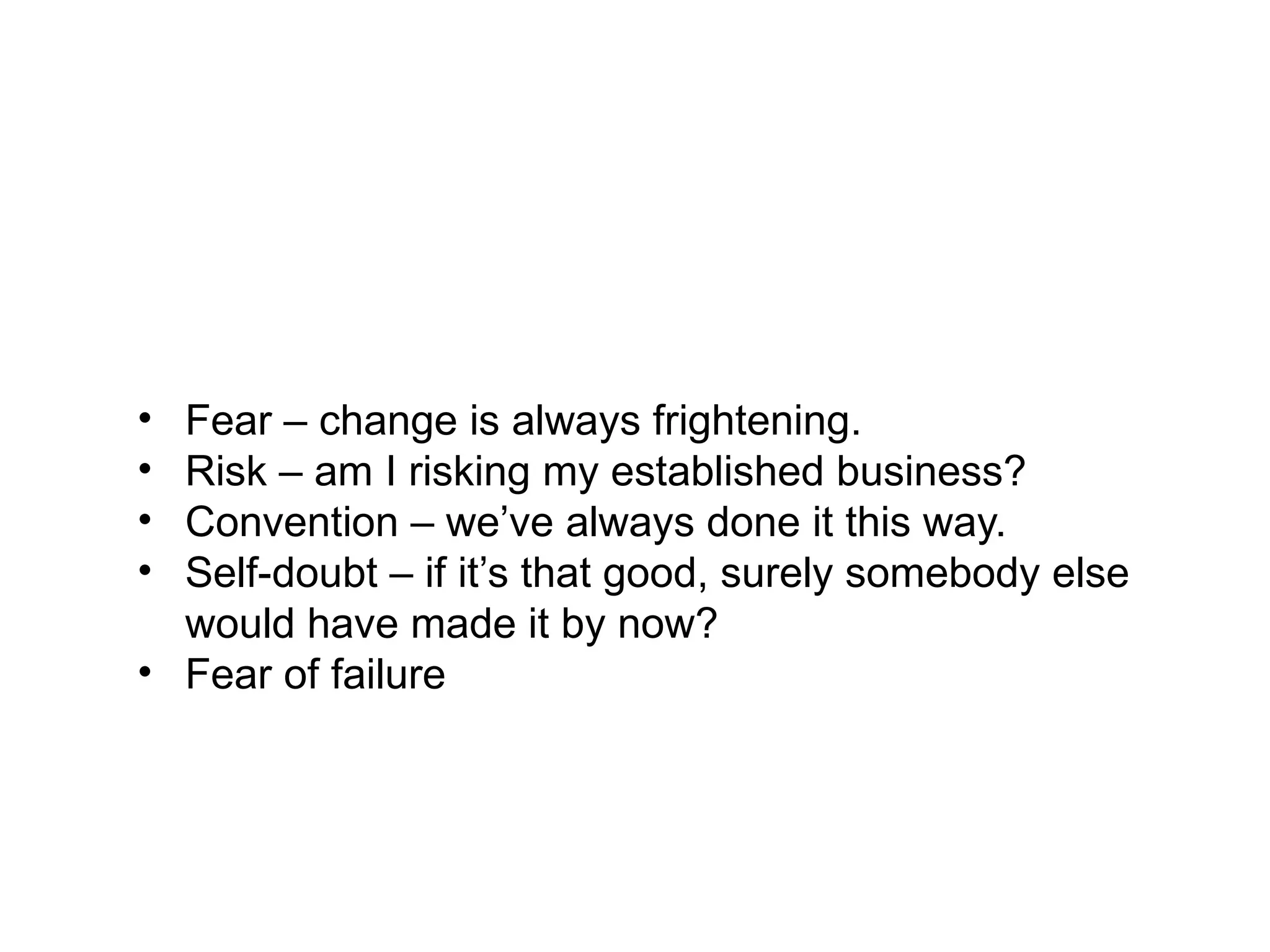
• Fear – change is always frightening.
• Risk – am I risking my established business?
• Convention – we’ve always done it this way.
• Self-doubt – if it’s that good, surely somebody else
would have made it by now?
• Fear of failure
62.
Readings
Chesbrough, H. (2003)Open Innovation, Harvard University Press:
Cambridge, MA.
Fagerberg, Jan, Fosaas, Morten, & Sapprasert, Koson. (2012).
Innovation: Exploring the knowledge base. Research Policy, 41(7),
1132-1153.
Fillis, I. (2002) An Andalusian Dog or a Rising Star? Creativity and
the Marketing/Entreprenseurship Interface. Journal of Marketing
Research, 18(1), 379-395.
Rothwell, R. (1994). Towards the fifth generation innovation
process. International Marketing Review, 11 (7-31).
#2 Ultimately we have to stand on the shoulders of those giants who came before us to understand what creativity truly is,,,,,
#5 Just look at how nature has inspired creativity and innovation…. The links between nature and nurture are apparent even in the simplest things!
#6 Edward de Bono (2008), a theorist of creativity, noted that the process of creativity does not just happen in a flash of inspiration. Individuals, entrepreneurs, teams and business don’t just sit waiting for the “lightbulb moment”; instead, he argues that they approach their problem systematically.
#7 There are two opposing views of creativity, suggested by Feldman 1999. Is it nature versus nurture?
#8 In this view creativity is born not made. In this view the act of being creative is to “unleash, harness, and empower potential from whatever source” (Landry, 2005, p. 53). The “artist is a channel for a superior power, creativity a gift from the gods, and the imagination a divine spark” (Throsby, 2001, p. 94).
#9 Yet the opposing view is that creativity can be cultivated in us all. It is something within the scope of everyone and in every job. The ability to think creatively, solve problems, assess situations. In this view creativity is an enduring human attribute we all have and can hone, like the musician hones his craft. Through practice.
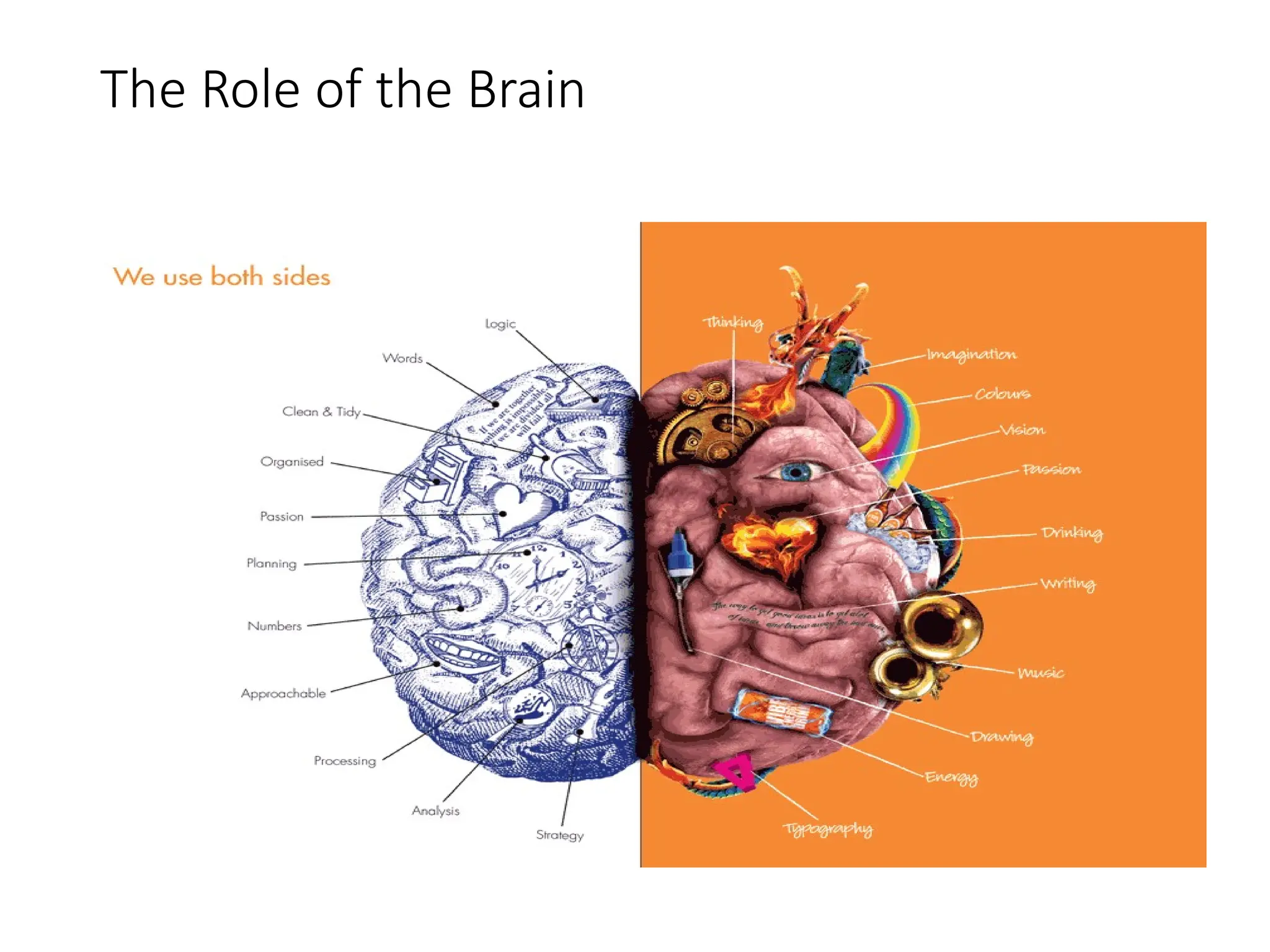
#12 Ultimately creativity is a process that we can all as humans tap into. Just look at the image above.
According to the theory of left-brain or right-brain dominance, each side of the brain controls different types of thinking. Additionally, people are said to prefer one type of thinking over the other. For example, a person who is "left-brained" is often said to be more logical, analytical, and objective, while a person who is "right-brained" is said to be more intuitive, thoughtful, and subjective.
In psychology, the theory is based on what is known as the lateralization of brain function. So does one side of the brain really control specific functions? Are people either left-brained or right-brained? Like many popular psychology myths, this one grew out of observations about the human brain that were then dramatically distorted and exaggerated.
The right brain-left brain theory originated in the work of Roger W. Sperry, who was awarded the Nobel Prize in 1981. While studying the effects of epilepsy, Sperry discovered that cutting the corpus collosum (the structure that connects the two hemispheres of the brain) could reduce or eliminate seizures.
Later research has shown that the brain is not nearly as dichotomous as once thought. For example, recent research has shown that abilities in subjects such as math are actually strongest when both halves of the brain work together. Today, neuroscientists know that the two sides of the brain work together to perform a wide variety of tasks and that the two hemispheres communicate through the corpus collosum.
"No matter how lateralized the brain can get, though, the two sides still work together," science writer Carl Zimmer explained in an article for Discover magazine. "The pop psychology notion of a left brain and a right brain doesn’t capture their intimate working relationship. The left hemisphere specializes in picking out the sounds that form words and working out the syntax of the words, for example, but it does not have a monopoly on language processing. The right hemisphere is actually more sensitive to the emotional features of language, tuning in to the slow rhythms of speech that carry intonation and stress."
In one study by researchers at the University of Utah, more 1,000 participants had their brains analyzed in order to determine if they preferred using one side over the other. The study revealed that while activity was sometimes higher in certain important regions, both sides of the brain were essentially equal in their activity on average.
“It’s absolutely true that some brain functions occur in one or the other side of the brain. Language tends to be on the left, attention more on the right. But people don’t tend to have a stronger left- or right-sided brain network. It seems to be determined more connection by connection," explained the study's lead author Dr. Jeff Anderson.
While the idea of right brain / left brain thinkers has been debunked, its popularity persists. So what exactly does this theory suggest?
The Right Brain
According to the left-brain, right-brain dominance theory, the right side of the brain is best at expressive and creative tasks. Some of the abilities that are popularly associated with the right side of the brain include:
Recognizing faces
Expressing emotions
Music
Reading emotions
Color
Images
Intuition
Creativity
The Left Brain
The left-side of the brain is considered to be adept at tasks that involve logic, language and analytical thinking. The left-brain is often described as being better at:
Language
Logic
Critical thinking
Numbers
Reasoning
The Uses of Right-Brain, Left-Brain Theory
Researchers have demonstrated that right-brain/left-brain theory is a myth, yet its popularity persists. While often over-generalized and overstated by popular psychology and self-help texts, understanding your strengths and weaknesses in certain areas can help you develop better ways to learn and study. For example, students who have a difficult time following verbal instructions (often cited as a right-brain characteristic) might benefit from writing down directions and developing better organizational skills.
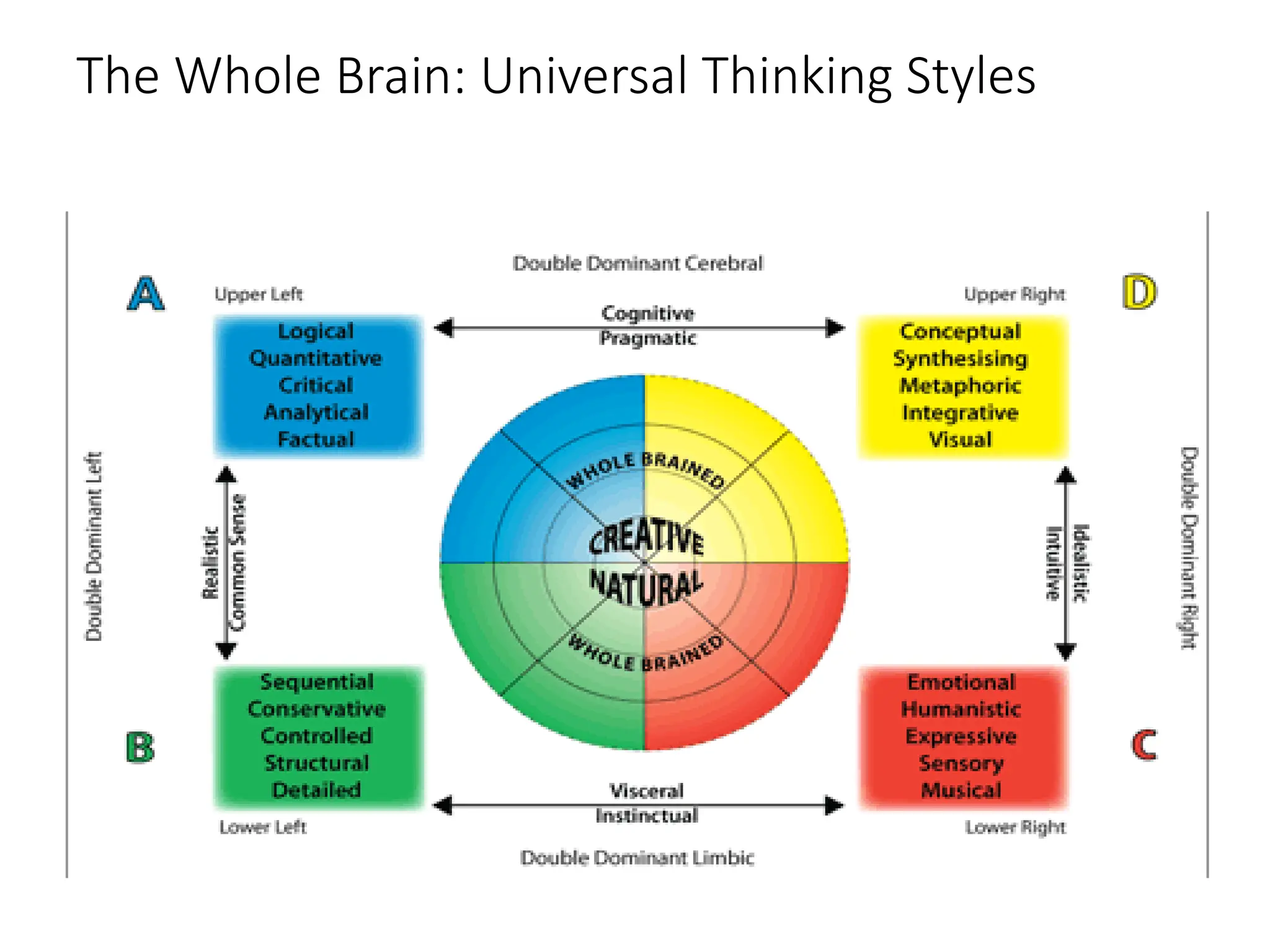
#13 The Whole Brain Model (shown above), is a metaphor for how we think, providing a useful framework to diagnose and describe the different types of thinking involved in any organization. It divides thinking into four quadrants, two on the “left brain” side and two on the “right brain” side. All four of the different thinking modes are in use and available to all of us, but we tend to prefer certain types over others.
In what kinds of situations can Whole Brain Thinking be used?
Decision Making
Most decisions benefit from a thought process that includes the review of multiple options and perspectives. A typical example is the purchase of a car. Quadrant A thinkers look at information on the actual performance of the vehicle. Quadrant B thinkers read a consumer report to gather research on the reliability and practical features (trunk size, safety records, etc.) of the vehicle. Quadrant C thinkers test drive the car to see if it “feels” right. And Quadrant D focuses on the aesthetics, color, styling and innovations of each model.
Using Whole Brain Thinking—the thinking of all quadrants—contributes to a better choice and avoids unpleasant surprises. Overlooking even one quadrant can result in a less than ideal outcome.
Problem Solving
Every problem situation can benefit from a Quadrant A review of the data and facts, as well as an analysis of the real problem at hand; the Quadrant D “big-picture” context and possible creative ideas; Quadrant C viewpoint of the “customer” of the problem and how the problem affects others; and Quadrant B step-by-step process to solve the problem and implement the solution.
Improving team interactions and performance
Most teams are formed to make the most of the differences among team members. But very often those differences stand in the way of the team living up to its potential. Whole Brain® Thinking can help a team to acknowledge the differences among team members and then use those differences to make the most of the ideas of each team member. In addition, once a team knows its preferences it can use that knowledge to enhance its communication with other teams and work groups which may have thinking preferences that are quite different.
Communication
The objective of most communication is to convey an idea, transfer information or persuade someone. How many times have you experienced the frustration of delivering a message only to realize that the other person “just didn’t get it.” In order to communicate effectively, it's important to understand the “language” and mindset of the person(s) you are communicating with. A diagnosis of the thinking preferences of the audience can provide the critical planning information you need to tailor your language and presentation to the audience. When the audience's preferences are in doubt, taking a Whole Brain approach to communication ensures that you've covered all the “languages.” This reduces the possibility of miscommunication and improves the chance that your message will be successfully received by the audience.
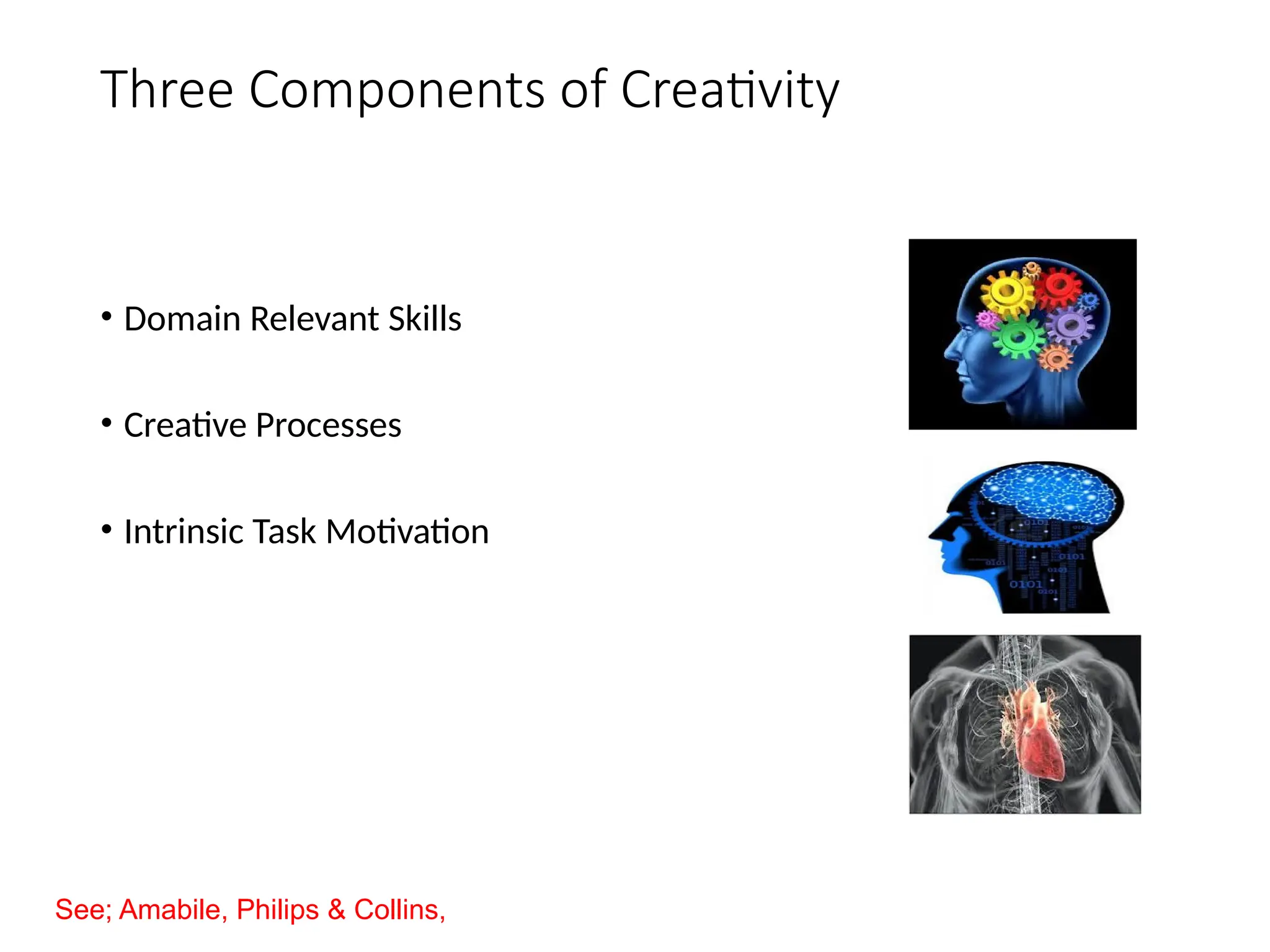
#14 Others have suggested creative process require the correct skill set to exploit opportunity. Or a deep routed motivation for the creative process to take hold.
#15 But going back to De Bono’s statement. Creativity whether innate or cultivated is the most important of all human resources. He believed this so much so that he developed “The Six Thinking Hats” technique (1985, 1999) to aid this process. The basic premise is for an individual or project team to learn how to separate thinking into six clear functions and roles by “wearing one hat at a time” when considering a problem. Each role is identified with a symbolic "thinking hat" in a different colour. By mentally wearing and switching "hats," teams can easily focus or redirect their thoughts, conversation, or meeting. At any one time, everyone will wear the same colour of hat, or in other words, everyone will look at the problem at hand from only one perspective, which at any given time is the perspective indicated by the hat being worn (see Figure 1).
De Bono’s “Six Thinking Hats” technique has had a wide range of applications in industry, from management training to new product development stages, and has become a highly regarded creative problem solving activity. It helps teams to generate knowledge and awareness of a certain problem area, and also encourages them to learn more about the problem as a team, as well as assisting them in researching possible solutions and incubating their ideas in moments of reflection by asking questions at each stage (see Figure 2).
#16 As suggested above the basic premise is for an individual or project team to learn how to separate thinking into six clear functions and roles by “wearing one hat at a time” when considering a problem.
Each role is identified with a symbolic "thinking hat" in a different colour. For example you can see in the slide each colour represents a different view point. From looking at new ways in the green hat to analysing data in the black hat.
By mentally wearing and switching "hats," teams can easily focus or redirect their thoughts, conversation, or meeting. At any one time, everyone will wear the same colour of hat, or in other words, everyone will look at the problem at hand from only one perspective, which at any given time is the perspective indicated by the hat being worn.
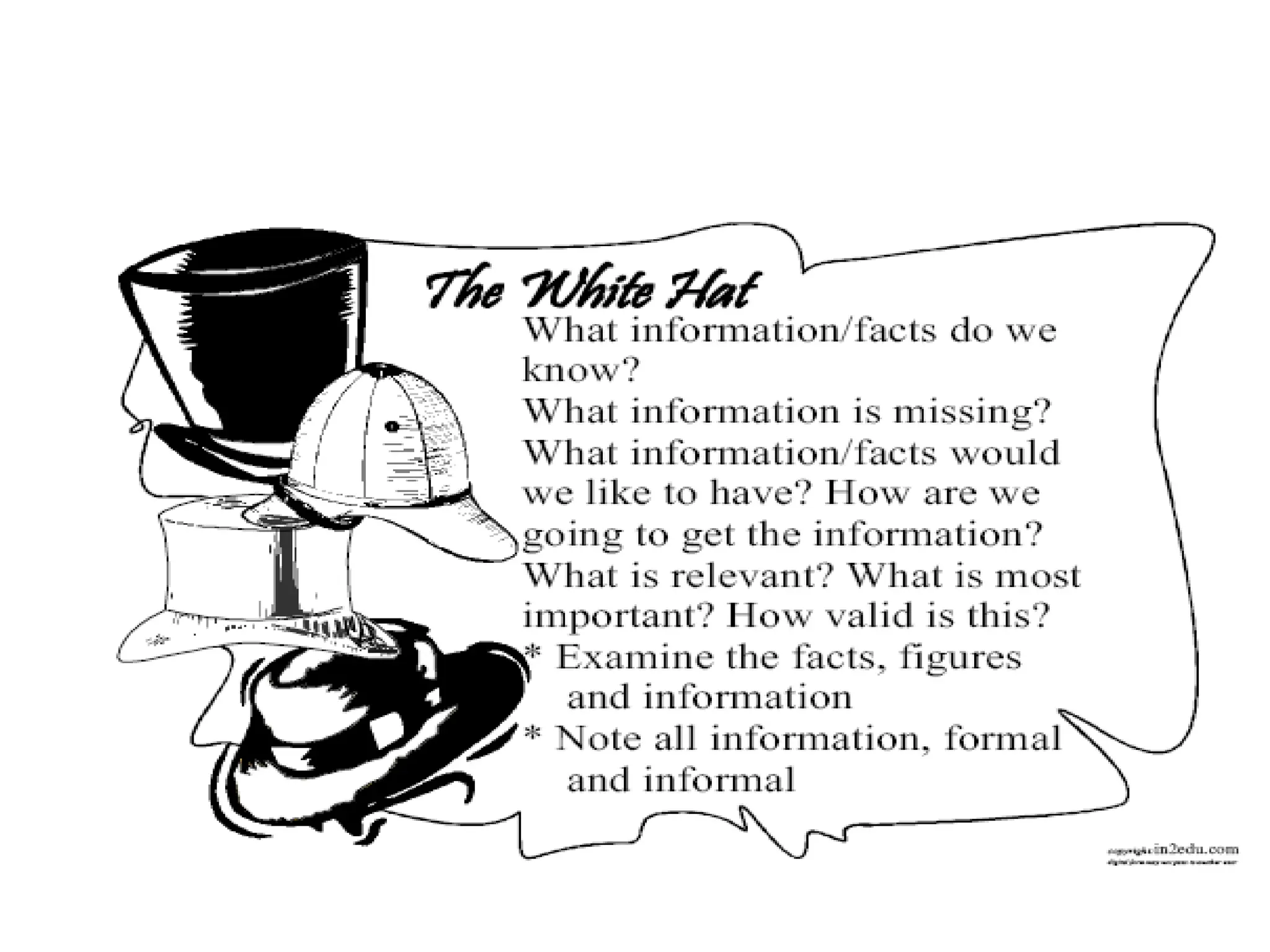
#17 The white hat is the current focus. Where are we now? Examination of all facts and figures.
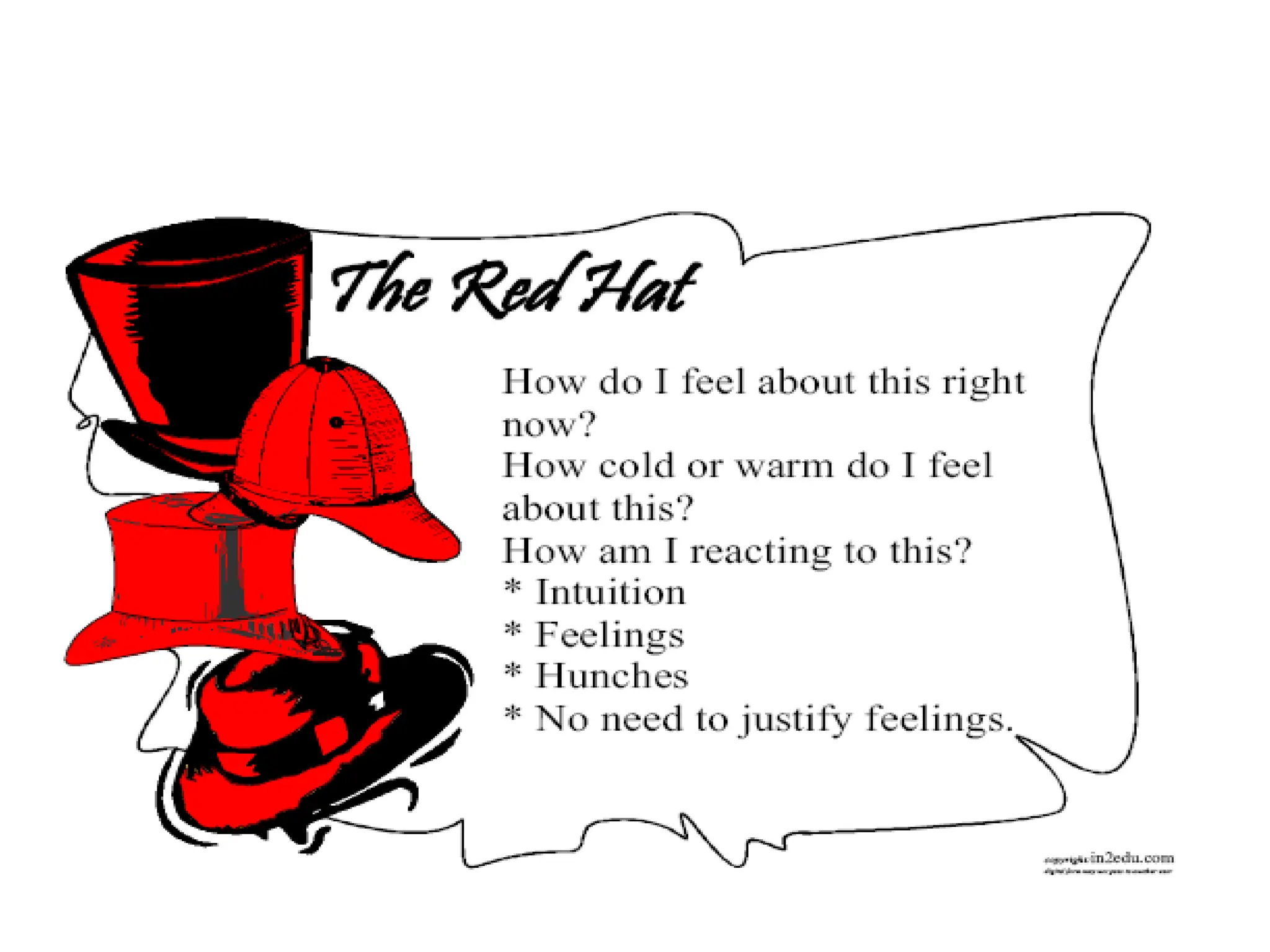
#18 This is the feelings hat. Where teams discuss how they feel about the position or idea.
#19 The black hat is logic. Is this the logical choice?
#20 The yellow hat is judgment. Is this idea feesible?
#21 The green hat represents the possibilities. This is for new ideas or solutions.
#22 The blue hat is the most important and sets the direction of the discussion.
#24 For example there are a number of ways to use the hats to consider problems or creative ideas….
#28 So if creativity can be harnessed as a process, are all ideas then opportunity for innovations?
#31 “Innovation is widely considered as the life blood of
corporate survival and growth”. Innovation is recognised to play a central role in
creating value and sustaining competitive advantage. Bessant et al. (2005, p. 1366) on
the role of innovation in renewal and growth emphasise “Innovation represents the
core renewal process in any organization. Unless it changes what it offers the world
and the way in which it creates and delivers those offerings it risks its survival and
growth prospects”.
The significance of innovation is not restricted to business organizations. The US
has a Department for Innovation (2008), and in the UK there has been widespread and
ongoing acknowledgement of the importance of innovation. In 2003, the Department of
Trade commented on the link between continuous innovation and jobs, profit and
standard of living: “If UK-based companies fail to innovate, jobs and profits will suffer,
and our standard of living will fall compared with other countries”. More recently, the
UK’s Department for Innovation Universities and Skills (2008) commented on the wider
implications of innovation in the face of globalisation and environmental challenges by
highlighting the importance of all types of innovation in creating and maintaining
competencies and responding to environmental and demographic restrictions. There is
agreement that in order to both sustain their competitive position and to strengthen it,
organizations and economies must innovate and promote innovation. Innovation is a
key policy and strategic issue.
Innovation is tightly coupled to change, as organizations use innovation as a tool in
order to influence an environment or due to their changing environments (internal and
external) (Damanpour, 1991). However, innovation may involve a wide range of
different types of change depending on the organization’s resources, capabilities,
strategies, and requirements. Common types of innovation relate to new products,
materials, new processes, new services, and new organizational forms (Ettlie and Reza,
1992). These different forms of innovation draw to varying extents on different teams,
departments, and professional disciplines. Therefore, innovation is of interest to
practitioners and researchers across a range of business and management disciplines,
and has been discussed variously in, for example, the literature on human resource
management, operations management, entrepreneurship, research and development,
information technology, engineering and product design, and marketing and strategy.
Each of these different disciplines proposes definitions for innovation that align with
the dominant paradigm of the discipline. As Damanpour and Schneider (2006, p. 216)
state: “Innovation is studied in many disciplines and has been defined from different
perspectives”.
#33 “Prophet of Innovation – Joseph Schumpeter and Creative Destruction” by Thomas McCraw (2007) – biography of Schumpeter.
Starting point: Schumpeter’s evolutionary approach
Some of the contributions to the core literature are theoretical in nature, such as Schumpeter’s classic texts ‘The Theory of Economic Development’, originally published in 1912 in German and in a revised English edition in 1934 (number four on the list). Here, Schumpeter portrays innovation as a dynamic force that causes continuous transformation of social, institutional and economic structures (Andersen, 2009, McCraw 2007).
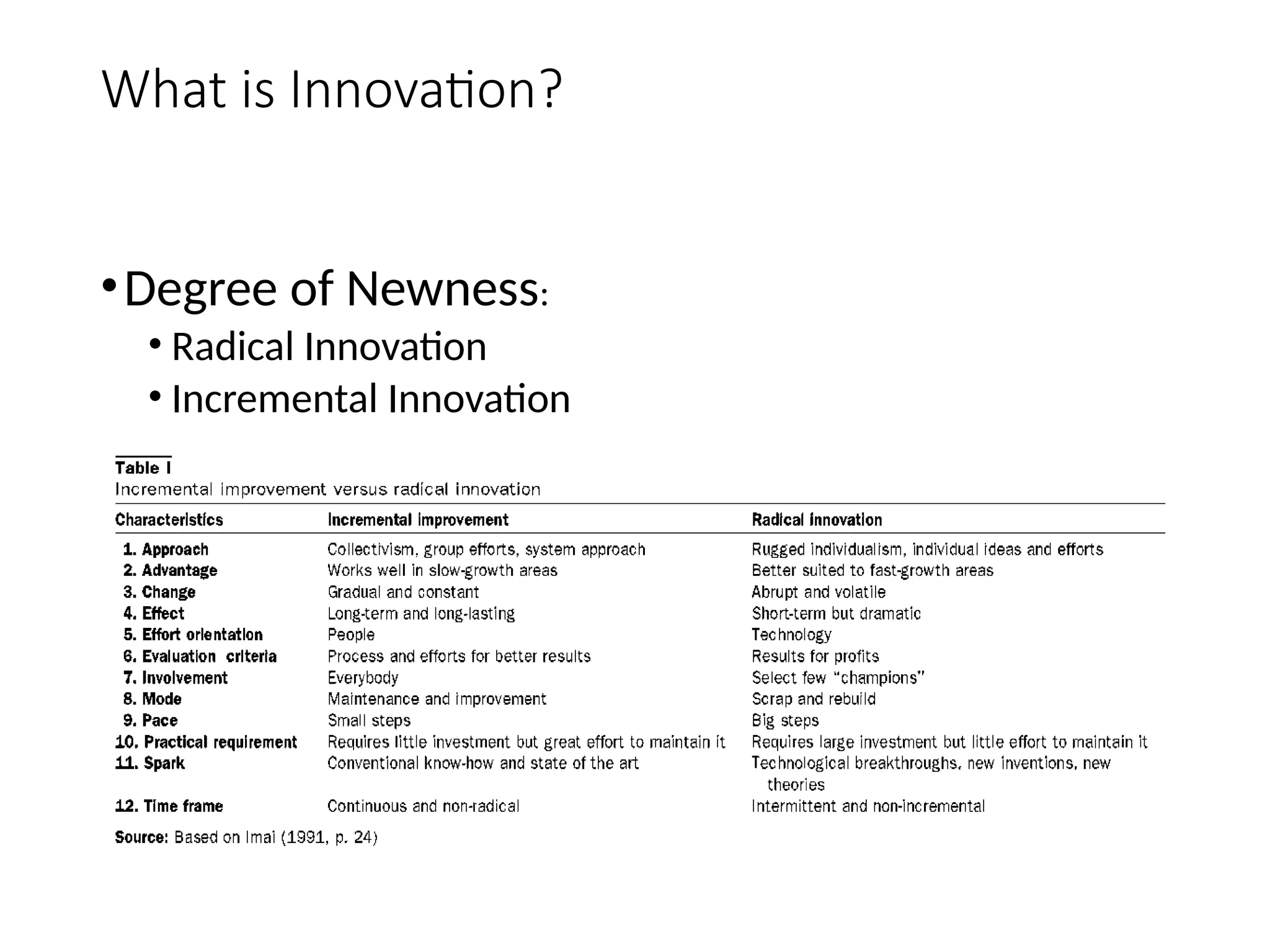
Many ideas that are central in innovation literature today can already be found here (Fagerberg 2003, 2004): e.g. the definition of innovation as ‘new combinations’ of existing knowledge and resources, the distinction between invention (new ideas) and innovation (implementing these in practice), the classification of innovations into product, process and organisational innovation, and the keen interest in how radical their social and economic impacts are (with the associated distinction between revolutionary, radical and marginal or incremental innovations).
Schumpeter, particularly in his early work, also emphasised the important role that committed entrepreneurs capable of overcoming an inert or resisting environment may play in innovation.
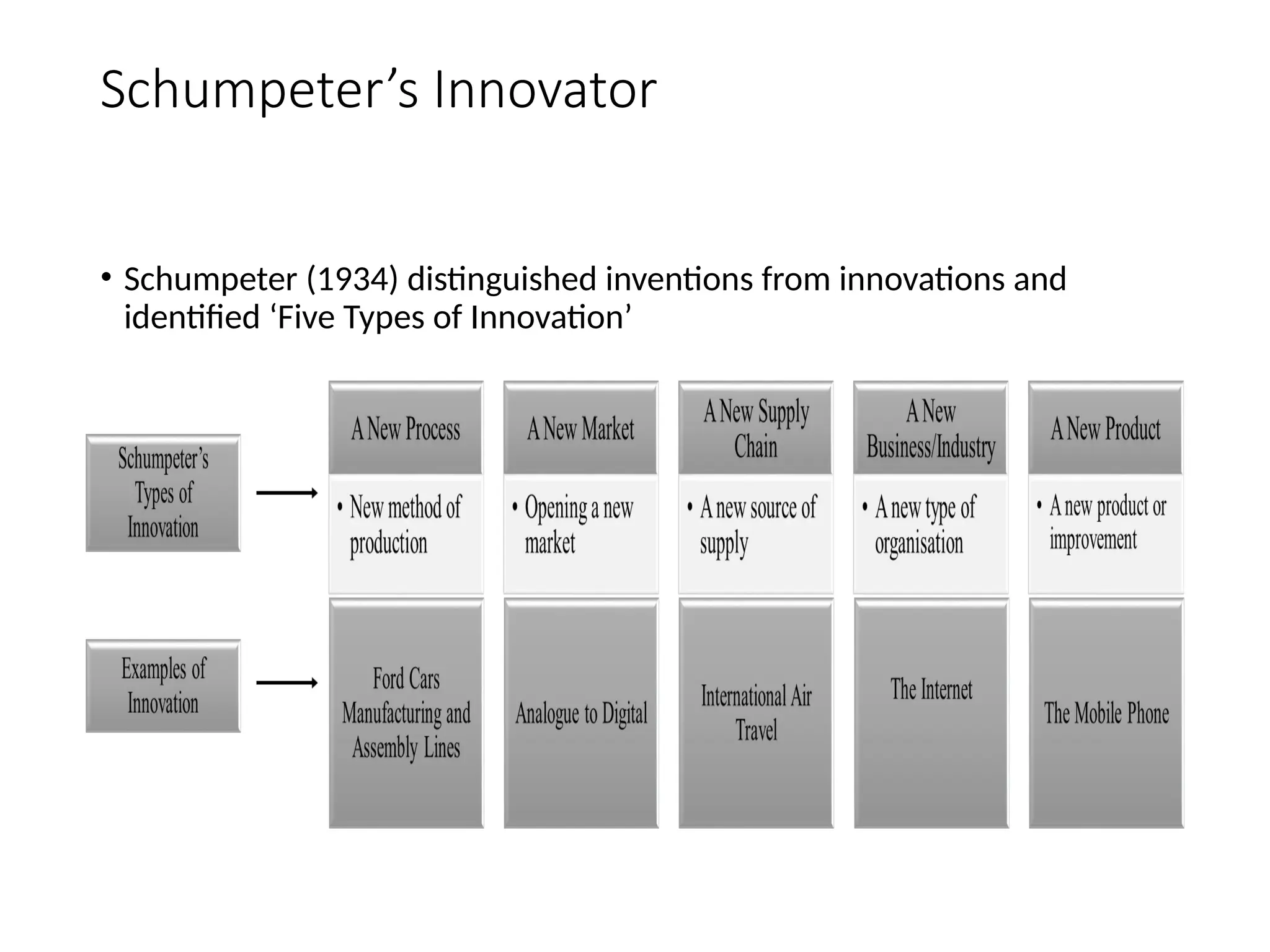
Schumpeter identified these 5 forces. These are fairly broad and can easily be applied to today’s organisations. It should be noted that they are not mutually exclusive, for example, a new good will often require a new method of production and also open up a new market. It is increasingly difficult to simply categorise innovations in accordance with Schumpeter’s taxonomy.
There is also a narrow technological view of innovation that is concerned mainly with product and process innovations where there is also substantive changes in technology. This has been the focus of much academic work, but in the broader area of innovation there is still much debate.
(1) Introduction of a new good – that is one with which consumers are not yet familiar – or of a new quality of a good.
(2) The introduction of a new method of production, that is one not yet tested be experience in the branch of manufacture concerned, which need by no means be founded upon a discovery scientifically new, and can also exist in a new way of handling a commodity commercially.
(3) The opening of a new market, that is a market into which the particular branch of manufacture of the country in question has not previously entered, whether or not this market has existed before.
(4) The conquest of a new source of supply of raw materials of half-manufactured goods, again irrespective of whether this source already exists or whether it has first to be created.
(5) The carrying out of the new organization of any industry, like the creation of a monopoly position (for example through trustification) or the breaking up of a monopoly position (Baumol quoting Schumpeter, 1912/1934: 66).
#34 Taking this idea further Christensen identified two typed of innovation….
#35 This is one of the earlier definitions of innovation.
All kinds of innovation involve “newness”
What makes it different to invention?
Widely accepted now is that innovation must involve some commercial endeavour.
It is the creativity of an entrepreneur that results in invention [creation of new knowledge] and innovation [application of knowledge) to create new products, services or processes
References: Schmookler, J. (1966) Invention and Economic Growth, Harvard University Press, Cambridge, MA, Peter F. Drucker (1993) Innovation and Entrepreneurship
(Harper Business edition, first edition 1986). HarperCollins Publishers; New York.
#36 You may wish to use a government department from your own country/setting that deals with enterprise/business.
#37 The reality is innovation is both about newness and adding value.
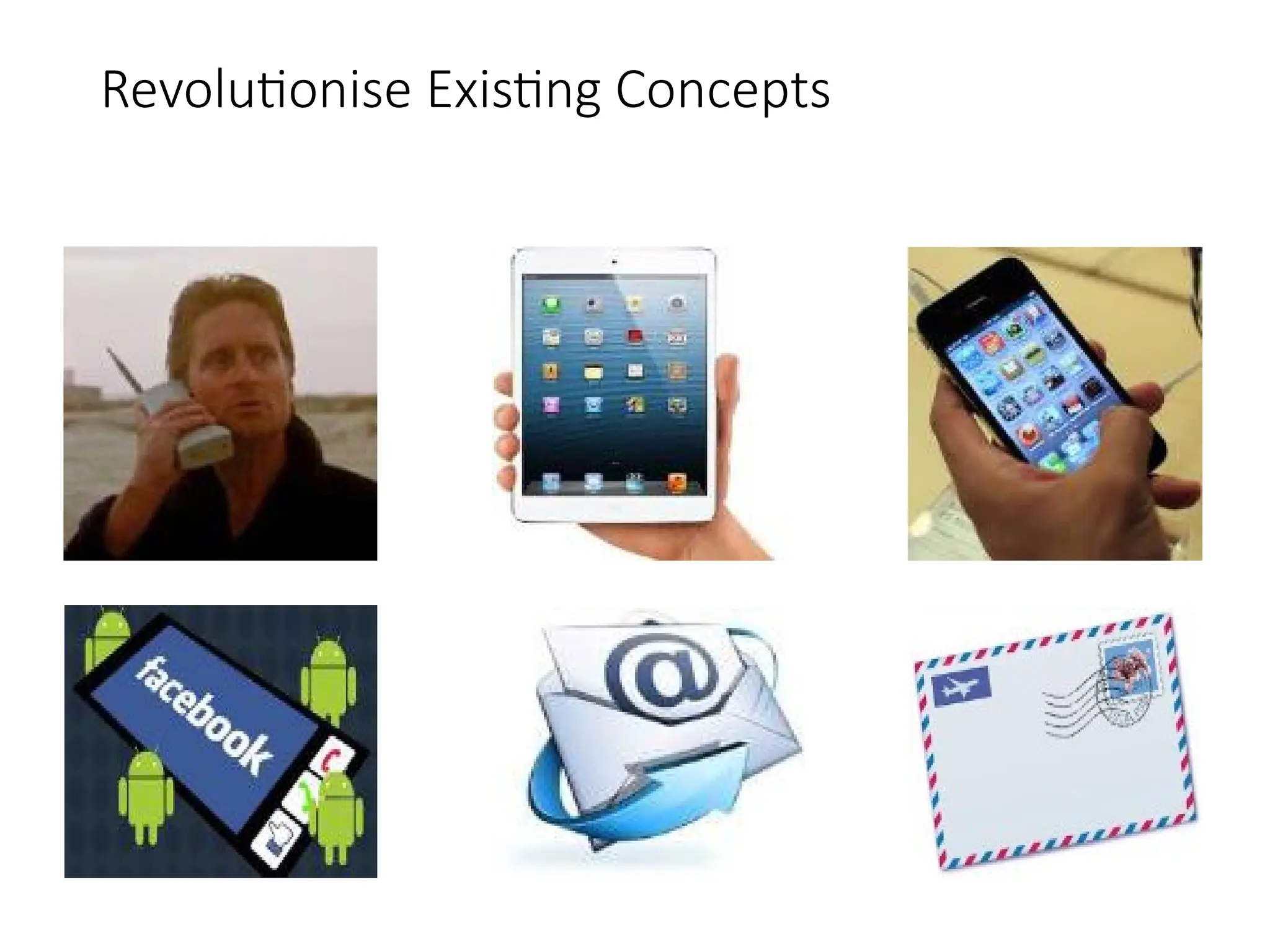
#43 It’s a way to revolutionise existing concepts. Just look at the traditional methods and the innovative ones we use today that have replaced the old.
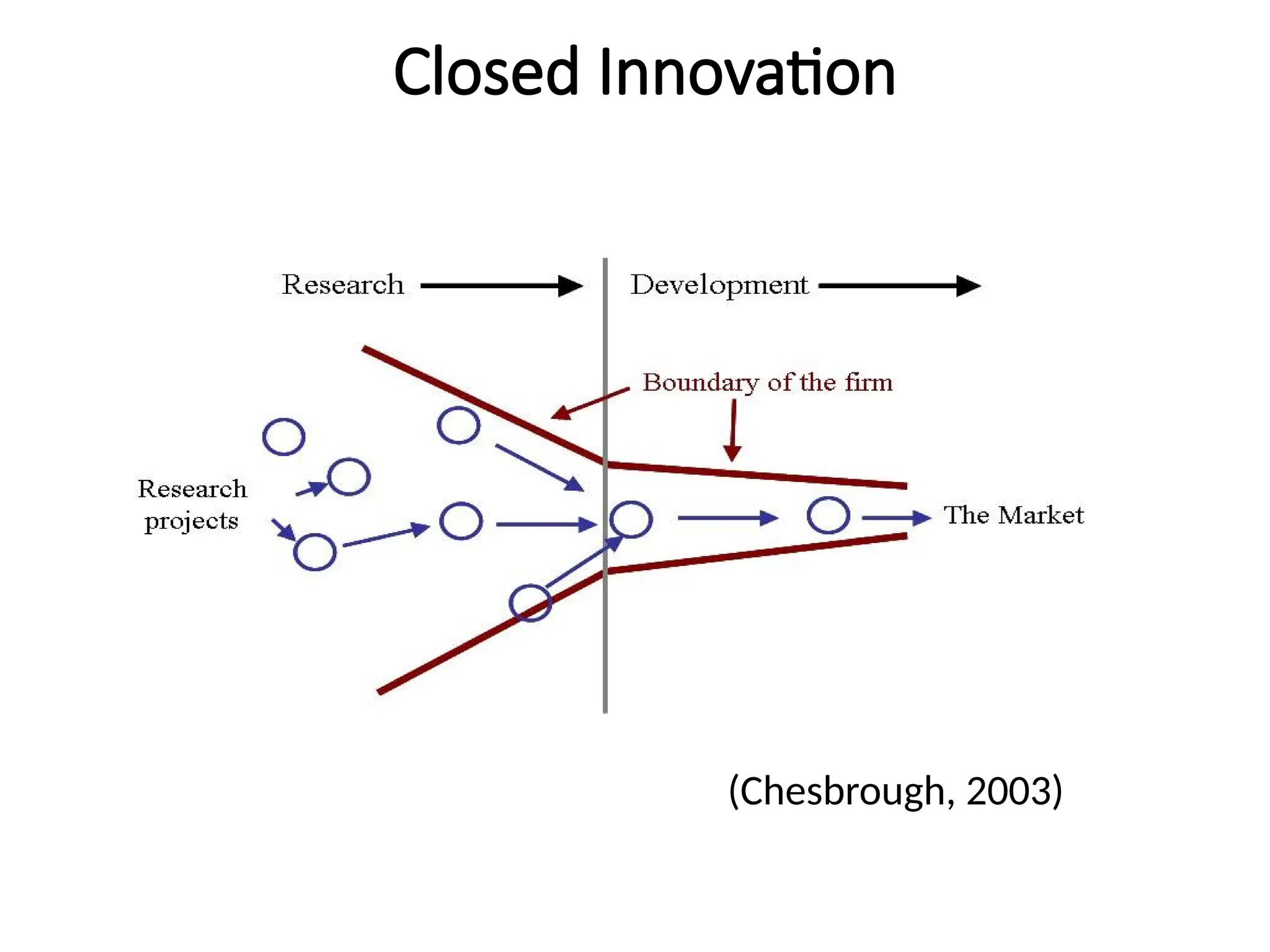
#44 The paradigm of closed innovation says that successful innovation requires control and ownership of the Intellectual property (IP). A company should control the creation and management of ideas. Roots of closed innovation go back to the beginning of the twentieth century when universities and governments were not involved in the commercial application of science. Some companies therefore decided to run their own research and development units. The entire new product development (NPD) cycle was then integrated within the company where innovation was performed in a "closed" and self-sufficient way.
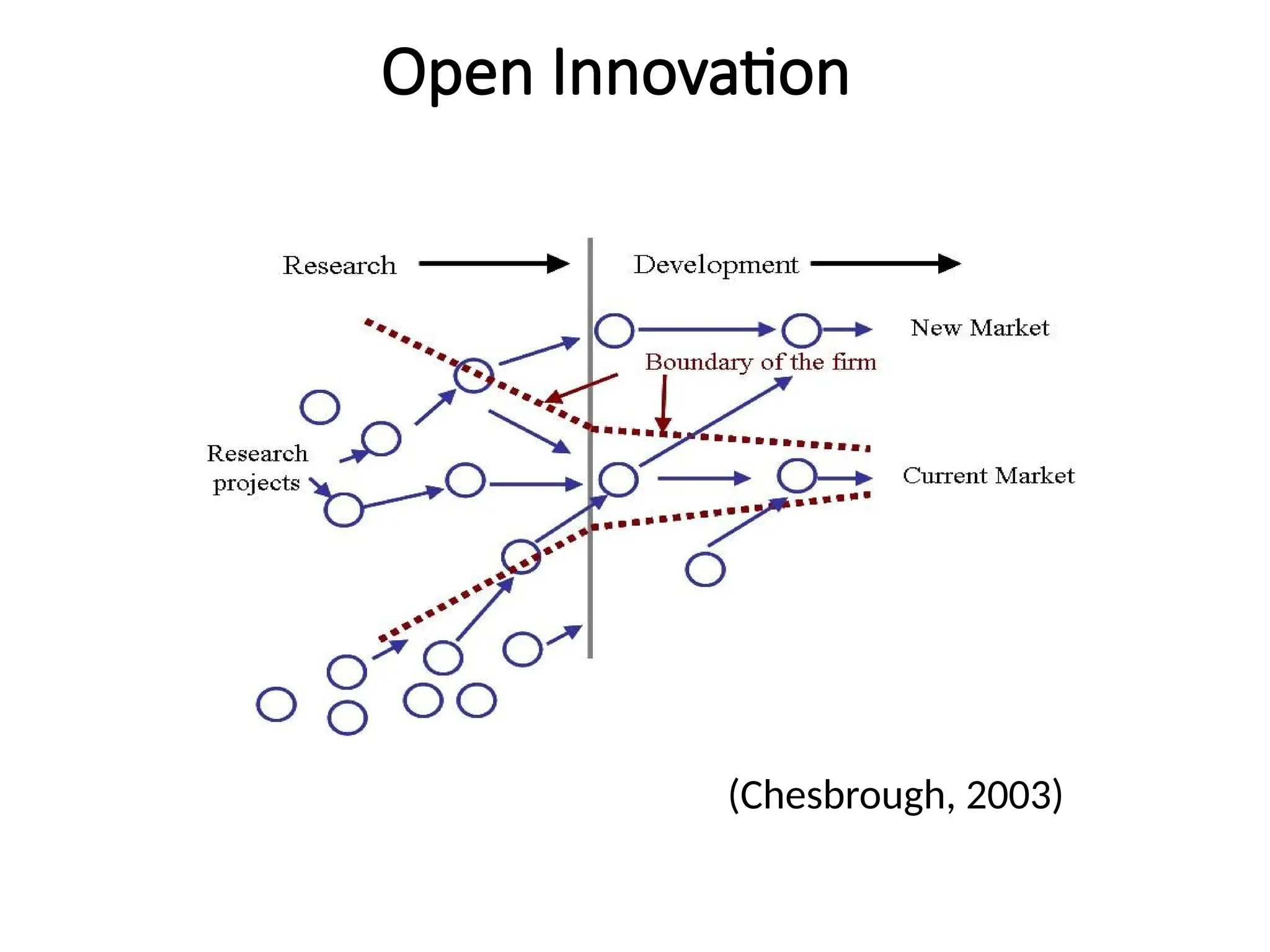
The central idea behind open innovation is that, in a world of widely distributed knowledge, companies cannot afford to rely entirely on their own research, but should instead buy or license processes or inventions (i.e. patents) from other companies. In addition, internal inventions not being used in a firm's business should be taken outside the company (e.g. through licensing, joint ventures or spin-offs).[3]
#46 The greatest example of a Closed Innovation Model is the company at 1 Infinite Loop, Cupertino. Working behind veils of secrecy and the occasional ‘strategic leak’ , Apple has delivered some of the greatest products in the the technology industry. The proponents of open innovation model do agree that Apple ‘s success lies in an innovation model that is ‘Closed’ yet conducive for openness. The single maniacal direction enforced by Steve Jobs and the radical internalisation of all branches of product development had brought out coherent products. They have managed to avoid ‘featuritis’ plaguing many ‘Open’ products.
#47 The greatest proponents of Open Innovation P&G,IBM are some of the examples of this nature of relationship.
Advantages:
Open innovation offers several benefits to companies operating on a program of global collaboration:
Reduced cost of conducting research and development
Potential for improvement in development productivity
Incorporation of customers early in the development process
Increase in accuracy for market research and customer targeting
Potential for viral marketing
Implementing a model of open innovation is naturally associated with a number of risk and challenges, including:
Possibility of revealing information not intended for sharing
Potential for the hosting organisation to lose their competitive advantage as a consequence of revealing intellectual property
Increased complexity of controlling innovation and regulating how contributors affect a project
Devising a means to properly identify and incorporate external innovation
Realigning innovation strategies to extend beyond the firm in order to maximise the return from external innovation
#48 But not all creative ideas are innovative and not all are opportunities….
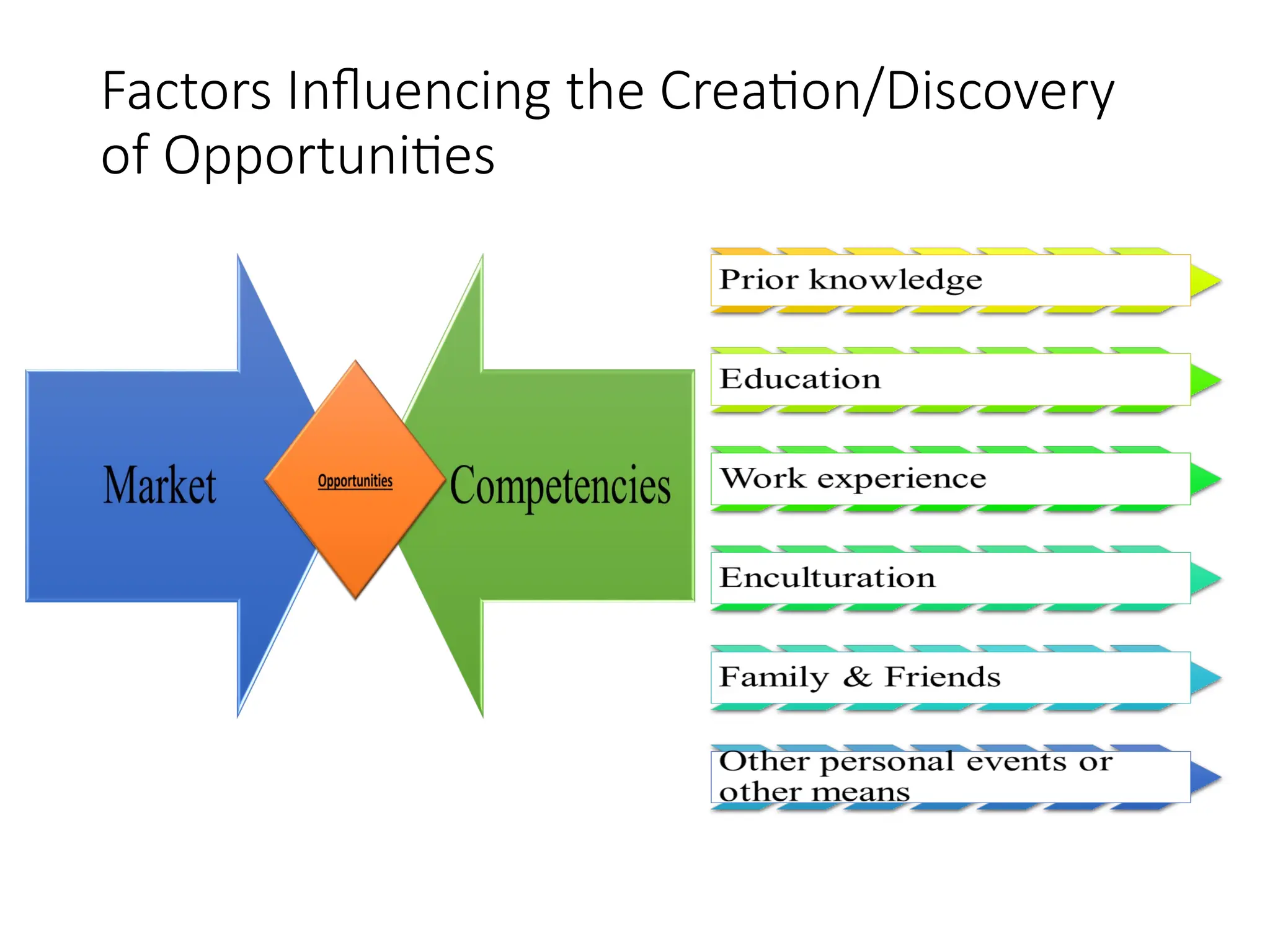
#54 However there are numerous factors which determine whether the idea itself is an opportunity or can be exploited. Demand and supply characteristics will play a role, economy and societal factors will also play a role. But in terms of the competencies of the individual exploring the idea as a possible opportunity this also need to be accounted for.
#55 The reality is that for an idea to be creative and to be turned into an innovative opportunity then there has to be the perception that this is creative. If the invention is not creative yet there is the opportunity space then the idea is perhaps copying an existing idea. If the idea is deemed to creative and no one can see the potential opportunity then the idea will struggle to become an innovation. Therefore there has to be a combination of both high creativity as well as a high perception of that creative invention as an opportunity.
#57 Remember that ideas start with often the simplest problems. But to take an idea and build a commercial business around it takes much more that this…
#58 Ultimately to be creative and for the idea to be an opportunity worth pursuing requires invention and innovation in combination. To create a truly innovative opportunity it is a process not an event. For an individual to develop an idea worth pursuing these elements need to be in place.
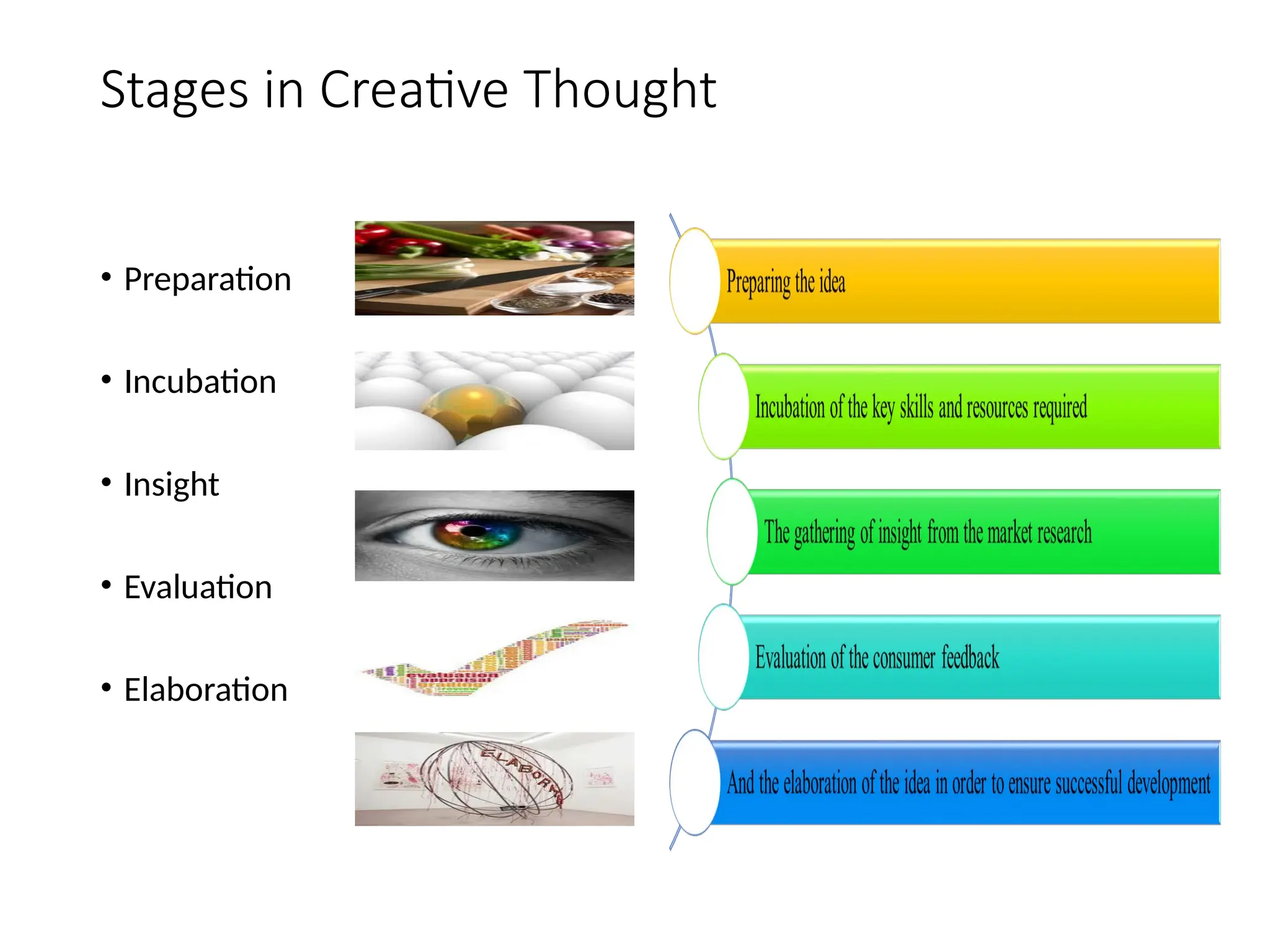
#60 However there are stages to creative thought. Preparing the idea, gathering information. Internalising the idea, developing, honing. Gaining insight by sharing the idea with others, then evaluating the feedback and elaborating the idea based on this. It’s a cyclical process of continuous improvement.
#61 What do you think is the biggest barrier businesses face? What about individuals?


![What is innovation?
“When an enterprise produces a good or service or uses a method or input that is
new to it, it makes a technical change. The first company to make a given
technical change is an innovator. Its action is innovation.”
Schmookler (1966)
“Innovation by definition must be successful in the market. “The test of innovation,
after all, lies not in its novelty, its scientific content, or its cleverness. It lies in its
success in the marketplace.”
Drucker (1993)
It is the creativity of an entrepreneur that results in invention [creation of new
knowledge] and innovation [application of knowledge] to create new products,
services or processes.](https://image.slidesharecdn.com/unit2-250403062528-9733ab6e/75/unit-2-pptx-creativity-innovation-and-entrepreneurship-35-2048.jpg)