Creativity & Change Everyone thinks of changing the world, but no one thinks of changing himself - Tolstoy
Resistance Resistance is simply a very effective, very powerful, very useful survival mechanism Resistance results when an organization focuses on the technical side and ignores the human side Can cripple an organization if employee believes it is not in their own best interest and not in the best interest of the organization
Causes of Resistance   Organization structure resists change Group norms act as a brake on an individual’s attempt to change behavior Efforts to change tasks of individuals or groups fail to take into account interdependencies among people, structure, tasks and the information system Change poses a threat to the specialized expertise that individuals/groups have developed Redistribution of decision-making authority threatens an individual’s power relationships with others Individuals/groups will resist change they believe threaten future resource allocations
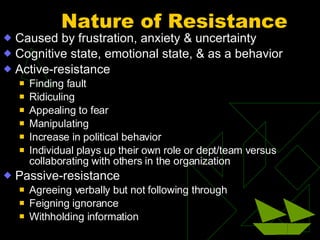
Nature of Resistance Caused by frustration, anxiety & uncertainty Cognitive state, emotional state, & as a behavior Active-resistance Finding fault Ridiculing Appealing to fear Manipulating Increase in political behavior Individual plays up their own role or dept/team versus collaborating with others in the organization Passive-resistance Agreeing verbally but not following through Feigning ignorance Withholding information
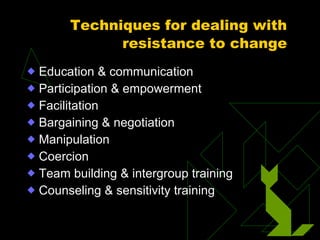
Techniques for dealing with resistance to change Education & communication Participation & empowerment Facilitation Bargaining & negotiation Manipulation Coercion Team building & intergroup training Counseling & sensitivity training
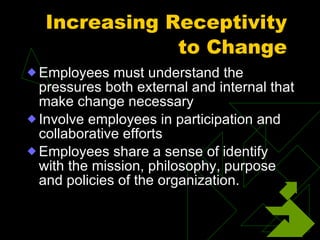
Increasing Receptivity to Change Employees must understand the pressures both external and internal that make change necessary Involve employees in participation and collaborative efforts Employees share a sense of identify with the mission, philosophy, purpose and policies of the organization.
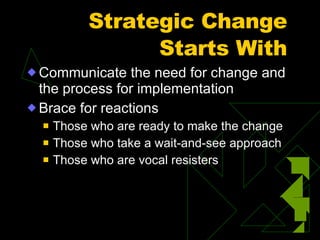
Strategic Change Starts With Communicate the need for change and the process for implementation Brace for reactions Those who are ready to make the change Those who take a wait-and-see approach Those who are vocal resisters
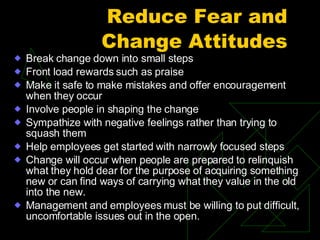
Reduce Fear and Change Attitudes Break change down into small steps Front load rewards such as praise Make it safe to make mistakes and offer encouragement when they occur Involve people in shaping the change Sympathize with negative feelings rather than trying to squash them Help employees get started with narrowly focused steps Change will occur when people are prepared to relinquish what they hold dear for the purpose of acquiring something new or can find ways of carrying what they value in the old into the new. Management and employees must be willing to put difficult, uncomfortable issues out in the open.
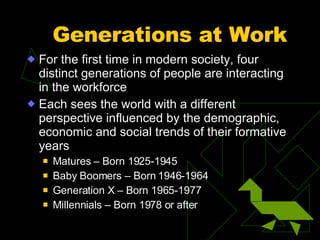
Generations at Work For the first time in modern society, four distinct generations of people are interacting in the workforce Each sees the world with a different perspective influenced by the demographic, economic and social trends of their formative years Matures – Born 1925-1945 Baby Boomers – Born 1946-1964 Generation X – Born 1965-1977 Millennials – Born 1978 or after
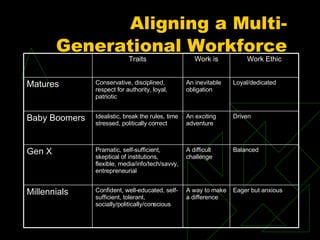
Aligning a Multi-Generational Workforce Eager but anxious A way to make a difference Confident, well-educated, self-sufficient, tolerant, socially/politically/conscious Millennials Balanced A difficult challenge Pramatic, self-sufficient, skeptical of institutions, flexible, media/info/tech/savvy, entrepreneurial Gen X Driven An exciting adventure Idealistic, break the rules, time stressed, politically correct Baby Boomers Loyal/dedicated An inevitable obligation Conservative, disciplined, respect for authority, loyal, patriotic Matures Work Ethic Work is Traits
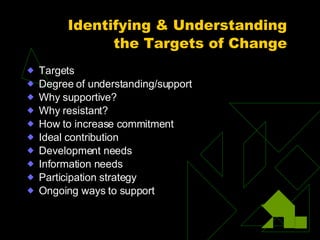
Identifying & Understanding the Targets of Change Targets Degree of understanding/support Why supportive? Why resistant? How to increase commitment Ideal contribution Development needs Information needs Participation strategy Ongoing ways to support
Barriers to Change   Inwardly focused cultures Paralyzing bureaucracy Parochial politics A low level of trust Lack of teamwork Arrogant attitudes A lack of leadership in middle management General human fear of the unknown
Process of Creating Major Change – John Kotter Establish a sense of urgency Creating the Guiding Coalition Develop a vision to help direct the change effort Communicate the change vision Empower broad-based action Generate short-term wins Consolidate gains and produce more change Anchor new approaches in the culture

Creativity & Change

  • 1.
    Creativity & ChangeEveryone thinks of changing the world, but no one thinks of changing himself - Tolstoy
  • 2.
    Resistance Resistance issimply a very effective, very powerful, very useful survival mechanism Resistance results when an organization focuses on the technical side and ignores the human side Can cripple an organization if employee believes it is not in their own best interest and not in the best interest of the organization
  • 3.
    Causes of Resistance Organization structure resists change Group norms act as a brake on an individual’s attempt to change behavior Efforts to change tasks of individuals or groups fail to take into account interdependencies among people, structure, tasks and the information system Change poses a threat to the specialized expertise that individuals/groups have developed Redistribution of decision-making authority threatens an individual’s power relationships with others Individuals/groups will resist change they believe threaten future resource allocations
  • 4.
    Nature of ResistanceCaused by frustration, anxiety & uncertainty Cognitive state, emotional state, & as a behavior Active-resistance Finding fault Ridiculing Appealing to fear Manipulating Increase in political behavior Individual plays up their own role or dept/team versus collaborating with others in the organization Passive-resistance Agreeing verbally but not following through Feigning ignorance Withholding information
  • 5.
    Techniques for dealingwith resistance to change Education & communication Participation & empowerment Facilitation Bargaining & negotiation Manipulation Coercion Team building & intergroup training Counseling & sensitivity training
  • 6.
    Increasing Receptivity toChange Employees must understand the pressures both external and internal that make change necessary Involve employees in participation and collaborative efforts Employees share a sense of identify with the mission, philosophy, purpose and policies of the organization.
  • 7.
    Strategic Change StartsWith Communicate the need for change and the process for implementation Brace for reactions Those who are ready to make the change Those who take a wait-and-see approach Those who are vocal resisters
  • 8.
    Reduce Fear andChange Attitudes Break change down into small steps Front load rewards such as praise Make it safe to make mistakes and offer encouragement when they occur Involve people in shaping the change Sympathize with negative feelings rather than trying to squash them Help employees get started with narrowly focused steps Change will occur when people are prepared to relinquish what they hold dear for the purpose of acquiring something new or can find ways of carrying what they value in the old into the new. Management and employees must be willing to put difficult, uncomfortable issues out in the open.
  • 9.
    Generations at WorkFor the first time in modern society, four distinct generations of people are interacting in the workforce Each sees the world with a different perspective influenced by the demographic, economic and social trends of their formative years Matures – Born 1925-1945 Baby Boomers – Born 1946-1964 Generation X – Born 1965-1977 Millennials – Born 1978 or after
  • 10.
    Aligning a Multi-GenerationalWorkforce Eager but anxious A way to make a difference Confident, well-educated, self-sufficient, tolerant, socially/politically/conscious Millennials Balanced A difficult challenge Pramatic, self-sufficient, skeptical of institutions, flexible, media/info/tech/savvy, entrepreneurial Gen X Driven An exciting adventure Idealistic, break the rules, time stressed, politically correct Baby Boomers Loyal/dedicated An inevitable obligation Conservative, disciplined, respect for authority, loyal, patriotic Matures Work Ethic Work is Traits
  • 11.
    Identifying & Understandingthe Targets of Change Targets Degree of understanding/support Why supportive? Why resistant? How to increase commitment Ideal contribution Development needs Information needs Participation strategy Ongoing ways to support
  • 12.
    Barriers to Change Inwardly focused cultures Paralyzing bureaucracy Parochial politics A low level of trust Lack of teamwork Arrogant attitudes A lack of leadership in middle management General human fear of the unknown
  • 13.
    Process of CreatingMajor Change – John Kotter Establish a sense of urgency Creating the Guiding Coalition Develop a vision to help direct the change effort Communicate the change vision Empower broad-based action Generate short-term wins Consolidate gains and produce more change Anchor new approaches in the culture