Poetry Terms
Alliteration:
the repetition of the initial
 consonant sound of words
within a phrase or sentence
Allusion:

a reference to a person, place,
   or thing--often literary,
mythological, or historical. The
    infinitive of allusion is
           to allude.
Assonance:
    the repetition of vowel
            sounds

“And so, all the night-tide, I lie down
              by the side
Of my darling, my darling, my life and
               my bride.
  --Edgar Allan Poe, Annabel Lee
Atmosphere:
the overall feeling of a work,
which is related to tone and
            mood
Blank verse:
Poetry or prose written in
    unrhymed iambic
       pentameter.

Plenty of modern poetry is
  written in blank verse.
Consonance:
the repetition of consonant sounds

 “The fair breeze blew, the white
            foam flew,
   The furrow followed free;”
 --The Rime of the Ancient Mariner
Couplets:
 A pair of rhyming lines in a
poem often set off from the
     rest of the poem.

 Shakespeare’s sonnets all
     end in couplets.
Diction
  the author’s choice of words

   An author has the option of
   choosing any word from our
language, why does he/she choose
   to use certain words and not
             others?
Elegy:
a poem mourning the dead
End rhyme:
  Rhyming words that are at
 the ends of their respective
lines—what we typically think
     of as normal rhyme.
Epic:
a long poem narrating the
 adventures of a heroic
          figure

i.e. Homer’s The Odyssey
Figurative Language:
   Whenever you describe something by
 comparing it with something else, you are
using figurative language. Any language that
goes beyond the literal meaning of words in
   order to furnish new effects or fresh
     insights into an idea or a subject.
Free Verse:
 poetry without a regular
pattern of meter or rhyme
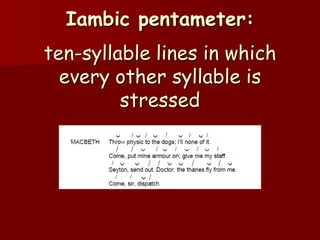
Iambic pentameter:
ten-syllable lines in which
  every other syllable is
         stressed
Imagery:
when an author uses a word or phrase
to stimulate the reader’s memory of
   one or more of the five senses
i.e. “Tita was so sensitive to onions, any time they
 were being chopped, they say she would just cry
       and cry; when she was still in my great-
  grandmother’s belly her sobs were so loud that
  even Nacha, the cook, who was half-deaf, could
                 hear them easily.”
             --Like Water for Chocolate
Internal rhyme:
a rhyme that occurs within
         one line

i.e.“He’s king of the Swing.”
Lyric:
   A type of poetry that
    expresses the poet’s
  emotions. It often tells
     some sort of brief
story, engaging the reader in
       the experience.
Metaphor:
   a comparison between
  essentially unlike things
    without an explicitly
comparative word such as like
            or as

  i.e.“This chair is a rock.”
Meter:
 the measured pattern of
rhythmic accents in poems
Mood:
 The feeling created in the
reader by a literary work or
 passage. The mood may be
 suggested by the writer's
choice of words, by events in
the work, or by the physical
          setting.
Ode:
a serious or lighthearted poem
 revolving around one subject
that is important to the writer
          or narrator
Onomatopoeia:
the use of words that sound
    like what they mean

   i.e. “buzz,” “bang,” or
          “tic-tock”
Oxymoron:
A figure of speech by which
 a word or phrase produces
 an incongruous, seemingly
 self-contradictory effect.

  i.e. “cruel kindness” or
        “pretty ugly”
Personification:
the endowment of inanimate
    objects or abstract
 concepts with animate or
       living qualities

   i.e. “The wind howled
    through the night.”
Prose:
 Writing organized into
sentences and paragraphs
   that is not poetry.
i.e. novels, short stories,
          essays
Quatrain:
a four-line stanza
Refrain:
a phrase or verse recurring
  at intervals in a song or
poem, especially at the end
   of each stanza; chorus
Rhyme:
the matching of final vowel
or consonant sounds in two
      or more words
Rhythm:
the recurrence of accent or
  stress in lines of verse
Simile:
a figure of speech involving a
 comparison between unlike
  things using like, as, or as
           though

i.e.“Her eyes were like stars.”
Sonnet:
a fourteen-line poem written in
      iambic pentameter

 Different kinds of sonnets have
 different rhyme schemes. The
 most notable are Shakespeare’s
    sonnets which employ the
abab,cdcd,efef,gg rhyme scheme.
Stanza:
a major subdivision in a poem

   A stanza of two lines is
 called a couplet; a stanza of
three lines is called a tercet;
   a stanza of four lines is
       called a quatrain.
Symbol:
an object or action in a literary
  work that means more than
     itself, that stands for
    something beyond itself
Theme:

 the idea of a literary work
abstracted from its details
of language, character, and
action, and cast in the form
  of a generalization; the
       lesson or moral
Tone:
the implied attitude of a writer
    toward the subject and
     characters of a work
Voice:
 the authorial presence in a
 piece of literature whether
in the first, second, or third
             person

Creative Writing | Poetry Terms

  • 1.
  • 2.
    Alliteration: the repetition ofthe initial consonant sound of words within a phrase or sentence
  • 3.
    Allusion: a reference toa person, place, or thing--often literary, mythological, or historical. The infinitive of allusion is to allude.
  • 4.
    Assonance: the repetition of vowel sounds “And so, all the night-tide, I lie down by the side Of my darling, my darling, my life and my bride. --Edgar Allan Poe, Annabel Lee
  • 5.
    Atmosphere: the overall feelingof a work, which is related to tone and mood
  • 6.
    Blank verse: Poetry orprose written in unrhymed iambic pentameter. Plenty of modern poetry is written in blank verse.
  • 7.
    Consonance: the repetition ofconsonant sounds “The fair breeze blew, the white foam flew, The furrow followed free;” --The Rime of the Ancient Mariner
  • 8.
    Couplets: A pairof rhyming lines in a poem often set off from the rest of the poem. Shakespeare’s sonnets all end in couplets.
  • 9.
    Diction theauthor’s choice of words An author has the option of choosing any word from our language, why does he/she choose to use certain words and not others?
  • 10.
  • 11.
    End rhyme: Rhyming words that are at the ends of their respective lines—what we typically think of as normal rhyme.
  • 12.
    Epic: a long poemnarrating the adventures of a heroic figure i.e. Homer’s The Odyssey
  • 13.
    Figurative Language: Whenever you describe something by comparing it with something else, you are using figurative language. Any language that goes beyond the literal meaning of words in order to furnish new effects or fresh insights into an idea or a subject.
  • 14.
    Free Verse: poetrywithout a regular pattern of meter or rhyme
  • 15.
    Iambic pentameter: ten-syllable linesin which every other syllable is stressed
  • 16.
    Imagery: when an authoruses a word or phrase to stimulate the reader’s memory of one or more of the five senses i.e. “Tita was so sensitive to onions, any time they were being chopped, they say she would just cry and cry; when she was still in my great- grandmother’s belly her sobs were so loud that even Nacha, the cook, who was half-deaf, could hear them easily.” --Like Water for Chocolate
  • 17.
    Internal rhyme: a rhymethat occurs within one line i.e.“He’s king of the Swing.”
  • 18.
    Lyric: A type of poetry that expresses the poet’s emotions. It often tells some sort of brief story, engaging the reader in the experience.
  • 19.
    Metaphor: a comparison between essentially unlike things without an explicitly comparative word such as like or as i.e.“This chair is a rock.”
  • 20.
    Meter: the measuredpattern of rhythmic accents in poems
  • 21.
    Mood: The feelingcreated in the reader by a literary work or passage. The mood may be suggested by the writer's choice of words, by events in the work, or by the physical setting.
  • 22.
    Ode: a serious orlighthearted poem revolving around one subject that is important to the writer or narrator
  • 23.
    Onomatopoeia: the use ofwords that sound like what they mean i.e. “buzz,” “bang,” or “tic-tock”
  • 24.
    Oxymoron: A figure ofspeech by which a word or phrase produces an incongruous, seemingly self-contradictory effect. i.e. “cruel kindness” or “pretty ugly”
  • 25.
    Personification: the endowment ofinanimate objects or abstract concepts with animate or living qualities i.e. “The wind howled through the night.”
  • 26.
    Prose: Writing organizedinto sentences and paragraphs that is not poetry. i.e. novels, short stories, essays
  • 27.
  • 28.
    Refrain: a phrase orverse recurring at intervals in a song or poem, especially at the end of each stanza; chorus
  • 29.
    Rhyme: the matching offinal vowel or consonant sounds in two or more words
  • 30.
    Rhythm: the recurrence ofaccent or stress in lines of verse
  • 31.
    Simile: a figure ofspeech involving a comparison between unlike things using like, as, or as though i.e.“Her eyes were like stars.”
  • 32.
    Sonnet: a fourteen-line poemwritten in iambic pentameter Different kinds of sonnets have different rhyme schemes. The most notable are Shakespeare’s sonnets which employ the abab,cdcd,efef,gg rhyme scheme.
  • 33.
    Stanza: a major subdivisionin a poem A stanza of two lines is called a couplet; a stanza of three lines is called a tercet; a stanza of four lines is called a quatrain.
  • 34.
    Symbol: an object oraction in a literary work that means more than itself, that stands for something beyond itself
  • 35.
    Theme: the ideaof a literary work abstracted from its details of language, character, and action, and cast in the form of a generalization; the lesson or moral
  • 36.
    Tone: the implied attitudeof a writer toward the subject and characters of a work
  • 37.
    Voice: the authorialpresence in a piece of literature whether in the first, second, or third person