Poetry

JONAROSA NONG
MASH-UP OF POETRY ELEMENTS
2014
What is
poetry?
A form of art in which
language is used for its
aesthetic and
evocative qualities
with or without its
apparent meaning.
It is derived from
the Greek word
poiesis, meaning
"making" or
"creating”
often uses particular
forms and conventions
to expand the literal
meaning of the words, or
to evoke emotional or
sensual responses
Purpose of Poetry
 To

express ideas, feelings and emotions.
What are
the
origins of
poetry?
Many ancient works, from
the Vedas to the Odyssey,
appear to have been
composed in poetic form
to aid memorization and
oral transmission, in
prehistoric and ancient
societies.
The oldest surviving poem is the Epic of
Gilgamesh, from the 3rd millennium BC in
Sumer (Mesopotamia, now Iraq), which was
written in cuneiform script on clay tablets and,
later, papyrus.
Other ancient epic poetry includes the
Greek epics, Iliad and Odyssey, and the
Indian epics, Ramayana and the
Mahabharata.
What are
the
genres of
poetry?
POETIC GENRES
Narrative
Poetry

Satirical
Poetry

Epic Poetry

Lyric Poetry

Dramatic
Poetry
Narrative Poetry
Tells

a story
May be the oldest genre
of poetry
Includes epics, ballads,
idylls and lays
Epic Poetry
It

recounts, in a continuous
narrative, the life and works
of a heroic or mythological
person or group of persons.
Dramatic Poetry
Is

drama written in verse to
be spoken or sung, and
appears in varying and
sometimes related forms in
many cultures.
uses the discourse of the
characters involved to tell a
story or portray a situation.
Satirical Poetry

A

punch of an insult
delivered in verse
often written for political
purposes.
A notable example is that
of
the
Roman
poet
Juvenal.
Lyric Poetry
Portrays

the poet's own
feelings, state of mind, and
perceptions.
Derived from the word "lyre“;
implies that it is intended to be
sung
Includes sonnets, elegy,
ballads, odes, villanelles and
pastourelles
POINT OF VIEW IN POETRY
POET
 The poet is the

author of the
poem.

SPEAKER
The speaker of the
poem is the
“narrator” of the
poem.
Types of Poetry

Ballad:
A poem that tells a story;
ballads are usually sung
Types of Poetry
Free Verse:
Poetry that doesn’t
follow any specific
patterns in rhythm,
rhyme scheme, or line
length; free verse may
contain rhymes, but
they are not used in a
prescribed manner
Types of Poetry
Haiku
A three-line Japanese
poetic form in the lines
follow the pattern of
five syllables in the
first line, seven
syllables in the second
line, and five syllables
in the third line.
Types of Poetry
Limerick:
a five-line poem that follows a specific rhyme
scheme and rhythm. The first, second, and fifth lines
contain eight syllables. Lines two and three contain
six syllables. Limericks are usually funny or silly.
There was an Old Man with a beard,
Who said, ‘It is just as I feared!
Two Owls and a Hen,
Four Larks and a wren
Have all built their nests in my beard
Types of Poetry
Narrative Poem:
A poem that tells the sequence of events of a
story;
Types of Poetry
Sonnet:
A very structured fourteen-line poem that follows a
specific rhyme structure and rhythm. The two most
common sonnets are the Italian sonnet and the English
sonnet. William Shakespeare wrote many English
sonnets, which are also referred to as Shakespearean
sonnets.
Another important thing to know

STANZA

consists of two or
more lines of poetry
that together form
one of the divisions
of a poem.
KINDS OF STANZAS
Couplet
Triplet (Tercet)
Quatrain
Quintet
Sestet (Sextet)
Septet
Octave

=
=
=
=
=
=
=

a two line stanza
a three line stanza
a four line stanza
a five line stanza
a six line stanza
a seven line stanza
an eight line stanza
What are
the basic
elements of
poetry?
Basic Elements of Poetry

RHYTHM

is the actual
sound that
results from a
line of poetry.
Basic Elements of Poetry

RHYTHM

the pattern of
stressed and
unstressed
syllables in a
line.
Basic Elements of Poetry

METER

the number
of feet in a
line
Basic Elements of Poetry

METER

Meter is the
definitive pattern
established for a
verse (such as
iambic
pentameter)
Basic Elements of Poetry

METER

is often
scanned based
on the
arrangement of
"poetic feet"
into lines.
Some examples of metric system
Iambic pentameter. It contains
five feet per line, in which the
predominant kind of foot is the
"iamb”
Dactylic hexameter. It has six
feet per line, of which the
dominant kind of foot is the
dactyl.
Basic Elements of Poetry

RHYME

consists of identical
(hard-rhyme) or
similar (soft-rhyme)
sounds placed at the
ends of lines or at
predictable locations
within lines (internal
rhyme).
Rhyme
When working with rhyme, you should always remember
that the most important part of verse is the last word.
 The last word of each verse is what establishes they
rhyme.

Twinkle, twinkle little star!
How I wonder what you are
Up above the world so high.
Like a diamond in the sky.

A
A
B
B

Rhyme
Schem
e
Basic Elements of Poetry

THEME

what the poet
wants to
express
through his
words.
Basic Elements of Poetry

THEME

may either be a
thought, a
feeling, an
observation, a
story or an
experience.
Basic Elements of Poetry

SYMBOLISM

virtual substances
and themes to
express the deep
hidden meaning
behind the
words.
Basic Elements of Poetry

SYMBOLISM

The use of
symbolism gives a
more reflective
empathy to the
poem.
Basic Elements of Poetry
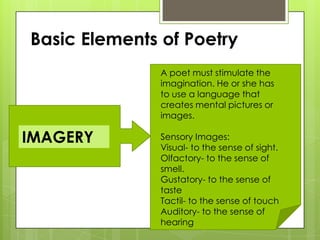
A poet must stimulate the
imagination. He or she has
to use a language that
creates mental pictures or
images.

IMAGERY

Sensory Images:
Visual- to the sense of sight.
Olfactory- to the sense of
smell.
Gustatory- to the sense of
taste
Tactil- to the sense of touch
Auditory- to the sense of
hearing
Recognizing Figurative
Language
The opposite of literal language is figurative
language. Figurative language is
language that means more than what it
says on the surface.
 It usually gives us a feeling about its
subject.
 Poets use figurative language almost as
frequently as literal language. When you
read poetry, you must be conscious of the
difference. Otherwise, a poem may make
no sense at all.
Recognizing Literal Language
“I’ve eaten so much I feel as if I could
literally burst!”
 In

this case, the person is not using the word
literally in its true meaning. Literal means "exact"
or "not exaggerated." By pretending that the
statement is not exaggerated, the person
stresses how much he has eaten.
Literal language is language that means exactly
what is said.
Most of the time, we use
literal language.
FIGURATIVE LANGUAGE
Simile
A

direct, explicit comparison of one thing
to another in which the words like or as
are used.

 Ex.

She looks like an angel.
Her lips are as sweet as honey.
Onomatopoeia
 The

attempt to echo or imitate sounds
with words

 Ex.

Bow-wow, oink-oink, tick-tack, howling
Litotes
 Understatement - basically the opposite of

hyperbole. Often it is ironic.

 Ex. Calling a slow moving person “Speedy”
Hyperbole
 An

exaggeration

 Ex.

I have been waiting for a million years
Idiom
 An expression where the literal meaning of the

words is not the meaning of the expression. It
means something other than what it actually
says.

 Ex. It’s raining cats and dogs.
Alliteration
 Repetition

of constant sounds usually at
the beginning of words

 Ex.

In the summer season, when soft was
the song…
PERSONIFICATION
 The

strategy of
giving
objects
human-like
qualities or
an object
given lifelike
qualities.

from “Ninki”
by Shirley Jackson
“Ninki was by this time irritated
beyond belief by the general
air of incompetence exhibited
in the kitchen, and she went
into the living room and got
Shax, who is extraordinarily lazy
and never catches his own
chipmunks, but who is, at least,
a cat, and preferable, Ninki
saw clearly, to a man with a
gun.
Metaphor
 An

indirect comparison of one thing to
another in which one thing is given
characteristics of another.

 Ex.

My love is a flower
He was al lion in battle
Idioms
 An

idiom or idiomatic expression refers to a
construction or expression in one language that
cannot be matched or directly translated wordfor-word in another language.

Example: "She has a bee
in her bonnet," meaning
"she is obsessed," cannot
be literally translated into
another language word for
word.
Credits for Slideshare
presentations used to create
this mash-up:
lucciano7
Poetry terminology 2012
http://www.slideshare.net/lucciano7/poetry-terminology15626203


Katrina Naval
Elements of poetry and scansion 2013
http://www.slideshare.net/katrinanaval3/elements-of-poetry-andscansion


Melanie cruz
Poetry 2013
http://www.slideshare.net/MelaniCruz1/poetry20818094?qid=3f7515c9-d996-4218-a58b1240e32712fe&v=qf1&b=&from_search=9


Poetry elements mash up

  • 1.
    Poetry JONAROSA NONG MASH-UP OFPOETRY ELEMENTS 2014
  • 2.
  • 3.
    A form ofart in which language is used for its aesthetic and evocative qualities with or without its apparent meaning.
  • 4.
    It is derivedfrom the Greek word poiesis, meaning "making" or "creating”
  • 5.
    often uses particular formsand conventions to expand the literal meaning of the words, or to evoke emotional or sensual responses
  • 6.
    Purpose of Poetry To express ideas, feelings and emotions.
  • 7.
  • 8.
    Many ancient works,from the Vedas to the Odyssey, appear to have been composed in poetic form to aid memorization and oral transmission, in prehistoric and ancient societies.
  • 9.
    The oldest survivingpoem is the Epic of Gilgamesh, from the 3rd millennium BC in Sumer (Mesopotamia, now Iraq), which was written in cuneiform script on clay tablets and, later, papyrus.
  • 10.
    Other ancient epicpoetry includes the Greek epics, Iliad and Odyssey, and the Indian epics, Ramayana and the Mahabharata.
  • 11.
  • 12.
  • 13.
    Narrative Poetry Tells a story Maybe the oldest genre of poetry Includes epics, ballads, idylls and lays
  • 14.
    Epic Poetry It recounts, ina continuous narrative, the life and works of a heroic or mythological person or group of persons.
  • 15.
    Dramatic Poetry Is drama writtenin verse to be spoken or sung, and appears in varying and sometimes related forms in many cultures. uses the discourse of the characters involved to tell a story or portray a situation.
  • 16.
    Satirical Poetry A punch ofan insult delivered in verse often written for political purposes. A notable example is that of the Roman poet Juvenal.
  • 17.
    Lyric Poetry Portrays the poet'sown feelings, state of mind, and perceptions. Derived from the word "lyre“; implies that it is intended to be sung Includes sonnets, elegy, ballads, odes, villanelles and pastourelles
  • 18.
    POINT OF VIEWIN POETRY POET  The poet is the author of the poem. SPEAKER The speaker of the poem is the “narrator” of the poem.
  • 19.
    Types of Poetry Ballad: Apoem that tells a story; ballads are usually sung
  • 20.
    Types of Poetry FreeVerse: Poetry that doesn’t follow any specific patterns in rhythm, rhyme scheme, or line length; free verse may contain rhymes, but they are not used in a prescribed manner
  • 21.
    Types of Poetry Haiku Athree-line Japanese poetic form in the lines follow the pattern of five syllables in the first line, seven syllables in the second line, and five syllables in the third line.
  • 22.
    Types of Poetry Limerick: afive-line poem that follows a specific rhyme scheme and rhythm. The first, second, and fifth lines contain eight syllables. Lines two and three contain six syllables. Limericks are usually funny or silly. There was an Old Man with a beard, Who said, ‘It is just as I feared! Two Owls and a Hen, Four Larks and a wren Have all built their nests in my beard
  • 23.
    Types of Poetry NarrativePoem: A poem that tells the sequence of events of a story;
  • 24.
    Types of Poetry Sonnet: Avery structured fourteen-line poem that follows a specific rhyme structure and rhythm. The two most common sonnets are the Italian sonnet and the English sonnet. William Shakespeare wrote many English sonnets, which are also referred to as Shakespearean sonnets.
  • 25.
    Another important thingto know STANZA consists of two or more lines of poetry that together form one of the divisions of a poem.
  • 26.
    KINDS OF STANZAS Couplet Triplet(Tercet) Quatrain Quintet Sestet (Sextet) Septet Octave = = = = = = = a two line stanza a three line stanza a four line stanza a five line stanza a six line stanza a seven line stanza an eight line stanza
  • 27.
  • 28.
    Basic Elements ofPoetry RHYTHM is the actual sound that results from a line of poetry.
  • 29.
    Basic Elements ofPoetry RHYTHM the pattern of stressed and unstressed syllables in a line.
  • 30.
    Basic Elements ofPoetry METER the number of feet in a line
  • 31.
    Basic Elements ofPoetry METER Meter is the definitive pattern established for a verse (such as iambic pentameter)
  • 32.
    Basic Elements ofPoetry METER is often scanned based on the arrangement of "poetic feet" into lines.
  • 33.
    Some examples ofmetric system Iambic pentameter. It contains five feet per line, in which the predominant kind of foot is the "iamb” Dactylic hexameter. It has six feet per line, of which the dominant kind of foot is the dactyl.
  • 34.
    Basic Elements ofPoetry RHYME consists of identical (hard-rhyme) or similar (soft-rhyme) sounds placed at the ends of lines or at predictable locations within lines (internal rhyme).
  • 35.
    Rhyme When working withrhyme, you should always remember that the most important part of verse is the last word.  The last word of each verse is what establishes they rhyme. Twinkle, twinkle little star! How I wonder what you are Up above the world so high. Like a diamond in the sky. A A B B Rhyme Schem e
  • 36.
    Basic Elements ofPoetry THEME what the poet wants to express through his words.
  • 37.
    Basic Elements ofPoetry THEME may either be a thought, a feeling, an observation, a story or an experience.
  • 38.
    Basic Elements ofPoetry SYMBOLISM virtual substances and themes to express the deep hidden meaning behind the words.
  • 39.
    Basic Elements ofPoetry SYMBOLISM The use of symbolism gives a more reflective empathy to the poem.
  • 40.
    Basic Elements ofPoetry A poet must stimulate the imagination. He or she has to use a language that creates mental pictures or images. IMAGERY Sensory Images: Visual- to the sense of sight. Olfactory- to the sense of smell. Gustatory- to the sense of taste Tactil- to the sense of touch Auditory- to the sense of hearing
  • 41.
    Recognizing Figurative Language The oppositeof literal language is figurative language. Figurative language is language that means more than what it says on the surface.  It usually gives us a feeling about its subject.  Poets use figurative language almost as frequently as literal language. When you read poetry, you must be conscious of the difference. Otherwise, a poem may make no sense at all.
  • 42.
    Recognizing Literal Language “I’veeaten so much I feel as if I could literally burst!”  In this case, the person is not using the word literally in its true meaning. Literal means "exact" or "not exaggerated." By pretending that the statement is not exaggerated, the person stresses how much he has eaten. Literal language is language that means exactly what is said. Most of the time, we use literal language.
  • 43.
  • 44.
    Simile A direct, explicit comparisonof one thing to another in which the words like or as are used.  Ex. She looks like an angel. Her lips are as sweet as honey.
  • 45.
    Onomatopoeia  The attempt toecho or imitate sounds with words  Ex. Bow-wow, oink-oink, tick-tack, howling
  • 46.
    Litotes  Understatement -basically the opposite of hyperbole. Often it is ironic.  Ex. Calling a slow moving person “Speedy”
  • 47.
    Hyperbole  An exaggeration  Ex. Ihave been waiting for a million years
  • 48.
    Idiom  An expressionwhere the literal meaning of the words is not the meaning of the expression. It means something other than what it actually says.  Ex. It’s raining cats and dogs.
  • 49.
    Alliteration  Repetition of constantsounds usually at the beginning of words  Ex. In the summer season, when soft was the song…
  • 50.
    PERSONIFICATION  The strategy of giving objects human-like qualitiesor an object given lifelike qualities. from “Ninki” by Shirley Jackson “Ninki was by this time irritated beyond belief by the general air of incompetence exhibited in the kitchen, and she went into the living room and got Shax, who is extraordinarily lazy and never catches his own chipmunks, but who is, at least, a cat, and preferable, Ninki saw clearly, to a man with a gun.
  • 51.
    Metaphor  An indirect comparisonof one thing to another in which one thing is given characteristics of another.  Ex. My love is a flower He was al lion in battle
  • 52.
    Idioms  An idiom oridiomatic expression refers to a construction or expression in one language that cannot be matched or directly translated wordfor-word in another language. Example: "She has a bee in her bonnet," meaning "she is obsessed," cannot be literally translated into another language word for word.
  • 53.
    Credits for Slideshare presentationsused to create this mash-up: lucciano7 Poetry terminology 2012 http://www.slideshare.net/lucciano7/poetry-terminology15626203  Katrina Naval Elements of poetry and scansion 2013 http://www.slideshare.net/katrinanaval3/elements-of-poetry-andscansion  Melanie cruz Poetry 2013 http://www.slideshare.net/MelaniCruz1/poetry20818094?qid=3f7515c9-d996-4218-a58b1240e32712fe&v=qf1&b=&from_search=9 

Editor's Notes

  • #14 is a short poem, descriptive of rustic life, written in the style of Theocritus' short pastoral poems, the Idylls.
  • #18 The pastourelle is a typically Old Frenchlyric form concerning the romance of a shepherdess. Villanelles do not tell a story or establish a conversational toneA villanelle has only two rhyme sounds.