A Workable Alternative 
To Copyright? 
2014-11-17 This work was created by Caroline N. Rowan and is licensed under the Creative Commons Attribution Non-Commercial ShareAlike License. To view a copy of the license, visit 
http://creativecommons.org/licenses/by-nc-sa/4.0/
Copyright: the exclusive right to 
produce copies and to control an 
original literary, musical, or artistic 
work, granted by law for a 
specified number of years. 
Collins Online Dictionary 
http://www.collinsdictionary.com/dictionary/english/copyright?showCookieP 
olicy=true
COPYRIGHT AND RELATED RIGHTS ACT, 2000 
S.I. 28 of 2000 
• 17.—(1) Copyright is a property right whereby, subject to this Act, the owner of the 
copyright in any work may undertake or authorise other persons in relation to that 
work to undertake certain acts in the State, being acts which are designated by this Act 
as acts restricted by copyright in a work of that description. 
(2) Copyright subsists, in accordance with this Act, in— 
(a) original literary, dramatic, musical or artistic works, 
(b) sound recordings, films, broadcasts or cable programmes, 
(c) the typographical arrangement of published editions, and 
(d) original databases.
Copyright: 
• Requires explicit prior permission from the copyright owner to 
use, amend, adapt, copy or distribute the copyright work. 
• Is an automatic right and does not have to be registered. 
• Covers only the expression of an idea, not the idea itself. 
• Copyright of work produced while working for an employer 
belongs to the employer, unless otherwise provided for in a 
contract of employment.
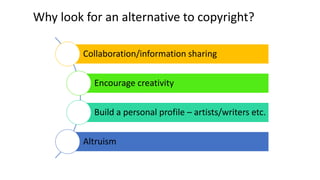
Why look for an alternative to copyright? 
Collaboration/information sharing 
Encourage creativity 
Build a personal profile – artists/writers etc. 
Altruism
CREATIVE COMMONS 
Creative Commons is a non-profit 
organisation that enables the sharing and 
use of creativity and knowledge through 
free legal tools. 
https://creativecommons.org/about
CREATIVE COMMONS LICENCES 
Creative Commons have created 
several licences which may be used 
free of charge by the public. 
These licences permit: 
• use of copyright material 
• without prior explicit permission 
• subject to the conditions of the 
licence.
Creative Commons licences 
do not replace copyright, 
but are based upon it.
Author/Creator – the individual/entity which created the 
content in the first instance. 
Licensor – the person/entity granting permission to use the 
created content. Licensor is not necessarily the creator of the 
content, as Creative Commons licences can facilitate third 
party licensing of content. 
Licensee – the person/entity to whom permission to use 
material is granted.
Creative Commons licences 
6 types: 
1. Attribution CC BY 
2. Attribution-ShareAlike CC BY-SA 
3. Attribution-NoDerivs CC BY-ND 
4. Attribution-NonCommercial CC BY-NC 
5. Attribution-NonCommercial-ShareAlike CC BY-NC-SA 
6. Attribution-NonCommercial-NoDerivs CC BY-NC-ND
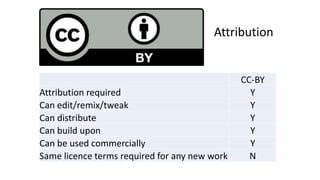
Attribution 
CC-BY 
Attribution required Y 
Can edit/remix/tweak Y 
Can distribute Y 
Can build upon Y 
Can be used commercially Y 
Same licence terms required for any new work N
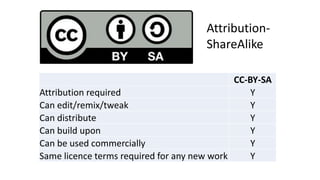
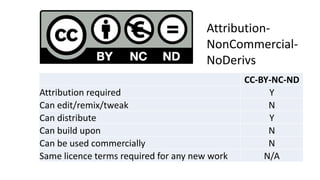
Attribution- 
ShareAlike 
CC-BY-SA 
Attribution required Y 
Can edit/remix/tweak Y 
Can distribute Y 
Can build upon Y 
Can be used commercially Y 
Same licence terms required for any new work Y
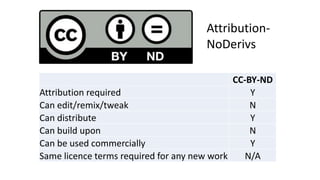
Attribution- 
NoDerivs 
CC-BY-ND 
Attribution required Y 
Can edit/remix/tweak N 
Can distribute Y 
Can build upon N 
Can be used commercially Y 
Same licence terms required for any new work N/A
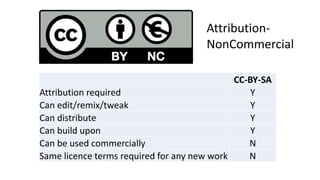
Attribution- 
NonCommercial 
CC-BY-SA 
Attribution required Y 
Can edit/remix/tweak Y 
Can distribute Y 
Can build upon Y 
Can be used commercially N 
Same licence terms required for any new work N
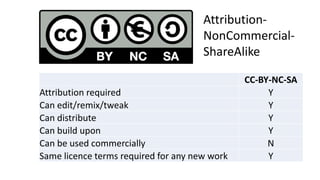
Attribution- 
NonCommercial- 
ShareAlike 
CC-BY-NC-SA 
Attribution required Y 
Can edit/remix/tweak Y 
Can distribute Y 
Can build upon Y 
Can be used commercially N 
Same licence terms required for any new work Y
Attribution- 
NonCommercial- 
NoDerivs 
CC-BY-NC-ND 
Attribution required Y 
Can edit/remix/tweak N 
Can distribute Y 
Can build upon N 
Can be used commercially N 
Same licence terms required for any new work N/A
All Creative Commons licenses require 
licensees to: 
Credit the licensor 
Keep copyright notices intact on all copies of the work 
Link to the licence from copies of the work.
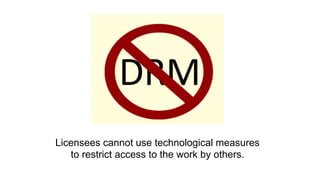
Licensees cannot use technological measures 
to restrict access to the work by others.
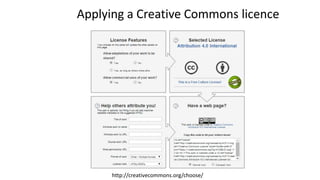
Applying a Creative Commons licence 
http://creativecommons.org/choose/
A few things to think about 
• Are there multiple elements which need to be licensed? 
• Does copyright legislation actually apply to the material? 
• Is anything in your material subject to licence from someone else? 
• Could the copyright belong to your employer? 
NB: Creative Commons licences cannot be revoked, even if you later delete 
content or stop distributing the work in question.
Useful links 
http://creativecommons.org/ 
http://www.ucc.ie/law/irishlaw/creativecommons/Creative- 
Commons-Ireland-summary.pdf 
https://wiki.creativecommons.org/Ireland 
UCC Law Department is the Irish Partner for Creative Commons 
Licence. Dr. Darius Whelan and Dr. Louise Crowley are the key 
contacts.
Any 
questions? 
Caroline N Rowan 
caroline.rowan.library@gmail.com

Creative commons-licencing-2014-11-17-inc-cc-licence

  • 1.
    A Workable Alternative To Copyright? 2014-11-17 This work was created by Caroline N. Rowan and is licensed under the Creative Commons Attribution Non-Commercial ShareAlike License. To view a copy of the license, visit http://creativecommons.org/licenses/by-nc-sa/4.0/
  • 2.
    Copyright: the exclusiveright to produce copies and to control an original literary, musical, or artistic work, granted by law for a specified number of years. Collins Online Dictionary http://www.collinsdictionary.com/dictionary/english/copyright?showCookieP olicy=true
  • 3.
    COPYRIGHT AND RELATEDRIGHTS ACT, 2000 S.I. 28 of 2000 • 17.—(1) Copyright is a property right whereby, subject to this Act, the owner of the copyright in any work may undertake or authorise other persons in relation to that work to undertake certain acts in the State, being acts which are designated by this Act as acts restricted by copyright in a work of that description. (2) Copyright subsists, in accordance with this Act, in— (a) original literary, dramatic, musical or artistic works, (b) sound recordings, films, broadcasts or cable programmes, (c) the typographical arrangement of published editions, and (d) original databases.
  • 4.
    Copyright: • Requiresexplicit prior permission from the copyright owner to use, amend, adapt, copy or distribute the copyright work. • Is an automatic right and does not have to be registered. • Covers only the expression of an idea, not the idea itself. • Copyright of work produced while working for an employer belongs to the employer, unless otherwise provided for in a contract of employment.
  • 5.
    Why look foran alternative to copyright? Collaboration/information sharing Encourage creativity Build a personal profile – artists/writers etc. Altruism
  • 7.
    CREATIVE COMMONS CreativeCommons is a non-profit organisation that enables the sharing and use of creativity and knowledge through free legal tools. https://creativecommons.org/about
  • 8.
    CREATIVE COMMONS LICENCES Creative Commons have created several licences which may be used free of charge by the public. These licences permit: • use of copyright material • without prior explicit permission • subject to the conditions of the licence.
  • 9.
    Creative Commons licences do not replace copyright, but are based upon it.
  • 10.
    Author/Creator – theindividual/entity which created the content in the first instance. Licensor – the person/entity granting permission to use the created content. Licensor is not necessarily the creator of the content, as Creative Commons licences can facilitate third party licensing of content. Licensee – the person/entity to whom permission to use material is granted.
  • 11.
    Creative Commons licences 6 types: 1. Attribution CC BY 2. Attribution-ShareAlike CC BY-SA 3. Attribution-NoDerivs CC BY-ND 4. Attribution-NonCommercial CC BY-NC 5. Attribution-NonCommercial-ShareAlike CC BY-NC-SA 6. Attribution-NonCommercial-NoDerivs CC BY-NC-ND
  • 12.
    Attribution CC-BY Attributionrequired Y Can edit/remix/tweak Y Can distribute Y Can build upon Y Can be used commercially Y Same licence terms required for any new work N
  • 13.
    Attribution- ShareAlike CC-BY-SA Attribution required Y Can edit/remix/tweak Y Can distribute Y Can build upon Y Can be used commercially Y Same licence terms required for any new work Y
  • 14.
    Attribution- NoDerivs CC-BY-ND Attribution required Y Can edit/remix/tweak N Can distribute Y Can build upon N Can be used commercially Y Same licence terms required for any new work N/A
  • 15.
    Attribution- NonCommercial CC-BY-SA Attribution required Y Can edit/remix/tweak Y Can distribute Y Can build upon Y Can be used commercially N Same licence terms required for any new work N
  • 16.
    Attribution- NonCommercial- ShareAlike CC-BY-NC-SA Attribution required Y Can edit/remix/tweak Y Can distribute Y Can build upon Y Can be used commercially N Same licence terms required for any new work Y
  • 17.
    Attribution- NonCommercial- NoDerivs CC-BY-NC-ND Attribution required Y Can edit/remix/tweak N Can distribute Y Can build upon N Can be used commercially N Same licence terms required for any new work N/A
  • 18.
    All Creative Commonslicenses require licensees to: Credit the licensor Keep copyright notices intact on all copies of the work Link to the licence from copies of the work.
  • 19.
    Licensees cannot usetechnological measures to restrict access to the work by others.
  • 20.
    Applying a CreativeCommons licence http://creativecommons.org/choose/
  • 21.
    A few thingsto think about • Are there multiple elements which need to be licensed? • Does copyright legislation actually apply to the material? • Is anything in your material subject to licence from someone else? • Could the copyright belong to your employer? NB: Creative Commons licences cannot be revoked, even if you later delete content or stop distributing the work in question.
  • 22.
    Useful links http://creativecommons.org/ http://www.ucc.ie/law/irishlaw/creativecommons/Creative- Commons-Ireland-summary.pdf https://wiki.creativecommons.org/Ireland UCC Law Department is the Irish Partner for Creative Commons Licence. Dr. Darius Whelan and Dr. Louise Crowley are the key contacts.
  • 23.
    Any questions? CarolineN Rowan caroline.rowan.library@gmail.com