Research Topic: Creative
Commons
Students: Nathalia Irizarry Lopez, Mariana Ferrer, and
Terrance Bryant
1
Copyright: an important part in
Creative Commons
In order to understand what “Creative Commons”
is, we must first understand what “copyright”
means. Copyright is a license that automatically
protects your work when you publish or
post it to the public or to
the online domain. This license protects libraries,
musical, artistic and other types of work.
2
I just plagiarized, what
happens now?
Because of such license, the creator of
any work is given the right to
control unauthorized sharing. If said work is
shared, the user can be sued with
charges of theft, plagiarism and invasion of
privacy. Creative Commons is considered a type
of copyright, according to CreaticeCommons.org.
3
Creative Commons: What is
it and does it do?
Creative Commons is a nonprofit organization founded
in 2001 by Lawrence Lessig, a professor
of Harvard Law School and Director of
the Edmond J. Safra Center for Ethics
of Harvard University. The organization helps users
copy, share, and reuse their creativity through
free legal tools.
4
Who can use these licenses and how?
Creative Commons is meant for creators, often
times called licensors, who want some rights
reserved, unlike copyright where you have all
rights reserved. According to Lessing L. (2018):
“Not supporting stealing, but supporting authors freeing
the part of the rights granted to
them by the law they don’t need.”
5
Creative Commons and the different types of
licenses
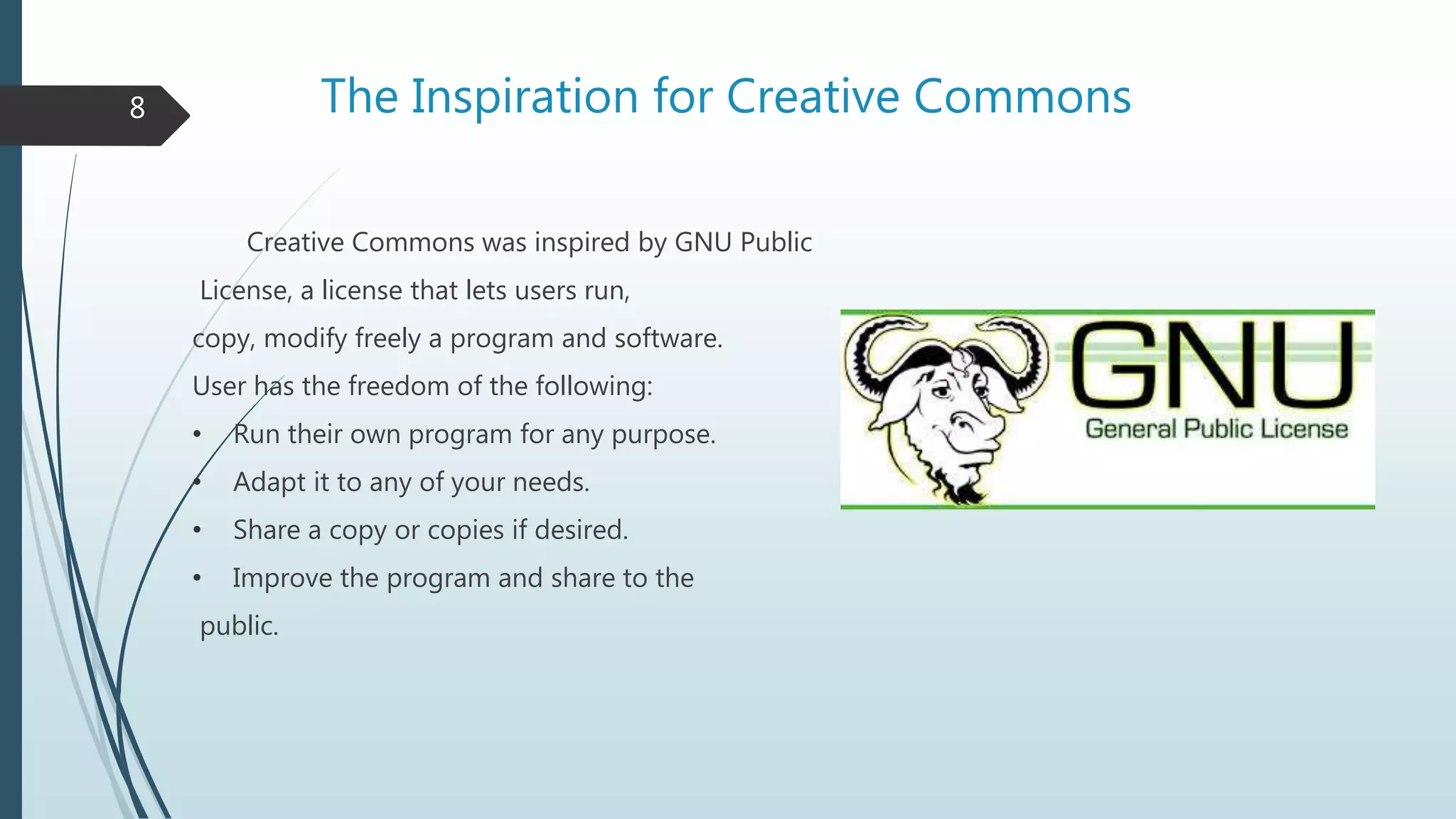
The Creative Commons has its own logo
but there are other types of licenses
that branch out of CC that creators
mix and match with. The names of
such licenses would be: the Attribution, ShareALike,
NonCommercial, and last but not least, NoDerivatives.
The examples of such logos are these:
6
Creative Commons Logo
Websites that share Creative Commons Works
415,100,000
49,000,000
46,700,000
40,000,000
36,900,000
28,700,000
6,600,000
3,100,000
2,700,000
2,300,000
1,200,000
740,896
446,126
200,000
USERS
WEBSITES
7
The Inspiration for Creative Commons
Creative Commons was inspired by GNU Public
License, a license that lets users run,
copy, modify freely a program and software.
User has the freedom of the following:
• Run their own program for any purpose.
• Adapt it to any of your needs.
• Share a copy or copies if desired.
• Improve the program and share to the
public.
8
Conclusion of our Research
Creative Commons is not only an organization,
it is a movement, known as copyleft,
it boomed the first generation of the
web and computers in the late 90’s.
Throughout this research, it was noticeable the
amount of dedication and backlash for one
goal, to inform potential to drive a
community through improvement of creativity and innovation.
9
community through improvement of creativity and innovation.
Although Creative Commons has had some controversies
with being sued for failing to address
its vision and mission, people still use
this tool to share their work publicly.
People advocate freedom of speech, freedom of
the press, online privacy policies and free
access to any information on the web.
10
References
Creative Commons (2001) FAQ, obtained from:
https://creativecommons.org/faq/
Creative Commons (2001)About, obtained from:
https://creativecommons.org/about/
Creative Commons (2001) Creative commons platform, obtained from:
https://creativecommons.org/about/platform/
Creative Commons (2001) Program areas, obtained from:
https://creativecommons.org/about/program-areas/
11
Duncan, G. (2011) The History of creative commons, obtained from:
https://www.wired.co.uk/article/history-of-creative-commons
Lifting, K. (2011) The evolution of copyright law in the arts, obtained from:
https://oprncommons.uconn.edu/cgi/viewcontent.cgi?referer=https://www.google.com.pr/&
httpsredir=1&article=1114&context=srhonors_theses
Lawrence, L. (2007) Creative Commons attribution 3.0, obtained from:
https://opencommons.uconn.edu/cgi/viewcontent.cgi?referer=https://www.google.com.pr/&
httpsredir=1&article=1114&context=srhonors_theses
Creative Commons (2011) State of Commons, obtained from:
https://stateofcreativecommons.org/
Markoff, J. (1989) Business technology; one mam’s fight for free software, obtained from:
https://www.nytimes.com/1989/01/11/business/business-technology-one-man-s-fight-for-
free-software.html?pagewanted=1
12
Europeian Union (2015) EU copyright reform must balance rightholders’ and users’
interests, say MEPs, obtained from: https://ipreurope.eu/eu- copyright-reform-
must-balance-rightholders-and-users-interests-say-meps/
Ortiz, R. (2014) Students and professors respond to plagiarism, obtained from:
https://coyotechronicle.net/students-and-professors-respond-to- plagiarism/
DigiFoe, (2016) ATOZ OF TEL: CREATIVE COMMONS (CC), obtained from:
https://digifoe.wordpress.com/2016/04/21/atoz-of-tel-creative-commons- cc/
Creative Commons (n.d) Downloads, obtained from:
https://creativecommons.org/about/downloads/
Intel Software (2018) Extending Rights for Users to Address Open Source
Compliance Issues, obtained from: https://software.intel.com/en-
us/blogs/2018/07/16/extending-rights-address-open-source-compliance-
issues
13

Creative Commons

  • 1.
    Research Topic: Creative Commons Students:Nathalia Irizarry Lopez, Mariana Ferrer, and Terrance Bryant 1
  • 2.
    Copyright: an importantpart in Creative Commons In order to understand what “Creative Commons” is, we must first understand what “copyright” means. Copyright is a license that automatically protects your work when you publish or post it to the public or to the online domain. This license protects libraries, musical, artistic and other types of work. 2
  • 3.
    I just plagiarized,what happens now? Because of such license, the creator of any work is given the right to control unauthorized sharing. If said work is shared, the user can be sued with charges of theft, plagiarism and invasion of privacy. Creative Commons is considered a type of copyright, according to CreaticeCommons.org. 3
  • 4.
    Creative Commons: Whatis it and does it do? Creative Commons is a nonprofit organization founded in 2001 by Lawrence Lessig, a professor of Harvard Law School and Director of the Edmond J. Safra Center for Ethics of Harvard University. The organization helps users copy, share, and reuse their creativity through free legal tools. 4
  • 5.
    Who can usethese licenses and how? Creative Commons is meant for creators, often times called licensors, who want some rights reserved, unlike copyright where you have all rights reserved. According to Lessing L. (2018): “Not supporting stealing, but supporting authors freeing the part of the rights granted to them by the law they don’t need.” 5
  • 6.
    Creative Commons andthe different types of licenses The Creative Commons has its own logo but there are other types of licenses that branch out of CC that creators mix and match with. The names of such licenses would be: the Attribution, ShareALike, NonCommercial, and last but not least, NoDerivatives. The examples of such logos are these: 6 Creative Commons Logo
  • 7.
    Websites that shareCreative Commons Works 415,100,000 49,000,000 46,700,000 40,000,000 36,900,000 28,700,000 6,600,000 3,100,000 2,700,000 2,300,000 1,200,000 740,896 446,126 200,000 USERS WEBSITES 7
  • 8.
    The Inspiration forCreative Commons Creative Commons was inspired by GNU Public License, a license that lets users run, copy, modify freely a program and software. User has the freedom of the following: • Run their own program for any purpose. • Adapt it to any of your needs. • Share a copy or copies if desired. • Improve the program and share to the public. 8
  • 9.
    Conclusion of ourResearch Creative Commons is not only an organization, it is a movement, known as copyleft, it boomed the first generation of the web and computers in the late 90’s. Throughout this research, it was noticeable the amount of dedication and backlash for one goal, to inform potential to drive a community through improvement of creativity and innovation. 9
  • 10.
    community through improvementof creativity and innovation. Although Creative Commons has had some controversies with being sued for failing to address its vision and mission, people still use this tool to share their work publicly. People advocate freedom of speech, freedom of the press, online privacy policies and free access to any information on the web. 10
  • 11.
    References Creative Commons (2001)FAQ, obtained from: https://creativecommons.org/faq/ Creative Commons (2001)About, obtained from: https://creativecommons.org/about/ Creative Commons (2001) Creative commons platform, obtained from: https://creativecommons.org/about/platform/ Creative Commons (2001) Program areas, obtained from: https://creativecommons.org/about/program-areas/ 11
  • 12.
    Duncan, G. (2011)The History of creative commons, obtained from: https://www.wired.co.uk/article/history-of-creative-commons Lifting, K. (2011) The evolution of copyright law in the arts, obtained from: https://oprncommons.uconn.edu/cgi/viewcontent.cgi?referer=https://www.google.com.pr/& httpsredir=1&article=1114&context=srhonors_theses Lawrence, L. (2007) Creative Commons attribution 3.0, obtained from: https://opencommons.uconn.edu/cgi/viewcontent.cgi?referer=https://www.google.com.pr/& httpsredir=1&article=1114&context=srhonors_theses Creative Commons (2011) State of Commons, obtained from: https://stateofcreativecommons.org/ Markoff, J. (1989) Business technology; one mam’s fight for free software, obtained from: https://www.nytimes.com/1989/01/11/business/business-technology-one-man-s-fight-for- free-software.html?pagewanted=1 12
  • 13.
    Europeian Union (2015)EU copyright reform must balance rightholders’ and users’ interests, say MEPs, obtained from: https://ipreurope.eu/eu- copyright-reform- must-balance-rightholders-and-users-interests-say-meps/ Ortiz, R. (2014) Students and professors respond to plagiarism, obtained from: https://coyotechronicle.net/students-and-professors-respond-to- plagiarism/ DigiFoe, (2016) ATOZ OF TEL: CREATIVE COMMONS (CC), obtained from: https://digifoe.wordpress.com/2016/04/21/atoz-of-tel-creative-commons- cc/ Creative Commons (n.d) Downloads, obtained from: https://creativecommons.org/about/downloads/ Intel Software (2018) Extending Rights for Users to Address Open Source Compliance Issues, obtained from: https://software.intel.com/en- us/blogs/2018/07/16/extending-rights-address-open-source-compliance- issues 13