Bank Impact from COVID-19
P re s e n t e r t o D r . M o h a m e d A b e d
p ro v i d e d b y G ro u p F
Introduction
2
In the accounting world, the general rule is
that accounts should give a true and fair
view. Generally, an accountant has a
professional responsibility to comply, a
corporation has a legal responsibility to
comply, and auditors have a legal
responsibility to give some sort of opinion on
compliance, yet frequently this all goes out
of the window. Frequently, accountants and
businesses are motivated to produce
accounts that don't show a true and fair
view. Not only this, but auditors rely on
sampling and somehow fail to spot there is a
problem.
Definition of
creative accounting
Creative accounting consists of accounting practices that
follow required laws and regulations, but deviate from what
those standards intend to accomplish. Creative accounting
capitalizes on loopholes in the accounting standards to falsely
portray a better image of the company. Although
creative accounting practices are legal, the loopholes they
exploit are often reformed to prevent such behaviors .. , but
deviate from the spirit of those rules with
questionable accounting ethics—specifically distorting results
in favor of the "preparers", or the firm that hired the
accountant.[1] They are characterized by excessive
complication and the use of novel ways of characterizing
income, assets, or liabilities, and the intent to influence
readers towards the interpretations desired by the authors.
The terms "innovative" or "aggressive" are also sometimes
used. Another common synonym is "cooking the books".
Creative accounting is oftentimes used in tandem with
outright financial fraud (including securities fraud), and lines
between the two are blurred. Creative accounting practices
are known since ancient times and appear world-wide in
various forms.[1]
3
FR
4
What is the Objective of Creative Accounting?
A typical creative accounting incident involves both human effort and a bias towards some objective;
Increased Profit
Most typically the objective is increased profits, inflated asset values, understated liabilities, and
overstated shareholder value.
Management Motivation
The motivation of management and accountants typically is bonuses, promotions, salary rises, etc.
Seeking Promotions
There can be other objectives of creative accounting. Most managers and accountants perform a
given role for two or three years before seeking a promotion. Therefore throughout that period, they
are motivated to show increases in profitability (year-on-year growth). This results in a form of
creative accounting that smooths out income and costs so that the result over the two or three-year
period is a growth in profits.
FR
5
Takeover and Acquisitions
Takeovers and acquisitions also create opportunities for creative accounting. In the year of the takeover,
the new management and accountant have a bias to show a dismal picture - low profits, deflated asset
values, inflated provisions, and perhaps an impacted stock value (as a result of the poor results if they are
made public). Then in the years proceeding the takeover, the assets can be re-inflated, and provisions
released, all contributing to increased profits and a perception that the new management is doing a great
job.
The above technique may also be used before a management buy-out. This helps the new buyers
negotiate a lower purchase price, and increases their return after the buy-out.
The aim of creative accounting is to make the company look better than it is. The creative accountant
manipulates the positioning of assets, liabilities, etc. A creative accountant does not provide a ‘true and
fair’ view of a company. That is what honest and ethical accountants should do.
What is the Objective of Creative Accounting?
FR
Techniques of
creative accounting
Creative accounting is actively applied in six areas. The
first area is regulatory flexibility, whereby changes in
accounting policy are permitted by accounting
regulation. For example, IAS permits carrying non-
current assets can be recovered at either revalued
amount or depreciated historical cost in asset
valuation. The Second area is the dearth of regulation
by which some accounting treatments might not be
fully regulated as there are few mandatory
requirements. The third area is management has a
large extent of estimation in discretionary areas, such
as assumption in bad debts provision. Fourthly, some
transactions can be timed to show the desired
appearance in accounts. For example, the manager is
free to choose the timing to sell the investment just to
increase earnings in the accounts. Fifthly, to
manipulate balance sheet amounts by using artificial
transactions. Last but not least, by reclassification and
presentation of financial amounts through balance
sheet manipulation in order to smooth financial
ratios and also based on a cognitive reference point in
financial numbers’ presentation. 6
FR
Using of Creative Accounting
Creative accounting is a method used to make or
interpret accounting policies falsely to misuse the
accounting techniques and standards being set by
the accounting bodies. It is an exploitation of
loopholes in our accounting system and audit
system after the accounts are finalized.
Creative accounting plays a significant role in
financial reporting but it has been negatively
correlated which means more managers involved
in it may decrease the value of financial
information, this study aims to shed light on the
impact of creative accounting ethics techniques on
the reliability of financial ...
7
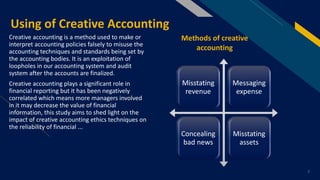
Misstating
revenue
Messaging
expense
Concealing
bad news
Misstating
assets
Methods of creative
accounting
FR
Advantages of Creative Accounting
• Creative accounting helps a business to set
the required parameters, which is
practically impossible. The business can
show a smooth and good growing graph. In
order to attract investors, the management
adopts this technique to show steady
profits and good revenue.
8
• Creative accounting is a set of
opportunistic accounting practices
deliberately developed by
Management in order, without
altering the composition of the
Equity, to issue Financial Statements
that provide an image of the
company similar to that desired by
Management, taking advantage of
the explicit or implicit flexibility that
allows accounting regulations.
• Reduce assets such as
inventories, customers or fixed assets with
excessive depreciation or provisions.
• Reduce inventory with changes in valuation
criteria.
• Reduce reserves and/or the result for the year.
• Hiding sales or raising expenses to reduce
profit.
FR
Disadvantages of Creative Accounting
9
• Reputational risk: In the long run, in case if this is disclosed that
the company does a creative accounting practice, then the
expectation from the company by their clients will also be at
risk; thus, the company may lose its business and dearly earned
a reputation
• Creative accounting plays a significant role in financial reporting
but it has been negatively correlated which means more
managers involved in it may decrease the value of financial
information, this study aims to shed light on the impact of
creative accounting ethics techniques on the reliability of
financial
FR
10
Conclusion
Creative accounting is an accounting practice that helps the company
deviate from the profits and revenues for the year by following rules
and regulations. It is a skill that experts use to manipulate company
accounts. The experts best handle the loopholes in the system, and
the method should be ethical; otherwise, it can be a severe problem
for the company’s management.
The most important thing here is that investors should be cautious
while choosing investment companies. They should know the
financial arrangements, which are possibly done by understanding
the notes to the accounts. The management should ask about any
suspicious item, and if the management cannot answer the query, the
investor should not invest their money in these bogus companies.
FR
11
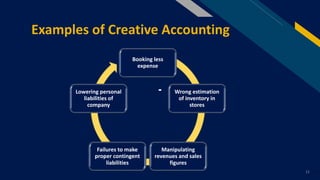
Examples of Creative Accounting
Booking less
expense
Wrong estimation
of inventory in
stores
Manipulating
revenues and sales
figures
Failures to make
proper contingent
liabilities
Lowering personal
liabilities of
company
Thank you

Bnaking Changdges After COVID-19 .ppt2024x

  • 1.
    Bank Impact fromCOVID-19 P re s e n t e r t o D r . M o h a m e d A b e d p ro v i d e d b y G ro u p F
  • 2.
    Introduction 2 In the accountingworld, the general rule is that accounts should give a true and fair view. Generally, an accountant has a professional responsibility to comply, a corporation has a legal responsibility to comply, and auditors have a legal responsibility to give some sort of opinion on compliance, yet frequently this all goes out of the window. Frequently, accountants and businesses are motivated to produce accounts that don't show a true and fair view. Not only this, but auditors rely on sampling and somehow fail to spot there is a problem.
  • 3.
    Definition of creative accounting Creativeaccounting consists of accounting practices that follow required laws and regulations, but deviate from what those standards intend to accomplish. Creative accounting capitalizes on loopholes in the accounting standards to falsely portray a better image of the company. Although creative accounting practices are legal, the loopholes they exploit are often reformed to prevent such behaviors .. , but deviate from the spirit of those rules with questionable accounting ethics—specifically distorting results in favor of the "preparers", or the firm that hired the accountant.[1] They are characterized by excessive complication and the use of novel ways of characterizing income, assets, or liabilities, and the intent to influence readers towards the interpretations desired by the authors. The terms "innovative" or "aggressive" are also sometimes used. Another common synonym is "cooking the books". Creative accounting is oftentimes used in tandem with outright financial fraud (including securities fraud), and lines between the two are blurred. Creative accounting practices are known since ancient times and appear world-wide in various forms.[1] 3
  • 4.
    FR 4 What is theObjective of Creative Accounting? A typical creative accounting incident involves both human effort and a bias towards some objective; Increased Profit Most typically the objective is increased profits, inflated asset values, understated liabilities, and overstated shareholder value. Management Motivation The motivation of management and accountants typically is bonuses, promotions, salary rises, etc. Seeking Promotions There can be other objectives of creative accounting. Most managers and accountants perform a given role for two or three years before seeking a promotion. Therefore throughout that period, they are motivated to show increases in profitability (year-on-year growth). This results in a form of creative accounting that smooths out income and costs so that the result over the two or three-year period is a growth in profits.
  • 5.
    FR 5 Takeover and Acquisitions Takeoversand acquisitions also create opportunities for creative accounting. In the year of the takeover, the new management and accountant have a bias to show a dismal picture - low profits, deflated asset values, inflated provisions, and perhaps an impacted stock value (as a result of the poor results if they are made public). Then in the years proceeding the takeover, the assets can be re-inflated, and provisions released, all contributing to increased profits and a perception that the new management is doing a great job. The above technique may also be used before a management buy-out. This helps the new buyers negotiate a lower purchase price, and increases their return after the buy-out. The aim of creative accounting is to make the company look better than it is. The creative accountant manipulates the positioning of assets, liabilities, etc. A creative accountant does not provide a ‘true and fair’ view of a company. That is what honest and ethical accountants should do. What is the Objective of Creative Accounting?
  • 6.
    FR Techniques of creative accounting Creativeaccounting is actively applied in six areas. The first area is regulatory flexibility, whereby changes in accounting policy are permitted by accounting regulation. For example, IAS permits carrying non- current assets can be recovered at either revalued amount or depreciated historical cost in asset valuation. The Second area is the dearth of regulation by which some accounting treatments might not be fully regulated as there are few mandatory requirements. The third area is management has a large extent of estimation in discretionary areas, such as assumption in bad debts provision. Fourthly, some transactions can be timed to show the desired appearance in accounts. For example, the manager is free to choose the timing to sell the investment just to increase earnings in the accounts. Fifthly, to manipulate balance sheet amounts by using artificial transactions. Last but not least, by reclassification and presentation of financial amounts through balance sheet manipulation in order to smooth financial ratios and also based on a cognitive reference point in financial numbers’ presentation. 6
  • 7.
    FR Using of CreativeAccounting Creative accounting is a method used to make or interpret accounting policies falsely to misuse the accounting techniques and standards being set by the accounting bodies. It is an exploitation of loopholes in our accounting system and audit system after the accounts are finalized. Creative accounting plays a significant role in financial reporting but it has been negatively correlated which means more managers involved in it may decrease the value of financial information, this study aims to shed light on the impact of creative accounting ethics techniques on the reliability of financial ... 7 Misstating revenue Messaging expense Concealing bad news Misstating assets Methods of creative accounting
  • 8.
    FR Advantages of CreativeAccounting • Creative accounting helps a business to set the required parameters, which is practically impossible. The business can show a smooth and good growing graph. In order to attract investors, the management adopts this technique to show steady profits and good revenue. 8 • Creative accounting is a set of opportunistic accounting practices deliberately developed by Management in order, without altering the composition of the Equity, to issue Financial Statements that provide an image of the company similar to that desired by Management, taking advantage of the explicit or implicit flexibility that allows accounting regulations. • Reduce assets such as inventories, customers or fixed assets with excessive depreciation or provisions. • Reduce inventory with changes in valuation criteria. • Reduce reserves and/or the result for the year. • Hiding sales or raising expenses to reduce profit.
  • 9.
    FR Disadvantages of CreativeAccounting 9 • Reputational risk: In the long run, in case if this is disclosed that the company does a creative accounting practice, then the expectation from the company by their clients will also be at risk; thus, the company may lose its business and dearly earned a reputation • Creative accounting plays a significant role in financial reporting but it has been negatively correlated which means more managers involved in it may decrease the value of financial information, this study aims to shed light on the impact of creative accounting ethics techniques on the reliability of financial
  • 10.
    FR 10 Conclusion Creative accounting isan accounting practice that helps the company deviate from the profits and revenues for the year by following rules and regulations. It is a skill that experts use to manipulate company accounts. The experts best handle the loopholes in the system, and the method should be ethical; otherwise, it can be a severe problem for the company’s management. The most important thing here is that investors should be cautious while choosing investment companies. They should know the financial arrangements, which are possibly done by understanding the notes to the accounts. The management should ask about any suspicious item, and if the management cannot answer the query, the investor should not invest their money in these bogus companies.
  • 11.
    FR 11 Examples of CreativeAccounting Booking less expense Wrong estimation of inventory in stores Manipulating revenues and sales figures Failures to make proper contingent liabilities Lowering personal liabilities of company
  • 12.