Building Competencies Through
     New Product Development :


                    Lecture by:
                            by:
            Djadja.Sardjana@gmail.com
13-Aug-09
13-Aug-              IMT MM-Biztel
                         MM-            1
Building Competencies Through
        New Product Development :
           Creating Project Plans to
        Focus Product Development
       Best Practice
          3m36


                   Definition, Scope and
                        Perspective
13-Aug-09
13-Aug-                    IMT MM-Biztel
                               MM-         2
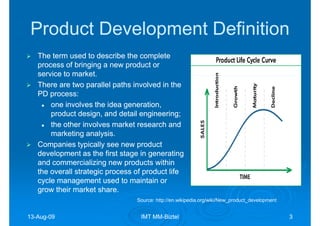
Product Development Definition
   The term used to describe the complete
   process of bringing a new product or
   service to market.
   There are two parallel paths involved in the
   PD process:
       one involves the idea generation,
       product design, and detail engineering;
       the other involves market research and
       marketing analysis.
   Companies typically see new product
   development as the first stage in generating
   and commercializing new products within
   the overall strategic process of product life
   cycle management used to maintain or
   grow their market share.
                                 Source: http://en.wikipedia.org/wiki/New_product_development


13-Aug-09
13-Aug-                           IMT MM-Biztel
                                      MM-                                                       3
Project Plan Definition
     A project plan, according to the Project Management Body of
     Knowledge, is
         A formal, approved document used to guide both project execution
         and project control.
         The primary uses of the project plan are to document planning
         assumptions and decisions, facilitate communication among
         stakeholders, and document approved scope, cost, and schedule
         baselines.
         A project plan may be summarized or detailed.
                                            Source: http://en.wikipedia.org/wiki/Project_plan


13-Aug-09
13-Aug-                         IMT MM-Biztel
                                    MM-                                                         4
Need of Aggregate Project Plan
              The long-term development of any
                   long-
              manufacturing company depends ultimately on
              the success of its product development
              capabilities.
              Often problems arise from the way companies
              approach the development process because
              they lack aggregate project plan.
                                           plan.
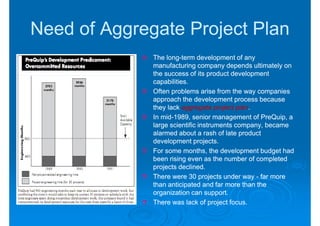
              In mid-1989, senior management of PreQuip, a
                 mid-                              PreQuip,
              large scientific instruments company, became
              alarmed about a rash of late product
              development projects.
              For some months, the development budget had
              been rising even as the number of completed
              projects declined.
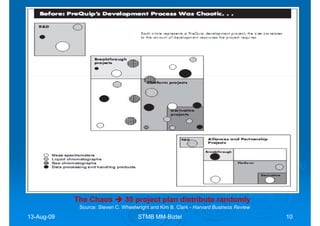
              There were 30 projects under way - far more
              than anticipated and far more than the
              organization can support.
              There was lack of project focus.
Bad quick-fixes
                   quick-
When a project ran into trouble,
engineers from other projects were
reassigned or, more commonly,
asked to add the crisis project to
their already long list of active
projects. The more projects they
added, the more productivity
dropped.
The reshuffling caused delays in
other projects, and the effects
cascaded.
As deadlines slipped and
development costs rose, project
managers faced pressure to cut
corners and compromise quality
just to keep their projects
moving forward.
Individual projects vs set of projects
 In most organizations, a management directs all its
 attention to individual projects - it micromanages project
 development.
 But no single project defines a company’s future or its
 market growth over time; the set of projects does.
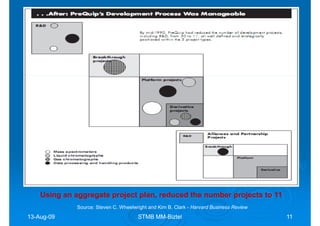
 Most companies, including PreQuip should start the
 reformation process by eliminating or postponing the
 lion’s share of their existing projects, eventually
 supplanting them with new set of projects that fits the
 business strategy and capacity constraints.
 The aggregate project plan provides a framework for
 addressing this difficult task.
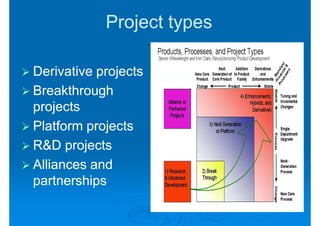
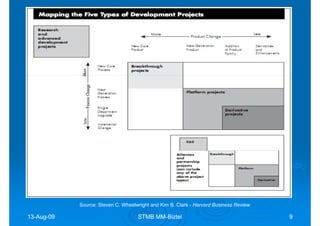
Project types

Derivative projects
Breakthrough
projects
Platform projects
R&D projects
Alliances and
partnerships
Source: Steven C. Wheelwright and Kim B. Clark - Harvard Business Review

13-Aug-09
13-Aug-                             STMB MM-Biztel
                                         MM-                                           9
The Chaos           30 project plan distribute randomly
             Source: Steven C. Wheelwright and Kim B. Clark - Harvard Business Review
13-Aug-09
13-Aug-                              STMB MM-Biztel
                                          MM-                                           10
Using an aggregate project plan, reduced the number projects to 11
              Source: Steven C. Wheelwright and Kim B. Clark - Harvard Business Review
13-Aug-09
13-Aug-                                STMB MM-Biztel
                                            MM-                                          11
Building Competencies Through
        New Product Development :
           Creating Project Plans to
        Focus Product Development

            BMW
            1m05


              Product Development KPI
                 and Best Practice
13-Aug-09
13-Aug-                IMT MM-Biztel
                           MM-          12
Some Characteristics
One can succeed and fail.
Project management success is subordinate to product
success. Project management success influences
product success.
Success has “hard” and “soft” dimensions.
Success is perceived.
Success criteria must be prioritized.
Success is affected by time.
Success is not always manageable.
Success may be partial.
Project Success
Project success is a topic that is frequently
discussed and yet rarely agreed upon. The
concept of project success has remained
ambiguously defined. It is a concept which
can mean so much to so many different
people because of varying perceptions,
and leads to disagreements about whether
a project is successful or not.
Two Components of Project Success

Project management success
This focuses upon the project process and, in
particular, the successful accomplishment of
cost, time, and quality objectives. It also
considers the manner in which the project
management process was conducted.
Product success
This deals with the effects of the project’s final
product.
Product Success
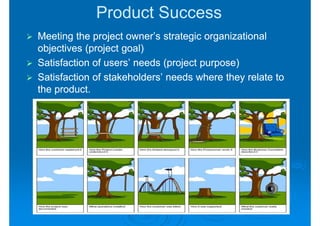
Meeting the project owner’s strategic organizational
objectives (project goal)
Satisfaction of users’ needs (project purpose)
Satisfaction of stakeholders’ needs where they relate to
the product.
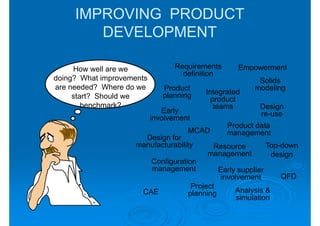
IMPROVING PRODUCT
        DEVELOPMENT

     How well are we             Requirements         Empowerment
                                   definition
doing? What improvements                                    Solids
are needed? Where do we       Product                      modeling
                              planning     Integrated
     start? Should we                        product
        benchmark?                            teams         Design
                              Early                         re-use
                           involvement
                                                  Product data
                                     MCAD         management
                       Design for
                     manufacturability      Resource             Top-down
                                           management             design
                           Configuration
                           management           Early supplier
                                                 involvement        QFD
                                      Project
                       CAE           planning        Analysis &
                                                     simulation
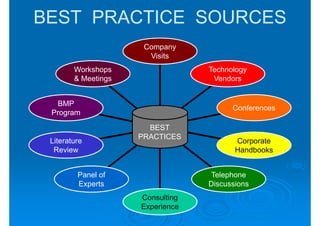
BEST PRACTICE SOURCES
                      Company
                       Visits
        Workshops                 Technology
        & Meetings                 Vendors


   BMP
                                        Conferences
 Program

                       BEST
                     PRACTICES
 Literature                              Corporate
  Review                                 Handbooks


         Panel of                  Telephone
         Experts                  Discussions
                     Consulting
                     Experience
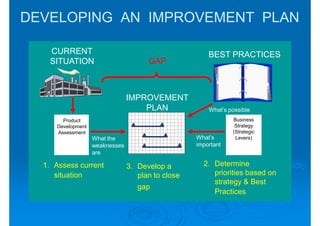
DEVELOPING AN IMPROVEMENT PLAN

   CURRENT                                             BEST PRACTICES
   SITUATION                          GAP


                                IMPROVEMENT
                                    PLAN               What’s possible
       Product                                                 Business
     Development                                                Strategy
     Assessment                                                (Strategic
                   What the                        What’s       Levers)
                   weaknesses                      important
                   are

  1. Assess current             3. Develop a         2. Determine
     situation                     plan to close        priorities based on
                                                        strategy & Best
                                   gap
                                                        Practices
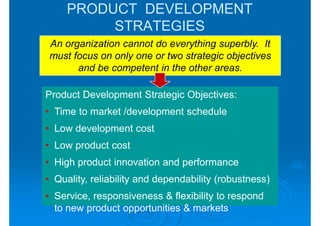
PRODUCT DEVELOPMENT
          STRATEGIES
An organization cannot do everything superbly. It
must focus on only one or two strategic objectives
      and be competent in the other areas.

Product Development Strategic Objectives:
• Time to market /development schedule
• Low development cost
• Low product cost
• High product innovation and performance
• Quality, reliability and dependability (robustness)
• Service, responsiveness & flexibility to respond
  to new product opportunities & markets
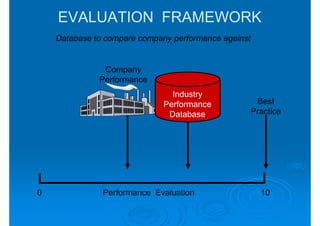
EVALUATION FRAMEWORK
    Database to compare company performance against


               Company
              Performance
                                Industry
                              Performance              Best
                               Database               Practice


0              Performance Evaluation                   10
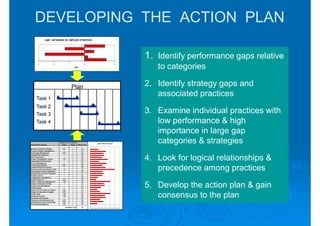
DEVELOPING THE ACTION PLAN
                  GAP - INTENDED VS. IMPLIED STRATEGY

                                                                      6
                                                                      5
                                                                      4
                                                                      3
                                                                      2
                                                                      1
                                                                                                                                            1. Identify performance gaps relative
                                                                                                                                               to categories
        -3                  -2                    -1                       0                        1                         2
                                                              GAP


                                                        Plan                                                                                2. Identify strategy gaps and
       Task 1
                                                                                                                                               associated practices
       Task 2
       Task 3                                                                                                                               3. Examine individual practices with
       Task 4                                                                                                                                  low performance & high
                                                                                                                                               importance in large gap
Assessment Category
                                     Assessment
                                       Weight
                                                       Company
                                                       Weight    Effectiveness
                                                                                                 BEST PRACTICES GAP
                                                                                                                                               categories & strategies
Business & Product Strategy              0.5              1          3.2
Product & Pipeline Management             1               1          3.7
Technology Management                   0.75              1          2.8


                                                                                                                                            4. Look for logical relationships &
Management Leadership                     1               1          4.5
Early Involvement                         1               1          5.1
Product Development Teams                1.5              1          5.3
Organizational Environment                1               1          6.4
Process Management                        1               1          3.4


                                                                                                                                               precedence among practices
Process Improvement                     0.75              1          3.3
Understanding the Customer                1               1          3.9
Requirements & Specifications Mgt.       1.5              1          3.4
Development Process Integration           1               1          5.0
Supplier/Subcontractor Integration        1               1          4.7
Product Launch                            1               1          5.1
Configuration Management                  1               1          6.8
Design Assurance                        0.75              1          6.6
Project & Resource Management           1.25              1          3.5
Design for Manufacturability
Product Cost Management
Robust Design
Integrated Test Design & Program
                                          1
                                          1
                                          1
                                        0.75
                                                          1
                                                          1
                                                          1
                                                          1
                                                                     4.4
                                                                     4.2
                                                                     5.7
                                                                     6.1
                                                                                                                                            5. Develop the action plan & gain
Design for Operation & Support          0.75              1          4.7
Product Data
Design Automation
Simulation and Analysis
Computer-Aided Manufacturing
                                        1.25
                                        1.25
                                          1
                                        0.75
                                                          1
                                                          1
                                                          1
                                                          1
                                                                     3.5
                                                                     5.2
                                                                     3.8
                                                                     4.6
                                                                                                                                               consensus to the plan
Collaborative Tools & Technology        0.75              1          2.9
Knowledge Management                     0.5              1          4.2
                                                                                 0          2        4       6        8       10       12
                                           Weighted Total            4.5
                                                                                     Bigger gap indicates greater improvement opportunity
Building Competencies Through
        New Product Development :
           Creating Project Plans to
        Focus Product Development

        Project Plan
           6m38


   Work The Plan, Plan The Work
13-Aug-09
13-Aug-                IMT MM-Biztel
                           MM-         23
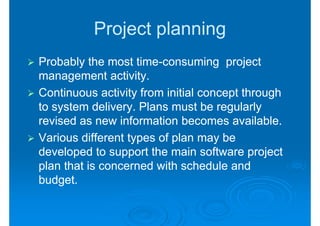
Project planning
Probably the most time-consuming project
                    time-
management activity.
Continuous activity from initial concept through
to system delivery. Plans must be regularly
revised as new information becomes available.
Various different types of plan may be
developed to support the main software project
plan that is concerned with schedule and
budget.
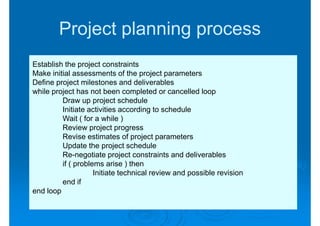
Project planning process
Establish the project constraints
Make initial assessments of the project parameters
Define project milestones and deliverables
while project has not been completed or cancelled loop
         Draw up project schedule
         Initiate activities according to schedule
         Wait ( for a while )
         Review project progress
         Revise estimates of project parameters
         Update the project schedule
         Re-negotiate project constraints and deliverables
         if ( problems arise ) then
                    Initiate technical review and possible revision
         end if
end loop
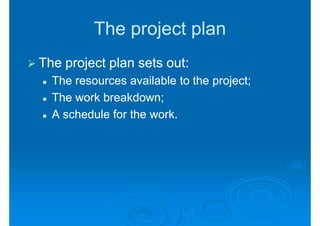
The project plan
The project plan sets out:
  The resources available to the project;
  The work breakdown;
  A schedule for the work.
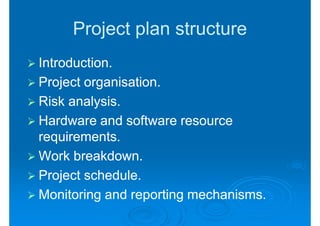
Project plan structure
Introduction.
Project organisation.
Risk analysis.
Hardware and software resource
requirements.
Work breakdown.
Project schedule.
Monitoring and reporting mechanisms.
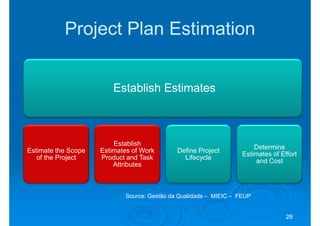
Project Plan Estimation


                         Establish Estimates


                         Establish
                                                                       Determine
Estimate the Scope   Estimates of Work       Define Project
                                                                   Estimates of Effort
   of the Project    Product and Task          Lifecycle
                                                                       and Cost
                         Attributes


                            Source: Gestão da Qualidade – MIEIC – FEUP


                                                                                  28
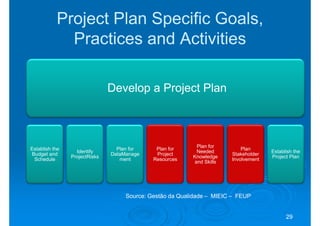
Project Plan Specific Goals,
             Practices and Activities

                               Develop a Project Plan


                                                           Plan for
Establish the                    Plan for     Plan for                     Plan
                  Identify                                 Needed                    Establish the
Budget and                     DataManage     Project                  Stakeholder
                ProjectRisks                              Knowledge                  Project Plan
 Schedule                         ment       Resources                 Involvement
                                                          and Skills


                                    Source: Gestão da Qualidade – MIEIC – FEUP


                                                                                           29
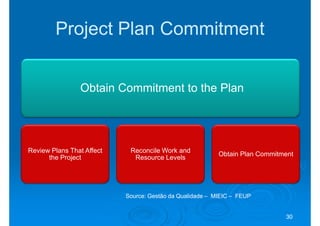
Project Plan Commitment


                Obtain Commitment to the Plan


Review Plans That Affect    Reconcile Work and
                                                          Obtain Plan Commitment
      the Project            Resource Levels


                           Source: Gestão da Qualidade – MIEIC – FEUP


                                                                             30
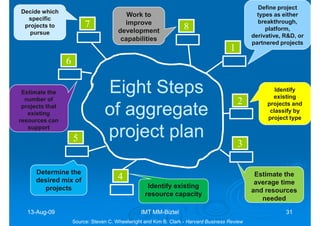
Define project
Decide which
                                           Work to                                                types as either
  specific
                                          improve                                                 breakthrough,
 projects to              7                                         8                                platform,
   pursue                               development
                                                                                                derivative, R&D, or
                                         capabilities
                                                                                                partnered projects
                                                                                       1
                 6


 Estimate the
  number of
                                  Eight Steps                                                           Identify
                                                                                                       existing
                                                                                           2         projects and
 projects that
   existing
resources can
                                  of aggregate                                                        classify by
                                                                                                     project type
   support
                     5            project plan
                                                                                           3

      Determine the                                                                              Estimate the
      desired mix of                    4
                                                                                                 average time
        projects                                    Identify existing
                                                                                                and resources
                                                   resource capacity
                                                                                                   needed

   13-Aug-09
   13-Aug-                                        IMT MM-Biztel
                                                      MM-                                                   31
                     Source: Steven C. Wheelwright and Kim B. Clark - Harvard Business Review
Building Competencies Through
        New Product Development :
           Creating Project Plans to
        Focus Product Development

        Listen to
        Customer
         2m11


            Conclusion & Final Words

13-Aug-09
13-Aug-              IMT MM-Biztel
                         MM-           32

IMT Lecture:Creating Project Plans To Focus Product Development.Mm Biztel 13 Aug09

  • 1.
    Building Competencies Through New Product Development : Lecture by: by: Djadja.Sardjana@gmail.com 13-Aug-09 13-Aug- IMT MM-Biztel MM- 1
  • 2.
    Building Competencies Through New Product Development : Creating Project Plans to Focus Product Development Best Practice 3m36 Definition, Scope and Perspective 13-Aug-09 13-Aug- IMT MM-Biztel MM- 2
  • 3.
    Product Development Definition The term used to describe the complete process of bringing a new product or service to market. There are two parallel paths involved in the PD process: one involves the idea generation, product design, and detail engineering; the other involves market research and marketing analysis. Companies typically see new product development as the first stage in generating and commercializing new products within the overall strategic process of product life cycle management used to maintain or grow their market share. Source: http://en.wikipedia.org/wiki/New_product_development 13-Aug-09 13-Aug- IMT MM-Biztel MM- 3
  • 4.
    Project Plan Definition A project plan, according to the Project Management Body of Knowledge, is A formal, approved document used to guide both project execution and project control. The primary uses of the project plan are to document planning assumptions and decisions, facilitate communication among stakeholders, and document approved scope, cost, and schedule baselines. A project plan may be summarized or detailed. Source: http://en.wikipedia.org/wiki/Project_plan 13-Aug-09 13-Aug- IMT MM-Biztel MM- 4
  • 5.
    Need of AggregateProject Plan The long-term development of any long- manufacturing company depends ultimately on the success of its product development capabilities. Often problems arise from the way companies approach the development process because they lack aggregate project plan. plan. In mid-1989, senior management of PreQuip, a mid- PreQuip, large scientific instruments company, became alarmed about a rash of late product development projects. For some months, the development budget had been rising even as the number of completed projects declined. There were 30 projects under way - far more than anticipated and far more than the organization can support. There was lack of project focus.
  • 6.
    Bad quick-fixes quick- When a project ran into trouble, engineers from other projects were reassigned or, more commonly, asked to add the crisis project to their already long list of active projects. The more projects they added, the more productivity dropped. The reshuffling caused delays in other projects, and the effects cascaded. As deadlines slipped and development costs rose, project managers faced pressure to cut corners and compromise quality just to keep their projects moving forward.
  • 7.
    Individual projects vsset of projects In most organizations, a management directs all its attention to individual projects - it micromanages project development. But no single project defines a company’s future or its market growth over time; the set of projects does. Most companies, including PreQuip should start the reformation process by eliminating or postponing the lion’s share of their existing projects, eventually supplanting them with new set of projects that fits the business strategy and capacity constraints. The aggregate project plan provides a framework for addressing this difficult task.
  • 8.
    Project types Derivative projects Breakthrough projects Platformprojects R&D projects Alliances and partnerships
  • 9.
    Source: Steven C.Wheelwright and Kim B. Clark - Harvard Business Review 13-Aug-09 13-Aug- STMB MM-Biztel MM- 9
  • 10.
    The Chaos 30 project plan distribute randomly Source: Steven C. Wheelwright and Kim B. Clark - Harvard Business Review 13-Aug-09 13-Aug- STMB MM-Biztel MM- 10
  • 11.
    Using an aggregateproject plan, reduced the number projects to 11 Source: Steven C. Wheelwright and Kim B. Clark - Harvard Business Review 13-Aug-09 13-Aug- STMB MM-Biztel MM- 11
  • 12.
    Building Competencies Through New Product Development : Creating Project Plans to Focus Product Development BMW 1m05 Product Development KPI and Best Practice 13-Aug-09 13-Aug- IMT MM-Biztel MM- 12
  • 13.
    Some Characteristics One cansucceed and fail. Project management success is subordinate to product success. Project management success influences product success. Success has “hard” and “soft” dimensions. Success is perceived. Success criteria must be prioritized. Success is affected by time. Success is not always manageable. Success may be partial.
  • 14.
    Project Success Project successis a topic that is frequently discussed and yet rarely agreed upon. The concept of project success has remained ambiguously defined. It is a concept which can mean so much to so many different people because of varying perceptions, and leads to disagreements about whether a project is successful or not.
  • 15.
    Two Components ofProject Success Project management success This focuses upon the project process and, in particular, the successful accomplishment of cost, time, and quality objectives. It also considers the manner in which the project management process was conducted. Product success This deals with the effects of the project’s final product.
  • 16.
    Product Success Meeting theproject owner’s strategic organizational objectives (project goal) Satisfaction of users’ needs (project purpose) Satisfaction of stakeholders’ needs where they relate to the product.
  • 17.
    IMPROVING PRODUCT DEVELOPMENT How well are we Requirements Empowerment definition doing? What improvements Solids are needed? Where do we Product modeling planning Integrated start? Should we product benchmark? teams Design Early re-use involvement Product data MCAD management Design for manufacturability Resource Top-down management design Configuration management Early supplier involvement QFD Project CAE planning Analysis & simulation
  • 18.
    BEST PRACTICE SOURCES Company Visits Workshops Technology & Meetings Vendors BMP Conferences Program BEST PRACTICES Literature Corporate Review Handbooks Panel of Telephone Experts Discussions Consulting Experience
  • 19.
    DEVELOPING AN IMPROVEMENTPLAN CURRENT BEST PRACTICES SITUATION GAP IMPROVEMENT PLAN What’s possible Product Business Development Strategy Assessment (Strategic What the What’s Levers) weaknesses important are 1. Assess current 3. Develop a 2. Determine situation plan to close priorities based on strategy & Best gap Practices
  • 20.
    PRODUCT DEVELOPMENT STRATEGIES An organization cannot do everything superbly. It must focus on only one or two strategic objectives and be competent in the other areas. Product Development Strategic Objectives: • Time to market /development schedule • Low development cost • Low product cost • High product innovation and performance • Quality, reliability and dependability (robustness) • Service, responsiveness & flexibility to respond to new product opportunities & markets
  • 21.
    EVALUATION FRAMEWORK Database to compare company performance against Company Performance Industry Performance Best Database Practice 0 Performance Evaluation 10
  • 22.
    DEVELOPING THE ACTIONPLAN GAP - INTENDED VS. IMPLIED STRATEGY 6 5 4 3 2 1 1. Identify performance gaps relative to categories -3 -2 -1 0 1 2 GAP Plan 2. Identify strategy gaps and Task 1 associated practices Task 2 Task 3 3. Examine individual practices with Task 4 low performance & high importance in large gap Assessment Category Assessment Weight Company Weight Effectiveness BEST PRACTICES GAP categories & strategies Business & Product Strategy 0.5 1 3.2 Product & Pipeline Management 1 1 3.7 Technology Management 0.75 1 2.8 4. Look for logical relationships & Management Leadership 1 1 4.5 Early Involvement 1 1 5.1 Product Development Teams 1.5 1 5.3 Organizational Environment 1 1 6.4 Process Management 1 1 3.4 precedence among practices Process Improvement 0.75 1 3.3 Understanding the Customer 1 1 3.9 Requirements & Specifications Mgt. 1.5 1 3.4 Development Process Integration 1 1 5.0 Supplier/Subcontractor Integration 1 1 4.7 Product Launch 1 1 5.1 Configuration Management 1 1 6.8 Design Assurance 0.75 1 6.6 Project & Resource Management 1.25 1 3.5 Design for Manufacturability Product Cost Management Robust Design Integrated Test Design & Program 1 1 1 0.75 1 1 1 1 4.4 4.2 5.7 6.1 5. Develop the action plan & gain Design for Operation & Support 0.75 1 4.7 Product Data Design Automation Simulation and Analysis Computer-Aided Manufacturing 1.25 1.25 1 0.75 1 1 1 1 3.5 5.2 3.8 4.6 consensus to the plan Collaborative Tools & Technology 0.75 1 2.9 Knowledge Management 0.5 1 4.2 0 2 4 6 8 10 12 Weighted Total 4.5 Bigger gap indicates greater improvement opportunity
  • 23.
    Building Competencies Through New Product Development : Creating Project Plans to Focus Product Development Project Plan 6m38 Work The Plan, Plan The Work 13-Aug-09 13-Aug- IMT MM-Biztel MM- 23
  • 24.
    Project planning Probably themost time-consuming project time- management activity. Continuous activity from initial concept through to system delivery. Plans must be regularly revised as new information becomes available. Various different types of plan may be developed to support the main software project plan that is concerned with schedule and budget.
  • 25.
    Project planning process Establishthe project constraints Make initial assessments of the project parameters Define project milestones and deliverables while project has not been completed or cancelled loop Draw up project schedule Initiate activities according to schedule Wait ( for a while ) Review project progress Revise estimates of project parameters Update the project schedule Re-negotiate project constraints and deliverables if ( problems arise ) then Initiate technical review and possible revision end if end loop
  • 26.
    The project plan Theproject plan sets out: The resources available to the project; The work breakdown; A schedule for the work.
  • 27.
    Project plan structure Introduction. Projectorganisation. Risk analysis. Hardware and software resource requirements. Work breakdown. Project schedule. Monitoring and reporting mechanisms.
  • 28.
    Project Plan Estimation Establish Estimates Establish Determine Estimate the Scope Estimates of Work Define Project Estimates of Effort of the Project Product and Task Lifecycle and Cost Attributes Source: Gestão da Qualidade – MIEIC – FEUP 28
  • 29.
    Project Plan SpecificGoals, Practices and Activities Develop a Project Plan Plan for Establish the Plan for Plan for Plan Identify Needed Establish the Budget and DataManage Project Stakeholder ProjectRisks Knowledge Project Plan Schedule ment Resources Involvement and Skills Source: Gestão da Qualidade – MIEIC – FEUP 29
  • 30.
    Project Plan Commitment Obtain Commitment to the Plan Review Plans That Affect Reconcile Work and Obtain Plan Commitment the Project Resource Levels Source: Gestão da Qualidade – MIEIC – FEUP 30
  • 31.
    Define project Decide which Work to types as either specific improve breakthrough, projects to 7 8 platform, pursue development derivative, R&D, or capabilities partnered projects 1 6 Estimate the number of Eight Steps Identify existing 2 projects and projects that existing resources can of aggregate classify by project type support 5 project plan 3 Determine the Estimate the desired mix of 4 average time projects Identify existing and resources resource capacity needed 13-Aug-09 13-Aug- IMT MM-Biztel MM- 31 Source: Steven C. Wheelwright and Kim B. Clark - Harvard Business Review
  • 32.
    Building Competencies Through New Product Development : Creating Project Plans to Focus Product Development Listen to Customer 2m11 Conclusion & Final Words 13-Aug-09 13-Aug- IMT MM-Biztel MM- 32