Marketing and innovation – A Classical view
The Marketing ConceptMarketing is a set of exchange processes developed to reach the objectives of the organization by the satisfaction of the needs of the other part of the exchangeThe Marketing Concept is the basic philosophy which underlies theses processes and insure their coherence 2
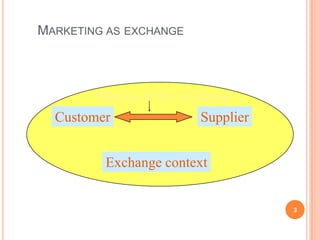
Marketing as exchangeObjects of the exchangeCustomerSupplierExchange context3
Marketing ManagementMarketing Management refers to the first and still dominant conceptualization of MarketingIt emerged in American universities in the 50-60’s,popularized by authors like Mac Carthy, Drucker or KotlerSubsequent research demonstrated that it was mainly influenced by B2C situations4
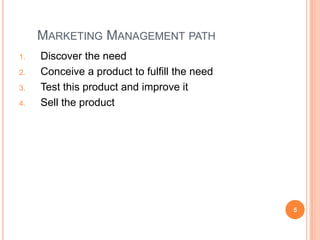
Marketing Management pathDiscover the needConceive a product to fulfill the needTest this product and improve itSell the product5
Marketing Management paradigmSegmentation – Targeting – PositioningMarketing Mix – Four P’sPlanning process6
Limits of the paradigmMainlydependant on productsMainlyconcernedwith standard productsMainlyrelated to consumer markets7
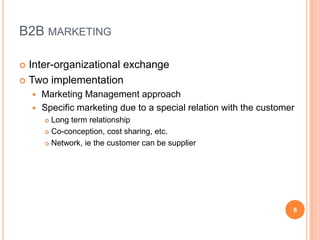
B2B marketingInter-organizational exchangeTwo implementationMarketing Management approachSpecific marketing due to a special relation with the customerLong term relationshipCo-conception, cost sharing, etc.Network, ie the customer can be supplier8
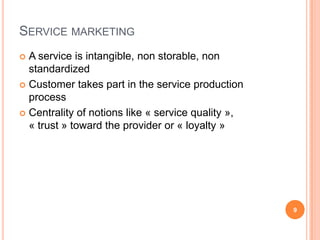
Service marketingA service is intangible, non storable, non standardizedCustomer takes part in the service production process Centrality of notions like « service quality », « trust » toward the provider or « loyalty »9
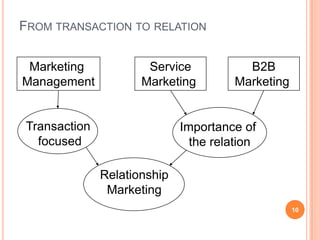
From transaction to relation10Marketing ManagementB2BMarketing ServiceMarketing Transaction focusedImportance of the relationRelationshipMarketing
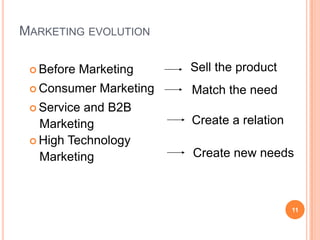
Marketing evolutionSell the product Before Marketing  Consumer Marketing Service and B2B    MarketingHigh Technology   MarketingMatch the needCreate a relationCreate new needs11
Conclusion
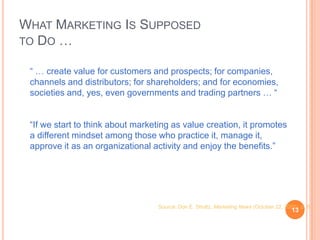
What Marketing Is Supposed to Do …“ … create value for customers and prospects; for companies, channels and distributors; for shareholders; and for economies, societies and, yes, even governments and trading partners … ““If we start to think about marketing as value creation, it promotes a different mindset among those who practice it, manage it, approve it as an organizational activity and enjoy the benefits.”Source: Don E. Shultz, Marketing News (October 22, 2001), p. 8.13
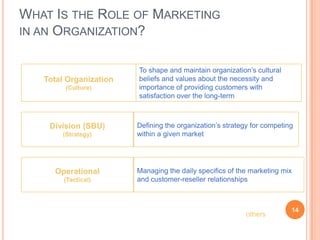
What Is the Role of Marketing in an Organization?Total Organization(Culture)To shape and maintain organization’s cultural beliefs and values about the necessity and importance of providing customers with satisfaction over the long-termDivision (SBU)(Strategy)Defining the organization’s strategy for competing within a given marketOperational(Tactical)Managing the daily specifics of the marketing mix and customer-reseller relationshipsEach level must provide continuity and be consistent with the others.14
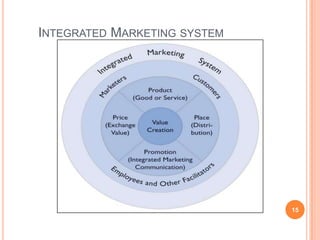
Integrated Marketing system15
Basic marketing questions  Are customer-oriented strategies adapted to changes in markets and buying behavior?Are customers involved earlier in the marketing process, leading to a better understanding of customers?What are your value-added marketing strategies: quality, service, and value?How effective are your internal marketing programs for employees?16
-1-Innovation17
Key ConceptsInventionIt is the birth of new ideas; itisan object, process, or technique which displays an element of novelty (Schumpeter, 1960) ; itisrelated to science and discoveryInnovationIt is the transformation and bundling of thoseideasintomarketableproducts and services; itisboth a process and a resultNew product / serviceIt isjust the result of the innovation process18
What is an innovation ?An innovation is something new 19
Classification of innovations20
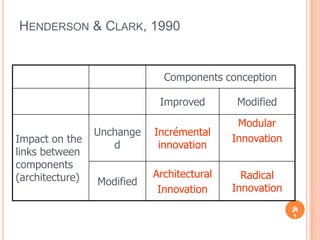
Henderson & Clark, 19902121
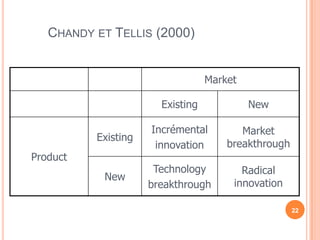
Chandy et Tellis (2000) 2222
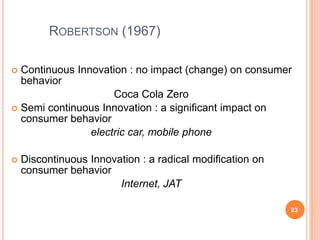
Robertson (1967)Continuous Innovation : no impact (change) on consumer behaviorCoca Cola ZeroSemi continuous Innovation : a significant impact on consumer behaviorelectric car, mobile phoneDiscontinuous Innovation : a radical modification on consumer behaviorInternet, JAT23
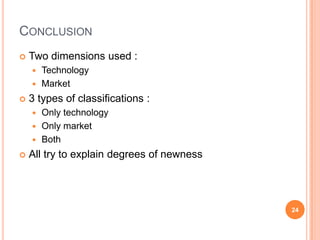
ConclusionTwo dimensions used :TechnologyMarket3 types of classifications :OnlytechnologyOnlymarketBothAll try to explaindegrees of newness24
What is newness ?25
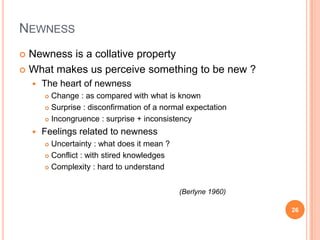
NewnessNewnessis a collative propertyWhatmakes us perceivesomething to be new ? The heart of newnessChange : as comparedwithwhatisknownSurprise : disconfirmation of a normal expectationIncongruence : surprise + inconsistencyFeelings related to newnessUncertainty : whatdoesitmean ?Conflict : withstiredknowledgesComplexity : hard to understand(Berlyne 1960)26
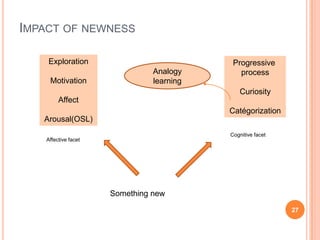
Impact of newnessExplorationMotivationAffectArousal(OSL)Progressive processCuriosityCatégorizationAnalogylearningCognitive facetAffective facetSomething new27
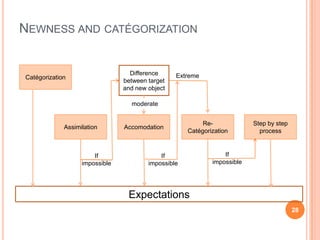
Newness and catégorizationCatégorizationDifferencebetweentarget and new objectExtrememoderateAssimilationAccomodationRe-CatégorizationStep by stepprocessIf impossibleIf impossibleIfimpossibleExpectations28
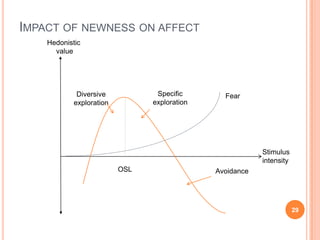
Impact of newness on affectHedonistic valueSpecificexplorationDiversiveexplorationFearStimulus intensityOSLAvoidance29
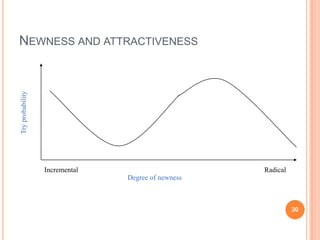
Newness and attractivenessTryprobabilityIncrementalRadical  Degree of newness30
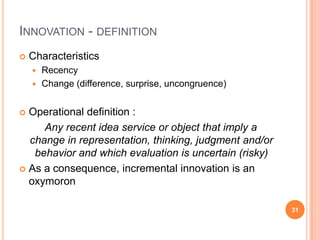
Innovation - definitionCharacteristicsRecencyChange (difference, surprise, uncongruence)Operational definition :    Any recent idea service or object that imply a change in representation, thinking, judgment and/or behavior and which evaluation is uncertain (risky)As a consequence, incremental innovation is an oxymoron31
Innovation diffusion32
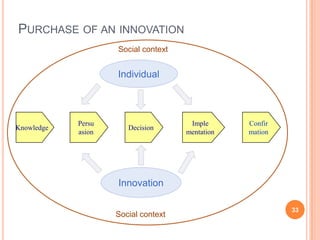
Purchase of an innovation33Social contextIndividualPersuasionKnowledgeDecisionImplementationConfirmationInnovationSocial context
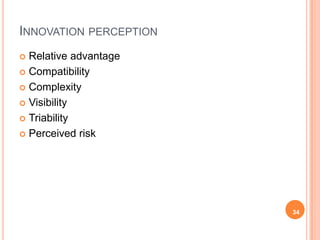
34Innovation perceptionRelative advantageCompatibilityComplexityVisibilityTriabilityPerceivedrisk
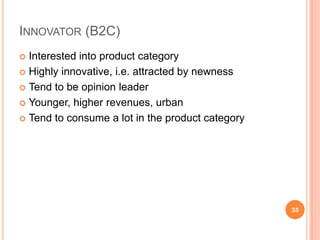
Innovator (B2C)InterestedintoproductcategoryHighlyinnovative, i.e. attracted by newnessTend to be opinion leaderYounger, higher revenues, urbanTend to consume a lot in the productcategory35
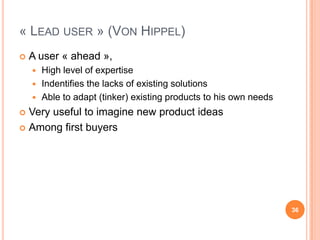
« Lead user » (Von Hippel)A user « ahead », High level of expertiseIndentifies the lacks of existing solutionsAble to adapt (tinker) existingproducts to hisownneedsVeryuseful to imagine new productideasAmong first buyers36
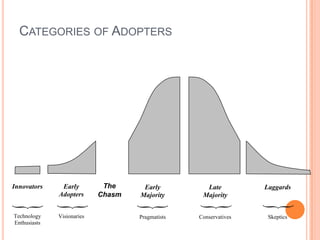
37Categories of AdoptersTheChasm
CONCLUSION38
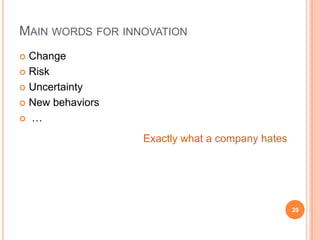
Main words for innovationChangeRiskUncertaintyNew behaviors …39Exactly what a company hates
-2-Marketing New Product Development Process
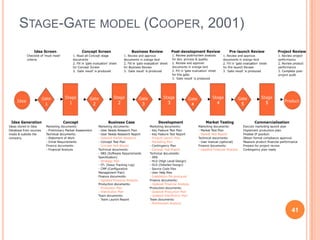
Stage-Gatemodel (Cooper, 2001)41
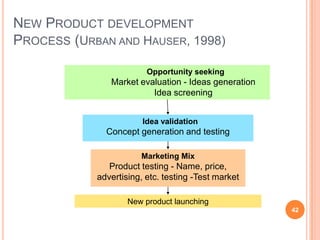
New Product developmentProcess (Urban and Hauser, 1998)42OpportunityseekingMarketevaluation - IdeasgenerationIdea screeningIdea validationConcept generation and testingMarketing MixProduct testing - Name, price, advertising, etc. testing -Test marketNew productlaunching
Idea generation43
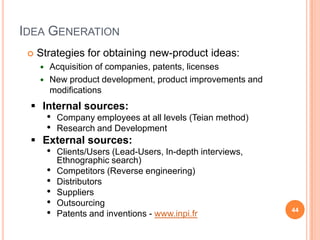
Strategies for obtaining new-product ideas:Acquisition of companies, patents, licensesNew product development, product improvements and modificationsIdea GenerationInternal sources:
Company employees at all levels (Teian method)
Research and Development
External sources:
Clients/Users (Lead-Users, In-depth interviews, Ethnographic search)
Competitors (Reverse engineering)
Distributors
Suppliers
Outsourcing
Patents and inventions - www.inpi.fr44
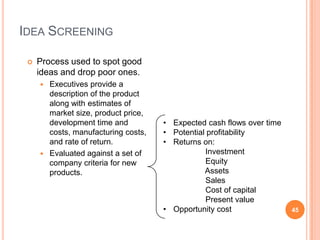
Idea ScreeningProcess used to spot good ideas and drop poor ones.Executives provide a description of the product along with estimates of market size, product price, development time and costs, manufacturing costs, and rate of return.Evaluated against a set of company criteria for new products.Expected cash flows over time
Potential profitability
Returns on:                   Investment                   Equity                   Assets                   Sales                   Cost of capital                   Present valueOpportunity cost45
Concept development and testing46
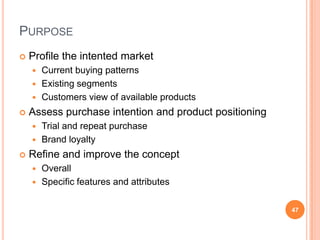
PurposeProfile the intented marketCurrent buying patternsExisting segmentsCustomers view of available productsAssess purchase intention and product positioningTrial and repeat purchaseBrand loyaltyRefine and improve the concept OverallSpecific features and attributes47
Main objectivesPurchase intentionsHow to improve/enhance the basic conceptCharacteristics of potential buyersFirst elements of launching strategyTargetCompetitvepositionning48
Research methods usedMay be qualitative or quantitativeQualitative techniques include:In-depth interviews of individuals
Focus groups

Seminario Internacional - Inovação e Marketing - Prof. Gilles Roehrich (UPMF) / Sustentare