1
Karl R. LaPan
The Northeast Indiana Innovation Center, Inc.
February 17, 2020
www.niic.net
Innovation Potential & Pathways
2
Today’s Agenda & Approach
Talk about innovation, its potential and promise
Share commercialization models
Discover ways to unleash entrepreneurial energy
Reimagine how we fuel innovation @ PFW
1
2
3
4
3
The Big Idea –
Imagine that PFW was a catalyst for
regional innovation and entrepreneurship
bringing together students, faculty, and
business/ industry partners to provide the
creative fuel for research that leads to
industrial innovation.
What would
that look like?
4
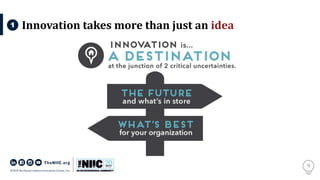
Innovation takes more than just an idea1
5
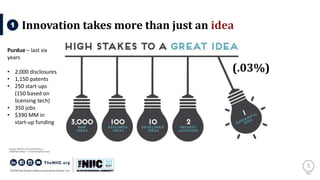
Innovation takes more than just an idea1
(.03%)
Purdue – last six
years
• 2,000 disclosures
• 1,150 patents
• 250 start-ups
(150 based on
licensing tech)
• 350 jobs
• $390 MM in
start-up funding
6
Understand Diverge Decide Prototype Validate
• Who are the users
• What are their needs
• What is the context
• Competitor review
• Formulate strategy
• Envision
• Develop lots
of solutions
• Ideate
• Choose the
best idea
• Storyboard
the idea
• Build something
quick and dirty to
show to users
• Focus on usability
not making it
beautiful
• Show the
prototype to real
users outside
the organization
• Learn what
doesn’t work
Design thinking…the right way to get started
7
• Can you build and deliver a product / service that satisfies the
customer problem or need?
• Do the product / service features deliver value (alleviate pain,
create gain) for the customer?
Product – Market Fit
8
Innovation takes more than just an idea1
9
Innovation takes more than just an idea1
10
Innovation takes more than just an idea1
11
Innovation comes in all shapes and sizes2
12
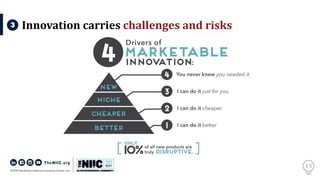
Innovation carries challenges and risks3
13
Innovation carries challenges and risks3
14
Innovation carries challenges and risks3
15
Innovation carries challenges and risks3
16
Innovation requires change4
17
Innovation requires change4
18
Innovation requires change4
Relevance…Obscurity
19
Innovation is about running experiments5
20
Innovation is about running experiments5
21
The path to success is not a straight shot
22
Exploiting market opportunities…a path to market
Many start-ups die before they generate enough
revenue to survive due to “Market Launch Barriers”
Technology
Development
Business Model
Commercial
Product
Investment Create value to
avoid “Market
Launch Barriers”
Revenue
23
Typical commercialization modes
Commercialization
Academic
Entrepreneurship
Student
Entrepreneurship Licensing Joint Venture Start-up
Tech Transfer
Start-up
Practice Project
Start-up with help
Exclusive
Non-Exclusive
Equity
Non-Equity
External
Internal
Sale
24
How does the process work?
University researcher
discovers new invention
and submits disclosure
Company makes
new products
OTT patents
invention
OTT licenses invention to company
OR decides to create start-up
(completely different path)
Company pays royalties
to University
Additional
research money
Federal and industry
research money
25
Commercialization in action
Launch
Review feasibility
and revise concept
Review tests and
redesign prototype
26
Traditional university-industry technology transfer model
Research results
from lab
Start-up companies
and large corporations
New products
in marketplace
• Students
• Publications
• Faculty consulting
• Industry sponsored research
• Industrial affiliate programs
• Intellectual property
licensing
27
Typical conversion process
~5-8 disclosures
received per week
•~25-40% of disclosures are
filed as patent applications
•Potentially licensable as
copyright, trademark,
biological materials, etc.
•Abandoned
20-25% disclosures, including
those patented are licensed
28
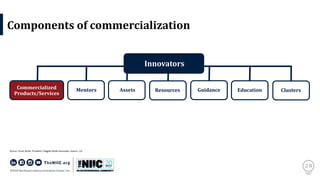
Components of commercialization
Education ClustersGuidanceResourcesAssetsMentorsCommercialized
Products/Services
Innovators
Source: Chuck Wolfe, President, Claggett Wolfe Associates, Auburn, CA
29
Technical
Assessment
A portfolio of essential commercialization services
Product
Development
Market
Assessment
Business
Development
Commercialization Services
30
Business incubation support…
Active Engagement, Customer-Centric, and Advisory
Coaches + Mentors + Service Providers + Networks + Community
Getting
Started
•Protecting IP
•Prototyping
•Business Planning
•Experimentation
(Testing Assumptions)
•Seed Funding
Proof of
Relevance
•Product Scaling
•Financial Margins
•Market Testing
•Validated Learning
Company
Building
•Opening Market Channels
•Manufacturing Assistance
•Marketing & Distribution
•Management Team
Building
•Venture/Debt Funding
Source: Chuck Wolfe, President, Claggett Wolfe Associates, Auburn, CA
31
Simple customer development model:
Right Action, Right Time
Source: Steve Blank, The Startup Company Handbook
Do I have a problem
worth solving?
FIT:
Product to
Solution
Have I built something
people want?
FIT:
Product to
Market
How do I
accelerate growth?
SCALE:
Product to
Growth
Raise money HERE
Focus: Validated Learning and Pivots Focus: Growth and Optimization
Proof of Relevance vs. Proof of Concept
32
3-Stage Structured Acceleration Process:
From Concept to Stable Business
Present your concept
Stage 1
• Market-validated
go-to-market plan
• Investor presentation
• Product soft model
Develop your product
and systems
Stage 2
• Developed product, with
additional market feedback
• Production and business
systems in place
Launch and grow your
product & business
Stage 3
• Delivered product
• Growth and continuous
improvement plans in place
33
Open Innovation
Unique Position
Sustainable
Advantage
Superior
Value
Innovation
Strategy
34
Open Innovation
• Sourcing ideas outside the organization not just inside -access new ways of doing things, new knowledge
• More distributed, more participatory, more decentralized (Chesbrough)
• Pros: Faster, Broader pool of ideas, attract investors/non-tradional partners
• Cons: Cost, Intellectual Property, cultural change
Closed vs. open innovation. Source: Research Gate
35
Our (somewhat methodical) process
Execute the
Business
Model. Launch,
Grow, Scale
Commercialization Process
Start-up Company
Come up with
business idea
(great or not
or crazy)
Define (Guess)
all the parts of
the Business
Model
Validate all
the parts of
the Business
Model
36
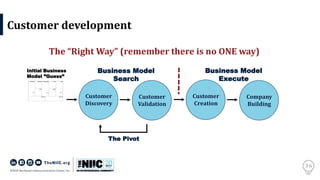
The “Right Way” (remember there is no ONE way)
Customer
Discovery
The Pivot
Business Model
Search
Business Model
Execute
Initial Business
Model ”Guess”
Customer development
Customer
Validation
Customer
Creation
Company
Building
37
The goal is to turn those guesses into facts through
Customer Discovery, verifying every hypothesis.
Customer
Discovery
The Pivot
Business Model
Search
Business Model
Execute
Initial Business
Model ”Guess”
Process: Customer Discovery
Customer
Validation
Customer
Creation
Company
Building
IMPORTANT: Founders run a Customer Development
Team (no sales, marketing or business development)
38
Create a Minimum Viable Product based on your CUSTOMER DISCOVER and
VALIDATE than people REALLY want it by selling it to them. If not, pivot, and
revise the Business Model and do it again.
Customer
Discovery
The Pivot
Business Model
Search
Business Model
Execute
Initial Business
Model ”Guess”
Process: Customer Validation
Customer
Validation
Customer
Creation
Company
Building
39
The VALIDATION occurs when you have successful
repeatable sales and the product is buildable…
Customer
Discovery
The Pivot
Business Model
Search
Initial Business
Model ”Guess”
Process: Customer Validation
Customer
Validation SALES!
That’s called
PRODUCT-MARKET
FIT
40
Where does this fit?
Execute the
Business
Model. Launch,
Grow, Scale
Start-up Company
Come up with
business idea
(great or not
or crazy)
Define (Guess)
all the parts of
the Business
Model
Validate all
the parts of
the Business
Model
Customer
Discovery
The Pivot
Initial Business
Model ”Guess”
Customer
Validation
Customer
Creation
Company
Building
41
Innovation is about running experiments5
42
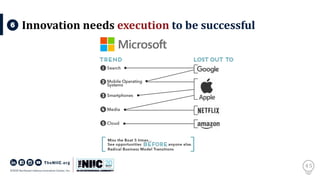
Innovation needs execution to be successful6
43
Innovation needs execution to be successful6
44
Innovation needs execution to be successful6
Business model components
But they’re all
GUESSES at
this point…
45
Innovation needs execution to be successful6
46
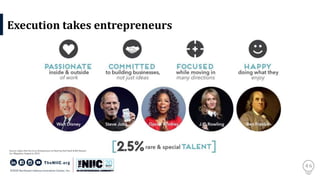
Execution takes entrepreneurs
47
Remember that…innovation
Takes more than just an idea
Comes in all shapes and sizes
Carries challenges and risks
Requires change
Is about running experiments
Needs execution to be successful
1
2
3
4
5
6
48
www.niic.net

Innovation Potential & Pathways

  • 1.
    1 Karl R. LaPan TheNortheast Indiana Innovation Center, Inc. February 17, 2020 www.niic.net Innovation Potential & Pathways
  • 2.
    2 Today’s Agenda &Approach Talk about innovation, its potential and promise Share commercialization models Discover ways to unleash entrepreneurial energy Reimagine how we fuel innovation @ PFW 1 2 3 4
  • 3.
    3 The Big Idea– Imagine that PFW was a catalyst for regional innovation and entrepreneurship bringing together students, faculty, and business/ industry partners to provide the creative fuel for research that leads to industrial innovation. What would that look like?
  • 4.
    4 Innovation takes morethan just an idea1
  • 5.
    5 Innovation takes morethan just an idea1 (.03%) Purdue – last six years • 2,000 disclosures • 1,150 patents • 250 start-ups (150 based on licensing tech) • 350 jobs • $390 MM in start-up funding
  • 6.
    6 Understand Diverge DecidePrototype Validate • Who are the users • What are their needs • What is the context • Competitor review • Formulate strategy • Envision • Develop lots of solutions • Ideate • Choose the best idea • Storyboard the idea • Build something quick and dirty to show to users • Focus on usability not making it beautiful • Show the prototype to real users outside the organization • Learn what doesn’t work Design thinking…the right way to get started
  • 7.
    7 • Can youbuild and deliver a product / service that satisfies the customer problem or need? • Do the product / service features deliver value (alleviate pain, create gain) for the customer? Product – Market Fit
  • 8.
    8 Innovation takes morethan just an idea1
  • 9.
    9 Innovation takes morethan just an idea1
  • 10.
    10 Innovation takes morethan just an idea1
  • 11.
    11 Innovation comes inall shapes and sizes2
  • 12.
  • 13.
  • 14.
  • 15.
  • 16.
  • 17.
  • 18.
  • 19.
    19 Innovation is aboutrunning experiments5
  • 20.
    20 Innovation is aboutrunning experiments5
  • 21.
    21 The path tosuccess is not a straight shot
  • 22.
    22 Exploiting market opportunities…apath to market Many start-ups die before they generate enough revenue to survive due to “Market Launch Barriers” Technology Development Business Model Commercial Product Investment Create value to avoid “Market Launch Barriers” Revenue
  • 23.
    23 Typical commercialization modes Commercialization Academic Entrepreneurship Student EntrepreneurshipLicensing Joint Venture Start-up Tech Transfer Start-up Practice Project Start-up with help Exclusive Non-Exclusive Equity Non-Equity External Internal Sale
  • 24.
    24 How does theprocess work? University researcher discovers new invention and submits disclosure Company makes new products OTT patents invention OTT licenses invention to company OR decides to create start-up (completely different path) Company pays royalties to University Additional research money Federal and industry research money
  • 25.
    25 Commercialization in action Launch Reviewfeasibility and revise concept Review tests and redesign prototype
  • 26.
    26 Traditional university-industry technologytransfer model Research results from lab Start-up companies and large corporations New products in marketplace • Students • Publications • Faculty consulting • Industry sponsored research • Industrial affiliate programs • Intellectual property licensing
  • 27.
    27 Typical conversion process ~5-8disclosures received per week •~25-40% of disclosures are filed as patent applications •Potentially licensable as copyright, trademark, biological materials, etc. •Abandoned 20-25% disclosures, including those patented are licensed
  • 28.
    28 Components of commercialization EducationClustersGuidanceResourcesAssetsMentorsCommercialized Products/Services Innovators Source: Chuck Wolfe, President, Claggett Wolfe Associates, Auburn, CA
  • 29.
    29 Technical Assessment A portfolio ofessential commercialization services Product Development Market Assessment Business Development Commercialization Services
  • 30.
    30 Business incubation support… ActiveEngagement, Customer-Centric, and Advisory Coaches + Mentors + Service Providers + Networks + Community Getting Started •Protecting IP •Prototyping •Business Planning •Experimentation (Testing Assumptions) •Seed Funding Proof of Relevance •Product Scaling •Financial Margins •Market Testing •Validated Learning Company Building •Opening Market Channels •Manufacturing Assistance •Marketing & Distribution •Management Team Building •Venture/Debt Funding Source: Chuck Wolfe, President, Claggett Wolfe Associates, Auburn, CA
  • 31.
    31 Simple customer developmentmodel: Right Action, Right Time Source: Steve Blank, The Startup Company Handbook Do I have a problem worth solving? FIT: Product to Solution Have I built something people want? FIT: Product to Market How do I accelerate growth? SCALE: Product to Growth Raise money HERE Focus: Validated Learning and Pivots Focus: Growth and Optimization Proof of Relevance vs. Proof of Concept
  • 32.
    32 3-Stage Structured AccelerationProcess: From Concept to Stable Business Present your concept Stage 1 • Market-validated go-to-market plan • Investor presentation • Product soft model Develop your product and systems Stage 2 • Developed product, with additional market feedback • Production and business systems in place Launch and grow your product & business Stage 3 • Delivered product • Growth and continuous improvement plans in place
  • 33.
  • 34.
    34 Open Innovation • Sourcingideas outside the organization not just inside -access new ways of doing things, new knowledge • More distributed, more participatory, more decentralized (Chesbrough) • Pros: Faster, Broader pool of ideas, attract investors/non-tradional partners • Cons: Cost, Intellectual Property, cultural change Closed vs. open innovation. Source: Research Gate
  • 35.
    35 Our (somewhat methodical)process Execute the Business Model. Launch, Grow, Scale Commercialization Process Start-up Company Come up with business idea (great or not or crazy) Define (Guess) all the parts of the Business Model Validate all the parts of the Business Model
  • 36.
    36 The “Right Way”(remember there is no ONE way) Customer Discovery The Pivot Business Model Search Business Model Execute Initial Business Model ”Guess” Customer development Customer Validation Customer Creation Company Building
  • 37.
    37 The goal isto turn those guesses into facts through Customer Discovery, verifying every hypothesis. Customer Discovery The Pivot Business Model Search Business Model Execute Initial Business Model ”Guess” Process: Customer Discovery Customer Validation Customer Creation Company Building IMPORTANT: Founders run a Customer Development Team (no sales, marketing or business development)
  • 38.
    38 Create a MinimumViable Product based on your CUSTOMER DISCOVER and VALIDATE than people REALLY want it by selling it to them. If not, pivot, and revise the Business Model and do it again. Customer Discovery The Pivot Business Model Search Business Model Execute Initial Business Model ”Guess” Process: Customer Validation Customer Validation Customer Creation Company Building
  • 39.
    39 The VALIDATION occurswhen you have successful repeatable sales and the product is buildable… Customer Discovery The Pivot Business Model Search Initial Business Model ”Guess” Process: Customer Validation Customer Validation SALES! That’s called PRODUCT-MARKET FIT
  • 40.
    40 Where does thisfit? Execute the Business Model. Launch, Grow, Scale Start-up Company Come up with business idea (great or not or crazy) Define (Guess) all the parts of the Business Model Validate all the parts of the Business Model Customer Discovery The Pivot Initial Business Model ”Guess” Customer Validation Customer Creation Company Building
  • 41.
    41 Innovation is aboutrunning experiments5
  • 42.
  • 43.
  • 44.
    44 Innovation needs executionto be successful6 Business model components But they’re all GUESSES at this point…
  • 45.
  • 46.
  • 47.
    47 Remember that…innovation Takes morethan just an idea Comes in all shapes and sizes Carries challenges and risks Requires change Is about running experiments Needs execution to be successful 1 2 3 4 5 6
  • 48.
  • 49.